


For decades, the United States of America stood not merely as a superpower, but as a symbol—of freedom, opportunity, and promise. From the ruins of war-torn continents to the aspirations of developing nations, America inspired hope. It attracted the brightest minds, the most industrious hands, and the boldest dreamers. It was not feared; it was admired.
Today, that image stands under strain.
Recent developments in America’s relations with the world—particularly with its traditional allies—suggest a troubling shift. The growing unease among nations, including long-standing NATO partners, raises a profound question: Is America, once a beacon, now becoming a force that others increasingly fear—and therefore avoid?
Fear as the New Foundation of Foreign Policy
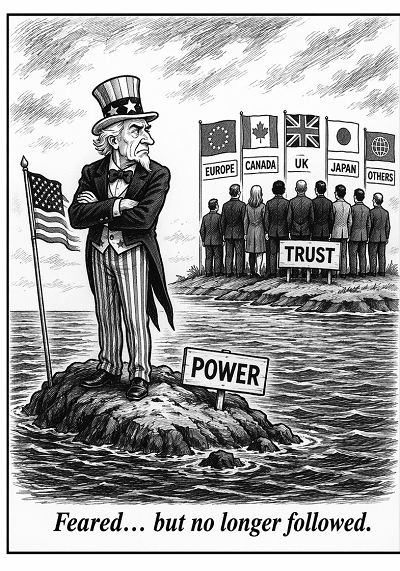
History teaches us that respect and influence cannot be sustained through fear alone. Fear may compel compliance for a time, but it rarely breeds loyalty or trust. When nations begin to fear a superpower, they instinctively distance themselves—not merely politically, but emotionally and strategically.
Recent actions by the United States have, in the eyes of many global observers, reinforced this perception of fear. The 2026 intervention in Venezuela, widely criticized by several nations and international bodies as a violation of international law, sent shockwaves across the world.
Even more consequential has been the ongoing conflict involving Iran. The U.S.-led military actions, including airstrikes and a naval blockade, have not only escalated tensions but also drawn sharp criticism—even from close allies.
What is striking is not merely the conflict itself, but the reaction to it.
When Allies Step Back
For perhaps the first time in recent memory, key NATO allies have openly declined to support major U.S. military initiatives. Countries such as Britain and France have refused to join American actions in the Strait of Hormuz, emphasizing diplomacy over confrontation.
The United Kingdom’s leadership has gone further—publicly criticizing the U.S. decision to go to war with Iran as a “mistake” that destabilizes the global economy and undermines security.
This is not mere disagreement. It is a signal.
It reflects a widening gap between America and its allies—a gap rooted not in differing interests alone, but in differing philosophies of power, legality, and global responsibility.
Even the suggestion that the United States might reconsider its role in NATO has raised alarms, with leaders warning that such a move would weaken both America and the global order it helped build.
The Erosion of Moral Authority
Power, when exercised without restraint, risks losing legitimacy. And legitimacy is the true currency of leadership in the modern world.
The perception—rightly or wrongly—that America acts unilaterally, disregarding international norms, has begun to erode its moral authority. Statements suggesting that America can act independently of international law reinforce a dangerous narrative: that might, rather than right, determines global conduct.
This perception has consequences.
Across continents, nations are recalibrating their relationships. Some are cautiously distancing themselves. Others are seeking alternative alliances. Even traditional partners are hedging their bets.
The world, it appears, is adjusting to a new reality—one where reliance on America is no longer taken for granted.
From Admiration to Anxiety
This transformation is particularly tragic when viewed against America’s historical legacy.
For generations, the United States represented possibility. It welcomed immigrants from every corner of the world. Scientists, engineers, doctors, entrepreneurs, and thinkers flocked to its shores—not out of compulsion, but out of admiration.
They built America
From Silicon Valley to Wall Street, from NASA’s explorations of space to breakthroughs in medicine, the contributions of immigrants have been immeasurable. America’s greatness has never been insular; it has been global in its composition.
But admiration thrives on inspiration—not intimidation.
If fear replaces admiration, the consequences will be profound. The world’s brightest minds will think twice before choosing America. Nations will hesitate before aligning themselves with it. And global public opinion—once overwhelmingly favorable—may gradually turn skeptical, even hostile.
The Psychology of Alienation
Human behavior offers a simple but powerful insight: we avoid what we fear.
This principle applies not only to individuals but also to nations. Fear creates distance. Distance breeds mistrust. And prolonged mistrust can evolve into resentment—even hostility.
History is replete with examples of great powers that mistook fear for respect. In each case, the result was isolation.
America must not fall into that trap.
The Cost to Americans
The most significant consequence of this trajectory will not be borne by foreign nations; it will be borne by Americans themselves.
Global alienation does not merely affect diplomacy; it affects trade, innovation, education, and cultural exchange. It impacts the willingness of countries to cooperate, invest, and collaborate.
An America that is isolated is an America that is diminished.
Moreover, the rise of anti-American sentiment abroad—however unjustified it may be—poses risks to American citizens, businesses, and interests worldwide.
This is not a distant or abstract concern. It is an immediate and tangible reality.
A Moment for Reflection
None of this diminishes America’s strengths. The United States remains a nation of extraordinary resilience, innovation, and democratic ideals. Its institutions, its people, and its capacity for self-correction are unmatched.
But strength must be guided by wisdom.
Leadership in the 21st century cannot be sustained through coercion alone. It requires partnership, respect for international norms, and a commitment to dialogue.
The world does not expect America to be weak. It expects America to be just.
Reclaiming the Idea of America
The challenge before the United States is not merely geopolitical—it is philosophical.
Will America continue down a path that breeds fear and alienation? Or will it reclaim its historic role as a leader that inspires rather than intimidates?
The answer lies not in military might, but in moral clarity.
America became great not because it was feared, but because it was believed in.
That belief must be restored.
(Prof. Indrajit S Saluja is the Chief Editor of The Indian Panorama, a weekly published from New York. He writes in three languages- English, Hindi, and Punjabi. He can be reached at salujaindra@gmail.com)



Be the first to comment