

Education serves as an innocuous tool in America’s grand project of global dominance
“The idea that knowledge is power is old and common, but its application to a gigantic political project is unique to America. Its project of global dominance has necessitated a model of nationalism which permits easy transfer of talent and feelings. The engineering of this transfer is essential to the imperial design of American nationalism. Education serves as an innocuous tool in this grand project. The popular metaphor that America is a melting pot does not reveal this political ambition.”

An American businessman asked a surprising question soon after we had taken adjoining economy seats on a transatlantic flight. It seemed as if the question had bothered him for a long time. In the privacy of an aeroplane, he felt safe enough to ask: “Can you tell me who this guy called Shakespeare was?” I was puzzled, but I smiled. We had introduced ourselves a few minutes ago. He was running an ancillary business for a big computer company.
Over the years, I have faced many complex questions from my students, but the difficulty with this question lay elsewhere. If someone didn’t know who Shakespeare was, how would you establish his importance? To say that the Bard was a renowned dramatist wouldn’t necessarily make sense to a middle-aged businessman. He had completed his education and a considerable part of his professional life without worrying about his ignorance of Shakespeare. Yet, there must be a cognitive void that he was aware of. He wanted to fill that void that very night.
When I narrated this story to a friend who teaches literature, she rightly wondered why I felt so uptight about Shakespeare. Perhaps it was a sign of my post-colonial education, I conceded. Decolonization is the current buzz, and it is growing comfortably alongside an unrecognized counter-trend inspired by the super-speciality focus associated with American education.
Cultivation of literary sensibility is now the precinct of ‘liberal arts’ — the term American universities have exported. Our private universities have adopted it with passion, while despite a much-publicized policy shift, public universities are doggedly carrying on with the old nomenclature of arts faculty departments and degrees. And at the same time, American-style hyper-vocationalism is growing in our private universities.
America is geographically distant, but our mental geography imparts it an emotional, inspiring proximity. Generations of educated youth have been motivated to study and settle there. Successive Indian governments may have entertained doubts about US designs in South Asia, but few would doubt that the public perception in India has treated America as a symbol of opportunity and aspiration.
Until quite recently, America symbolized democratic concerns and sensibility. The sight of Indians being sent back handcuffed on military planes created a shock which was soon absorbed. Nowadays, America’s denial of global concerns like climate change has been perceived as one of the many eccentricities of the Donald Trump administration.
His social media posts have similarly caused amusement more than serious surprise, and certainly not revulsion. His recent announcement of the imminent death of a civilization was no exception. Abusive words for the nation that America regards as an evil enemy seemed to cross a vague grey, rather than red, line in public discourse. Did the death of a civilization contain a nuclear threat, many wondered.
America dropped two atomic bombs during World War II, but no US President has expressed regret or vowed future avoidance. Also, there has never been a consensus that American children should learn about Hiroshima with embarrassment.
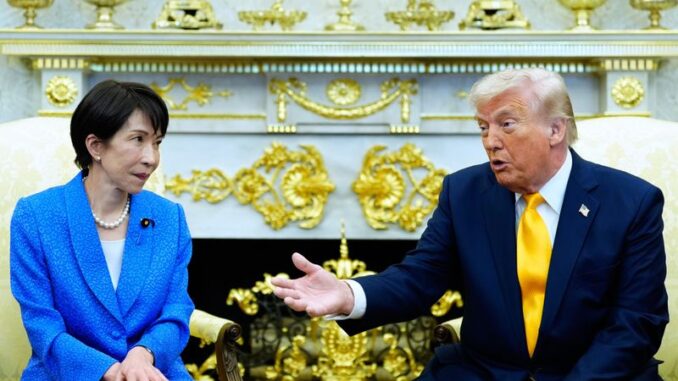
During Japanese Prime Minister Sanae Takaichi’s visit to the US in March, Trump did not hesitate to mention Japan’s bombing of Pearl Harbour in 1941. Four years later, Japan had surrendered when the US dropped freshly manufactured bombs on Hiroshima and Nagasaki. Although history books make it a point to deny that these endgame attacks on the two Japanese cities were acts of retribution, any reference to Pearl Harbour usually invokes the nuclear conclusion of the war. Apparently, Trump did not mind awakening in his Japanese visitor’s mind the terrible memory of Hiroshima and Nagasaki.
Throughout the ongoing war with Iran, he has maintained a persona of a powerful man who stays cool and jokes about inflicting a hellish experience on ordinary people.
Trump represents a country famous for many universities. They hold a fascination for our youth. I have lost many of my bright and hard-working students to Trump’s nation. He is the democratically chosen leader of his country. If you believe that education should nurture certain basic values like concern for life, his description of bombs and bomber planes as beautiful sounds alarming. When he turns funny in front of journalists, many of them can be heard laughing, suggesting that he is not alone in entertaining violent thoughts. His discourse does represent a wider change in America’s public mind. Perhaps it is not a change, but merely an evolution — and we are expected to ignore its meaning.
A few years ago, an opportunity to grasp the nature of American nationalism came my way quite unexpectedly. A senior friend from Jawaharlal Nehru University (JNU) told me that his son was not going to return home. Nothing extraordinary, I thought. He had finished his M.Phil in computer science. I knew that academic opportunities in computer science must be greater and more attractive in California than in Bengaluru.
My JNU friend took out an envelope from his briefcase. It contained the report of his son’s M.Phil thesis examiner in America. I looked at the report without much hope of understanding it because the discourse of computer science is Greek to me. But the last paragraph caught my eye. It pointed out with sharp clarity the link between research and nationalism. The examiner had recorded his view that this young man must be discouraged from going home because his work was necessary for maintaining America’s leadership in the field.
The idea that knowledge is power is old and common, but its application to a gigantic political project is unique to America. Its project of global dominance has necessitated a model of nationalism which permits easy transfer of talent and feelings. The engineering of this transfer is essential to the imperial design of American nationalism. Education serves as an innocuous tool in this grand project. The popular metaphor that America is a melting pot does not reveal this political ambition.
It is not the first time in history that imperialism and nationalism have come together. Several European nations exemplified this blend in the 19th century when they were consolidating their economic hold across far-flung colonies.
(Krishna Kumar is a former NCERT Director and a Hindi short story writer and columnist)


Be the first to comment