

Democracy, Power and the Making of a Political Nation
When India became independent in 1947, it inherited a state but had to build a democratic political system almost from the ground up. The country was vast, poor, deeply diverse and still recovering from Partition. Its political institutions had been created for colonial administration, not popular government. Yet India’s founding generation made a remarkable choice: democracy would not be postponed until the country became richer, more educated or more stable. It would begin immediately.
Over the next eight decades, Indian politics became a story of continuity and disruption. Jawaharlal Nehru established the early traditions of parliamentary democracy and institution-building. Congress dominated the first decades, but the rise of regional parties, social movements and new political forces gradually transformed the party system. Wars with China and Pakistan altered the country’s understanding of national security. Indira Gandhi’s centralisation of power culminated in the Emergency, followed by the historic electoral verdict of 1977. The 1980s and 1990s brought coalition governments, Mandal politics and the rise of regional forces. Economic liberalisation in 1991 changed the aspirations and expectations of voters. The BJP’s emergence as a major national force eventually produced a new era of majority governments.
Through these changes, however, one institution remained at the heart of the political system: the voter.
Nehru’s India: Building Democracy from the Ground Up
The first years of the republic were dominated by the enormous challenge of building a functioning nation-state. Jawaharlal Nehru, India’s first prime minister, believed that political democracy, economic development and scientific modernization had to advance together.
The institutions established during these years became the framework within which Indian politics would operate for generations. Parliament was given a central role in national life. The judiciary was expected to function independently. The Election Commission was established to supervise elections. The civil services were reorganized to serve an independent India. Universities, scientific institutions, research laboratories and public-sector enterprises became instruments of national development.
Nehru’s political vision was shaped by several ideas: parliamentary democracy, secular citizenship, economic planning, scientific temper and an independent foreign policy. He believed that India had to modernize without losing its democratic character.
This was an extraordinary experiment. Many newly independent countries moved towards military rule or authoritarian government. India did not. Its leaders accepted that governments would derive legitimacy from elections and that political opposition was a legitimate part of public life.
The system was not perfect. Congress dominated politics, the bureaucracy became powerful and economic controls sometimes produced inefficiency. Yet the basic democratic framework survived.
That achievement would become one of the defining legacies of the republic’s first generation.
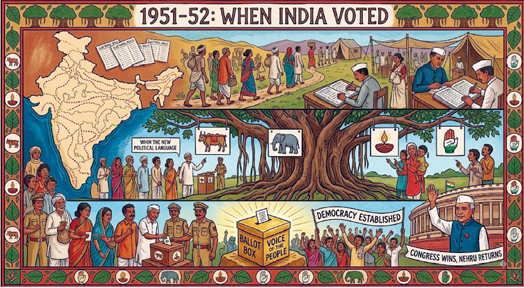
1951–52: When India Voted
Nothing demonstrated the ambition of the new republic more clearly than its first general election.
Held between 1951 and 1952, the election involved an electorate of extraordinary size. Most Indians had never voted before. Literacy was low, communications were difficult and millions lived in remote rural areas.
Yet the Election Commission undertook the enormous task of creating electoral rolls, establishing polling stations and transporting ballot boxes across the country.
The election also required a new political language. For millions who could not read, party symbols became essential. The symbols on the ballot helped voters identify their preferred candidates and parties.
The result was a landmark in world history.
India had not waited for universal education or prosperity before introducing universal adult suffrage. Ordinary Indians were given the right to determine who would govern them.
The Congress won a commanding victory, and Nehru returned as prime minister. But the most important winner was the democratic system itself.
The first election established a principle that would define the republic: political power would ultimately be decided by the ballot box.
Language, Identity and the Reorganization of States
The political map created at independence did not remain unchanged.
One of the earliest major challenges came from demands for states based on language. In a country where language was closely linked with identity, culture and regional history, many people believed that administration should reflect linguistic realities.
The death of Potti Sriramulu after a prolonged fast demanding a separate Telugu-speaking state brought the issue to the national forefront. Andhra State was created in 1953.
The movement prompted a broader examination of India’s internal boundaries. The States Reorganization Commission studied the issue, and the States Reorganization Act of 1956 redrew much of the map.
The process continued. Maharashtra and Gujarat were created in 1960. Punjab was reorganised in 1966, leading to the creation of Haryana and changes in the boundaries of Punjab. Later decades brought the creation of several new states, including Chhattisgarh, Jharkhand, Uttarakhand and Telangana.
The reorganization of India demonstrated the flexibility of the Union.
Regional identity did not necessarily have to threaten national unity. By accommodating linguistic aspirations within the constitutional framework, India showed that federalism could become a means of managing diversity rather than suppressing it.
The map of India changed.
The idea of India did not.
The Congress Era
For the first three decades after independence, the Congress dominated national politics.
Its strength came from its history as the principal organization of the freedom struggle, its extensive grassroots network and its ability to accommodate different ideological and social groups.
Congress was more than a conventional political party. It was a broad political coalition containing socialists, conservatives, centrists, regional leaders and competing interest groups.
Opposition parties existed and regularly contested elections, but Congress remained the central force of Indian politics.
This dominance gave the early republic political stability. It also created a distinctive form of politics in which many ideological battles were fought inside Congress itself.
Over time, however, this system began to weaken.
New social groups demanded political representation. Regional identities became stronger. Opposition parties expanded their influence.
The era of one-party dominance would eventually give way to a more competitive political system.
1962: The War That Changed India’s Strategic Thinking
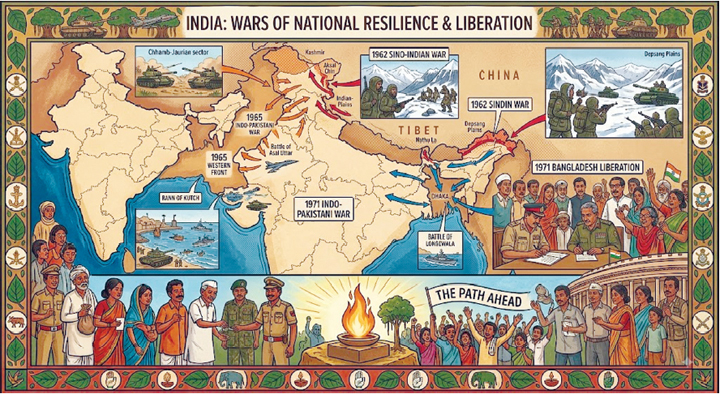 The early republic had hoped that diplomacy and peaceful coexistence could provide the foundation for relations with its neighbors.
The relationship with China shattered that confidence.
Border disputes and deteriorating relations culminated in the 1962 war. India’s military performance was deeply disappointing, and the defeat generated a national reassessment of defense policy.
The country began strengthening its armed forces and defense infrastructure.
The war also changed the political atmosphere.
Foreign policy could no longer be viewed separately from military preparedness. India’s leaders increasingly recognised that national sovereignty required both diplomatic strength and credible defence capabilities.
The experience would influence Indian strategic thinking for decades.
1965 and 1971: War, Security and National Confidence
The conflict with Pakistan in 1965 reinforced the importance of military preparedness.
Prime Minister Lal Bahadur Shastri became associated with the slogan “Jai Jawan, Jai Kisan”, linking the security of the country with the productivity of its farmers.
The war ended through the Tashkent Agreement in January 1966, but Shastri died shortly afterwards.
Five years later came the war that transformed India’s regional position.
Political repression and conflict in East Pakistan produced a massive refugee crisis in India. Tensions escalated, and in December 1971 India entered the war.
The conflict ended with the surrender of Pakistani forces in East Pakistan and the emergence of Bangladesh.
The victory transformed Indira Gandhi’s political standing.
India had demonstrated its military strength, and the war became one of the defining moments of the country’s post-independence history.
Indira Gandhi: The Centralization of Power
Indira Gandhi became prime minister in 1966 and gradually emerged from the shadow of the Congress establishment.
Her political rise was accompanied by a growing emphasis on direct popular mobilization.
The 1969 split in Congress marked a decisive turning point. Indira Gandhi increasingly presented herself as the champion of the poor and disadvantaged, using the slogan “Garibi Hatao” as a powerful political message.
Bank nationalization and other measures strengthened her image as a leader willing to challenge established economic interests.
The 1971 election produced a major victory, followed later that year by India’s military success in the Bangladesh war.
But alongside her political achievements came an increasing concentration of authority around the prime minister’s office.
The Congress organization became more centralized.
The balance between leader, party and institutions changed.
That transformation would reach its most controversial point in 1975.
The Emergency: When Democracy Was Suspended
On 25 June 1975, India entered a period that remains the darkest chapter in its democratic history.
The Emergency curtailed civil liberties, imposed press censorship and led to the arrest of opposition leaders and political activists. The government defended the decision as necessary to preserve national stability, while critics regarded it as a fundamental assault on democratic freedoms.
The period also witnessed serious abuses of state power, including coercive sterilisation drives and forced evictions in some areas.
The Emergency demonstrated that democratic institutions could not be taken for granted.
Parliamentary democracy existed, but institutions could be weakened when political authority became excessively concentrated.
Yet the eventual restoration of elections produced one of the most important demonstrations of democratic resilience in Indian history.
In 1977, the people were given the opportunity to pass judgment.
They did.
1977: The Voter Delivers a Verdict
The 1977 general election changed Indian politics.
The Congress was defeated at the national level for the first time since independence.
The Janata Party, formed from several opposition groups, came to power, and Morarji Desai became prime minister.
The government struggled with internal divisions and eventually collapsed. But its historical significance went far beyond its relatively brief tenure.
The election demonstrated that no political party was permanently entitled to govern India.
The voter could remove even the most powerful government.
The ballot box had become an instrument of democratic accountability.
The political system would never again be quite the same.
The Rise of Coalition India
The decades that followed witnessed increasing political fragmentation.
The Congress remained a major force, but regional parties and new social movements became increasingly influential.
The 1989 election opened a prolonged period of coalition politics at the Centre. Governments increasingly depended on alliances among parties with different ideological and regional interests.
This period also saw the rise of identity-based political mobilization.
The implementation of the Mandal Commission recommendations intensified debates over caste, representation and reservations. At the same time, the Ram Janmabhoomi movement contributed to the expansion of the BJP.
Regional parties gained unprecedented importance.
The politics of Delhi increasingly depended on what happened in Lucknow, Chennai, Kolkata, Hyderabad, Patna, Mumbai and other state capitals.
Coalition politics therefore transformed Indian federalism in practice.
The states became more powerful political actors.
1991: The Political Meaning of Economic Change
The economic crisis of 1991 marked another watershed.
India faced a severe balance-of-payments crisis and was forced to reconsider the economic model that had dominated the first four decades after independence.
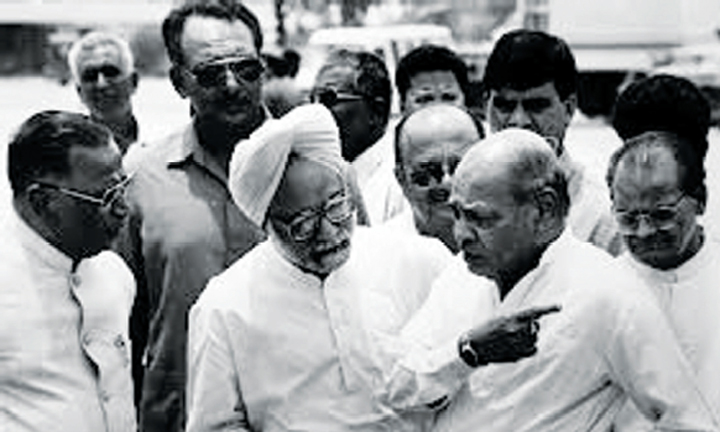
Prime Minister P.V. Narasimha Rao and Finance Minister Manmohan Singh introduced sweeping reforms.
Industrial licensing was reduced.
Trade barriers were lowered.
Private enterprise received greater freedom.
Foreign investment was encouraged.
The reforms changed the economy, but their political consequences were equally profound.
A new middle class expanded.
Urban aspirations grew.
Private enterprise became increasingly important.
Telecommunications and information technology transformed economic life.
The voter increasingly expected not only political freedom but jobs, better roads, electricity, education, housing, consumer choice and economic opportunity.
Politics was entering the age of aspiration.
Regional Parties Redraw the Political Balance
As the Congress system weakened, regional parties emerged as powerful political forces.
In Tamil Nadu, the Dravidian parties transformed state politics. In Andhra Pradesh, the Telugu Desam Party became a major regional force. In Uttar Pradesh and Bihar, parties representing different caste and social constituencies changed the political balance. Maharashtra, West Bengal, Odisha, Punjab and other states developed their own powerful political formations.
Regional parties brought new voices into national politics.
They also forced national governments to negotiate.
The era when Delhi could dominate the political system without substantial consultation with state leaders was disappearing.
India was becoming more politically federal.
The rise of regional parties also represented a broader democratization of political power.
Groups that had historically been underrepresented increasingly found political platforms of their own.
The BJP’s Rise
The emergence of the BJP as a major national force fundamentally transformed Indian politics.
The party expanded rapidly from the late 1980s, drawing strength from organizational growth, ideological mobilization and the Ram Janmabhoomi movement.
Its rise changed the national political competition.
In 1996, the BJP emerged as the largest party in the Lok Sabha. Although its first government lasted only briefly, the party subsequently built a durable coalition under Atal Bihari Vajpayee.
The National Democratic Alliance demonstrated that the BJP could govern a diverse country through coalition politics.
The 1998 and 1999 elections established the party as a central force in national government.
The Vajpayee years coincided with significant developments in infrastructure, telecommunications and India’s strategic capabilities, including the nuclear tests of 1998.
The political centre of gravity had shifted.
Congress was no longer the natural default party of national government.
From Coalition Governments to Majority Rule
The first decade of the 21st century was dominated by coalition politics.
The United Progressive Alliance came to power in 2004 and returned in 2009, with Manmohan Singh serving as prime minister.
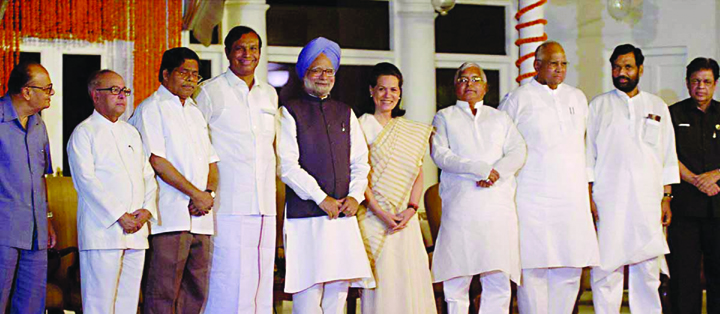
The period witnessed high economic growth during much of the 2000s and the expansion of major welfare programs. The Right to Information Act and the rural employment guarantee program became important elements of the policy landscape.
But the government also faced controversies over corruption, policy-making and coalition constraints.
In 2014, the political system entered another new phase.
The BJP won a majority in the Lok Sabha under Narendra Modi.
It was the first time since 1984 that a single party had secured a majority on its own.
The party returned with another majority in 2019.
The political system had therefore moved through a remarkable cycle: from Congress dominance to fragmentation, from fragmentation to coalition government, and from coalition politics to a new era of majority governments.
The Digital Political Age
The political India of the 21st century is also a profoundly different communications environment.
Political campaigns that once depended on newspapers, posters, public meetings and radio have expanded into television, smartphones and social media.
Leaders can communicate directly with millions of citizens.
Political messaging travels instantly.
Campaigns can be national, regional and hyperlocal at the same time.
Digital politics has increased political engagement but has also intensified concerns about misinformation, polarization and the quality of public debate.
The modern voter is therefore exposed to an unprecedented volume of political information.
The challenge is no longer simply access to information.
It is determining what information deserves trust.
The Indian Voter: The Real Constant
Political parties have changed.
Governments have fallen.
New states have emerged.
Ideologies have evolved.
Economic policies have been transformed.
But the Indian voter has remained at the centre of the system.
The first-time voters of 1951–52 belonged to a largely rural and economically poor country. Today’s electorate is larger, younger in many respects, more urban, more connected and exposed to vastly greater political information.
Yet the Indian voter cannot be reduced to a single political category.
Voting behavior varies according to region, caste, community, class, age, gender, economic circumstances, leadership preferences and local issues.
A national election and a state election can produce very different outcomes because voters often distinguish between levels of government.
This complexity is one of the defining features of Indian democracy.
India does not have one political conversation.
It has hundreds of conversations taking place simultaneously.
Institutions and the Democratic Test
Elections are the most visible expression of Indian democracy, but democracy is larger than elections.
Its foundations also include Parliament, the judiciary, the Election Commission, the federal system, an independent civil service, the media, political parties and civil society.
Every generation has tested these institutions.
The Emergency demonstrated how vulnerable democratic freedoms can become when political power is concentrated.
The 1977 election demonstrated the ability of voters to restore political accountability.
Coalition governments demonstrated that power could be dispersed across parties and regions.
The rise of majority governments has once again placed greater emphasis on the relationship between executive authority and institutional checks.
Indian democracy has therefore never been a finished product.
It has been a continuing experiment.

Be the first to comment