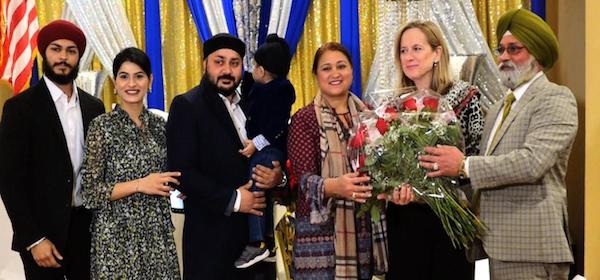
RICHMOND HILL, NY(TIP): The Queens Indian American community organized a reception to Melinda Katz, the Queens Borough President who is completing two terms this year.
Melinda is now eying the post of District Attorney of Queens. It was a public relations exercise for Melinda who is admired for her work, in particular by the Punjabi community.
Jarnail Singh Gilzian and Melinda Katz
A Punjabi community leader Jarnail Singh Gilzian who owns the famous banquet and Restaurant Richie Rich in Richmond Hill hosted the reception which was attended by a large number of community leaders from Queens and Long Island.
The more prominent amongst them who also spoke on the occasion included Mohinder Singh Gilzian, President of Indian Overseas Congress, Harbans Singh Dhillon, former Election Commissioner, Gurdwara Sikh Cultural Society, Harpreet Singh Toor, former Chairman, Gurdwara Sikh Cultural Society, Satnam Singh Parhar, Former President, India Association of Long Island, and Bhinda Begowalia, President of Begowal Society. Each speaker spoke highly of Melinda and pledged support in her bid for District Attorney of Queens.
Melinda Katz addresses the gathering. Seen to her right is Jarnail Singh Gilzian
Speaking on the occasion, Melinda spoke of her work as Queens Borough President. She pledged her support to the community which had always supported her. She thanked Jarnail Singh Gilzian for organizing a reception to enable her to reach out to a large number of her supporters and voters.
Sections of the gatheringSections of the gatheringSections of the gatheringSections of the gathering
Earlier, on her arrival, Melinda was welcomed with a bouquet presented to her by Jarnail Singh Gilzian’s family.
During her more than an hour- stay, Melinda went around meeting everyone individually and obliging them with photographs.
Melinda Katz poses for a photograph with community leadersGilzian family with Melinda
“Bob Mueller is doing exactly the right thing by simply focusing on this investigation and trying to determine the truth,” says Panetta. “I don’t know what the final result is going to be, but I have a sense that whatever that final report shows that people are going to thank Bob Mueller for the way he handled this.”
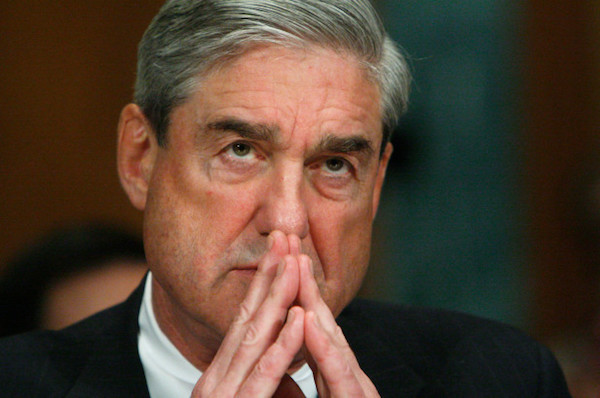
Special counsel Robert Swan Mueller III is the second-most famous man in Washington. Time Magazine just ranked him No. 3 on their Person of the Year list, after crusading journalists and President Trump. It is impossible to spend a day in this town without hearing or reading Mueller’s name. He will go down in history, for better or worse, as one of the pivotal figures of the Trump era.
All this for a man who seldom speaks and is rarely seen. He is omnipresent and absent, inescapable but elusive, the invisible yang to Trump’s gold-plated yin.
“Mueller’s silence has invited noisy speculation from partisans,” writes Time. “To critics on the right, he is an overzealous prosecutor drunk on power and roaming beyond his mandate in a bid to drum Trump out of office. To liberals, he is a crusading hero who won’t quit until he brings the President to justice. The public narrative of Mueller’s investigation this year has often described its central character more as myth than man.”
Such is the peculiar nature of Washington that a powerful man who shuns the spotlight should become an object of fascination, and the specific character of Mueller — an old-school WASP indifferent to entreaties for speeches, interviews and photo-ops. More people have seen Robert De Niro playing Mueller on “Saturday Night Live” than have seen the special counsel himself.
“I always joke that Bob Mueller has turned down more interview requests in his career than most people in Washington ever get in the first place,” says Garrett Graff, author of “The Threat Matrix: Inside Robert Mueller’s FBI and the War on Global Terror” and Mueller’s de facto biographer. “Contrary to every single thing that the president tweets today, Mueller is and always has been probably the most apolitical nonpartisan person in the city. He does everything that he can to avoid the public spotlight and anything even slightly resembling politicking.”
Mueller is content to be known and respected within a very small circle of close friends and colleagues. That’s rare in a town filled with former high school class presidents with enough egos to “float battleships,” as former senator Alan Simpson put it. Politicians love cameras — and Twitter feeds, Instagram and more — but Mueller’s only public statement as special counsel came on May 17, 2017, the day he was appointed: “I accept this responsibility and will discharge it to the best of my ability.”
More than anything, silence has come to define Mueller. He’s become a meme, a cartoon superhero or supervillain, more powerful with every word he does not say.
“Like all the FBI directors I have known, including myself, Bob is not about to try his case or run his evidence by the court of public opinion,” says William Webster, the only man to head both the FBI and the CIA. “That’s not how our FBI works. It’s not how Bob Mueller works. It might make for good tv ratings, but it leaves too much open for misunderstanding and, in my opinion, creates a circus atmosphere around critically important cases.”
Kenneth W. Starr, the independent counsel investigating President Bill Clinton, had a different approach: He spoke to reporters during his five years in that job in hopes it would help Americans better understand the reasons for the investigation.
“Relationships between prosecutors and the press are inherently difficult and sensitive,” he says. “A federal prosecutor wields important powers and thus should always be held accountable by the American people. That accountability carries with it, in my view, a role for providing public information . . . without transgressing important limitations — especially the protection of grand jury secrecy.”
Mueller, says Starr, may have been chastened by former FBI director James B. Comey’s “inappropriate public relations approach” and wants the charging documents to speak for themselves. “All things considered, I think he has followed a wise strategy, albeit at the expense of a more complete public understanding of his important work.”
Leon Panetta, former White House chief of staff and head of the CIA, says there’s another reason for Mueller’s silence: He doesn’t want to give President Trump any ammunition that could compromise the case. “He really feels that the integrity of the investigation has to be protected and not allow the president to undermine it.”
Mueller is not instinctively somebody who plays the political game, says Panetta, who has known the prosecutor for years. “He didn’t even particularly like to testify before Congress, but he knew that he had to do it. He really thought that those who were out there in the press were only undercutting their position rather than strengthening it.”
“More than anything, silence has come to define Mueller. He’s become a meme, a cartoon superhero or supervillain, more powerful with every word he does not say”.
In fact, Mueller — by temperament and professional experience — has always preferred to be judged by his deeds, not his words. He grew up in Princeton, a childhood of privilege and private boarding schools, where self-aggrandizement and promotion were considered poor form. His stints as a Marine platoon leader during the Vietnam War and as a federal prosecutor emphasized teamwork rather than any individual effort. During his 12-year tenure as head of the FBI, he rarely appeared at public events and turned down virtually all the A-list invitations that came with that title.
During his trip to the Capitol to brief Congress in June 2017 — one month after becoming special counsel — Mueller and his team navigated back hallways and stairwells to avoid the media. There have been only three widely circulated sightings in the wild since then: One photo of Mueller standing on a street corner in March, one in July with Mueller and Donald Trump Jr. both waiting to catch a flight at Gate 35X at Reagan National Airport and one of Mueller and his wife in September at the Genius Bar in Georgetown’s Apple store, where they were getting help with a laptop.
The dearth of images led to this plea by Slate staff writer Heather Schwedel earlier this year: “Why are we clamoring for new Mueller pics like paparazzi stalking Jennifer Aniston? Because every time his investigation into Russia’s interference in the 2016 presidential election makes news — which is a lot these days — sites like Slate must use the same photos of Mueller we’ve been using since this past summer . . . . Our nation’s poor photo editors are stuck with a cache of boring, already-used shots of one of the most newsworthy figures of our political moment.”
Who is Robert Mueller?
By now, it goes without saying that Mueller and his prosecutors run the tightest ship in Washington. No interviews, no leaks, no whispers, no jokes, no nuthin’. In August, members of his team were spotted by the press waiting for a Shake Shack delivery at an Alexandria hotel during Paul Manafort’s trial. Shake Shack, huh? joked a reporter. Peter Carr, Mueller’s spokesman, would not even confirm the order.
Mueller rarely ventures outside his temporary office in a nondescript federal building. Even in his most public role before this, as head of the FBI, Mueller only appeared in public when it was important to the bureau. Most photos of him are from testimony to the Senate several years ago. His last speaking appearance (announced before he was named special counsel) was in May 2017 at the graduation of his granddaughter from a small boarding school in Massachusetts.
“One of the things that I think is important in understanding him is understanding the perspective that he brings to this job,” says Graff. “If you got him in a moment of candor, he would say that this is no more than the third-hardest job that he has ever had after the Marines in Vietnam and after being FBI director in the wake of 9/11. In that sense, the photo of him at the Apple Store is indicative of a lot: He’s just continuing to lead his life. His life has always been under the radar and non-showy, and that’s exactly how he has comported himself as special counsel.”
Mueller’s private life is even more circumspect. It is possible, after following the bread crumbs of his biography, to determine his comings and goings. He lives in a gated community in Georgetown with his wife of 52 years, Ann. They have two daughters, Melissa and Cynthia, seen only when they attended his 2001 confirmation hearing as head of the FBI. The couple regularly attends services at an Episcopal church in downtown Washington. They both play golf, although Ann’s the better golfer of the two.
And they have a weekly dinner date, usually at their favorite Italian restaurant a few miles from their home. The Muellers have been regulars for years, typically sitting unnoticed behind the bar in the back of the room. How, in this age of smartphones and cameras, does Mueller pull that off? Slip in a side door? The owner, as did everyone contacted for this article, declined to comment.
In fact, virtually everyone within Mueller’s orbit refused to talk about him. “I’ll pass along your request, but she never returns calls about Mueller,” explained the assistant of a lawyer who worked for him many years ago.
“The people that he has surrounded himself with throughout his career are temperamentally very like him,” explains Graff. “And he has a good set of longtime friends in D.C. that he primarily socializes with. He’s someone who draws a pretty firm line between work and home in terms of socializing. Part of the answer is just that the people around him don’t share the things that they do with him. And he has developed a series of places that he likes to go where I think that privacy is respected — and they’re also not the trendiest restaurants on 14th Street where he would be recognized.”
Even the press has been unwilling to cross Mueller’s invisible line. Salt Lake Tribune reporter Thomas Burr tweeted that he saw Mueller in June: “Gotta love DC. Walk into restaurant, run into the special counsel.” But Burr declined to say which restaurant, despite a flurry of responses to the tweet.
Some of this is respect for Mueller. Some of this is the fear of unintentionally providing a piece of information that could compromise the Russia investigation. And some of this is just fear for Mueller himself. Given the heated rhetoric surrounding President Trump — and a gunman who shot up Comet Ping Pong over the Pizzagate conspiracy theory — friends and colleagues are reluctant to say anything that could harm him in any way.
“Bob Mueller is doing exactly the right thing by simply focusing on this investigation and trying to determine the truth,” says Panetta. “I don’t know what the final result is going to be, but I have a sense that whatever that final report shows that people are going to thank Bob Mueller for the way he handled this.”
We asked Mueller’s spokesman if he had a response to . . . well, anything.
“We appreciate your reaching out,” replied Carr. “But we’ll decline comment at this time.”
BJP gets Rs 210 cr of Rs 222-cr bonds sold in FY18; donors remain anonymous
NEW DELHI(TIP): Notwithstanding the aim to bring in transparency in funding to political parties by giving an alternative to cash donations, the latest data reveals that after six rounds of sale of electoral bonds, donors continue to be anonymous, as the norms allow them to remain secretive.
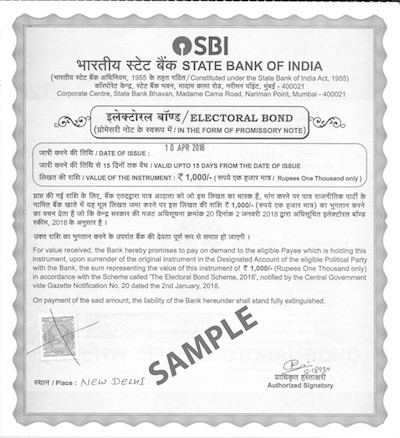
Sources reveal that as per the data, despite being available in five denominations — Rs1,000, Rs10,000, Rs1 lakh, Rs10 lakh and Rs1 crore — more than 90 per cent of electoral bonds were sold in the top two units, which apparently were purchased by big business houses.
It is also learnt that the total number of bonds sold in six phases were 2,134 of which 2,007 went for higher denominations of Rs10 lakh and Rs1 crore, as they were mostly bought in metros like Mumbai, Hyderabad, Kolkata and the national capital.
Incidentally, for financial year 2017-18, the ruling BJP in its declaration to the Election Commission said it received an income of Rs210 crore from contribution through electoral bonds. Sources said during this period (2017-18) electoral bonds worth Rs 222 crore were sold. Therefore, it is clear from the figures that almost 95 per cent of the total bonds went to the BJP account.
On several occasions, experts and even the poll panel raised the issue of secrecy norm in the electoral bond, saying it will only cement the nexus between political parties and corporate donors.
As the government, while notifying the electoral bond scheme, had claimed it envisaged total clean money and substantial transparency coming into the system of political funding, the Election Commission had raised concerns and had written to the Law Commission in May 2017 over amendments in the Finance Act, 2017, which brought about changes in the Income Tax Act, the Companies Act, 2013, and the Representation of People Act, 1951, to enable the launch of the electoral bonds scheme.
Former Chief Election Commissioner OP Rawat is also reported to have talked about grey areas with respect to electoral bonds. “Earlier, we had expressed concern regarding transparency and the possibility of shell companies, which can buy electoral bonds,” he had said.
Donation process
Electoral bonds are available in five denominations: Rs 1,000, Rs 10,000, Rs 1 lakh, Rs 10 lakh and Rs 1 crore
Bonds will not carry the name of the payee and will be valid for 15 days
Can be used to donate funds to registered parties only
Can be encashed only through that party’s bank account
WASHINGTON(TIP):Defending his decision to withdraw troops from the war-torn Syria, US President Donald has Trump said America cannot be the world’s policeman.
President Trump and First Lady Melania secretly left Washington on Christmas night and visited Iraq on Wednesday, December 26 to deliver holiday greetings to US combat troops.
“President Trump and the First Lady travelled to Iraq late on Christmas night to visit with our troops and Senior Military leadership to thank them for their service, their success, and their sacrifice and to wish them a Merry Christmas,” White House press secretary Sarah Sanders said in a tweet.
Trump delivered a speech to around 100 uniformed service members at an air base west of Baghdad where he defended his decision to pull American troops out of Syria.
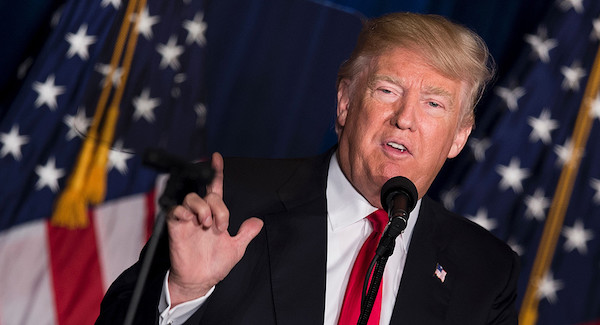
“The US cannot continue to be the policeman of the world,” Trump said after he addressed American soldiers. He said the US could use Iraq as a regional launching pad to carry out operations against the IS and Syria.
NEW YORK (TIP): President Barack Obama was honored Wednesday, December 12 night with the Robert F. Kennedy Human Rights “Ripple of Hope” award at a gala in New York.
“I’m very humbled by this honor. I’m not sure if you’ve heard but I’ve been on this hope kick for a while now,” Obama said in his speech Wednesday to laughs from the audience. “I gave a big speech on hope. I ran a couple of campaigns. Hope. It’s my kind of thing. … So I’d like to thank all of you for officially validating my hope credentials.”
Later in his remarks, Obama said, “It can be tempting to succumb to the cynicism, the belief that hope is a fool’s game for suckers.”
“And worse, at a time when the media is splintered and our leaders seem content to make up whatever facts they consider expedient, a lot of people have come to doubt even the very notion of a common ground, insisting the best we can do is to retreat into our respective corners, circle the wagons and then do battle with anybody who is not like ourselves,” Obama said. “Bobby Kennedy’s life reminds us to reject such cynicism.”
Discovery CEO David Zaslav, Humana CEO Bruce Broussard and New Jersey Gov. Phil Murphy were also honored with this year’s Ripple of Hope award.
“As Bobby Kennedy taught us, the thing about hope is that it travels through space *and* time, first splashing against the rocks, but eventually breaking down the walls of cruelty and injustice,” Obama wrote on Twitter Wednesday night echoing his speech. “And if we do our best with the time we’re given, others will take hope in our example.”
RFK Human Rights president, Kerry Kennedy, speaking at the of the 50th Anniversary of “Ripple of Hope” Photo /Mohammed Jaffer-SnapsIndia
Kerry Kennedy, the organization’s president and daughter of Robert Kennedy, presented the 44th president with the award for those who have “demonstrated a commitment to social change.”
“Bobby Kennedy was one of my heroes,” Obama said in a statement back in August when it was first announced he’d be receiving the award. “He was someone who showed us the power of acting on our ideals, the idea that any of us can be one of the ‘million different centers of energy and daring’ that ultimately combine to change the world for the better.”
Seen in the picture are New Jersey Governor Phil Murphy with wife Tammy Snyder Murphy, Dr. Navin Mehta , Mrs. Mehta, Kenny Desai, Mrs. Desai, and H.R.Shah Photo / Mohammed Jaffer-SnapsIndia
This year marks the 50th anniversary of the organization RFK Human Rights’ founding and Kennedy’s historic campaign for the White House.
Past recipients of the Ripple of Hope award include Hillary Clinton, Bill Clinton, Joe Biden, Al Gore, John Lewis, Robert De Niro, Taylor Swift and George Clooney.
SBI, Bank of Baroda, Indian Bank and Vijaya Bank may not need capital.
NEW DELHI(TIP): The government on Thursday, December 20, said it will enhance the capital infusion in public sector banks to Rs 83,000 crore, taking the total to Rs 1.06 lakh crore for the fiscal.
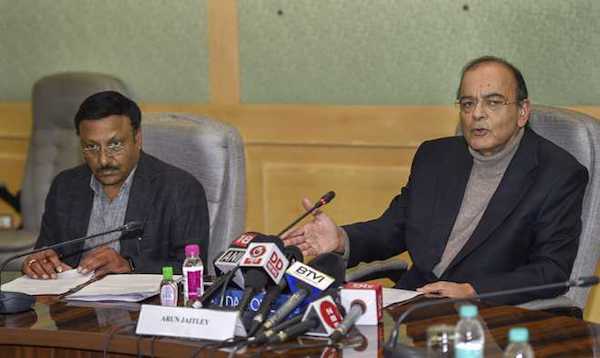
The capital will be pumped in over the next few months, Finance Minister Arun Jaitley said, adding that the move will increase the lending capacity of public sector banks (PSBs) as well as help some of them come out of RBI’s watchlist.
The government had earlier announced infusion of Rs 65,000 crore in PSBs in 2018-19, of which Rs 23,000 crore has already been disbursed, while Rs 42,000 crore is remaining.
The government Thursday sought Parliament’s approval for infusion of an additional Rs 41,000 crore.
This amount, sought to be infused in the banks through issue of government securities (recapitalization bonds), is over and above the Rs 2.11 lakh crore recapitalization plan announced in October 2017.
The recapitalization, the finance minister said, will enhance the lending capacity of state-owned banks and help them come out of RBI’s Prompt Corrective Action (PCA) framework.
“Now this Rs 1.06 lakh crore this year and Rs 83,000 crore which is remaining is going to be utilized under four different heads. The first of course is to ensure that banks meet their regulatory capital norms.
“The second will be that the better performing banks under PCA are given capital to achieve a 9 per cent Capital to Risk Weighted Assets Ratio (CRAR) and required capital conservation buffer and the 6 per cent net NPA requirements so that some of them are able to come out of the PCA itself,” he said.
The third category will be the non-PCA banks which are very close to the PCA red-line will be provided capital so that they do not come under the framework, he said.
Some capital will also be provided to banks which are going to be amalgamated to meet regulatory norms and growth capital, Jaitley added.
Earlier this year, the government had announced merger of Dena Bank and Vijaya Bank with Bank of Baroda.
Jaitley also said the non-performing assets (NPAs) recognition, started in 2015, is almost complete, and the September quarter has shown decline in bad loans.
Gross NPAs of PSBs started declining after peaking in March 2018, registering a reduction of Rs 23,860 crore in the first half of the fiscal.
Speaking to reporters, Financial Services Secretary Rajiv Kumar said three banks were on the verge of being included in the PCA, but with this infusion, they will be safe.
A total of 11 out of the 21 PSBs are under RBI’s PCA framework, which imposes lending restrictions on weak banks.
“India’s PCA framework for weaker banks has more onerous thresholds, that is higher capital thresholds and a net NPA threshold that further embeds capital requirement on account of provisioning of NPAs.
“Today’s proposal is an expression of government’s commitment that each PSB is an article of faith and aims at securing compliance even for the higher regulatory norms,” Kumar said.
Asked if the Nirav Modi scam-hit Punjab National Bank (PNB) will get capital support, he said it could be a candidate for fund infusion.
Kumar said PSBs have recovered Rs 60,726 crore of bad loans in the first half of the current fiscal year, which is more than double the amount recovered in the corresponding period last year.
In October 2017, the government decided to infuse Rs 2.11 lakh crore in PSBs over the next two years-through budgetary provisions of Rs 18,139 crore, recapitalization bonds of Rs 1.35 lakh crore, and the balance through raising of capital by banks from the market.
The government envisaged that PSBs would raise Rs 58,000 crore from the stock markets by March 2019 to meet Basel III norms.
Kumar said out of this, Rs 24,400 crore has been raised by banks so far.
The secretary also said four banks-SBI, Bank of Baroda, Indian Bank and Vijaya Bank-may not need capital.
“If Congress were to wins elections in 2019, the BJP supporters will go ballistic against the elected government and that is the time Congress party needs to show its civility, and they will, as they have a proven record. Unlike our Goonga Prime Minister, the Congress Prime Minister will speak out against anyone calling the BJP supporters anti-National or anti-Hindu. No one is anti-National or anti-Hindu, it is the wild imagination of fanatics among BJP to sow the seeds of discord.”
Atsunami of good news has just hit India, five of the 29 states of India held the elections in December 2018, and produced amazing results, and the winner is the Indian Democracy.
Parties come and go, but what is constant is our freedom. Freedom to speak, freedom to prosper, and freedom to marry whom you want, eat what you want, drink what appeals to you, wear what works for you, and believe whatever the hell suits you.
I am sure no Indian wants someone to tell him or her how to live. The BJP followers will not like what the Congress may tell them to do, and the same is true the other way around. The durable policy is to follow the principles of freedom.
Modi has time to show that he really believes in Democracy and is not authoritarian. He can do that by initiating three national awards; Patriotic Citizen, Patriotic Media and National Chamcha Award. The award goes to those individuals and News Media who relentlessly criticize the government to keep them on their toes, and National Chamcha Award goes to the individuals who consistently equate support for Government as a Patriotic act. A true patriot would hold the feet of the government to the fire rather than do the chamchagiri and let the country make mistake after mistake.
If Congress were to wins elections in 2019, the BJP supporters will go ballistic against the elected government and that is the time Congress party needs to show its civility, and they will, as they have a proven record. Unlike our Goonga Prime Minister, the Congress Prime Minister will speak out against anyone calling the BJP supporters anti-National or anti-Hindu. No one is anti-National or anti-Hindu, it is the wild imagination of fanatics among BJP to sow the seeds of discord.
I am proud of India’s freedom and salute the men and women who went to jail and took the beatings but chose to fight for freedom. They not only got the freedom but set up great institutions for India. Today India is among the top 7 powerful nations, and the credit goes to Gandhi, Nehru, Azad, Patel, Ambedkar and a few others who had the vision and laid the foundation of a great nation.
Two BJP contestants in two states, a Minister for Cow Welfare and Minister for Happiness lost the elections badly. This is a major loss and a clear signal to the party that Indians cannot be fooled over and over again with the issue of cow or the building of a temple.
Whether you align with BJP, INC or other parties, you have the freedom to speak and prosper because the foundation of our nation was laid out on the principles of Democracy. We cannot let anyone curb those freedoms, the media needs to be free and people need to free.
I admire Modi’s supporters in America and their loyalty. I wish they show the same devotion to India by respecting every Indian without prejudice.
Do you recall a tyrant grandfather or even a father, who is all about control, he claims to live a simple life, but wants to keep everyone under his thumb? Our Prime Minister, under the guise of Sanyasi (hermit), claims that he has nothing to gain and wants nothing. How does he account for enriching his friends? Would a Sanyasi do that?
We cannot blame Modi for who he is, he is conditioned by the RSS schools where they teach exclusive ideology and disrespect to others who do not think like them. A majority of Hindus innocently believe that RSS is a service organization but fail to see the poison it injects into the innocent children. I wish Modi frees himself from the petty Hindutva ideology and becomes an all-embracing leader and a giant like Nehru.
I pray that a handful of right-leaning Hindu Americans fight their temptations to support the forces in India who want to deny the freedoms to ‘other’ Indians. Their American born children think they are stupid to have such hatred towards the other.
Whether you align with BJP, INC or other parties, you have the freedom to speak and prosper because the foundation of our nation was laid out on the principles of Democracy. We cannot let anyone curb those freedoms, the media needs to be free and people need to free.
A young Hindu Medical doctor doing his residency stayed with me for a month while attending a conference in Washington DC. We had terrific conversations on a daily basis. He wished his parents had the opportunity to know Muslims, Christians, Dalits, Sikhs, and the Blacks. He deplored their hatred towards them. He said, he has lived in the dorms, and everything they have said about others was wrong.
There are parents out there who are selfish and poison their kids by injecting ill-will towards others. Some Hindu parents tell their kids how bad Muslims, Christians and Sikhs are and vice versa goes as well, they even believe Dalits are untouchables. The dumb men (women are not as hateful) don’t realize that when the kids grow up in America, they have to work with the very people they were told to stay away from. It must be painful for the kids to work with others, many of them wish they did not have such ugly parents. I urge the Indian Americans not to poison their kids, the kids have sixty to seventy years to live, let them decide whom to love or hate based on their personal experience and not prejudice.
The Law of Karma does not spare anyone. Modi’s arrogance will bring him down in 2019. He has got to stop bullshitting Indians with issues that don’t put food on their tables or clothe their kids or have clean drinking water. Let him make one promise and keep rather than make ten and cheat.
All of us want the best for fellow humans including Modi. Mr. Modi can make a comeback in 2024 if he turns BJP into a party where every Indian, be it a Muslim, Sikh, Christian or Dalit wants to become a member of his party. He has got to do his praischit (repentance) for quietly letting a few goons to go on a killing spree in 2001. Indians will forgive him if seeks forgiveness. Hinduism is not a religion of violence or revenge, it is not about forcing others to eat, drink or believe against their will. It Hinduism is not a violent religion, then the moderate Hindus have an obligation to protect the image of Hinduism and not let the Hindutva guys tarnish it.
Indians are good people, they are as good as gold. They are clamoring for a leader who can bring jobs and don’t want to be fooled again.
Two BJP contestants in two states, a Minister for Cow Welfare and Minister for Happiness lost the elections badly. This is a major loss and a clear signal to the party that Indians cannot be fooled over and over again with the issue of cow or the building of a temple.
(The author is a public speaker and the Executive Director of the Center for Pluralism in Washington, DC. He is committed to building cohesive societies and offers pluralistic solutions on issues of the day. More about him at https://www.linkedin.com/in/mikeghouse/)
The recent Assembly elections in India in which the Congress Party wrested three Hindi heartland States from BJP should alarm the BJP. However, the Congress Party had better not have the misconception that it is their victory. In fact, the BJP lost to Congress in Rajasthan, Madhya Pradesh and Chhattisgarh because it failed to come up to the expectations of people who were desperate to get rid of a non-performing government. They rejected the BJP. Since there was no other choice for people in these States which do not have regional parties, they voted or Congress Party. Where there was a regional party, as in Telangana, or in Mizoram, voters rejected both the BJP and the Congress.
These results are not likely to replicate in other Assembly elections or in Parliamentary elections. In large States, like Bihar and UP (Hindi heartland again), there are so many regional parties who have in the past given ample evidence of their sway over voters. The BJP which won a landslide in Parliamentary elections in UP will have a lot to worry, going by its performance in the 3 States it recently lost. It is not the Congress Party which will pose a threat to BJP; it is the regional parties in these two States which have a large number of Parliamentary seats. In fact, for both the national parties, real threat comes from regional parties. Congress will be handicapper in asking for a bigger slice of seats when it sits down with the partners in alliance which include all kinds of regional parties- BSP, SP in UP, and RJD and other outfits in Bihar.
What the Congress Party need to focus on is good governance which means taking care of the people. May be, the performance of Congress governments as people-friendly governments in the freshly acquired States will send a message to other States and people will regain their lost faith in the Congress Party. It alone can revive the Congress Party. It alone can make once again Congress Yukt Bharat, as against Congress mukt Bharat.
“It is quite confusing for an ordinary Indian to figure out the motivation for the Prime Minister to honor a devoted Congressman and freedom fighter who is a Gujarati ahead of another great leader from the state: Mohandas Karamchand Gandhi. Nevertheless, to the world, Gandhi, Nehru, and Patel will remain great icons of freedom and justice, and the height of the statues will not diminish their greatness one way or the other.”
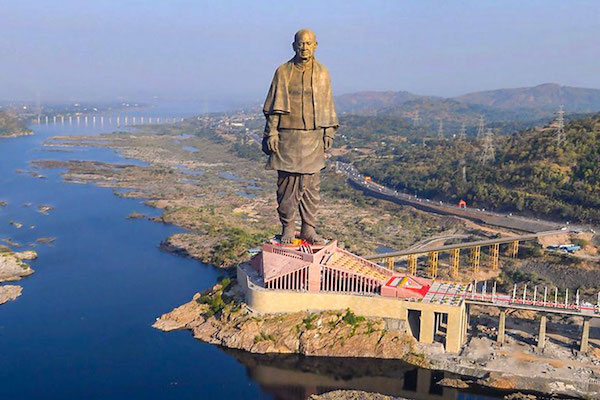
Prime Minister Narendra Modi inaugurated the world’s tallest statue of Sardar Vallabhbhai Patel, the Iron Man of India, who was the first home minister, on his 143rd birth anniversary in Gujarat recently. The country has spent about Rs 3000 crore (about $430 million) from the treasury on the monument, which is being promoted as a Statue of Unity. It reflects Patel’s efforts after Independence to consolidate the princely states into the current Republic of India.
We owe it ourselves to remember our heroes and icons of history and it is also the legacy of these legends that motivates us to go forward. Our lives are indeed built upon the shoulders of these giants who went through immeasurable hardships to guarantee us the freedom and liberty we enjoy today.
Nobody questions the wisdom of honoring Sardar Patel. However, they will be hard-pressed to explain how in a country that ranks at the bottom of the list of nations in ensuring food security for its people could afford such a luxury. According to the latest report on the Global Hunger Index, India ranks 100 out of 119 on an index that weighs the ability of countries to provide food for its citizens. India fares worse than Iraq, Bangladesh, and North Korea.
Then again, if we were to build the tallest statue for anyone, the first name on anybody’s list would be of Mahatma Gandhi, who is not only the father of the nation but also world-renowned for his philosophy of non-violence. Gandhi was considered a great inspiration for world leaders such as Nelson Mandela and Martin Luther King Jr and many cities in the world are adorned with his statues.
Then there was Jawaharlal Nehru, the first prime minister, and architect of modern India who spent almost ten years in prison under the British and was considered the foremost leader in the freedom struggle. It should be remembered that Patel’s heroic effort for national integration was conducted under Nehru’s leadership. Nehru inherited an India where life expectancy was 31 years, only 20 percent of the people could read or write, and 80 per cent of the people could not afford two meals a day.
It was Nehru along with B.R. Ambedkar who built institutions that have continued to provide freedom, justice, and opportunities to every Indian citizen regardless of caste, creed, region or religion. However, today, the ruling BJP is engaged in running a bitter campaign to undo and discredit his legacy of secularism and inclusiveness. It would be a grave injustice to forget Nehru’s significant role in building a post-independent democratic society and imbuing it with pride and purpose at a time of conflict and chaos.
Sardar Patel was a loyal Congressman who upheld the values and principles of the Congress party which he served throughout his . Since the ascendance of the BJP to power in New Delhi four years ago, it appears that a carefully crafted strategy is in place to appropriate icons and legacies that the party is sorely lacking. It is as if the party is so embarrassed by the lack of pedigree that it is even willing to go out and create some history of its own.
After Mahatma Gandhi was assassinated, it was Sardar Patel who was instrumental in banning the RSS. He subsequently wrote to RSS chief M.S. Golwalkar on September 11, 1948: ‘As regards to RSS and Hindu Mahasabha, our reports do confirm that as a result of the activities of these two bodies, particularly the former, an atmosphere was created in the country in which such ghastly tragedy became possible.’
It is known that the RSS remained aloof during the freedom struggle. The words and deeds of erstwhile leaders of the RSS from recorded history indicate that they were not only non-participants in the freedom struggle in which hundreds of people were risking their lives every day but also collaborators who supported the British on critical occasions. The British acknowledged that the RSS had ‘scrupulously kept itself within the law, and refrained from taking part in the disturbances that broke out in August 1942.’
Therefore, it is quite confusing for an ordinary Indian to figure out the motivation for the Prime Minister to honor a devoted Congressman and freedom fighter who is a Gujarati ahead of another great leader from the state: Mohandas Karamchand Gandhi. Nevertheless, to the world, Gandhi, Nehru, and Patel will remain great icons of freedom and justice, and the height of the statues will not diminish their greatness one way or the other.
(The author is a former Chief Technology Officer of the United Nations and Vice-Chairman of the Indian Overseas Congress, USA)
WASHINGTON(TIP): Tulsi Gabbard, the first Hindu lawmaker in the US Congress, has said she was “seriously” considering running for the White House in 2020.
This is for the first time that the four-time Democratic lawmaker in the US House of Representatives from Hawaii has indicated that she may run for the presidency. If she announced her candidature, she would be the first Hindu ever to be running for the presidency in the US. And if elected in 2020, she would be the first Hindu president of USA. Also, she could be the youngest ever and first woman to be elected as the US President.
“I’m concerned about the direction of our country. I’m thinking through it very carefully,” she said in response to a question on her presidential run.
Before challenging President Donald Trump in the November 2020 elections, she would have to contest against her own Democratic Party colleagues in primary elections beginning early that year.
In the last few weeks, Gabbard has been talking to her party leaders and reaching out to Indian-Americans to get their feedback on the issue.
Among those Democrats speculated to run for the 2020 primaries include former Vice-President Joe Biden, Senators Elizabeth Warren, Kirsten Gillibrand, Amy Klobuchar, Tim Kaine and Indian-origin Senator Kamala Harris.
NEW DELHI(TIP): A resurgent Congress on Tuesday, December 11 made significant gains in the Assembly elections, dealing a body blow to the BJP in Chhattisgarh Rajasthan and Madhya Pradesh.
The reverses for the BJP in the Hindi heartland threw wide open the 2019 Lok Sabha elections which until a few months ago appeared to be in the grip of Prime Minister Narendra Modi’s party.
The Assembly polls held for five states also saw the Telangana Rashtra Samithi (TRS) recording a landslide win for a second consecutive term and the Mizo National Front (MNF) scripting a spectacular victory dislodging the Congress in its last bastion in the Northeast to return to power after 10 years.
Buoyed by the Congress’ good showing in the polls that was dubbed as a semi-final for the 2019 general elections, party president Rahul Gandhi said the outcome is a “clear message” to the Modi government that people are not happy with it and time has come for a change.
Prime Minister Narendra Modi got a massive mandate but refused to listen to “heartbeat of the country”, Gandhi told reporters.
With Congress set to form governments in Chhattisgarh, Rajasthan and Madhya Pradesh, Gandhi said the selection of chief ministers in the three states will be done “smoothly”. “We have defeated the BJP in Madhya Pradesh, Rajasthan and Chhattisgarh… There will be no issue over (selection of) chief minister. It will be done smoothly.”
Finance Minister Arun Jaitley said the results were certainly not as expected and asserted the poll outcome was an opportunity to pause and analyze.
“Mr. Trump, wary of not disrupting his West Asia policy, may stay the course on Saudi Arabia for now. But the growing criticisms of the partnership on Capitol Hill can’t be ignored. The Senate has already voted with a huge majority to move forward legislation to end the U.S. involvement in the Yemen war.”
The Central Intelligence Agency (CIA) has reportedly concluded that Mohammed bin Salman, the Saudi Arabian Crown Prince, personally ordered the killing of Jamal Khashoggi. The murder of the Saudi dissident journalist at the Kingdom’s Istanbul consulate on October 2 has already triggered a global outrage against MBS, as the Crown Prince is known. But U.S. President Donald Trump seems unfazed by both the findings of his spy agency as well as the mounting global outcry. He called the CIA assessment “very premature”, while Secretary of State Mike Pompeo said the U.S.’s “historic commitment” to Saudi Arabia is “absolutely vital to America’s security” and its “interests in the Middle East”.
Thinking like realists
This is a popular argument in Washington. Realists would say the relationship with Saudi Arabia is so vital for American national interests that the U.S. should overlook certain aspects of Saudi behavior. The Trump administration repeats this argument to justify its lack of action against Riyadh in the wake of the murder of Khashoggi. But does Saudi Arabia actually have such leverage over America?
The Saudi-U.S. partnership can be dated back to the 1945 meeting between President Franklin D. Roosevelt and Saudi King Abdulaziz ibn Saud, the founder of modern Saudi Arabia and father of current monarch Salman bin Abdulaziz. In the meeting, held on board the USS Quincy in the Suez Canal, both leaders came to a two-way agreement: the U.S. would support and provide military training for Saudi Arabia, while the Kingdom would provide oil and political backing in return. This alliance made sense for both countries during the Cold War. The Saudis were anxious about communist expansion into the Arab/Muslim world. Half of Yemen fell into the hands of Marxists in 1967, and in 1978 communists took power in Afghanistan. And the U.S. wanted uninterrupted flow of oil for its own economic expansion and the post-war reconstruction of Europe. It also wanted a political ally in West Asia.
But the conditions that laid the foundation of this partnership have changed. The Soviet Union fell apart almost three decades ago. America’s dependency on Saudi Arabia for oil has also decreased over the years. True, Saudi Arabia remains a major supplier of oil to the U.S. But it doesn’t have the leverage over the American economy as it had in 1973 when Arab countries imposed an embargo on mostly Western nations in protest against their support for Israel during the Yom Kippur War with Egypt. The U.S. is now one of the top three crude producers, along with Russia and Saudi Arabia.
Other arguments in favor of stronger partnership cite the massive Saudi investments in the U.S., both treasury securities and private businesses. But Saudi Arabia acts in its interest, not with the goal of helping the U.S. economy. If it sells its U.S. assets, that would also hurt the Saudi economy badly. After all, from economic diversification at home to security guarantees, Saudi Arabia needs the U.S. more than the other way around, which offers Washington room for strategic man oeuvre.
While the strategic potential of the partnership has been shrinking, the U.S. has come under greater scrutiny, especially in the post-9/11 world, for its support for Saudi Arabia, the Wahhabi kingdom that stands opposed to everything the U.S. preaches on global stages — from democracy and respecting human rights to religious freedom and independent media. It was this broad context that allowed former U.S. President Barack Obama to take a different approach towards Saudi Arabia. He retained the fundamental elements of the partnership, including trade and economic ties, arms sales and security guarantees, while refusing to act in Syria on the Saudis’ behalf and moving further ahead to strike a nuclear deal with Iran. He even asked the Saudis and the Iranians to share West Asia and institute a “Cold Peace” in the region.
Back to square one
But President Trump has reversed this approach and rebuilt the administration’s West Asia policy, making Saudi Arabia its centerpiece. The twin objectives of the Trump policy are to ensure Israel’s security and roll back Iranian influence. It’s this tilt that is now stopping him from moving against the Saudis. The administration has already declared what its Iran policy is. It has already pulled the U.S. out of the Iran nuclear deal. And the Americans need Saudi support in their effort to isolate and weaken Iran, something Israel too has been demanding for years. But this is not a larger national security argument, nor is it a realistic one. When the fundamentals of a partnership get weakened and the region undergoes major changes, how long can the U.S. allow its Iran obsession to dictate its policies towards West Asia?
From the realpolitik point, even if the U.S. wants to limit Iranian influence, Saudi Arabia under MBS is not helping the cause. It lost the Syria war. Its intervention in Yemen drove the Houthis further into Iran’s embrace. The Qatar blockade has divided the Arab world (Qatar has now quit OPEC as well). The detention of the Lebanese Prime Minister last year has played Lebanese politics into the hands of Hezbollah, the Iran ally.
Mr. Trump, wary of not disrupting his West Asia policy, may stay the course on Saudi Arabia for now. But the growing criticisms of the partnership on Capitol Hill can’t be ignored. The Senate has already voted with a huge majority to move forward legislation to end the U.S. involvement in the Yemen war. Republican Senator Bob Corker accused the White House of “moonlighting as a public relations firm for the Crown Prince”. Rand Paul, another Republican Senator, says it’s time for America to stand up and tell Saudi Arabia, “enough”. These are not isolated moral outbursts; they suggest changing undercurrents. There is a growing realization in Washington that the Saudi pillar of its West Asia policy is getting weak. Mr. Trump, driven by his own notional obsessions, might overlook it. But future American Presidents can’t. They may have to start from where Mr. Obama stopped.
(Source: The Hindu. The author is a columnist. He can be reached at stanly.johny@thehindu.co.in)
Christian Michel fought long and hard to avoid a deportation to India. He was earlier successful in preventing a court appearance in Italy where the case against the chief of AgustaWestland for bribing Indian officials and politicians fell through for want of sufficient proof. Significantly, the then UPA government had moved the Italian court as a civil party. The die was cast for the extradition of Michel from Dubai in July last year when the Enforcement Directorate arrested Shivani Saxena for routing money on his behalf. The claim then, as it is now, was that Saxena will lay out the money trail, especially to politicians, since she herself was a conduit.
Little has been heard of that case. Even in the first CBI charge-sheet, except for former IAF chief SP Tyagi and his kin, no other bureaucrat felt the heat. Indeed, probe into defense deals worldwide is like entering the Bermuda Triangle. Investigations generally run into lack of response from countries and companies involved in the case. The massive financial muscle of the worldwide military industrial complex is generally successful in ensuring that cases where graft is alleged are brushed under the carpet. Against that backdrop it is gratifying that India has bagged a foreigner middleman, an elusive species in all past instances of corrupt defense deals.
The BJP has hoisted Michel’s arrest into a poll issue even though two middlemen remain out of India’s grasp. The CBI also requires considerable legwork to prove that the alleged money trail went to highly placed political beneficiaries. The issue of middlemen infiltrating the IAF, the Defense Ministry and the higher political echelons needs sincerity of purpose rather than political grandstanding. The ball is in now in the legal domain and will be argued on merits. But there is also a gaping lacuna in the Indian defense acquisition process — onerous conditions have caused a paucity of authorized liaison persons to navigate foreign companies through the shoals of Indian babudom. This gives space for shadowy operators to ply their trade.
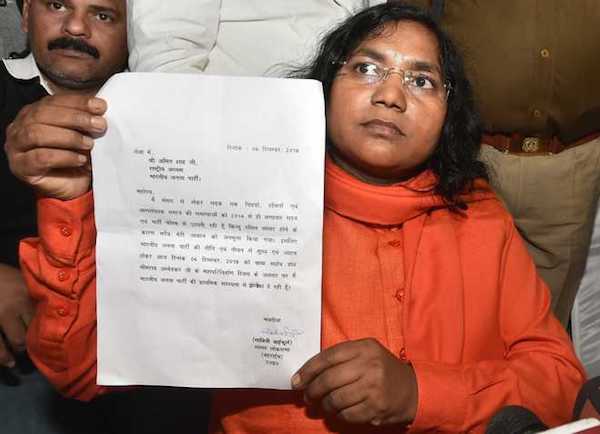
LUCKNOW(TIP): Accusing the BJP of dividing society, disgruntled party MP from Bahraich Sadhvi Savitri Bai Phule on Thursday, December 6 resigned from the saffron party.
Speaking to reporters in Bahraich, Dalit leader said upholding the Constitution and the rights it guarantees to the Scheduled Castes and Scheduled Tribes is her duty for which she is resigning.
Phule announced to hold a massive rally at Ramabai Ambedkar maidan in Lucknow on December 23. She promised to make an “explosive announcement” at the rally.
“I have resigned from the party. But I will continue as a Lok Sabha member till the end of my tenure,” she said.
She has also accused the BJP of dividing society and often the party over its Hindutva plank.
The Dalit MP, who has long been critical of the party’s leadership and resigned from the party on the death anniversary of B R Ambedkar, said she wants to get the Constitution implemented in letter and spirit.
“Desh ke chowikdar ki pehredari mein, sansadhono ki chori karai ja rahi hai (the country’s resources are being looted under the watch of the country’s gateman),” she said in a derisive reference to Prime Minister Narendra Modi.
Slamming the BJP, she said people did not get Rs 15 lakh as promised but money was being misused in the construction of statues and temples.
“It (BJP) is spreading hatred by raking up Hindu-Muslim, India-Pakistan issues and doing nothing to bring back those who fled with our money,” the 37-year-old MP said.
Ministers, she added, were making statements against the spirit of the Constitution “It seems the BJP wants to run the country from Manusmriti and not from the Constitution,” Phule asserted, referring to the ancient Hindu code.
“I am resigning on the death anniversary of B R Ambedkar as Manuwadi mentality is being promoted and the RSS, the VHP and the BJP are hurting the sentiments of Dalits and Muslims by creating a 1992 like situation. They are playing divisive politics and vitiating the communal atmosphere…,” she said.
Phule also said she wanted to draw the country’s attention towards the issue of reservations in promotion.
Reacting to her resignation, BJP spokesperson Harishchandra Srivsatava said Phule was trying to hide her failures as she had failed to meet the expectations of the people of Bahraich.
“From today onwards, I have nothing to do with the BJP. My voice was being ignored in the party as I am a Dalit. There is a great conspiracy against Dalits and their rights. Reservation for Dalits and backwards is also being slowly taken away,” she said.
Known for her controversial statements, Phule has been attacking the BJP and its governments at the Centre and in Uttar Pradesh for their alleged indifference to the concerns of Scheduled Castes.
On Tuesday, Phule said Lord Hanuman was “a Dalit and a slave of ‘Manuwadi’ people”, adding her voice to the row which erupted over UP Chief Minister Yogi Adityanath’s statement that the deity was a Dalit.
Asked about the Ram temple issue, pending in the Supreme Court, Phule said the BJP is raking up the matter as it has no other issues.
“The country does not need a temple. Will it end unemployment and other problems of Dalits and backwards? The temple will benefit Brahmins, who are only 3 per cent. The money offered in temples are used by them for their gains and make our community (Dalit) their slave,” she had said.
Phule earlier also raised questions on BJP leaders dining at Dalit homes and termed Pakistan founder Muhammad Ali Jinnah, “a mahapurush” (great personality), causing embarrassment to her party.
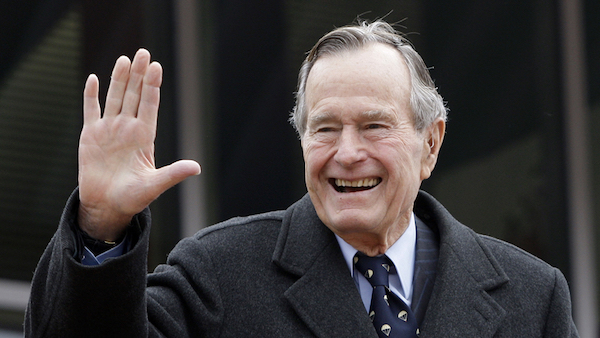
HOUSTON(TIP): Following his second funeral service on Thursday, December 6 morning, the former president was buried at the family gravesite beside his wife of 73 years, Barbara Bush, who died in April at the age of 92, and their daughter Robin, who died of leukemia in 1953 when she was only three.
After a state funeral on Wednesday in Washington that was attended by the country’s five living presidents and foreign dignitaries, Bush’s flag-draped coffin was flown to Houston.
Located on the campus of Texas A&M University, the George H.W. Bush Presidential Library and Museum houses Bush’s presidential archives and is also home to exhibitions dedicated to him and the former first lady.
Bush’s granddaughter Jenna Bush Hager takes comfort in the fact that the three of them have finally been reunited. “I had the opportunity to talk with my grandpa about the afterlife,” the Today show star, 37, captioned a touching tribute on Instagram. “This is what he said: He answered without any hesitation. ‘Yes, I think about it. I used to be afraid. I used to be afraid of dying. I used to worry about death. But now in some ways I look forward to it.’ And I started crying. I managed to choke out, ‘Well, why? What do you look forward to?’ “
In response, he said: “‘Well, when I die, I’m going to be reunited with these people that I’ve lost.’ And I asked who he hoped to see. He replied, ‘I hope I see Robin, and I hope I see my mom.’”
Her grandfather went on to share that he didn’t know whether his daughter would still look like “the 3-year-old that she was, this chubby, vivacious child,” when they saw each other again, or whether she would be all grown up.
George W. Bush expressed the same gratitude for their reunion during the emotional eulogy he delivered at his father’s state funeral on Wednesday. “Every day of his 73 years of marriage, dad taught us all what it means to be a great husband … He was dedicated to her totally,” the 43rd president reflected on his parents’ relationship.
Following the death of wife Barbara on April 17, Bush 41 remained devoted to his bride, sitting beside her casket for hours in his wheelchair as mourners paid their respects while she laid in repose one day before her invitation-only funeral.
But the weight of her passing clearly took a toll on Bush, who was hospitalized less than 24 hours after burying his wife after contracting an infection that spread to his blood. He later recovered and traveled to the family’s beloved summer home in Kennebunkport, Maine, in mid-May, but a week later was readmitted to the hospital for low blood pressure and fatigue.
In the days since the former president’s death last Friday at the age of 94, Washington and the rest of the country have come together to mourn his loss.
His remains laid in state at the U.S. Capitol Rotunda, followed by a state funeral at the Washington National Cathedral on Wednesday. President Trump, First Lady Melania Trump, as well as all living former presidents and their spouses — Barack and Michelle Obama, Bill and Hillary Clinton, and Jimmy and Rosalynn Carter — attended to pay their respects in person.
Shortly after the service, George W. and wife Laura Bush as well as their extended family traveled back to Houston with Bush’s casket on Special Mission 41. Following the second funeral service, the casket was transported by train to Bush’s final resting place at College Station, where he rejoined his wife and daughter at last.
“We’re going to miss you,” George W. added during his eulogy. “So through our tears, let us know the blessings of knowing and loving you, a great and noble man … The best man a son or daughter could have … And in our grief, let us know that dad is hugging Robin and holding mom’s hand again.”
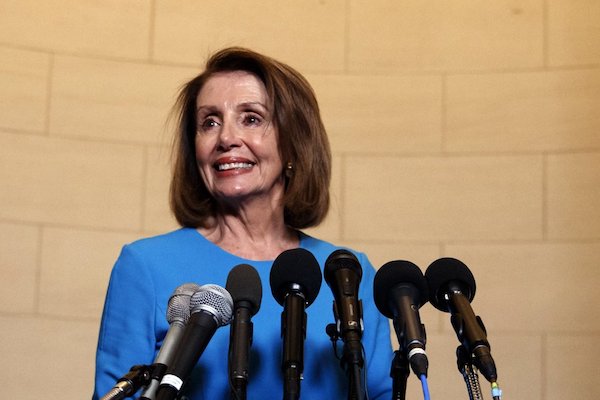
WASHINGTON(TIP): Nancy Pelosi won support from a majority of Democrats on Wednesday, November 28, to be House speaker, marking an important milestone in her quest to lead the House when her party takes majority control of the chamber in January.
The Democratic caucus vote in favor of Pelosi, who served as the first woman speaker from 2007 to 2011, brings her a step closer to the gavel that many expect her to regain.
But becoming Madame Speaker might not be easy.
Though she ran uncontested, Democrats who oppose her have called for fresh leadership and a change in the “status quo.”
Pelosi faces a final test in January when the full House votes on leadership.
To become speaker, she will need support from a majority of the full House – 218, if all members vote.
“Are there dissenters? Yes,” Pelosi said after receiving her party’s nomination. “But I expect to have a powerful vote as we go forward.”
Once undecided midterm election results are called, Democrats could have as many as 235 members in the House, which would mean she could afford to lose 17 of their votes in January if all Republicans voted against her.
Some Democrats, however, could vote “present” instead of voting for either Pelosi or incoming Republican Leader Kevin McCarthy. That would lower the number of “yes” votes she needs.
In Wednesday’s vote, 32 Democrats voted against her and three did not vote.
But Rep. Eric Swalwell, D-Calif., predicted the party will unify when voting publicly on the House floor in January.
“More people are coming off the ‘Never Pelosi’ letter than are going on it,” Swalwell said of lawmakers who previously withheld their support. “I think the momentum is in her direction.”
Rep. Elijah Cummings pleaded with Democratic holdouts to reconsider Pelosi’s bid and seemed bewildered with the more than 30 members who voted against her.
“Here we are, a woman who has given her blood sweat and tears, who has sacrificed over and over and over again, who has had some of the most phenomenal accomplishments of any speaker to serve in the House,” the Maryland Democrat said. “Then at a time when she has led us to have one of the greatest number of women that we’ve ever had, I would say to them, ‘what do you want?’”
NEW YORK(TIP):Sen. Jose Peralta, the 47-year-old Queens lawmaker, who lost his reelection bid, died of a heart attack on Wednesday, November 21 night, according to news reports. The Democrat was pronounced dead at 8 p.m. at Elmhurst Hospital Center in Queens, according to the Daily Mail, and his family was with him at the time.
Peralta was first elected to the state Senate in a special election in 2010, becoming the first Dominican-American in the chamber. Peralta, whose district included Jackson Heights, Corona, Elmhurst, East Elmhurst and parts of Woodside and Astoria, also served in the Assembly from 2002 to 2010.
He had been a longtime proponent of the state DREAM Act, a measure that would allow undocumented immigrants to qualify for state-funded financial aid for college. The measure, long stalled in the state Senate, may have a chance of passing in the 2019 session now that Democrats have won control of the chamber.
New York Mayor Bill de Blasio, among many others, tweeted his condolence .
—————————————————————————————————————-
✔
@NYCMayor
Jose Peralta was a proud son of Queens and the Dominican Republic. He worked his way up from the grassroots, with heart and tenacity. Chirlane and I are both pained by his sudden loss. Our prayers are with his wife Evelyn and his sons.
7:51 AM – Nov 22, 2018
———————————————————————————————————————
Shiv Dass, a founder President of Jackson Heights Merchants’ Association, and President of Indian American Merchants’ Association, has condoled the death of Sen. Peralta. He said in a statement to The Indian Panorama that Sen. Peralta was a great friend of the Indian American community who looked to him for championing their cause. He was held in high esteem by the merchant community of Jackson Heights with whom he was in regular touch, always eager to help them with any problems and issues. Mr. Dass said though the entire community has lost a supporter , it was a personal loss to him, as he has lost a longtime friend.
ISTANBUL(TIP): A Turkish newspaper reported on Thursday, November 22, that CIA director Gina Haspel signaled to Turkish officials last month that the agency had a recording of a call in which Saudi Arabia’s crown prince gave instructions to “silence” Saudi journalist Jamal Khashoggi.
Asked about the report, a Turkish official said he had no information about such a recording. Saudi Arabia has said Crown Prince Mohammed bin Salman had no prior knowledge of Khashoggi’s killing at the Saudi consulate in Istanbul six weeks ago.
“There is talk of another recording,” Hurriyet newspaper journalist Abdulkadir Selvi wrote in a column, saying the purported call took place between Prince Mohammed and his brother, Saudi Arabia’s ambassador to Washington. “It is being said that CIA chief Gina Haspel indicated this during her visit to Turkey,”” he wrote, adding that they had discussed Khashoggi, a critic of the kingdom’s de facto ruler. “It is being said the crown prince gave orders to ‘silence Jamal Khashoggi as soon as possible’,” in a call which was monitored by the US agency, he said.
Khashoggi was killed at the Saudi consulate in Istanbul on October 2 in an operation that Turkey’s President Tayyip Erdogan has said was ordered by the highest level of Saudi leadership.
After offering numerous contradictory explanations, Riyadh said last week Khashoggi had been killed and his body dismembered when negotiations to persuade him to return to Saudi Arabia failed.
(Source: Agencies)
CIA did not blame Saudi crown prince, says Trump
WASHINGTON(TIP): “They didn’t conclude,” Mr. Trump said on Thursday, November 22, when asked about the CIA’s evaluation by reporters at Mar-a-Lago in Florida, BBC reported.
U.S. President Donald Trump has said that the CIA did not blame Saudi Crown Prince Mohammed bin Salman for ordering the murder of journalist Jamal Khashoggi.
Khashoggi was murdered on October 2 in the Saudi consulate in Istanbul.
Officials told U.S. media such an operation would have needed the prince’s approval.
“They didn’t conclude,” Mr. Trump said on Thursday when asked about the CIA’s evaluation by reporters at Mar—a—Lago in Florida, BBC reported.
“They have feelings certain ways. I have the report, they have not concluded, I don’t know if anyone’s going to be able to conclude the crown prince did it,” he said.
The President has repeatedly stressed the importance of Saudi Arabia to the U.S. following the killing.
Earlier this week, Mr. Trump released a statement suggesting that the crown prince “could very well” have known about the incident.
His statement said: “[It] could very well be that the crown prince had knowledge of this tragic event — maybe he did and maybe he didn’t!”
On November 17, White House Press Secretary Sarah Sanders told reporters that Mr. Trump had confidence in the CIA following conversations with Director Gina Haspel and Secretary of State Mike Pompeo about the Khashoggi murder.
Sources quoted in the U.S. media at the time stressed that there was no single piece of evidence linking the crown prince directly to the murder, but officials believed the killing would have required his endorsement.
Saudi Arabia called the claim false and insisted that the crown prince knew nothing about plans for the killing.
The Gulf kingdom’s public prosecutor says Khashoggi was killed as a result of a “rogue operation”.
However, the Hurriyet newspaper reported on Thursday that Ms. Haspel told Turkish officials last month the CIA had a recording in which the crown prince gave instructions to “silence” the Saudi writer as soon as possible.
When asked about the claims by reporters, Mr. Trump said: “I don’t want to talk about it. You’ll have to ask them.”
The Saudi crown prince left on a visit to “brotherly Arab states” on Thursday, Saudi state media reported, beginning a regional tour with the United Arab Emirates.
It will be his first official trip abroad since Khashoggi was killed.
The crown prince is also expected to participate in a G20 meeting of world leaders in Buenos Aires, Argentina, at the end of the month that will be attended by leaders from the US, Turkey and a number of European countries.
Meanwhile, France has announced that it is imposing sanctions on 18 Saudi nationals —— the same individuals targeted with sanctions by the U.S., UK and Germany — allegedly linked to the Khashoggi murder.
Their list of individuals does not include the crown prince, a spokesperson for the French ministry of foreign affairs said.
The notion that the far right is being muzzled despite the inordinate media attention it has garnered — from print, television, radio and digital — is one that it has managed to project with great success, feeding into the wider image the far right has attempted to propagate of it being an anti-establishment, revolutionary force
Last month, ‘Newsnight’, a weekday BBC current affairs program, faced much criticism online over a segment due to be aired that evening on 35-year-old Stephen Christopher Yaxley-Lennon, better known to the world as Tommy Robinson, co-founder of the English Defence League and a cause célèbre of the far right globally. Alongside the provision of yet another platform to him, it was the way the story was promoted that troubled observers the most. Ahead of the program, ‘Newsnight’ ran images of Mr. Robinson staring determinedly into the camera, his mouth covered with duct tape. “Is Tommy Robinson a man raising concerns that others ignore, or a far-right figure exploiting the victims of sexual abuse for his own ends?” asked the program on its social media promotional.
This image of Mr. Robinson muzzled was the very one that he and his supporters had been seeking to project, despite the fact that as Miqdaad Versi, a spokesperson for the Muslim Council of Britain, noted on Twitter that in the last three months he has been mentioned on broadcast over 100 times. Far from him being shunned by the media, he has been interviewed on prominent news shows in recent years, as well as being an invitee at the Oxford Union. “Is Tommy Robinson being ignored and silenced by the media asks the media who won’t stop reporting on him,” tweeted Amna Saleem, a Scottish-Pakistani writer rather fittingly. The preposterousness of the suggestion that he is being silenced is also evidenced by his social media profile: clips of him speaking, often looking furtively into the camera as if to emphasize the supposed silencing, attract millions of viewers.
Image Management
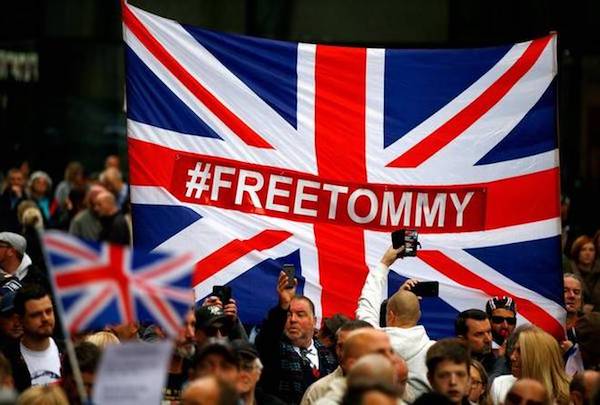
The notion that the far right is being muzzled despite the inordinate media attention it has garnered — from print, television, radio and digital — is one that it has managed to project with great success, feeding into the wider image the far right has attempted to propagate of it being an anti-establishment, revolutionary force. It also appears to be something that many of its proponents ardently believe. “We are being gagged,” a supporter of Mr. Robinson, wearing a t-shirt with the logo “#Free Speech #Free Tommy”, told the Canadian media website The Rebel Media outside a court recently. Hundreds of his supporters gathered outside the Old Bailey last month for a hearing over allegations of contempt of court that Mr. Robinson is facing over his filming of suspects in a criminal trial involving “grooming gangs”. While his supporters have insisted he is a “martyr” to the British cause, and the only one to speak out, others have rightly pointed out that he has simply exploited the case of grooming gangs to further his toxic, Islamophobic world view, exacerbating the situation and taking the attention away from the victims and the debate on real practicable ways in which grooming gangs could be prevented from harming more people in the future.
He is far from the only figure on the right in Britain to present himself as a “brave soldier” of free speech, and the “oppressed” — as among the only ones willing to take on the “dangerous liberals” supposedly trying to clamp down on free speech and impose their world view to the determinant of the marginalized majority. Katie Hopkins, an ultra-right campaigner, proclaimed herself the “Jesus of the outspoken”. In May, a “Day for Freedom” protest took place on London’s Parliament Square that attracted leading figures on the right. In April, Mark Meechan, a right-wing comedian, sought to portray a fine of £800 by a court in the U.K. for teaching a dog to do a Nazi salute for a YouTube video in terms of the curtailment of free speech.
In academia
The same contention has also been propagated by sections of the right more broadly. In an article last year, Niall Ferguson, the right-wing British historian of empire, insisted that the “biggest threat to free speech” came from the left. Last year, when academics and students protested against Oxford University’s support for the “ethics and empire” project that sought to create a list of the rights and wrongs of the empire, publications such as the Daily Mail accused them of bullying and attempting to silence Nigel Biggar, the professor behind the initiative. Last year, the Daily Telegraph ran an incendiary story accusing a young black student of “forcing” the University of Cambridge to replace white authors with black authors and only retracted the factually incorrect story after huge public outrage and a torrent of abuse directed at the student herself.
It has also manifested itself in other ways. Last year Britain’s Universities Minister gave priority to a requirement that universities be required to guarantee free speech or face fines and potential de-registration in a consultation that was set to take place, pointing to “examples of censorship”. This again appeared to be an acknowledgement of an argument propagated by those on the right that “snowflake” students — too easy to take offence — were somehow stifling voices on the right through no-platforming initiatives that sought to protest the space given to them to voice offensive perspectives. There have been a handful of cases where students have pushed for particularly controversial speakers not to be allowed to speak on campus, yet the right managed to put the issue at the top of the government’s agenda, despite the many challenges facing Britain’s university sector.
The mainstreaming of this perspective has been toxic and debilitating on public life in the U.K. and beyond. A fear of being perceived to be closed to the perspectives of the right — which has been labelled “balance” — has led to a willingness by media outlets to offer voices even on issues where scientific consensus leaves little doubt. Earlier this year, the BBC faced much criticism over the space it provided to climate change deniers, until a briefing note sent to the staff in September pointed to the danger of a “false balance”. “You do not need a ‘denier’ to balance the debate,” the organization was forced to clarify to its staff in a reference to man-made climate change.
Meanwhile, the far right has continued to rise steadily, spurred on by burgeoning acceptance of the issues raised by them that would once have been unthinkable, including by the media. There are over 100 live terror investigations related to the far-right as of October, while it emerged that MI5 is to take the lead in dealing with right-wing terrorism amid rising concern about its reach. Last week at least five men were arrested in connection with a video that showed the burning of an effigy of London’s Grenfell Tower. The blaze at the tower, home to largely ethnic minority residents, in June 2017 killed 72 people.
Beyond Britain
The usurpation of the free speech debate by the far right is, of course, not confined to Britain. It has become an essential part of the playbook of the movement across the world, while Mr. Robinson himself is held up by right-wing figures across the world as a poster-boy. The unwillingness of the media in Britain and beyond to call out those efforts for what they are will only continue to bolster that effort. The ability of the media to confront the far right, without unconsciously or otherwise adopting its rules of engagement, and its positioning of debates, is likely to be one of its biggest challenges going forward.
(Source: The Hindu. The author can be reached at vidya.ram@thehindu.co.in)
BJP government adopted a competitive-exam strategy to improve India’s rankings, meeting minutes and official correspondence show.
By Akshay Deshmane
“The elaborate filing requirements of the Goods and Services Tax had hurt medium and small enterprises while demonetization had hamstrung their cash flows, Hazari said and added, “I would think it is surprising if the MSMEs have said that their ease of doing business has improved.”
Yet, Modi and his government have been quick to market this improvement in India’s rank on an index prepared for mid-size firms operating in two of the most prosperous cities of India as evidence of an actual improvement of economic conditions across the country”.
Prime Minister Narendra Modi’s unhealthy obsession with the World Bank’s Doing Business ranking hijacked India’s reform agenda over the course of the Bharatiya Janata Party (BJP) government’s four-year tenure, according to hundreds of pages of meeting minutes, interviews with key players and official correspondence reviewed by HuffPost India.
The documents reveal how the Modi government first sought to lobby the World Bank into changing its methodology to reflect a better rank for India. When that didn’t achieve any significant success, the government prioritized minor institutional and procedural tweaks to game the ranking system, rather than embark on a bold agenda of economic reform as promised.
This monomaniacal focus on putting India among the top 50 countries in the ranking, economists said, gave the World Bank disproportionate influence in India’s economic reform process. It has also revived a persistent concern that the Modi government preferred to focus its energies on optics instead of actual governance and reform.
This monomaniacal focus on putting India among the top 50 countries in the ranking, economists said, gave the World Bank disproportionate influence in India’s economic reform process
“If you keep on finding the easiest things to change, then you are effectively letting the World Bank’s ratings decide what kind of changes you want, rather than deciding what is your own sense of priorities,” said Laveesh Bhandari, an economist and director of the Indicus Foundation, who had written a column for The Indian Express outlining these concerns.
Reports published immediately after India’s dramatic rise up the rankings— from 142 to 77 over four years— have surmised as much. But this is the first comprehensive account that relies on previously unreported documents—accessed through the Right To Information—to provide a blow-by-blow account of how Finance Minister Arun Jaitley and officials in the Prime Minister’s Office adopted the “competitive exam”, tuition-center approach familiar to most Indians eager to improve their rank in a competitive setting.
“You have literally to crack the code,” Jaitley said, at a self-congratulatory press conference on 31 October, the day when the latest ranking showed India rising up to the 77th position from 100 last year.
Yet cracking the code, former bureaucrats involved in the process said, wasn’t necessarily good for the economy, much like cracking the board exams isn’t a good indicator of actual learning.
“If we are improving our position, why are we not getting more investment?” said Arvind Mayaram, who served as Finance Secretary for the first few months of the Modi government’s tenure before he was shunted out to the Tourism Ministry.
“I would only say that the proof of pudding is in the eating. If the investment rate was around 38% of the GDP in 2011, obviously ease of doing business must have been much superior then than it is in 2018, when it is around 27%,” Mayaram said.
Cracking the code, former bureaucrats involved in the process said, wasn’t necessarily good for the economy, much like cracking the board exams isn’t a good indicator of actual learning.
Amitabh Kant, a Modi favorite and former secretary of the Department of Industrial Policy and Promotion (DIPP), pushed back at this characterization of his government’s performance.
“A lot of work has happened in the past four years on business reforms and the rankings are a reflection of that,” said Kant, now CEO of the NITI Aayog.
Yet much of this work, HuffPost India found, was akin to rearranging the procedural deck chairs on the listing ship of India’s faltering economy.
Preparing to crack the code
On 26 December 2017, Jaitley held an important meeting at his ministry’s office in North Block with the Modi government’s most senior bureaucrats—revenue secretary Hasmukh Adhia, DIPP secretary Ramesh Abhishek, economic affairs secretary and former World Bank Executive Director Subhash Chandra Garg, among others—to address a pressing problem.
The World Bank had moved the “cut-off date” for finalizing the Ease of Doing Business Report 2019 by a whole month. As a consequence, “the time available to introduce reforms is shorter by a month”, said DIPP secretary Abhishek, according to meeting minutes reviewed by HuffPost India.
Abhishek could not be reached for comments on this story.
The timeline and sequencing of the so-called reforms being discussed in the meeting, the minutes make clear, were not dictated by political considerations, discussions with coalition partners or, heaven forbid, an overarching economic vision or strategy. Rather, the reform process was treated like a World Bank-provided syllabus to be completed on time.
The World Bank would send out its questionnaires to respondents by February 2018, said Abhishek, and “it is therefore important that these reforms are implemented at the earliest”. The questionnaires Abhishek referred to are sent to select businessmen, analysts and other private parties to corroborate claims of reforms made by governments.
There are 10 quantitative indicators which the bank considers, including the ease of starting a business, getting construction permits and trading across borders, among others, for a mid-size firm, and each indicator is scored and ranked separately. These scores are then aggregated into an overall score for each country. Across the world, the Bank measures performance on the 10 indicators in two cities in the case of all large economies—in India, these cities are Mumbai and Delhi.
The agenda of Jaitley’s meeting was to ram through as many quick changes as possible.
To be sure, many of the changes sought in the meeting could have real benefits for a few. But while the government’s attempts to reduce red tape were laudable, analysts said, they were not a substitute for macro-economic reform.
At Jaitley’s meeting, for instance, proposed “reforms” included eliminating the need for a company seal or rubber stamp to open a bank account, and eliminating the need to submit a cancelled cheque as part of the employee provident fund application process.
His bureaucrats quickly identified streamlining cross-border trading as an easy way to improve rankings. Thus the department of revenue eliminated the need for traders to submit hard documents, and tried to improve the capacity of the online customs payment gateway.
According to the minutes, Gopal Krishna, Secretary of the Shipping Ministry, said the Jawaharlal Nehru Port Trust, which handles about 40% of India’s oceanic trade, would digitize import and export related documentation. Interestingly, the port had made the same claim in 2015 for exactly the same reason .
The focus on cross-border trade would pay off handsomely for the government, as India’s rankings in this specific indicator jumped to 80 in the Doing Business Report 2019 that was released on 31 October. A similar improvement of construction permit procedures saw India’s ranking jump from 181 to 52.
Another area of focus was the time and paperwork needed to start a new business.
At the meeting, Abhishek said India needed to reduce the number of official procedures to start a business to six, and the number of days to complete these procedures down to five, to rank amongst the top 50 economies.
At the time, it took 30 days to start a new business, and required 11 procedures in Mumbai and 12 in Delhi.
The latest report shows the government managed to eliminate one step by reducing procedures to 10, and also seemingly reduced the time required to 16 days for Delhi and 17 days for Mumbai. The rank for this indicator also jumped up by 21 ranks to 137 in the latest report for the preparation of which this was a key meeting of top officials.
On that afternoon, the meeting concluded with Jaitley telling the senior officials to submit an action-taken report on the points discussed by 31 January 2018.
Bhandari, the economist, said that allowing minor procedural changes to disproportionately influence the rankings in a significant way was not the government’s fault, but a flaw in the way the rankings were designed.
This flaw, Bhandari said, could skew reform priorities away from comprehensive measures that could help the economy as a whole—like improving contract enforcement, skilling and employability or internal trade—towards quick fixes that result in an inordinate rise in the rankings but narrowly affect particular sectors like construction, for instance. Thus he cautioned against resorting to this approach repeatedly.
How the efforts began
Jaitley’s 26 December 2017 meeting was one of the most recent instances of an approach adopted immediately in the aftermath of the 2014 general elections which installed a new bunch of decision makers on the Raisina Hill.
On 16 July 2014, two months after Modi swept to power on the promise of bringing jobs, investment and prosperity, his Principal Secretary Nripendra Misra held a meeting in the PMO to discuss a “concrete strategy for moving up India’s rank” on the EODB index with the secretaries of the corporate affairs ministry, department of economic affairs, DIPP and the ministry of commerce, according to meeting minutes reviewed by HuffPost India.
“The meeting focused on the more immediate and quickly doable process improvements.” Dr KP Krishnan, an official representing the department of economic affairs in the PMO meeting, subsequently summed up in an internal noting.
Interestingly, one of the tasks discussed at this meeting involved the streamlining and digitization of customs documents within one month, a “reform” measure that was also discussed in the December 2017 meeting with Jaitley.
In what would become a familiar pattern for the Modi government, the Information and Broadcasting Ministry was tasked with “Preparation of literature and preparatory activities for global campaign to be taken up on to priority”.
Crucially, all attendees were told to keep the World Bank abreast of all the good work they were doing.
“It was emphasized that all these measures should be brought to the notice of the World Bank. All concerned should engage with the World Bank in this regard,” the minutes read.
Two weeks later, on 29 July 2014, though they were not discussed in the meeting, the government announced changes to three central labor laws. The Indian press immediately hailed the changes as transformative; yet the government was sorely disappointed to learn that the World Bank was only planning to consider reforms made before 1 June 2014.
Mayaram, the then Finance Secretary and Kant, the then DIPP secretary, were tasked with writing to the World Bank to plead for the deadline to be extended, and the new reforms to be taken into account, so the government could show an immediate improvement in India’s business environment in the Doing Business Report 2015, which was scheduled to be released a few months later. The PMO kept a close track of this.
“It is learnt that the DBR, 2015 is at the stage of drafting and consolidation,” Mayaram, the then Finance secretary wrote to MN Prasad, Executive Director of the World Bank for Bangladesh, Bhutan, India and Sri Lanka, on 21 August 2014. “In this regard, it is important that the reference period for documenting reforms in the report is extended to the middle of August, 2014 (instead of 1st June, 2014) to cover the recent reform measures also.”
Kant, for his part, lobbied Kaushik Basu, then senior vice president and Chief Economist at the World Bank.
“The new Indian government is deeply concerned about India’s low ranking on the ease of doing business as reflected in the “Doing Business 2014″ report published by the World Bank Group,” Kant wrote in a letter dated September 10, 2014 and reviewed by HuffPost India. “I would like to emphasize that the methodology adopted to arrive at the rankings needs to be further refined so as to paint the correct picture. Drawing conclusions based on the studies conducted in only two cities, namely, Mumbai and Delhi, overdependence on the regulations in place for small and medium enterprises and responses received from a narrow set of services users such as lawyers, accountants and brokers, inadequate appreciation of factors impinging on general business climate such as conservation of environment & ecology may lead to skewed conclusions, especially for a country like India with a huge geographical canvas dotted by varying shades of regulatory mechanisms.”
Incidentally, this is one of the most persistent critiques made by independent experts about the ranking to this day.
Despite these letters, the World Bank refused to extend the deadline or change its methodology as per India’s demands and in October 2014, when the Doing Business Report 2015 came out, India’s EODB ranking actually fell from 134 to 142.
Methodology issues
The Modi government, in its initial years, also sought to lobby the Bank into changing its methodology while seeking to rise up the ranking at the same time. In its official communications, it also compared the World Bank methodology with the World Economic Forum’s Global Competitive Index and was favorably inclined towards the latter as it showed a better rank for India.
In his 21 August 2014 letter to the Bank’s Executive Director, Mayaram requested for a meeting with the “senior management” of the Bank with a delegation of Indian bureaucrats led by Kant to impress upon them India’s urgent concerns.
“We must effectively engage with the World Bank to convince them about the need to change the methodology so that the DBR reflects India’s position more correctly,” Mayaram wrote, referring to the Doing Business Report by its initials. Official correspondence, released under the RTI, shows while Kant did not go for a meeting with the Bank’s Chief Economist Basu, he wrote the above quoted letter lobbying for a change in the methodology.
When India’s rank improved marginally from 142 to 131 in October 2015 but still remained far from the ambitious target of top 50 countries set by Modi, senior government officials took to writing petulant letters to World Bank officials and to each other, questioning the basis of the rankings.
On 1 April 2016, for instance, Revenue Secretary Adhia wrote to the then World Bank Executive Director for India and other South Asian countries, Subhash Chandra Garg, saying, “Whether we look at the Doing Business Report in relative terms or absolute terms, the findings seem seriously skewed.”
(In July 2017, Garg would be repatriated from the Bank to the Indian government, where he was appointed as economic affairs secretary in the Finance Ministry.)
In September 2016, anticipating a lackluster ranking for India on the index, DIPP Secretary Abhishek wrote to then economic affairs secretary Shaktikanta Das, expressing his disappointment with the World Bank team for relying on the opinions of chosen respondents on the reforms process, rather than on government data.
“It was evident from the discussion that the Doing Business team is giving more credence to unsubstantiated averments of a few dozen respondents over the actual system log and individual case-wise database running in thousands of sheets” Abhishek wrote to Das following a video conference with the World Bank team to discuss the points of contention about reform claims made by the government for the then upcoming 2017 report, according to his letter dated 26 September 2016, reviewed by HuffPost India.
So, on 25 October 2016, when much to the government’s embarrassment, India’s rank improved by one spot from 131 to 130 despite hectic lobbying, Modi went on the warpath.
An official statement released by the PMO on 26 October 2016 about Modi’s sixteenth interaction through PRAGATI, a platform for the PM’s direct review meetings with officials, said, “Mentioning the World Bank’s latest Report on Ease of Doing Business, the Prime Minister asked all Chief Secretaries and all Secretaries of the Government of India to study the report, and analyze the potential areas where there is scope for improvement in their respective departments and states. He asked for a report from all concerned in this regard, within a month, and asked the Cabinet Secretary to review the same thereafter.”
In November 2016, Modi would announce demonetization—now almost universally acknowledged as a terrible idea. Meanwhile, the government lobbied relentlessly with the Bank, according to a senior government official with knowledge of the matter.
“Fact is, this government pleaded with the World Bank quite vehemently and initially, Amitabh Kant was at the vanguard of it. Indian government’s persuasion has worked,” this official said. He explained why he felt that Indian government’s “persuasion” (he chuckled at the word “lobbying” while saying this) worked with the Bank, “We are one of the largest borrowers which means that the interest we pay to the bank greases its salaries. So obviously there is a lot of clout that India also has over the bank.”
“If the Prime Minister also tells the President that look, this is not right, India should be better than what you are showing,” the official continued. “They also oblige.”
Whether we look at the Doing Business Report in relative terms or absolute terms, the findings seem seriously skewed: Revenue Secretary Hasmukh Adhia
Over the next two years, the government’s efforts bore fruit. From 2014 to the most recent report that came out early this month, as India’s rank jumped from 142 to 77, the government changed its views on the Bank’s methodology.
In late 2014, Jaitley told Parliament in a written reply to a question from a parliamentarian that the “government has indicated its concerns about the indicators used, methodology, sample size, use of ranking, neglect of qualitative and country specific business environment, etc. to the World Bank.”
This November, as the government’s five-year effort at lobbying the bank paid off, Jaitley hailed the ranking as the product of “independent research” based on “objective criteria”.
“Only a focused and a purpose oriented Government could have achieved this,” Jaitley concluded.
Small and medium sized businesses feel demonetization and GST have adversely affected their prospects.
An undesirable dream?
As the Modi government continues to invest efforts into improving India’s Doing Business rankings keeping in mind the target of joining the top 50, some question if the government should really care so much about what is ultimately an arbitrary index produced by a multilateral lending agency.
“They should be able to tell the investors which is a good country to invest in, right?” the former finance secretary Mayaram said about the ranking. “But if your methodology is flawed then it has no value. That’s what I said then and I still hold it today that there is not much value because the methodology is flawed.”
The 2019 ranking for instance, put China—arguably the one place where the world has done the most business in the past decade—at 46, while Rwanda is ranked 29th.
“If you consider yourself as the six largest economy or, by PPP, third largest economy in the world, then for you to get very upset or excited about what ranking the World Bank or World Economic Forum, or anyone else does, it only shows a little lack of confidence,” Mayaram concluded.
Mumbai-based independent analyst Hemindra Hazari said he was struck by India’s improved rankings in context of a difficult time for small and medium size Indian companies.
“If it is in terms of the large corporates, then it is perhaps possible that they have seen an improvement in the business,” Hazari said. “But when you talk about MSMEs, in the last two years, our dear government has given two mortal wounds in the form of demonetization and implementation of the GST.”
The elaborate filing requirements of the Goods and Services Tax had hurt medium and small enterprises while demonetization had hamstrung their cash flows, Hazari said and added, “I would think it is surprising if the MSMEs have said that their ease of doing business has improved.”
Yet, Modi and his government have been quick to market this improvement in India’s rank on an index prepared for mid-size firms operating in two of the most prosperous cities of India as evidence of an actual improvement of economic conditions across the country.
On 3 November, for instance, Modi said, the rankings are an “indicator of India’s strengthening economy and quick progress”. He said this while answering a question posed by a BJP volunteer from Korba, Chhattisgarh, who wanted to know the relevance of the rankings in the life of the ‘common man’. Modi further said that the improvement in rankings over four years by almost half —going from 142 in 2014 to 77 in 2018—shows the Indian economy had improved twice over ever since his government was sworn in, and this marked a definitive change from the previous government. He also told party volunteers from election-bound Chhattisgarh, Madhya Pradesh and Rajasthan during the online interaction that he wants the BJP volunteers to keep track of good news about the country and ensure that they repeatedly speak about it among people, presumably voters.
NEW DELHI (TIP): The Election Commission on Thursday, November 22, said fresh elections in Jammu and Kashmir would be held within the next six months even as it did not rule out the possibility of holding polls there before the Lok Sabha polls due next year.
“The Jammu and Kashmir assembly polls must be held on the first occasion before May … it could be held before parliament elections also,” Chief Election Commissioner O P Rawat said.
He said as per the Supreme Court, the outer limit for holding fresh polls after dissolution of a house is six months, that is May 2019.
At the same time, he made it clear that the Commission will decide on poll dates after “considering all aspects.”
He said, SC verdict, an outcome of Presidential reference, also said polls will have to be held on the first occasion which means even before six months.
He said the same principle was applied in Telangana where the assembly was dissolved prematurely.
The state Governor Satya Pal Malik dissolved the assembly on Wednesday evening, after People’s Democratic Party leader Mehbooba Mufti staked claim to form government along with her arch-rival Omar Abdullah’s National Conference (NC) and the Congress. They claimed the support of 56 lawmakers in the 87-member state assembly.
Shortly after, People’s Conference leader Sajad Lone also staked claims to form the government. Lone, who has two lawmakers, said he had the support of the BJP’s 25 legislators and “more than 18” others.
WASHINGTON(TIP): A November 15 Washington Post report says WikiLeaks’ founder Julian Assange has been charged under seal, prosecutors inadvertently revealed in a recently unsealed court filing — a development that could significantly advance the probe into Russian interference in the 2016 election and have major implications for those who publish government secrets.
The disclosure came in a filing in a case unrelated to Assange. Assistant U.S. Attorney Kellen S. Dwyer, urging a judge to keep the matter sealed, wrote “due to the sophistication of the defendant and the publicity surrounding the case, no other procedure is likely to keep confidential the fact that Assange has been charged.” Later, Dwyer wrote the charges would “need to remain sealed until Assange is arrested.”
Dwyer is also assigned to the WikiLeaks case. People familiar with the matter said what Dwyer was disclosing was true, but unintentional.
Joshua Stueve, a spokesman for the U.S. Attorney’s Office in the Eastern District of Virginia said, “The court filing was made in error. That was not the intended name for this filing.”
An FBI spokeswoman declined to comment.
Federal prosecutors in the Eastern District of Virginia have long been investigating Assange, and in the Trump administration had begun taking a second look at whether to charge members of the WikiLeaks organization for the 2010 leak of diplomatic cables and military documents which the anti-secrecy group published. Investigators also had explored whether WikiLeaks could face criminal liability for the more recent revelation of sensitive CIA cyber-tools.
Special Counsel Robert S. Mueller III has also exploring the publication by WikiLeaks of emails from the Democratic National Committee and the account of Hillary Clinton campaign chairman John D. Podesta. Officials have alleged the emails were hacked by Russian spies and transferred to WikiLeaks.
Mueller has also been exploring, among other things, communications between the group and associates of President Trump, including political operative Roger Stone and commentator and conspiracy theorist Jerome Corsi.
In July, his office charged 12 Russian military spies with conspiring to hack DNC computers, steal the organization’s data and publish the files in an effort to disrupt the election and referred in an indictment to WikiLeaks, described only as “Organization 1,” as the platform the Russians used to release the stolen emails.
A spokesman for the special counsel’s office declined to comment.
It was not immediately clear what charges Assange would face. In the past, prosecutors had contemplated pursuing a case involving conspiracy, theft of government property or violating the Espionage Act. But whether to charge the WikiLeaks founder was hardly a foregone conclusion. In the Obama administration, the Justice Department had concluded that pursuing Assange would be akin to prosecuting a news organization. Former Attorney General Jeff Sessions, though, had taken a more aggressive stance and vowed to crack down on all government leaks.
Barry J. Pollack, one of Assange’s attorneys, said, “The only thing more irresponsible than charging a person for publishing truthful information would be to put in a public filing information that clearly was not intended for the public and without any notice to Mr. Assange. Obviously, I have no idea if he has actually been charged or for what, but the notion that the federal criminal charges could be brought based on the publication of truthful information is an incredibly dangerous precedent to set.”
The filing in the Eastern District of Virginia came on August 22, in a case that combines national security and sex trafficking. Seitu Sulayman Kokayi, 29, was charged with enticing a 15-year-old girl to have sex with him and send him pornographic images of herself. But he was detained in part, according to the court filing, because he “has a substantial interest in terrorist acts.”
His father-in-law, according to the filing, has been convicted of terrorist acts. The case involves previously classified information, according to government filings, and prosecutors plan to use information obtained under the Foreign Intelligence Surveillance Act. Kokayi was indicted last week and is set to be arraigned Friday morning.
The case had been sealed until early September, though by itself it attracted little notice. On Thursday, November 15 evening, Seamus Hughes, the deputy director of the Program on Extremism at George Washington University who is known for scrubbing court filings, joked about the apparent error on Twitter — which first brought it to the attention of reporters.
Even if he is charged, Assange’s coming to the United States to face trial is no sure thing. Since June 2012, Assange has been living in the Ecuadorian embassy, afraid that if he steps outside he will be arrested.
When he first sought asylum in the embassy, he was facing possible extradition to Sweden in a sex crimes case. He has argued that case was a pretext for what he predicted would be his arrest and extradition to the United States.
In the years since, the Swedish case has been closed, but Assange has said he cannot risk leaving the embassy because the U.S. would attempt to have him arrested and extradited for disclosures of U.S. government secrets. Throughout that time, the U.S. has refused to say whether there are any sealed charges against Assange.
If Assange were to leave the embassy and be arrested by British authorities, he would likely still fight extradition in the British courts.
WASHINGTON(TIP): Indian American Neomi Rao has been nominated by US President Donald Trump to fill Justice Brett Kavanaugh’s seat on the DC Circuit Court of Appeals.
Trump, during Diwali celebrations at the Roosevelt Room of the White House, announced the nomination of the 45-year-old regulatory czar for the DC Circuit which is considered next to the US Supreme Court.
If confirmed by the Senate, Ms Rao, who is currently administrator, Office of Information and Regulatory Affairs (OIRA), would be the second Indian-American judge in this powerful court after judge Sree Srinivasan, who was appointed during the previous Obama regime.
“She is going to be fantastic. Great person,” Trump said.
Ms Rao will fill the seat vacated by Supreme Court Justice Kavanaugh, who served on the appeals court for 12 years.
A formal announcement on her nomination is expected to be made by the White House.
“I just nominated Rao to be on the DC circuit court of appeals, the seat of justice Brett Kavanaugh. That could be a big story,” Trump announced.
Ms Rao thanked the President for the “confidence” he has shown in her.
Called the ‘regulatory czar’ of Trump administration in her current capacity, she oversees implementation of the administration’s deregulatory agenda and regulation-related executive orders.
She was confirmed by the Senate with a 54-41 vote in July 2017 to head the OIRA and is known among legal circles as a highly respected administrative law scholar who has distinguished herself for her right-of-center views, media reports stated.
A former clerk for conservative Supreme Court Justice Clarence Thomas, Ms Rao was recommended for the post by former White House counsel Don McGahn. Trump’s nomination of Ms Rao is in recognition of her contribution in cutting down regulations.
Ms Rao has previously served in all three branches of the federal government, and before taking on her current role in the executive branch, she was associate counsel and special assistant to the president for the George W Bush administration.
A graduate of Yale University and the University of Chicago Law School, Ms Rao also worked in the private sector, in the international arbitration group of the London-based law firm, Clifford Chance LLP.
LONDON(TIP): Two Indian-origin Ministers on Thursday, November 15 resigned their positions in protest at the draft withdrawal agreement passed by the British Cabinet, while a Pakistani-origin politician resigned from his role as trade envoy to Pakistan over the government’s approach to offering asylum to Asia Bibi as well as the Brexit deal.
Shailesh Vara, the Minister of State for Northern Ireland and Suella Braverman, a Minister within the Ministry for Exiting the EU, both tendered their resignations to the Prime Minister in letters made public on Thursday morning, joining more senior figures, including Brexit Secretary Dominic Raab and Work and Pensions Secretary Esther McVey.
Sri Lankan-origin Ranil Jayawardena also stepped down as a Minister. Rehman Chishti said he was stepping down as the Conservative Party’s vice chairman and the Prime Minister’s Trade Envoy to Pakistan.
Mr. Vara became the first Minister to tender his resignation following the Cabinet meeting on Wednesday. In his letter, he said that he could not support an agreement that left Britain in a “half-way house with no time limit on when we will finally be a sovereign nation.”
“There is every possibility that the U.K.-EU trade deal that we seek will take years to conclude. We will be locked in a customs arrangement indefinitely, bound by rules determined by the EU over which we have no say,” he warned.
Pointing to Northern Ireland, he warned that it would be subject to a different relationship with the EU with the rest of U.K., threatening the economic and constitutional integrity of the U.K. While Mr. Vara had supported the Remain campaign in the run up to the referendum, he supported the leadership bid of Brexiteer Michael Gove in his party leadership campaign in 2016 following the resignation of David Cameron.
“The proposed Northern Ireland Backstop is not Brexit,” insisted Ms. Braverman in her resignation letter. “It prevents an unequivocal exit from a customs union with the EU.”
Ms. Braverman was an influential campaigner to leave the EU, chairing the European Research Group, which has been campaigning for a “hard” Brexit, until she joined the government earlier this year.
Mr. Chishti also expressed his disagreement with the withdrawal agreement and his disagreement with the “lack of leadership shown by the U.K. government” over the Asia Bibi case. “What I found shocking is that this British government is failing to put into practice the core values that our country stands for; religious freedom, justice, morally doing the right thing… the government should not wait to see if another country offers sanctuary, we should have had the conviction to lead on this matter and offer sanctuary ourselves straight away,” he wrote in his letter.
The resignations further reduce the presence of Indian-origin Ministers in the U.K. government, following the high-profile resignation of Priti Patel last year. Rishi Sunak, the son-in-law of Infosys’ Narayana Murthy, remains a Minister within the Department of Housing, Communities and Local Government, as does Alok Sharma, Britain’s Minister for Employment.
WASHINGTON(TIP): Indian Americans were praised by the US President Donald Trump for their “incredible” performance in his administration. Trump has appointed more than two dozen Indian Americans to senior positions since he assumed office in 2017.
“I’m grateful to have numerous Americans of Indian and Southeast Asian heritage who fulfill critical roles across my administration. And they’ve done an incredible job,” Trump said as he hosted Diwali celebrations in the Roosevelt Room, November 13.
Except for the former South Carolina Governor Nikki Haley, around two dozen of his top Indian-American lieutenants were present at the celebrations.
Ms Haley, the first-Indian-American appointed to top Cabinet-level position, resigned last month as the US ambassador to the UN.
In eight years, former president Barack Obama had appointed more than 50 Indian-Americans to key administration positions, including Raj Shah as United States Agency for International Development administrator; Nisha Desai Biswal as the Assistant Secretary of State for South and Central Asia and Richard Verma as the US Ambassador to India.
By appointing more than two dozen Indian Americans in key administrative positions, Trump seems to be on the track to breaking the record set by his predecessor.
“Many of them are here today, including the Chairman of the Federal Communications Commissions, Ajit Pai,” Trump said as he called upon him.
“Ajit, where’s Ajit? Come here, Ajit. I just didn’t like one decision he made, but that’s all right,” he said as the small audience burst into laughter. “Not even a little bit. But he’s independent,” said the president.
Seema Verma, who in her capacity as administrator of the Centers of Medicare and Medicaid Services, is playing a key role in healthcare reforms, Trump said.
“Chairman of the Federal Energy Regulatory Commission, Neil Chatterjee. Where is Neil? Good. Nice to see you,” said the US president indicating that he personally knows each one of these Indian-Americans.
“The acting administrator of Drug Enforcement, and another person that I’ve become very close to, Uttam Dhillon,” Trump said.
Signup to our Newsletter!
Don’t miss out on all the happenings around the world