Tag: President of India

  • Anti-terror fight is against a mindset, not any religion, says PM Modi

    Anti-terror fight is against a mindset, not any religion, says PM Modi

    NEW DELHI (TIP): Prime Minister Narendra Modi on Thursday said the fight against terrorism and radicalization was not against any religion, but against a mindset that misguides the youth.

    Speaking at a conference on “Islamic heritage: Promoting understanding and moderation”, Modi said India’s values of equality, diversity and harmony strengthened it in a world of uncertainty and these were important to defeat violence and extremism.

    “Indian democracy is a celebration of age-old pluralism,” Modi said in a speech to an audience that included King Abdullah II of Jordan and many Islamic clerics and scholars.

    Abdullah, a 41st generation direct descendant of Prophet Mohammed, is known for his global initiative to fight radicalization and terrorism. He is also the custodian of holy sites in Jerusalem, including the Al-Aqsa mosque, the third holiest site in Islam, located in the Old City of Jerusalem.

    India views Jordan as an “oasis of stability and harmony” in conflict ridden West Asia and New Delhi is looking to deepen bilateral ties with the country, according to senior government officials in New Delhi.

    India has been a victim of terrorism since the 1980s and, since the 1990s, witnessed an Islamist insurgency in Kashmir that has claimed many thousands of lives. India blames Pakistan for supporting anti-India terrorist groups inimical in Kashmir.

    In his speech, Modi said that “those who perpetrate acts of violence against humanity perhaps don’t realise that they harm the religion they claim to stand for.”

    “The fight against terrorism and extremism, against radicalization is not a fight against any religion. It is a fight against a mentality that misguides our youth to perpetrate acts of violence against innocents,” he said, urging the youth to associate themselves with the humanitarian aspects of Islam on the one hand and the use of modern technology on the other.

    In his speech, the Jordanian king said the current global war against terror should not be viewed as a fight between religions. “It is between moderates of all faiths and communities and against extremists who spread hatred and violence,” he said. He also emphasized the need to “recognize and reject the misinformation groups promote about Islam, or indeed any religion.”

    “We need to take back the airwaves and internet from the voices of hatred, those who have victimized our world not only with bombs and terror but with ignorance and lies,” the king said, adding that inclusion was the path to coexistence.

    “The fact that the king came to India and delivered this address is very significant given that he is the direct descendent of the Prophet (Mohammed). His words carry great weight,” said a person familiar with Abdullah’s visit.

    Later in the day, India and Jordan signed 12 agreements including a framework pact on defence cooperation that defines the “scope of such cooperation and making provisions for implementation of the cooperation in some of the recognized areas like training; defence industry; counterterrorism; military studies; cybersecurity; military medical services, peace-keeping, etc.,” a statement from the Indian foreign ministry said.

    Another pact aims to set up a Centre of Excellence in Jordan “for training of minimum 3,000 Jordanian IT professionals over a period of 5 years, and setting up of a resource centre in India for training of master trainers in IT field from Jordan,” the foreign ministry statement said.

    A third pact on setting up a fertilizer production facility in Jordan “with a long-term agreement for 100% off take to India” was also signed. It is aimed at ensuring long-term and sustained supply of rock phosphate to India, the statement said.

    Briefing reporters after official talks between Modi and Abdullah, S. Tirumurthy, secretary-economic relations in the Indian foreign ministry said, “There was a keenness on both sides to take this (the relationship) further.”

    Both sides are looking at closer security cooperation given that Jordan sits at the crossroads of a very volatile region neighbouring Israel, Palestine, Syria, Iraq and Saudi Arabia.

    Source: PTI

  • Pageantry Marks Celebration of India’s 69th Republic Day

    Pageantry Marks Celebration of India’s 69th Republic Day

    ASEAN leaders attend as chief guests

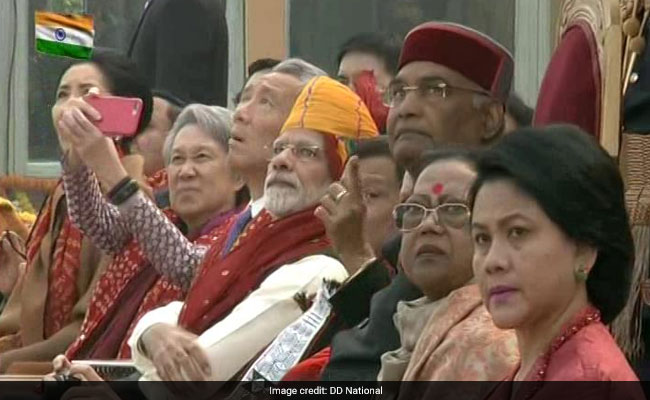
    NEW DELHI (TIP): Amid an unprecedented security cover, celebrations for the 69th Republic Day began on the Rajpath here on Friday in the presence of the leaders of 10 ASEAN nations who are attending the event as chief guests.

    Prime Minister Narendra Modi paid his tributes to the martyrs by laying a wreath at Amar Jawan Jyoti in the presence of Defence Minister Nirmala Sitharaman and the three service chiefs.

    Later Modi, wearing a saffron, red and green colored safa, reached the Rajpath and received and greeted President Ram Nath Kovind.

    Most of the ministers of the Modi government, including Home Minister Rajnath Singh, Finance Minister Arun Jaitley, Health Minister JP Nadda, Information and Broadcasting Minister Smriti Irani, Law Minister Ravi Shankar Prasad and Environment Minister Harsh Vardhan were among those present on the occasion.

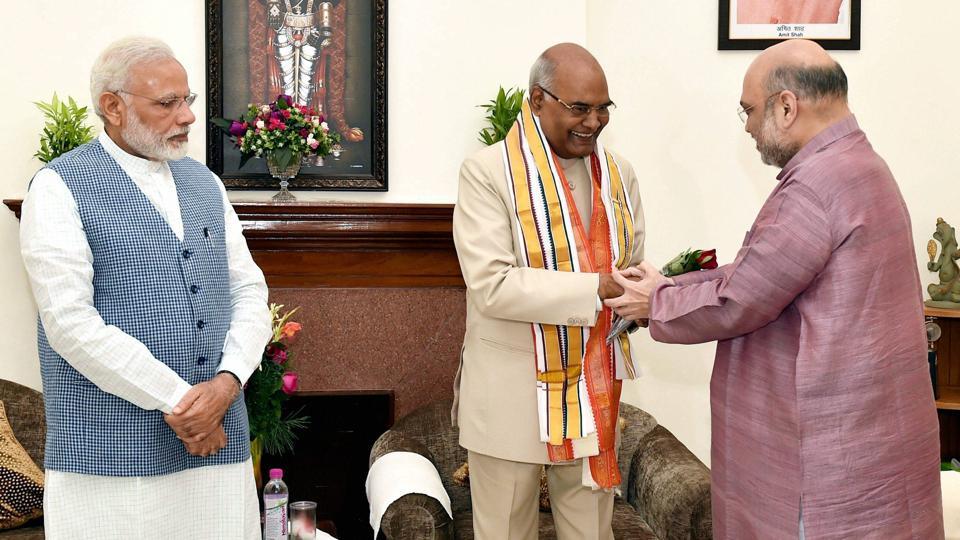
    BJP president Amit Shah was also present.

    The ASEAN leaders, here to attend the India-ASEAN Commemorative Summit, are the chief guests at the Republic Day parade which was termed by Prime Minister Narendra Modi as “historic and unprecedented”.

    The ASEAN, founded in 1967, comprises Thailand, Vietnam, Indonesia, Malaysia, the Philippines, Singapore, Myanmar, Cambodia, Laos and Brunei.

    The ASEAN leaders attending the parade are Singaporean Premier Lee Hsien Loong Brunei’s Sultan Haji Hassanal Bolkiah, Indonesian President Joko Widodo, Philippines President Rodrigo Roa Duterte, Cambodian Prime Minister Hun Sen, Malaysian Prime Minister Najib Razak, Thailand’s Prime Minister General Prayut Chan-o-cha, Myanmar’s State Counsellor Aung San Suu Kyi, Vietnamese Prime Minister Nguyen Xuan Phuc and Lao PDR’s Prime Minister Thongloun Sisoulith.

    Twenty-three tableaux, including those representing various states, ministries, the All India Radio (AIR) among others, will roll down the Rajpath.

    Public broadcaster Doordarshan has 38 cameras installed for the coverage of the celebrations. For the first time, six cameras have been deployed for coverage beyond India Gate.

    The parade commenced amid a heavy security blanket with thousands of security personnel, anti-aircraft guns and sharpshooters deployed in view of the event being attended by ASEAN leaders.

    Cold weather conditions and dense fog failed to dampen the spirits of those who came to watch the parade

    (Source:  PTI)

  • The new President, Ram Nath Kovind

    The new President, Ram Nath Kovind

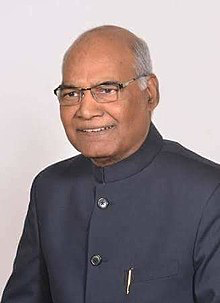
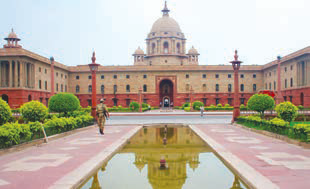
    As India’s 14th President, Ram Nath Kovind will be expected to play the important role of safeguarding the spirit of the Constitution and the foundations of our parliamentary democracy. Unlike his immediate predecessor Pranab Mukherjee, Mr. Kovind moves into Rashtrapati Bhavan after a stint in a Raj Bhavan. Arguably, it is a Raj Bhavan, and not the office of the Vice-President, that is the best preparatory ground for the non-ceremonial duties of the President, particularly those that may involve invoking the office’s discretionary power. After general elections that produced hung Lok Sabhas, former Presidents R. Venkataraman, Shankar Dayal Sharma and K.R. Narayanan adopted different procedures to decide who would have the first shot at forming the government. Venkataraman and Sharma invited the leader of the single largest party, with varying results. While Rajiv Gandhi declined Venkataraman’s invitation in 1989, A.B. Vajpayee accepted Sharma’s invitation in 1996, only to see his government last no more than 13 days. In 1998, Narayanan ascertained the support Mr. Vajpayee had before calling him to form the government. Like these predecessors, Mr. Kovind may be involved in situations with no set precedent. Also, while the use and abuse of Article 356, and the imposition of President’s Rule, are now monitored closely by the higher courts, as President he will necessarily have to use his own discretion should the Union Cabinet send such a recommendation. On contentious pieces of legislation, he can be extremely influential when he counsels caution, using his moral authority and the weight of his public office.

    Mr. Kovind secured an impressive victory, receiving more than the number of votes pledged to him, signifying acceptance levels that go beyond the NDA’s political spectrum. Once the names of the candidates for the election were known, much of the interest centered on the support he would garner from Opposition parties not affiliated to the Congress. That he did win substantially more votes vindicates the faith the BJP’s leadership placed on his candidature. To the BJP’s credit, it did not choose a dyed-in-saffron member of the Sangh Parivar. Mr. Kovind’s candidature may have been a strategic political compromise. On the one hand, it ensured the wider support that the BJP wanted and, on the other, it wasn’t entirely politically neutral, not enough anyway to allow the Congress or the Left parties the satisfaction of a consensus candidate. He is a Dalit, and his nomination was intended by the BJP to signal a socially inclusive agenda. But as President, Mr. Kovind will have to rise above political and social identities. He will be called upon to apply his mind and distinguish between settled conventions and questionable precedents in arriving at decisions. The office of the President was not conceived as merely a ceremonial post. The discretionary powers that he has demand a delicate balance without slipping into being either an unthinking rubber stamp or an overzealous interventionist.

    (The Hindu)

  • Ram Nath Kovind elected as the 14th President of India

    Ram Nath Kovind elected as the 14th President of India

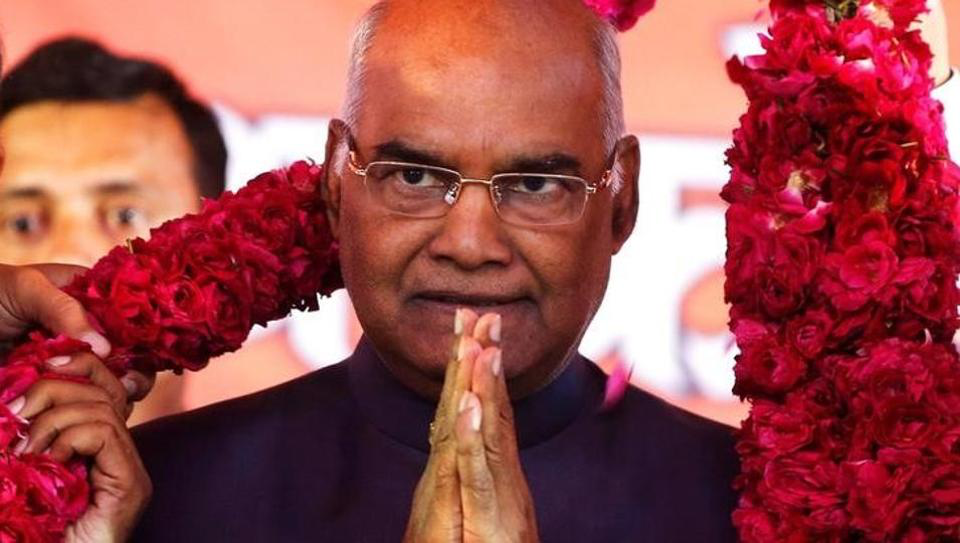
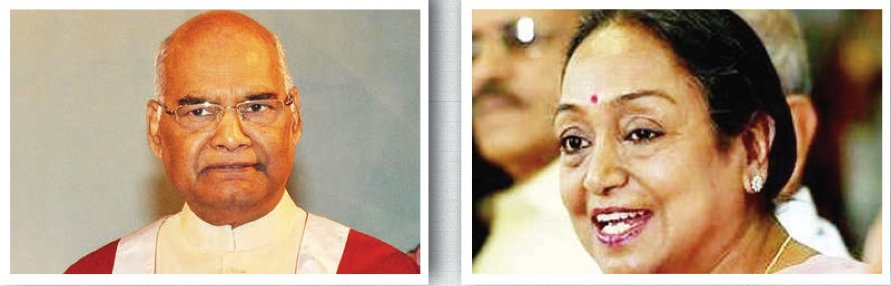
    NEW DELHI (TIP): Ram Nath Kovind has won the presidential election after securing over two-thirds of the total electoral college votes. Mr Kovind will be sworn-in as the 14th President of India on July 25. Prime Minister Narendra Modi congratulated Ram Nath Kovind for winning the presidential election. PM Modi tweeted: “Congratulations to Shri Ram Nath Kovind Ji on being elected the President of India! Best wishes for a fruitful & inspiring tenure.” Flowers and extra security had arrived at the former Bihar governor’s home in Delhi long before the official announcement and sweets were passed around at his hometown in Uttar Pradesh. The counting of votes for the presidential election began at 11 am today. The contest, between the ruling NDA’s Ram Nath Kovind and the Opposition’s Meira Kumar, both Dalits, had seen nearly 99 per cent lawmakers and legislators cast their vote – the highest ever. Voting had taken place on July 17.

    Speaking after his victory, President-elect Ram Nath Kovind said, “Me being elected President is a message for a person who has walked on an honest path. Thoughts of serving my nation have brought me this far”. He went on to say that “My job will be to uphold and protect the Constitution of India”.

    “I salute all the people of India,” Mr Kovind said as he narrated that “I never thought that I will become president one day. It was never my goal. But for the country, for society, my hard work has brought me till here”.

    “I congratulate and thank opposition candidate Meira Kumar,” he said. Speaking about his responsibility as India’s first citizen, Mr Kovind said, “It is a great responsibility to be elected to the post that has been graced by great men like Dr Rajendra Prasad, Dr Sarvapalli Radhakrishnan, Dr APJ Abdul Kalam and Shri Pranab Mukherjee”.

    On his victory, he said “Personally this is an emotional moment for me.”

    Speaking about his humble background as a farmer’s son, Mr Kovind said, “It has been raining in Delhi since the morning. Rains remind me of my village, of our kachcha home with walls of mud and a roof that could not repel water during the monsoon. My siblings and I used to stand and wait for the rains to end. Today there are many Ram Nath Kovinds who are getting wet in the rain, working hard, toiling in the fields for one square meal in the evening. Today I want to tell them that I will be their representative in the Rashtrapati Bhavan.”

    Meanwhile, Meira Kumar who lost to Kovind, congratulated President- elect, saying her fight for secularism and the oppressed will continue.

    “I congratulate Sh. Ram Nath Kovindji for becoming the President of India.

    “My best wishes are with Sh. Kovindji as it has fallen upon him to uphold the Constitution in letter & spirit in these challenging times,” she tweeted.

  • AAP declares support  for Meira Kumar in Prez poll

    AAP declares support for Meira Kumar in Prez poll

    NEW DELHI (TIP): The Aam Aadmi Party declared it’s support for former Lok Sabha speaker Meira Kumar in next week’s presidential poll on July 13 (Thursday) evening. Kumar, who will take on the NDA candidate and former Bihar governor RN Kovind, had called up AAP national convenor Arvind Kejriwal and sought his support, senior party leader Sanjay Singh said.

    “The election of President and Vice President should be above partisan politics and we would have preferred a consensus candidate. But in the present circumstances, we prefer a strong and united opposition,” Singh said

    Kumar is the candidate of the combined opposition but parties such as JD-U and BSP have declared their support for Kovind. The opposition, led by the Congress, had kept

    AAP leaders away from the multi-party deliberations for deciding their presidential candidate.

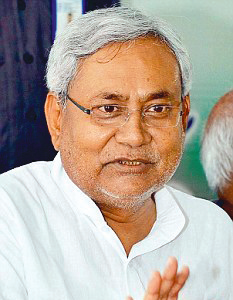
  • In Nitish backing Kovind, BJP sees cracks in alliance

    In Nitish backing Kovind, BJP sees cracks in alliance

    NEW DELHI (TIP): Even as the party attacks Nitish Kumar for not acting against RJD chief Lalu Prasad and his family in alleged graft cases, BJP sees the Bihar CM’s support to NDA presidential nominee Ram Nath Kovind as a serious division in the alliance rather than an “isolated” act.

    A senior BJP member said Kumar’s support to Kovind was reminiscent of his stance when he had supported UPA’s presidential nominee Pranab Mukherjee in 2012 despite being part of NDA. Subsequently, Kumar parted ways with the NDA.

    “By support to the NDA nominee, Kumar has expressed displeasure with RJD and Congress and the ‘mahagathbandhan’ will not last six months,” he claimed. The party is keenly seeing what Kumar’s position on the vice-president’s election will be.

    BJP’s optimism is in contrast to remarks by JD(U) members like K C Tyagi, who said Kumar’s support to Kovind did not have political ramifications beyond the presidential poll. However, while reacting to RJD and Congress’s criticism of the CM, even Tyagi has recalled JD(U)’s alliance with BJP when Vajpayee was PM.

    BJP feels the CM is keen to differentiate himself from his partners. “Candidature of Meira Kumar was a known secret. Kumar could have waited for two days. But he had made up his mind and Kovind’s selection made it easy for him,” the BJP member said. He said Meira Kumar’s particular Scheduled Caste was a sizeable one in Bihar and it could have been a poll ploy to support her. “But a large section of JD(U) wanted to join hands with BJP.”

    After support for demonetisation, the latest trigger for Kumar to explore a break-up with the ‘mahagathbandhan’ is premised on several factors, including possibility of legal action against Lalu’s family members. The CM, it is felt, has also realised the futility of forging a grand national alliance against BJP since Congress is unlikely to formally back anyone for PM other than Rahul Gandhi.

    PREZ POLL FIGHT BETWEEN IDEOLOGIES, SAYS MEIRA

    PATNA (TIP): Opposition’s presidential pick Meira Kumar has described her electoral fight with NDA nominee Ram Nath Kovind as a contest between two ideologies — communalism and secularism.

    The former Lok Sabha Speaker was interacting with Bihar’s ruling Congress and RJD legislators at a posh hotel in Patna on Thursday, ten days before the election is to be held on July 17. The other ruling ally, JD (U), has announced support to Kovind.

    “Our country is standing at the crossroads… There’s complete darkness on one side where people are being divided on religious and caste lines and the poor being suppressed for political advantage.

    We (read the parties supporting her) are on the other side, trying to help the suppressed sections. This is what we have been doing since ages,” she said, alleging people today were afraid of even walking beside a cow.

    Thanking RJD chief Lalu Prasad who was the first politician after Congress president Sonia Gandhi to call her, Meira said he told her about his support. “I knew he would support me for I have seen him lead the people of Bihar in stalling nefarious attempts to communalise the country in the past,” she said and hoped history would be repeated with her win.

  • Only Kovind, Meira left in the fray

    Only Kovind, Meira left in the fray

    NEW DELHI (TIP): NDA nominee Ram Nath Kovind and Opposition candidate Meira Kumar are the only two contestants in the race for the President’s post, with the nomination of around 90-plus other hopefuls being rejected today on the day of scrutiny.

    Former Bihar Governor Kovind will face former Lok Sabha Speaker Kumar in the July 17 elections to the top post.

    The final scrutiny led to the rejection of a majority of hopefuls because they did not fulfil the basic requirements.

  • Presidential Election in India: Kovind and Meira Kumar fight an ideological battle

    Presidential Election in India: Kovind and Meira Kumar fight an ideological battle

    BJP Fields Ram Nath Kovind as NDA’S Presidential Candidate; Opposition’s Presidential nominee Meira Kumar is a diplomat-turned-politician

    NEW DELHI (TIP): BJP has picked Bihar Governor Ram Nath Kovind as the NDA nominee for the top constitutional post. The selection of the 71-year-old Dalit leader and a two-term BJP Rajya Sabha MP, has come as a surprise to many.

    The BJP government has been under fire from opposition for a number of attacks on Dalits across India. However, naming Kovind as a presidential candidate may let them off the hook.

    BJP President Amit Shah made the announcement following an over two-hour long meeting of the party’s parliamentary board, which was attended by Prime Minister Narendra Modi and senior party leaders.

    Seeking support from opposition parties, Shah said Modi spoke to Congress President Sonia Gandhi and former Prime Minister Manmohan Singh and sought their support.

    Top BJP leaders also spoke to various opposition parties and got in touch with their allies. Meanwhile, the opposition has selected Meira Kumar as its presidential candidate. A diplomat-turned-politician and Congress’ Dalit face, Meira Kumar had a steady rise in echelons of power since she made her electoral debut in the mid-eighties.

    Daughter of former deputy prime minister late Jagjivan Ram, Kumar, 72, was also the first woman to occupy the high office of the Lok Sabha Speaker between 2009 and 2014 during the UPA-II rule.

    The career of Kumar, who is soft-spoken, in the rough and tumble of politics began when she quit her cushy Indian Foreign Service (IFS) job and decided to fight the Lok Sabha polls in 1985, a year before her father’s death.

    She was elected to Lok Sabha for the first time from Bijnor in Uttar Pradesh in 1985, defeating top Dalit leaders Mayawati and Ram Vilas Paswan. From being a foreign service officer to a five term MP and then a Cabinet minister, Kumar has traversed a long way and a varied course that came in handy to her in running the Lok Sabha that often throws itself into scenes of tumult.

    She holds an MA and LLB degrees along with an advanced diploma in Spanish. Kumar became an MP for the second time in 1996 and again in 1998 from Delhi’s Karol Bagh constituency but lost her seat in 1999 when NDA returned to power. She was re-elected in 2004 with a huge margin from Sasaram in Bihar, the constituency of her father, and became an MP for the fifth time in 2009.

    In between, she had quit Congress for two years from 2000 citing differences with the party leadership. She rejoined the party in 2002.

    In UPA’s first term, she was inducted into the Union Cabinet. She handled the Social Justice and Empowerment and Water Resources portfolios.

    Subsequently, after UPA’s return to power in 2009, she was elected unopposed as the first woman speaker of the Lok Sabha, where she became popular for her polite interventions, the most popular of them being “baith jaiye” (please have your seat).

    Kumar described her appointment as the Lok Sabha Speaker as a “historic moment” in India’s politics. She held the post from 2009 to 2014.Armed with a degree in law and a masters in English, she joined the IFS in 1973 and served in the embassies in Spain, the UK and Mauritius. She also served as a member of the India-Mauritius Joint Commission.

    In the party organization, she rose steadily from being an All India Congress Committee general secretary for two years from 1990 and again between 1996-1998. She became a member of the Congress Working Committee in 1990 and continued for 10 years till 2000. After a gap of two years, she was re-inducted in the CWC in 2002 and remained its member till 2004.

    As an MP, she served, among other positions, as a member of the Consultative Committee attached to the External Affairs Ministry, Public Accounts Committee, Committee on Home Affairs and its Sub-Committee on Personnel Policy of Central Para- Military Forces and Joint Committee on Empowerment of Women.

    She was also a member of Committees on Food and Consumer Affairs and Environment and Forests. Born in Bihar’s Arrah district on March 31, 1945, Kumar studied in Indraprastha College and Miranda House in Delhi University. She holds medals for rifle shooting too. Armed with a law degree, Kumar became a member of the Supreme Court Bar Association in 1980. Married to Manjul Kumar, a Supreme Court lawyer, the couple has one son and two daughters.

    Interestingly, Babu Jagjivan Ram had rebelled against Indira Gandhi but her son Rajiv insisted on Meira quitting her cushy diplomatic job to join the Congress.  Kumar is an avid follower of Indian classical music and is known to be a voracious reader.

    (Source: PTI)

  • PRESIDENTIAL PICK LIKELY TO COME FROM PARTY AS BJP LOOKS WITHIN

    PRESIDENTIAL PICK LIKELY TO COME FROM PARTY AS BJP LOOKS WITHIN

    As consultation starts within the saffron party and with the Opposition for the prez election, the ruling side wants a President who has strong BJP affiliation

    NEW DELHI (TIP): India’s next President is likely to be a dyed-in-thewool BJP leader, contrary to speculation that the ruling party might field a technocrat or some apolitical candidate.

    Prime Minister Narendra Modi is yet to discuss his preference with party leaders , but ruling party said the leadership is not inclined to repeat the 2002 experiment when it had to fielded an ‘outsider’, APJ Abdul Kalam, for the top post.

    As consultation starts within the BJP and with the Opposition for the July 17 election, the ruling side wants a President who has “strong BJP affiliation”.

    On June 16 (Friday), Union ministers Rajnath Singh and Venkaiah Naidu drove to the residence of BJP patriarch LK Advani and also called on Murli Manohar Joshi. Although the two members of the BJP’s Margdarshak Mandal were seen as possible contenders, sources said that Friday’s meetings with the two were to seek their views on the party’s presidential candidate. Advani and Joshi had fallen out of favour with the party leadership earlier. They are unlikely to be considered for the post, said party sources. Finance minister Arun Jaitley is returning from abroad on Saturday and is expected to touch base with socialist parties over the next few days.

    Kalam was a surprise candidate in 2002 for a greater consensus, but the changed scenario in 2017 gives the BJP more manoeuvring space to pick candidate from among its leaders. India elects its President through a complex voting pattern involving all parliamentarians and members of legislative assemblies – each of them having a different vote value. An MP has the highest vote value.

    Today, BJP has a clear majority in the Lok Sabha and government in more than a dozen states. NDA’s total strength in Parliament is over 400 out of total 776. “Such mandate is not to choose an ‘outsider’ for the top post,” a government leader said. The Rashtriya Swayamsevak Sangh, too, is averse to a Kalam-type experiment.

    This position rules out chances for the likes of agricultural scientist MS Swaminathan, whose name has been proposed by the National Democratic Alliance partner Shiv Sena, or the Metro-man, E Sreedharan.

    The BJP is likely to announce the name of its candidate on June 22 and the nomination is expected the next day. Sure of its victory, the BJP will also choose its candidate with an aim to break the new found unity in the Opposition. A divide in the camp can take the fizz out of campaign to bring anti-BJP forces under one umbrella. “It will be a success for us, even if we manage to wean away one or two major parties from the Opposition camp,” a Union minister said. Source: HT

  • RACE FOR RASHTRAPATI BHAVAN –  THIS IS HOW INDIA’S NEXT PRESIDENT WILL BE ELECTED

    RACE FOR RASHTRAPATI BHAVAN – THIS IS HOW INDIA’S NEXT PRESIDENT WILL BE ELECTED

    NEW DELHI (TIP): As President Pranab Mukherjee’s term ends on July 24, the Election Commission today announced that voting for choosing India’s next president will be held on July 17 while counting will be on July 20 if needed.

    Although none of the political parties have come up with names of their candidates yet speculations are on the rife. Some Opposition leaders have been trying to come up with the name of a consensus candidate. The ruling BJP-led NDA is likely to announce their nominee in the next fewdays.

    WHO CAN VOTE

    Only members of the electoral college are eligible to vote in the presidential election. The electoral college comprises elected members of both Houses of Parliament and elected members of the legislative Assemblies of all states including Delhi and the union territory of Puducherry. A total of 4896 voters including 4120 MLAs and 776 elected MPs are eligible to cast their ballot.

    WHO CANNOT VOTE

    All nominated members of Rajya Sabha, Lok Sabha and legislative Assemblies do not have the right to vote. Members of the Legislative Councils also do not have voting rights.

    HOW THE VOTING WILL HAPPEN

    Unlike Lok Sabha and Assembly elections in India, the presidential elections do not have electronic voting system using EVMs. The Election Commission will supply a special pen to all voters to mark their choice of candidate on ballot papers.

    A principle of proportional representation is followed under which the elector has to mark preferences against the names of the candidates. The elector can mark as many preference as the number of candidates.

    While the marking of the first preference is compulsory for the ballot paper to be valid, other preferences are optional.

    WHERE WILL VOTING BE HELD

    Polling for the election will take place in the Parliament House and in the premises of the legislative Assemblies.

    SECRET BALLOT

    The Constitution has expressly provided that election to the office of President shall be by secret ballot. Voting procedure laid down in the 1974 Rules provides that after marking the vote in the voting compartment, the elector is required to fold the ballot paper and insert it in the ballot box.

    NO WHIP

    Political parties cannot issue any whip to their MPs and MLAs in the matter of voting in the Presidential election.

    NOMINATION OF CANDIDATES

    The nomination paper of a candidate has to be subscribed by at least 50 electors as proposers and by at least another 50 electors as seconders. A security deposit of Rs 15,000 is also needed.

    ELECTION SCHEDULE
    June 14: Issue of notification
    June 28: Last date to make nomination
    June 29: Date for scrutiny of nomination
    July 1: Last day to withdraw nomination
    July 17: Date of Election (if needed)
    July 20: Counting of votes will be held in Delhi (if needed)

    Presidents of India

    ? Rajendra Prasad: 1950 to 1962

    ? Sarvepalli Radhakrishnan: 1962 to 1967

    ? Zakir Hussain:1967 to 1969

    ? VV Giri (Acting President): 1969 to 1969

    ? Mohammad Hidayatullah (Acting President): 1969 to 1969

    ? V.V Giri: 1969 to 1974

    ? Fakhruddin Ali Ahmed: 1974 to 1977

    ? Basappa Danappa Jatti (Acting President): 1977 to 1977

    ? Neelam Sanjiva Reddy: 1977 to 1982

    ? Giani Zail Singh: 1982 to 1987

    ? R Venkataraman: 1987 to 1992

    ? Shankar Dayal Sharma: 1992 to 1997

    ? K R Narayanan: 1997 to 2002

    ? APJ Abdul Kalam: 2002 to 2007

    ? Pratibha Patil: 2007 to 2012

    ? Pranab Mukherjee: 2012 to present