Tag: Prime Minister Narendra Modi

  • BBC gets fresh summons over Modi documentary

    BBC gets fresh summons over Modi documentary

    NEW DELHI (TIP): Delhi’s Rohini Court on July 7 issued fresh notices to the British Broadcasting Corporation (BBC), Wikimedia Foundation and U.S.-based digital library Internet Archive in a defamation case over the two-part documentary on Prime Minister Narendra Modi, repots Ishita Mishra. The summons was issued in a case filed against the three by Bharatiya Janata Party (BJP) leader Binay Kumar Singh.

    The order was served through the Union Ministry of Law and Justice after noting that both were foreign entities and thus subject to the rules formulated under the Hague Convention.

    In the previous hearing of the matter, on May 3, the lawyers of the two foreign entities had told the court that they have not served the notice on this case properly and that this court does not have the jurisdiction to deal with the defamation case against them.

    Additional District Judge Ruchika Singla, who is hearing the matter, said that it is clear that as per the rules formulated under the Hague Convention and by the Government of India, the summons/notices in foreign countries can be effected only through the Department of Legal Affairs, Ministry of Law and Justice, Government of India, which has admittedly not been done in the present case.

    “Hence, it is directed that the summons be issued afresh to the defendants [BBC, Wikimedia Foundation and Internet Archive] on the filing of process fee within seven days to be served through the Department of Legal Affairs, Ministry of Law & Justice as per rules,” the judge added.

    According to the defamation complaint of Mr. Singh, the BBC documentary, India: The Modi Question, has defamed organizations like the RSS, VHP and the BJP.

    The prayers made in the defamation complaint are that the court should pass an order restraining all the Defendants (including their agents, representatives, associates, heirs, relatives etc.) to cease the publishing of two-volume documentary series “India: TheModiQuestion” or any other defamatory material pertaining to the Plaintiff, (RSS and VHP) on their platforms.

    It is also prayed from the court to pass a direction to the defendants to tender an unconditional apology to the Plaintiff as well as to the RSS and VHP as well as pass a decree of damages of ₹10,00,000 in favor of the Plaintiff and against the defendants.

  • World celebrates International Day of Yoga

    World celebrates International Day of Yoga

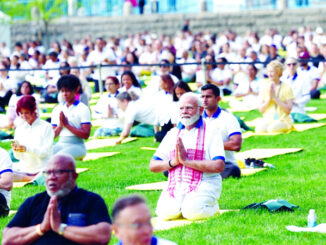
    Defence Minister Rajnath Singh performs yoga onboard INS Vikrant in Kochi and (left) President Droupadi Murmu performing yoga.

    The world on June 21 marked the 9th year of the International Day of Yoga. UN recognised June 21 as the International Day of Yoga through a resolution in 2014. While the global celebration of IDY 2023 was led by Prime Minister Narendra Modi at the UN Headquarters in New York, USA, the national celebration of IDY 2023 was led by Vice-President of India, Jagdeep Dhankhar at Jabalpur in Madhya Pradesh.
    ‘Yoga is a way of life’, says PM Modi in New York
    In a grand display of India’s soft power, Prime Minister Narendra Modi participated in the International Day of Yoga celebrations at the United Nations headquarters in New York on June 21, and described yoga as a “truly universal” and unifying force across ethnicities, faiths and cultures. The UN north lawns, overlooking the Hudson river, turned into a sea of white with an estimated 2,000 people representing around 135 nationalities joining

    Modi, the UN General Assembly president Csaba Korosi and the New York mayor Eric Adams in performing yoga.

    Some 650 people gather to practise yoga to mark the day on the grounds of Tsukiji Honganji Temple in Tokyo. Image Credit: AFP

    The participation of the most number of nationalities in a single yoga session hit the Guinness Book of World Records, and the Prime Minister hailed this unprecedented coming together of people from across the world. “Yoga comes from India. It is a very old tradition. But it is living and dynamic. Yoga is free from copyright, from patents, from royalty payments. Yoga is adaptable to your age, gender and fitness level. Yoga is portable — you can do it at home or work or in transit. Yoga is flexible — you can practice it alone or in a group, learn from somewhere or be self taught. It is unifying, for all ethnicities, faiths, cultures. Yoga is truly universal. When we do Yoga, we feel fit, mentally calm and emotionally content,” Modi said, speaking in English.
    The exercises were led by Annelies Richmond, a yoga trainer and the director of Art of Living, US. Among others present at the event were UN’s deputy secretary general Amina Mohammed, actor Richard Gere, award-winning chef Vikas Khanna, Grammy winner Ricky Kej, and a host of US corporate leaders, military veterans, television personalities, Yoga practitioners and teachers, and members of the Indian diaspora.
    But the event was as much about India showcasing its leadership in multiple domains.
    Modi reminded the audience, as did the UNGA president, that India proposed marking June 21 as the International Day of Yoga nine years ago. “It was wonderful to see the world come together to support the idea back then,” he said.
    On peacekeeping, with India contributing the highest number of troops among all countries to UN forces, Modi said he in 2015 spoke of building a memorial in honour of those who had given up their lives.
    “In 2015, I had called for a new memorial at UN in their memory. Last week, the whole world joined hands to make this reality soon. As the largest troop contributing nation, we are grateful to all nations for their support.”
    And last year, Modi said, the whole world came together to support India’s proposal to mark 2023 as the International Year of Millets. “Millets are a superfood, they promote holistic health and are good for the environment.”

    People perform Yoga in Batu Caves, Selangor, Malaysia. Image Credit: REUTERS

    Returning to the theme of yoga, Modi said that it was not just about an exercise on a mat. “Yoga is a way of life. It is a holistic approach to health and well-being. It is way to bring mindfulness in thought and action. It is a way to live in harmony with self, with others and with nature.”
    Expressing his happiness that many were working on scientifically validating different aspects of yoga, Modi urged everyone to use the power of yoga to be kind to oneself, to each other, and to nature; to build bridges of friendship and peace; to build a cleaner and more sustainable future; and to build “one earth, one family and one future” — the last is the theme of India’s G20 presidency.
    Adams, the influential New York mayor, said an individual had two mothers — one who gave birth, one who sustained. “Yoga keeps us connected to both mothers and to each other.”
    In a video message, UN secretary general Antonio Guterres said Yoga offered a “haven of calm”, reduced anxiety, promoted well-being, helped develop discipline and patience and connected people to the planet “which so badly needs our protection”.
    Explaining how yoga diplomacy had become a part of India’s soft power, Harsh Pant of New Delhi’s Observer Research Foundation (ORF) said, “The global acceptance of Yoga Day is a testament to both Modi’s effective leadership on the issue and India’s growing global clout. This has allowed India to shape its soft power in ways that were not anticipated a few years back.”
    Pant said it was an interesting exercise that showed how soft power can be wielded and how it intersected with a country’s strategic rise.
    Since the International Day of Yoga began, yoga has emerged as one of India’s biggest soft-power brands, allowing the country to take the lead in the global health and wellness sectors. The widespread celebrations have allowed the centuries-old practice to gain global recognition and popularity, propelled by government backing.
    After the New York leg of his visit, Modi arrived in Washington DC on Wednesday afternoon eastern time for the official state visit. The US administration, particularly the White House, has gone all out in welcoming him with both ceremony and substance.

    Yoga enthusiasts take part in a mass yoga session at the amphitheatre lawns at North Beach in Durban, South Africa. Image Credit: AFP


  • India: Gangster Capitalism Financing Criminals in Politics & Sham Democracy

    India: Gangster Capitalism Financing Criminals in Politics & Sham Democracy

    By Dave Makkar

    Mr. Makkar has made serious allegations against the Modi government, politicians and the big businesses which need a careful and honest probing. We call upon our readers to initiate the task of investigating in their own way whether or not they find the allegations worth believing. The Indian Panorama invites an open debate to unravel the truth. Please send in your comments to editor@theindianpanorama.com

                                                                                             EDITOR

    The criminalization of politics is directly related to “Gangster Capitalism” that is being practiced in India since its independence in 1947. In India, politicians are selected & financed by the “New India Company” – NIC; voters play a part in the charade of voting for them!

    These elites are also promoting and financing “Hindu Rashtra” a communal agenda, call it a “Majoritarian Rule” where Upper caste Hindus are more equal even than the lower caste Hindus. No one can ignore  how the minorities especially Muslims & Christians are being treated under Modi Rule since 2014. Unfortunately, history tells us that such countries rarely progress much. Retd. Admiral Arun Prakash in an interview has observed that  under the current rulers, “India is prone to a Civil War in the very near future”.

    Since my student days every year on India’s Independence Day & Republic Day, I used to look back and compare the gradual deterioration in the functioning of democracy, the Master’s (Ruling Class & their Financiers) Ruling the Slaves (The Indian Public) Governance system getting more cruel witherosion in moral and social fiber of the society, year after years. This Masters & Slaves Governance system in India, implemented by East India Company &more strictly & violently enforced by British Crown; was later adopted by the Congress after independence in 1947.That is the reason India still has British time Sedition & UAPA laws.

    1990 was a turning point in my life when Chandra Shekhar with 61 MP’s (out of 525-member Lok Sabha/lower house) from the breakaway group of Janta Dal was installed Proxy PM with the outside support of 195 Congress MPs under Rajiv Gandhi & 25 MPs of splinter groups by toppling the V P Singh government. The entire operation was financed by Dhirubhai Ambani with bribes to every MP across the party line because V P Singh government was pursuing money laundering, tax evasion, political & bureaucratic bribes and other wrong doings against Ambani group. That forced me to say publicly that from now onward the likes of Ambani’s whenever they feel like can install any one as Proxy PM in India.

    After Chandra Shekhar, Indians have seen administration after administrations marred in corruption, criminals getting elected to public offices and MLAs &MPs for sale to the highest bidder; all under the facade of democracy.

    Since 2014 this deterioration has been so fast that India can no longer be called a democracy and the most pathetic,  it is inhibited by the world famous rich, highly educated and intelligent people that do not care about social and moral corruption that has infected every institution of their government while  majority of their fellow Indians live subhuman lives in the ocean of poverty and hunger with no basic human rights.

    The most disturbing is the large number of criminals in the BJP and in Modi’s  Cabinet of Ministers. Out of 303 BJP MPs, 116 have criminal record including a bomb maker & a terrorism accused and 22 are in Cabinet and out of those 16 ministers have serious criminal cases registered against them. Most pathetic is, Home Minister Amit Shah was accused of having orchestrated the extrajudicial killings under CM Modi of Gujarat. Serious criminal cases include terrorism, treason, arson, murder, rape, robbery, burglary, communal disharmony/hate speeches, electoral violations, and kidnapping, among others. If that is the plight of India’s Parliament and government run by criminals; one can for sure say the states must be doing worse than this!

    The criminalization of politics is directly related to “Gangster Capitalism” that is being practiced in India since its independence in 1947. In India, politicians are selected & financed by the “New India Company” – NIC; voters play a part in the charade of voting for them! It was Congress that gave their blessings to the formation of “New India Company” in 1947 to replace “The East India Company” with prominent shareholders of that time like Birlas, Sighanias etc. The current prominent Shareholders of “New India Company” are Ambani, Adani, Tata, Aggarwals, Jindals, Ruia’s & Fraud Religious Gurus Ram Dev, Ravi Shankar, Jaggi Vasudev with many other major names. NIC along with the Politicians they selectare the termites that have eaten up the public wealth along with the social and moral fiber of India. The NIC & politicians are directly responsible for acute poverty, illiteracy, un-employment, communalism, catechism, lack of basic civic & health care services and massive corruption at all levels of governance including judiciary & media in India. With the majority of the mainstream media owned by Ambani & Adani; the corruption, communalization bigotry against minorities & suppression of news uncomfortable for Modi govt in Media has reached to new level after 2014. Media owned by them decide what information is to be released for public consumption and anyone questioning the rulers or establishment of Hindu Rashtra is conveniently dubbed as  “Anti-National”.

    The most dangerous part is that NIC shareholders have no relevant experience or expertise or have never invented any product or an idea. None of them have any vision for a country of over 1.39 billion people with the majority of them being poor. Their expertise is in how to swindle and scam to get bank funding for their highly cost inflated projects. They buy/lease perpetually, public owned natural wealth like land, oil wells, spectrum, mining rights, airports, railway stations, National Monuments and more at highly undervalued cost & terms which is a fraud on the owners that is public. The other expertise they do have is in financing criminal, communal & corrupt politicians with no vision for the country; so that these shareholders can govern India through them. The example is coronation of Modi first as CM of Gujarat and later as PM of India. Adani and Ambani have  prospered the most under Modi; Adani from $70 Million net worth in 1998 is now worth $92.2 Billion  and Ambani who was Congress Party owner turned BJP owner in 2013, his net worth zoomed from $23.6 Billion  to $ 95.3 Billion  despite India’s GDP falling from 10% growth to -8% in 2021,  amid 45 years high unemployment, poverty and hunger that may lead to a humanitarian crisis.

    Recent report on inequality from Oxfam points out —one of the biggest increases in wealth was that of Gautam Adani, whose wealth multiplied eight-fold during the pandemic, and Oxfam notes that he made use of state connections to become the country’s largest operator of ports and its largest thermal coal power producer, wielding market control over power transmission, gas distribution, and now privatized airports — all once considered public goods.

    World Inequality Report finds that India stands out as a poor and very unequal country, with an affluent elite. World Inequality Report estimates that the ratio of private wealth to national income increased from 290% in 1980 to 555% in 2020, one of the fastest such increases in the world, throughout history.

    India had 102 billionaires last year, and now the number is  142. On the other hand, there are estimates that 150 to 160 million peopleslid into poverty during the same period. The income of poorest Fifth plunged 53% in last 5 years of Modi rule.All his Grand Schemes with Millions of Dollars for Advertising have  proved  a big disaster for India. The United Nations says that half of the new poor globally are coming from India. So,  what we’re looking at is inequality reaching obscene proportions.

    Modi government is notorious  for suppressing inconvenient information and manipulate data, refusing to release the results of the 2017-18 national consumer expenditure survey. World Inequality Report finds that India stands out as a poor and very unequal country, with an affluent elite. These elites are also promoting and financing “Hindu Rashtra” a communal agenda, call it a “Majoritarian Rule” where Upper caste Hindus are more equal even than the lower caste Hindus. No one can ignorehow the minorities especially Muslims & Christians are being treated under Modi Rule since 2014. Unfortunately, history tells us that such countries rarely progress much. Retd. Admiral Arun Prakash in an interview has observed that  under the current rulers, “India is prone to a Civil War in the very near future”.

    (The author is a social activist. He can be reached at davemakkar@yahoo.com)

  • Indian Overseas Congress USA stages protest against Modi policies at the United Nations

    Indian Overseas Congress USA stages protest against Modi policies at the United Nations

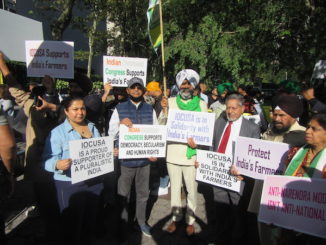
    NEW YORK (TIP): The Indian Overseas Congress, USA, an advocacy organization that promotes democracy, human rights, and equal justice together with its supporters and friends, held a protest rally in front of the United Nations on Saturday, September 25, 2021, as Prime Minister Narendra Modi was delivering his address to the General Assembly.

     “Although we have no issues with a Prime Minister of India visiting the U.S. or the U.N. and promoting better bi-lateral relations or promoting world peace, it is imperative to let him know at the same time that we do not approve of his misgovernance in dealing with COVID epidemic or undermining the democratic institutions,” said George Abraham, Vice-Chairman of the IOCUSA. “If there is to be genuine economic progress and social development in India, political tranquility and social harmony is a pre-requisite without which there would be very little hope for the future. Let us, at the minimum, raise our voices, no matter how feeble it may be, because one day our next generation might ask where you have been when India took a turn towards authoritarianism and fascism,” Abraham added.

    “I am glad to state that IOCUSA stands firmly behind India’s farmers who have been denied their rightful voice and concerns to be heard by the Modi government which has pushed a set of bills through the parliament for the benefit of the crony capitalists and to the detriment of our farmers” Mr. Mohinder Singh Gilzian, President of the IOCUSA said.  “We want Modi to know that the NRI voice will continue to be raised in support of their protest unless and until he resolves these issues,” Mr. Gilzian added.

    Indian Overseas Congress, USA held a protest rally against Modi policies in front of the United Nations on Saturday, September 25, 2021

    The protesters carried slogans and chanted examples to point out the failures of the Modi government, e.g., “Anti-Narendra Modi isn’t anti-national,” “We are all Indians. Stop discrimination based on religion, caste and language”, “Protect India’s constitution”, “IOCUSA supports democracy, freedom, and human rights”,” IOCUSA supports India’s farmers”, “IOCUSA -proud supporter of pluralistic India” and so forth.

    Mr. Mohinder Singh Gilzian, President of the IOCUSA, Mr. Harbachen Singh, Secretary-General, Mr. George Abraham, Vice-Chairman, Mr. John Thomas, Ms. Sophia Sharma, General Secretary, Vice-President, Ms. Leela Maret, President, Kerala Chapter, Mr. Amar Singh Gulshan and President, Haryana Chapter were among those who took part in the protest.

  • September 24 New York & Dallas E – Edition

    [vc_row][vc_column][vc_column_text]

    Edition

    [/vc_column_text][/vc_column][/vc_row][vc_row][vc_column width=”2/3″][vc_custom_heading text=”Dual Edition” font_container=”tag:h2|text_align:center” google_fonts=”font_family:Istok%20Web%3Aregular%2Citalic%2C700%2C700italic|font_style:700%20bold%20regular%3A700%3Anormal” link=”url:https%3A%2F%2Fwww.theindianpanorama.news%2Fwp-content%2Fuploads%2F2021%2F09%2FTIP-September-24-Dual-Edition.pdf|||”][vc_single_image image=”114934″ img_size=”full” add_caption=”yes” alignment=”center” onclick=”custom_link” link=”https://www.theindianpanorama.news/wp-content/uploads/2021/09/TIP-September-24-Dual-Edition.pdf”][/vc_column][vc_column width=”1/3″][vc_single_image image=”82828″ img_size=”medium” alignment=”center” onclick=”custom_link” link=”https://www.theindianpanorama.news/advertising-media-kit-portal-indian-panorama/”][vc_single_image image=”82829″ img_size=”medium” alignment=”center” onclick=”custom_link” link=”https://www.theindianpanorama.news/advertising-media-kit-portal-indian-panorama/”][/vc_column][/vc_row]

  • Our diversity is the identity of our strong democracy, says PM Modi at UNGA

    Our diversity is the identity of our strong democracy, says PM Modi at UNGA

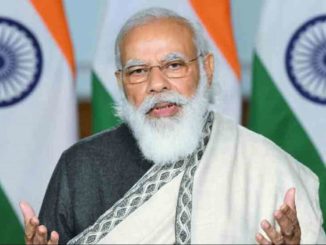
    UNITED NATIONS (TIP): Prime Minister Narendra Modi, in his address to the 76th session of the UNGA on September 25, 2021, said that countries with “regressive thinking” that are using terrorism as a “political tool” must understand that it is an equally big threat for them also.

    Mr. Modi said that he represents a country which is proud to be known as the mother of democracy and cited his own rise from a tea seller at a railway station to the Prime Minister of India to underscore the strength of India’s democracy.

    “I represent a country that is proud to be known as the mother of democracy. On 15th of August this year, India entered into the 75th year of its independence,” he said.

     “We have had a great tradition of democracy that goes back to thousands of years”.

    “Our diversity is the identity of our strong democracy,” he said.

    “It is a country that has dozens of languages, hundreds of dialects, different lifestyles and cuisines. This is the best example of a vibrant democracy,” the Prime Minister said.

    “The strength of our democracy is demonstrated by the fact that a little boy who at one time used to help his father at his tea stall at a railway station is today addressing the United Nations General Assembly for the fourth time as prime minister of India,” he said.

    “I will soon have spent 20 years serving my countrymen as head of government. First, as the longest serving Chief Minister of Gujarat and then as the Prime Minister for the last seven years,” Mr. Modi said, adding that democracy has delivered.

    Mr. Modi said that countries with “regressive thinking” that are using terrorism as a “political tool” must understand that it is an equally big threat for them also, in a veiled attack on Pakistan which is often accused by its neighbors of providing safe havens to terrorists.

    Prime Minister also said that in order to strengthen the rules-based world order, the international community must speak in unison, in an apparent reference to China which is flexing its military muscles in the Indo-Pacific.

    Noting that the world is facing an increased threat of regressive thinking and extremism, Mr. Modi said countries that are using terrorism as a political tool have to understand that terrorism is an equally big threat to them.

    “It is absolutely essential to ensure that Afghanistan’s territory is not used to spread terrorism and for terrorist activities,” he said. “We also need to ensure that no country tries to take advantage of the delicate situation in Afghanistan and use it for its own selfish interests.” Pakistan’s neighbors, including Afghanistan and India, and the U.S. have long accused Islamabad of providing safe haven and support to militants, a charge denied by it.

    Mr. Modi said that oceans are also a shared heritage.

    “Our oceans are also the lifeline of international trade. We must protect them from the race for expansion. The international community must speak in one voice to strengthen a rule-based world order,” he added.

    Mr. Modi underscored the need for the United Nations to reform itself to be able to be more relevant and deliver more effectively. He couched a message for the UN in his quote from the Nobel Laureate Rabindranath Tagore which recommended moving forward fearlessly on the path of righteousness and all weaknesses and doubts will disappear.

  • PM Modi reaches New York to address 76th UNGA session on September 25th morning

    PM Modi reaches New York to address 76th UNGA session on September 25th morning

    September 25, 2021

    TIP Special Correspondent

    NEW YORK (TIP): Prime Minister Narendra Modi on Friday late night arrived in New York where he is scheduled to address the 76th session of the United Nations General Assembly, which was held virtually last year due to the Covid pandemic.

    Modi flew to New York from Washington after holding his first bilateral meeting with US President Joe Biden in the Oval Office of the White House and attended his first in-person Quad summit on Friday.

    The prime minister and his counterparts – Scott Morrison of Australia and Japan’s Yoshihide Suga – attended the meeting of Quad leaders hosted by US President Biden in Washington.

    “Landed in New York City. Will be addressing the UNGA at 6:30 PM (IST) on the 25th,” the prime minister said in a tweet.

    “Voicing the sentiments of the 1.3 billion people of India! PM @narendramodi arrives in New York to address the 76th UNGA tomorrow. India’s current membership of the @UN Security Council lends even greater significance!” the Ministry of External Affairs said in a tweet.

    Modi will address the world leaders at the UN General Debate on Saturday morning. He is the first world leader scheduled to address the world organization.

    The prime minister was received at the airport by India’s ambassador to the US Taranjit Singh Sandhu and India’s Permanent Representative to the UN ambassador T S Tirumurti.

  • Modi holds first bilateral meeting with President Biden; discusses Indo-Pacific, climate and COVID

    Modi holds first bilateral meeting with President Biden; discusses Indo-Pacific, climate and COVID

    US – India relationship is destined to be “stronger, closer and tighter”, says Bide

    TIP Special Correspondent

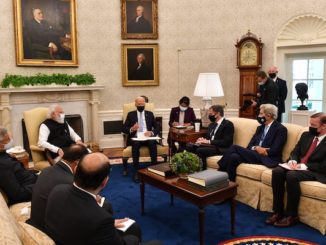
    WASHINGTON, DC (TIP): Prime Minister Narendra Modi on Friday, September 24, described as “outstanding” his first bilateral meeting with US President Joe Biden who said the Indo-US relationship is destined to be “stronger, closer and tighter” as the two leaders discussed a wide range of issues, including combating COVID-19, climate change, trade and the Indo-Pacific. President Biden, who welcomed Prime Minister Modi in the Oval Office of the White House said that today they are starting a new chapter in US-India relationship.

    Observing that he has long believed that the US, India relationship can help them solve global challenges, Biden in his opening remarks before a battery of India and American media said they are now “are launching a new chapter in history of India US ties, taking on some of the toughest challenges we face together.”

    And this starts with a shared commitment to end COVID-19, he said. Prime Minister Modi, who is visiting the US for the 7th time after assuming office in 2014, described Friday’s bilateral meeting with Biden that lasted more than 60 minutes as “important” as they’re meeting at the start of the third decade of this century.

    “Your leadership will certainly play an important role in how this decade is shaped. The seeds have been sown for an even stronger friendship between India and the US,” Prime Minister Modi told Biden.

    “Had an outstanding meeting with @POTUS @JoeBiden. His leadership on critical global issues is commendable. We discussed how India and USA will further scale-up cooperation in different spheres and work together to overcome key challenges like COVID-19 and climate change,” Modi tweeted after the meeting. Biden said the relationship between India and the US, the largest democracies in the world, is “destined to be stronger, closer and tighter.” “I’ve long believed that the US-India relationship can help us solve a lot of global challenges. In fact, back in 2006, I had said that by 2020 India and the US will be among the closest nations in the world,” Biden told Modi. “Today, we’re launching a new chapter in the history of US-India ties, taking on some of the toughest challenges we face together, starting with a shared commitment,” he said.

    Biden said he and Prime Minister Modi would talk about what more they can do to fight COVID-19, take on the climate challenge that the world face, and ensure stability in the Indo-Pacific, including with their quiet partners.

    India, the US and several other world powers have been talking about the need to ensure a free, open and thriving Indo-Pacific in the backdrop of China’s rising military maneuvering in the region.

    “Of course, our partnership is more than just what we do. It’s about who we are in our shared responsibility to uphold democratic values, our joint commitment to diversity, and it’s about family ties, including four million Indian-Americans make the United States, stronger every single day,” he said.

    Noting that the world would celebrate Mahatma Gandhi’s birthday next week, Biden said, “We’re all reminded that his message of non-violence, respect, tolerance, matters today maybe more than ever had.”

    On this, Modi said, “Gandhi Ji spoke about trusteeship, a concept which is very important for our planet in the times to come.” Noting that trade will be an important factor in the Indo-US ties in the coming decade, the Prime Minister said that there is much to be done in the area.

    Modi said this decade will be shaped by talent and people-to-people linkages. “I am glad the Indian diaspora is making an active contribution towards the US’ progress.” He said that technology is becoming a driving force. “We have to utilize our talents to leverage technology for greater global good.”

    Modi recalled his interactions with Biden in 2014 and 2016, saying “that time you had shared your vision for ties between India and US. I am glad to see you are working to realize this vision.”

    He said that each of the subjects mentioned by the president are crucial for the India-US friendship. “His efforts on COVID-19, mitigating climate change and the Quad are noteworthy,” Modi added.

    “This morning I’m hosting Indian Prime Minister Narendra Modi at the White House for a bilateral meeting. I look forward to strengthening the deep ties between our two nations, working to uphold a free and open Indo-Pacific, and tackling everything from COVID-19 to climate change,” President Biden had tweeted minutes before the meeting. While the two leaders have met earlier when Biden was the Vice President of the country, this is for the first time that Biden is meeting Modi after he became the 46th president of the US in January.

    Both Biden and Prime Minister Modi have spoken over the phone multiple times and have attended a few virtual summits, including that of the Quad in March hosted by the US president. The last telephone conversation between them took place on April 26.

    Spokesperson of the Ministry of External Affairs Arindam Bagchi said that India US relationship is a partnership of trust. “Globally we will make a difference!” he tweeted.

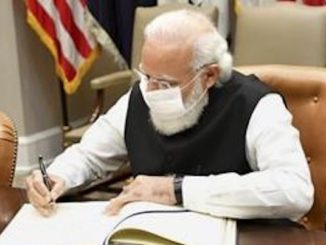
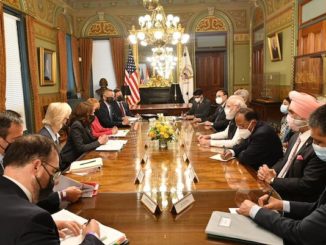
    “Vibrant discussions between” Modi and Biden. “Joseph Biden on global, regional & bilateral issues. An expansive agenda including defense, security, health, education, trade, IT, economic, Science and Technology energy and People to People ties,” Bagchi said. The Prime Minister also signed the visitor book in the Roosevelt Room of the White House. “Registering the spirit of India United States friendship in ink,” the spokesperson tweeted. The Indian delegation included S Jaishankar, Minister of External Affairs; Ajit Doval, National Security Advisor; Harsh Vardhan Shringla, Foreign Secretary and Taranjit Singh Sandhu, India’s Ambassador to the United States.

    The American delegation included Antony Blinken, Secretary of State; Jake Sullivan, National Security Advisor; John Kerry, Special Presidential Envoy for Climate; Kurt Campbell, Deputy Assistant to the President and Coordinator for Indo-Pacific Affairs; Donald Lu, Assistant Secretary of State for South and Central Asian Affairs and Sumona Guha, Special Assistant to the President & Senior Director for South Asia at National Security Council.

    Visit www.theindianpanorama.news for more stories on PM Modi’s US visit


  • PM Modi, Japanese Premier Suga reaffirm commitment for free, open Indo-Pacific

    PM Modi, Japanese Premier Suga reaffirm commitment for free, open Indo-Pacific

    September 24, 2021

    TIP Special Correspondent

    WASHINGTON, DC (TIP): Prime Minister Narendra Modi and his Japanese counterpart Yoshihide Suga have reaffirmed their commitment towards a free, open and inclusive Indo-Pacific region, as they reviewed the multi-faceted bilateral relationship and exchanged views on recent global developments, including in Afghanistan.

    During their meeting here on Friday, September 24, the two Prime Ministers agreed to enhance bilateral security and defense cooperation, including in the area of defense equipment and technologies, according to a statement issued by the Ministry of External Affairs (MEA).

    Prime Minister Modi thanked Suga for his personal commitment and leadership, both as Prime Minister and Chief Cabinet Secretary earlier, in enabling great advances in the India-Japan Special Strategic & Global Partnership over the last few years, it said.

    “The two Prime Ministers reviewed the multi-faceted relationship between the two countries and exchanged views on recent global and regional developments, including in Afghanistan. They reaffirmed their commitment towards a free, open and inclusive Indo-Pacific region,” it said.

    The two Prime Ministers welcomed the increasing economic engagement between the two countries.

    “Furthering friendship with Japan,” the MEA said in a tweet after the meeting. “Prime Ministers @narendramodi and @sugawitter had a fruitful meeting in Washington DC. Both leaders held discussions on several issues including ways to give further impetus to trade and cultural ties,” it said.

    A special strategic and global partnership with Japan- firmly rooted in history and based on common values, it further said.

    They welcomed the launch of the Supply Chain Resilience Initiative (SCRI) between India, Japan and Australia earlier this year as a collaborative mechanism to enable resilient, diversified and trustworthy supply chains, the statement said.

    Prime Minister Modi highlighted the need to develop bilateral partnerships in manufacturing, MSME and skill development.

    Prime Minister Suga informed Modi that in order to operationalize the Specified Skilled workers (SSW) agreement which was signed earlier this year, the Japanese side would be undertaking skill and language tests in India from early 2022, it said.

    They discussed the Covid-19 pandemic and efforts to address it and highlighted the increasing importance of digital technologies and in this regard positively evaluated the progress in the India-Japan Digital Partnership, especially in start-ups.

    The two leaders exchanged views on further collaboration in various emerging technologies. Discussions also took place on climate change issues and green energy transition, and the potential for Japanese collaboration with India’s National Hydrogen Energy Mission, the statement said.

    The two prime ministers reaffirmed their commitment to advance efforts to facilitate the smooth and timely implementation of the Mumbai-Ahmedabad High Speed Rail (MAHSR) project.

    They also welcomed the progress in bilateral developmental projects in India’s Northeastern Region under the India-Japan Act East Forum, and noted possibilities for further enhancement of such cooperation, it said.

    Prime Minister Suga expressed confidence that the strong momentum attained by the India-Japan partnership in the last few years will continue even under the new administration in Japan.

    Modi conveyed that he was looking forward to welcoming the next prime minister of Japan to India for India-Japan Annual Summit in the near future.

    Modi and Suga spoke in April this year and the two leaders underscored the importance of working together to create resilient, diversified and trustworthy supply chains, ensuring reliable supply of critical materials and technologies, and developing new partnerships in manufacturing and skill development to deal with the crisis.

    Suga had called off a scheduled visit to India in April end in view of the coronavirus situation.

    Speaking after virtually inaugurating a Japanese Zen Garden and Kaizen Academy set up at the premises of the Ahmedabad Management Association (AMA) in June, Modi had described Suga as a very straight-forward person.

    “Prime Minister Suga and I believe that during the time of this Covid-19 pandemic crisis, the Indo-Japanese friendship and our partnership have become even more relevant for global stability and prosperity. Today, when we are facing several global challenges, it is the need of the hour that our friendship and relationship get stronger day by day,” Modi had said.

    He said efforts like setting up of the Kaizen Academy are a beautiful reflection of this relationship.

    Modi said the launch of the Zen Garden and Kaizen Academy is a “symbol of the spontaneity and modernity of India-Japan relations”.

    Visit www.theindianpanorama.news for more stories on PM Modi’s US visit.

  • PM Modi discusses bilateral, regional, global issues with Australia’s Morrison

    PM Modi discusses bilateral, regional, global issues with Australia’s Morrison

    September 24, 2021

    TIP Special Correspondent

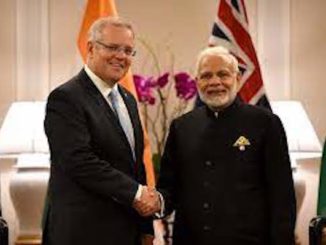
    WASHINGTON, DC (TIP): Prime Minister Narendra Modi has met his Australian counterpart Scott Morrison here ahead of the first in-person Quad meeting to be hosted by US President Joe Biden and discussed a broad range of issues of bilateral, regional and global importance, including the Indo-Pacific.

    The meeting between Modi and Morrison on Friday, September 24, came a week after they spoke over phone and reviewed the rapid progress in the India-Australia Comprehensive Strategic Partnership, including through the recent ‘two-plus-two’ dialogue, and exchanged views on regional developments and the forthcoming Quad meeting.

    This was the first in-person meeting between the two leaders in the post-pandemic period.

    “They reviewed progress since the last leader’s summit that was held virtually in June 2020, and they resolved to continue their close partnership and cooperation for the mutual wellbeing of both sides,” Foreign Secretary Harsh Vardhan Shringla told reporters while details of the meeting.

    The last bilateral meeting was the Leaders’ Virtual Summit held on June 4 last year when the Strategic Partnership between India and Australia was elevated to a Comprehensive Strategic Partnership, the Ministry of External Affairs (MEA) said in a statement.

    During the meeting here, Modi and Morrison discussed a broad range of issues of bilateral, regional and global importance, it said.

    The Prime Ministers “resolved to continue close cooperation for mutual well-being and towards advancing their shared objective of an open, free, prosperous and rules-based Indo-Pacific region,” the MEA said.

    India, the US and several other world powers have been talking about the need to ensure a free, open and thriving Indo-Pacific in the backdrop of China’s rising military maneuvering in the region.

    China claims nearly all of the disputed South China Sea, though Taiwan, the Philippines, Brunei, Malaysia and Vietnam all claim parts of it. Beijing has built artificial islands and military installations in the South China Sea.

    “Great to meet with my good friend and a great friend of Australia, Indian PM Narendra Modi during my visit to the US,” Morrison tweeted.

    “A wide-ranging and productive discussion ahead of the first in-person Quad meeting as we look to further deepen the partnership between our two countries,” Morrison said.

    Prime Minister Modi in a tweet said, ”It is always wonderful to interact with my good friend, PM @ScottMorrisonMP. We had wide-ranging deliberations on strengthening cooperation in the fields of commerce, trade, energy and more.” According to the MEA statement, in their meeting, Modi and Morrison reviewed the ongoing negotiations on a bilateral Comprehensive Economic Cooperation Agreement (CECA) and welcomed the visit to India by former Australian prime minister Tony Abbott as Morrison’s Special Trade Envoy for India and noted the commitment of both sides to achieve an early harvest announcement on an interim agreement by December 2021.

    They underlined the need for the international community to address the issue of climate change on an urgent basis as Prime Minister Modi highlighted the need for a broader dialogue on environment protection, it said, adding that both the leaders also discussed possibilities of providing clean technologies.

    Modi and Morrison agreed that “as two vibrant democracies in the region, the two countries needed to work closer together to overcome the challenges in the post-pandemic world, inter alia to enhance supply chain resilience,” the MEA said.

    “Both leaders lauded the immense contribution of the Indian diaspora to Australia’s economy and society, and discussed ways to enhance people to people ties,” the statement added.

    Prime Minister Modi also invited Morrison to visit India.

    “The Prime Minister mentioned that the Indian community was very well looked after during the COVID crisis in Australia. He especially mentioned that to the Prime Minister and there was an appreciation of the contribution of the Indian diaspora in Australia,” Shringla said.

    Earlier, Office of Prime Minister Modi said on Twitter: “Advancing friendship with Australia. PM @ScottMorrisonMP held talks with PM @narendramodi. They discussed a wide range of subjects aimed at deepening economic and people-to-people linkages between India and Australia.

    Ministry of External Affairs spokesperson Arindam Bagchi termed the meeting as “another chapter in our Comprehensive Strategic Partnership with Australia”.

    “Another chapter in our Comprehensive Strategic Partnership with Australia! PM @narendramodi and @ScottMorrisonMP met today. Discussed regional & global developments as well as ongoing bilateral cooperation in areas related to Covid-19, trade, defense, clean energy & more,” Bagchi said on Twitter.

    The meeting assumes significance as External Affairs Minister S Jaishankar and Defense Minister Rajnath Singh on September 11 held the ‘two-plus-two’ talks in New Delhi with their Australian counterparts Marise Payne and Peter Dutton.

    It was the first meeting between the prime ministers of India and Australia since the AUKUS (Australia, the UK and the US) security partnership was unveiled last week by US President Biden, British Prime Minister Boris Johnson and Morrison.

    In response to a question, Shringla said that Prime Minister Morrison did briefly mention rationale from the Australian side in seeking to initiate the AUKUS Alliance.

    “He felt that the technology that they received was appropriate and there was a brief discussion in that regard,” he said.

    In a tweet, the prime minister’s office described it as advancing friendship with Australia. “They discussed a wide range of subjects aimed at deepening economic and people-to-people linkages between India and Australia,” the PMO tweeted. The AUKUS partnership, seen as an effort to counter China in the Indo-Pacific, will allow the US and the UK to provide Australia with the technology to develop nuclear-powered submarines for the first time.

    Australia said its decision to join a security alliance with the US and the UK is aimed at developing capabilities that can contribute along with India and other countries in deterring behavior that threatens the peace and security in the Indo-Pacific.

    In the first reaction from India on the contentious alliance, Shringla on Tuesday said that the new security agreement among the US, the UK and Australia is neither relevant to the Quad nor will have any impact on its functioning, and they are not groupings of a similar nature.

    Shringla said while the AUKUS is a security alliance among the three countries, the Quad is a plurilateral grouping with a vision for a free, open, transparent and inclusive Indo-Pacific.

    The Quad comprises India, the US, Japan and Australia.

    Visit www.theindianpanorama.news for more stories on PM Modi’s US visit.

  • PM Modi and US Vice President Kamala Harris discuss bilateral ties, Indo-Pacific

    PM Modi and US Vice President Kamala Harris discuss bilateral ties, Indo-Pacific

    September 23, 2021

    TIP Special Correspondent

    WASHINGTON, DC (TIP): Prime Minister Narendra Modi on Thursday, September 23, described India and America as ”natural partners” as he held the first in-person meeting with Vice President Kamala Harris at the White House during which they decided to further cement the Indo-US strategic partnership and discussed global issues of common interest, including threats to democracy, Afghanistan and the Indo-Pacific.

    ”India and America are natural partners. We have similar values, similar geopolitical interests,” Modi said in a joint media appearance with Harris, the first-ever person of Indian origin to be elected as the vice-president of the United States.

    Noting that India and the US are the largest and oldest democracies, Modi said the two countries share values and their coordination and cooperation are also gradually increasing.

    This is the first meeting between the two leaders. Harris had earlier spoken with Modi over the phone in June during the COVID-19 crisis in India.

    ”You are the source of inspiration for so many people across the world. I am completely confident that our bilateral relationship will touch new heights under President Biden and your leadership,” Modi told Harris.

    The two leaders were wearing masks as they both spoke in front of a battery of pool reporters from both India and the US.

    Modi invited the 56-year-old Democratic leader and Second Gentleman Douglas Emhoff to visit India.

    ”Both President Biden and you assumed office at a time when our planet faced very tough challenges. In a short time, you have had many achievements to your credit be it COVID-19, climate change or the Quad,” Modi said.

    In a statement, the Ministry of External Affairs said the two leaders exchanged views on recent global developments, including in Afghanistan and reaffirmed their commitment towards a free, open and inclusive Indo-Pacific region.

    The two leaders discussed the COVID-19 situation in their countries, including ongoing efforts to contain the pandemic through expedited vaccination efforts, and ensuring supply of critical medicines, therapeutics and healthcare equipment, it said.

    ”As relates to the Indo-Pacific, the US stresses on maintaining a free and open Indo-Pacific,” Harris said, amidst China’s aggressive moves in the strategically vital region.

    India, the US and several other world powers have been talking about the need to ensure a free, open and thriving Indo-Pacific in the backdrop of China’s rising military maneuvering in the region.

    China claims nearly all of the disputed South China Sea, though Taiwan, the Philippines, Brunei, Malaysia and Vietnam all claim parts of it. Beijing has built artificial islands and military installations in the South China Sea.

    Harris said the world is more interconnected and more interdependent than ever before. “And the challenges that we face today have highlighted that fact. COVID-19, climate crisis and the importance of our shared belief in the Indo-Pacific region,” she said. “Both sides acknowledged the importance of collaborative action on climate change. Prime Minister spoke about India’s push for increasing renewable energy and the recently launched National Hydrogen Mission. He also emphasized the importance of lifestyle changes to promote environmental sustainability,” the statement said.

    Modi noted that he had the opportunity to speak to Harris after she assumed the Vice Presidency. ”One of our interactions happened when India was battling a very tough wave of COVID-19 infections. I recall your kind words of solidarity that time,” Modi said.

    India was confronted with the second wave of the COVID 19 pandemic. A very difficult time for India, he said. “Like a family, the sense of kinship and so warmly, you extended a helping hand, the words that you chose when you spoke to me, I will always remember that, and I’d like to thank you from the bottom of my heart,” the prime minister said.

    ”Like a true friend, you had given a message of cooperation, and were very full of sensitivity and immediately after that we found that the US government, the US corporate sector and the Indian community, all came together to help India,” he said.

    Modi said that the US Government, companies based in the USA and the Indian diaspora were very helpful when India was fighting a tough wave of COVID-19 infections.

    Both leaders acknowledged the vibrant people-to-people linkages as the bedrock of the mutually beneficial education linkages and the flow of knowledge, innovation and talent between our two countries.

    Modi said that four million people of Indian origin are acting as a bridge of friendship between the two countries.

    Harris described India as a ”very important partner” to the US and welcomed New Delhi’s announcement that it will soon resume vaccine export.

    India stopped the export of COVID-19 vaccines after the second wave of the pandemic hit the country in April this year.

    On Monday, India said that it will resume export of surplus COVID-19 vaccines in the fourth quarter of 2021 under the ”Vaccine Maitri” programme and to meet its commitment to the COVAX global pool. On the issue of the climate crisis, she told Modi that the US working together with India can have not only a profound impact on people of nations but around the world itself.

    Harris said that it is incumbent on the two nations to protect democracies in the best interests of people of the two countries.

    ”As democracies around the world are under threat, it is imperative that we defend democratic principles and institutions within our respective countries and around the world. And that we maintain what we must do to strengthen democracies at home and it is incumbent on our nations to of course protect democracies in the best interests of people of our countries,” she said.

    Their meeting comes a day ahead of the maiden bilateral meeting between Modi and President Joe Biden and the Quad Leaders’ Summit at the White House on Friday.

    Since taking office, Harris has met with or spoken to over 30 world leaders, promoting US interests on issues ranging from global health to climate change to cyber threats.

    PM Modi later tweeted:

    Narendra Modi

    @narendramodi

    Glad to have met

    @VP

    @KamalaHarris

     Her feat has inspired the entire world. We talked about multiple subjects that will further cement the India-USA friendship, which is based on shared values and cultural linkages.


    Visit www.theindianpanorama.news for more stories on PM Modi’s US visit

  • VP Harris in her first meeting with PM Modi talks about defending democracies

    VP Harris in her first meeting with PM Modi talks about defending democracies

    TIP Special Correspondent

    WASHINGTON, DC (TIP): Voicing concern over the threat to democracies around the world, Vice President Kamala Harris on Thursday, September 23, underscored the need to defend democratic principles and institutions in both India and the US.

    Harris made the remarks in a joint media appearance with Prime Minister Narendra Modi before their first in-person meeting at the White House during which they decided to further cement the Indo-US strategic partnership and discussed global issues of common interest, including the Indo-Pacific.

    “As democracies around the world are under threat, it is imperative that we defend democratic principles and institutions within our respective countries and around the world, and that we maintain what we must do to strengthen democracy at home and it is incumbent… to protect democracy in the best interest of the people of our country,” she said in her remarks as she welcomed Modi to her ceremonial office.

    “I know from personal experience and from my family of the commitment of the Indian people to democracy, and the work that needs to be done, we can begin to imagine, and then actually achieve our vision for democratic principles and institutions,” she said.

    Harris said that she looks forward to discussing how the two countries can continue to best work together to strengthen their relationship around their mutual concerns and the challenges they face, but also the opportunities that those challenges present.

    She had earlier spoken with Modi over phone on June 3.

    India, she said, is a very vital partner to the United States.

    “Throughout our history, our nations have worked together and stood together, to make our world a safer and stronger world.

    “Mr. Prime Minister, when you and I last spoke, we talked about how our world is interconnected… and the challenges that we face today highlighted that fact… with COVID-19, the climate crisis and the importance of our shared belief in a free and open Indo-Pacific region,” Harris said.

    She said that early in the COVID-19 pandemic, India was a vital source of vaccines for other countries.

    “When India experienced a surge of COVID… the United States was very proud to support India and needed its and responsibility to vaccinate its people,” she said.

    Harris welcomed India’s announcement that it will soon be able to resume vaccine export and it is of particular note and admiration that India is currently vaccinating approximately 10 million people a day.

    “The President and I believe very strongly that the United States working together with India would have not only a profound impact on the future of our respective nations but on the world itself” on climate, she said.

    “And as it relates to the Indo-Pacific, the United States, like India, feels very strongly about the pride of being a member of the Indo Pacific, but also the fragilities of the importance and the strength as well of those relationships, including maintaining a free and open Indo Pacific,” the Vice President said.

    Harris also touched upon the issue of climate change.

    “On the issue of the climate crisis, I know that India and we take this issue quite seriously. The President and she believe very strongly that the United States working together with India would have a profound impact on people of the two countries,” she added.

    Their meeting comes a day ahead of the maiden bilateral meeting between Modi and President Joe Biden and the Quad Leaders’ Summit at the White House on Friday, September 24.

    Since taking office, Harris has met with or spoken to over 30 world leaders, promoting US interests on issues ranging from global health to climate change to cyber threats.

  • PM Modi meets CEOs of five top American Companies; encourages them to invest in India

    PM Modi meets CEOs of five top American Companies; encourages them to invest in India

    September 23, 2021

    TIP Special Correspondent

    WASHINGTON, DC (TIP): Prime Minister Narendra Modi on Thursday, September 23, met a group of five top American corporate leaders on a one-on-one basis from a range of diverse sectors ranging from drones to 5G, semiconductor, and solar and encouraged them to step up their investments by highlighting the vast opportunities in India.

    Modi holding talks with Qualcomm CEO Cristiano Amon
    Photo / Twitter

    “Talking technology…,” the Prime Minister’s Office said in a Twitter post after Modi’s meeting with Qualcomm CEO Cristiano Amon and First Solar CEO Mark Widmar. They had a productive interaction, it said.

    “PM Modi highlighted the vast opportunities India offers. Mr. Amon expressed keenness to work with India in areas such as 5G and other” Digital India efforts, it added.

    Qualcomm, which started its operations in 1996, has operations specializing in wireless modem and multimedia software, Digital Signal Processing (DSP) and embedded applications, and digital media networking solutions.

    In India, Qualcomm Ventures has invested in companies that address key domestic issues from dairy, transportation to defense.

    “Toward making India a global innovation hub!” Ministry of External Affairs (MEA) Spokesperson Arindam Bagchi tweeted. The Prime Minister had a conversation with Amon on investment opportunities in hi-tech sectors in India.

    “Discussed recent electronics and telecom manufacturing PLI schemes; and measures to strengthen innovation ecosystem,” he added.

    They discussed investment opportunities offered in India’s telecommunications and electronics sector. This included the recently launched Production Linked Incentive Scheme (PLI) for Electronics System Design and Manufacturing (ESDM) as well as developments in the semiconductor supply chain in India, the MEA said in a release.

    “Strategies for building the local innovation ecosystem in India were also discussed,” the ministry added.

    “Powering India’s Solar Potential!” Bagchi said after Modi’s meeting with Widmar. They discussed India’s renewable energy landscape.

    PM Modi and First Solar CEO Mark Widmar discussed India’s renewable energy landscape.
    Photo / Twitter

    Widmar shared plans to use the PLI scheme for manufacturing solar power equipment with unique thin-film technology; and integrating India into global supply chains, Bagchi said in a tweet.

    First Solar has successfully commissioned 150 MW of Utility-Scale Solar Power to the Grid in India and has installed 1.8 GW of solar capacity in the country. Early this year, it announced its intention to set up a new 3.3 GW Facility in India. As such First Solar is contributing to India’s plans to ramp up solar power generation to 100 GW by 2022.

    During the meeting, the prime minister elaborated on India’s efforts to harness solar energy, including the ‘One world, One sun and One grid’ initiative and investment opportunities in the sector, his office said in a tweet.

    “They talked about India’s renewable energy landscape, particularly solar energy potential, and our target of 450 GW electricity generation from renewable sources by 2030,” the ministry said.

    Discussions also took place about First Solar’s interest in setting up manufacturing facilities in India using their unique thin-film technology by availing the recently launched Production Linked Incentive (PLI) Scheme, as well integrating India into global supply chains, it added.

    Prime Minister Modi discussed with Adobe CEO Shantanu Narayen his company’s ongoing activities in India and future investment plans
    Photo / Twitter

    In his meeting with Adobe CEO Shantanu Narayen, Prime Minister Modi discussed Adobe’s ongoing activities in India and future investment plans, according to Bagchi.

    “Ideas to leverage Digital India flagship programme in sectors like health, education and R&D were also discussed,” he said. “Deepening Knowledge Partnerships!” he tweeted.

    After North America, India represents Adobe’s biggest operations with over 6,000 employees across its campuses in Noida and Bengaluru. India also serves as an innovation hub for Adobe, with the Indian R&D team contributing to development of every Adobe product. Moreover, initiatives such as Adobe’s Grassroots Innovation Challenge and Women-in-Technology Scholarship are fueling the ongoing digital revolution in India.

    The Prime Minister discussed with Vivek Lall, chief executive of General Atomics India’s strides in drone technology, including the path-breaking reforms and PLI scheme
    Photo / Twitter

    Modi also met Vivek Lall, chief executive of General Atomics, and Stephen A Schwarzman from Blackstone.

    The Prime Minister and Lall discussed India’s strides in drone technology, including the path-breaking reforms and PLI scheme, the PMO said in a tweet.

    “They spoke about strengthening the defense technology sector in India. Lall appreciated the recent policy changes to accelerate defense and emerging technology manufacturing and augment capacity building in India,” the MEA said.

    General Atomics, which opened its first office in India in 2018, is making significant contributions to deepen India-US defense and security cooperation. It is working with both governments in an effort to provide India with the latest systems and technologies supporting national defense.

    General Atomics has also partnered with Indian companies to develop solutions for Indian defense as well as capacity building.

    PM Modi discussed with Stephen A Schwarzman, CEO Blackstone, the ongoing projects and further investment opportunities in India, including under the National Infrastructure Pipeline and National Monetisation Pipeline. Schwarzman is seen presenting his book to Modi
    Photo / Twitter

    “India remains an attractive investment destination! PM @narendramodi met Mr. Stephen Schwarzman, CEO @blackstone. Discussed ongoing projects and further investment opportunities in India, including under the National Infrastructure Pipeline and National Monetisation Pipeline,” Bagchi tweeted.

    Blackstone, which started its operations in India in 2006 and has so far invested around USD 15 billion in various sectors including private equity, real estate, education, fashion, packaging and housing finance.

    Blackstone Real Estate Fund is said to be the largest owner of commercial real estate in India. The company played a key role in launching India’s first real estate investment trust (REIT) along with its partner Embassy Group in 2019 and has since then launched two REITs in the country.

    PM Modi tweeted:

    Narendra Modi

    @narendramodi

    It was a delight to meet Mr. Stephen Schwarzman, the CEO of

    @blackstone

    His commercial success and intellectual prowess are admirable. We talked about India’s investment potential and why our country is one of the world’s most attractive destination for investment.

    At the end of his round of meetings, Modi tweeted:

    Narendra Modi

    @narendramodi

    Through the morning, had extensive discussions with top CEOs and business leaders on investment in India. They were appreciative of India’s reform trajectory. Closer economic linkages between India and USA benefit the people of our nations.

    Visit www.theindianpanorama.news  for more stories on Prime Minister Modi’s US visit

  • Indian diaspora has distinguished itself across the world: Modi

    Indian diaspora has distinguished itself across the world: Modi

    September 23, 2021

    TIP Special Correspondent

    WASHINGTON, DC (TIP): Prime Minister Narendra Modi has commended the Indian Diaspora for distinguishing itself across the world, as he received an enthusiastic welcome from the community on his arrival here on a major visit to further enhance Indo-US relations.

    Modi was warmly greeted by groups of Indian-Americans at the airport soon after his plane landed here on Wednesday and later at the hotel where he had an interaction with the members of the community.

    “Grateful to the Indian community in Washington DC for the warm welcome. Our diaspora is our strength,” Modi said in a tweet along with a set of pictures of his interaction with Indian-American CEOs.

    “It is commendable how the Indian diaspora has distinguished itself across the world,” Modi said.

    One of the signature events of Prime Minister Modi’s overseas visits has been his meetings with the diaspora community in large gatherings.

    However, due to the current COVID-19 situation, the prime minister is unlikely to have a large gathering or meeting with the diaspora.

    Modi has been popular among Indian-Americans, who constitute more than 1.2 per cent of the country’s population.

    The community is increasingly playing an important role, including in American politics.

    Modi, who is visiting the US for the 7th time after assuming office in 2014, and the first time after President Biden took on the reins of America, has said that his visit would be an occasion to strengthen the Indo-US Comprehensive Global Strategic Partnership and consolidate ties with Japan and Australia.

    Apart from meeting US President Joe Biden and Vice President Kamala Harris, Modi is also scheduled to have separate bilateral talks with his Australian counterpart Scott Morrison and Japanese Prime Minister Yoshihide Suga.

    Visit www.theindianpanorama.news for more news on Modi’s visit to the US.

  • Can the United States Renege on the Payment Due to the WHO?

    Can the United States Renege on the Payment Due to the WHO?

    COVID-19  came from Wuhan in China in late December 2019.                               

    It is widely believed that China is responsible for the creation and spread of Coronavirus which has snuffed out  197 K lives  in the US, ad 942K lives  worldwide (as on September16). The Virus has shaken the world economies, including America’s.  President Trump has accused WHO of not warning  member states of a public health crisis in time and delaying the information  to help China cover-up its misconduct.  –EDITOR                   


    The accuser, US President Donald Trump , and the accused WHO’s Director-General Dr. Tedros Adhanom Ghebreyesus

    POTUS has accused WHO’s Director-General Dr. Tedros Adhanom Ghebreyesus (“Dr. Tedros”) of being ethically compromised, or worse, and “China-centric” in his performance – such that the early alarm system that the WHO is responsible to trigger to warn member states’ leaders of a public health crisis was not “rung” timely, but delayed to help China cover-up its misconduct – and promised, as a punishment, to withhold Dues-payment to the WHO. The United States is the single largest member state-contributor to WHO’s budget, be it assessed or voluntary “dues.” Even, as the Bill and Melinda Gates Foundation is the largest private donor.

    The short answer is “yes.” The long answer is “yes; but, it will cause consternation.” 

    In violation of Truth in Labeling laws and WHO’s unethical behavior, China has successfully mis-labeled the “Wuhan Virus” aka the “China Virus” into a neutered “Coronavirus” or “Covid-19” – unlike a century ago, when it was the Spanish Influenza, so-named as it originated in Spain.  Today, China admits – a point of sharp dispute – that it came from the Wuhan Wet Market on or about December 30, 2019, even as nobody doubts that “Wuhan” is in China. Many believe it escaped due to poor protocols from the Virology Lab in Wuhan prior to December 2019, as Patient Zero was admitted on December 1, 2019 in Wuhan hospital. The protein make-up of the virus taken from Patient Zero is different than the ones identified by China as coming out of the Wet Market and given to WHO and others in mid-January 2020. For greater detail, see my Open Letter to POTUS, dated April 14, 2020. China has to-date not turned over Patient Zero’s genome, which is different than the one they did turn over in late January 2020.

    President Trump was infuriated with WHO for having failed to sound the alarm on or about December 1, 2019 and thereby caused so many Americans to get sick or die – when they didn’t have to but for the WHO’s complicity in covering up China’s mis-deeds. The early and timely alarm is the primary reason for WHO’s existence, and had it performed properly, all nations’ leaders would have timely shut down their borders and blocked Chinese visitors in December 2019 to limit the infection.  Trump acted rightfully, as every homeowner would, in refusing to pay the Home Alarm company after a group of intruders came into the house illegally and no alarm went off causing great loss to life, limb and property.

    So, let us look at WHO: it has a governing body – World Health Assembly (“WHA”) – which meets annually in Geneva, composed of its 194 member states. It has an Executive Board, that effectuates the mandates of the WHA. The WHA appoints the Director General of the WHO, currently, the embattled Dr. Tedros. A look at the binding Ethical Principles of the WHO underpins President Trump’s frustration and desire to punish China, the place of origin of the virus, as well as all aiders and abettors, none more important that Dr. Tedros who refused to sound the alarm timely in December 2019 and who to-date has not secured Patient Zero’s genome – even as vaccines are being developed – based upon the genome of the virus that was subsequently released by China as a “cloaking device” – to cloak the virus Patient Zero was infected with.

     “WHO is firmly committed to the following ethical principles:

    Integrity: To behave in accordance with ethical principles, and act in good faith, intellectual honesty and fairness.

    Accountability: To take responsibility for one’s actions, decisions and their consequences.

    Independence and impartiality: To conduct oneself with the interests of WHO only in view and under the sole authority of the Director-General, and to ensure that personal views and convictions do not compromise ethical principles, official duties or the interests of WHO.

    Respect: To respect the dignity, worth, equality, diversity and privacy of all persons.

    Professional Commitment: To demonstrate a high level of professionalism and loyalty to the Organization, its mandate and objectives.”

    Well, a calm reading and the WHO and its DG Dr. Tedros would stand charged for violating these binding ethical codes: for he lacks “integrity,” “accountability,” Independence and Impartiality” of a fiduciary, “Respect” of all those who needlessly got sick or died because he wouldn’t sound the alarm timely, and “Professional Commitment.”

    That the world – people and governments – need a world health organization is obvious. This one has failed, and failed shamelessly by embracing Corruption instead of Honor. I have proposed that it be replaced and the UN Charter be amended. A new “UN Security Council” be created in place and stead of the Trusteeship Council, called the “UN Pandemic Council,” and it have 12 Permanent Members, and either 9 or 13 Rotating Members. It would have Responsibility to Protect (“R2P”) jurisdiction, and it can also have OPCW jurisdiction for chemical warfare, as Wuhan Virus is biowarfare, and each can create a global public health crisis. The P12’s Veto power would not be individualized, but require a group of 4-member states. Humanity has embedded its Hope into the United Nations – which celebrates its 75th year for its many achievements, including, the Cuban Missile crisis and no WW III. We need to strengthen multilateralism, so humanity is better served by governments – as Abraham Lincoln at Gettysburg told us we must.

    That America has suffered so much – even the dastardly attack on Pearl Harbor killed less than 2400 American. And, we responded to Imperial Japan’s temerity and warmongering, beat them by dropping two Nukes (“Little Boy” and “Fat Man”) – when less than 2400 were killed. How many Pearl Harbors did China do to us with its Wuhan Virus? Oh, had it been a mistake, China would have apologized and offered to indemnify us for our losses – be it pain and suffering or economic losses. That is what civilized persons  and nations do: admit error, and indemnify the other’s losses. But, China went “belligerent,” not just in the South China Sea sinking and killing Philippines’ Fishermen in their national sovereign 12-mile waters, but even sending a mandate to its diplomats to become “Wolf Warriors,” so-called, after a Chinese movie of a Chinese Commando who kills Americans in Africa. China is at war with the United States and lots of other countries; they just conveniently forgot to send us that notice in writing, or too many of our leaders like being a “Neville Chamberlain” – and continue to appease China by being calibrated and reasonable – by punishing her less than her minimum sentence: express remorse, indemnify all victims fully, and promise not to misbehave by removing the triggers from each rifle, missile, gun and bomb. Imagine, if POTUS actually responded to China’s war upon us nine (9) months ago; the artificial Mischief Reef made from the sand vacuumed up from the ocean’s floor would sink back to ocean depths. Chinese Communist Party’s China is rejuvenating the Ming Dynasty’s Tribute system. Either we remove China’s Jaws of War – peacefully or by whatever means necessary – or we all need to learn Chinese. Luckily, since a very tight election for President of these United States is upon us, perhaps Winston Churchill will make a cameo appearance in one of our candidates for POTUS, and do to CCP’s global-dominating China, what he did to Hitler’s fascist Germany.

    So, President Trump is right to withhold payment of dues – until WHA or the Executive Board fires Dr. Tedros “for cause.” Of course, if President Barack Obama’s Attorney General Loretta Lynch could indict FIFA leadership as a U.S. Attorney for the Eastern District of New York, you know that Attorney General Bill Barr can indict Dr. Tedros, and the WHO if he wanted – in his sleep before the Grand Jury, so powerful is the evidence of misconduct. If the world cancelled all the debt China owns in every country, and created a trust fund to pay victims in a like manner as those who suffered in the WTC on 9/11, China’s indemnification of losses just to America (federal, state and local) and Americans would exceed $15 Trillion.

    That China is interfering in our elections, after infecting us with almost 100 “Pearl Harbors,” is beyond the cavil, and we must rise to defend our Flag and our nation – as ordinary Americans heroically did in 1814 at Fort McHenry under heavy bombardment from the Brits to repeatedly takedown the Flag. Indeed, Francis Scott Key, a hostages-release lawyer-negotiator, seeing such bravery, spontaneously wrote our “Star Spangled Banner.”

    Everyday hardworking Americans are worthy of American Exceptionalism; may our leaders be also, and actually and fully ‘defend and protect’ these United States from enemies who commit war upon us. A nine-month old un-declared war by CCP’s China has devastated us, unleashed a French Revolution of 1787 lawlessness and criminality upon our streets, and still we wait – wait for POTUS Trump and Secretary of Defense Esper to respond with full force before Election Day. It’s much easier to pick between a would-be negotiator-appeaser Chamberlain and a Churchill, who well depicted in the movie, “The Darkest Hour,” what is needed now: “we shall never surrender!”

    (The author is Father, American Patriot, Lawyer, Wuhan Virus-Survivor. Chair, National Advisory Council South Asian Affairs, Advisor to Ukraine Mission to United Nations. Twitter @ravibatra”)                       

  • Rousing welcome awaits Prime Minister Narendra Modi  in Houston

    Rousing welcome awaits Prime Minister Narendra Modi in Houston

    PM  to address annual UN General Assembly session on September 27

    Modi-Trump meeting , a possibility

    NEW YORK(TIP): Nine  days before the arrival of Prime Minister Narendra Modi in Houston, the city seems to be witnessing an unprecedented activity, probably never ever witnessed before. It is all to give a rousing reception to Prime Minister of India who will be addressing a mammoth gathering of  50,000, a number which has already registered for the event named  Howdy, Modi’ ,  on September 22.

    The historic event in Houston is intended  to showcase the influence of Indian American community.  This will be PM Modi’s 3rd major address to the Indian American community after he became  prime minister in 2014,  and the first after his re-election in May this year.

    Modi is likely to leave New Delhi for the US on September 21 and will first travel to Houston and then to New York from September 23 to 28.

    According to reports in Indian media, while he is planning to spend five days in New York, from September 23 to 28,  plans are being explored for a day-long visit to Washington DC for a bilateral meeting with the US President at the White House.

    It is learnt that Delhi and Washington are looking at September 25 and 26 as possible dates for the visit and a bilateral meeting between the Prime Minister and the US President.

    If it works out, then this will be his third visit to the White House in the last six years and third meeting with Trump this year. Modi had last visited White House in June 2017 when he met Trump. He went to the White House in September 2014 when then US President Barack Obama had hosted him.

    In New York, PM will address the annual UNGA session on September 27. As Prime Minister, Modi had given his maiden address to world leaders at the UNGA in 2014. His visit in September and address to world leaders at the UN will be the first after winning a second term as Prime Minister.

    In a bid to implement the Paris Agreement on Climate Change, UN Secretary General Antonio Guterres will host the 2019 Climate Action Summit on September 23 which will be addressed by Modi.

    Modi will be felicitated by the Bill and Melinda Gates Foundation for his leadership of the Swachch Bharat Mission. He will be presented with the 2019 Global Goalkeeper Award on September 24.

    As the world commemorates Mahatma Gandhi’s 150th birth anniversary, Modi will also host a special event ‘Leadership Matters: Relevance of Gandhi in the Contemporary World’ on September 24 in the Economic and Social Council Chamber in the UN Headquarters.

    He will also be the keynote speaker at the Bloomberg Global Business Forum on September 25.

    Modi will also inaugurate the Gandhi Peace Garden, an innovative initiative to commemorate Gandhi’s 150 birth anniversary this year.

    Also on cards are some meetings with the Indian American community.


  • 40,000 people register for ‘Howdy, Modi’ community summit in Houston

    40,000 people register for ‘Howdy, Modi’ community summit in Houston

    HOUSTON(TIP): Around 40,000 people have registered themselves for Indian American community summit “Howdy, Modi!” here, which will be addressed by Prime Minister Narendra Modi on September 22 during his visit to the US for the UN General Assembly session, organizers of the event said.

    “Howdy”, short for ‘How do you do?’, is a friendly greeting commonly used in southwestern United States.

    Attendance to the summit is free, but passes have to be obtained which is now open for public, said the host Texas India Forum, a Houston-based non-profit body, which expects around 50,000 people to attend the prime minister’s address to the Indian diaspora at the sprawling NRG football stadium in the U.S.’ fourth most populous city.

    Houston, which has one of the largest concentrations of over 5,00,000 Indian American community in the U.S., is the energy capital of the world. Energy security is a priority area for the prime minister.

    Houston Mayor Sylvester Turner said, “I look forward to welcoming PM Modi to Houston, home to one of the biggest and most vibrant Indian communities in the U.S.”

    ‘Visit will strengthen ties’

    “This historic visit will strengthen the already robust bonds between Houston and India on trade, culture and tourism — all of which benefit every Houstonian.”

    Over 39,000 people have signed up in the first two weeks. There are more than 1,000 volunteers and 650 Welcome Partner organizations for the event, the Texas India Forum said.

    According to convener of the organizing committee Jugal Malani, before the prime minister’s address, the event, with the tagline ‘Shared Dreams, Bright Futures’, will include a cultural program that puts a spotlight on Indian-American contributions to the United States.

    “We want the entire city of Houston to come enjoy the festivities and learn about Indian-Texan relations,” he said.

    This will be Mr. Modi’s third major address to the Indian American community after he became the prime minister in 2014 and the first after his re-election in May.

    The previous two were at the Madison Square Garden in New York in 2014 and the Silicon Valley in 2016. Both the events were attended by more than 20,000 people.

    U.S. Senator John Cornyn said, “On behalf of the hundreds of thousands of Indian-Americans in Texas, and as co-chair of the Senate India Caucus, I welcome Prime Minister Modi to Houston.”

    “India continues to be a key security and economic partner of the United States, and I look forward to seeing that relationship strengthen with his visit to Texas,” he said.

    A number group of organizations from a wide spectrum of the Indian diaspora in the United States has mobilized support for the “Howdy, Modi!” event.

    Sanjay Ramabhadran, the president of the Texas Lyceum said, “The future of Texas is inextricably tied to global trade and strategic relations. As a Texas-wide leadership group focused on civil discourse on the important policy issues facing our state, we recognize that this visit will be a giant step in further strengthening Texas- India relations on numerous fronts.”

    According to WISER Trade, the US Census Bureau, and the Foreign Trade Division, in 2019 (year to date), India is Houston’s fourth largest trading partner just behind Brazil, China and Mexico.

    New Texas gun laws that go into effect Sept. 1

    Texas lawmakers have passed several measures protecting the rights of gun holders. From protecting licensed gun holders during natural disasters to raising the number of armed school marshals allowed on school campuses, Texas lawmakers have passed several measures protecting the rights of gun holders.

    Those licensed to carry firearms will soon be able do so in places of worship, such as a synagogue or a church.

    Legislators also created laws prohibiting residential or commercial property owners from restricting possession of firearms by residents or their guests.


  • No longer seeing eye to eye?

    No longer seeing eye to eye?

    With India recalibrating its relations with other powers, the India-U.S. equation is not quite balancing out

    By Suhasini Haidar

    At his speech at the Shangri-La Dialogue in Singapore last week, billed as a major foreign policy statement, Prime Minister Narendra Modi spoke of India and the U.S.’s “shared vision” of an open and secure Indo-Pacific region. Yet his words differed so much from those of U.S. Defense Secretary James Mattis, who spoke at the same event, that it seemed clear that New Delhi and Washington no longer see eye-to-eye on this issue, and several others as well.

    Oceanic gulf

    To begin with, Mr. Modi referred to the Indo-Pacific, a term coined by the U.S. for the Indian and Pacific Oceans region, as a natural geographical region, not a strategic one, while Mr. Mattis called the Indo-Pacific a “priority theatre” and a “subset of [America’s] broader security strategy” for his military command, now renamed the Indo-Pacific Command. While Mr. Modi referred to India’s good relations with the U.S., Russia and China in equal measure, Mr. Mattis vowed to counter China’s moves in the Indo-Pacific and referred to the U.S. National Defense Strategy released this January, which puts both China and Russia in its crosshairs as the world’s two “revisionist powers”.

    The divergence in their positions, admittedly, are due more to a shift in New Delhi’s position over the past year than in the U.S.’s, when Mr. Modi and President Donald Trump met at the White House. A year ago, the Modi government seemed clear in its intention to counter China’s growing clout in its neighborhood, especially post-Doklam, challenge the Belt and Road Initiative (BRI), and back a Quadrilateral grouping of India, the U.S., Japan and Australia to maintain an open Indo-Pacific. Today, the Doklam issue has been buried, the BRI isn’t as much a concern as before, and the government’s non-confrontational attitude to the Maldives and Nepal indicates a softened policy on China in the neighborhood. Meanwhile, Mr. Modi now essays a closer engagement with Chinese President Xi Jinping and a relationship reset with China after the Wuhan meeting.

    The Quad formation, which is holding its second official meeting today in Singapore, has also been given short shrift. India rejected an Australian request to join maritime exercises along with the U.S. and Japan this June, and Navy Chief Admiral Sunil Lanba said quite plainly last month that there was no plan to “militarize” the Quad. Contrast this with India’s acceptance of military exercises with countries of the Shanghai Cooperation Organisation (SCO), the Russia-China led grouping it will join this week in Qingdao, and one can understand some of the confusion in Washington. Pentagon officials, who had come to accept India’s diffidence on signing outstanding India-U.S. foundational agreements, are now left scratching their heads as India publicly enters the international arena in the corner with Russia and China, while proclaiming its intention to continue energy deals with Iran and Venezuela in defiance of American sanctions.

    Era of summits

    In a world where summits between leaders have replaced grand strategy, the optics are even clearer. Mr. Modi will have met Mr. Xi and Russian President Vladimir Putin four-five times each by the end of the year, if one counts informal and formal summits, as well as meetings at the SCO, BRICS and G-20. In contrast, nearly half the year has gone in just scheduling the upcoming 2+2 meet of Indian and U.S. Ministers of Defense and Foreign Affairs.

    Trade protectionism is clearly the other big point of divergence between India and the U.S., which have in recent months taken each other to the World Trade Organisation on several issues. There has been a surge in disputes between the two countries: on the new American steel and aluminum tariffs, the proposed cuts in H1B professional visas and cancellation of H4 spouse visas, on India’s tariffs and resistance to U.S. exports of dairy and pork products, on Indian price reductions on medical devices, and Reserve Bank of India rules on data localization on Indian servers for U.S. companies.

    The row over Harley-Davidson motorcycles is a case in point, where what should have been a small chink in the relationship has ended up denting the discourse quite seriously. When Mr. Trump announced to Harley executives and union representatives in February last year that he would stop countries “taking advantage” of them, no one in New Delhi paid much attention. Over the year, Mr. Trump grew more vocal in this demand, including twice during meetings with Mr. Modi in Washington and Manila, calling for India to scrap its 75-100% tariffs, given that the U.S. imposes zero tariffs on the import of Indian Royal Enfield motorcycles. Mr. Modi tried to accommodate U.S. concerns, and even called Mr. Trump on February 8 this year to tell him that tariffs were about to be cut to 50%. But after Mr. Trump divulged the contents of their conversation publicly, trade talks were driven into a rut. Officials in Washington still say that if India were to slash its rates, it would see major benefits in other areas of commerce, while officials in New Delhi say that with Mr. Trump having gone public with Mr. Modi’s offer, it would be impossible to back down any further. In fact, a new cess has taken tariffs back up to 70%.

    The biggest challenges to a common India-U.S. vision are now emerging from the new U.S. law called Countering America’s Adversaries Through Sanctions Act and the U.S.’s withdrawal from the Iran nuclear deal with the threat of more secondary sanctions. Both actions have a direct impact on India, given its high dependence on defense hardware from Russia and its considerable energy interests in Iran. In particular, India’s plans to acquire the Russian S-400 missile system will become the litmus test of whether India and the U.S. can resolve their differences. Clearly the differences over a big-ticket deal like this should have been sorted out long before the decisions were made; yet there is no indication that the Trump administration and the Modi government took each other into confidence before doing so.

    In the face of sanctions

    Defense Minister Nirmala Sitharaman’s avowal of the S-400 agreement, and Foreign Minister Sushma Swaraj’s open defiance of U.S. sanctions on Russia, Iran and Venezuela at separate press conferences this month couldn’t have helped. It also didn’t help that owing to Mr. Trump’s sudden decision to sack Rex Tillerson as Secretary of State in March, the 2+2 meeting in April, which may have clarified matters, was put off. The truth is, building a relationship with the Trump administration in the past year has been tricky for both South Block and the Indian Embassy in Washington, as more than 30 key administration officials have quit or have been sacked — they have had to deal with three National Security Advisers, two Chiefs of Staff, as well as two Secretaries of State as interlocutors.

    It is equally clear that the India-U.S. equation isn’t balancing out quite the way it did last year, when Mr. Modi and Mr. Trump first announced the idea of the “2+2” dialogue. Ms. Swaraj, Ms. Seetharaman and their American counterparts have their work cut out for them during their upcoming meeting in Washington on July 6. If a week is a long time in politics, in geopolitics today a year is an eternity.

    (The author is Deputy Resident Editor & Diplomatic Affairs Editor, The Hindu. She can be reached at suhasini.h@thehindu.co.in)


  • Modi on Jinnah

    Modi on Jinnah

    By Mike Ghouse

    Prime Minister Modi has missed many opportunities to show his goodwill; he is yet to translate his ‘good’ intentions into ‘outcomes.’ The troublemakers from his party have presented him another opportunity to show his mettle and stop them from tearing the society apart. All he has to do is speak up about Jinnah’s picture at Aligarh Muslim University.

    Whether it is good, bad or ugly, we have to have to preserve our history as a reference. Every society has portrayed evil and good simultaneously, and religious scriptures are full of such stories. Not a single religion has wiped the wicked men in their narration.

    Ravan is a part of our story. Should the man who abducted Ma Sita be removed from Ramayana?

    Hitler is one of the evilest men in human history for attempting to annihilate a whole race. How can such a man be a hero to Modi’s organization, the RSS?

    Godse killed Mahatma Gandhi, and Godse’s picture adorns the sacred halls of the parliament; does it mean Modi would have approved Godse to kill Gandhi?

    No, we cannot change or alter history, it is what it is, and we have to live with it.

    The rogues among us, the Indians are continually looking to brew trouble, while the Prime Minister remains silent or tacitly approves the agitation.

    Sometimes I wonder, why didn’t we heed Sanjeev Bhatt? When the Gujarat riots broke out, Mr. Bhatt said, Modi chose to remain silent for three days and hinted to his men to go ahead and do all the damage they can until he is forced to stop it.

    Do you see a pattern here? When Dalit girls were raped and hung on the tree, Modi did not say a word. When Kalburge, Gauri Lankesh, and others were killed in broad daylight, Modi did not say a word.  When Akhlaq was lynched and murdered, Modi did not say a word. The list is quite long, but the pinnacle of his silence came when the six-year-old Asifa and a four-year-old girl were raped, he did not say a word for two days until the entire nation came together to compel him to speak.

    Vinayak Damodar Savarkar, in one of his books Six Glorious Epochs of Indian History clearly explains why raping of Muslim women is justifiable and not to do so when the occasion permits is not virtuous or chivalrous but cowardly. This idea is repulsive to the moderate majority of Hindus, but that is Modi’s indoctrination as a pracharak of the RSS. Is that the reason he chooses to remain silent when rapes tear up the nation?

    If Modi were dumb, I would not complain, but he is not.

    If Modi were deaf, I would not complain, but he hears everything.

    Some of his party members are raising hell over Jinnah’s photo at the Aligarh Muslim University. As head of the most important democracy in the world, his role is to build cohesive societies and not allow destruction and chaos. It will damage India in the long haul.

    All Modi has to do is a tweet or hold a press conference immediately after the incident- and say that he will not tolerate anyone messing with law and order, even if it were his ministers. If this man has good intentions, it is time to prove it.  He should try this method at least five times and see how quickly things will stop from spreading.

    No Indian should live in fear of the other; it is not good for the county, we should not be spending our time battling out on what you wear, eat, drink or believe. We should be spending time on how to save farmers, create jobs so fellow Indians can have three healthy meals.

    India’s prosperity is partially driven by foreign direct investment and trade.  If Modi does not control and puts a stop to harassment, lynching, rapes and chaotic situations, India may face what apartheid South Africa faced once. There is no incentive for the investors to feel safe with their investments in India. Modi’s friends will run away with money; the average Indian will lose.

    If Modi does not reign on these, he will sink India. https://www.theindianpanorama.news/featured/modi-will-sink-india-if-he-does-not-rein-in-the-rapists/

    There are many Indians who have left India and gone on to become Citizens of other nations.  Let’s say if America and India are at odds, the American Indians will stand with the US, they have to prove their loyalty to America and will go against India.  Should India strip all the civilian awards given to them because they are with the enemy now? I say no, what was done with good intentions should remain intact.

    Jinnah was a part of our independence movement, together, we got the freedom. As Indians, we generally disagree with the partition, and Muslim Indians in particular, feel betrayed. That is a part of our history, and we have to live with it.

    As a civilized nation, we cannot remove Jinnah’s picture. Jinnah is part of India’s history and will remain one. Will Modi speak up and put an end to the chaos or does it help him to play dirty and stay silent?

    A few good videos:

    1. https://www.youtube.com/watch?v=7R-uF_T0sgw&feature=share
    2. https://www.facebook.com/NationalMirror1/videos/2009302016002489/

    (The author is the president of the Center for Pluralism in Washington, DC. He is committed to building cohesive societies and offers pluralistic solutions on issues of the day).

  • It’s not about the nuclear deal

    It’s not about the nuclear deal

    The U.S. won’t ease the terms of sanctions on Iran, as the goal is regime change in Tehran

    By Chinmaya R. Gharekhan
    The impact on India will be severe. The price of crude is already close to $80. Energy imports from Iran will become difficult and expensive. Fuel prices will go up. The Reserve Bank of India might have to increase interest rates to contain inflation and step in to check the fall in the rupee’s value. All this might have a direct bearing on politics, given the fact that the government was the beneficiary of low crude price for the first four years but may have to face consequences of inflation and attendant factors in its fifth, says the author.

    If — and that’s a big if — the leaders of the U.S., China, South Korea and North Korea succeed in concluding a deal on the denuclearization of the Korean peninsula as well as on a peace treaty formally ending the Korean War, they would be front runners for the Nobel Peace Prize. That deal could appropriately be called a Joint Comprehensive Plan of Action (JCPOA) if it lays down a detailed blueprint for denuclearization, with provisions of intrusive inspections. The only thing that could stand in their way is Iran.

    There should be little doubt that U.S. President Donald Trump’s real, but of necessity undeclared, objective in withdrawing from the Iran nuclear deal is a regime change in Tehran. This goal is even more ardently desired by Israel and Saudi Arabia. Ever since Iranian President Mahmoud Ahmadinejad made particularly provocative statements about Israel, Israelis of all political persuasions have wanted to get rid of the regime in Iran. The Saudis have openly called for cutting off the head of the (Iranian) snake. Thus, three important and powerful states have a congruence of interests seldom seen in recent times.

    Iranian discontent

    There have been frequent and persistent reports in the Western media for several months about large-scale demonstrations and protests by Iranian people against the regime. Living conditions are difficult. Iran did not get the goodies that it expected after signing the JCPOA. Inflation is high. The Iranian rial is trading at 75,000 to the dollar. People are angry with the government. According to the well-researched work Democracy in Iran: Why It Failed and How It Might Succeed by American academic Misagh Parsa, disaffection among the people has manifested itself in several forms. Hundreds of mosques do not have imams and the attendance at Friday prayers has dwindled dramatically. Some are converting to Christianity and, according to Professor Parsa, even to the Baha’i faith, which is the largest non-Muslim community in Iran. Professor Parsa states that there is massive corruption as well as economic inequality in Iran. All in all, he suggests that it is quite likely that there might be a revolutionary upsurge, though he is careful not to indicate any timeline for it.

    A different calculation

    It is this discontent that Mr. Trump might be counting on tapping. His calculation seems to be that the reimposition of severe sanctions would render life very difficult, almost unbearable, for the populace who might, in the absence of other avenues, take to the streets, as they did in 1979 to overthrow the Shah’s regime which too, like the present one, had strong military and oppressive secret services such as the Savak but which could not defeat public anger, frustration and rage. For these reasons, Mr. Trump is unlikely to listen to voices of reason or to appeals from his Western allies. He is equally not likely to grant exemptions from sanctions to any country engaging in any form of trade and other transactions with Iran. His administration will follow strict interpretation of the guidelines regarding the sanctions regime.

    Iranian restraint

    Iran has shown restraint, forsaking knee-jerk reaction. It did not declare that the deal was dead, as it might well have done. It did not announce immediate resumption of uranium enrichment, which it emphasized will be at the industrial level. It has so far not called off International Atomic Energy Agency (IAEA) inspections. Iran will consult with the other signatories to the JCPOA for several weeks before taking any further action. This shows the maturity of Iranian diplomacy. It remains to be seen how long France and others will stick to their position of continuing to adhere to the deal; they will eventually have to fall in line in some way with the Americans, if not for political then for economic considerations. For Mr. Trump, the Republicans are fully with him and the Democrats will be too eventually.

    Will Iran live up to the American calculation? For the present, Mr. Trump’s decision has strengthened the hardliners. President Hassan Rouhani, regarded as a moderate, has no option but to take a defiant stance. The Iranian people, proud as they are of their heritage, will stand behind their regime. But there may come a time when their hardships reach a stage when they might feel compelled to take to the streets.

    In the meanwhile, Iran will even more vigorously support the Bashar al-Assad regime in Damascus, in which it will be joined by Russia and Hezbollah, which has done very well in the parliamentary elections in Lebanon this month. The Houthi rebels in Yemen will feel more emboldened to take on the Saudi-led coalition; of course, the Yemeni people will continue to suffer, as will the Syrian people, for years to come. Iran will more directly intervene in Iraq and render the possibility of progress in the non-existent peace effort in Afghanistan even more difficult.

    If the regime in Tehran does not collapse, the Washington-Jerusalem-Riyadh axis might look for an alternative course of action, not excluding military. In that case, the Nobel Peace Prize will elude Mr. Trump.

    Prime Minister Narendra Modi has established special relationship with Israel and its present Prime Minister, Benjamin Netanyahu. He has also made efforts to forge intimate relations with the U.S. With both India has the upper hand, since it is they who want to sell expensive military hardware to India. Under the circumstances, India has made a well-drafted two-sentence statement on the Trump decision. The first strikes a balance between Iran’s right to develop nuclear energy for peaceful purposes as also the international community’s concern to ensure that its nuclear program remains strictly peaceful. The second sentence contains implicit disapproval of the American decision and warns, again implicitly, against any strong military action. For India, the question will also be: can it rely on the U.S. to honor even its written word embodied in international agreements? Mr. Trump wants to annul every single achievement of his predecessor — Obamacare, the North American Free Trade Agreement, the Trans-Pacific Partnership, the Paris Agreement, and now JCPOA. India will have to remain vigilant in dealing with this administration; it would not be prudent to assume that it is a special case.

    Fallout for India

    The impact on India will be severe. The price of crude is already close to $80. Energy imports from Iran will become difficult and expensive. Fuel prices will go up. The Reserve Bank of India might have to increase interest rates to contain inflation and step in to check the fall in the rupee’s value. All this might have a direct bearing on politics, given the fact that the government was the beneficiary of low crude price for the first four years but may have to face consequences of inflation and attendant factors in its fifth.

    (The author is a former Indian Ambassador to the United Nations, was Special Envoy for West Asia in the Manmohan Singh government)

  • India in Trumpland needs to cut Trade Deals with US to keep afloat

    India in Trumpland needs to cut Trade Deals with US to keep afloat

    By Arun Kumar

    The businessman-author of The Art of the Deal, who looks at every issue as a transaction, would also be in no hurry to tear up the Iran nuclear deal, Pompeo or no Pompeo. For him, threat is a negotiating tactic. So, India has little to lose sleep on this count”.

    Washington is said to be in turmoil sending shock waves across the world from New York to New Delhi, with a mercurial President Donald Trump firing aides left and right and courting controversy with his fiats.

    Will his new incoming hawkish National Security Adviser John Bolton, who has in the past advocated military strikes against both Iran and North Korea, push his boss into another war and upend the proposed summit between Trump and North Korean leader Kim Jong-un?

    Or would CIA director Mike Pompeo, another hardliner set to replace moderate Secretary of State Rex Tillerson, spur the President to make good on his campaign promise to tear up the “disastrous” Iran nuclear deal forcing nations like India into yet another balancing act?

    And would Trump’s imposition of steel and aluminum tariffs, essentially aimed at China, set off a trade war catching India in the crossfire?  Or perhaps the brash billionaire would implode in a clash of wills with special counsel Robert Mueller, former FBI director, probing alleged Russian interference in the 2016 presidential election and any collusion with the Trump campaign?

    Or maybe the juicy tales of alleged dalliances with a porn star and a Playmate would finally prove the undoing of “The Donald”, as the first wife of the thrice married former reality TV star lovingly called him?

    As pundits on either side of the political divide fill the airwaves with such kite flying, “There is no news anymore. It’s all Trump,” as noted TV host Larry King lamented ripping into TV channels going after eyeballs and newspapers savoring the circulation windfall.

    With Trump setting the agenda, there is hardly any attempt to look at the issues dispassionately and give the devil his due. For instance, when the President ordered the expulsion 60 Russian diplomats in response to nerve agent attack on a former Soviet spy in Britain, Los Angeles Times, among others, had a different take.

    “Trump quiet as US expels 60 suspected Russian spies,” read the Times’ headline, even as the liberal daily acknowledged lower down that it was the “most aggressive diplomatic slap down since the end of Cold War”.

    Thus, contrary to instant analysts’ fears there is little danger of Trump, who in 2004 described the Iraq war as a “big fat mistake”, leading the US into another conflagration as his “America First” policy leaves no room for “regime change” or “nation building” abroad.

    The businessman-author of The Art of the Deal, who looks at every issue as a transaction, would also be in no hurry to tear up the Iran nuclear deal, Pompeo or no Pompeo. For him, threat is a negotiating tactic. So, India has little to lose sleep on this count.

    North Korea too would likely be a different story. Trump has often been painted as getting his strategic advice from TV shows, particularly Fox News, and influenced by the last man he sees before making up his mind. But contrary to conventional wisdom, the President keeps his own counsel. Witness the number of men who have been shown the door. These include Steve Bannon, his former chief strategist, who was once portrayed by influential Time on its cover as “The Great Manipulator” and “The second most powerful man in the world”.

    Trump surprised the world by accepting an invitation for nuclear talks with Kim in May after trading childish barbs with the “little rocket man” about the size of their nuclear buttons as he threatened to respond with “fire and fury” to any provocations from Pyongyang.

    Ahead of the crucial summit that he agreed to despite telling Tillerson that “our wonderful Secretary of State was wasting his time trying to negotiate” with Kim, Trump has scored his first victory on the tariff issue with South Korea.

    Under the significant one-on-one deal, Seoul has agreed to limit its steel exports to the US and ease US auto imports. Pundits concede that Trump might well pull a rabbit out of his hat at the summit. Henry Kissinger, the legendary architect of Richard Nixon’s opening up to China, has endorsed the summit attributing it to Trump’s unique style. As he told the New York Times that it may not be what “we traditionalists would have recommended in the first place” but “it could restore a political initiative to us, and could compel a conversation with countries (who may not otherwise want one).”

    During the presidential campaign, Trump had vowed to be a “true friend” to and “best friends” with India.

    But that has not prevented him from slamming India’s “high” import duties on Harley-Davidson bikes. His administration has also taken India, which has a $24 billion trade surplus with the US, to the WTO, challenging export subsidies that benefit $7 billion Indian exports. But given Prime Minister Narendra Modi’s bonhomie with Trump, they too could well work out a deal like South Korea.

    Indians are also concerned about the Trump administration’s plans to restrict H-1B visas for professionals, which are largely cornered by Indians, and limiting visas to relatives to immediate family. But his plans to introduce a point-based merit system for immigration may well work to the advantage of Indians in the long run.

    Other than that, thanks to bipartisan political support, Trump has continued to consolidate ties with India that have been growing stronger under three previous Presidents — Bill Clinton, George Bush and Barack Obama. As he told Modi last June, “The relationship between India and the United States has never been stronger, never been better.”

    His national strategy unveiled last January also welcomes “India’s emergence as a leading power and stronger strategic and defense partner” as a counterbalance to China in the Indo-Pacific Region.

    With the fight against terrorism emerging as an important area of convergence, the Trump administration also did something unprecedented in suspending security assistance to Pakistan after several warnings to Islamabad to stop supporting terrorists fell on deaf ears.

    Indian interests may be safe in Trumpland, but the ongoing Russia probe has been hanging like a cloud on Trump with all his Russia-related actions viewed as suspect. He has been itching to fire Mueller to end what he deems as the “single greatest witch-hunt in American political history”.

    Republican leaders have cautioned him against sparking a constitutional crisis by firing Mueller with Lindsey Graham, former Republican presidential rival turned supporter, warning that it would be “the beginning of the end of his presidency”.

    But Trump being Trump, he may well do the unthinkable — and yet survive!

    (The author is an expert on India-US relations)

  • Narendra Modi’s U.K. visit in April signals new goals

    Narendra Modi’s U.K. visit in April signals new goals

    ‘Bharat ki baat, sabke saath’ event on April 18

    NEW DELHI (TIP): Prime Minister Narendra Modi’s second visit to the U.K. in less than three years is due to take place in April, with a community event in central London planned alongside bilateral engagements, and the Commonwealth Heads of Government Meeting.

    A publicity campaign for the ‘Bharat ki baat, sabke saath’ event on April 18 kicked off on Wednesday, March 28. “A unique niche event… it will be a one of its kind live interactive conversation,” tweeted the BJP’s Vijay Chauthaiwale.

    The event will be held in central London, as against the Wembley Stadium, where Mr. Modi addressed a gathering of around 60,000 people, and will be a smaller affair, with around 1,500 to 2,000 people.

    Within the first hours of the website for free registration going live, the number of registrations had already exceeded this figure.

    The planned format highlights the different tone of the current visit and the audience Mr. Modi hopes to focus on — while the Wembley event was pitched very much as a “diaspora” event, with community performances — the April event is targeted at a more global audience, matching the aspirations of the visit, which is pegged around the ambitions of taking the Commonwealth to a new level. India’s active engagement is seen as key to the revival of the Commonwealth during the heads of government meeting on April 19 and 20, and the preceding Commonwealth Business Forum.

    Visiting London earlier this year, Suresh Prabhu touted the leadership role that India could adopt in the organization.

    However, others are hopeful the visit will also provide an opportunity for the U.K. government to express concerns over a number of developments in India. Earlier this month Foreign Office Minister Mark Field, responding to a debate in the House of Commons Westminster Hall, during which MPs expressed concerns, said the government would raise the issue of the treatment of Christian and Sikh minorities in India in the “appropriate manner” during CHOGM to ensure that Parliament’s voice was “properly heard.”

    “He will appreciate that diplomacy sometimes needs to be done behind closed doors, rather than with megaphones,” he told MPs.

    With the government of Theresa May touting a free trade deal with India as one of the ambitions of a “global” post-Brexit Britain, the visit will be a crucial, though sensitive one for the UK.

    Earlier this year Britain and India agreed to the terms of a memo on the swift return of Indian illegal immigrants from the U.K. – an issue that has repeatedly been raised by the British government and seen as an obstacle to immigration reform on the British side.

    India’s action will park the ball back in Britain’s court and strengthen calls for change from the U.K. when it comes to immigration and visa issues, particularly for business travelers, students and those in professional services.

    Protests and rallies are also expected to take place, as they did during Mr. Modi’s last visit. The Sikh Federation, U.K. said it expected large numbers to turn out for a protest rally during the visit. The protest will raise issues including the detention of U.K. citizen Jagtar Singh Johal by Indian authorities last year.

    (Source: The Hindu)

  • The French Connections

    The French Connections

    The Macron visit underlined the growing strategic convergence that draws India and France together

    By Rakesh Sood
    The slew of bilateral agreements and memoranda of understanding signed, the detailed ‘joint statement’ and accompanying ‘vision statements’ on cooperation in space and the Indian Ocean Region, the boat ride in Varanasi, and Prime Minister Narendra Modi’s warmly reciprocated diplohugs indicate that the relationship has received a momentum that gives it critical mass and greater coherence, says the author.

    With French President Emmanuel Macron’s recent visit to India, the India-France Strategic Partnership launched in 1998 seems finally to have come of age. In these two decades, both sides have gradually enhanced cooperation in diverse fields covering civil nuclear, defense, space, counter-terrorism, education, research and development in science and technology, culture, urban development, climate change, trade and economics and people-to-people contacts. The slew of bilateral agreements and memoranda of understanding signed, the detailed ‘joint statement’ and accompanying ‘vision statements’ on cooperation in space and the Indian Ocean Region, the boat ride in Varanasi, and Prime Minister Narendra Modi’s warmly reciprocated diplohugs indicate that the relationship has received a momentum that gives it critical mass and greater coherence.

     A shared worldview

    As a country that has prided itself on its ‘exceptionalism’, France has always been sympathetic to similar Indian claims based on its ancient civilization. This is why both countries were quick to voice support for global multi-polarity once the Cold War ended. French discomfort with the U.S.’s unipolar moment in the 1990s was evident when it described it as a ‘hyperpower’.

    Defense cooperation with France began in the 1950s when India acquired the Ouragan aircraft and continued with the Mystères, Jaguar (Anglo-French), Mirage 2000, Alizè planes and the Alouette helicopter. Joint naval exercises, later christened Varuna, date back to 1983.

    Cooperation in the space sector has continued since the 1960s when France helped India set up the Sriharikota launch site, followed by liquid engine development and hosting of payloads. Today, it is a relationship of near equals and the ‘vision statement’ refers to world class joint missions for space situational awareness, high resolution earth observation missions with applications in meteorology, oceanography and cartography. Inter-planetary exploration and space transportation systems are cutting edge science and technology areas that have also been identified.

    Yet the Cold War imposed limitations on the partnership. After the Cold War, France decided that its preferred partner in the Indian Ocean Region would be India. In January 1998, President Jacques Chirac declared that India’s exclusion from the global nuclear order was an anomaly that needed to be rectified. After the nuclear tests in May 1998 when India declared itself a nuclear weapon state, France was the first major power to open dialogue and displayed a far greater understanding of India’s security compulsions compared to other countries. It was the first P-5 country to support India’s claim for a permanent seat in an expanded and reformed UN Security Council.

     Building a partnership

    With the establishment of a Strategic Dialogue, cooperation in defense, civil nuclear, space, intelligence sharing, and counter-terrorism has grown. An agreement for building six Scorpène submarines in India with French help was signed in 2005. Similarly, technology sharing, and acquisitions of short range missiles and radar equipment were concluded. Joint exercises between the air forces and the armies were instituted in 2003 and 2011, respectively. The government-to-government agreement for 36 Rafale aircraft, salvaged out of the prolonged negotiations for the original 126 which were at an impasse, was as much driven by technical requirements as by political considerations. The ambitious offset target of 50% (nearly ₹25,000 crore), properly implemented, can help in building up India’s budding aerospace industry.

    In the nuclear field, an agreement was signed about a decade ago for building six EPR nuclear power reactors with a total capacity of 9.6 GW for which negotiations have been ongoing between the Nuclear Power Corporation of India (NPCIL) and Areva, and now EdF. Terror strikes in France in recent years by home-grown terrorists have enlarged the scope of counter-terrorism cooperation to include cyber security and discussions on radicalization.

    Even though these areas provided a robust basis for engagement, it remained primarily at a government-to-government level. In recent years, it was clear that for a wider partnership, strengthening business-to-business and people-to-people relationships was essential. Climate change and renewable energy resources, particularly solar, soon emerged as a new plank, reflected in the multilateral initiative of the International Solar Alliance. Another area identified was urban planning and management of services like housing, transport, water, sanitation, etc. using the public private partnership model which the French have employed successfully. Mr. Macron’s visit has enabled progress to be registered across a variety of sectors including the strategic partnership areas.

    There has been a growing convergence of interests in maritime cooperation. Like India, France has expressed concern about China’s growing presence in the Indian Ocean Region. French overseas territories in the Indian and the Pacific Oceans provide it with the second largest exclusive economic zone globally. It has long maintained bases in Reunion Islands and Djibouti and established one in Abu Dhabi in 2009. This regional dimension is reflected in the Vision Statement on cooperation in the Indian Ocean Region.

    The signing of MoUs regarding the provision of reciprocal logistics support to each other’s armed forces, exchange and reciprocal protection of classified information and developing shared space studies and assets for maritime awareness provide the basis on which to strengthen joint naval exercises. With the U.S., naval cooperation has been easier with the Pacific Command which covers China and the region up to the Bay of Bengal but more difficult with the Central Command which covers western Indian Ocean and the Arabian Sea because of Central Command’s privileged relationship with Pakistan. Therefore, strengthening cooperation with France, particularly in the western Indian Ocean Region makes eminent strategic sense even as India develops its presence in Oman (Duqm) and Seychelles (Assumption Island).

    The agreement on the industrial way forward between NPCIL and EdF affirms that work at Jaitapur will commence before the end of 2018. Equally significant are the two agreements signed between EdF and other French entities and L&T and Reliance, respectively, reflecting the engagement of Indian industry.

    Trade has grown in recent years but at $10 billion is half of the trade with Germany. The signing of nearly $16 billion worth of agreements at the business summit indicates that private sectors in both countries are beginning to take notice. There are nearly 1,000 French companies present in India including 39 of the CAC 40 while over a hundred Indian businesses have established a presence in France. In the past, Indian companies saw the U.K. as the entry point for Europe; now with Brexit approaching, Mr. Macron has cleverly pitched that India should look at France as its entry point for Europe and Francophonie! The flagship program of Smart Cities in which France is focusing on Chandigarh, Nagpur and Puducherry is taking shape as more than half the business agreements signed related to electric mobility, water supply, waste management and smart grids.

     Educational links

    Potentially, the most significant was the focus on youth and student exchanges. Currently about 2,500 Indians go to France annually to pursue higher education, compared to more than 250,000 from China. A target has been set to raise it to 10,000 by 2020. The agreement on mutual recognition of academic degrees and the follow-on Knowledge Summit, where 14 MoUs between educational and scientific institutions were signed, is a welcome move.

    Tourism is another area that has received attention. A target of a million Indian tourists and 335,000 French tourists has been set for 2020. Given that France receives over 80 million tourists a year and India around nine million, these targets may seem modest but reflect that while there are only about 20 flights a week between India and France, there are four times as many to Germany and 10 times as many to the U.K.

    The Strategic Partnership has already created a solid foundation; other aspects have now received the much needed focus and with proper implementation, it can add to the growing strategic convergence that draws India and France together.

    (The author is a former Ambassador to France and currently Distinguished Fellow at the Observer Research Foundation. E-mail: rakeshsood2001@yahoo.com)

  • Anti-terror fight is against a mindset, not any religion, says PM Modi

    Anti-terror fight is against a mindset, not any religion, says PM Modi

    NEW DELHI (TIP): Prime Minister Narendra Modi on Thursday said the fight against terrorism and radicalization was not against any religion, but against a mindset that misguides the youth.

    Speaking at a conference on “Islamic heritage: Promoting understanding and moderation”, Modi said India’s values of equality, diversity and harmony strengthened it in a world of uncertainty and these were important to defeat violence and extremism.

    “Indian democracy is a celebration of age-old pluralism,” Modi said in a speech to an audience that included King Abdullah II of Jordan and many Islamic clerics and scholars.

    Abdullah, a 41st generation direct descendant of Prophet Mohammed, is known for his global initiative to fight radicalization and terrorism. He is also the custodian of holy sites in Jerusalem, including the Al-Aqsa mosque, the third holiest site in Islam, located in the Old City of Jerusalem.

    India views Jordan as an “oasis of stability and harmony” in conflict ridden West Asia and New Delhi is looking to deepen bilateral ties with the country, according to senior government officials in New Delhi.

    India has been a victim of terrorism since the 1980s and, since the 1990s, witnessed an Islamist insurgency in Kashmir that has claimed many thousands of lives. India blames Pakistan for supporting anti-India terrorist groups inimical in Kashmir.

    In his speech, Modi said that “those who perpetrate acts of violence against humanity perhaps don’t realise that they harm the religion they claim to stand for.”

    “The fight against terrorism and extremism, against radicalization is not a fight against any religion. It is a fight against a mentality that misguides our youth to perpetrate acts of violence against innocents,” he said, urging the youth to associate themselves with the humanitarian aspects of Islam on the one hand and the use of modern technology on the other.

    In his speech, the Jordanian king said the current global war against terror should not be viewed as a fight between religions. “It is between moderates of all faiths and communities and against extremists who spread hatred and violence,” he said. He also emphasized the need to “recognize and reject the misinformation groups promote about Islam, or indeed any religion.”

    “We need to take back the airwaves and internet from the voices of hatred, those who have victimized our world not only with bombs and terror but with ignorance and lies,” the king said, adding that inclusion was the path to coexistence.

    “The fact that the king came to India and delivered this address is very significant given that he is the direct descendent of the Prophet (Mohammed). His words carry great weight,” said a person familiar with Abdullah’s visit.

    Later in the day, India and Jordan signed 12 agreements including a framework pact on defence cooperation that defines the “scope of such cooperation and making provisions for implementation of the cooperation in some of the recognized areas like training; defence industry; counterterrorism; military studies; cybersecurity; military medical services, peace-keeping, etc.,” a statement from the Indian foreign ministry said.

    Another pact aims to set up a Centre of Excellence in Jordan “for training of minimum 3,000 Jordanian IT professionals over a period of 5 years, and setting up of a resource centre in India for training of master trainers in IT field from Jordan,” the foreign ministry statement said.

    A third pact on setting up a fertilizer production facility in Jordan “with a long-term agreement for 100% off take to India” was also signed. It is aimed at ensuring long-term and sustained supply of rock phosphate to India, the statement said.

    Briefing reporters after official talks between Modi and Abdullah, S. Tirumurthy, secretary-economic relations in the Indian foreign ministry said, “There was a keenness on both sides to take this (the relationship) further.”

    Both sides are looking at closer security cooperation given that Jordan sits at the crossroads of a very volatile region neighbouring Israel, Palestine, Syria, Iraq and Saudi Arabia.

    Source: PTI