Tag: Punjab

  • Atma Singh And Punjabi Chamber Of Commerce Raise $10,000 For Rebuilding Uttarakhand

    Atma Singh And Punjabi Chamber Of Commerce Raise $10,000 For Rebuilding Uttarakhand

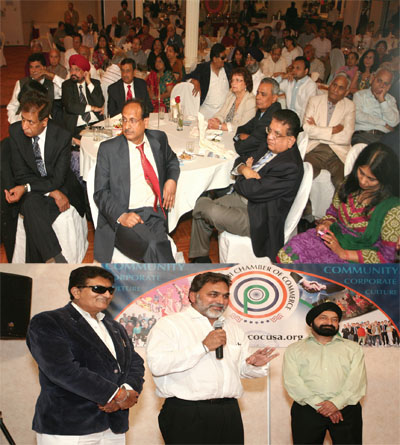
    EDISON, NJ (TIP): A fund raiser to rebuild the flood ravaged Uttarakhand where there has been a massive loss of life and property was organized at Akbar restaurant here on July 12. The fundraiser was organized by New Jersey based entrepreneur and community activist Atma Singh, president of Punjabi Chamber of Commerce who joined hands with other voluntary organizations to raise funds.

    According to the announcement made by Atma Singh at the fundraiser, a total of $10,000 was raised. Singh said, “The amount will be rushed to the Prime Minister Relief Fund at the earliest.” “Indian American population of Central New Jersey responded to my call to extend a helping hand for the disaster affected people of our native land and I am grateful to them”, Singh said.

    A large number of community leaders and public officials attended the event, including Prabhu Dayal, former Consul- General of India, NJ Assemblyman Upendra Chivukula, Edison Mayor Toni Ricigliano and Councilman Dr Sudhanshu Prasad”.

  • God, Move Over

    God, Move Over

    It is time to see technology as a tool and not an end that defines a new fundamentalist religion through which corporations become the new gods.
    Technologies are tools for doing or making things They are a means to transform what nature has given into food, clothing, shelter, means of mobility, means of communication. Technology is a means to an end; it is no an end in itself. But when we stop perceiving technology as a means mediating between nature and human needs and elevate it to an end in itself, we falsely give it the status of a religion.

    The Green Revolution bred seeds to respond to chemical fertilizers -they were called “miracle seeds” The father of the Green Revolution, Norman Borlaug, called the 1 people he sent across the world to spread chemicals by introducing new seeds his “wheat apostles”. This is the discourse of religion, not o science and technology. the Green Revolution was introduced in India in 1965-66, no assessment was made of the impact chemical fertilizer will have on soil organisms, soil structure and the soil’s water-holding capacity.

    No attempt was made to compare the yields of Green Revolution varieties and the outputs of indigenous varieties and mixed farming system When we started to con serve native seeds thro ugh the Navdanya movement in 1987, we found many of the indigenous varieties outperformed the Green Revolution varieties in grain yield They also outperformed them in total biomas yield -this really matters because while the grain is eaten by humans, straw is food for soil organisms and farm animals.

    Our work on mixtures and biodiverse systems of farming shows that as a system, indigenous biodiversity produces more food and nutrition per acre. If we had a scientific approach to making choices about the technologies we use to produce our food, agroecology would win hands down. But the Green Revolution is promoted blindly as a religion, and not on the basis of science.

    Why else would finance minister P. Chidambaram announce in his Budget speech that the Green Revolution, which has destroyed the soil, water, biodiversity of Punjab, would now be expanded to eastern India? Is the government trying to impose the cancer epidemic of Punjab on Bihar, West Bengal, Orissa and Jharkhand? Does it want to deplete and poison the waters of eastern India like it did to the waters of Punjab? Does it want the rich biodiversity of eastern India to disappear like the biodiversity of Punjab has disappeared to create monocultures of rice and wheat? In the language of doublespeak, through a “memorandum of understanding” with biotech corporation Monsanto, the Punjab government is now introducing hybrid maize in the name of “diversification”.

    Substituting one monoculture with another is not diversification, putting more diversity on our farms is. More than 75 per cent of hybrid maize goes for industrial use, especially animal feed. This is not a food system to reduce the hunger of people; it is a system to supply profits for the insatiable greed of corporations and industry. While feeding the hungry is the mantra, the real religion is greed. Genetic engineering is the latest technology being imposed on India and the world as the new miracle.

    There are only three groups of GMO (genetically modified organisms) applications -Bt crops that are supposed to control pests, herbicide resistant crops that are supposed to control weeds, and future promises of biofortification in the form of Golden Rice for addressing Vitamin A deficiency, and GMO bananas for removing iron deficiency. When we assess genetic engineering as a tool that aims to achieve the objectives of reducing pests and weeds or increases Vitamin A and iron, it clearly fails the test.

    GMOs have created superpests and superweeds instead of reducing pests and weeds. Golden rice is 7,000 per cent less efficient in providing Vitamin A and GMO bananas will be 3,000 per cent less efficient in providing iron than alternatives available in our rich but rapidly disappearing biodiversity. GMOs continue to be promoted as a religion in spite of all the evidence that they are failing to do the job they are designed for.

    And as in religious fundamentalism, here also there is intolerance of alternatives – alternative paradigms, alternative approaches to food production and independent science. We are already witnessing the viciousness with which the industry attacks anyone who provides an alternative. The new Seed Legislation introduced by the European Commission on May 6, 2013, is a desperate attempt by the biotechnology industry to criminalize the alternative of open source seeds for farms and gardens in order to establish a monopoly of the seed and biotechnology industry.

    Another example is the attack on scientists whose scientific research has provided evidence of harm. The more the industry claims that the GMO debate is about science, the more they silence science and replace it with their pseudo-religion. Technological determinism replaces technological pluralism. Technological totalitarianism replaces democratic choice and responsibility.

    A consequence of making technology an end rather than a means is ignoring its impacts and failing to take responsibility for the harm it does to nature and people. The ultimate expression of irresponsibility is to create immunity for those who cause harm. A recent example is the Monsanto Protection Act in the US which allows agricultural companies such as Monsanto to ignore court orders against selling genetically-engineered seeds.

    Similarly, the Government of India has prepared a draft bill to establish the Biotechnology Regulatory Authority of India (BRAI). According to the bill, the authority will be an autonomous and statutory agency to regulate the research, transport, import, manufacture and use of organisms and products of modern biotechnology. GMO today means “god move over”.

    But genetic engineering in not a game of lego in which genes can be moved around without any impact on the organism or the environment. It is time to put nature and people back in the technology narrative. It is time to see technology as a tool, and not an end that defines a new fundamentalist religion through which corporations become the new gods.

  • 6 Indian-American kids’ culinary skills feted at White House

    6 Indian-American kids’ culinary skills feted at White House

    WASHINGTON (TIP): Six Indian-American kid chefs have been honored for their fabulous culinary skills by US First Lady Michelle Obama at the White House’s “Kids State Dinner” as part of her initiative to tackle obesity and promote healthy eating among American children.

    Anisha Patel from Ohio, Ganesh Selvakumar from Pennsylvania; Devanshi H Udeshi from Texas; Emma Scielzo from Maryland, Vijay I Dey from North Carolina and Shefali Singh from Massachusetts were among 54 children invited by the First Lady for the event at the White House yesterday where they also had a chance encounter with President Barack Obama. “Now, first of all, usually at a state dinner, I get invited.

    So I don’t know what happened on this one — somehow the invitation slipped through somewhere. But it looks like you guys are having fun,” the President said amid laughter. Selected from over 13,000 contestants nationwide, the six Indian Americans probably constituted the largest number of kids from any ethnic group. So far, Indian Americans have been known for winning various science and math competitions and those like Spelling Bee and Geography Bee.

    “And we’re really proud of you winning this challenge — because, frankly, I’m not a great cook and — I’m not bad, but I don’t do it that much. Its hard to find the time,” the President said. “But when I do cook, I’m following a recipe.

    And to think that all of you have invented all this fabulous food just shows how creative you are and it shows that food that tastes good can be healthy, too,” Obama said. 10-year old Emma Scielzo, a third generation Indian American who attributes her winning recipe of “Chicken Masala Wrap” to her Indian grandparents who immigrated to the US several decades ago from Punjab, was one of three children who were selected to shoot short cooking videos.

  • 6 Indian-American kids’ culinary skills feted at White House

    6 Indian-American kids’ culinary skills feted at White House

    WASHINGTON (TIP): Six Indian-American kid chefs have been honored for their fabulous culinary skills by US First Lady Michelle Obama at the White House’s “Kids State Dinner” as part of her initiative to tackle obesity and promote healthy eating among American children. Anisha Patel from Ohio, Ganesh Selvakumar from Pennsylvania; Devanshi H Udeshi from Texas; Emma Scielzo from Maryland, Vijay I Dey from North Carolina and Shefali Singh from Massachusetts were among 54 children invited by the First Lady for the event at the White House yesterday where they also had a chance encounter with President Barack Obama.

    “Now, first of all, usually at a state dinner, I get invited. So I don’t know what happened on this one — somehow the invitation slipped through somewhere. But it looks like you guys are having fun,” the President said amid laughter. Selected from over 13,000 contestants nationwide, the six Indian Americans probably constituted the largest number of kids from any ethnic group.

    So far, Indian Americans have been known for winning various science and math competitions and those like Spelling Bee and Geography Bee. “And we’re really proud of you winning this challenge — because, frankly, I’m not a great cook and — I’m not bad, but I don’t do it that much. Its hard to find the time,” the President said. “But when I do cook, I’m following a recipe.

    And to think that all of you have invented all this fabulous food just shows how creative you are and it shows that food that tastes good can be healthy, too,” Obama said. 10-year old Emma Scielzo, a third generation Indian American who attributes her winning recipe of “Chicken Masala Wrap” to her Indian grandparents who immigrated to the US several decades ago from Punjab, was one of three children who were selected to shoot short cooking videos.

  • Ishrat Jahan case: CBI gets closer to Modi, may quiz Amit Shah

    Ishrat Jahan case: CBI gets closer to Modi, may quiz Amit Shah

    NEW DELHI (TIP): The CBI, probing the June 2004 fake encounter deaths of Mumbai college student Ishrat Jahan and three other terror suspects in Ahmedabad, is likely to examine the then state home minister Amit Shah to verify if he had known about the conspiracy. The agency will take Shah’s version for the first time as part of the probe, after filing its charge sheet in the case early next week, according to a CBI source. “There is a suspicion that a case accused was in touch with Shah before and after the incident telephonically, the records of which we are verifying.

    We may examine him after filing our charge sheet, which will be followed by a supplementary charge sheet,” he said. The agency may charge sheet Intelligence Bureau’s special director Rajinder Kumar, a 1979 batch Indian Police Service officer who was posted in Gujarat from 2001 to 2005, without seeking a prosecution sanction from the home ministry. “We don’t need any prosecution sanction to charge sheet the IB officer since sanction under section 197 of the CrPC is mandatory only if the crime is committed as part of the government servant’s official duties. This was a fake encounter, orchestrating it wasn’t part of his official duty,” he said. “No prosecution sanction was required to charge sheet senior police officers accused in fake encounter probes in Punjab,” said the source. A home ministry source, however, said that CBI’s evidence only indicated that Kumar was in the loop, not conspired to murder.

  • US Sikh Group Offers $10,000 To Deliver Summons To Badal

    US Sikh Group Offers $10,000 To Deliver Summons To Badal

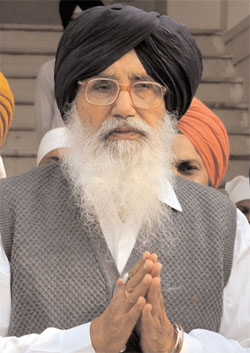
    MILWAUKEE (TIP): Punjab chief minister Parkash Singh Badal is expected to visit Wisconsin next week, and a Sikh group accusing him of human-rights violations is offering $10,000 to anyone who serves him with a federal summons while he’s here. The New York-based advocacy group Sikhs for Justice has filed two federal lawsuits in Milwaukee against Badal. The first lawsuit was thrown out in May over conflicting reports about whether the person served with court papers was actually Badal.

    The group plans to be far more diligent this time. Badal is expected to be in Milwaukee on July 5 for a wedding, and the group has hired three agencies of professional servers to deliver the papers. The servers plan to stake out airports in Milwaukee and Chicago. They’ll try to track him down at the wedding venue, and they’ll look for him at all points in between. Their goal is to deliver a court summons, which can be handed to him or even dropped at his feet. “We are not taking any chances this time,” said Gurpatwant Pannun, legal adviser for Sikhs for Justice.

    “We want to have a photograph and, if possible, video” of Badal being served. Pannun said the chief minister commands a police force that has terrorized and tortured countless people, including the lawsuit’s three plaintiffs. The lawsuit also names Badal’s son, Sukhbir, as a defendant. Sukhbir is Punjab’s deputy chief minister, in which capacity he also oversaw and condoned the detainment and torture of political prisoners, the suit contends.

    Harcharan Bains, who is Badal’s media adviser, would not confirm whether his client will be in the US next week. “We will give a legal response to the summons” if papers are served, Bains said. “The case against Badal is politically motivated but our response will be strictly in accordance with the law.” Badal was represented in the first lawsuit by former federal prosecutor Steven Biskupic, who did not immediately return a message seeking comment.

    Even if papers are served, the Badals could return to India and refuse to attend any US hearings. But Pannun said it wouldn’t bother him if the defendants were convicted in absentia. “That’s fine,” Pannun said. “This will expose them,” he said. Sikhs for Justice will pay separate $10,000 rewards for serving each of the defendants. Anyone _ not only professional servers _ can claim the bonus. The group planned to post a copy of the one-page summons online so anyone could download it and serve one or both defendants.

    The bonus will go to whichever person’s service is considered valid by the federal court in Milwaukee. The civil lawsuit lays out allegations by three Sikhs who say they were detained in Punjab for days without charges and subjected to beatings by a police force overseen by the Badals. All three plaintiffs now live in Fresno, California. Jeet Singh said he was detained four times between 2001 and 2009 for a total of 48 days. He claimed he was waterboarded and beaten with leather belts and that wooden rollers were applied on his legs and thighs.

    His wife, Gurdeep Kaur, said she was detained for 30 days in 2001, during which time male and female officers slapped her and banged her head against a wall. Jagtar Singh alleged he was given electric shocks on his ears, laid on an ice slab and doused in cold water. He also said he was beaten with wooden sticks and leather belts and tied in a wooden trap for extended periods. The lawsuit says the Badals not only condoned the acts but rewarded some of the officers involved.

    Sikhs for Justice initially tried to serve Badal when he visited suburban Milwaukee last year. He was in town following a shooting rampage in which a white supremacist opened fire at a Sikh temple, killing six people. But a man who said he was at the event as an interpreter testified that the papers were handed to him, not to Badal. A judge concluded that the process servers who believed they served Badal made an “honest mistake”.

  • Emaar MGF Receives Rs 8.6k Crore Fine Notice

    Emaar MGF Receives Rs 8.6k Crore Fine Notice

    NEW DELHI (TIP): Realty giant and Commonwealth Games Village builder Emaar MGF was on Tuesday slapped with a show-cause notice of Rs 8,600 crore by the Enforcement Directorate for violating Foreign Exchange Management Act (FEMA). The company is alleged to have diverted FDI money to buy thousands of acres of agricultural land in violation of FEMA and FDI rules and could face a penalty in excess of Rs 25,000 crore.

    Significantly, the development comes on a day the Union Cabinet approved the Real Estate Regulators Bill. Sources said the company had used a modus operandi similar to as alleged in the case of Walmart, under investigation by the ED for diverting FDI money to retail sector through various subsidiaries. Emaar MGF allegedly used a maze of subsidiaries through which it diverted FDI money — brought in for investment in construction projects — to buy agricultural land. ED first raided 13 premises of the company here and elsewhere in 2009 in connection with the case and had seized several documents and large amounts of cash.

    Investigations then found that almost 70% of the company’s land bank was agricultural land. Out of over 12,000 acres of land bank with the company, close to 8,500 acres were found to be agricultural, most of which is alleged to have been bought by FDI money. The firm is also alleged to have floated over 300 companies as subsidiaries in India and abroad with several of its lowgrade employees listed as directors. Some of these companies were allegedly used to divert FDI into agricultural land bought around Delhi, Haryana , Punjab and Uttar Pradesh.

  • PROMINENT LEGAL LUMINARIES OF INDIAN ORIGIN IN THE US

    PROMINENT LEGAL LUMINARIES OF INDIAN ORIGIN IN THE US

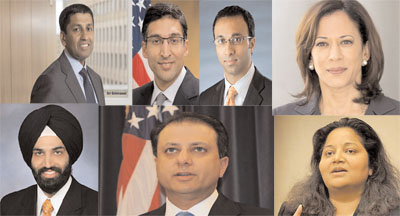
    WASHINGTON (TIP): Recently, Indian-American Srikanth Srinivasan scripted history after he was confirmed as the first South Asian judge to America’s second highest court. But Srinivasan is not the only famous person of Indian origin who has made it to the top ranks in US judicial system.
    Srikanth Srinivasan was appointed as a judge on the prestigious US Court of Appeals in Washington DC, the highest judicial appointment achieved by an Indian-American. Born in Chandigarh, Srinivasan spent nearly two decades as an extraordinary litigator before serving as Principal Deputy Solicitor General of the United States. Now he will serve with distinction on the federal bench. Srinivasan will be the first South Asian American to serve as a circuit court judge in US history.
    Preet Bharara, who was born in Punjab, is the US attorney for the Southern District of New York. In 2012, Bharara was named by Time magazine as one of ‘The 100 Most Influential People in the World’ and was also featured on a cover of Time Magazine. His office was responsible for the high-profile prosecutions of insider trading and other financial fraud on Wall Street including the investigation against the Galleon Group of Raj Rajaratnam and former McKinsey chief Rajat Gupta. Bharara graduated from Harvard College and Columbia Law School.

    Neal Katyal served as Acting Solicitor General of the United States from May 2010 until June 2011. A graduate of Dartmouth College and Yale Law School, Katyal currently runs the appellate practice at the law firm Hogan Lovells and teaches at the Georgetown University Law Center, where he was one of the youngest tenured professors in the university’s history. Katyal has served as counsel or co-counsel for numerous US Supreme Court cases.

    Amit Mehta, an Indian-origin lawyer, is a partner at Washington law firm Zuckerman Spaeder, and has been involved in many big cases, including helping former IMF president Dominique Strauss-Kahn successfully get criminal assault charges in New York state court dismissed. Mehta, 39, is also a board member of the Mid-Atlantic Innocence Project, which seeks to reverse and prevent wrongful convictions in DC, Maryland and Virginia.

    Preeta D. Bansal served as the General Counsel and Senior Policy Advisor to the US federal Office of Management and Budget from 2009 until 2011. Before her assignment in the Obama administration, she served as a law partner at Skadden, Arps, Slate, Meagher & Flom

    Amandeep Sidhu is a partner of law firm McDermott Will & Emery in Washington DC. He has built a reputation as a strong litigator with a solid commitment to pro bono cases. He is a founding member of The Sikh Coalition and has fought a pro bono battle on behalf of three Sikh men who wanted to serve in the US Army. He was able to successfully show that the men were able to meet uniform requirements by using Army-issued cloth for the turbans and that even with a beard, the men could not only use a gas mask effectively, but surpass their clean-shaven comrades in field tests. Eventually the men were allowed to join the service, but Sidhu said that he would settle for nothing less than a policy change.

    Kamala Devi Harris is the Attorney General of California following the 2010 California state elections. Earlier she had served as District Attorney of San Francisco from 2004 to 2011. Recently, US President Barack Obama apologized to Kamla Harris, for his comment in which he described the Indian-American as the best-looking attorney general of America – which many alleged was a sexist remark.

  • Spot-fixing money paid to Sreesanth seized in Mumbai

    Spot-fixing money paid to Sreesanth seized in Mumbai

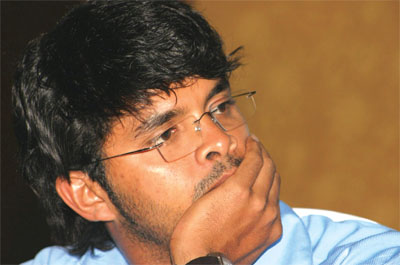
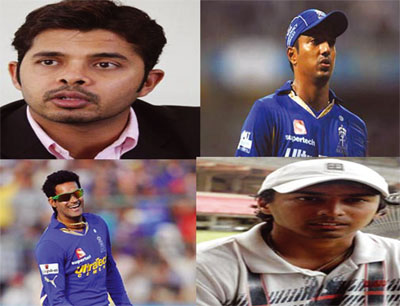
    NEW DELHI (TIP): With the recovery of Rs 5.5 lakh from an apartment in Mumbai, the Delhi Police has claimed to have taken account of the entire money allegedly paid to arrested cricketer Sreesanth for spot-fixing by bookies. The recovery was made on the basis of information provided by Sreesanth’s friend Abhishek Shukla, who was arrested on Wednesday. Shukla was arrested for allegedly hiding Sreesanth’s electronic gadgets and the money that was paid to him by the bookies. He was granted bail by a Delhi court.

    Shukla took Delhi Police officials to his apartment at Lokhandwala in Mumbai and an amount of Rs 5.5 lakh, allegedly belonging to Sreesanth was recovered. In an IPL match between Rajasthan Royals and Kings XI Punjab in Mohali on May 9, a Rs 40-lakh deal was struck with Sreesanth for conceding a specified number of runs in an over. Sreesanth was playing for Rajasthan Royals.

    The bookies gave Rs 10 lakh to Sreesanth’s friend Jiju Janardhan. The cricketer later received the money. The investigators have also claimed to have recovered four bills, which showed that Sreesanth spent Rs 7.33 lakh by credit card and cash in Jaipur and Mumbai. The payments were made a few days before his arrest. The first bill is for Rs 1.7 lakh while the second one is for Rs 1.58 lakh.

    In both case, Rs 1 lakh was paid through credit card and the rest by cash. The third bill is for Rs 2.1 lakh, out of which Rs 2 lakh was paid through credit card and the remaining in cash. The three bills purportedly showed that the money was spent in Jaipur. The fourth bill for Rs 1.95 lakh, dated May 14, is from “Diesel” store in Mumbai. “On that day, Sreesanth had paid Rs 1.95 lakh for buying denims and other articles from Diesel store. Shukla was handling the money.

    After the purchases, Shukla took the money in a black bag to his Lokhandwala apartment,” police sources said. Shukla reportedly wanted to become Sreesanth’s agent. He first met the cricketer in Bangalore about six years ago. The Delhi Police had earlier claimed that immediately after Sreesanth’s arrest, Jiju had given Rs 2 lakh to Shukla. The money was taken from the cricketer’s room in Mumbai.

    After Sreesanth’s arrest, his friend Rajiv was directed by the police to call Jiju and tell him to arrive at Hotel Intercontinental in Mumbai. Investigators claimed Jiju then spoke to someone in Malyalam over the phone. The police has obtained intercepts of the telephonic conversation.

  • SPOT-FIXING PROBE REACHES DOORSTEP OF BCCI CHIEF’S FAMILY

    SPOT-FIXING PROBE REACHES DOORSTEP OF BCCI CHIEF’S FAMILY

    CHENNAI/MUMBAI (TIP): The IPL fixing scandal has reached the doorstep of Indian cricket’s powerful boss and Chennai Super Kings (CSK) owner N Srinivasan’s family — quite literally. A day after a report about the police investigating Srinivasan’s son-in-law and CSK CEO Gurunath Meiyappan’s phone conversations with Dara Singh’s son Vindu for possible links with a betting syndicate, a fivemember crime branch team from Mumbai arrived in Chennai on May 23 morning to serve summons on Meiyappan.

    They first went to the headquarters of Srinivasan-controlled India Cements, and on finding no one there, stuck a copy of the summons on the door before going to Meiyappan’s home around 2pm to instruct him to present himself before the CB between 11am and 5pm within 24 hours. But with no member of the family available to meet the team, they were initially not let in by the guard; after several phone calls, they were allowed into the compound.

    Rama Subbu, the chief security officer of India Cements, arrived soon thereafter and was seen signing a paper which the officers handed him. Strangely though, on his way out, he denied having received any summons on behalf of Meiyappan. Later in the evening, the crime branch is reported to have received a one-page fax from Meiyappan saying he was out of town and seeking time till Monday, with the assurance that he would appear in person. A top police officer said night that no decision had been taken on whether to allow him the extra time.

    If the police were to reject such a request, which seems unlikely, Meiyappan could be arrested. The whereabouts of the 35-year-old continued to be shrouded in mystery with speculation placing him variously in Kodaikanal (where he has a holiday home), Kolkata (where CSK plays the IPL finals on Sunday against the winners of the Mumbai Indians vs Rajasthan Royals match) and Delhi (to prepare his legal defence with top-flight lawyers).

    Nor is there any word as to where the BCCI chief might be although New Delhi was abuzz with rumours that he would leverage his considerable clout to counter what his supporters consider a “politicallymotivated conspiracy to discredit him”. On May 16, the day Sreesanth and his two Rajasthan Royals were arrested, Srinivasan had said, “One or two bad eggs cannot sully the game,” before stating, on further questioning, “I hope nobody else is involved, but if information comes to BCCI, we will act immediately.”

    I was close to Bhajji, Virat: Vindu Dara Singh MUMBAI (TIP): Vindu Dara Singh has told Mumbai police that he knew several players but was close to Virat Kohli, Harbhajan Singh, and Manpreet Gony. Gony, who now plays for Kings XI Punjab, played one-dayers for India while he was with Chennai Super Kings in 2008. Police said they are yet to come across anything that links the three players to Vindu’s betting racket. Vindu also revealed the names of Bollywood celebrities who bet on IPL matches.

    He acted as a middleman, placing bets on their behalf with bookies. He said he came in contact with the betting syndicate several years ago through a friend, Anand Saxena, who introduced him to Ramesh Vyas and Shobhan Mehta, both big bookies. He got to know Sreesanth through Ajit Chandila and some Delhi-based bookies.

  • Police book Honey Singh for singing lewd songs

    Police book Honey Singh for singing lewd songs

    NAWANSHAHR (TIP): Three days after Punjab and Haryana high court rapped Punjab government for not taking action against controversial singer Honey Singh, Punjab police on Friday registered an FIR against him at the Nawanshahr police station.

    The singer has been booked under Section 294 of the IPC (obscene acts and songs) for crooning vulgar songs, one of which is titled ‘Main Hoon Balatkari’ (I’m a rapist). The high court on May 14 had pulled up the Punjab government and asked it to get tough with the Hoshiarpur-born singer, who already has a similar police case registered against him in Lucknow.

    “We have started collecting evidence against the singer regarding the case and our next course of action will depend entirely on what we lay our hands on,” said Nawanshahr SSP Dhanpreet Kaur. Police registered the case on the complaint of Parvinder Singh Kitna, a local resident, who also heads an NGO. The complaint was filed in January but at that time, the police had refused to register a case, prompting Kitna to move the HC seeking ban on playing and sale of vulgar songs in the state. According to the FIR, Honey’s songs were crossing all barriers of decency and his one particular song – ‘Mein Hoon Balatkari’ — even provoked sexual violence against women.

    Honey and some of his songs had come under the spotlight in the wake of Nirbhaya gang rape case for use of sexist lyrics and commodifying women. The singer had faced flak from various quarters. Some of his programmes were forcibly cancelled when the entire nation was shocked over Nirbhaya’s plight. Conviction under Section 294 of the IPC can lead to imprisonment, which may extend up to three years. Meanwhile, the high court has also directed Honey to appear before it on July 4, when the case will come up for hearing again.

  • Zardari Agrees To Restore Cj To Office

    Zardari Agrees To Restore Cj To Office

    In March 2009, growing demonstrations led Zardari to agree to restore the chief justice to office; the government also subsequently announced it would appeal the banning of Sharif and his brother from politics. The supreme court overturned the ban in May, and in July it ruled that Musharraf’s emergency rule had been unconstitutional and illegal. In April, the government received pledges of .2 billion in foreign aid (over two years) to help finance social programs.

    As government forces moved to restore control over areas near Swat, the situation in Swat deteriorated, and in May the military mounted a major offensive against the militants there. In subsequent weeks Islamic militants in response mounted a number of suicide bomb attacks in Pakistani cities, and fighting also intensified in S and N Waziristan and other areas.

    Some 2 million people were displaced by the fighting. The fighting in Swat was declared largely over by late July and by September four fifths of the residents had returned to Swat. Militant attacks continued in Pakistani cities, however, and in Oct., 2009, the military launched a major offensive against militants based in S Waziristan; after some two weeks of fighting militants largely pulled back, ceding most of their main bases to the military by mid-November. In Mar., 2010, an offensive was launched in Orakzai agency in the Tribal Areas, against militants believed to have fled there from S Waziristan; some 200,000 people were displaced by the fighting.

    Fighting continued also in Bajaur and other parts of the Tribal Areas. In Dec., 2009, the supreme court ruled illegal a 2007 Musharraf decree that had declared an amnesty on corruption cases. Benazir Bhutto and the PPP had sought the amnesty in order to end prosecutions begun under Prime Minister Sharif that they asserted were politically motivated, but some 8,000 government officials, politicians, and others were ultimately absolved by the decree.

    The court also called for any case that was derailed by the decree to be reopened. Pakistan and India resumed talks in Feb., 2010; it was the first meeting since the 2008 Mumbai attacks, and agreed a year later to restart formal peace talks. In Apr., 2010, Pakistan adopted constitutional changes that reduced the powers of the president and increased those of the prime minister and parliament, making the president a largely ceremonial head of state; the powers of the provinces were also increased, and the North-West Frontier Province was renamed Khyber Pakhtunkhwa.

    Beginning in late July, the monsoon season resulted in devastating floods of unprecedented proportions along the Indus and its tributaries that impacted, to a greater or lesser degree, all of the country’s provinces and submerged roughly one fifth of its land area. Some 20 million people, the vast majority of them farmers, were affected by the floods, which continued in some areas through September. Some 1,800 died, and the damage was estimated at .7 billion.

    Zadari, who left the country during the crisis, was increasingly unpopular as a result, and the scale of the disaster overwhelmed the government’s ability to respond. Pakistan’s government, which was in financial difficulties before the floods, was faced with estimated rebuilding and recovery costs of billion. By December the financial difficulties threatened the government when the Muttahida Qaumi Movement (MQM) withdrew from the governing coalition over an impending fuel price increase.

    Prime Minister Gilani was forced to roll back the increase in early January in order to regain MQM’s support, and a sales tax overhaul—a condition imposed by the IMF for the release of additional loans—was postponed. The first week of January also saw the assassination of the governor of Punjab because of his support for reforms to Pakistan’s blasphemy laws; in March the minorities minister was similarly killed. In May, 2011, Osama bin Laden, who was in hiding in Abbottabad, Pakistan, was killed there by U.S. commandos, leading to tense relations between Pakistan and the United States; in July the U.S. government announced significant cuts in U.S. aid to Pakistan.

    In Sept., 2011, severe monsoon flooding again hit the country, mainly in Sind. Relations with the United States were further strained in November after U.S. forces, under unclear circumstances during nighttime operations, launched deadly air attacks on Pakistani forces by the Afghanistan border.

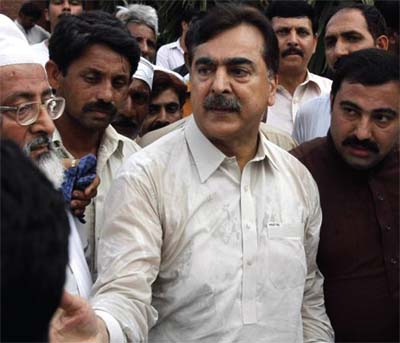
    In early 2012 the Pakistani supreme court sought to force the prime minister to ask Swiss officials to reopen a corruption case against President Zadari; the case was among those affected by the 2007 amnesty that the court overturned in 2009. Prime Minister Gilani refused, arguing that the president had immunity, leading the court to convict Gilani of contempt in Apr., 2012. The court then disqualified Gilani as a member of parliament and prime minister in June. Raja Pervez Ashraf, the minister for water and power and a PPP member, subsequently succeeded Gilani as prime minister; Ashraf subsequently also refused to ask the Swiss to reopen the Zadari corruption case.

    Ashraf’s arrest, on corruption charges relating to his previous post, was ordered by the supreme court in Jan., 2013, but anticorruption officials called the charges questionable and refused to arrest him.

    Historic elections
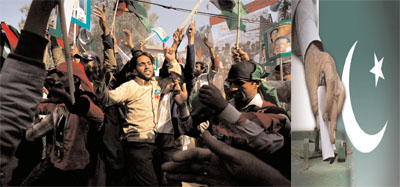
    May 11, 2003, saw historic elections in Pakistan. Despite the violence in the run-up to the elections, which saw regular bomb blasts and the kidnapping of the son of a former prime minister, May 11 votes marked the first time the country has transitioned from one democratically elected government to another. Former Prime Minister Nawaz Sharif is expected to be the new prime minister, based on preliminary results.

    KEY EVENTS IN PAKISTAN’S POLITICAL HISTORY
    -Aug. 14, 1947: Pakistan is founded when British rule over the region ends and the Asian subcontinent is partitioned into Islamic Pakistan, divided into East and West, and predominantly Hindu India.
    -Sept. 11, 1948: Pakistan founder Muhammad Ali Jinnah dies.
    -Oct. 16, 1951: Pakistan’s first prime minister, Liaquat Ali Khan, assassinated in gun attack, triggering political instability.
    -Oct. 27, 1958: Pakistani army chief Mohammed Ayub Khan seizes power.
    -March 25, 1969: After months of opposition rioting in West and East Pakistan, Mohammed Ayub Khan hands over power to army chief Gen. Yahya Khan.
    -Dec. 7, 1970: East Pakistan-based Awami League wins general elections. In response, Yahya Khan suspends the government, triggering widespread rioting in East Pakistan. Civil war breaks out in the wake of army action.
    -Dec. 16, 1971: Pakistan troops surrender in East Pakistan after India’s intervention in the civil war. East Pakistan becomes independent Bangladesh.
    -Dec. 20, 1971: Yahya Khan resigns, Zulfikar Ali Bhutto becomes president. A parliamentary system of government is adopted later, and Bhutto becomes prime minister.
    -July 5, 1977: Pakistani army chief Gen. Mohammed Zia ul-Haq seizes power.
    – April 4, 1979: Bhutto hanged after Supreme Court upholds his death sentence on charges of conspiracy to murder and Zia rejects his mercy petition.
    -Aug. 17, 1988: Zia dies in a mysterious plane crash.
    -December 2, 1988: Bhutto’s daughter Benazir becomes Pakistan’s first woman prime minister.
    -Aug. 6, 1990: Ms. Bhutto’s government dismissed amid charges of corruption and mismanagement.
    – Nov. 1, 1990: Nawaz Sharif becomes prime minister following election.
    -April 18, 1993: President Ghulam Ishaq Khan dismisses Sharif’s government on corruption charges but the Supreme Court revokes the order and reinstates Sharif.
    -July 18, 1993: Due to serious differences between President Khan and Prime Minister Sharif, then-army chief Gen. Waheed Kakar forces both to resign.

  • Return Of The Tiger

    Return Of The Tiger

    NAWAZ SHARIF IS PAKISTAN’S NEW CAPTAIN
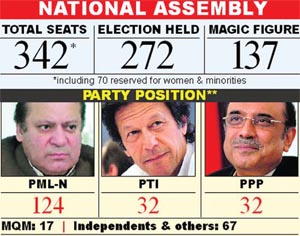
    ISLAMABAD (TIP): The Pakistan Muslim League-Nawaz (PML-N) is all set to form government in Islamabad as it has acquired majority in the National Assembly after as many as 17 independent winners of NA seats joined the Nawaz Sharif-led party. The News quoted sources as saying that a party meeting would be convened during the next two days to discuss formation of Cabinet. Nawaz’s brother Shahbaz Sharif met Jamiat Ulema-i-Islam-Fazl chief Maulana Fazlur Rehman and invited him to join the government in Islamabad. However, Fazl sought time to seek consent of his party’s central committee.

    The sources said that Fazl failed in convincing Sharif to form coalition government in Khyber Pakhtunkhwa, where Imran Khan’s Pakistan Tehreek Insaf (PTI) emerged as the largest party in May 11 polls. Toppled in a 1999 military coup, jailed and exiled, Pakistan’s Nawaz Sharif has made a triumphant election comeback and is certain to become the Prime Minister for a third time. The Pakistan Muslim League- Nawaz (PML-N) has taken an unassailable lead in the landmark elections with its main rivals — former cricketer Imran Khan’s Tehrik-i-Insaf (PTI) and the Pakistan People’s Party (PPP) — trailing far behind.

    To win a simple majority, a party or coalition would have to bag 137 of the 272 National Assembly seats for which polls were held. Another 70 seats in the 342- member National Assembly are reserved for women and minorities. Sharif is set to return to power at a time when Pakistan is facing several major challenges, including growing extremism, a strong Taliban presence in the country’s northwest, rampant corruption, uneasy relations with the US ahead of the withdrawal of foreign forces from war-torn Afghanistan and an economy that has virtually been in free fall for the past few years. Sharif ’s party is also set to form the government in the Punjab province where it was leading in 204 seats out of 304. The PTI was unexpectedly trailing far behind in Punjab though it was bracing for forming government in that province.

    Sharif won reminding people of the path of progress on which the country was moving under his rule in 1990s and five years of good governance under his brother Shahbaz Sharif in Punjab after the 2008 polls. During his rallies, Sharif blamed the PPP for crippling power outages that hit Punjab most, paralysing its industry, disrupting social and economic life and rendering millions of factory workers unemployed. Amid wave that he will be the next premier, influential politicians who had been shifting parties in the past, moved in a big way to join the PML-N giving it a major victory.

    img21

    The PML-N also got the backing of business houses, the middle class, factory workers and rural poor. Imran fascinated and motivated millions of youth, and educated middle class which turned up to vote in large numbers. Imran, who pledged to eliminate corruption, devolve power to lowest level in villages, recast relations with US, collect taxes from rich and run clean austere government, won on three seats — Peshawar, Rawalpindi and home district Mianwali — of the four he contested. He, however, lost to his former party loyalist Ayaz Sadiq of PML-N in Lahore.

    Sharif and Shahbaz Sharif won handily on two seats each and so did PTI’s president Javed Hashmi while its chairman Shah Mahmood Qureshi lost on both seats he contested. The PPP was routed in Punjab and was the case of its ally, ANP in Khyber Pakhtunkhawa, where its president Asfandyar Wali Khan also lost. Rudderless and leaderless, it failed to conduct any election campaign in the country. The Bhutto name, however, won for it Sindh province. It newly appointed presidents Manzoor Wattoo in Punjab and Anwar Saifullah in KP lost. The party could win only one National Assembly seat in Punjab. Former Prime Minister Raja Pervez Ashraf was also demolished badly. Individually, former minister Shaikh Rashid won in Rawalpindi with the PTI help and Ejazul Haq, son of ex-military dictator Ziaul Haq, won in Bahawalnagar.

  • Democracy wins, federation loses

    Democracy wins, federation loses

    While Nawaz Sharif has won the election decisively, he faces the challenge of reaching out beyond his main base in Punjab to the rest of Pakistan
    Pakistan achieved a historic landmark with the completion of its five-year term by the civilian coalition government led by the Pakistan Peoples Party (PPP) and the successful completion of elections resulting in the clear victory for Nawaz Sharif’s Pakistan Muslim League (PML-N). The election results, surprising for many, point to the challenges ahead for the country. Although the PML won enough seats to be able to form the government without having to bargain too much with too many factions, its success comes entirely through the support of one ethnic group – the Punjabis. Every Pakistani province appears to have chosen a different party to represent it. The overall high turnout nationwide masks the harsh reality that very few people voted in Balochistan, where alienation from the centre has been growing.

    Ethnicity
    There is no doubt that people voted out the incumbents amid questions about their performance. But the virtual wiping out of the PPP in Punjab means that each Pakistani political party now reflects the dominant sentiment of a particular ethnic group. The PPP was the only party that had representation from all four provinces of Pakistan in the outgoing Parliament. The election result may be a step forward for Pakistani democracy. It is a step backward for the Pakistani federation. Given the history of complaints about Punjabi domination, Nawaz Sharif will have to reach out to the leaders of other provinces. Authoritarian rule has undermined national unity in the past because of Punjab’s overwhelming supremacy in the armed forces, judiciary and civil services.

    Democracy should not breed similar resentment among smaller ethnic groups through virtual exclusion from power at the centre. In addition to bringing the provinces other than Punjab on board, Sharif’s other major headache would be to evolve a functioning relationship with Pakistan’s military establishment. Although he rose to prominence as General Zia-ul Haq’s protégé, Sharif clashed with General Pervez Musharraf over civilian control of the military. He might be tempted to settle that issue once and for all, partly because of the sentiment generated by his overthrow and imprisonment by Musharraf. Changing the civil-military balance in favor of the civilians would be a good thing. But if it is done without forethought and caution, it could end up risking the democratic gains of the last several years. The PML-N’s view of Pakistani national identity being rooted in Islam and the two-nation theory does not differ much from that of the Pakistani establishment. His real difference with the establishment is over his belief that he, as the elected leader, and not the military must run the country.

    Foreign policy
    Sharif has publicly stated his intention to pick up the threads of the peace process he initiated with Atal Behari Vajpayee in 1999. That process was undermined by the Kargil war, which Sharif now says was initiated by Musharraf without his authority. There can be no assurance that the establishment will let Sharif move forward over changing Pakistan’s posture towards Afghanistan and India, something it did not allow the PPP-led coalition to pursue. Moreover, having been elected with the support of hardline conservative Punjabis, how far can Sharif go against the wishes of his base? During the election campaign, Sharif said little about Afghanistan. In his previous two terms he maintained close ties with the United States but did nothing against the jihadi groups.

    It was under Sharif’s rule that Pakistan officially recognized the Taliban regime and established diplomatic relations. This time, he has spoken of good relations with the West but his voters are overwhelmingly anti-American. The best he might be able to do on foreign policy would be to say the right things publicly without making tough policy decisions. The Punjab electorate, in particular, and some parts of Khyber-Pukhtunkhwa were clearly swayed by a hypernationalist tide, with tinges of Islamist grandiloquence.

    Sharif’s PML-N and Imran Khan’s PTI used similar hypernationalist, anti-American language about Pakistan no longer asking the West for aid. Both parties courted Islamist extremists to bolster their respective vote banks. It might be difficult for them to get off that tiger any time soon. The National Assembly seat break-up is skewed in favor of one province, the largest province of Punjab. Punjab sends 148 general and 35 women’s seats or a total of 183 out of 342 seats which is more than half the seats in the lower house of Parliament.With deep ethnic, linguistic and economic diversity among the provinces, with trust between the provinces being at an all-time low and with the challenge of terrorism facing the country, there is a need for Mr. Sharif to show statesmanship and to appeal beyond his urban Punjabi base.

    Other players
    Sharif is not the only one facing challenges. The PPP has suffered a national setback but has held onto its base in Sindh. It is now time for the party to look inwards and understand that the country has changed. It is growing more urban and Sindh is also doing so. The party is down but not out. It will have to reinvigorate itself by asserting its liberal, social democratic roots. Like the Congress in India, it can continue to seek unity in leadership from the family of Zulfikar Ali Bhutto and Benazir Bhutto. But it has to be a party that is not dismissed as a family enterprise. As for Imran Khan, he achieved a breakthrough by mobilizing disenchanted, apolitical youth. But if he seeks to remain relevant he must realize that there is more to politics than slogans and catch-all phrases. Railing against corrupt and patronage-based politicians is one thing, offering a viable democratic alternative is quite another.

  • Mumbai Indians look to preserve dominance

    Mumbai Indians look to preserve dominance

    Sitting comfortably at the top of the table, Mumbai Indians have done enough to cement their place in the playoffs. In their last match of the league round against Kings XI Punjab, they would want to carry their winning momentum before meeting Chennai Super Kings in the first qualifier. As formidable as they appear, their opponents would have made note of how the Mumbai batsmen managed just 34 runs in the last five overs against Royals.

    Prior to that match, against Sunrisers Hyderabad, Mumbai’s batting was struggling until Kieron Pollard came in and thwarted Sunrisers with a blistering innings. Sachin Tendulkar, who missed the previous game, has been declared fit* but could still sit out the game. “The games are coming thick and fast and it has been just three days since he sprained his wrist,” Anil Kumble, the Mumbai Indians mentor, said. “Though he has recovered, he will probably give the match here a miss.” Local boy Rishi Dhawan might also find a place in the side.

    Sunrisers’ victory over Rajasthan Royals put Kings XI out of the reckoning for the playoffs spot. With their tournament drawing to a close, Kings XI would like to register one last win and beating a highprofile team like Mumbai would certainly please their fans. In the spotlight Adam Gilchrist’s announcement of his retirement from the IPL at the end of the season evoked a sense of déjà vu, just like his batting over the last couple of games. Having scratched around for form in the early part of the tournament, his innings have been crucial to the side’s wins in the last two games. Will Glenn Maxwell get an extended run? Or will he make way for Dwayne Smith? IPL 2013’s most expensive player didn’t last for too long in his first outing as an opener for Mumbai this season.

    He dominated the bowlers for as long as he was at the crease, but his wicket came after he had gotten off to a good start. For all the hype that surrounds his selection, the team will be expecting more runs from him. Stats and trivia Among Kings XI batsmen, Shaun Marsh has scored the most runs against Mumbai Indians, scoring 337 in 7 matches.

    Adam Gilchrist is the most successful wicket-keeper in the IPL with 66 dismissals in 79 matches.Kings XI’s lowest total in IPL – 87 – came against Mumbai in 2011.

    TEAMS MAT WON LOST TIED N/R PTS
    Mumbai Indians 15 11 4 0 0 22
    Chennai Super Kings 16 11 4 0 0 22
    Rajasthan Royals 15 10 6 0 0 20
    Sunrisers Hyderabad 15 9 6 0 0 18
    Royal Challengers Bangalore 15 8 7 0 0 16
    Kings XI Punjab 15 7 8 0 0 14
    Kolkata Knight Riders 15 6 9 0 0 12
    Delhi Daredevils 15 3 12 0 0 6
    Pune Warriors 15 3 12 0 0 6
  • Congress, SAD supporters die in clash

    Congress, SAD supporters die in clash

    AMRITSAR (TIP): A day after one person was killed at a poll rally in Bathinda district, two more — a SAD and a Congress supporter — were gunned down on May 17 at Chakk Mishri Khan village in Amritsar during a clash between two groups. Zila parishad and block samiti polls will be held in Punjab on May 19. Tension was brewing between two groups in the village over a consensus to elect the village sarpanch.

    Though police said the clash was a result of an old rivalry between two families and the immediate trigger was a dispute related to two kanals and 13 marlas of land, the prime accused in the case is Jagir Singh — SAD sarpanch of the village. The father of a member of the rival group, Manjit Singh, is likely to run for polls to the sarpanch’s post. Following the incident,along with Jagir Singh, two others — Mangat Singh and Major Singh — who allegedly accompanied him, were arrested.

    Eleven others were booked in the case. The deceased have been identified as Gurjinder Singh (45), a Congress supporter, and Balkar Singh (in his early 20s), a SAD supporter. “The accused used a .12 bore weapon to kill Gurjinder. He was shot in the chest and died on the spot. We have recovered the weapon,” Border Range IG Ishwar Chander said. Balkar, on the other hand, died of a bullet injury in his left ribs. Chander added that in 1966, Jagir, his brother and some others had murdered Gurjinder’s uncle Dalip Singh. “The immediate trigger was a land dispute. Jagir Singh, accompanied by a number of persons, had headed towards the house of Manjit Singh. When Gurjinder tried to intervene, he was shot dead…

    The murders had nothing to do with the block samiti and zila parishad polls. The block samiti candidate has already been elected unanimously,” he said. Denying Congress’ allegations that police were being selective in getting weapons deposited ahead of the upcoming polls, Chander said: “All three weapons belonging to Jagir Singh had already been deposited. We are investigating whether the weapon used was licensed.

    People from places like Amritsar also accompanied Jagir Singh when he went towards Manjit Singh’s house.” The Congress, meanwhile, alleged that Balkar was murdered by the Akalis themselves to get a cross-case registered. “Manjit Singh’s father Sawinder Singh was to contest the panchayat polls. This is one of the reasons why Jagir Singh and his men attacked them. They were armed and when Gurjinder Singh went to intervene, he was shot dead. None of the Congressmen had any weapon. After Gurjinder was shot dead, SAD leaders shot their own man Balkar Singh to get a cross-case registered,” said Congress supporter Nirvail Singh.

    Jagir’s supporter Narinder Singh, however, denied the allegations. “Manjit Singh’s group first opened fire in order to kill Jagir Singh, but the bullet hit Balkar Singh. Even the Congressmen could have later shot Gurjinder to get a cross-case registered.” The IG, meanwhile, said as of now, no cross case had been registered. “We are investigating how Balkar Singh was killed,” he said, adding that 15 police parties had been formed to arrest the remaining accused. Congress leader from the area, Sukhbinder Singh Sarkaria, described Gurjidner’s killing as a “cold blooded murder”. Asked about Balkar’s death, he said: “I have been told by Congressmen that Akalis themselves shot him dead. I will look into it after visiting the village.”

  • Gilani’s son got threats from LeJ, Sipah-e-Sahaba

    Gilani’s son got threats from LeJ, Sipah-e-Sahaba

    MULTAN (TIP): Former Pakistan Prime Minister Yousuf Raza Gilani’s son Ali Haider, kidnapped by gunmen while campaigning for Pakistan’s landmark elections, had received threats from the banned Lashkar-e-Jhangvi (LeJ) and Sipah-e-Sahaba. Though no group has claimed responsibility for the abduction, Mr. Gilani and other members of his family told The Express Tribune that Mr. Ali Haider had been receiving “death and kidnapping threats” from the LeJ and Sipah-e-Sahaba. Mr. Ali Haider, 27, was kidnapped on Thursday while campaigning for the May 11 polls in his hometown of Multan, often considered a stronghold of the Mr. Gilani family.

    The gunmen shot and killed Mr. Ali Haider’s personal secretary and a bodyguard when they resisted. Police arrested five suspects in Multan and officials claimed two of them had “important information” about the kidnapping. While there was no official word on the interrogation of the suspects, the Tribune quoted its sources as saying that Mr. Ali Haider had been taken by his abductors to Kabeerwaala, considered a stronghold of the LeJ. The banned Tehrik-e-Taliban Pakistan refused to comment on the abduction. “I do not want to comment (on the incident).

    We do not know as to who has kidnapped him, and why and how he was kidnapped,” said Taliban spokesman Ihsanullah Ihsan. Sources in Punjab Police told PTI on Thursday that they believed Mr. Ali Haider was kidnapped by a faction of the Punjabi Taliban based in Mian Chanu, 80 km from Multan district. The Punjabi Taliban largely comprises members of the LeJ, which also has links with al-Qaeda. The LeJ has been linked to a series of high-profile terrorist acts, including the 2009 attack on the Sri Lankan cricket team in Lahore and two deadly bomb attacks in Quetta earlier this year that killed nearly 200 people, a majority of them Hazara Shias.

  • Shaheed Nanak Singh Lecture Delivered

    Shaheed Nanak Singh Lecture Delivered

    “India’s unity and diversity are like the colours of a rainbow. If one were removed, its charm and beauty would be diminished”. – SHAHEED NANAK SINGH.
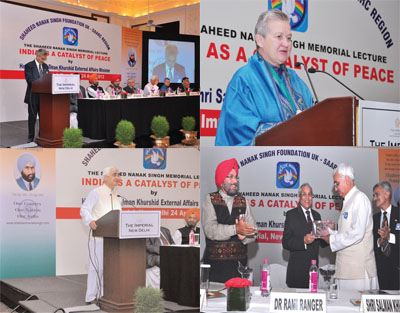
    NEW DELHI (TIP): The 6th Shaheed Nanak Singh Memorial Lecture was delivered by Salman Khurshid Minister for External Affairs Govt. of India, on 24th April at The Imperial Hotel, New Delhi, India. This year’s lecture was attended by over 200 elite guests including H.E. Ms. Nancy J Powell, US Ambassador to India, H.E. Gen JJ Singh, Governor of Arunachal Pradesh, H.E. Laimonas Talat-Kelpsa, Ambassador of Lithuania, H.E. Borislav Kostov, Ambassador of Bulgaria, H.E. Daniele Mancini, Ambassador of Italy, H.E. Prof. Piotr Klodkowski, Ambassador of Poland, H.E. Piotr Opalinski, Minister Counsellor, Deputy Head of Mission, Poland, H.E. Raimund Magis, Ambassador for Austria, H.E. Mark Reynhardt, Counsellor for South African High Commission, H.E. Tariq A Karim, High Commissioner of Bangladesh, the representatives from Belgium and Honorary Consuls of Samoa and Moldova.

    Also attending were Ambassador Rajesh Prasad, Ambassador Shri Nalin Suri, former Indian High Commissioner to the UK, Shri. Tarlochan Singh, Former Head of Minority Commission and member of parliament, General SK Sinha, Former Vice Chief of the Indian Army and Governor J&K, Shri Vivek Tankha, Former Additional Solicitor General to the Govt. of India, Vice Chief of Indian Navy, Admiral Robin Dhowan, Mr Jassi Khangura MLA, Punjab and Mr Surinder Singla former Finance Minister, Punjab. Mr Mukesh Anand, Chairman of the Foundation, paid tribute to Sardar Shaheed Nanak Singh Ji (www.shaheednanaksingh.com) who was born on 11th September 1903 in Kuntrila, Rawalpindi District, now in Pakistan.

    He was a great freedom fighter who dedicated his entire life for freedom, communal harmony and the unity of India. He strongly opposed the partition of India as he could foresee the consequences of breaking up India on the basis of religion. He delivered his last public speech on 4th March 1947 at Kup Mandi, Multan City, Pakistan along with Dr Saifudin Kichlew, President of the Punjab Congress.

    Sadly he fell the very next day, a martyr at the young age of 43, while trying to save 600 students of D.A.V School, Multan who were caught up in communal riots. He left behind a young widow of 35 and 8 young children, the oldest being 14 years old. Whilst delivering the Shaheed Nanak Singh Memorial lecture, Shri Salman Khurshid paid tribute to a great son of India who laid down his life for the principal of upholding India’s unity.

    He was particularly pleased to see that the Shaheed’s message was being carried forward by his Foundation. He praised the Shaheed’s youngest son Dr. Rami Ranger MBE for living up to the ideals of his illustrious father. In his impressive and memorable lecture, the Hon. Minister spoke about the necessity for peace in the world in order to progress. He said India has always been a catalyst for peace.

    India’s foreign policy was to foster a good relationship with its neighbours for the greater good of mankind. He said India was often accused of being weak in her resolve. However, he said it was easy to become violent but very difficult to be peaceful and India would never opt for the easy option. H.E. Gen JJ Singh the former Army Chief and now Governor of Arunachal also paid tribute to a man whose love for his motherland proved greater than self or his family.

    The Shaheed’s message of unity is as important today as the day he fell while saving innocent lives. He paid tribute to India’s rich civilization and felt proud to be an Indian. He said that whilst we promote peace, we must also be prepared to defend ourselves.With the absence of strength, our peace could be threatened. H.E. US Ambassador Ms Nancy J Powell thanked the organisers for inviting her to this important event.

    She praised India for being a land of ideas and that peace in the world is yet another good idea. Her own country, America, valued India’s friendship in this endeavour. The cooperation of India and the US would not only further peace in the region but also in the world. She was looking forward to working together for peace and prosperity in the world. Mr Tarlochan Singh, former Head of the Minority Commission and member of parliament also paid tribute to Shaheed Nanak Singh who tried desperately to stop the breakup of India.

    Just before his death, he called a peace conference and made a case to remain united. He further pleaded that a temporary gain for a few would become a permanent loss to the nation. He thanked Dr. Rami Ranger for coming each year to pay tribute to his father and to remind us in India of the need for unity between religions, races and castes. Mr Vivek Tankha the former Additional Solicitor General of India said it was not often that he got the opportunity to speak about a real patriot.

    He spoke about a family who for generations had dreamt and thought for Mother India, never flinched to offer the supreme sacrifice yet had never claimed credits or brownie points for what they did. He saluted such personalities and said that good people had to meet to ensure the bad did not takeover. He said we had no choice but to be together for the good of our country. He ended by stating that he was proud to be a part of this mission. Gen SK Sinha, former Vice Chief of Indian Army and Governor of J&K, said he had lived through the holocaust in 1947 as a young Major. He saw suffering on an unparalled scale.

    Over a million were killed and many millions uprooted and became refugees in a land where they were born. He fondly recalled the Shaheed Nanak Singh Lecture he delivered himself at the Punjabi University, Patiala a few years back. He said during this time he came to know more about the Shaheed and his son Dr Rami Ranger and became inspired by their lives. Dr. Rami Ranger, the youngest son of Shaheed Nanak Singh, summed up his father’s vision and foresight in an evocative vote of thanks.

    He thanked all the speakers, the trustees (Gp Capt DV Arora VSM & CA Alok Goel ) and Ms Shivani Mohan for conducting the proceedings most effectively and eloquently. He pointed out that India’s soul was its secular and democratic constitution where equality for all was enshrined regardless of race, religion or gender. Each year with the Shaheed Nanak Singh Memorial Lecture we reminded ourselves of the sacrifices people had paid for our freedom.

    He emphasized that it was imperative that we be proactive in pursuing peace and that if we did nothing, then we would achieve nothing and as a result we must promote and celebrate unity. He concluded by saying that if Shaheed Nanak’s Singh’s legacy could unite India, then his father would not have died in vain and together we could make India great. Dr Rami Ranger, on behalf of the Shaheed Nanak Singh Foundation, presented the Hon.

    Minister Shri Salman Khurshid ji with the “Soul of India” Award for his Services to Mother India and then to complete the occasion a sumptuous dinner was served to the guests.

  • Hopes And Fears Ahead Of Pakistan Polls

    Hopes And Fears Ahead Of Pakistan Polls

    LAHORE (TIP): All was quiet on the streets of Lahore on Friday as people geared up for the elections. The provincial government announced a holiday across Punjab around noon on Thursday, shutting down local businesses and giving people one extra day to get home to their villages to cast their vote in what appears to be the first historic elections since Zulfiquar Bhutto’s party, the PPP won the elections in 1977 by a wide margin. There are more than 200 parties in the electoral process, 86 million voters and 5,000 candidates.

    Yet across the country there are only two names being bandied about: Imran Khan and Nawaz Sharif. The third hidden voice of the PPP’s Asif Ali Zardari is expected to emerge with news of the election results. Across social media, in cafes and on the roadside, there is a sense that Imran Khan – whether or not you support him – has roused election fever in everyone, not just the youth. The young, the middle aged and the youth are repeating the mantra “This is the first time I’m going to vote”.

    Even those cynical about the elections process admit that the energy on ground is palpable. “Benazir Bhutto was the last charismatic leader we had,” said Shahvaar Ali Khan, a musician whose ad company, Farigh Four launched PTI’s media campaign for change with the slogan, “Naya Pakistan’ or a New Pakistan. “Now (the leader) is Imran despite his simplistic, yet sincere and honest political analysis.”

    Indeed, in the urban centres of Pakistan many people, across the age spectrum are expressing their support for this reality. Some have read the PTI’s manifesto, many haven’t. But they’re hoping that Imran Khan will deliver guidance in governance, just as he did on the cricket field. This means that Sharif is finding a deep challenge in his stomping grounds. Across Lahore there is evidence that longtime former supporters of the PML-N aren’t going to vote for him. “I’m going to vote for Imran Khan,” said a businessman who didn’t want to be named.

    “But I’m going to walk into my polling station announcing that I’m voting for Nawaz Sharif.” In Lahore on Thursday evening, the last day for rallying before today’s elections, people thronged on Mall Road, and around Liberty Market, the city’s commercial areas. Mothers came with their children dressed in their preferred party colours, many of them showing off the PTI’s red, white and green.

    “I’m so excited. It was so much fun to see so many people all looking forward to a change,” said Moosa Baksh, a 21-year-old architecture student who joined the Liberty Market crowd with his friends. Asked what he’d feel if Imran Khan didn’t win. “I’ll be really sad,” he said. There is also a sense that Imran Khan’s superstar status is helping get women out of their homes and into the polling stations.

    “In a lot of our families many of the husbands are voting for Nawaz Sharif and our wives are voting for Imran Khan,” said Mian Raza Mansha, a prominent Pakistani businessman. “I’ve heard a lot of men saying they’re going to try and prevent their wives from going to the polling stations,” he laughed. With so much focus on Pakistan’s big cities, it is unclear what the mood in Pakistan’s rural areas is, where a majority of the electorate lives.

    Voters tied as serfs to their landowners have traditionally voted for their caste and biradari. PTI, with no links to the biradari system has promised to break that hold. In the cities there a sense of a newly mobilized voting class that has long been enfranchised to vote but has not felt compelled to make it to a polling station on elections day. Outside a polling station where workers were setting up the booths, three men sat outside discussing the potential election results.

    “It’s going to be a hung parliament,” said Omar Farooq, 48, an electrician. “I’ve been listening to the radio all morning. ” “Nonsense,” said his friend, Asif Ali, 36. “It’s going to be an Imran Khan sweep. He’s going to take the entire country.”

  • Global Coffee Chains Take The Cuppa To Smaller Towns

    Global Coffee Chains Take The Cuppa To Smaller Towns

    MUMBAI (TIP): International coffee retailers are brewing plans to launch more outlets, especially in smaller towns and cities. Discretionary spending may be low, but coffee chains are eyeing tier- 2 and -3 cities to beat the high saturation levels and rentals in the metros. While UK-chain Costa Coffee is gearing up to enter towns such as Ludhiana and Jalandhar in Punjab, Australia’s Di Bella Coffee recently launched a 5,000 sq. ft. outlet in Hyderabad, its largest.

    “High rentals are a challenge, but that is not going to stop us from opening 40-50 stores a year and entering more cities in Punjab,” says Santhosh Unni, Managing Director, Costa Coffee. With 107 outlets, the coffee chain intends crossing 150 outlets this year, and emerging as the second largest player after CCD (Cafe Coffee Day). Di Bella Coffee has two flagship stores measuring 3,000 sq. ft. and 5,000 sq. ft. in Hyderabad. “High rentals and saturation in cities like Mumbai has made us enter tier-2 and -3 cities, which are still not exposed to international coffee chains.

    There have been great sales out of Hyderabad as the city still does not have an international coffee chain. At 5,000 sq. ft., we are the largest coffee retail outlet in the country,” says Sachin Sabharwal, Managing Director, Di Bella Coffee.

    No slowing down

    Considering that the last quarter has been challenging for quick service restaurants, coffee chains do not believe in slowing down.“Discretionary spends have been down since the last quarter, but the boom in retail is still happening, which will offset it,” adds Sabharwal. Di Bella Coffee has ten outlets in Mumbai.

    Meanwhile, CityMax Hospitality, the master franchise for Gloria Jeans Coffee, plans to open at least 15-20 stores a year. While it is present in Mumbai and Delhi as well as smaller cities such as Pune and Ahmedabad, more tier-2 city launches are on the anvil.

    Much potential

    As Vishal Sawhney, President, City Max Hospitality says, “Coffee retail is still a huge market and there is demand. After tier 1 cities, we need to expand more into tier-2 and -3 cities.”

    Last week, Pan India Food Solutions, the master franchise for the Coffee Bean and Tea Leaf, entered Punjab with two stores in Chandigarh. “We intend opening one store every 3-4 weeks as there is demand for local area coffee formats even in smaller cities such as Chandigarh,” adds K.S. Narayanan, Chief Executive Officer, Pan India Food Solutions.

  • Pakistani Prisoner Attacked In Jammu Jail, Condition Serioussupreme Knowledge Of Brahman

    Pakistani Prisoner Attacked In Jammu Jail, Condition Serioussupreme Knowledge Of Brahman

    JAMMU: A Pakistani prisoner Sanaullah serving a life term was attacked inside the high-security Kot Balwal jail by a fellow inmate this morning and his condition is stated to be serious, official sources said. It was not immediately known whether the attack on the 52-year-old convict with a sharp weapon was a backlash against the death of Indian prisoner Sarabjit Singh in a hospital in Pakistan yesterday after being comatose for nearly a week following a brutal assault by fellow inmates in a high-security Lahore jail, officials said. Official sources said the Kot Balwal jail superintendent Rajni Sehgal has been suspended by the Jammu and Kashmir government which also ordered a probe. The sources said Sanaullah, a resident of Pakistan, was admitted in Government Medical College hospital in an unconscious condition with serious injuries on his head after being hit by a fellow inmate in the morning.

    A case of assault was registered against Vinod Kumar, an exserviceman who is also serving a life term in the jail in the outskirts of Jammu. Kumar hails from Uttrakhand. Meanwhile, Pak high commission in Delhi expressed serious concern over the attack on a Pakistani prisoner in the high security Kot Bhalwal jail in Jammu and sought immediate consular access to him. The sources said the health condition of Sanaullah was stated to be very critical as he was hit with a very sharp weapon. He may be shifted to Chandigarh’s PGI for treatment as his Glasgow Coma Scale (GCS) was pretty low.

    GCS is a scale for measuring level of consciousness, especially after a head injury, in which scoring is determined by three factors: amount of eye opening, verbal responsiveness, and motor responsiveness. Sanaullah was arrested on April 1999 in connection with five cases related to terror activities. The attack occurred ahead of Sarabjit’s funeral at his native village in Punjab. Following the death of 49-year-old Sarabjit in Pakistan, Union Home Ministry had issued advisories to all states for maintaining high vigil in jails and ensure there was no attack on any Pakistani prisoner lodged there. Excluding fishermen, there are about 220 Pakistani prisoners in Indian jails. A similar number of Indians are lodged in Pakistani jails.

  • Sarabjit Singh’s Killers Must Be Punished

    Sarabjit Singh’s Killers Must Be Punished

    Even as thousands in Bhikhiwind, Amritsar, the native place of Sarabjit Singh, watched with tearful eyes the cremation of the brave son of India, some thoughts must have crossed their minds. Why did he have to die the way he did? Why was he to be battered to death? And finally, who is responsible for the tragic end to his life? Even as the thousands were overwhelmed with grief when leaders of all hue, including Rahul Gandhi, the Punjab Chief Minister Prakash Singh Badal, the Deputy Chief Minister Sukhbir Singh Badal and several others paid their homage to the dear departed Sarabjit Singh whose body was draped in the tri-color, some thoughts must have crossed their minds. Where were these people when Sarabjit Singh was languishing for 22 long years in a Pakistani prison? Where were these leaders when his sister repeatedly expressed concern for her brother’s safety? Where were these leaders when she ran from pillar to post begging for saving her brother’s life? Even amidst overwhelming grief, these people must have been filled with abhorrence for the unfeeling and inhuman bodies known as their leaders. No, more than that, they must have been filled with rage to think that the insensitivity of their leaders led to the loss of a life and devastation of a family.

    I can understand why a whole nation is upset that a son of India was inhumanly and brutally killed in a Pakistani jail. I can understand the rage of the people of India against their political leaders and the government of India. I can understand their anger against the government of Pakistan. However, I am afraid, this may be a passing sentiment with the people. But let it not be so with government of India. A government is worth nothing if it cannot protect its people. Let government of India learn it better now than never. Let government of India shed its attitude of unconcern and think of the dignity of its people and the nation. The least it can do is to put diplomatic pressure on Pakistan to punish those guilty of snuffing out the life of an Indian citizen. It may not bring back to life the gone for ever Sarabjit Singh. But it will be a consolation to people of India and more particularly, the bereaved family, that the culprits who were responsible for the death of their kin were brought to justice.

  • Cremated With State Honours

    Cremated With State Honours

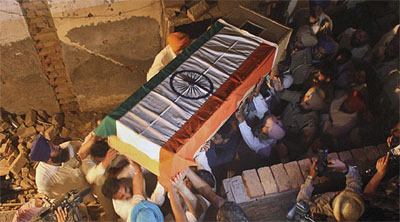
    BIKHIWIND (TIP): The mortal remains of Sarabjit Singh, which were brought to his village here 23 years after he inadvertently crossed over to Pakistan, were consigned to flames on May 3 afternoon with state honours. Draped in the tricolour, the body of Sarabjit Singh was taken to the cremation ground from the village school in a procession. Sarabjit’s family members performed his last rites. Union minister of state for external affairs Preneet Kaur, an MP from Patiala, Punjab chief minister Parkash Singh Badal, his deputy Sukhbir Badal and a number of leaders attended the last rites of Sarabjit. Congress vice-president Rahul Gandhi also attended the funeral of Sarabjit Singh. The government had announced a state funeral and also a three-day mourning as a mark of respect to Sarabjit, besides financial aid and government jobs for his family. The village with a population of around 11,000 and located about 36km from Amritsar, is in a state of mourning since Thursday with residents gathering near the house of the family after the news of the Indian prisoner’s death spread.

    Shops and commercial establishments in this area have also remained shut. The village witnessed angry protests with locals raising anti-Pakistan slogans and burning effigies. Officials of the district administration had made arrangements for the state funeral in the outskirts of Bikhiwind. A large posse of police personnel were deployed. Meanwhile, a second autopsy was conducted on Thursday night by a team of six doctors at the government-run Amritsar Medical College to ascertain the cause of Sarabjit’s death. The first postmortem was carried out at the Jinnah Hospital in Lahore. Chief minister Parkash Singh Badal has demanded an independent probe by an international agency into the circumstances leading to Sarabjit’s death. According to his family, Sarabjit had inadvertently crossed the zero-line near here in an inebriated state while working in his fields which run along the border. Sarabjit was arrested in 1990 by the name of Manjit Singh by Pakistan army in 1990. He was accused of being an Indian spy and was charged with plotting series of bomb blasts in 1989 at Lahore and Multan. He was tried by courts and was awarded death penalty. Sarabjit’s trial in Pakistan was based on a statement which Pakistani authorities had claimed was given by him during the course of investigation. However, Sarabjit had said during his trial in court that he was a farmer on the Indian side of the border and had strayed into Pakistan while he was drunk, a stand which was also taken by his family members. His 54-year-old sister Dalbir Kaur had unsuccessfully led a campaign to secure Sarabjit’s freedom. She was joined by Sarabjit’s wife Sukhpreet Kaur (around 45-year-old) and daughters Swapandeep Kaur and Poonam, both in their mid twenties.

    The two daughters were minors when their father crossed over to Pakistan and they had their first glimpse of their father in 2008 when they went to Pakistan with their mother and aunt. Dalbir Kaur had gone to Pakistan a couple of times as part of her attempts since 1991 to get her brother freed. Sarabjit, the second Indian prisoner to die in Pakistan’s notorious Kot Lakhpat jail in Lahore this year, was brutally attacked on Friday last by six fellow inmates when he and other prisoners were brought out of their cells for a break. Sarabjit was convicted of alleged involvement in bomb attacks in Punjab province that killed 14 people in 1990 and spent about 22 years in Pakistani prisons. His mercy petitions were rejected by the courts and former Pakistan President Pervez Musharraf. The previous Pakistan Peoples Party-led government had put off Sarabjit’s execution for an indefinite period in 2008.

  • Sarabjit Singh Returns In A Coffin

    Sarabjit Singh Returns In A Coffin

    NEW DELHI (TIP): The body of Sarabjit Singh was brought back on May 2 evening in a special aircraft sent by India. Two Indian diplomats accompanied the body, which was received at Amritsar airport by Minister of State for External Affairs Preneet Kaur and Punjab Deputy Chief Minister Sukhbir Singh Badal. Following an autopsy in Amritsar, Sarabjit will be cremated in his village Bhikhiwind on Friday with full state honours extended by the Punjab government. Prime Minister Manmohan Singh called Sarabjit a “brave son of India” and said it was “particularly regrettable” that Pakistan did not heed pleas to take a humanitarian view of his case. Sarabjit, who was assaulted in Lahore’s Kot Lakhpat jail by fellow inmates on April 26, died at 1.30 am India time on May 2 after a “cardiac arrest”, according to doctors at Lahore’s Jinnah Hospital.

    The death row prisoner was reported to be in a “nonreversible coma” and close to “brain death” on Wednesday. Punjab announced financial assistance of Rs 1 crore for the family, and declared state mourning for three days. The state government has already announced government jobs for Sarabjit’s daughters Swapandeep Kaur and Poonam. A devastated Dalbir Kaur, sister of Sarabjit, called for her brother to be declared a martyr, and asked all political parties to unite for a strong collective response to Pakistan. The Prime Minister said that the criminals responsible for “the barbaric and murderous attack must be brought to justice”. The Indian government demanded that Pakistan conduct a “thorough probe” and ensure punishment for those responsible. “This was simply the killing of an Indian citizen while in the custody of Pakistani authorities,” Syed Akbaruddin, spokesperson for the Ministry of External Affairs, said in a statement. “The attack highlights the need for concerted action by Pakistan to safeguard Indian prisoners in Pakistan.” Parliament observed two minutes of silence in memory of Sarabjit.

    Both Houses adopted a resolution expressing Parliament’s “deep sense of shock and sorrow”, and condemning the “inhuman treatment” meted out to Sarabjit. The resolution hoped that the culprits would be brought to book. BJP president Rajnath Singh condemned the “cold blooded murder” and demanded that India call back its high commissioner in Pakistan and scale down diplomatic relations. Asked if normal ties with Pakistan were possible in the wake of Sarabjit’s death, External Affairs Minister Salman Khurshid said, “I think it is a big question that in coming days we will have to examine and see how do we work.” Home Minister Sushil Kumar Shinde and Congress vice-president Rahul Gandhi visited the distraught family of Sarabjit at the residence of Rajkumar Verka, vice-chairman of the National Commission for Scheduled Castes. Rahul hugged Dalbir as she wept, and offered his condolences.

    In Lahore, police added murder charges to the FIR registered against two death row prisoners, Amer Aftab alias Amer Tambewala and Mudassar, who had been booked earlier for the attack on 49-year-old Sarabjit. Najam Sethi, the caretaker chief minister of Pakistan’s Punjab province, assured Indian High Commissioner Sharat Sabharwal that Sarabjit’s murderers would be brought to justice. The Indian envoy met Sethi on a scheduled visit to Lahore. Sethi also ordered a judicial enquiry and directed officials to ensure that the probe was completed in 15 days. The inquiry will be conducted by a high court judge, state-run Radio Pakistan reported. Sarabjit’s body was handed over to the Indian High Commission after an autopsy at Jinnah Hospital.

  • Sikhs Take Out An Impressive Sikh Day Parade In New York

    Sikhs Take Out An Impressive Sikh Day Parade In New York

    NEW YORK, NY (TIP): Organized by the Sikh Cultural Society, Richmond Hill, New York, the Sikh Day Parade on April 27 in Manhattan, New York, attracted, as usual, large crowds of Sikh men, women and children from the Tri -States area of New York, New Jersey and Connecticut. Besides, contingents came from as far as Philadelphia and Maryland.

    An estimated 30,000 ( according to the organizers, 50, 000) Sikhs participated. The parade that started from 36th street and Madison Ave wound its way through the city and ended up at 26th Street and Madison Ave for the conference. The event is held annually to mark Vaisakhi, the harvest festival of Punjab that coincides with the day the Tenth Master of the Sikhs, Guru Gobind Singh, created the order of Khalsa in 1699. All along and at the conference, placards with Prof. Davinderpaul Singh Bhullar’s photograph were carried by the participants who raised slogans for freedom for Bhullar and denounced government of India for being unjust to the Sikhs. Pro Khalistan slogans were also raised. The parade was dedicated to Prof. Davinderpaul Singh Bhullar who is in death row in India. The Parade passed a resolution requesting President of USA to secure freedom for Prof. Bhullar. The memorandum to US President alleged atrocities on Sikhs in India in 1984 (Operation Blue Star in which “1600 innocent Sikhs were killed” and killing of Sikhs in the wake of Indira Gandhi’s assassination when “3000 innocent Sikhs were brutally murdered”) and continued injustice to the community in India. It said Prof. Bhullar is being unjustly put to death even though there is no evidence of the crime he is said to have committed.

    The resolution read, inter alia, ” Sikh Cultural Society on behalf of this 50,000 strong peaceful gathering of Sikhs from the Tri-State area, but in spirit of all the Sikh Americans pass the resolution to request Mr. Barack Obama, the President of USA, to use his good offices and ask Indian government to stop the execution of Prof. Bhullar” . The resolution was received by Harpreet Singh Sandhu, an official with the Director of Public Engagement, White House. The first to be asked to speak was the President of Sikh Youth of America, the most vocal Khalistani organization that was founded by Dr. Amarjit Singh of Washington. Gurvinder Singh Manna, in his 8 minute long speech called upon the Sikhs all over the world to raise their voice of protest against death to Prof. Bhullar. He said that Prof. Bhullar’s confessional statement was obtained under duress and there is no witness nor any other corroborative evidence to prove his guilt. Even the judgment of the three judge bench was a split judgment when the presiding judge Justice Shah did not find Prof. guilty. The President of India who rejected Prof. Bhullar’s mercy petition did so without following the proper process of consulting the presiding judge, since the law says in the case of a split judgment, President should confer with the presiding judge in deciding on a mercy petition. Manna called upon Sikhs to work tirelessly to have their homeland without which they will always be subjected to injustice.

    Another noteworthy speaker at the parade conference was Ganga Singh Dhillon, one of the front ranking fighters for Sikh homeland, who, in spite of his frail health, was present to read out the resolution and present his viewpoint. He said, “sloganeering only helps government of India to brand Sikhs as separatists.” He noted that nothing could be achieved by raising slogans. The only way was to fight for Sikh homeland. Obviously, he was repeating himself when he went to Pakistan and from there organized the militant movement for Khalistan. Others who spoke included Boota Singh Kharaund, President of Shiromani Akali Dal , Mann (Simranjit Singh Mann ), Attorney Jaspreet Singh, Baljinder Singh Brar from Gurdwara Dashmesh Darbar, Carterot, Gurmej Singh, President, Gurdwara Baba Makhan Shah Lobana, New York, and Hardev Singh Padda, President, Sikh Gurdwara, Flushing. Two former Khalistani leaders, Gurmit Singh Auluck and Paramjit Singh Ajarawat, from Washington appeared to be ignored by the organizers. Auluck used to be the principal voice of Khalistanis some 20 years ago. He held sway up to 2000 and then faded out. Paramjit Ajarawat also was a potent Khalistani voice but now seems to have lost esteem with the Sikh leaders.

    They were invited to speak at the end when the gathering had almost left. Their disappointment was writ large on their faces. Contrary to their fate, resurrection of octogenarian Ganga Singh Dhillon, who has links in Pakistan, is surprising and intriguing. Among the political leaders and law makers present were Congresswoman Grace Meng, Council Member Mark Weprin, and Reshma Saujani who is seeking election to the Public Advocate in September, 2013. Gurdev Singh Kang, President of the Sikh Cultural Society which organizes the parade every year, expressed his gratitude to the participants for turning out in large numbers and celebrating the event in a befitting manner. He thanked the guest speakers, including the local politicians and law makers, for their time and valuable views they expressed.