Tag: PyeongChang 2018 Winter Olympic Games

  • 23rd Olympic Winter Games at PyeongChang end on a bright note, as Norway heads tally with a record number of medals

    23rd Olympic Winter Games at PyeongChang end on a bright note, as Norway heads tally with a record number of medals

    Ivanka Trump was cynosure of all eyes at the closing ceremony

    Special Report by
    Prabhjot Singh in
    PyeongChang

    PYEONGCHANG, SOUTH KOREA (TIP): The curtains were finally rung down on the 23rd Olympic Winter Games at PyeongChang on Sunday, February 25, after a glittering and impressive ceremony that saw athletes from all participating nations dancing their hearts out to the beats of music.

    Norway’s gold medalists Ingvild Flugstad Oestberg, Astrid Uhrenholdt Jacobsen, Ragnhild Haga and Marit Bjeorgen pose on the podium after the cross-country women’s 4x5km relay at the PyeongChang.
    Photo / Courtesy CNN

    The Olympic flag was ceremoniously handed over to Mayor of Beijing for holding the 2022 Olympic Winter Games there. After Sochi (2014), Olympic Winter Games continue to be confined to Eurasia. Not only that, next summer Olympic Games will also be in Asia, in Tokyo, Japan, in 2020.

    The 2018 Olympic Games had many highs and lows as politics took the center stage at the start with the North Korea joining South Korea in fielding a unified Women’s Ice Hockey team besides sending a strong contingent, including cheer leaders, besides a high-powered political delegation.

    While many participating nations, including Norway, Canada and the hosts Korea had every reason to cheer about, it was not so sweet for the US, both on sports and political fronts. Its athletes could not perform that well as was expected and politically, the North Korean presence in the Games at every forum was perhaps a thorn in its flesh.

    President of the International Olympic Committee Thomas Bach, President of South Korea Moon Jae-in, North Korea’s delegation leader Kim Yong Chol and Ivanka Trump, senior White House adviser, attend the closing ceremony.
    Photo /courtesy Reuters

    While the Vice-President of the United States, Governor-General of Canada, Prime Ministers of Japan, Norway and the Netherlands witnessed the opening ceremony, it was Ivanka Trump, daughter of the US President, who was cynosure of all eyes at the closing ceremony.

    Participation of North Korea may have stalled the threats of a global nuclear confrontation emanating from the war of words between the US and North Korea, the situation threatened to relapse into pre-Olympic times as the US insisted on imposing strong sanctions against the North Koreans.

    There was, however, a bright spot when North Korea offered to have a dialogue with the United States. How the Trump Administration reacts to the offer will be known in coming days.

    Whatever be the political outcome of the barbs of the World leaders, the PyeongChang 2018 Winter Olympic Games were not without controversies. Starting with suspension of the Russian Olympic Committee and imposition of ban on 50-odd Russian athletes for being part of a concerted campaign to evade Doping control violations during the 2014 Olympic Winter Games at Sochi, two Russian athletes, including a bronze medalist in mixed Curling, were banned after testing positive for banned substances.

    The Anti-Doping Agency (WADA), that has its headquarters in Montreal, Canada, had set up two special Commissions in PyeongChang that heard appeals of 50-odd banned Russian athletes and rejected all upholding the right of the International Olympic Committee to decide the eligibility criteria for participation in the Games.

    Exquisite Fireworks
    Photo/ Courtesy CNN

    The Games were perhaps the coldest after Lillehammer. The last two editions – Sochi (2014) and Vancouver (2010) were held in a little warmer weather than freezing cold and windy PyeongChang.

    Norway finished at the top of the medals tally.

    The 39 medals won by it is an all-time Winter Games record by any country. With 14 gold medals, they matched Germany’s first place totals, and by virtue of another 14 silver and 11 bronze, the Games of PyeongChang 2018 belonged to Norway.

    Unsurprisingly, the Norwegians were most prolific in cross-country skiing – the nation’s top medal contributor with 14 – led by Marit Bjoergen. She took five in Korea (two gold, a silver, and two bronze) for 15 overall in her career. The 37-year-old is the most decorated winter Olympian of all-time, and rightly it was her win in the very last event at PyeongChang that lifted Norway over Germany.

    The official Olympic medal table ranks countries in order of most gold acquired. To that end, Germany had top spot in its grasp but for conceding a shorthanded goal to Olympic Athletes from Russia in the men’s hockey final with less than a minute to go. The Russian team went on to win the hockey final, leaving Germany second in the medal standings.

    With 14, Germany tied Norway, and Canada’s record from Vancouver 2010 for most gold medals won by a country at a single Winter Games. They added 10 silver and seven bronze medals for 31 overall. Massive contribution to the German cause came from Francesco Friedrich (bobsleigh) and Natalie Geisenberger (luge), each winning two gold medals.

    Canada has every reason to be pleased with its performance here as it also has a record haul of medals. Tessa Virtue and Scott Moir team were the darlings of the Canadian contingent with their golds both in Team Figure Skating and Ice Dancing. Kim Boutin with three medals became the only Canadian athlete in PyeongChang to end with three medals, a silver and two bronze medals.

    The Netherlands won all its 20 medals (eight gold, six silver and bronze) in speed skating (16 on the big oval, and four in short track). Of note, Jorien ter Mors made the podium in both disciplines, winning gold in the women’s 1000m on the oval, and joining her short track teammates to take the 3000m relay bronze.

    The South Koreans had their best-ever medal haul at the Olympic Winter Games with 16 (five gold, seven silver, four bronze). As expected, Korean speed skaters were most effective winning 13 of the medals, seven long track, six in short. In the latter Choi Minjeong was a double gold medalist.

    As mentioned earlier, Japan, the host of the next Olympic summer Games in 2020, did well to win 13 medals (four gold, five silver, four bronze). It is perhaps the best-ever show by Nippon as it was helped by Yuzuru Hanyu becoming the first back-to-back Olympic men’s figure skating champion since American Dick Button did it in 1948 and 1952.

    Athletes from the United States may not like to remember these Games for their laurels. Though they dethroned their neighbors and arch rivals Canada in women’s Ice Hockey final in a shoot out, their medal count down from 28 four years ago to 23 in Korea. Nonetheless, nine gold medals cannot be discounted, including two Olympic titles that Canada held since Turin 2006: men’s curling and women’s hockey.

    Though the Russians remained in spate of controversies throughout the Games, they had something to cheer about too.

    Bye, Bye 2018 Winter Olympic Games at PyeongChang

    At these Games their biggest highlight by far was the women’s figure skating showdown between Alina Zagitova and Evgenia Medvedeva. The two teens finished first and second, respectively, with Zagitova becoming the second youngest Olympic women’s figure skating champion at 15 years and 281 days, just 26 days older than Tara Lipinksi of the United States who still holds that record. The Olympic Athletes from Russia leave Korea with 17 medals.

    They had requested the IOC for permission to participate in the closing ceremony with Russian flag. The Russians were allowed to compete here as a neutral team and the IOC flag under the banner of Olympic Athlete Russia. Their request to participate in closing ceremony with Russian flag was, however, turned down and the IOC reiterated with the suspension.

    Arguably the most impressive individual performance of PyeongChang belonged to Ester Ledecka. The Czech Olympian shocked the winter sports world by winning the women’s super-G on skis reportedly borrowed from American Mikaela Shiffrin (herself a gold medalist in the giant slalom). Primarily a snowboarder, Ledecka doubled her golden tally taking the women’s parallel giant slalom, becoming the first woman to win gold in two different sports at one Olympic Games. Hers were the only two gold medals for the Czechs.

    Some non-traditional winter sports countries often manage to find one athlete who can dominate a particular discipline. For the Brits, that’s Lizzy Yarnold. The skeleton racer repeated as Olympic champion, in the process becoming the nation’s first winter athlete to win two Olympic gold. Britain also saw its first-ever winter double podium with Laura Deas delivering skeleton bronze.

    Martin Fourcade won a hat-trick of gold medals in biathlon. The most impressive athlete on the planet in this discipline, the Frenchman has been on top of the podium five times (a French Olympic record) counting a double gold at Sochi 2014. He’s now up to seven Olympic biathlon medals at the age of 29.

    Other notable national achievements included New Zealand and Spain ending winter medal droughts dating back to 1992, while Hungary ended an even longer wait going back to 1980 by taking the 5000m short track relay gold.

    Staying with short track, Italy’s Arianna Fontana became the most decorated Olympic speed skater in her discipline with three more podiums taking her to eight, and Belarus’ Darya Domracheva added to her illustrious career becoming the first woman to win four Olympic gold medals in biathlon.

    India’s two-member contingent returned home without a medal. Shiva Keshawan finished 34th in Luge while Jagdish Singh in cross country skiing was placed 103rd in a field of 119.

    Will meet again in 2022 in Beijing
    Photo / courtesy Olympic

    In all six new nations, including Malaysia, made their debut in Olympic Winter Games here. Besides, there were at least half a dozen athletes who earned the distinction of representing their countries both in summer and winter editions of Olympic Games.

    -Courtesy PTC News

  • US Women’s Hockey Team Beats Canada 3-2 for Gold at PyeongChang Olympics

    US Women’s Hockey Team Beats Canada 3-2 for Gold at PyeongChang Olympics

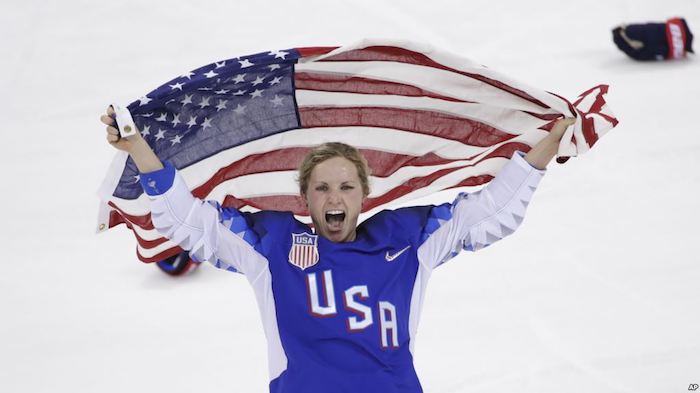
    GANGNEUNG, SOUTH KOREA (TIP): US Women’s Hockey team gave a shock to the fancied Canadians by winning the Gold in a thrilling penalty shootout 3 to 2.

    Jocelyne Lamoureux-Davidson, the sixth U.S. shooter in a shootout, skated slowly toward the net, faked a shot, shifted the puck left, then pulled it right before tucking the puck past the outstretched glove of diving Canada goalie Shannon Szabados.

    “I knew she was going to pull something,” forward Kendall Coyne said. “She is phenomenal in shootouts. She always had something up her sleeve.”

    Lamoureux-Davidson said the move is called “Oops, I did it again” and she has practiced it “thousands of times.”

    “I butchered it a thousand times,” she said. “Just glad it worked this time.”

    That was the game-winner in a 3-2 victory that ends Canada’s streak of four consecutive Olympic women’s hockey gold medals and perhaps changes the course of U.S. women’s hockey for years to come.

    “This is greater than a trophy and a medal,” said U.S. center Gigi Marvin, a three-time Olympian who also scored in a shootout.

    The fact that the Americans won the game in dramatic fashion merely adds to its historical significance. The game was played on Feb. 22, 38 years to the day after Herb Brooks’ team downed the Soviets on Mike Eruzione’s goal in the “Miracle on Ice.”

  • “Double” Olympians in limelight

    “Double” Olympians in limelight

    By Prabhjot Singh in PyeongChang.

    PyeongChang (TIP): One of the toughest things in sports is to be an Olympian. On an average, every four years only 5,000 to 7,000 sportsmen and women qualify to be Olympians and less than 1 per cent of them distinguish themselves and become Olympic medalists.

    Naturally, it becomes much tougher to be both Winter and Summer Olympian. Though there are not many instances when athletes have competed in both summer and winter Olympic Games, yet few sportsmen and women, with their hard work and dedication, have scripted success stories in these mega sports events held within two years of each other.

    Most recent case is of Kaillie Humphries and Phylicia George of Canada who won a bronze medal at PyeongChang.

    Pita Taufatofua decided immediately after finding out he would be Tonga’s flag-bearer that he would wear traditional Tongan dress instead of the usual team uniform at the opening ceremony.
    Photo / courtesy TODAY

    Who does not remember Tonga’s Pita Taufatofua who became a global sensation overnight when he arrived shirtless in freezing cold of the opening ceremony of the PyeongChang 2018 winter Olympic Games. He belongs to a select band of those athletes who have competed in successive summer and winter Olympic Games.

    He competed in Taekwondo event in the 2016 summer Olympic Games in Rio and finished 114th in 15 km Cross-country skiing here.

    It may be more than a dream for those who make it. It is the reality for a number of athletes from Canada who are competing here at PyeongChang.  Two of them, Phylicia George and Seyi Smith, moved from track and field to Bobsleigh, an event that has also attracted some African athletes, including all-woman Nigerian team, to Winter Olympic Games.

    “I started cross country skiing in 2017 and the training was perhaps the hardest I have ever done in my life,” Pita told media. “Races where we hope we could do well were getting cancelled and we had to book last minute one way ticket to the race where myself and German Madrazo of Mexico could finally qualify for PyeongChang 2018.”

    Pita’s story is for those who after setting a target stay determined to achieve it.

    “I was one of those people who thought I could sort of walk on and continue doing what I was doing before,” says Canadian track and field star Smith, who competed in the 4 x 100m relay at London 2012. “The overlap between track and bobsled is not as much as people think.”

    Phylicia George, who competed in the 100m hurdles at London 2012 and Rio 2016, echoes Smith’s sentiment about bobsleigh being a whole lot more than just running fast on ice.

    “The biggest thing was getting stronger, lifting a lot heavier,” says George. “I think I did not respect how much strength played a role and how much stronger I needed to get to be able to find the positions that I needed behind the sled.”

    Seyi Smith, moved from track and field to Bobsleigh

    Beyond the need for physical strength, Smith and George also needed to dip into their reserves of psychological strength to overcome the inevitable obstacles of adapting to a whole new athletic discipline.

    For Smith, though, there was never serious thought given to abandoning the quest.

    “Everybody warned me when I first started out, saying, ‘You better watch out, Seyi, this is not track, there is not the glamour, you are going to be working in the cold and lifting sleds,’’” says Smith.

    “It has been quite the opposite. Every month I have liked it more and more. I told one of the guys that the only time I actually said that I was having fun out loud is right before we crashed in training. So, I don’t say it out loud anymore. But inside, I am still enjoying myself quite a bit.”

    George fared a bit differently, having competed at the Summer Games less than two years ago, and still being active in track and field. She says getting started in bobsleigh was “very rough” and she definitely second-guessed her decision.

    But having been recruited to bobsleigh by Kaillie Humphries, the two-time reigning Olympic champion in the two-women event, it was perhaps inevitable that George’s competitive spirit would eventually win the day.

    “There definitely were days when I was like, ‘man, what am I doing out here?’” says George. “But seeing myself get better and being a part of a team was a really cool and interesting aspect for me, where I’m used to being an individual. … I am really happy I stuck with it and saw my potential through.”

    Kaillie Humphries (right), and Phylicia George after winning bronze in women’s bobsleigh on Wednesday, February 21

    It is not a usual combination that would end on Olympic podium. While one had two Olympic medals to her belt, she gets a new partner who happens to be veteran of two summer Olympic Games, and the new combination ends with Olympic Bobsleigh bronze.

    The pair is none other than mentor Kaillie Humphries and her new partner Phylicia George, otherwise Hurdler in Track and Field.

    For Kaillie it has been her third straight Olympic bobsleigh medal.

    With this medal, Canada has taken its tally to 21 with nine golds and is currently placed at overall number three position.

    Humphries and George had been in fifth place after the first two runs, but were just four-one hundredths of a second out of a podium position. They made up that ground in their third run, moving into third place with a cumulative time of 2:32.12. That gave them a buffer of 0.05 on fourth-placed Americans Jamie Greubel Poser and Aja Evans.

    In the final run, Humphries steered the sled down the track in 50.77 seconds for a four-run total time of 3:22.89, ensuring a podium finish with just the two leading tandems to go.

    Humphries came to PyeongChang as the two-time reigning Olympic champion. She is now the first Canadian bobsledder to win three Olympic medals.

    For George, it is her first Olympic medal and it comes in her Winter Olympic debut after she competed at two Summer Games in the 100m hurdles, making the final at both London 2012 and Rio 2016. She began bobsleigh training late last summer and competed in her first international race just this past November. She and Humphries won World Cup gold and silver together in January.

    Slovenian Ice Hockey player tests positive for doping

    As the PyeongChang 2018 Winter Olympic Games are inching towards a close, another case of violation of doping controls saw a Slovenia Ice Hockey player voluntarily accepting the charge and offered to quit the Olympic village.

    The Anti-doping Division of the Court of Arbitration for Sport (CAS ADD) at the Pyeongchang 2018 Olympic Winter Games (OWG) announced that it has registered a new case.

    Further to a request from the International Olympic Committee (IOC), and based upon the agreement of the parties, the CAS ADD has issued the following decision:

    Zika Jeglic, Ice Hockey, Slovenia, tested positive in-competition test with fenoterol (beta-2 agonist; specified substance). He accepted an anti-doping rule violation. As a consequence, the athlete is suspended from competing in the remainder of the Olympic Winter Games Pyeongchang 2018; the athlete will leave the Olympic Village within 24 hours; the procedure will continue and the CAS ADD will issue a final award after the conclusion of the Games.

    At the start of the second week of the Games, the Anti-doping Division of the Court of Arbitration for Sport, started procedure involving the athlete Aleksandr Krushelnitckii (mixed curling; OAR).

    Though a date has been fixed for hearing, yet no further information is being provided at this point.

    Earlier, a Japanese athlete also tested positive for doping and was suspended.

    -Courtesy PTC News

  • Politics, Sports go hand in hand

    Politics, Sports go hand in hand

    Politics is an integral part of human life. Whenever two or more people get together and get involved in any animated discussion on any subject politic starts.And Olympics, the biggest sporting extravaganza, that brings people from all nationalities, ethnicities, economic, religious and linguistic backgrounds, politics is but natural to happen.

    Though Olympics are supposed to be an opportunity to “contribute to building a peaceful and better world” through bringing countries together in the name of friendly sports, yet they have their own limitations or politics Be it keeping out one nation or the other or ban one or more group of athletes on one pretext or the other. The sacred Olympic mission, however, has frequently been undermined by real-world politics, and this year is one of the best examples of that.

    Politics in sports or sports politics may be two entirely different domains but politic remains the common denominator. There may be endless examples of staunch political rivals rubbing shoulders together in controlling sports. And, Olympics are no different.

    From North Korea to ban on Russia for violating Doping controls, politics in the ongoing PyeongChang 2018 Winter Olympic Games, have spread to other areas, including conduct and uttering of other World leaders or their actions.

    Much of this year’s tension comes with the fact that North Korea is competing in the games in the first time in 8 years.

    The move came after tensions escalated between North Korea and the rest of the world in the wake of a series of North Korean missile tests along with the news their nuclear program has progressed at an alarming rate.

    Long before the opening ceremony of the Games on February 9, politics were on the center stage.

    A day before the opening ceremony, the US Vice President Mike Pence, who headed the US delegation to the games, snubbed North Korean delegate Kim Yong Nam by not shaking hands with Yong at a dinner with political leaders, when he shook everyone else’s hand.

    The snub came a day before Pence announced new sanctions against North Korea alongside Japanese Prime Minister Shinzo Abe.

    By remaining seated during the unified Korean team’s parade, he became a direct target of criticism as it was taken more of a disrespect to the host nation than the controversy back home over NFL players not paying respect to national anthem. There was wide criticism in some circles when players knelt or remained seated during the national anthem at NFL Games. The comments made by President Donald Trump on the issue hawked headlines. Even Mike Pence himself had done the same thing during a game between Indianapolis Colts and the San Francisco 49ers.

    South Korean President Moon Jae-in and his wife shook hands with Kim Yong Nam at the opening ceremony. This is the first time since the Korean war that South Korea has welcomed a North Korean delegation. The handshake was a significant diplomatic signal.

    What made the political analysts sit up and take cognizance when the US President refused to stand up or even clap when a unified Korean contingent during the parade at the opening ceremony. It was taken as an insult both to the hosts South Korea and its athletes.

    South and North Korea have fielded a unified women’s hockey team for the Games. For the sake of records, South Korea was ranked last in the sport coming into the Games. As such the performance of the team would be far from embarrassing.

    Despite diplomatic efforts by the President of South Korea, many of the Koreans are not very happy as they have been creating online petitions and protesting about North Korea’s inclusion.

    They are also unhappy that whenever they switch on TV sets, they find too much of the North Korean delegation.

    The US Vice President Mike Pence is also involved in a political tug of war with two out gay American athletes, skater Adam Rippon and skier Gus Kenworthy.

    In an interview in January, ice-skater Adam Rippon was quite in media saying that he was not interested in meeting Mike Pence ahead of his performance because he “funded gay conversion therapy”.

    He went further, assailing Pence and Trump for their policies and statements, especially when President Trump labelled some nations as “shit holes”.

    Skier Gus Kenworthy spoke out against Pence’s role on Ellen in February, calling it “a bad fit.”

    In response, Pence tweeted saying that “don’t let fake news distract you.” Kenworthy, however, took the controversy forward by posting a picture of him and Rippon, captioned ” I feel incredibly honored to be here in Korea competing for the US and I’m so proud to be representing the LGBTQ community alongside this amazing guy! Eat your heart out, Pence.”

    The reports of a meeting between the Vice President and Rippon for putting the debate to an end were denied. Mike Pence is known for supporting anti-LGBT legislation.

    Another development that smacks of politics and tormenting the Olympic movement has been the ban on Russia. Only select Russian athletes from the Olympic powerhouse have been allowed to compete in the games here as Ad Hoc Commission of the Court of Arbitration for Sports dismissed appeals from over 50 athletes and coaches against the participation ban imposed on them by the International Olympic Committee. The charge against the Russian athletes has been that there was State sponsored violation of the Doping control at the last edition of the Games held in Sochi.

    The World Anti-Doping Agency (WADA) found evidence of systemic tampering with urine samples at the Sochi games. Russian athletes allowed to participate in PyeongChang took part in the opening ceremony parade without the Russian flag.

    Instead, they have been allowed Olympic Athlete Russia banner.

    In the last edition of summer Olympic Games at Rio, there were “Refugee” athletes. But none from that group is here.

    Perhaps “Refugee” athletes do not play Winter sports.

    (The author, Executive Editor, PTC News, is currently in PyeongChang for the 2018 Olympic Games) (Articles / Courtesy PTC News)

  • Olympics throw up many new champions

    Olympics throw up many new champions

    Olympics, the biggest sporting event, sieve out the best. Many new champions emerge surpassing the best of their opponents. At times they rewrite new records. But are there many events in Winter Olympic Games where new records could be rewritten.

    There are some events, especially in speed skating, where speed and time are measurable. And in figure skating points awarded are counted towards deciding winners. But unlike summer Games, Olympic or World Records equaled or surpassed during Winter Olympic Games are far and few.

    It would be no exaggeration to say that Winter Olympic Games are still more natural and human controlled than the technology driven summer Olympic Games. While summer Olympics besides moving indoors into air-conditioned halls, with synthetic surfaces and high tech measuring gadgets have become highly competitive with minutest details taken to choose the best, it is still, in many cases in Winter Olympic Games, judging is left to human eye and adjudication.

    Competitions, especially snow events are held in the open natural environs though most of the events on ice have already moved  indoors.

    The current Winter Olympic Games are the first that are governed or covered by 5G tech environs but still the playing or competition conditions are all natural where human intervention is minimal.

    The Games may be the coldest ever with temperatures running as low as minus 12 degrees Celsius with strong chilly winds, and yet the Koreans have demonstrated their tremendous technological advancement, both in the conduct of the opening ceremony and the competitions thereafter.

    Each Olympic throws up new heroes and heroines.

    Here in PyeongChang, of six new nations making debut, four are from tropical world.

    And the Nigerians are making the cut with the first ever women’s Bobsleigh team for a tropical country.

    Participation of tropical countries in Winter Olympic Games has been rising. India, for example, has been participating for last six editions, thanks to its sole Luge player, Shiva Keshavan.

    At Sochi in the last edition of Winter Olympic Games, Jennifer Jones, Kaitlyn Lawes, Jill Officer, and Dawn McEwen comprised a female Team Canada that made curling history, methodically marching to gold with nary a blemish on their resume: 11- 0 and the second Canadian female team to ever win gold in the event.

    Meet Noriaki Kasai (Japan), who was placed eighth in men’s normal hill ski jumping, hopes to win a medal here in his eighth Olympic Games. He does not want to give up and hopes to be there when the Olympic Games return to Japan in 2026, his 10th. For India’s Shiva Keshavan, PyeongChang has been his sixth in a row.

    Another unique record was set at Sochi. A change in name did not mean a change in result for Russia’s Viktor Ahn, formerly Ahn Hyun-soo of South Korea. Racing for his new national flag, Ahn won three golds and a bronze in short track. That gave him eight career medals in the sport, matching the record held by Apolo Ohno (USA). It did, however, also give him six career golds, the most ever for a short track skater.

    At Sochi, with a bronze in the men’s luge singles, Armin “Il Cannibale” Zoeggeler (Italy) had won a medal in every men’s singles luge even since Lillehammer 1994. The six medals havebeen the longest individual winning streak at the Olympics.

  • PyeongChang 2018  Winter Olympic Games: Punjabi ‘Tadka’ is missing

    PyeongChang 2018 Winter Olympic Games: Punjabi ‘Tadka’ is missing

    Special Report by
    Prabhjot Singh in
    PyeongChang

    In to the second week of competitions in biting windy cold, the 23rd Winter Olympic Games in the mountainous PyeongChang in South Korea are still without any sign of Punjabi flavor. Known for their quick adaptability and tremendous corporal endurance, the global Punjabi community, has not taken fancy to winter sports.

    Canada is a strong contender for gold medals in Ice Hockey, both in men’s and women’s sections. But neither their men nor their women team has any player of Punjabi origin. Look at Canada’s men’s field hockey team. It is never complete without a Punjabi boy in it. Why not in Ice Hockey?

    Interestingly, no other sporting event appears complete without Punjabi “tadka”. Though nearly 3000 athletes from 95 nations are here, there is hardly any one of Punjabi origin. There are four South Asians, including

    India’s Shiva Keshavan, competing here. Besides Shiva, born to Indian father and Italian mother, there is Jagdish Singh in cross country skiing, representing India. And then there are two Pakistanis – Mohammed Karim and Syed.

    If one looks at track record of Punjabi immigrants, they have done very well, making a mark for themselves, in the new countries of their residence. From trade, business, industry, agriculture, education, technology and politics, besides others, they have scripted many success stories.

    Punjabis are credited with taking field hockey across all five continents but coming to Ice Hockey, they appear to be very late starters.

    Last month, when Canada’s most successful and celebrated woman hockey player, Hayley Wickenheiser, came to India build a women’s hockey team, she went to Let and Ladakh and not Punjab. She was there for almost a fortnight and hopes to take Indian women’s Ice Hockey team to Canada to participate in a Hockey Festival.

    With a mandate to make the Wickenheiser Women World Hockey Festival (Wickfest) tournament accessible to teams even in the most remote parts of the world, Hayley Wickenheiser considers the progress of humanity as a social responsibility and she is using hockey as the medium through which to unite the world and bring people together though sport. With the facilitation of Team India’s participation in WickFest, she and her team are tapping in to a nation which boasts a population of 1.324 billion and uniting it with a community that is among the largest visible minority presences here in Canada. This initiative also allows Canada to lead by example as a country that sets the global bar for equality and empowerment of women.

    But when we come to men, Punjabi immigrants, who have made a mark in winter sports in general and Ice Hockey in particular, are countable on finger tips.

    Hockey Night in Canada: Punjabi, for example, has made Harnarayan Singh a popular name not only in Canada but worldwide.

    Singh, whose great-grandfather one was one the first Sikhs to immigrate to Canada, says he’d always dreamed of becoming a hockey announcer.

    “You know, I was obsessed with the sport, and you know, growing up in a small town in southern Alberta where there weren’t any other visible minorities, hockey was the icebreaker for me amongst my classmates,” he recalls. Hockey Night in Canada: Punjabi has helped spread the sport in the country’s large Punjabi community. After English and French, it’s the next most common language in Canada.

    “People find that they have more camaraderie amongst their colleagues at work because they’re able to participate in those conversations about last night’s game,” he told an interviewer, saying “We also have amongst the immigrant families, and the grandkids born here have a natural inclination to liking hockey. And because of the broadcasts now in Punjabi, they’re able to understand the game and three generations are watching hockey together, it’s a tradition now in their family household.”

    Harnarayan Singh attended broadcasting school in Canada to become a hockey announcer.

    “It’s amazing, I mean it proves that it’s not just fun and entertaining, it’s bridging the gap between immigrants and their new country, and it’s a great way to show how multiculturalism can work,” he says.

    Like Singh, many in sports hope to see Punjabi players in the NHL as they have done in NBL. Minorities of any kind are a rarity in typical North American sports,but there is already an uptick of young Punjabi kids signing up for ice hockey, basketball and baseball. There is Jhujhar Khaira, a 24-yearold 6’4″ Punjabi boy playing for Edmonton Oliers as a Left winger. Another youngster Akash Bains is also knocking at doors of NHL after playing for Everett Silver Tips Hockey Club. S. Khaira is another Punjabi youngster on the horizon. Incidentally they all come from British Columbia.

    Will 2022 Winter Olympic Games in Beijing see Punjabi “tadka”?