
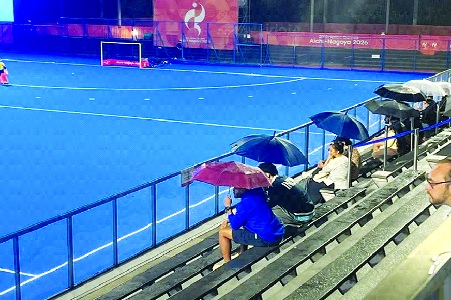

Aichi-Nagoya (TIP): Raincoats and umbrellas are out everywhere in Nagoya, Gifu, and other cities playing host to the ongoing Aichi 2026 Asian Games. With inclement weather refusing to abate, some of the events, especially those held outdoors, have already seen plenty of cancellations and abandonments, thus taking away some of the sheen of the prestigious continental sporting extravaganza.
These are not only raincoats of various shapes, colours and sizes, but also a variety of umbrellas, which are captivating both participating athletes, officials, and members of the media in the Games cities.
Interestingly, umbrellas are freely available at all outdoor venues. To match the generous offer of the organisers, even some of the taxi operators have simple umbrellas available on board their vehicles for use by their customers or passengers. It is left to the discretion of passengers or spectators visiting the outdoor venues to return these umbrellas or not.
“It does not cost much to get a simple see-through umbrella that is being freely used in Nagoya and other cities. Though rain is common, this time of the year is considered the best part of the year with little to moderate rain, says a taxi driver who claims he has already given away 10 umbrellas to his customers. “I do not expect them back,” he adds.
Five important games of cricket, including all the quarterfinals, have been cancelled or abandoned due to incessant rains. The weather is generally two to four degrees cooler than the temperatures at this time of the year.
Because of inclement weather, the performance of some of the athletes, especially in outdoor events, has been impacted. Track and field, for example, has been hit the most after cricket and softball.
Raincoats and umbrellas apart, my interest also veered around the Indian community in the Nagoya and Osaka area. The other day, as we were travelling by train from our Airbnb to Nagoya, we met Raghav, a research scholar from Trichur in Kerala, now living in Osaka.
Raghav has been in Japan for a couple of years and completed his doctorate in quantum mechanics in Osaka, where he is currently employed as a research associate by a private university in Osaka.
“For the past few days, I have been on holiday to watch the Asian Games. My interest is in individual events. The other day, I saw Indian shot putters Tajinderpal Singh Sidhu and Manpreet Kaur winning medals in their respective events. After watching gymnastics, swimming, and some other events, I will go back to Osaka.
“In Osaka University, there are about 50 Indian students, while in my university, I am the only one,” says Raghav, claiming that he has started loving Japan. People are disciplined and respectful.
Raghav says that there are some Indian restaurants in Osaka and Nagoya, and interestingly, the majority of them are run by Nepalese.
The other day, while looking for a media shuttle to Gifu, the hockey venue, we came across a Pakistani engineer, Zishan Khan, working for a French event company. Zishan Khan says that his loyalties remain divided between India and Pakistan.
“My grandmother moved from Bhopal in India to Pakistan in 1960. Our family continued to visit India for many years. My father always enjoyed cordial relations with Sikhs. I come from the Chitral area, and we know many Sikhs in Peshawar,” says Zishan Khan, who was specially employed for the Asian and Para Asian Games by the French company.
Zishan Khan has been working at some of the venues that have been hosting football matches of both the Asian and Para Asian Games.
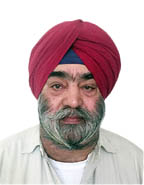
(Prabhjot Singh is a Toronto-based senior journalist who writes on Sports, politics and community. He can be reached at prabhjot416@gmail.com)


Be the first to comment