Tag: Russia

  • Upset Hindus urge Australia fightwear firm to withdraw battling Hindu gods rashguards

    Upset Hindus urge Australia fightwear firm to withdraw battling Hindu gods rashguards

    MELBOURNE (TIP): Upset Hindus are urging Gosford (New South Wales, Australia) based fightwear firm “Raven Fightwear” for immediate withdrawal of “Battle of the Gods – Hanoman v Ganesha” rashguards displaying images of Hindu deities Lord Ganesha and Lord Hanuman in a battle mode.

    Hindu statesman Rajan Zed, in a statement in Nevada said that it was trivialization of Lord Ganesha and Lord Hanuman, who were highly revered in Hinduism, as there was no scriptural evidence that any Hanuman versus Ganesha battle took place. Inappropriate usage of Hindu deities or concepts for commercial or other agenda was not okay as it hurt the devotees.

    Zed, who is President of Universal Society of Hinduism, also urged Raven Fightwear and its CEO to offer a formal apology, besides withdrawing “Battle of the Gods – Hanoman v Ganesha” rashguards from its website and stockists.

    Zed further said that such trivialization of Hindu deities was disturbing to the Hindus world over. Hindus were for free artistic expression and speech as much as anybody else if not more. But faith was something sacred and attempts at trivializing it hurt the followers, Zed added.

    “Battle of the Gods – Hanoman v Ganesha” men’s/women’s long sleeve rashguards were priced at $64.95 each on the website of Raven Fightwear, which specializes in Mixed Martial Arts apparel and claims to be “one of Australia’s fastest growing fight wear brands”. It has stockists in Australia, United Kingdom, USA, Canada, Czech Republic, Singapore, Russia; and its products include shorts, rashguards, gloves t-shirts, hoodies. “Our designs center around Norse mythology”, it states.

    In Hinduism, Lord Ganesha is worshipped as god of wisdom and remover of obstacles and is invoked before the beginning of any major undertaking. Lord Hanuman is known for incredible strength and was a perfect grammarian.

  • Russia takes over US compound in Moscow in retaliation over sanctions

    MOSCOW (TIP): Russian authorities on Wednesday took over a summer-house compound in Moscow leased by the US embassy, five days after the Kremlin ordered Washington to slash its diplomatic presence in Russia.

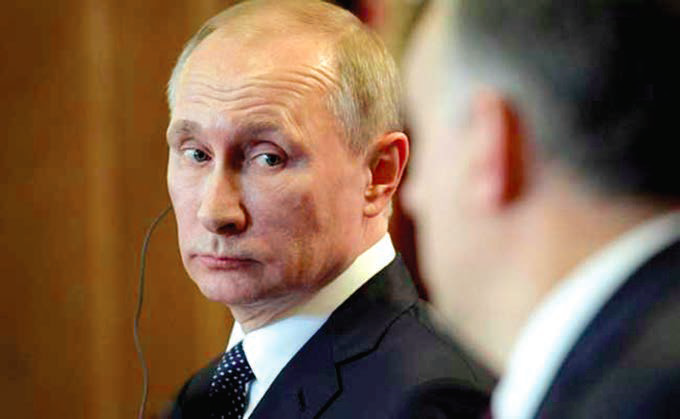
    In retaliation for new US sanctions, President Vladimir Putin has ordered the United States to cut around 60 percent of its diplomatic staff in Russia by Sept. 1, and said Moscow would seize a dacha country villa used by US embassy staff and a warehouse.
    US employees cleared out the dacha on Tuesday and a Reuters journalist who visited the property on Wednesday saw a large metal padlock securing the front gate.

    The one-storey building and courtyard, previously used by diplomatic staff at weekends and to host embassy parties, was empty and cleared of barbecue equipment and garden furniture.

    Two policemen in a car in front of the main entrance said they had been instructed to guard the property and did not expect any visits from US or Russian officials.

    “I don’t know when this situation will change,” one of the policemen said. Maria Olson, a spokeswoman for the US embassy, had no immediate comment when contacted by Reuters.

    She was quoted by Russia’s Interfax news agency as saying the embassy had retrieved all its possessions from the villa, and from the warehouse. Putin said on Sunday Russia had
    ordered the United States to cut 755 of its 1,200 diplomatic staff in its embassy and consular operations, though many of those let go will be Russian citizens, with the United States allowed to choose who leaves.

    The ultimatum issued by the Russian leader is a display to voters at
    home that he is prepared to stand up to Washington – but is also carefully calibrated to avoid directly affecting the US investment he needs, or burning his bridges with US President Donald Trump.

    One local Russian employee at the embassy, who declined to be named when speaking to the media, said staff were still in the dark about their future employment.

    “They say they will have to cut a lot of jobs – not just diplomats and technical staff, but also in the ancillary services, including drivers, janitors and cooks,” he said. “I hope I won’t be in trouble, but who knows.” (Reuters)

  • China-India border spat casts shadow ahead of BRICS summit

    China-India border spat casts shadow ahead of BRICS summit

    BEIJING (TIP): China is taking an increasingly tough line on a border row with India amid a rising crescendo of nationalism in state media, and President Xi Jinping looks set for an awkward encounter with Prime Minister Narendra Modi at a multilateral summit next month.

    Diplomats say Beijing would like to resolve the border issue before a summit of the BRICS nations – that also groups Brazil, Russia and South Africa – in the Chinese city of Xiamen in early September, and ensure nothing dampens what China wants to be a show of cooperation and friendship among developing countries.

    But that could be tough. On Wednesday, China ramped up the rhetoric, accusing India of “concocting” excuses over the illegal entry of the South Asian nation’s military into Chinese territory.

    “China will take all necessary measures to safeguard its legitimate and lawful rights and interests,” the foreign ministry said.

    The two sides’ troops are confronting each other close to a valley controlled by China that separates India from its close ally, Bhutan, and gives China access to the so-called Chicken’s Neck, a thin strip of land connecting India and its remote northeastern regions.

    Most previous standoffs, such as one in 2014 just ahead of a rare trip to India for Xi, were resolved with both sides withdrawing their forces. There has been no shooting since a brief border war in 1962.

    Talks are happening behind the scenes, but with little apparent progress. Meantime, Chinese and India media have been taking a strident approach, with a Chinese state-run newspaper last week saying China could use force. “The problem is the media on both sides are whipping things up. This makes it hard for China or India to back down,” said a Beijing-based source who is familiar with the discussions between the two sides.

    The Indian government has asked political parties to refrain from politicising the issue and allow diplomacy to work. “Show what we are made of” : China’s defence ministry last week also warned India not to harbour any illusions about the Chinese military’s ability to defend its territory.

    A source with ties to the military, who spoke recently to a senior Chinese officer involved in the stand off, said China has no appetite for conflict with India but could not be seen to be weak. “Nobody wants to fight about this, but if India keeps making trouble then we’ll have to show them what we’re made of,” the source said, citing the conversation with the senior officer.

    China has repeatedly called on India to withdraw its forces. An Indian government source closely tracking the standoff said there was no change in the ground situation in Doklam, with the two sides remaining in a standoff.

    Indian military expert Nitin Gokhale said India was prepared for a long haul. “The decision is to stay resolute on the ground and reasonable in diplomacy,” Gokhale said.

    China has been briefing foreign diplomats on the stand off, saying it wants a resolution but that its patience won’t last for ever. “There’s no easy solution,” said an Asian diplomat, who attended a briefing, referring to both sides’ insistence that they are in the right. For the time being, China looks ready to keep things calm, said another Asian diplomat, familiar with China’s thinking on the issue. “China really wants to resolve this ahead of the BRICS summit. It doesn’t want anything to affect the atmosphere,” the diplomat said. “The gloves could come off after the summit though.” (Reuters)

  • Beijing sends conciliatory signals after Doval’s first meeting with his Chinese counterpart Yang Jiechi

    Beijing sends conciliatory signals after Doval’s first meeting with his Chinese counterpart Yang Jiechi

    BEIJING (TIP): In the first official meeting between top Indian and Chinese officials since the Doklam stand-off+ became public, national security adviser Ajit Doval met state councillor Yang Jiechi here on July 27, offering the possibility of serious diplomatic efforts to deescalate the confrontation.

    Yang, who as China’s state councillor overseeing foreign affairs occupies a powerful position in the state council, is the Chinese nominee in the India-China special representative level dialogue with Doval. An influential post, the state councillor is a member of the state council.

    Indications of how the bilateral meeting went could be gleaned by the commentary released by the official Xinhua news agency which sent out a conciliatory signal before Doval is expected to meet Chinese president Xi Jinping on Friday. It spoke of the need to enhance mutual trust as the two countries are “not born rivals”.

    The comments released by the official Xinhua news agency made a strong plea to avoid the possibility of a war. “Most economies, including those in the West, will find themselves negatively affected by an India-China war in a globalised and intertwined world today,” it said. In Delhi, the Indian government reminded China of the agreements on peace and tranquility that go back to 1993.

    Yang also held separate meetings with security officials of three other countries on the sidelines of a security dialogue of BRICS nations comprising Brazil, Russia, India, China and South Africa.

    He discussed issues concerning bilateral relations, international and regional issues and multilateral affairs with the visiting security officials, the official Xinhua news agency said.

    The remarks are a contrast to the hectoring tone in the comments published in publications like Global Times that are seen to reflect the views of the government.

    China’s official spokespersons have accused India of trespassing into Chinese territory, ignoring India’s protests that the face-off near the Sikkim-Tibet-Bhutan trijunction has been caused by unilateral attempts by China to alter the ground position.

    There are signs that the two neighbours might be able to scale down tensions that have spiked due to the military muscle flexing over China’s bid to build a road through a plateau in Bhutanese territory.

    This is the first time in weeks that the official media ran a commentary without demanding withdrawal of Indian troops from the disputed Doklam region. China has so far been insisting that troop withdrawal is a pre-condition to a “meaningful dialogue”.

    Doval reached Beijing on Thursday ahead of his planned meetings with Chinese President Xi Jinping and state counsellor Yang Jiechi on Friday. “The recent border issue between the two countries shows a lack of strategic trust on the Indian side,” Xinhua said.

    It is not China but a set of problems common to all developing countries like corruption, a lack of quality education and healthcare that is holding back India.

    “India must understand that China wishes what’s good for the Indian people and would love to see a strong India standing shoulder by shoulder with China,” Xinhua, which reflects the government’s thinking said, giving an emotional touch to the vexed relationship.

    Doval’s formal purpose of visiting Beijing is to attend a security dialogue of BRICS nations. He is expected to discuss the border standoff with Chinese leaders in separate meetings. Chinese foreign ministry has said that bilateral meetings are usually held during BRICS meetings and indirectly confirmed meetings on the border issue with Doval.

    “Instead of being rivals, India and China have much more common ground, common interests and common aspirations. Both as developing countries, the two need to work together on important issues like fighting climate change, protectionism and the financial privileges of Washington,” Xinhua said.

    It further said, “Hopefully, wisdom will guide the two countries to common prosperity. There is more than enough room for them to co-exist and thrive in Asia and in the world”.

    “Both China and India need to enhance communication and nurture trust between them, first by recognizing that the two are not born rivals and that harboring ill will against each other is dangerous,” Xinhua added.

  • Russia signs deal to use Syria air base for 49 years

    Russia signs deal to use Syria air base for 49 years

    MOSCOW (TIP): President Vladimir Putin has signed a law ratifying a deal with the Syrian government allowing Russia to keep its air base in Syria for almost half a century, official documents show.

    The original deal, signed in Damascus in January, sets out the terms under which Russia can use its Hmeymim air base in Latakia Province which it has used to carry out air strikes against forces opposing President Bashar al-Assad.

    Putin approved the agreement on Wednesday, after the two chambers of the Russian parliament backed it earlier this month, according to the government’s official information portal.

    The document says Russian forces will be deployed at the Hmeymim base for 49 years with the option of extending that arrangement for 25-year periods.

    The base has been at the heart of Moscow’s military foray since it intervened in the conflict in September 2015, helping turn the tide in favour of Assad, one of Russia’s closest Middle East allies. (Reuters)

  • An Unfazed Jeff Sessions decides to stay on despite Trump’s annoyance with him

    An Unfazed Jeff Sessions decides to stay on despite Trump’s annoyance with him

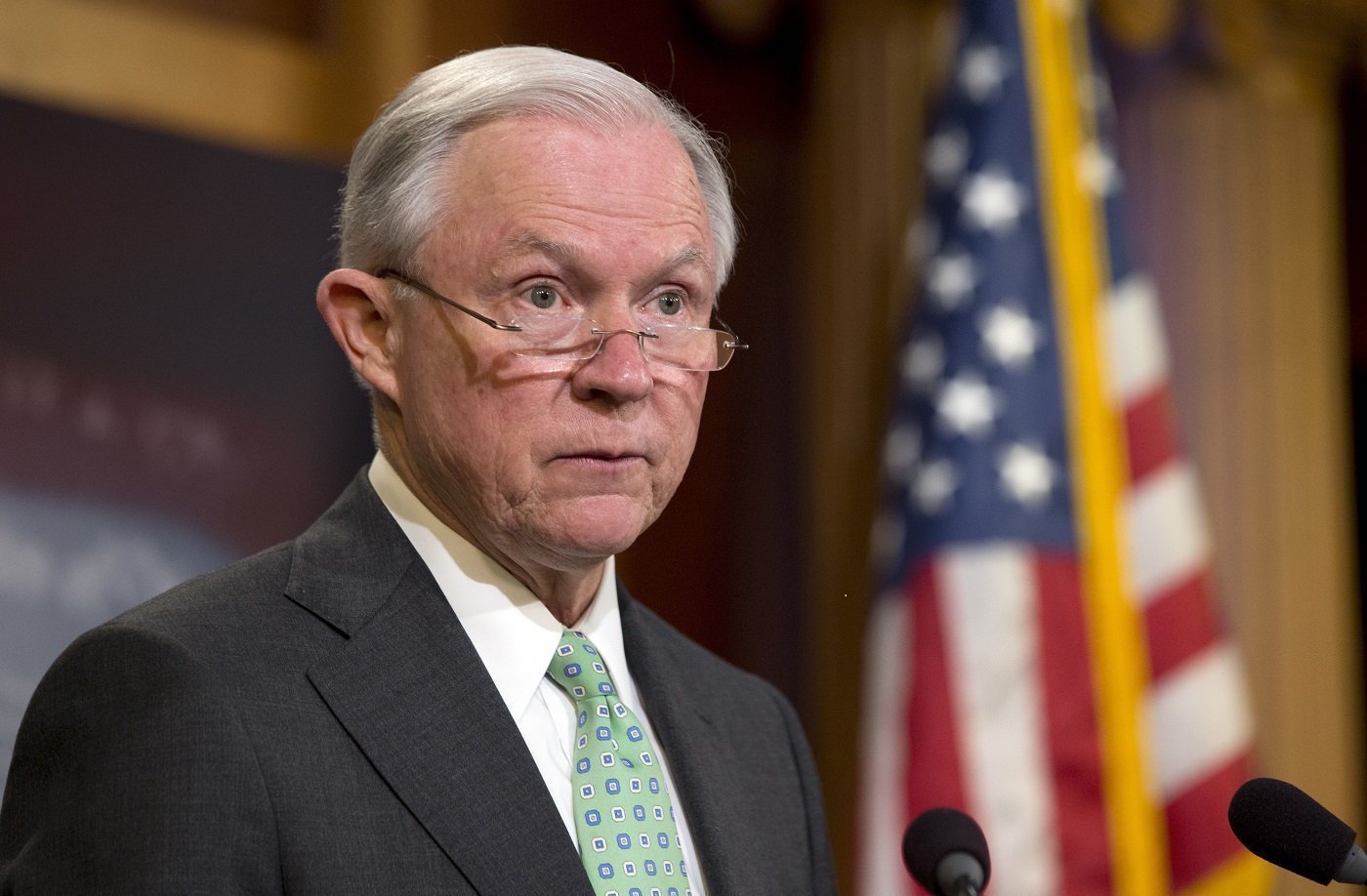
    WASHINGTON (TIP): Attorney General Jeff Sessions says he plans to stay on the job. That wouldn’t be news except that in an interview with The New York Times, July 19, President Trump openly criticized Sessions for recusing himself from Russia investigation.  Trump said that if he knew then what he knows now, he wouldn’t have nominated Sessions to be the attorney general. “Sessions should have never recused himself, and if he would – if he was going to recuse himself, he should have told me before he took the job, and I would have picked somebody else”, Trump said in the interview.

    Sessions said that he had the “honor of serving as attorney general,” and that he plans “to continue to do so as long as that is appropriate.” Asked whether he could keep running the Justice Department given Trump’s comments, he responded: “I’m totally confident that we can continue to run this office in an effective way.”

    Meanwhile, President Trump has no plans to fire Jeff Sessions, his spokesperson said Thursday, July 20, even after his extraordinary attacks cast doubt on the fate of the attorney general and Robert Mueller, the special counsel leading the Russia investigation.

    While Trump still disagrees with Sessions’ decision to recuse himself from the Russia investigation, White House spokeswoman Sarah Sanders said, “clearly, he has confidence in him, or he would not be attorney general.”

  • Indian American Congresswoman Jayapal, Congressman Cicilline Introduce Resolution of Inquiry for Release of Documents Pertaining to Possible Obstruction of Justice

    Indian American Congresswoman Jayapal, Congressman Cicilline Introduce Resolution of Inquiry for Release of Documents Pertaining to Possible Obstruction of Justice

    WASHINGTON (TIP): After the Department of Justice released a heavily redacted, single-page document confirming that Attorney General Jeff Sessions lied to the FBI about his contacts with the Russian government, House Judiciary Committee members, Representatives Pramila Jayapal (WA-07) and David Cicilline (RI-01) introduced a resolution of inquiry requesting the Trump administration release any and all information pertaining to Attorney General Sessions’ involvement in the firing of FBI director James Comey in violation of his recusal and related matters.

    “For six months, we have watched the Trump administration make a mockery of our laws and the highest office in our land while our Republican colleagues refuse to allow hearings on obstruction of justice and collusion with Russia,” said Rep. Jayapal. “Our resolution of inquiry will force the House Committee on the Judiciary to consider allegations of obstruction of justice involving the Justice Department. The Senate Judiciary Committee is taking action on the matter. We need the Republicans on our committee to wake up and take these issues seriously. We have a duty as members of Congress and the Judiciary Committee to exercise oversight over the administration and the Justice Department.”

    “We’ve known for a while now that Paul Ryan and the Republicans don’t want to work with us on just about anything. That’s true for jobs, tax fairness, infrastructure, workforce training, and health care,” said Rep. Cicilline. “But what’s most outrageous is that they don’t even want to work with us to make sure the American people know the truth about allegations of obstruction of justice involving the Justice Department. There is no more serious responsibility than protecting our democracy and the American people deserve members of Congress who take this responsibility seriously.”

    The two representatives demanded that House Republicans wake up and conduct oversight of the Trump administration. Attorney General Sessions has failed to disclose his meetings with the Russian government, largely ignored his recusal from the Russia investigation and helped to fire the FBI Director under false pretext. On July 13, the Department of Justice released a document that suggests the Attorney General failed to disclose any contacts with foreign governments on his security clearance application.

    The Jayapal-Cicilline Resolution is designed to obtain information about these and other systemic problems at the highest levels of the Trump administration. The Majority has refused to conduct even basic oversight of the Department of Justice. This resolution will force the issue, and leave each member to choose whether the House Judiciary Committee will begin to address these urgent problems or continue to be complicit in the administration’s undermining of justice.

    Jayapal and Cicilline will closely follow ongoing developments specifically pertaining to the role of Donald Trump Jr. and Jared Kushner in potential collusion between the Trump campaign and Russia. If the administration fails to be more forthcoming about these troubling developments, Jayapal and Cicilline plan to amend the resolution to demand more transparency and accountability to the American people.


  • California Democrat files article of impeachment against US President and accuses him of obstruction of justice

    California Democrat files article of impeachment against US President and accuses him of obstruction of justice

    WASHINGTON (TIP): A Democratic Congressman has filed the first article of impeachment against President Donald Trump charging him with obstruction of justice in the probe into alleged Russian meddling in the US polls.

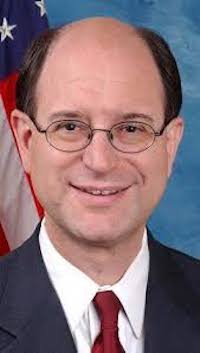
    Democratic Congressman from California Brad Sherman introduced the article of impeachment against Trump for high crimes and misdemeanors. Democrat Al Green has signed on to the resolution introduced by Sherman.

    This is for the first time that a US lawmaker has introduced an article of impeachment against Trump, who was sworn in as the 45th US President on January 20. However, the move is likely to be stalled in the Republican-controlled Congress.

    The House of Representatives needs to pass it by a majority vote for the article to move forward. Trump’s Republican party has an advantage of 46 votes in the current House of Representatives and it is unlikely that the Republican lawmakers would vote on such an impeachment move.

    The White House dismissed Sherman’s move with spokeswoman Sarah Huckabee Sanders saying: “I think that is utterly and completely ridiculous and a political game at its worst.”

    “Recent disclosures by Donald Trump Jr indicate that Trump’s campaign was eager to receive assistance from Russia. It now seems likely that the President had something to hide when he tried to curtail the investigation of National Security Advisor Michael Flynn and the wider Russian probe,” Sherman said after introducing the article of impeachment against Trump.

    “I believe his conversations with, and subsequent firing of, FBI Director James Comey constitute Obstruction of Justice,” he said.

    Everyday Democrats, Republicans, and the entire world are shocked by the latest example of America’s “amateur President”, he said.

    “Lack of impulse control, accompanied by a refusal to have his staff control his impulses. We’re no longer surprised by any action, no matter how far below the dignity of the office—and no matter how dangerous to the country,” Sherman said.

    “But the Constitution does not provide for the removal of a President for impulsive, ignorant incompetence. It does provide for the removal of a President for High Crimes and Misdemeanors,” he asserted.

    As the investigations move forward, additional evidence supporting additional articles of impeachment may emerge, he noted. “However, as to the Obstruction of Justice…the evidence we have is sufficient to move forward now. And the national interest requires that we do so,” the Democratic lawmaker said.

    (Source: PTI)

  • Officials say 76 police officers hurt in clashes with anti-G20 protesters

    Officials say 76 police officers hurt in clashes with anti-G20 protesters

    HAMBURG (TIP): At least 76 police officers were hurt on Thursday in clashes with anti-G20 protesters in Hamburg, German authorities said, as a demonstration dubbed “Welcome to Hell” erupted in violence shortly after it began.

    “Police are still being attacked,” said a spokesman for Hamburg’s police force, adding that most of the officers hurt sustained light injuries.

    Demonstrations turned violent late Thursday, as German police clashed with a group of masked anti-capitalist activists hurling bottles and stones.

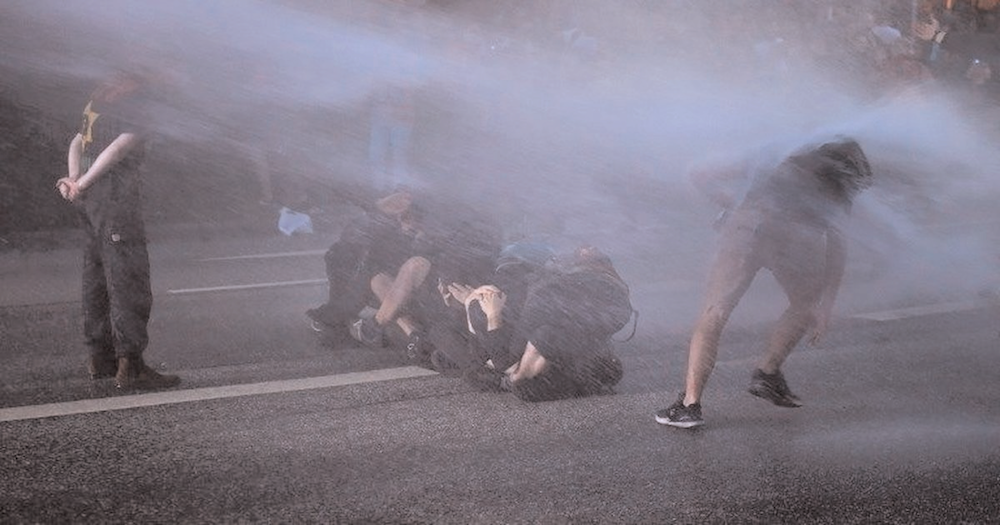
    What should have been a peaceful march by around 12,000 people in Hamburg protesting against globalisation was halted as police used water cannon and tear gas to disperse around 1,000 far-left militants.

    Police called with loudspeakers on protestors to remove their masks but this was ignored and after more objects were thrown, authorities decided to separate them from the other protestors, police said on Twitter.

    “Unfortunately it has come to the first clashes. We are implementing corresponding measures,” read another tweet.

    Protesters were seen scrambling to leave the scene, while others defiantly stood in the way of water cannon trucks as they moved in surrounded by riot police with helmets and batons.

    Police tweeted a photo of a car and flames and said shop windows were smashed. The main “Welcome to Hell” march was then called off but thousands of people remained as night fell and demonstrators engaged in smaller skirmishes in the back streets of Germany’s second city, AFP correspondents said.

    Up to 100,000 demonstrators are expected before and during the two-day Group of 20 meeting gathering Trump, Russia’s Vladimir Putin and Xi Jinping of China starting on Friday.

    There were 20,000 police on standby together with armoured vehicles, helicopters and surveillance drones. A holding centre for detainees has been set up in a former hardware store with space for 400 people.

    “War, climate change, exploitation are the result of the capitalist system that the G20 stands for and which 20,000 police are here to defend,” demonstrator Georg Ismail told AFP.

    Major events like the G20 have in recent years usually been held in remote locations, but Germany was forced by its logistical demands to host it in a large city with a big venue and dozens of hotels.

    Hamburg is desperate to avoid a rerun of the kind of major clashes seen at the 2001 G8 summit in Genoa or the Frankfurt opening of the new European Central Bank building in 2015.

    In Hamburg, some 30 demonstrations have been announced, organised by anti-globalisation activists and environmentalists, trade unions, students and Church groups.

    “Welcome to Hell” organiser Andreas Blechschmidt said the motto is “a combative message… but it’s also meant to symbolise that G20 policies worldwide are responsible for hellish conditions like hunger, war and the climate disaster”.

    The main focus of attention inside the G20 venue on the first day of the summit on Friday will be Trump’s first face-to-face meeting with Putin. Speaking in the Polish capital earlier on Thursday in front of 10,000 people, Trump didn’t mince his words about Moscow.

    “We urge Russia to cease its destabilising activities in Ukraine and elsewhere, and its support for hostile regimes — including Syria and Iran — and to instead join the community of responsible nations in our fight against common enemies and in defence of civilisation itself,” he said.

    Arriving in Hamburg later Thursday, Trump headed to talks with German Chancellor Angela Merkel, who has vowed to defend the 2015 Paris climate accord despite the US leader’s decision to withdraw.

    Merkel said before meeting the US president that Trump was facing isolation within the G20 over the issue — one of several topics where the new US leader is likely to clash with his fellow leaders. (Reuters)

  • Ten killed and dozens hurt in Bangladesh garment factory blast

    Ten killed and dozens hurt in Bangladesh garment factory blast

    DHAKA (TIP): A boiler has exploded at a Bangladeshi garment factory killing 10 people and injuring dozens, fire officials said on July 2, the latest mishap to hit one of the world’s biggest garment producers.

    The accident happened late on Monday at a plant of Multifabs Limited, a Bangladeshi company on the outskirts of the capital, Dhaka, a fire official said.

    The firm supplies knitted apparel to clients in Sweden, Denmark, Germany, Russia, Spain, Netherlands and Britain, including to Littlewoods, one of Britain’s oldest retail brands, according to its website.

    “Nine people were killed in the blast and one died in hospital,” fire service official Palash Chandra Modak said. The company said the plant was functioning well and the boiler had just been serviced.

    “This was an accident. Everything was fine,” Mahiuddin Faruqui, company chairman and managing director told Reuters. “The boiler was running well. After servicing when workers were trying to restart it, it went off.” Bangladesh’s garment-making industry, the biggest in the world after China’s, employs four million people and generates 80 percent of its export earnings.

    Multifabs started operating in 1992, and reached $70 million in exports in 2016, supplying European brands such as fashion chain Lindex, which is part of Finnish retailer Stockmann and Aldi, Faruqui said. (Reuters)

  • Indian American to embark on solo flight around the world

    Indian American to embark on solo flight around the world

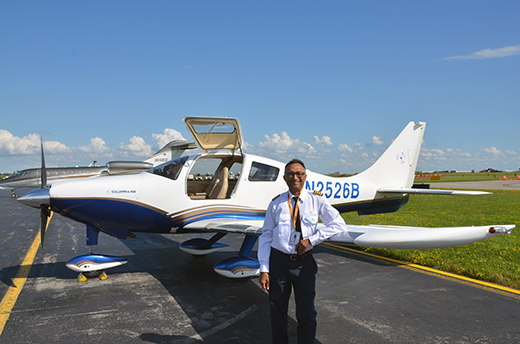
    NEW YORK (TIP): On July 4, Ravinder K. Bansal, a retired entrepreneur of Indian origin, will embark on a solo flight around the world in a single-engine Cessna 400 to raise money for a hospital in Haryana. He hopes to raise $750,000 to purchase an MRI machine for a hospital in his hometown Ambala.

    The 100-bed hospital Rotary Ambala Cancer and General Hospital has been built with donations from philanthropists both in the US and India. The contribution is also a tribute to his elder brother Subhash Bansal’s wife, Sneh Bansal, who died of cancer in India, in 2005.

    “I am excited to start my round the world trip from Buffalo Niagara International Airport on July the 4th. This mission for me is very personal as it not only is an adventure that I have been dreaming about for a while, but will also get the hospital a needed piece of MRI equipment now and help bring awareness about cancer in rural community around Ambala. Above all, it will generate publicity for the hospital that will hopefully continue to bring donations/support from the local and international community and Rotarians to keep the hospital operating and growing in future”, Bansal wrote in his blog.

    Ravi Bansal, a resident of Buffalo, New York, is the pilot/owner of Cessna 400. The Cessna 400 is the fastest FAA-certified fixed-gear, single-engine piston aircraft in production today, reaching a speed of 235 knots (435 km/h) true air speed at 25,000 feet (7,600 m).  The 19,878-mile trip will have several stops in different countries including England, France, Italy, Greece, Jordan, UAE, Oman, and India while going; and while returning Bansal would come via Thailand, Malaysia, Philippines, Japan, Russia, and Canada.

  • Western sanctions made Russia stronger: Putin

    Western sanctions made Russia stronger: Putin

    MOSCOW (TIP): Russia has climbed out of recession despite continuing Western sanctions, President Vladimir Putin said on Thursday, adding that the restrictions have forced the country to “switch on our brains” to reduce its dependence on energy exports.

    Speaking in a live call-in show televised nationwide, Putin deplored the US Senate’s decision yesterday to impose new sanctions on Russia as a reflection of Western efforts to “contain” Russia, but insisted that the measures only have made the country stronger.

    The Republican-led Senate voted Wednesday to punish Moscow for interfering in the 2016 election by approving a wide-ranging package of sanctions that targets key sectors of Russia’s economy and individuals who carried out cyberattacks.

    The Senate bill follows up on several rounds of other sanctions imposed by the United States and the European Union over Russia’s annexation of Ukraine’s Crimean Peninsula and its support for pro-Russia insurgents in eastern Ukraine.

    Putin argued that Russia has done nothing to warrant the Senate’s move, saying it highlights the West’s policy of containing Russia and also reflects domestic infighting in the United States. “It’s evidence of a continuing internal political struggle in the US,” he said. Putin said that the sanctions have given Russia an incentive to shed its dependence on oil and gas exports and “switch on our brains and talents” to develop other industries. He emphasised that electronics, aerospace industries and agriculture have all received a boost. Russia has responded to the US and EU sanctions by halting most Western food imports, a move that has helped increase Russian agricultural output.

    Russian farmers have pleaded with the Kremlin to keep the import ban even if the West lifts its sanctions, but Putin said that if “our partners lift the sanctions against our economy, we will respond in kind.”

    The Russian leader claimed that the “crisis is over,” pointing at modest economic growth over the past nine months, low inflation and rising currency reserves. Putin said that a slump in oil prices had been a more important factor in Russia’s economic slowdown than the sanctions.

    He acknowledged that the Russian economy hasn’t yet shed its dependence on exports of raw materials, but noted that non-energy exports have been growing. Putin recognised that people’s incomes have fallen and 13.5 per cent of Russians now live below the poverty line currently equivalent to $170.

    Most of the questions during the tightly-choreographed show were about low salaries, decrepit housing, failing health care and other social problems.

    Like in the past, Putin chided local officials for failing to provide due care for people and ordered them to quickly fix the flaws. Even before the show ended, local officials rushed to report that they are looking into the problems.

    Putin also offered a glimpse into his closely guarded private life, saying he has two grandchildren whose privacy he wants to respect. Putin, who in 2013 announced on state television that he was divorcing his wife, has two daughters in their early 30s who haven’t been seen in public for years and became a subject of rumours. One of Putin’s daughters was reported to be in charge of a lucrative project to build a Silicon Valley-like community under the auspices of Moscow State University.

    Putin said during the show that both of his daughters live in Moscow and “work in science and education.” He said one of his grandchildren goes to pre-school and the other, a boy, has just been born. He said he doesn’t want to give details about his family for fear of hurting their privacy (AP)

  • IS chief may be dead, says Russia: No information to support claim: US

    IS chief may be dead, says Russia: No information to support claim: US

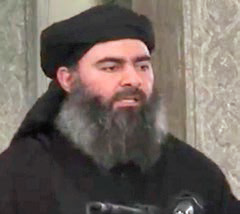
    MOSCOW (TIP): Russia said June 16 it was verifying whether the elusive Islamic State terror group chief Abu Bakr al-Baghdadi had been killed in a targeted Russian airstrike in strife-torn Syria last month.

    The airstrike on May 28 was carried out on the outskirts of the dreaded militant group’s de facto capital Raqqa, on a command post where IS leaders were holding a meeting, according to Russian state media reports.

    “According to information, which is being verified via different channels, the meeting was also attended by the (IS) leader Ibrahim Abu Bakr al-Baghdadi, who was eliminated in  the strike,” the ministry said, according to the TASS news agency.

    The leaders were discussing their exit from the city through the so-called southern corridor, the ministry said. The airstrike was carried out following drone footage confirmation of the council’s meeting location, state-run Sputnik reported.

    Other state media reported that more than 300 “terrorists” were killed in the strike. Earlier, the Russian army, in a statement, said Sukhoi warplanes carried out a 10-minute night-time strike on May 28 at a location near Raqqa, where IS leaders had gathered to plan a pullout by militants from the group’s stronghold.

    There have been a number of previous reports of Baghdadi’s death. This is the first time, however, that Russia has said it may have killed the IS leader. Other media reports have previously claimed he had been killed or critically injured by US-led coalition air strikes.

    Reacting to the report, Russian Foreign Minister Sergey Lavrov told journalists that there is no one-hundred-per cent confirmation yet that leader of the Islamic State terror group outlawed in Russia, al-Baghdadi, has been killed, ” So far, I have no one-hundred-percent confirmation of this information,” Lavrov said.

    The Pentagon said on Friday, June 16, it did not have information to support Moscow’s claims that its forces may have killed Islamic State leader Abu Bakr al-Baghdadi in an air strike near the Syrian city of Raqqa last month. “We have no information to corroborate those reports,” Pentagon spokesman Navy Captain Jeff Davis said, Reuters reported.

    US defense officials said they were unable to confirm the reports. Col. Ryan Dillon, a spokesman for the US-led coalition’s operation against IS in Syria and Iraq, said the coalition “cannot confirm these reports at this time.” There has been no official comment from Syria’s government, the BBC reported.

    So far, there has been minimal reaction from online supporters of IS to news of the reported death of the group’s leader, it said. One high-profile IS supporter on the messaging app Telegram shared a post denying the news and saying that when an IS leadership figure is killed, the group does not hide it.

    He expected Baghdadi to come out soon with a message to prove he was still alive. The IS has earned global notoriety for imposing a hardline form of Islam that has included stonings, beheadings and amputations. (Source: PTI)

  • Vladimir Putin: I am not a woman, so I don’t have bad days

    Vladimir Putin: I am not a woman, so I don’t have bad days

    NEW YORK (TIP): Film director Oliver Stone, whose series of conversations with Vladimir Putin air next week on Showtime, said he watched Megyn Kelly interview the Russian president on NBC and concluded that “he knew his stuff and she didn’t.” Kelly’s interview, which aired on the debut of her newsmagazine, “Sunday Night with Megan Kelly,” on Sunday, “became machine-gun like,” Stone said, and was an example of how American journalism frequently leaves little room for nuance.

    “I think she was attractive and she asked hardball questions, but she wasn’t in position to debate or counter him, because she didn’t know a lot of things,” he said. NBC News President Noah Oppenheim shot back that “no one here is interested in Oliver Stone’s unsolicited thoughts on Megyn Kelly’s appearance or his ill-informed opinion of her journalism.”

    “But so long as we’re offering each other professional feedback, please let him know I don’t think he’s made a decent movie since the early `90s,” he said. Putin was combative when asked in the NBC interview about hacking in the US presidential election and relations between Russia and President Donald Trump’s team. He’s more serene on Showtime, where more than a dozen interviews that Stone conducted with the Russian president between 2015 and early this year unfold one hour per night for four nights starting Monday.

    As an example of where he believed Kelly was mistaken, Stone said the claim that 17 US intelligence agencies had concluded the Russians were behind election year hacking and used as a preface for a question had been “walked back.” It was a reference to testimony from James Clapper, former director of national intelligence, about a hacking report by three specific agencies. The independent organization Politifact has produced a report that backs Kelly, however, because Clapper had earlier said that all 17 intelligence agencies he had supervised agreed about Russia’s involvement.

    Stone, a controversial figure who has interviewed Fidel Castro and Hugo Chavez and produced a documentary backing Putin’s version of events in the Ukraine, conducts a Putin interview far less confrontational than Kelly’s, at least on the basis of two episodes provided for screening by Showtime. One critic, Marlow Stern in The Daily Beast, called in a “wildly irresponsible love letter” to Putin.

    The filmmaker’s style does include its share of ingratiating remarks. “You have a lot of discipline, sir,” he says at one point. “You are an excellent CEO. Russia is your company,” he says at another.

    Besides office sit-downs, Putin is interviewed driving a car, walking through horse stables at his home and after he played in a hockey game. When Putin makes a claim about a letter he received from the CIA and Stone asks him to produce it, the Russian president says, “My words are enough.” Yet Stone also challenges Putin on his authoritarian style and questions his claims of democratic reform. The filmmaker said in an interview that there are more direct questions about relations with the United States in the unseen third and fourth episodes.

    He asks Putin about assassination attempts and, while it was inadvertent in one case, captures a couple of eyeopening moments. Asked if he ever have bad days, Putin replies that “I am not a woman so I don’t have bad days,” adding a reference to “natural cycles” affecting behavior.

    During a discussion about gay rights, Putin said about a homosexual male: “I prefer not to go in the shower with him. Why provoke him?” Stone is aware that he’ll receive criticism for not pushing Putin hard enough. “I’m not a journalist,” he said. “I’m a filmmaker and I was taking a different approach.”

    The project’s value comes in seeing Putin talking about his life and world view in an extended format, seeing the personal and political history that drives policy for the US’s biggest adversary, and simply how his mind works. At one point Stone asks Putin about a 13 percent inflation rate, and is quickly corrected. “Twelve point nine,” he said. “It’s crucial for the United States to understand another point of view,” Stone said. “I’m interested in preventing a further deterioration in relations.”

    The film also features Stone screening a copy of the Cold War-era satire “Dr. Strangelove” for the stone-faced Russian leader. “I pushed him where I felt he should be pushed,” Stone said. “At a certain point, you know that that person is not going to change his approach. He’s a leader. He thinks things through and he’s made his point. I can’t think of anything more that I could have said or done.” (AP)

  • Fighting Terrorism is at the Top of the Agenda at the SCO Summit

    Fighting Terrorism is at the Top of the Agenda at the SCO Summit

    In the capital of Kazakhstan, Astana, a meeting of the defense ministers of the member countries of the Shanghai Cooperation Organization (SCO) was held on June 7. At the meeting, the members of the delegations made a number of statements concerning both the situation in Syria and the fight international terrorism in general.

    First of all, all the representatives agreed that Indian and Pakistani membership that will become true tomorrow, June 8, will enhance SCO’s security capabilities. Referring to international problems, the SCO participants concurred that the terrorism in a short time turned into the biggest threat to the global security. At the same time, all the members of the delegations noticed that the situation is aggravating with every passing day by numerous local conflicts in the world and by inability of the Western countries to overcome differences, to form a common and united front against this evil and to work together to build a bastion against terrorism.

    In this regard, the Syrian issue has become a key topic of the agenda during the meeting. The SCO-countries gave the highest priority to the question. A detailed briefing session was held for new Member States (India and Pakistan) on the common attitude of the participating countries to the key crisis in the Middle East. As it was noted at the meeting, it is in the Syrian Arab Republic the main forces of the Islamic State are concentrated. It was also stated that the Syrian Arab army coordinating its activities in order to ensure the success operations undermined in the end the potential of the IS fighters and Syria has been “at the forefront of fighting international terrorism” for a long time.

    Special attention was paid to the creation of de-escalation areas in Syria, which could contribute to ending the civil war and thus intensifying efforts to combat ISIS and Al-Nusra. The representatives of SCO-Member countries also noticed that practical steps are being taken to implement the agreements reached at the moment. The priority tasks, namely ensuring the monitoring of all the commitments undertaken, as well as creating conditions for the restoration of the destroyed infrastructure were also highlighted.

    The countries of the Shanghai Cooperation Organization agreed to provide support to each other in Syria and to exchange military experience in conducting counter-terrorism operations. Interaction within the SCO in the future was decided to focus on identifying and anticipating any terrorist activities.

    Inside Syria Media Center’ experts reasonably assume that the Member states will need to create joint effective managing tools to stop penetration of terrorism and radicalism into the SCO’s area of responsibility. A fair guess would be that the special attention would be paid to an operative exchange of the information available on the activities of terrorist groups.

    Such a summit is clearly useful for Syria from the point of view of practicality. People in Syria hope the talks will equip the SCO-members better to meet the challenges of terrorism. Syria needs support to be able to tackle the difficulties and to take the steps necessary for a just and lasting peace.

    SUMMARY: To be noted is that the Shanghai Cooperation Organization (SCO), or Shanghai Pact, is a Eurasian political, economic, and military organization which was founded in 1996 in Shanghai by the leaders of China, Kazakhstan, Kyrgyzstan, Russia, Tajikistan, and Uzbekistan. These countries, except Uzbekistan, had been members of the Shanghai Five, founded in 1996; after the inclusion of Uzbekistan in 2001, the members renamed the organization. On 10 July 2015, the SCO decided to admit India and Pakistan as full members. India and Pakistan signed the memorandum of obligations on 24 June 2016 at Tashkent, thereby starting the formal process of joining the SCO as the full members. Now in Astana the countries are going to become full members.

    The meeting of the SCO-defense ministers takes place once a year and the heads of the military departments have the opportunity both to share their views on the events taking place in the world and to work out a common strategy. In addition, it is possible to hold bilateral meetings to discuss in detail the plans of military cooperation on the margins of the meeting.

  • Lies, Plain and Simple : James Comey

    Lies, Plain and Simple : James Comey

    “We are under Siege”: President Trump Trump’s personal counsel accuses Comey of leaking “classified information”
    I.S. Saluja

    WASHINGTON (TIP): In the Atlantic season of hurricanes, one political hurricane could turn out to be historic- the Comey testimony. In his testimony before the Senate Intelligence Committee, June 8, former FBI Director James Comey affirmed his belief that President Trump fired him “because of the Russia investigation.” He did not accuse the president of obstructing justice, leaving that question up to Robert Mueller, the appointed special counsel. In response, Trump’s personal lawyer accused Comey-inaccurately though-of leaking “classified information”, referring to the memos Comey had drafted regarding his conversations with the president.

    Ousted FBI director James Comey testified before the Senate Intelligence Committee on Thursday, June 8, and didn’t pull any punches when discussing President Trump. Here are five takeaways from his blockbuster testimony.

    “Lies, plain and simple”: Throughout his testimony, Comey accused Mr. Trump of misleading Americans about the nature of his tenure at the Bureau and his  firing in May. “The administration then chose to defame me and more importantly the FBI, by saying the organization was poorly led,” Comey said at the onset of his testimony.

    “Those were lies, plain and simple.” Mr. Trump and his allies have criticized Comey’s tenure numerous times since his firing. The president even reportedly called Comey a “real nut job” during his meeting with Russian diplomats. Last month, Deputy White House Press Secretary Sarah Huckabee Sanders said that Comey had “lost the confidence” of the FBI’s rank-and-file agents, which Comey, among others, dispute.

    Why he was fired: Comey told the committee that he does “take him at his word” on one thing — that he was terminated over the Russia investigation. Comey said the “shifting explanations” for his ouster “confused” and increasingly, “concerned” him, as the White House’s official explanation for his firing contradicted that of the president’s. Comey said he couldn’t be sure of why the president fired him, but that he believes the president’s public comments.

    After firing Comey, Mr. Trump told NBC’s Lester Holt he thought of the thought of “made-up” story of ties between Russia and the Trump campaign when he fired Comey, and he told Russian diplomats that firing Comey relieved “great pressure” on him from the FBI’s Russia probe.

    “I take the president at his word that I was fired because of the Russia investigation,” Comey said in the hearing. And he went further, suggesting that the president hoped to “change” the way the Russia probe was being conducted. “I was fired in some way to change the way the Russia investigation was being conducted,” Comey said. “That is a big deal. On top of that, the Russia investigation itself is vital because of the threat. And if any American were part of that, that is a very big deal.”

    Comey leaked: How did the existence of Comey’s memos make it to the press? He leaked them. Comey says he believes the memos were his personal property and written in his capacity as a private citizen, although he has now turned them over to Special Counsel Robert Mueller. In fact, Comey says he hoped that by sharing what he had written in the memos with the news media, he could help trigger the appointment of a special counsel to investigate Russian interference in the 2016 election.

    Comey, however, did not leak the memos to the press himself. Nor did he rely on his friend Benjamin Wittes, a legal blogger who frequently teases new revelations in the Russia investigation with his Twitter account. Instead, Comey said that he turned to a “good friend” who teaches at Columbia Law School to share what he had written with the memos. That friend, CBS News’ Andres Triay reports, is Daniel Richman, a law professor at Columbia.

    “Lordy, I hope there are tapes” : Mr. Trump tweeted after firing Comey last month that the ex-FBI chief “better hope that there are no ‘tapes’ of our conversations before he starts leaking to the press!” Comey says this tweet inspired him to leak the contents of his memos to the press, because he felt he “needed to get that out into the public square.”

    “Lordy, I hope there are tapes,” Comey said during a back-and-forth with Sen. Dianne Feinstein, D-California, to laughter from the crowd. He later said that if Mr. Trump had indeed recorded any of their conversations that he hoped they would be released. He also disclosed that Special Counsel Robert Mueller has his memos.

    Loretta Lynch’s strange request: Comey said his reasoning behind his much-criticized July 2016 announcement that the FBI would not recommend charges against Hillary Clinton over her private email server had a lot to do with then-Attorney General Loretta Lynch holding a private meeting with former President Bill Clinton on a Phoenix, Arizona tarmac.

    But that wasn’t the only reason he decided to make the announcement. “Probably the only other consideration that I guess I can talk about in open setting is that at one point the attorney general had directed me not to call it an investigation, but instead to call it a ‘matter,’ which confused me and concerned me, but that was one of the bricks in the load that led me to conclude I have to step away from the department if we’re to close this case credibly,” Comey said.

    Trump is not under investigation — or, rather, he wasn’t: As Comey said in his written statement before the hearing, Comey did in fact inform Mr. Trump three times that he was not personally under investigation. Mr. Trump, Comey said, was frustrated that the FBI did not make this public, and asked Comey to make it so several times. But Comey had serious reservations about letting it be known that Mr. Trump wasn’t under investigation, among them that if that information were to be made public, the FBI would then have to announce that Mr. Trump was under investigation if that ever became the case.

    Of course, whether Mr. Trump is under investigation now is impossible to know, since Comey was fired on May 9, and the Russia investigation may have expanded since then. Who all are the guys on Intelligence Committee who questioned James Comey?

    Richard Burr, Republican of North Carolina: The chairman of the committee, which he joined in 2007, Mr. Burr embraced President Trump during the campaign. But he has earned praise from his peers in both parties in recent weeks for the seriousness with which he has taken his role in leading the Senate’s investigation.

    Mark Warner, Democrat of Virginia: Mr. Warner, the highest-ranking Democrat on the committee, has thrived in the spotlight that the investigation brings. He has in the past expressed presidential ambitions and has praised Mr. Burr, whom he calls a friend, for his leadership of the committee.

    Jim Risch, Republican of Idaho: Mr. Risch was elected to the Senate in 2009 and has been a member of the committee since then. He is one of Mr. Trump’s strongest supporters in Congress and has expressed significant concern about leaks to the news media. He is a former governor of Idaho.

    Dianne Feinstein, Democrat of California: Ms. Feinstein, who was once the head of the committee, has in the past criticized Mr. Comey for his actions in the investigation into Hillary Clinton’s email server. But she expressed concern after he was fired in May and said then that she believed he should “absolutely” testify before the other committee on which she sits, the Senate Judiciary Committee.

    Marco Rubio, Republican of Florida: A candidate for president in 2016, Mr. Rubio joined the Intelligence Committee in 2011. Mr. Rubio has been willing to criticize Mr. Trump, his former campaign rival, and has been dismissive of the president’s complaints that the Russia investigation is a “witch hunt.”

    “We are nation of laws, and we are going to follow those laws,” Mr. Rubio said recently. Ron Wyden, Democrat of Oregon: Mr. Wyden, who has been on the panel since 2001, has been a strong critic of the Trump administration and had early on called for Mr. Comey to appear in front of the committee.

    Susan Collins, Republican of Maine: Ms. Collins, who has been on the committee since 2013, is known as one of the more moderate Republicans now serving in the Senate. She has been tougher on the president than many colleagues in her party. “I really want to know the truth no matter who is implicated, no matter where the evidence leads,” she told The Times last month.

    Martin Heinrich, Democrat of New Mexico: Mr. Heinrich joined the committee when he arrived in the Senate in 2013. He pushed the F.B.I.’s acting director, Andrew McCabe, to assert that Mr. Comey still enjoyed “broad support” among the agency’s rank and file.

    Roy Blunt, Republican of Missouri: Mr. Blunt, along with Ms. Collins, has been a strong supporter of Congress’s investigation into Russia’s actions in the 2016 presidential election. A former acting house majority leader, he has been on the panel twice, leaving after 2012 and rejoining in 2015.

    Angus King, Independent of Maine (Caucuses with Democrats): Mr. King, a former governor of Maine, has been on the committee since he joined the senate in 2013. One of the most steadfast members of the committee, he caused a stir on Wednesday when he pressed Mr. McCabe and other intelligence officials on why they could not elaborate on earlier conversations they had with Mr. Comey.

    James Lankford, Republican of Oklahoma: Mr. Lankford, who was once a Baptist youth minister, joined the committee in 2015. He has insisted on the seriousness of its investigation into Russia’s alleged interference and has said that he hopes that Mr. Comey’s hearing will “hopefully end speculation and lead us to facts.”

    Joe Manchin, Democrat of West Virginia: Mr. Manchin, a moderate Democrat and a former governor of West Virginia, is known for crossing the aisle. He joined the Senate in 2011 and was assigned to the committee this year. He told the news media that Mr. Comey, shortly before his firing, had sought more resources for the Russia investigation.

    Tom Cotton, Republican of Arkansas: A former member of the U.S. Army and the youngest U.S. senator, Mr. Cotton has expressed skepticism of Mr. Comey’s accounts of his interactions with Mr. Trump. He joined the committee in 2015.

    Kamala Harris, Democrat of California: Ms. Harris was ferocious in her calls for a special prosecutor to supervise the F.B.I.’s Russia investigation. Often named as a potential presidential candidate, Ms. Harris, a former attorney general of California, was assigned to the committee this year when she joined the Senate. She has expressed impatience with the Senate’s probe, saying that she thinks it needs to be sped up.

    John Cornyn, Republican of Texas: Mr. Cornyn, the majority whip, only recently joined the panel. He is one of Mr. Trump’s stronger allies in Congress and was reportedly being considered to replace Mr. Comey before taking himself out of the running last month.

    Jack Reed, a Democrat from Rhode Island, and John McCain, Republican of Arizona, also questioned Mr. Comey on Thursday. As the leaders of the Armed Services Committee, they are “ex officio” members of the Intelligence Committee, as are the Senate majority leader, Mitch McConnell, and the Senate minority leader, Chuck Schumer.


  • US missile interceptor test a threat to China: Experts

    US missile interceptor test a threat to China: Experts

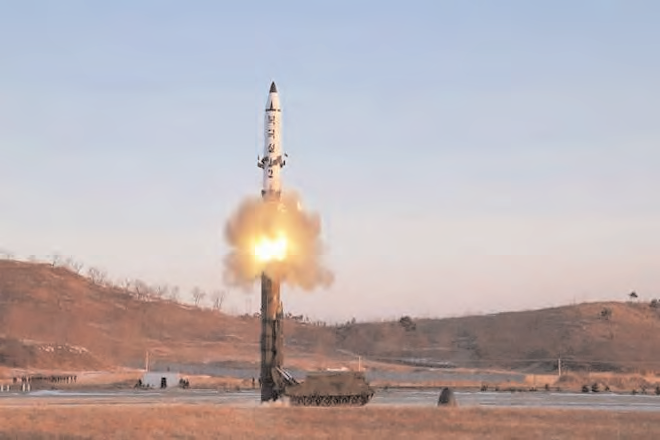
    BEIJING (TIP): The successful test of a US missile interceptor has sparked concerns in China as experts said it will break the strategic balance with other nuclear powers and signals preparations for military action against nuclear-armed North Korea The US has successfully tested a mock intercontinental ballistic missile (ICBM) using its own upgraded long-range interceptor warhead.

    “This test is similar to actual combat because it used X-band radar to track and lock on to the target – an ICBM – by itself. In the past, the US used a medium-range missile and the defence system had the data and information about the target before the test,” Yang Chengjun, a senior military strategist on missile studies from the PLA Rocket Force, told the Global Times.

    Officials said the US interceptor missile travelled at 27,040km per hour and hit its target over the Pacific Ocean. The test came a day after North Korea tested its ninth ballistic missile this year, which travelled 450 kms before splashing down in the Sea of Japan. Pentagon spokesperson Navy Captain Jeff Davis said the test had been planned for some time and was not timed specifically as a response to North Korea. “In a broad sense, North Korea is one of the reasons why we have this capability,” he said in a statement.

    Yang said the US test indicates it is preparing for military action as tensions in Northeast Asia increased. However, North Korea’s test only proves that it has mediumrange missiles, not ICBMs, so the US’ missile defence system is targeting nuclear powers like China and Russia, which could launch ICBMs to strike US territory, Yang said.

    The US interceptor has an uneven track record, having succeeded nine times out of 17 attempts against missiles in tests since 1999, although the most recent test in June 2014 was a success, state-run Xinhua news agency reported.

    The US has 26 interceptors based at Fort Greely in Alaska and four at Vandenberg Air Force Base. Last week, the Pentagon presented its 2018 budget to Congress, proposing spending $7.9 billion on missile defence, including $1.5 billion for the ground-based mid- course defence programme.

    “The balance between nuclear armed countries is based on ‘Mutual Assured Destruction’ (MAD), and the development of missile defence systems is for the US to seek absolute security. But it’s actually damaging the balance and it will surely bring about an arms race among nuclear armed countries,” Chu Yin, an associate professor at the University of International Relations said. “China also has its missile defence system, with technology very similar to the US’, but the system is not as comprehensive as the US system,” Yang noted.

    China has already exercised about the US deployment of THAAD (Terminal High Altitude Area Defence) interceptor missiles in South Korea to ward off to counter missile threats from North Korea as its radars provide a deep look into Chinese territory, specially its missile activities. (PTI)

  • Russian state has never been involved in hacking: Putin

    Russian state has never been involved in hacking: Putin

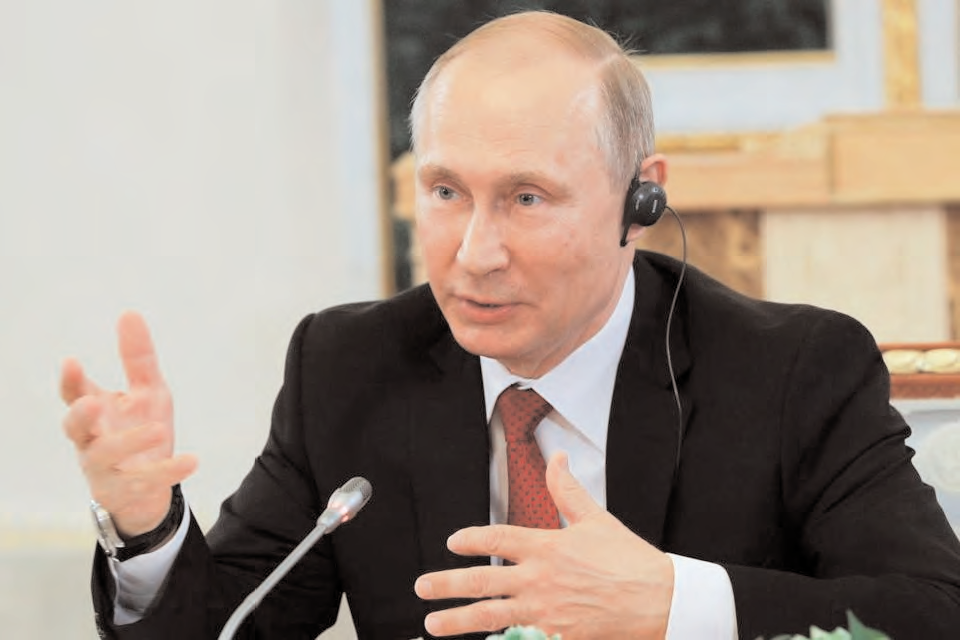
    ST PETERSBURG (TIP): President Vladimir Putin insisted June 1 that the Russian state has never engaged in hacking and scoffed at allegations that hackers could influence the outcome of elections in the United States or Europe.

    But the Russian leader admitted the possibility that some individual “patriotic” hackers could have mounted some attacks amid the current cold spell in Russia’s relations with the West.

    Speaking at a meeting with senior editors of leading international news agencies, Putin also alleged that some evidence pointing at Russian hackers’ participation in attacks could have been falsified in an attempt to smear Russia.

    “I can imagine that some do it deliberately, staging a chain of attacks in such a way as to cast Russia as the origin of such an attack,” Putin said. “Modern technologies allow that to be done quite easily.” US intelligence agencies have accused Russia of hacking into Democratic Party emails, helping President Donald Trump’s election victory, and the Congressional and FBI investigations into the Trump campaign’s ties with Russia have shattered Moscow’s hopes for a detente with Washington. Putin said the “Russo-phobic hysteria” makes it “somewhat inconvenient to work with one another or even to talk.”

    “It’s having an impact, and I’m afraid this is one of the goals of those who organize it are pursuing and they can fine-tune the public sentiments to their liking trying to establish an atmosphere that is going to prevent us from addressing common issues, say with regard to terrorism,” the Russian leader said. Putin predicted “this will end, sooner or later,” adding that “we are patient, we know how to wait and we will wait.”

    Asked if Russian hackers could try to shape the outcome of German parliamentary elections later this year, Putin said: “We never engaged in that on a state level, and have no intention of doing so.”

    He noted that Russia can work constructively with any German leader, adding that he had good ties with German Chancellor Angela Merkel despite some differences.

    Russian meddling was also a concern in France, with Putin publicly expressing his sympathy for President Emmanuel Macron’s rivals in the campaign. Macron’s aides claimed in February that Russian groups were interfering with his campaign, and a document leak hit Macron’s campaign in the final hours of the French race.

    Moscow has strongly denied all allegations of election meddling. Putin argued that hackers, wherever they come from, can’t sway election outcomes because the public mood cannot be manipulated that easily. “I’m deeply convinced that no hackers can radically influence another country’s election campaign,” he said.

    “No hackers can influence election campaigns in any country of Europe, Asia or America.” Putin added that while the Russian state has never been involved in hacking, Russia-West tensions could have prompted some individuals to launch cyberattacks.

    “If they have patriotic leanings, they may try to add their contribution to the fight against those who speak badly about Russia,” he said. “Theoretically it’s possible.”

    Russia’s relations with the West have been at post-Cold War lows over the Ukrainian crisis. The US and the EU have slapped Moscow with sanctions over its annexation of Ukraine’s Crimean Peninsula and support for pro- Russian insurgency in eastern Ukraine.

    Putin said Thursday that economic restrictions against Russia have had “zero effect.” He predicted that the current strain in relations will ease, because “it’s counterproductive and harmful.”

    Touching on tensions in the Pacific, Putin said Russia’s military deployments on a group of Pacific islands also claimed by Japan have been caused by concerns about the US military buildup in the region.

    The four islands, called the Northern Territories in Japan and the southern Kurils in Russia, were seized by the former Soviet Union at the end of the World War II, preventing the two countries from signing a peace treaty.

    Putin said the US will likely continue to build up its missile shield in the region even if North Korea agrees to curb its nuclear and missile programs, in the same way it has continued to develop missile defenses in Europe despite a deal with Iran that curbed its nuclear program in exchange for lifting international sanctions. (AP)

  • Modi, Putin discuss strategic ties; ink nuclear pact

    Modi, Putin discuss strategic ties; ink nuclear pact

    Modi to meet Trump on June 26

    ST PETERSBURG (TIP): Prime Minister Narendra Modi met Russian President Vladimir Putin in St Petersburg on June 1 and the two countries concluded a much awaited agreement to build the last two units of the Kudankulam nuclear power plant in Tamil Nadu.

    In St Petersburg, the Russian President’s hometown, Modi and Putin discussed ways to take their energy and strategic ties forward. Russia and India signed five pacts, reflecting the partnership between the traditional allies.

    The Nuclear Power Corporation of India Limited and Russia’s Atomstroyexport, a subsidiary of Rosatom, the regulator of Russia’s nuclear complex, will jointly build the reactors of the 6,000 megawatt plant. The final two units will have a capacity to produce 1,000MW of power.

    “International relations see ups and downs, but history is witness Indo-Russia relations have not seen any ups and downs,” the Prime Minister said and thanked President Putin for playing a crucial role in getting India the SCO membership. Putin said India will become a full-fledged member of the SCO in a week.

    Also, he said in an exclusive interview to PTI that Russia does not have any “tight” military relationship with Pakistan, and asserted that its close friendship with India cannot be diluted.

    But he sidestepped a question on Kashmir, saying “no matter where the threat comes from, it is unacceptable and we will always support India in its fight against terrorism”. Modi, who is on a four-nation tour, will return from France on June 3. He will travel to Astana in Kazakhstan for the Shanghai Cooperation Organization (SCO) summit on June 8 and 9.

    Modi is expected to meet US President Donald Trump on June 26 in Washington, it is learnt.

    This would be a highly-anticipated first meeting between the two after Trump took office in January. Government sources said counter-terrorism, maritime security and Afghanistan will top Modi’s agenda during his two-day visit to the US from June 25.

    His official functions in Washington will be confined to the first half of June 26.

    The possibility of the Indian private sector’s commitment to create jobs and opportunities in the US is likely to be his agenda. That could be an attempt to bridge gaps as the latest US policies are inimical to immigrant workers following Trump’s poll promise to create and protect American jobs.

    On his way to the US, Modi will stop in the Netherlands. He will visit Portugal on his return journey. (Source: PTI)

  • Indian American envoy defends Kushner, says Kushner will continue to do ‘his work’

    Indian American envoy defends Kushner, says Kushner will continue to do ‘his work’

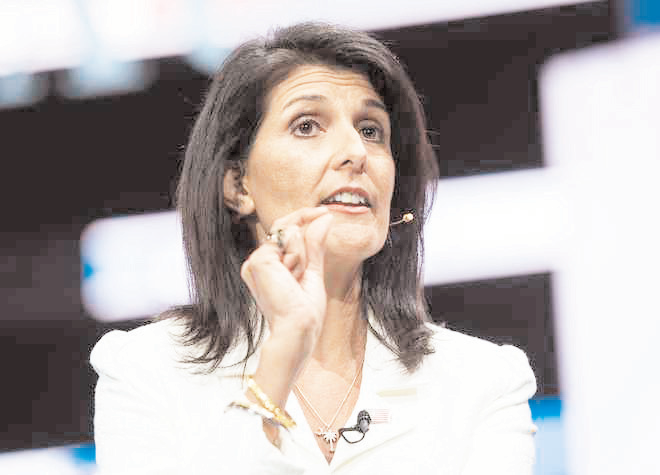
    WASHINGTON (TIP): President Donald Trump’s top adviser and son-in-law Jared Kushner, on the firing line for his reported attempt to set up a “back-channel” with Russia, has received support from US ambassador to the UN Nikki Haley who was once a bitter critic of Donald Trump. “If you know Jared, he’s a very calm, stable voice,” Haley told MSNBC.

    The Indian-American envoy’s defense of Kushner, 36, came after the American media reported last week that he discussed to open a secret “back-channel” between Russia and Trump’s presidential transition team in a meeting with the Russian ambassador to the US, Sergey Kislyak, last December.

    “There is not a lot that rattles him. So, I suspect that he’ll continue doing his work like he always has. He’s said that he will totally comply with the investigation and give every ounce of information that they need. And I think we can expect that,” Haley said in response to a question.

    She said she did talk to Kushner often, but has not since the news came out last week that he wanted to open a secret line of communication with Russia bypassing formal channels. “Well, I haven’t talked to him since all of this came out,” Haley said.

    The White House too has defended the role of Kushner, who is married to Donald Trump’s daughter, Ivanka. “I would just say that Kushner’s attorney has said that Kushner has volunteered to share with Congress what he knows about these meetings, and he will do the same if he’s contacted and connected with any other inquiry,” White House press secretary Sean Spicer told reporters.

    Both secretary of state Rex Tillerson and national security adviser Lt Gen HR McMaster have discussed that, and “in general terms, back channels are an appropriate part of diplomacy,” he said.

    Yesterday Politico reported that Kushner is back in the West Wing and he continues to lead meetings despite the rising tide of Russia-related questions.

  • OPEC extends oil output cut by nine months to fight glut

    OPEC extends oil output cut by nine months to fight glut

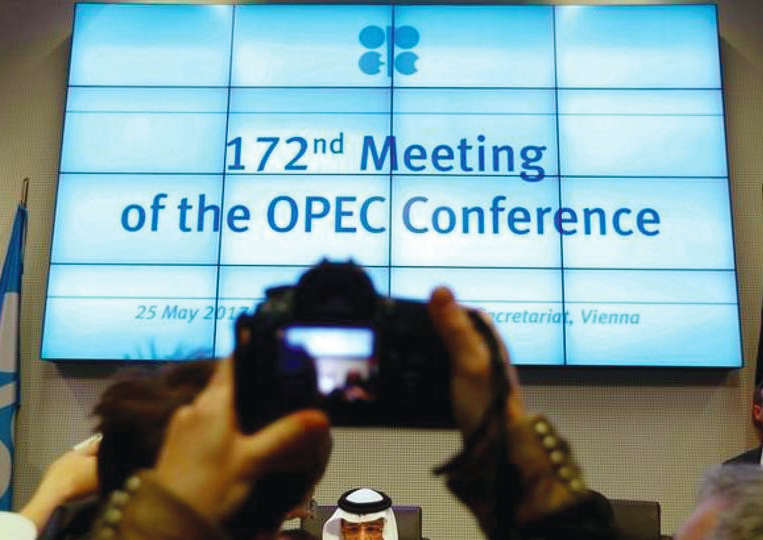
    VIENNA (TIP): OPEC decided on May 25 (Thursday) to extend cuts in oil output by nine months to March 2018, OPEC delegates said, as the producer group battles a global glut of crude after seeing prices halve and revenues drop sharply in the past three years.

    The cuts are likely to be shared again by a dozen non-members led by top oil producer Russia, which reduced output in tandem with the Organization of the Petroleum Exporting Countries from January.

    OPEC’s cuts have helped to push oil back above $50 a barrel this year, giving a fiscal boost to producers, many of which rely heavily on energy revenues and have had to burn through foreign currency reserves to plug holes in their budgets.

    Oil’s earlier price decline, which started in 2014, forced Russia and Saudi Arabia to tighten their belts and led to unrest in some producing countries including Venezuela and Nigeria.

    The price rise this year has spurred growth in the U.S. shale industry, which is not participating in the output deal, thus slowing the market’s rebalancing with global crude stocks still near record highs.

    By 1150 GMT, Brent crude had fallen 1.3% to around $53 per barrel as market bulls were disappointed OPEC would not deepen the cuts or extend them by as long as 12 months. [O/R] OPEC oil ministers were continuing their discussions in Vienna after three hours of talks. Non-OPEC producers were scheduled to meet OPEC later in the day. In December, OPEC agreed its first production cuts in a decade and the first joint cuts with non-OPEC, led by Russia, in 15 years. The two sides decided to remove about 1.8 million barrels per day from the market in the first half of 2017, equal to 2% of global production.

    Despite the output cut, OPEC kept exports fairly stable in the first half of 2017 as its members sold oil from stocks. The move kept global oil stockpiles near record highs, forcing OPEC first to suggest extending cuts by six months, but later proposing to prolong them by nine months and Russia offering an unusually long duration of 12 months.

    “There have been suggestions (of deeper cuts), many member countries have indicated flexibility but … that won’t be necessary,” Saudi Energy Minister Khalid al-Falih said before the meeting.

    Source: Reuters

  • Fake News Hyperventilating or Constitutional Crisis, with Brutus lurking in the Ides of March?

    Fake News Hyperventilating or Constitutional Crisis, with Brutus lurking in the Ides of March?

      By Ravi Batra
    The cascading events, generally are layered and rarely, as now, erupt into a crescendo from an approaching constitutional crisis.

    Initially, let me disclose that I am a registered Democrat, and seeing how Hillary’s team, including, DNC, illegally mistreated Sen. Bernie Sanders, and how Huma profited by quitting as Hillary’s deputy chief of staff and was immediately rehired as a “special government employee” and simultaneously got paid to work for the Clinton Foundation and Teneo Holdings – unethical and corrupt – I voted for Donald J. Trump to shake up the Establishment who, like Marie Antoinette, wanted Americans to “eat cake” when they couldn’t afford to “buy bread.” No hardworking American can get such a sweet Huma-Deal, soaked in conflicts of interests and influence peddling, without being shamed and maybe, going to jail. Leave aside Bill’s famous Tarmac Meeting with AG Lynch, forcing her recusal, and causing Comey to act as he did in 2016, where he, Comey cut Hillary a huge break by not indicting her for her planned-private email server, her housekeeper printing classified emails for Hillary’s review, and with full access to Bill to know all confidential matters without any “pillow talk” or an “audit trail” – due to password-sharing by Hillary to her housekeeper (and perhaps, Bill and Huma, etc.). General Petraeus ought get a presidential pardon from President Trump.

    I also admit that I didn’t like Preet Bharara being “fired,” after he was re-hired, as that hurt everyday New Yorkers from getting a government Lincoln decreed, while making those in power feel above-the-law again.

    Now, I turn to the issues at hand. Here is what we know, based upon the fast and furious reportage by The Washington Post, of Watergate fame, The New York Times and CNN, etc.

    President Trump likes General Flynn; even, after terminating him for lying to the Vice President. Perhaps, he likes Flynn too much. We know that Obama administration was told about Flynn-Russia contacts by our Special Allies in Europe. We know Obama warned then-president-elect Trump about Flynn. Yet, Trump as president appointed Flynn NSA, only, to fire him 18 days after he knew Flynn lied to the Vice President, with a termination oddly soaked with Flynn-love.  The bizarre Comey-termination, after a prior failed Loyalty-Pledge Request, was immediately followed by the incredulous Lavrov-Kislyak Oval Office visit with American Media barred, and POTUS later admitting to NBC’s Lester Holt that he, DJT, was thinking of the Russia Investigation when he fired Comey, hence, admitting his invisible state-of-mind worthy of self-immolation.

    If I was personal counsel to Donald J. Trump, not White House Counsel to the Office of the President of the United States, which requires the fiduciary duties protect the Office of the President and not necessarily the man who is president, I would want to know the answer to one critical bifurcated question, to wit: “Donald, did you create or approve of a plan, during your presidential campaign, that a “reachout” to Russia ought occur because you want to: (1)  “restart” US-Russia relations so as to defuse the ever-warming resurgence of the Cold War, as a matter of future US policy to cause Crimea’s return to Ukraine, NATO to refocus on defeating Terror, and Russian nuclear-armed submarines, ships and planes to join United States and NATO to enforce global peace and security? Or, (2) win the 2016 election with help from a foreign power, that is hostile to the United States, in violation of American democracy and rule of law and become the Manchurian President – remote-controlled by Russia?

    If Donald’s answer is YES to (1) and NO to (2), then he is like Nixon in 1968 delivering his famous China Speech at the Council on Foreign Relations, later to open up the world to China in 1971 and switch Taiwan’s United Nations Security Council seat from ROC to PRC. It’s all legal, even as history judges China the winner over Nixon, as China, instead of being a counterbalance to the then-Soviets, pulled a Veto along with Russia in 2013 in UNSC after Syria’s chemical war crimes.

    If Donald’s answer if NO to (1) and YES to (2), then he is in worse shape than Nixon’s Watergate Cover-Up, as here, it would be Trump’s Crime with Trump’s Cover-Up.

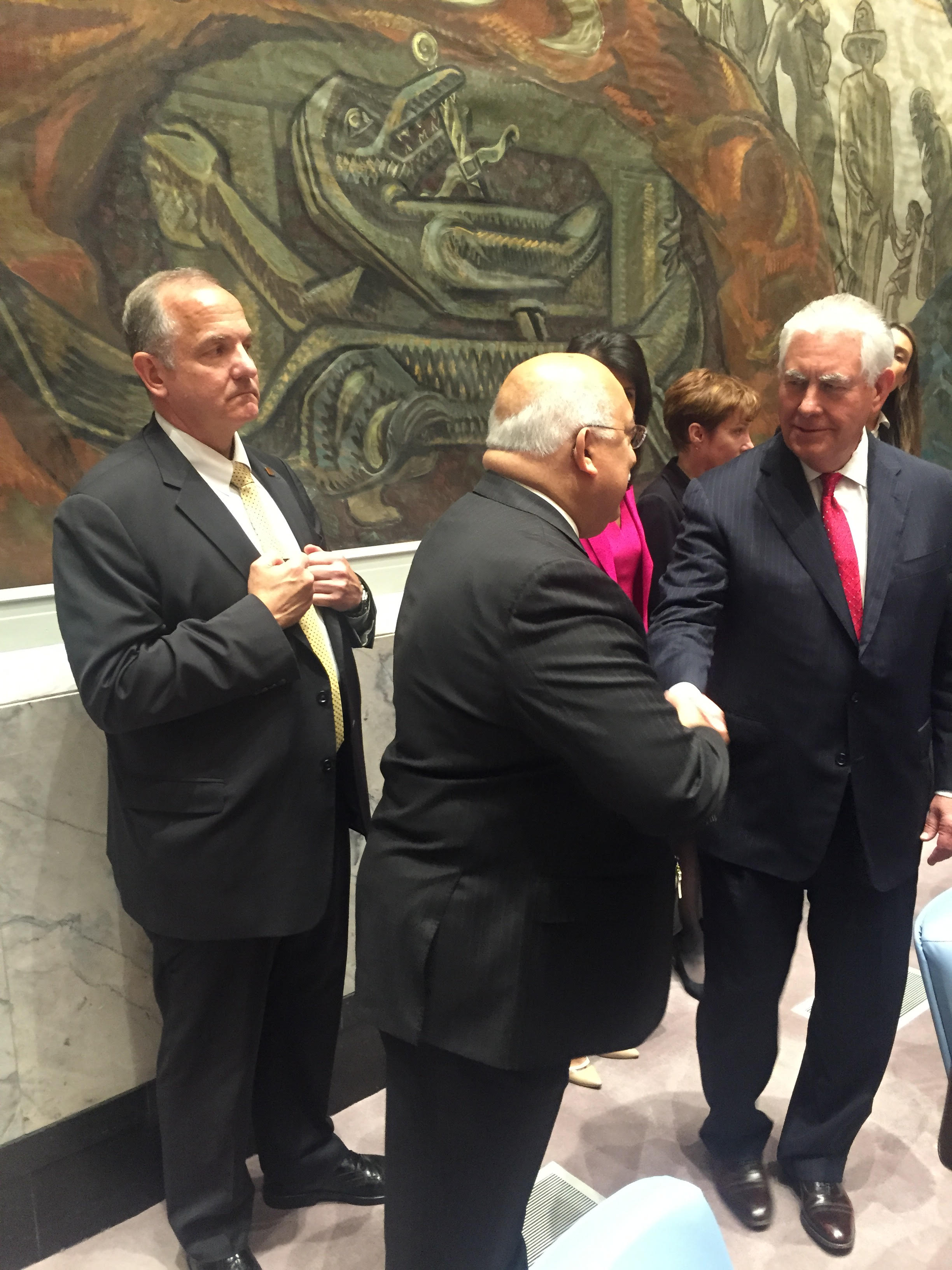
    Assuming DJT’s answers are YES and NO, not NO and YES, then I would advise him to cut loose everybody as President Reagan did in the Iran-Contra Affair, and let everybody, especially those who sought to make individual side profits from such Russian engagements to face the music, Congressional and Special Counsel Robert Mueller. For saving the Trump Presidency may be valuable to America and everyday Americans. Just look at what he has accomplished in his First foreign trip with the mature and uniquely capable Rex Tillerson by his side in Riyadh, Saudi Arabia. Just a few years ago, Saudi Arabia was so sick of our non-action against Syria, that after winning the coveted UN Security Council seat, Amb. Abdallah Y. Al-Mouallimi made history by declining the seat and Riyadh considered setting up an alternate multilateral system of government, given the void of American leadership in face of heart wrenching suffering caused by Syria and ISIS.

    However, there is a unique weakness that President Trump faces, that neither Nixon nor Reagan faced, in this early onset of the Impeachment Season: Both Houses of Congress are in Republican control. This is not so much a strength for the disruptive president, as it is a weakness. The Republicans want more than anything to retain both Houses in the 2018 Mid-Term elections. So, after getting the Tax Cut, they prefer to cause Impeachment to start out of righteous indignation, as then they get the normal-Establishment Mike Pence to be president – assuming he is not tainted and already-resigned by knowing about Flynn as Chair of Trump Transition Committee (for how could Flynn have lied to the Vice President in 2017, when Mike Pence already knew about Flynn-Russia and Flynn-Turkey in 2016) – well, then Speaker Paul Ryan is President. So, Mr. President, “beware the Ides of March” as “Brutus” lurks. Julius Caesar Act 1 Scene 2.

    (Ravi Batra, an eminent NY attorney, is a former NYS Commissioner, Joint Commission on Public Ethics; Chair, National Advisory Council South Asian Affairs)

  • Iran votes for reform

    Iran votes for reform

    “Mr. Rouhani’s decisive victory is a shot in the arm for the moderates coming after the elections in February last year for the Parliament and the Assembly of Experts where the moderates and the reformists had registered significant gains”, says the author.
    By Rakesh Sood

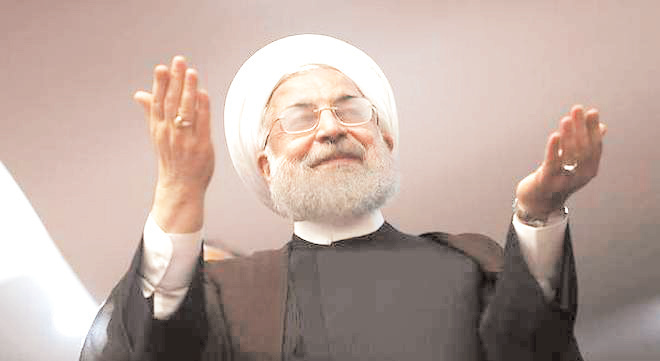
    After a difficult campaign, President Hassan Rouhani won a crucial second term in Iran’s presidential elections held on May 19. A high turnout of 73% helped him score a convincing victory over his principal challenger Ebrahim Raisi, a conservative cleric, in the first round itself, winning 57% of the votes compared to Mr. Raisi’s 38.5%. More than two-thirds of Iran’s voters are in urban areas and most of them are Rouhani supporters; therefore, as voting hours got extended to midnight indicating a high turnout, the mood in the Rouhani camp turned jubilant.

    A DIFFICULT CAMPAIGN:

    In 2013, Mr. Rouhani had campaigned and won on a platform that focused on bringing sanctions to an end,which he was able to achieve in July 2015 with the Joint Comprehensive Plan of Action (JCPOA), a nuclear agreement concluded with the P-5 + 1. The sanctions relief has had a positive impact on the economy with oil exports up and GDP growth hitting 6% last year though expectations were higher. In a TV debate in the run-up to the election, Mr. Raisi described the JCPOA as ‘a check that Rouhani had failed to cash’. Opinion polls had favored Mr. Rouhani, because Mr. Raisi, though close to the Supreme Leader,Ayatollah Ali Khamenei, was considered a relative newcomer to politics. However, concern grew when Mohammad Bagher Ghalibaf, a former Iranian Revolutionary Guards Corps (IRGC) pilot and the Mayor of Tehran since 2005, withdrew from the race in support of Mr. Raisi, who had spent most of his life in the judiciary before being appointed custodian of the shrine of Imam Reza in Mashhad last year. He also controls Astan-e-Quds Razavi, one of the wealthiest foundations, and is seen a possible successor to the present Supreme Leader who is 77 and in poor health.

    Therefore Mr. Rouhani’s decisive victory is a shot in the arm for the moderates coming after the elections in February last year for the Parliament and the Assembly of Experts where the moderates and the reformists had registered significant gains.

    ROUHANI’S CONSTRAINTS:

    However, given Iran’s complex governance structures, President Rouhani will have to tread carefully as his powers and those of the directly elected 290- member Parliament are constrained by the non-elected authorities. The key power center is the Supreme Leader who is appointed by the Assembly of Experts and in turn appoints the heads of radio and TV, the armed forces and the IRGC, the Supreme National Security Council, the 51-member Expediency Council and the higher judiciary. He also chooses six members of the powerful Guardian Council, with the other six nominated by the judiciary. The Guardian Council in turn vets candidates for all elections, presidential, parliamentary and the 88-member Assembly of Experts. It cleared only six candidates out of the more than 1,600 who filed nominations for the presidential contest; rejections included former President Mahmoud Ahmadinejad’s nomination. In addition, it approves all legislation passed by Parliament to ensure its consistency with Islamic jurisprudence. A dispute between Parliament and the Council is resolved by the Expediency Council. The Assembly of Experts is directly elected and its primary role is to appoint the Supreme Leader, critical during Mr. Rouhani’s second term.

    Mr. Rouhani’s principal challenge will be to sustain economic growth and nudge the reform process forward in order to tackle unemployment, currently running at over 12%, and higher among the youth. He has promised to expand individual and political rights, enlarge women’s role and ensure greater accountability.

    Some of these will be challenged. While his victory margin is a clear endorsement for reform, the Supreme Leader will play a critical balancing role. It is interesting that, in his immediate remarks, he praised the Iranian people for the impressive turnout, but did not congratulate the winner.

    In foreign policy, Mr. Rouhani will present the image of a moderate and more outward-oriented Iran. He is no stranger to Iran’s complex politics. From 1989 to 2005, he was Secretary of the Supreme National Security Council, reporting to the Supreme Leader, and handled the nuclear negotiations during 2003-05.

    During this period, he also served a term each as Deputy Speaker of Parliament and as member of the Expediency Council. Following Mr. Ahmadinejad’s election in 2005, he quit. After being elected in 2013, he persuaded the Supreme Leader to shift responsibility for the nuclear negotiations to the Foreign Ministry and let Foreign Minister Mohammad Javad Zarif take the lead.

    In addition to managing his home front, the other challenge for Mr. Rouhani will be keep the JCPOA going in the face of the U.S. Congress’s and now President Donald Trump’s declared hostility.

    DEALING WITH TRUMP:

    During the election campaign, Mr. Trump had called it the ‘worst deal ever’ and threatened to tear it up as soon as he was elected! Subsequently, he seems to have modified his position, realizing perhaps that it is not just a bilateral agreement with Iran but also includes Russia, China, the U.K., France, Germany and the European Union. In April, the Trump administration certified that Iran was abiding by its obligations but Secretary of State Rex Tillerson added that a 90- day policy review would be undertaken in view of ‘Iran’s alarming ongoing provocations’.

    More recently, on May 17, the Trump administration continued the sanctions waiver (under Section 1245 of the National Defense Authorization Act 2012), needed every 120 days even while imposing sanctions on seven Iranian and Chinese individuals and entities on account of missile proliferation activities.

    In April, a slew of human rights related sanctions were imposed. In mid- June another waiver, this time under the Iran Freedom and Counter-Proliferation Act, will need to be renewed if the JCPOA is to be sustained. These are necessary because in 2015, the Republican-dominated Congress rejected the JCPOA and U.S.

    President Barack Obama used executive authority to waive U.S. sanctions but these waivers need to be renewed periodically. The JCPOA was the outcome of protracted negotiations over more than a decade, during which Iran had steadily built up its nuclear capabilities, especially in the enrichment domain, and in 2015 was estimated to be only months away from acquiring enough Highly Enriched Uranium to produce one device (approximately 25 kg) though Iran consistently maintained that its program was exclusively for peaceful purposes. Given deep suspicions however, the JCPOA with its extensive inspection and reporting obligations was the best way to prevent Iran from developing a military nuclear capability for the next 10-15 years.

    Opponents say that while cheating is unlikely, they fear that Iran will retain its nuclear appetite after abstaining during the 10-15 year period and resume its activity once the inspection obligations expire.

    THE SAUDI FACTOR:

    Perhaps the most troubling problem is the new embrace of Saudi Arabia that was in evidence during Mr. Trump’s visit. It raises the prospects of greater U.S. involvement in the war in Yemen and can push relations with Iran into a confrontation. In 2016, there were 19 ‘incidents at sea’ between U.S. and Iranian vessels in the Persian Gulf. The most serious was in January 2016 when the IRGC held two U.S. vessels and 10 servicemen, accused of trespassing in Iranian waters. The crisis was resolved within hours, thanks to some quick phone conversations between U.S. Secretary of State John Kerry and Mr. Zarif. That link is missing today.

    It is all the more ironic because Iran is the one country that is opposed to the Islamic State. Yet the U.S. is keener to bless the Saudi-created Islamic Military Alliance to Fight Terrorism, a grouping of 41 Sunni nations, under the command of former Pakistani Army Chief, General Raheel Sharif. It remains unclear what the role of this coalition is, to fight the IS or Iran or in Yemen, or to secure the Gulf monarchies!

    For the last quarter century, the U.S. practiced dual containment of Iran and Iraq, a policy that suited both Israel and Saudi Arabia. Mr. Obama’s push for the JCPOA was driven by a desire to extricate U.S. policy from this stranglehold and expand options. If a return to the Saudi embrace creates additional tensions and a collapse of the JCPOA, it could push Iran to cross the nuclear threshold with much wider regional implications.Mr. Rouhani’s challenges are just beginning.

    (The author is a former diplomat and currently Distinguished Fellow at the Observer Research Foundation. He can be reached at rakeshsood2001@yahoo.com)

  • Russian Interference in US Elections 2016: Probe Tentacles Grow

    Russian Interference in US Elections 2016: Probe Tentacles Grow

    Jared Kushner Under Scrutiny in Russia Probe, Say Officials

    WASHINGTON (TIP): An NBC News report said, May 25, quoting “multiple US officials” that Jared Kushner, the president’s son-in-law and one of his senior advisers, has come under FBI scrutiny in the Russia investigation. “Investigators believe Kushner has significant information relevant to their inquiry, officials said. That does not mean they suspect him of a crime or intend to charge him”, says the NBC News. CNN said in a report on May 25, “The FBI’s criminal probe of Russian meddling in the 2016 presidential election is increasingly touching on the multiple roles of senior White House adviser

    Jared Kushner on both the Trump campaign and the Trump transition team. “Points of focus that pertain to Kushner include: the Trump campaign’s 2016 data analytics operation; his relationship with former national security adviser Michael Flynn; and Kushner’s own contacts with Russians, according to US officials briefed on the probe”. CNN report says further:”Federal investigators have been taking a  closer look at the Trump campaign’s data analytics operation, which was supervised by Kushner, officials say, and are examining whether Russian operatives used people associated with the campaign — wittingly or unwittingly — to try to help Russia’s own data targeting.

    “Kushner, the president’s son-in-law, worked with and helped oversee the campaign’s data operation contractors based in San Antonio, Texas. “Kushner has described how, beginning last June, he began testing the use of data targeting to sell Trump merchandise.

    Eventually, according to a November Forbes magazine profile, the data operation helped the Trump campaign figure out where the candidate’s message was resonating in states like Michigan and Wisconsin, places where conventional political wisdom suggested they would be wasting time and money. “I called somebody who works for one of the technology companies that I work with, and I had them give me a tutorial on how to use Facebook micro-targeting,” Kushner told Forbes.

    A source connected to the data analytics group said the team has not been contacted about any Russia related probe. “We have not been contacted by anyone and don’t know anything formally about an investigation,” the source said.

    The FBI focus on Flynn also touches on Kushner because he led the presidential transition’s foreign policy efforts. Kushner’s impact grew during the transition, which one source says he effectively ran — along with another campaign aide Rick Dearborn — once New Jersey Gov Chris Christie was removed. This source says both Kushner and his wife Ivanka Trump wanted Flynn in as national security adviser. A source close to Kushner denied that he pushed for Flynn. Kushner has acknowledged meeting during the transition with Russia’s ambassador and separately with the head of a Russian bank.

    According to a source familiar with what transpired, neither meeting discussed sanctions but instead focused on establishing a backchannel to Russia’s president. Those meetings are of interest to the FBI.

    The FBI’s scrutiny of Kushner places the bureau’s sprawling counterintelligence and criminal investigation not only on the doorstep of the White House, but the Trump family circle. The Washington Post first reported last week that a senior White House official close to Trump was a “person of interest,” but did not name the person. The term “person of interest” has no legal meaning. The officials said Kushner is in a different category from former Trump aides Paul Manafort and Michael Flynn, who are formally considered subjects of the investigation.

    According to the Justice Department’s U.S. Attorneys’ Manual, “A ‘subject’ of an investigation is a person whose conduct is within the scope of the grand jury’s investigation.”

    Records of both Manafort and Flynn have been demanded by grand jury subpoenas, NBC News has reported. It is not known whether Kushner has received any records requests from federal investigators. Also unclear is what precisely about Kushner’s activities has drawn the FBI’s interest as it investigates whether Trump associates coordinated with the Russian campaign to interfere in the election. Former

    FBI Director Robert Mueller is now leading the probe as a special counsel. Kushner met at least once in December with the Russian ambassador, Sergey Kislyak, and he also met last year with a Russian banker, Sergey Gorkov.

    “Mr. Kushner previously volunteered to share with Congress what he knows about these meetings,” Kushner’s lawyer, Jamie Gorelick, told NBC News. “He will do the same if he is contacted in connection with any other inquiry.”

    Congressional aides have said they would like to question Kushner about that meeting, and Kushner has said he would voluntarily appear before the Senate intelligence committee as part of its Russia investigation.

    Gorkov is chairman of VneshEconomBank, a Russian governmentowned institution that has been under U.S. sanctions since July 2014. Gorkov studied at the training school for the FSB, one of Russia’s intelligence services.

    Kushner, whose family’s real estate empire is worth $1.8 billion, according to Forbes, wields significant power in the White House. He is married to Trump’s daughter, Ivanka.

  • After 21 yrs, end of road for Chevrolet vehicles in India

    After 21 yrs, end of road for Chevrolet vehicles in India

    GM to stop selling products, focus on exports

    NEW DELHI (TIP): American auto major General Motors today decided to stop selling its vehicles in India as there was no turnaround in its fortunes here after struggling for over two decades to make a mark. It started its India journey in 1996.

    The company will now focus on exporting vehicles from its manufacturing plant at Talegoaon in Maharashtra after it stopped production at its first plant at Halol in Gujarat last month. It has also exited from four other international markets, including Russia and Europe.

    GM Executive VP and President of GM International Stefan Jacoby said after exploring many options the company determined that the increased investment originally planned for India would not deliver the returns of other significant global opportunities.

    “It would also not help us achieve a leadership position or compelling, long-term profitability in the domestic market,” he added.

    GM sales in India were down nearly 21% in 2016-17 to 25,823 units. Its production, however, grew about 16% to 83,368 units most of which were exported.

    In 2015, GM had announced plans to invest $1 billion to enhance manufacturing operations and roll out 10 locally produced models in India while deciding to stop production at its first plant at Halol in Gujarat. However, struggling to make a turnaround in India, the company put on hold the plan and undertook a full review of its future product portfolio here.

    VOLVO CARS TO START ASSEMBLY IN INDIA

    GOTHENBURG (TIP): Swedish auto major Volvo Cars will start assembly operations in India by the end of this year to expand in the local market and become more competitive and profitable. It will start assembling its premium SUV XC90 and has entered into a contract manufacturing agreement with Volvo Group India to use the latter’s existing infrastructure near Bengaluru and production licence. “It’s impossible to grow on imports in India. That’s why we are entering India with local assembly,” Volvo Cars president and CEO Hakan Samuelsson told a group of visiting Indian reporters.

    Source: PTI