
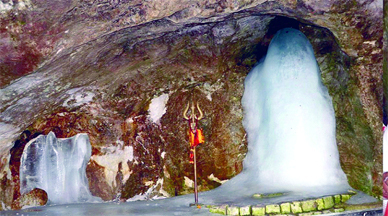

High in the Himalayan ranges of Jammu & Kashmir, nestled at an altitude of nearly 3,888 meters (12,756 feet), lies a cave of ice and silence — a sacred space where spirituality meets nature in its most sublime form. The Amarnath Yatra is more than a pilgrimage. It is a test of faith, endurance, devotion, and inner awakening, attracting lakhs of devotees from across India and the world. Amarnath Yatra will start on July 3, 2025, and end on August 9, 2025. This year Shri Amarnathji Yatra is 38 days long.
A Journey Etched infaith
Every year, between June and August, thousands of devotees embark on the Amarnath Yatra to seek blessings of Lord Shiva, manifested in the form of a naturally occurring ice Lingam deep within the Amarnath Cave. As the moon waxes and wanes, so too does the size of the ice stalagmite – a phenomenon that many believe is divine.
The pilgrimage, spanning treacherous terrain and weather extremes, has earned a reputation not just for its religious significance but also for the remarkable physical and spiritual transformation it brings to the yatris (pilgrims).
The Route: Steps Toward the Divine
There are two primary routes to reach the Amarnath shrine:
Pahalgam Route (Traditional)
– Length: Approx. 45 km (one way)
– Key Stops: Chandanwari, Pissu Top, Sheshnag, Panchtarni, Amarnath Cave
– Considered more scenic, with views of alpine meadows, glacier-fed streams, and snow-capped peaks. This route requires a longer duration but offers ample opportunity for spiritual introspection.
Baltal Route (Shorter & Steeper)
– Length: Approx. 14 km (one way)
– Favored by younger or more experienced trekkers, this route is steep but can be completed within a day. Helicopter services are also available on this route for those unable to trek, but this year, there is no helicoptor service due to security reasons following the Pahalgam terror attack of April 22 in which 26 people were killed.
Preparation: Physical, Mental, Spiritual
The high-altitude trek demands strong physical endurance and mental resilience. Pilgrims are advised to undergo medical checkups and start preparing weeks in advance with brisk walking, breathing exercises, and yoga.
The journey tests the limits of the body but elevates the spirit. Along the route, one witnesses heartwarming sights – strangers helping each other, volunteers offering free food and shelter (langars), and the air echoing with chants of “Har Har Mahadev!” and “Bum Bum Bhole!”
The Ice Lingam: A Miracle of Nature
Inside the 130-foot-high Amarnath Cave, lies the holy Shiva Lingam, formed naturally from the freezing of water droplets. Flanked by smaller ice formations believed to represent Mata Parvati and Lord Ganesha, this ice Lingam is a mesmerizing marvel – a symbol of eternal, formless divinity.
Devotees wait for hours for darshan, often moved to tears upon beholding the icy deity. The spiritual vibrations inside the cave are palpable, as if time slows down in the presence of the divine.
Security: A High-Priority Mission
Given the geopolitical sensitivity of the region, the Amarnath Yatra is one of the most secure pilgrimages in India. The entire route is fortified with the presence of the Indian Army, CRPF, and Jammu & Kashmir Police. Medical camps, oxygen booths, and rescue stations are placed at regular intervals to ensure the safety of pilgrims. In recent years, technological advancements such as RFID tracking, online registration, and GPS mapping have further improved the logistics of the yatra.
The Legend and History of Amarnath
The sanctity of the Amarnath Cave is woven into the mystical fabric of Hindu mythology and oral tradition. To truly understand the spiritual gravity of this yatra, one must journey back not only through geography, but through time – into the very heart of a divine love story and cosmic revelation.
The Immortal Tale: Amar Katha
According to Hindu lore, Goddess Parvati, consort of Lord Shiva, once asked him why he wore a garland of skulls. Shiva replied that each skull symbolized one of her previous births – as she had taken many incarnations and died, yet he remained the eternal, unchanged one.
This led Parvati to question the secret of immortality (Amar Tatva). Moved by her deep desire to understand this divine mystery, Shiva agreed to reveal the secret – but only in the most secluded and sacred place, where no living being could overhear.
Thus began their celestial journey. Shiva first left behind Nandi, his bull, at Pahalgam. At Chandanwari, he discarded the crescent moon from his matted hair. He released the five elements (Earth, Water, Fire, Air, and Sky) at Panchatarani, and finally, he entered the Amarnath Cave, accompanied only by Parvati.
Before beginning his narration, Shiva created Rudra, a fiery being, and instructed him to eliminate every living creature nearby – including birds, insects, and animals – to ensure absolute secrecy. Then, inside the cave, he began revealing the Amar Katha – the profound secret of eternal life.
Unbeknownst to them, a pair of pigeons had hidden in the cave and overheard the entire story. Having absorbed the divine truth, they too became immortal – and many pilgrims to this day report sightings of two pigeons near the cave, even in the freezing temperatures and high altitude. These pigeons are considered sacred symbols of the yatra’s divine legacy.
Historical Mentions and Rediscovery
The earliest recorded reference to the Amarnath Cave dates back to Rajatarangini, the 12th-century historical chronicle written by Kalhana, which mentions pilgrimages to sacred Himalayan sites. While it is likely that locals and ascetics knew of the cave for centuries, organized pilgrimage in its modern form became prominent much later.
In popular accounts, it is said that the cave was rediscovered by a Muslim shepherd named Buta Malik in the 15th century. Legend has it that a wandering sage gave young Buta a bag of coal, which miraculously turned into gold upon reaching home. When he rushed back to thank the sage, the man had vanished – and in his place stood the entrance to the sacred cave of Amarnath. Malik is believed to have shared this discovery with locals, and the cave has since become a prominent site of pilgrimage.
To this day, the descendants of Buta Malik are traditionally accorded a share in the offerings made by devotees at the shrine, signifying the syncretic spirit of the region and the shared guardianship of sacred space.

Excellent pieces. Keep posting such kind of info on your page. Im really impressed by your blog.
Right now it sounds like Movable Type is the best blogging platform out there right now. (from what I’ve read) Is that what you’re using on your blog?
Hello there, You’ve performed a fantastic job. I’ll certainly digg it and for my part recommend to my friends. I’m confident they’ll be benefited from this website.
Right now it looks like Expression Engine is the best blogging platform available right now. (from what I’ve read) Is that what you’re using on your blog?
At this time it appears like WordPress is the best blogging platform available right now. (from what I’ve read) Is that what you’re using on your blog?
May I simply say what a comfort to discover someone that actually knows what they are talking about on the net. You definitely understand how to bring an issue to light and make it important. More people have to check this out and understand this side of your story. It’s surprising you’re not more popular because you definitely have the gift.
Study cryptocurrency services by asking what they provide, which permissions they require and how their documentation describes them.
An educational reading theme about approaching digital asset topics with curiosity and a critical eye.