Category: SPECIAL

  • From Principled Left to Power Without Purpose: The CPM’s Crisis in Kerala

    From Principled Left to Power Without Purpose: The CPM’s Crisis in Kerala

    By George Abraham

    The people of Kerala have spoken decisively in the recent Panchayat and Municipal elections, delivering a clear rebuke to the corrupt and authoritarian style of governance under Pinarayi Vijayan and his close coterie within the CPM. As one surveys the damage inflicted on a party that was once a credible voice for the poor and the disadvantaged, it is evident how far it has fallen and reduced to an empty shell, stripped of ideological coherence and moral authority.

    It is therefore worth revisiting whether the CPM’s past misjudgments continue to haunt it today, accelerating its steady decline and pushing the party toward political irrelevance. Once a formidable force in West Bengal since Independence, the CPM governed the state uninterrupted for 34 years. The turning point came during the final phase of its rule, when land acquisition controversy severely undermined its credibility. The violence in Nandigram proved to be a fatal blow, exposing a governance model increasingly associated with intimidation, favoritism, and corruption at both local and state levels.

    At the national level, the CPM remained a powerhouse even as the UPA-1 wrested power from the NDA in 2004. Together, the CPI and CPM commanded more than 61 seats in the Lok Sabha. With such significant representation, the Left could have demanded key portfolios in the Manmohan Singh cabinet, strengthening its national influence while delivering transformative projects to its strongholds in West Bengal and Kerala. Instead, the party squandered this historic opportunity by staying on the sidelines and ultimately withdrawing support from the government over the Indo–U.S. Civil Nuclear Agreement, a landmark deal that legitimized India’s entry into the global nuclear order.

    Prakash Karat, then General Secretary of the CPM, will likely be remembered as one of the principal architects of the party’s marginalization in national politics, having presided over decisions that sacrificed strategic influence at the altar of ideological rigidity. His insistence on party discipline culminated in the unfortunate and widely criticized action against a leader of immense stature, the then Speaker of the Lok Sabha, Mr. Somnath Chatterjee, an episode many viewed as a display of political arrogance that further eroded the party’s credibility. What we are witnessing today appears to be a continuation of that decline, now unfolding under the stewardship of Pinarayi Vijayan, with the CPM steadily losing its remaining footholds and diminishing its relevance in contemporary Indian politics.

    The Pinarayi Vijayan regime is not only eroding the party’s legacy as a populist force but is also widely perceived as one of the most corrupt administrations in Kerala’s history. It is a striking paradox that a leader who rose from modest beginnings is now seen as embracing luxury and fostering a culture of nepotism. Power is widely believed to be heavily centralized in the Chief Minister’s Office, with cabinet ministers and party functionaries frequently sidelined, thereby weakening collective decision-making. Critics further argue that transparency and accountability have been severely compromised, and that dissent or questioning of authority is met with little tolerance, marking a sharp departure from the Left’s traditional democratic ethos.

    Over time, a series of controversies have significantly dented the public image of the Pinarayi Vijayan administration. The gold smuggling case, which involved individuals with alleged links to the Chief Minister’s Office, raised serious questions about oversight and accountability. The LIFE Mission controversy further called attention to possible procedural violations, while irregularities in cooperative banks—allegedly involving party cadres—have reinforced perceptions of entrenched corruption within the system.

    Adding to these concerns, T. Veena, the Chief Minister’s daughter, has been named in an ongoing corporate fraud case linked to Cochin Minerals and Rutile Limited (CMRL). The Serious Fraud Investigation Office (SFIO) has alleged that Veena and her firm, Exalogic Solutions, received approximately ₹2.7 crore from CMRL without providing corresponding services, amounting to alleged fraudulent payments under the Companies Act. The Enforcement Directorate has also reportedly registered a case under the Prevention of Money Laundering Act (PMLA) in connection with these transactions. These matters remain under investigation.

    Equally troubling for the people of Kerala is what critics describe as economic mismanagement by the current government. Rising public debt and increasing dependence on borrowing point to a growing fiscal strain. The administration is accused of showing limited regard for fiscal discipline and offering little clarity on sustainable revenue generation. Despite repeated announcements of memoranda of understanding (MoUs), private investment, outside the consumer sector, has remained limited, resulting in inadequate job creation and continued migration of young Keralites in search of better opportunities elsewhere.
    Over the years, the CPM has been the principal nemesis of the BJP in Kerala, with youth cadres from both sides frequently engaging in violent clashes that have tragically resulted in loss of life. The CPM also positioned itself as the foremost proponent and defender of secularism, often castigating the Congress for what it perceived as ideological laxity. CPM leaders routinely and vociferously criticized the BJP’s policies and its Hindutva-driven politics.

    However, what has unfolded during the Pinarayi Vijayan regime has given rise to troubling accusations and narratives suggesting informal or tactical understandings, and even collaboration between the CPM and the BJP. Despite multiple corruption allegations involving Pinarayi Vijayan and his family, the BJP has adopted a noticeably soft approach, raising serious questions among political observers. Even the long-pending Lavalin case involving Pinarayi Vijayan has been deferred repeatedly, not at the behest of the defense but reportedly at the request of the prosecution. These developments prompt an uncomfortable question: whether knowingly or otherwise, the CPM has aligned itself with the BJP’s broader objective of creating a Congress-mukt Bharat.
    Such short-sightedness is deeply concerning. History shows that the BJP has consistently absorbed or marginalized its partners once it secures a foothold. A compromised and vulnerable Pinarayi Vijayan thus becomes a liability for Kerala, a complacent collaborator who risks opening the door for the BJP to inject communal poison into a state long known for its social harmony. Reports of closed-door meetings between CPM and BJP leaders have further fueled these suspicions. There is widespread speculation that vote transfers or tacit understandings may emerge in the upcoming Assembly elections, serving the interests of both parties. Similar patterns have been observed in West Bengal, where historical accounts from local and panchayat elections describe tactical cooperation between BJP and CPM workers at the grassroots level to counter the Trinamool Congress.
    Until now, BJP’s failure to gain a strong foothold in Kerala has largely been due to a vigilant electorate that instinctively shifts support between the UDF and the LDF whenever communal politics appears to gain ground. This delicate voter equilibrium, however, is being severely undermined by the CPM’s alleged attempts to protect the private interests of the Vijayan family.
    Pinarayi Vijayan and the present CPM leadership have strayed far from the values and principles upheld by stalwarts such as E. M. S. Namboothiripad and A. K. Gopalan, leaders who dedicated their lives selflessly to the upliftment of the poor and the marginalized without seeking personal gain. While I am not an admirer of communist philosophy, I have always respected those leaders for their idealism, personal sacrifice, and moral integrity, which deserve universal admiration. Pinarayi Vijayan, however, has rewritten that script, sacrificing ideological purity for personal and political survival, pushing the party toward irrelevance and plunging the state into deep uncertainty.

    The CPM today stands at a crossroads. Socialism in its classical form has failed across much of the world, and in Kerala the party appears increasingly devoid of a coherent political philosophy. Instead, it seems intent on perpetuating power through policies that erode the state’s financial stability, disturb social peace, and foster opportunistic alliances with communal forces for short-term gains, often accompanied by reckless populism and vote-oriented freebies.

    The verdict delivered by the people of Kerala in recent local body elections is not merely an electoral setback; it is a moral indictment. The people of Kerala are no longer blind to these ploys. History offers the CPM a sobering lesson. In West Bengal, prolonged rule bred arrogance, intolerance of dissent, and ultimately collapse. In national politics, ideological inflexibility squandered historic opportunities and hastened marginalization. Kerala now stands at a similar inflection point. The persistence of alleged compromises, whether ideological, ethical, or tactical, threatens not only the party’s future but also the delicate secular and social fabric of the state.
    (George Abraham is a former chief technology officer, United Nations. He is Vice-Chair of IOCUSA. He can be reached at gta777@gmail.com

  • 9/11: The deadliest terrorist attacks in American history

    9/11: The deadliest terrorist attacks in American history

    This year marks the 22nd anniversary of the terrorist attacks on the U.S. On September 11, 2001, 2,977 people were killed in the deadliest terrorist attacks in American history. The moment shocked the nation. Two planes, hijacked by Islamic jihadists vowing death to all Americans, plowed into both towers at the World Trade Center in New York.

    On September 11, 2001, terrorists linked to the Islamic extremist group al Qaeda—founded by Osama bin Laden—hijacked four commercial passenger airplanes and carried out suicide attacks against targets in the United States. Two of the planes were flown into the World Trade Center in New York City. Within a few hours, both of the twin towers collapsed into rubble, demolishing a large section of lower Manhattan. A third plane hit the Pentagon in Arlington, Virginia, just outside Washington, D.C. The passengers and crew of the fourth plane fought back, and the plane was downed in a field near Shanksville, Pennsylvania.
    Almost 3,000 people were killed in the 9/11 terrorist attacks, including the 19 al Qaeda terrorists. The shocking events of September 11 were televised globally and left much of the world reeling in horror. The administration of President George W. Bush responded by declaring a “war on terrorism,” including the creation of the Department of Homeland Security and the invasion of Afghanistan.
    World Trade Center
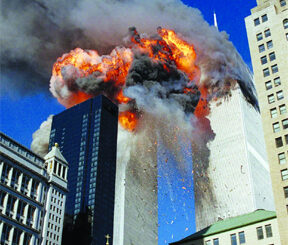
    On September 11, 2001, at 8:45 a.m. on a clear Tuesday morning, an American Airlines Boeing 767 loaded with 20,000 gallons of jet fuel crashed into the north tower of the World Trade Center in New York City.
    The impact left a gaping, burning hole near the 80th floor of the 110-story skyscraper, instantly killing hundreds of people and trapping hundreds more in higher floors.
    As the evacuation of the tower and its twin got underway, television cameras broadcasted live images of what initially appeared to be a freak accident. Then, 18 minutes after the first plane hit, a second Boeing 767—United Airlines Flight 175—appeared out of the sky, turned sharply toward the World Trade Center and sliced into the south tower near the 60th floor.
    The collision caused a massive explosion that showered burning debris over surrounding buildings and onto the streets below. It immediately became clear that America was under attack.
    The hijackers were Islamic terrorists from Saudi Arabia and several other Arab nations. Reportedly financed by the al Qaeda terrorist organization of Saudi fugitive Osama bin Laden, they were allegedly acting in retaliation for America’s support of Israel, its involvement in the Persian Gulf War and its continued military presence in the Middle East.
    Some of the terrorists had lived in the United States for more than a year and had taken flying lessons at American commercial flight schools. Others had slipped into the country in the months before September 11 and acted as the “muscle” in the operation.
    Where Did the 9/11 Planes Take Off From?
    The 19 terrorists smuggled box-cutters and knives through security at three East Coast airports—Logan International Airport in Boston, Dulles International Airport in Washington, D.C. and Newark International Airport in New Jersey—and boarded four early-morning flights bound for California, chosen because the planes were loaded with fuel for the long transcontinental journey. Soon after takeoff, the terrorists commandeered the four planes and took the controls, transforming ordinary passenger jets into guided missiles.
    Pentagon Attack
    As millions watched the events unfolding in New York, American Airlines Flight 77 circled over downtown Washington, D.C., before crashing into the west side of the Pentagon military headquarters at 9:45 a.m.
    Jet fuel from the Boeing 757 caused a devastating inferno that led to the structural collapse of a portion of the giant concrete building, which is the headquarters of the U.S. Department of Defense.
    All told, 125 military personnel and civilians were killed in the Pentagon, along with all 64 people aboard the airliner.
    Twin Towers Collapse
    Less than 15 minutes after the terrorists struck the nerve center of the U.S. military, the horror in New York took a catastrophic turn when the south tower of the World Trade Center collapsed in a massive cloud of dust and smoke.
    The structural steel of the skyscraper, built to withstand winds in excess of 200 miles per hour and a large conventional fire, could not withstand the tremendous heat generated by the burning jet fuel.
    At 10:30 a.m., the north building of the twin towers collapsed. Only 18 people in the World Trade Center towers at the time of the collapse survived. Most were with a group of FDNY firefighters in the North Tower’s Stairwell B, which remained intact. One woman survived after the stairs she was rushing down disintegrated around her. Almost 10,000 others were treated for injuries, many severe.
    Flight 93
    Meanwhile, a fourth California-bound plane—United Flight 93—was hijacked about 40 minutes after leaving Newark Liberty International Airport in New Jersey. Because the plane had been delayed in taking off, passengers on board learned of events in New York and Washington via cell phone and Airfone calls to the ground.
    Knowing that the aircraft was not returning to an airport as the hijackers claimed, a group of passengers and flight attendants planned an insurrection.
    One of the passengers, Thomas Burnett, Jr., told his wife over the phone that “I know we’re all going to die. There’s three of us who are going to do something about it. I love you, honey.” Another passenger—Todd Beamer—was heard saying “Are you guys ready? Let’s roll” over an open line.
    Sandy Bradshaw, a flight attendant, called her husband and explained that she had slipped into a galley and was filling pitchers with boiling water. Her last words to him were “Everyone’s running to first class. I’ve got to go. Bye.”
    The passengers fought the four hijackers and are suspected to have attacked the cockpit with a fire extinguisher. The plane then flipped over and sped toward the ground at upwards of 500 miles per hour, crashing in a rural field near Shanksville in western Pennsylvania at 10:10 a.m. All 44 people aboard were killed. Its intended target is not known, but theories include the White House, the U.S. Capitol, the Camp David presidential retreat in Maryland or one of several nuclear power plants along the eastern seaboard.
    How Many People Died in the 9/11 Attacks?
    A total of 2,996 people were killed in the 9/11 attacks, including the 19 terrorist hijackers aboard the four airplanes. Citizens of 78 countries died in New York, Washington, D.C., and Pennsylvania.
    At the World Trade Center, 2,763 died after the two planes slammed into the twin towers. That figure includes 343 firefighters and paramedics, 23 New York City police officers and 37 Port Authority police officers who were struggling to complete an evacuation of the buildings and save the office workers trapped on higher floors.
    At the Pentagon, 189 people were killed, including 64 on American Airlines Flight 77, the airliner that struck the building. On Flight 93, 44 people died when the plane crash-landed in Pennsylvania.
    America Responds to the Attacks
    At 7 p.m., President George W. Bush, who was in Florida at the time of the attacks and had spent the day being shuttled around the country because of security concerns, returned to the White House. At 9 p.m., he delivered a televised address from the Oval Office, declaring, “Terrorist attacks can shake the foundations of our biggest buildings, but they cannot touch the foundation of America. These acts shatter steel, but they cannot dent the steel of American resolve.”
    In a reference to the eventual U.S. military response he declared, “We will make no distinction between the terrorists who committed these acts and those who harbor them.”
    Operation Enduring Freedom, the American-led international effort to oust the Taliban regime in Afghanistan and destroy Osama bin Laden’s terrorist network based there, began on October 7. Within two months, U.S. forces had effectively removed the Taliban from operational power, but the war continued, as U.S. and coalition forces attempted to defeat a Taliban insurgency campaign based in neighboring Pakistan.Osama bin Laden, the mastermind behind the September 11th attacks, remained at large until May 2, 2011, when he was finally tracked down and killed by U.S. forces at a hideout in Abbottabad, Pakistan. In June 2011, then-President Barack Obama announced the beginning of large-scale troop withdrawals from Afghanistan; it took until August 2021 for all U.S. forces to withdraw.
    Department of Homeland Security Created
    In the wake of security fears raised by 9/11 and the mailing of letters containing anthrax that killed two and infected 17, The Homeland Security Act of 2002 created the Department of Homeland Security. It was signed into law by President George W. Bush on November 25, 2002. Today, the Department of Homeland Security is a cabinet responsible for preventing terror attacks, border security, immigrations and customs and disaster relief and prevention.
    The act was followed two days later by the formation of the National Commission on Terrorist Attacks Upon the United States. The bipartisan “9/11 Commission,” as it came to be known, was charged with investigating the events that lead up to September 11th. The 9/11 Commission Report was released on July 22, 2004. It named Khalid Sheikh Mohammed, the accused mastermind behind 9/11, “the principal architect of the 9/11 attacks.”
    Mohammed led propaganda operations for al Qaeda from 1999-2001. He was captured on March 1, 2003 by the Central Intelligence Agency and Pakistan’s Inter-Services Intelligence and interrogated before being imprisoned in Guantanamo Bay detention camp with four other accused terrorists charged with 9/11-related war crimes. The use of torture, including waterboarding, during Khalid Sheikh Mohammed’s interrogation has received international attention. In August 2019, a U.S. military court judge in Guantánamo Bay, Cuba set a trial date for Mohammed and the other four men charged with plotting the 9/11 terrorist attacks to begin in 2021; it was later postponed because of the COVID-19 pandemic.
    Economic Impact of 9/11
    The 9/11 attacks had an immediate negative effect on the U.S. economy. Many Wall Street institutions, including the New York Stock Exchange, were evacuated during the attacks. On the first day of trading after the attacks, the market fell 7.1 percent, or 684 points. New York City’s economy alone lost 143,000 jobs a month and $2.8 billion wages in the first three months. The heaviest losses were in finance and air transportation, which accounted for 60 percent of lost jobs. The estimated cost of the World Trade Center damage is $60 billion. The cost to clean the debris at Ground Zero was $750 million.
    Victim Compensation Fund
    Thousands of first responders and people working and living in lower Manhattan near Ground Zero were exposed to toxic fumes and particles emanating from the towers as they burned and fell. By 2018, 10,000 people were diagnosed with 9/11-related cancer.
    From 2001 to 2004, over $7 billion dollars in compensation was given to families of the 9/11 victims and the 2,680 people injured in the attacks. Funding was renewed on January 2, 2011, when President Barack Obama signed The James Zadroga 9/11 Health and Compensation Act into law. Named for James Zadroga, a New York City Police officer who died of respiratory disease he contracted after rescuing people from the rubble at Ground Zero, the law continued health monitoring and compensation for 9/11 first responders and survivors.
    In 2015, funding for the treatment of 9/11-related illness was renewed for five more years at a total of $7.4 billion. The Victim Compensation Fund was set to stop accepting claims in December 2020.
    On July 29, 2019, then-President Trump signed a law authorizing support for the September 11 Victim Compensation Fund through 2092. Previously, administrators had cut benefits by up to 70 percent as the $7.4 billion fund depleted. Vocal lobbyists for the fund included Jon Stewart, 9/11 first responder John Feal and retired New York Police Department detective and 9/11 responder Luis Alvarez, who died of cancer 18 days after testifying before Congress.
    Anniversary and Memorial
    On December 18, 2001, Congress approved naming September 11 “Patriot Day” to commemorate the anniversary of the 9/11 attacks. In 2009, Congress named September 11 a National Day of Service and Remembrance.
    The first memorials to September 11 came in the immediate wake of the attacks, with candlelight vigils and flower tributes at U.S. embassies around the world. In Great Britain, Queen Elizabeth sang the American national anthem during the changing of the guard at Buckingham Palace. Rio de Janeiro put up billboards showing the city’s Christ the Redeemer statue embracing the New York City skyline.
    For the first anniversary of the attacks in New York City in 2002, two bright columns of light were shot up into the sky from where the Twin Towers once stood. The “Tribute in Light” then became an annual installation run by the Municipal Art Society of New York. On clear nights, the beams are visible from over 60 miles away.
    A World Trade Center Site Memorial Competition was held to select an appropriate permanent memorial to the victims of 9/11. The winning design by Michael Arad, “Reflecting Absence,” now sits outside the museum in an eight-acre park. It consists of two reflecting pools with waterfalls rushing down where the Twin Towers once rose into the sky.
    The names of all 2,983 victims are engraved on the 152 bronze panels surrounding the pools, arranged by where individuals were on the day of the attacks, so coworkers and people on the same flight are memorialized together. The site was opened to the public on September 11, 2011, to commemorate the 10-year anniversary of 9/11. The National September 11 Memorial & Museum followed, opening on the original World Trade Center site in May 2014. The Freedom Tower, also on the original World Trade Center site, opened in November 2014.
    Although to many Americans 9/11 seemed like a random act of terror, the roots of the event had been developing for years. A combination of factors that coalesced in the late 1990s led the catastrophic event. These factors included regional conditions in the Middle East that motivated the perpetrators, as well as intelligence lapses and failures that left the United States vulnerable.
    Osama Bin Laden was relatively unknown in the United States before 9/11, even as he was amassing popularity, followers, and fame in the Middle East during the 1990s. In 1988, he was one of the founders of al Qaeda, a militant Islamic terrorist organization that organized and carried out the 9/11 attacks. Bin Laden called for indiscriminate killing of all Americans who, he claimed, were “the worst thieves in the world today” (9/11 Report, page 47). It was the perfect historical moment for that rallying cry.

    Throughout the 20th century, a wave of secular, nationalist revolutions swept through the Middle East, taking root in Egypt, Libya, Iraq, Yemen, and other countries. While these movements were awash in promising ideology, the new regimes quickly became autocratic and suppressed dissent. Their critics turned to violent revolution to express their dissatisfaction with the secular governments.
    At the same time, social malaise, especially among young men who were struggling to find decent jobs and start their own families in corrupt oil states, provided easy targets for radicalization. Bin Laden’s message that America was the “head of the snake” and the root of all society’s problems resonated well with the discontent.
    By the mid-1990s, Bin Laden was the head of al Qaeda, a multifaceted and highly developed terrorist network carrying out attack after attack on Americans in the Middle East. It was a new type of terrorism to which the US intelligence agencies struggled to adapt. Much of the intelligence community had not even imaged the specific type of hijacking and terrorism carried out on 9/11. They were preparing for threats such as the 1993 bombing of the World Trade Center and bombing in 2000 of the USS Cole.
    Much of the intelligence community’s focus was on reactive law enforcement activity rather than proactive countering of terrorism. A telling quote from the 9/11 commission report focuses on the lack of a proactive response: “The process was meant, by its nature, to mark for the public as the events finished – case solved, justice done. It was not designed to ask if the events might be harbingers of worse to come. Nor did it allow for aggregating and analyzing facts to see if they could provide clues to terrorist tactics more generally – methods of entry and finance, and mode of operation inside the United States” (Commission Report, p. 73).
    Bin Laden had amassed substantial power due to conditions in the Middle East as well as his charismatic leadership, and the US intelligence community was underprepared for a 9/11 style attack. In the aftermath of 9/11, these two factors continued to affect US policy in the Middle East, particularly in Iraq.
    The aftermath
    The emotional distress caused by the attacks—particularly the collapse of the twin towers, New York City’s most visible landmark—was overwhelming. Unlike the relatively isolated site of the Pearl Harbor attack of 1941, to which the September 11 events were soon compared, the World Trade Center lay at the heart of one of the world’s largest cities. Hundreds of thousands of people witnessed the attacks firsthand (many onlookers photographed events or recorded them with video cameras), and millions watched the tragedy unfold live on television. In the days that followed September 11, the footage of the attacks was replayed in the media countless times, as were the scenes of throngs of people, stricken with grief, gathering at “Ground Zero”—as the site where the towers once stood came to be commonly known—some with photos of missing loved ones, seeking some hint of their fate.
    Moreover, world markets were badly shaken. The towers were at the heart of New York’s financial district, and damage to Lower Manhattan’s infrastructure, combined with fears of stock market panic, kept New York markets closed for four trading days. Markets afterward suffered record losses. The attacks also stranded tens of thousands of people throughout the United States, as U.S. airspace remained closed for commercial aviation until September 13, and normal service, with more rigid security measures, did not resume for several days.
    The hunt for bin Laden
    In September 2001 President Bush announced that he wanted Osama bin Laden captured—dead or alive—and a $25 million bounty was eventually issued for information leading to the killing or capture of bin Laden. Bin Laden evaded capture, however, including in December 2001, when he was tracked by U.S. forces to the mountains of Tora Bora in eastern Afghanistan. Bin Laden’s trail subsequently went cold, and he was thought to be living somewhere in the Afghanistan-Pakistan tribal regions.
    U.S. intelligence eventually located him in Pakistan, living in the garrison city of Abbottabad, and in the early morning hours of May 2, 2011, on orders from U.S. Pres. Barack Obama, a small team of U.S. Navy SEALs assaulted his compound and shot and killed the al-Qaeda leader.
    Source: Miller Center and History.com

  • Creation of Khalsa

    Creation of Khalsa

    Khalsa, the purified and reconstituted Sikh community instituted by Guru Gobind Singh on March 30, 1699, on (Baisakhi Day. His declaration had three dimensions: it redefined the concept of authority within the Sikh community; it introduced a new initiation ceremony and code of conduct; and it provided the community with a new religious and political vision. Khalsa is used to denote both the body of initiated Sikhs and the community of all Sikhs.
    The early Sikh community had been shaped by three levels of authority: the masands (“Guru’s deputies”) were responsible for local congregations; the Guru was the active central authority; and the revealed word as recorded in Sikh scriptural text served as the symbolic base. With the establishment of the Khalsa, the authority of the masands was eliminated. They were expected either to become members of the community on a par with all others or to leave the fold.
    Guru Gobind Singh also introduced a new initation rite. More commonly called amrit pahul (“the nectar ceremony”) but also known as khande ki pahul (literally, “ceremony of the double-edged sword”), it was centred on a belief in the transformative power of the revealed word. The word was recited while water for initiation was stirred with a double-edged sword. Every Sikh who underwent the ceremony became a member of the Khalsa, was assigned the name Singh (“Lion”), and was expected to observe a rigorous code of conduct (rahit) symbolized by the wearing of five items: kes (long hair), kangha (a comb), kachha (a pair of shorts), karha (a steel bracelet), and kirpan (a sword). The names of these items begin with the Punjabi letter k and thus came to be known as the five Ks. The Singhs were also expected to forswear tobacco, alcohol, and certain types of meat.
    In its third aspect the Khalsa embodied a concrete political agenda: the pledge to realize the rule of the Sikh community (Khalsa Raj, “kingdom of God”) in the Punjab. These three interlocking dimensions have made the institution of the Khalsa perhaps the most powerful force in shaping Sikh identity during the past three centuries. Initially a male institution, it is now open to women (who take the name Kaur [“Princess]) as well, though Khalsa authority remains firmly in male hands.
    Foundation
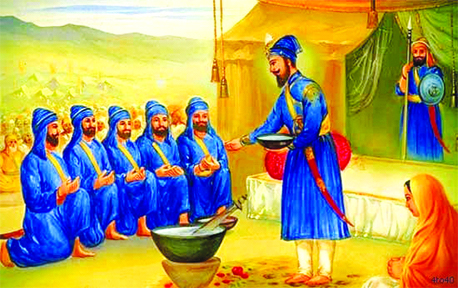
    The tenth master Guru Gobind Singh asked Sikhs to gather at Shri Anandpur Sahib on 13 April 1699, the day of Vaisakhi, the annual harvest festival. Guru Gobind Singh addressed the congregation from the entryway of a tent pitched on a hill, now called Shri Kesgarh Sahib. He drew his sword, according to the Sikh tradition, and then asked for a volunteer from those who gathered, someone willing to sacrifice his head. One came forward, whom he took inside a tent. The Guru returned to the crowd without the volunteer, but with a bloody sword.
    He asked for another volunteer and repeated the same process of returning from the tent without anyone and with a bloodied sword four more times. After the fifth volunteer went with him into the tent, the Guru returned with all five volunteers, all safe. Rather, the Guru had slaughtered 5 goats from which the blood had appeared. He called the volunteers the Panj Pyare and the first Khalsa in the Sikh tradition. These five volunteers were : Daya Ram (Bhai Daya Singh), Dharam Das (Bhai Dharam Singh), Himmat Rai (Bhai Himmat Singh), Mohkam Chand (Bhai Mohkam Singh), and Sahib Chand (Bhai Sahib Singh).
    Guru Gobind Singh then mixed water and sugar into an iron bowl, stirring it with a double-edged sword while reciting gurbani to prepare what he called Amrit (“nectar”). He then administered this to the Panj Pyare, accompanied with recitations from the Adi Granth, thus founding the khanda ki pahul (baptism ceremony) of a Khalsa – a warrior community. After the first five Khalsa had been baptized, the Guru asked the five to baptize him as a Khalsa. This made the Guru the sixth Khalsa, and his name changed from Guru Gobind Rai to Guru Gobind Singh.
    He introduced ideas that indirectly challenged the discriminatory taxes imposed by Islamic authorities. For example, Aurangzeb had imposed taxes on non-Muslims that were collected from the Sikhs as well, for example the jizya (poll tax on non-Muslims), pilgrim tax and Bhaddar tax – the last being a tax to be paid by anyone following the Hindu ritual of shaving the head after the death of a loved one and cremation. Guru Gobind Singh Ji declared that Khalsa do not need to continue this practice, because Bhaddar is not dharam, but a bharam (illusion).
    Not shaving the head also meant not having to pay the taxes by Sikhs who lived in Delhi and other parts of the Mughal Empire.However, the new code of conduct also led to internal disagreements between Sikhs in the 18th century, particularly between the Nanakpanthi and the Khalsa.
    “Guru Gobind Singh Ji” had a deep respect for the Khalsa, and stated that there is no difference between the True Guru and the Sangat (panth). Before his founding of the Khalsa, the Sikh movement had used the Sanskrit word Sisya (literally, disciple or student), but the favored term thereafter became Khalsa. Additionally, prior to the Khalsa, the Sikh congregations across India had a system of Masands appointed by the Sikh Gurus. The Masands led the local Sikh communities, local temples, collected wealth and donations for the Sikh cause.
    “Guru Gobind Singh Ji” concluded that the Masands system had become corrupt, he abolished them and introduced a more centralized system with the help of Khalsa that was under his direct supervision. These developments created two groups of Sikhs, those who initiated as Khalsa, and others who remained Sikhs but did not undertake the initiation. The Khalsa Sikhs saw themselves as a separate religious entity, while the Nanak-panthi Sikhs retained their different perspective.
    The Khalsa warrior community tradition started by “Guru Gobind Singh Ji” has contributed to modern scholarly debate on pluralism within Sikhism. His tradition has survived into the modern times, with initiated Sikh referred to as Khalsa Sikh, while those who do not get baptized referred to as Sahajdhari Sikhs.
    Dress and code of conduct
    Guru Gobind Singh Ji initiated the Five K’s tradition of the Khalsa.
    These are five items that are worn on the body. They can be considered a uniform for Amritdhari Sikhs, also called ‘Khalsa Sikhs’. These Sikhs outwardly show their commitment to the Sikh faith to others. However, many Sahajdhari Sikhs (Sikhs who have not gone through the Amrit Sanskar ceremony) often wear some or all of the five Ks too.
    Each of the five Ks has its own symbolic meaning:
    Kara
    Because it is a circle, the kara represents the eternal nature of Waheguru, without beginning or end. It reminds Sikhs of the unbreakable relationship they have with God. It is a reminder that they must do the work of God at all times and avoid the Five Vices (pride, greed, lust, anger and attachment to material possessions).
    Kesh
    Sikhs believe that the hair is a gift from God. They believe it was intended to be worn naturally and so it must not be cut. Hair is often viewed as a symbol of strength and vitality in Sikh culture. Sikhs often wear a turban to keep it clean. However, the turban is not one of the five Ks.
    Kanga
    Sikhs carry this around to help them keep themselves tidy. It also helps them to remember that they must keep themselves in a clean and tidy state both physically and mentally. Sikhs often refer to the kanga removing knots from their hair as a metaphor for how following the teachings of God removes the tangles and difficulties from a person’s life.
    Kaccha/kachera
    This plain, comfortable underwear is a reminder that Sikhs must show self-control, modesty and chastity. This means they cannot undertake sexual activity unless they are married, and they must not commit adultery. The kaccha also reminds Sikhs of what the warriors who fought for their faith wore on the battlefield.
    Kirpan
    Sikhs carry around this small single-edged sword to represent their duty to protect their faith and defend those in need. It reminds Sikhs to always fight for justice and protect the weak. It must never be used in anger. Today, the kirpan is worn for its symbolism, not as an actual weapon. Because of the practical difficulties of wearing a kirpan, some Sikhs prefer to wear an alternative, such as a pendant in the shape of a kirpan on a neck chain.
    The Guru also announced a code of discipline for Khalsa warriors. Tobacco, eating meat slaughtered according to Muslim ritual and sexual intercourse with any person other than spouse were forbidden. The Khalsas also agreed to never interact with those who followed rivals or their successors.The co-initiation of men and women from different castes into the ranks of Khalsa also institutionalized the principle of equality in Sikhism regardless of one’s caste or gender. According to Owen and Sambhi, Guru Gobind Singh Ji’s significance to the Sikh tradition has been very important, as he institutionalized the Khalsa, resisted the ongoing persecution by the Mughal Empire, and continued “the defense of Sikhism and Hinduism against the Muslim assault of Aurangzeb”.

    According to the Sikh Code of Conduct (Sikh Rehat Maryada), Amritdhari Khalsa Sikh men must wear a turban and the 5 K’s. Baptized women are not required to tie a turban, and it remains a personal choice. It also clearly states that it is not appropriate for Sikh women to cover their face with any type of veil as practiced in the Indian, Islamic, or Judeo-Christian traditions. Piercing of the nose or ears for wearing ornaments is forbidden for Sikh men and women. Sikhs cannot wear any token of any other faith. Sikhs must not have their head bare or wear caps. They also cannot wear any ornaments piercing through any part of the body.
    Duties and warriors
    A Khalsa is enjoined, to be honest, treat everyone as equal, meditate on God, maintain his fidelity, resist tyranny and religious persecution of oneself and others.
    One of the duties of the Khalsa is to practice arms. This has been deemed necessary due to the rising persecution of the rulers. Before joining the Khalsa, most of the people were from professions like farming, pottery, masonry, carpenters, Labanas, etc.
    Guru Gobind Singh Ji in Oct 1708 deputed his disciple Banda Singh Bahadur Ji to lead the Khalsa in an uprising against the Mughals. Banda Singh Bahadur Ji first established a Sikh kingdom and then brought in the Land reforms in the form of breaking up large estates and distributing the land to peasants. He and his comrades were eventually defeated and executed, but he became an icon among the Sikhs. After a long exile the Khalsa regrouped under Nawab Kapur Singh, who gathered local Khalsa leaders and created Dal Khalsa, a coalition army. The Dal Khalsa fought against the Mughals and the Afghans, eventually resulting in the establishment of a number of small republics called misls (autonomous confederacies) and later in the formation of the Sikh Empire. After the fall of the Mughal empire and the later establishment of the Sikh Empire in Punjab, the Khalsa was converted into a strong, multireligious and multinational fighting force, modernized according to European principles: the Sikh Khalsa Army which had a huge role in the expansion of the empire. Led by generals like: Maharaja Ranjit Singh Ji himself, Misr Diwan Chand and Hari Singh Nalwa. It successfully defeated all its adversaries, including the Afghan tribals and army, Hill Chiefs, Misldars, Chinese, Tibetan and Gurkhas. By the time of death of Maharaja Ranjit Singh Ji in 1839, the whole army of Sikh Empire was assessed at 120,000 men, with 250 artillery pieces. The irregular levies were included.
    The official name of the state (Sikh Empire) of Sikhs was “Sarkar-i-Khalsa”: Government of the Khalsa. The boundaries of this state stretched from Tibet to Afghanistan and from Kashmir to Sutlej in the south and included regions of Punjab, Khyber Pakhtunkhwa, Kashmir, Ladakh, etc. The “Sarkar-i-Khalsa” was dissolved during two wars fought against the British between 1846 and 1849.
    Sewa
    Sewa means ‘selfless service’. It is acting selflessly, helping others in a variety of different ways, without any reward or personal gain. Sewa is a way of life for Sikhs and is part of their daily routine. Sikhs believe that sewa is an act of service towards Waheguru and, therefore, that it will lead them to become gurmukh.
    Sikhs perform sewa in a variety of ways, such as helping the sangat and the local community, helping at the gurdwara, and cleaning, washing dishes or serving in the langar.
    Performing sewa is important for Sikhs because it demonstrates the belief in equality and the importance of all people, it serves others, showing humility (ie showing that people do not believe they are better than anyone else), it shows love for Waheguru – Sikhs believe that Waheguru is present in everyone, and so helping people means helping Waheguru, it helps Sikhs to become more gurmukh – this is because it helps them to develop five key virtues, which are truth and truthful living, compassion and patience, contentment, humility and self-control, love, and wisdom and courage, it stops Sikhs becoming manmukh, because their focus is on the needs of others rather than themselves, it helps Sikhs to move away from the five vices, which are anger, pride, lust, greed and attachment to material possessions.

  • Valentine’s Day

    Valentine’s Day

    Love and romance. Candy and flowers. Cards and gifts. Dinner and dancing. Valentine’s Day comes along with a whole host of plans and accoutrements that are meant to all boil down to one thing: Love. And it all comes in the name of one man, St. Valentine, who was an interesting (and perhaps slightly misunderstood) character in history.

    But why exactly do we celebrate Valentine’s Day and why does it fall on February 14? Well, we’ve trawled through the history books to find out the real reasons so you don’t have to – and the background casts a very different light on the holiday.

    How did Valentine’s Day start?

    Valentine’s Day is a fixed day on the calendar that got lumped into a mid-February holiday on the ancient Roman calendar called Lupercalia—which some historians believe is what led to Valentine’s Day being all about love. Lupercalia celebrated fertility, and may have included a ritual in which men and women were paired off by choosing names from a jar. In Ancient Greece, people observed a mid-winter celebration for the marriage of the god Zeus and the goddess Hera.

    Why is Valentine’s Day celebrated on February 14th?

    In general, early Christians often opted to celebrate holidays on days that coincide with existing festivals and celebrations (like Christmas and winter solstice), so they placed Valentine’s Day on February 14th, while Lupercalia was celebrated on February 15th.

    Who was Saint Valentine? (And what does he have to do with chocolate hearts?)

    Not much, it turns out. St. Valentine’s Day was a feast day in the Catholic religion, added to the liturgical calendar around 500 AD. The day was commemorated for martyred saints named—you guessed it—Valentine. Differing legends celebrate three different saints called Valentine or Valentinus, but since very little was known about these men and there were conflicting reports of the St. Valentine Day story, the feast day was removed from the Christian liturgical calendar in 1969.

    But even though not much is known about the real history of the Saint Valentines on whom the holiday is based, the legend of Saint Valentine has several tellings. One legend says that Saint Valentine refused to convert to paganism and was executed by Roman Emperor Claudius II. Prior to his execution, he was able to miraculously heal the daughter of his jailer, who then converted to Christianity along with his family. Another legend says a bishop called Saint Valentine of Terni is the true namesake of the holiday; this Saint Valentine was also executed.

    But according to others—and this is how Saint Valentine became affiliated with a love-focused holiday—Saint Valentine was a Roman priest who performed weddings for soldiers forbidden to marry, because of a Roman emperor’s edict decreeing married soldiers did not make good warriors and thus young men could not marry. This Saint Valentine wore a ring with a Cupid on it—a symbol of love—that helped soldiers recognize him. And, in a precursor to greeting cards, he handed out paper hearts to remind Christians of their love for God. Because of this legend, Saint Valentine became known as the patron saint of love. The Saint Valentine prayer asks Saint Valentine to connect lovers together, so that two become one, and the couple remembers their devotion to God. While the Saint Valentine story set the groundwork for establishing the day as a holiday for romantic love, what truly solidified the connection between Saint Valentine and love was a poem by medieval author Geoffrey Chaucer in 1375, which historians consider the origin of the “modern” celebration of Valentine’s Day, where we celebrate our romantic partnership with one other person.

    Why do we celebrate Valentine’s Day?

    Chaucer lived in the Middle Ages, the era of courtly love, when broad, romantic statements of devotion—poems, songs, paintings—celebrated partnership. By the end of the 15th century, the word “valentine” was being used to describe a lover in poems and songs of the day, and in the 18th century, a book called The Young Man’s Valentine Writer was published in England. By the mid-19th century, mass-produced paper Valentine’s Cards were being created (though DIY Valentine card ideas are still worth trying), and Valentine’s Day as we know it was born.

    The truth about Valentine’s Day history is that the romantic holiday isn’t immune to tragedy. During Prohibition in Chicago, seven men were killed by a gang organized by Al Capone on Feb. 14, 1929. The Valentine’s Day Massacre became a flashpoint in Prohibition history, with police and lawmakers going after the gangs and mobs that had formed in cities to control then-illegal substances like alcohol.

    What is Galentine’s Day, and how is it related to Valentine’s Day?

    A modern (and fun!) take on Valentine’s Day, Galentine’s Day seems to have been popularized by Amy Poehler’s character Leslie Knope on Parks and Recreation. It’s a day to celebrate the friends that you love. It’s celebrated on February 13 (leaving you plenty of time to celebrate your mate on official Valentine’s Day the following day). Galentine’s Day gifts have become a nice way to celebrate the people who mean so much to you.

    What is the meaning of Valentine’s Day?

    Over the years (and centuries), Valentine’s Day has been a religious celebration, an ancient ritual day, and a commercial holiday. All that change means the meaning of Valentine’s Day is truly whatever you want it to be: You can skip the celebrations completely, buy yourself some chocolate or flowers, or express your love and appreciation for the people in your life, whether they’re co-workers, romantic partners, friends, or family members.

    How to Celebrate Valentine’s Day

    Celebrating Valentine’s Day comes with all sorts of inherited romantic traditions which can certainly be fun and bring lots of joy! But this is also a great way to get creative with showing people how much they are loved–even if it isn’t a romantic relationship.

    Try out some of these ideas for celebrating Valentine’s Day:

    Make a Card or Gift for Someone

    Whether it’s a romantic partner or just a friend, Valentine’s Day is a great day to say “I Love You”. Hand made cards and gifts are especially welcome when it comes to showing someone how much they are cared for. January is a dark and quiet month anyway, so there’s plenty of time to prepare homemade gifts from a hobby like knitting a scarf, braiding a friendship bracelet, embroidering a towel, painting a picture or simply making a card.

    Send Roses for Valentine’s Day

    With delivery services abounding in almost every town, getting flowers delivered has never been easier! Choose to send red roses that stand for passion; yellow for friendship; pink for sweetness; peach for sincerity or gratefulness; white for purity or loyalty; ivory for perfection; and lavender for a crush (or love at first sight!).

    Make Dinner Reservations

    It’s likely that a last minute idea for going out to dinner will result in ordering takeout to eat at home, because restaurants are basically always full on Valentine’s Day. But, think ahead (sometimes months ahead, depending on the popularity of the restaurant) and make a reservation for two at a romantic place.

    Enjoy a Story About Love

    Head over to a local bookstore or library and browse the selection of novels or biographies that might feature stories about love. Or, it might even be interesting to read a biography about the guys named Valentine!

    Valentine’s Day thing of past? Indian govt says celebrate ‘Cow Hug Day’ on Feb 14

    The Animal Welfare Board of India has issued a notice appealing cow lovers to celebrate February 14 – a day celebrated across the world as Valentine’s Day – as ‘Cow Hug Day’. The government advisory body said that hugging a cow will bring “emotional richness” and will increase “individual and collective happiness”.

    Criticising the “dazzle of western civilisation”, the board said that vedic traditions are “almost on the verge of extinction due to the progress of west culture over time.”

    “In view of the immense benefit of the cow, hugging with cow will bring emotional richness hence will increase our individual & collective happiness. Therefore, all the cow lovers may also celebrate the February 14 as Cow Hug day keeping in mind the importance of mother cow and make life happy and full of positive energy,” the advisory said.

    The welfare board called cow the “backbone of Indian culture and rural economy”, adding that the animal represent “cattle wealth and biodiversity.”

    “It is known as “Kamdhenu” and “Gaumata” because of its nourishing nature like mother, the giver of all providing riches to humanity,” it said.

    The board said that the advisory was issued on the direction of the Department of Animal Husbandry and Dairying under ministry of Fisheries, Animal Husbandry and Dairying.

  • Salient features of Constitution

    Salient features of Constitution

    Indian constitution, one of the utmost admired constitutions in the world was enacted after ‘ransacking’ all the known constitutions of the world at that time. This constitution that we have enacted has stood the test of times. Though provisions were borrowed from other constitutions, the constitution of India has several salient features that distinguish it from constitution of other countries

    Some of its salient features are discussed below:

    Lengthiest written constitution

    Constitution can be classified into written constitution such as that of America or unwritten constitution such as that UK.

    The constitution of India is a written constitution which happens to be the lengthiest written constitution in the world.

    It is comprehensive, elaborate and a detailed document

    The factors that have contributed to this phenomenon are: geographical factors (vastness of country and diversity), Historical factors (Influence of GoI, 1935), Single constitution for both centre and state and dominance of legal luminaries

    Drawn from various sources

    It has borrowed most of its provisions from the constitution of various other countries as well as from the Government of India act, 1935. Ex: structural part from GoI, 1935, independence of judiciary from USA, Fundamental Rights from USA etc

    Though it is borrowed, the Indian constitution-makers made sure the borrowed features were made suitable to Indian conditions. Ex: Though we borrowed cabinet form of governance from UK, the cabinet is not all-supreme as in the case of UK.

    Preamble of the constitution

    The Preamble consists of the ideals, objectives and basic principles of the Constitution.

    The salient features of the Constitution have developed directly and indirectly from these objectives which flow from the Preamble

    It asserts India to be a Sovereign Socialist Secular Democratic Republic and a welfare state committed to secure justice, liberty and equality for the people and for promoting fraternity, dignity the individual, and unity and integrity of the nation.

    The Preamble is the nature of Indian state and the objectives it is committed to secure for the people.

    Democratic system

    The authority of the government rests upon the sovereignty of the people. The people enjoy equal political rights.

    Free fair and regular elections are held for electing governments

    India is a republic

    The Preamble declares India to be a Republic.

    India is not ruled by a monarch or a nominated head of state. India has an elected head of state (President of India) who wields power for a fixed term of 5 years.

    After every 5 years, the people of India indirectly elect their President.

    Union of states

    Article I of the Constitution declares, that “India that is Bharat is a Union of States.”

    Fundamental Rights and duties

    The Constitution of India grants and guarantees Fundamental Rights to its citizens.

    The constitution of India confirms the basic principle that every individual is permitted to enjoy certain basic rights and part III of the Constitution deals with those rights which are known as fundamental right.

    The Six FR include- Right to Equality; Right to Freedom; Right Against Exploitation; Right to Freedom of Religion; Cultural and Educational Rights and Right to Constitutional Remedies (Art. 32).

    The fundamental rights are justiciable and are not absolute. Reasonable constraints can be imposed keeping in view the security-requirements of the state.

    A new part IV (A) after the Directive Principles of State Policy was combined in the constitution by the 42nd Amendment, 1976 for fundamental duties.

    Directive Principles of State Policy

    A unique aspect of the Constitution is that it comprises of a chapter in the Directive Principles of State Policy.

    These principles are in the nature of directives to the government to implement them to maintain social and economic democracy in the country.

    Parliamentary System:

    The Constituent Assembly decided to espouse Parliamentary form of government both for the Centre and the states.

    In Indian parliamentary system, distinction is made between nominal and real executive head.

    The Council of Ministers is responsible before the Lok Sabha, The lower house of union parliament. There are close relations between executive and legislature.

    Federal structure of government

    A federal state is a state where a country is divided into smaller regions and the government is functioning at two levels

    The Indian Constitution has envisaged a federal structure for India considering the geographical vastness and the diversity of languages, region, religions, castes, etc.

    Written Constitution, supremacy of the Constitution, division of powers between Union and States, bicameral Legislature, independent Judiciary, etc. are the features of Indian federation.

    Scholars describe India as a ‘Quasi-Federation’ (K.C. Wheare) or as ‘a federation with a unitary bias, or even as ‘a Unitarian federation.’

    Universal adult franchise

    All men and women enjoy an equal right to vote. Each adult man and woman above the age of 18 years has the right to vote.

    All registered voters get the opportunity to vote in elections.

    Single integrated State with Single Citizenship:

    India is the single Independent and Sovereign integrated state.

    All citizens enjoy a common uniform citizenship.

    They are entitled to equal rights and freedoms, and equal protection of the state.

    Integrated Judicial system

    The Constitution provides for a single integrated judicial system common for the Union and the states.

    The Supreme Court of India works at the apex level, High Courts at the state level and other courts work under the High Courts.

    Independent Judiciary

    It is necessary to secure the philosophical foundations of the rule of law and democracy

    Firstly, the Constitution makers created a separate Judiciary independent of Legislature and Executive.

    Secondly, the Constitution has ensured complete independence of Judiciary in the matters of administration and finances.

    Amending the Constitution of India

    Amending the Constitution of India is the procedure of making modifications to the nation’s fundamental law or supreme law.

    The procedure of amendment in the constitution is laid down in Part XX (Article 368) of the Constitution of India.

    This procedure guarantees the sanctity of the Constitution of India and keeps a check on uninformed power of the Parliament of India.

    Judicial Review

    The judiciary has significant position in Indian Constitution and it is also made independent of the legislature and the executive.

    The Supreme Court of India stands at the peak of single integrated judicial system

    It operates as defender of fundamental rights of Indian citizens and guardian of the Constitution.

    Basic Structure doctrine

    The basic structure doctrine is an Indian judicial norm that the Constitution of India has certain basic features that cannot be changed or destroyed through amendments by the parliament.

    The basic features of the Constitution have not been openly defined by the Judiciary. At least, 20 features have been described as “basic” or “essential” by the Courts in numerous cases, and have been incorporated in the basic structure.

    In Indira Gandhi v. Raj Narayan case and also in the Minerva Mills case, it was witnessed that the claim of any particular feature of the Constitution to be a “basic” feature would be determined by the Court in each case that comes before it.

    Secularism

    In no other country of the world so many religions co-exist as in India. In view of such diversity the Constitution guarantees complete freedom of religion to all. The citizens of our country are free to follow any religion and they enjoy equal rights without any distinction of caste, creed, religion or sex.

  • Framing of the Indian Constitution

    Framing of the Indian Constitution

    From 9th December 1946 to 26th November 1949, the constitution of India was framed which came into force after two months of completion, that is on 26th January 1950, celebrated as the republic day of India. The years spent in the making of the Indian Constitution were marked exceptionally tumultuous as:

    –              1942, Quit India struggle was just going through in our nation

    –              Subhas Chandra Bose bid to establish freedom through armed struggle

    –              August 1946, the Great Calcutta Killings

    –              Improvement in the ratings of the Indian Navy in different parts of the country including Bombay in 1946

    Timeline

    –              1945: The Labour Government came into power on July 26, 1945 in Britain

    –              1946: The Cabinet Mission announced the constitutional scheme on 16th May

    –              Cabinet Mission’s constitutional scheme was accepted by Muslim league on 16 June

    –              The schemes to form Interim Government at the Centre were presented on 6 June

    –              Direct Action Day was announced by the muslim league on 16 August 1946

    –              Interim Government was established and Nehru was designated as the Vice-President on 2 September

    –              The Interim Government was joined by the Muslim league on 13 October

    –              Attlee, the British Prime Minister met Indian leaders on 3-6 December

    –              Sessions were introduced in the constituent assembly on 9 December

    –              1947: Dissolution of constituent assembly demanded by the Muslim league on 29 January

    –              Interim government had its last meeting on 16 July

    –              The Constituent Assembly of Pakistan elected Jinnah as their first president on 11 August

    –              Pakistan celebrates its independence on 14 August

    –              India celebrates its independence on 15 August

    –              1949: Constitution of India was signed in 1949

    The Making of the Constituent Assembly

    –              M.N Roy first proposed the idea of constituent assembly in 1934. Later, under the Cabinet Mission Plan of 1946, elections were held for the formation of a constituent assembly

    –              The Constituent Assembly was formed for the purpose of writing a constitution for independent India

    –              The constituent assembly members were not elected on the basis of the universal adult franchise, but chosen in 1945-46 from the provincial legislatures

    –              The Muslim League boycotted the Constituent Assembly as they wanted a separate constitution for Pakistan

    –              In order to create a sense of participation, the people in India were supposedly asked to analyse what needs to be amended for improvement and send their views to officials

    –              Many of the linguistic minorities were on their toes to protect their mother tongue., while dalits demanded an end to all seat reservations and caste oppression. Religious minorities wanted special safeguards

    –              Issues like social justice and  cultural rights were highlighted in these public discussions and were also debated on the floor of the Assembly

    The Dominant Voices in the Constituent Assembly

    –              The total members of the Constituent Assembly is 389. Of these, six members played particularly important roles

    –              Jawaharlal Nehru proposed the “Objective Resolution”. He also proposed that India’s National Flag should be of three colours saffron, green, and white in equal proportion with a dark blue coloured wheel at the centre

    –              Rajendra Prasad was President of the Assembly, where he had to steer the discussion along constructive lines while ensuring every member had equal chance to put across their views

    –              Ambedkar served as Chairman of the Drafting Committee of the Constitution

    –              Other members of the drafting committee are Alladi Krishnaswamy Aiyar from Madras and K.M. Munshi from Gujarat, N. Gopalaswami, Mohammad Saadulla, B.L. Mitter, D.P. Khaitan

    –              The Constitutional Advisor was B.N Rau

  • Making of the Republic of India

    Making of the Republic of India

    R-day special

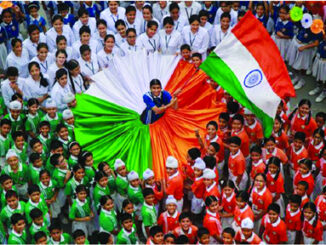
    India celebrates Republic Day annually on 26 January, and this year the country will celebrate its 74th Republic Day to mark the day India became a sovereign republic. While India gained independence from the British in 1947, but it wasn’t until 26 January 1950 that the Indian Constitution came into effect and India became a sovereign state, declaring it a republic. This day is celebrated with much pomp and fervour all over India, and in India’s capital Delhi, parades, tableaus and spectacular displays by the defense forces are showcased at Rajpath. The Indian flag is also hoisted all over the country.

    The Indian Constitution was drafted by Dr BR Ambedkar who is known as the Architect of the Indian Constitution. 26 January was chosen as the day to announce India becoming a republic as in 1929 on the same day the Indian National Congress denounced colonial rule and proclaimed Purna Swaraj, “complete freedom from the British”. And while the Constitution came into force in 1950 under a democratic government system, it was adopted by the Indian Constituent Assembly on 26 November 1949. This completed the country’s transition into becoming a sovereign republic.

    India celebrates Republic Day to commemorate the day the Government of India Act (1935) set by the British Raj was replaced by the Indian Constitution as the governing document of India. Other than flag hoisting, reciting the national anthem and organising shows and events on this day, the defense forces including the Indian Army, Navy, Air Force, police and paramilitary forces showcase their skills and display India’s defence prowess at the parade on Rajpath which is broadcast on television . Other than performing stunts, air shows, stunts on motorbikes, tanks and other weapons systems are also showcased. Alongside these are the beautifully decorated tableaus that reflect the uniqueness and beauty of the various states of India.

    India became independent from the British Rule on 15th August, 1947. However, the country did not have its own constitution and wholly depended on the modified colonial Government of India Act, 1935. Also, India was headed by King George VI, until the adoption of the Indian Constitution in 1950. Prior to this, the seeds of a republican nation were sowed by Pt. Jawaharlal Nehru in the Lahore session at the Indian National Congress at the midnight of 31st December, 1929 – 1st January, 1930.

    The tricolor flag was unfurled by the nationalists present who took a pledge to celebrate “Purna Swaraj” (complete Independence) Day every year on 26th January, while continuing to fight for the establishment of a Sovereign Democratic Republic of India. The independence was achieved in 1947 while the professed pledge was redeemed on 26th January, 1950.

    The Indian Constituent Assembly was called together on 9th December, 1946, where a committee was formed. Dr. B.R. Ambedkar became the chairman of the committee, who along with the other members drafted the Constitution. The Indian Constitution included 395 Articles and 8 Schedules. The Constitution was adopted by the Constituent Assembly on 26th November, 1949. In the following year on 26th January, 1950, the Constitution of India came into force and became a sovereign democratic republic of India, 894 days after the withdrawal of British Rule in 1947, which is why, it is said that India achieved its true independence on this day. Next, elections were held and Dr. Rajendra Prasad was elected as the first President of free India. He took the oath at the Durban Hall in the Government House, which was followed by the Presidential drive along the five-mile route to the Irwin Stadium. He unfurled the National Flag at the stadium. This transition of India into a sovereign democratic republic nation is indeed a historical event. The two-decade long journey, right from the conceptualization of the dream in 1930 to its actual realization in 1950, is certainly worth a grand celebration. Today, the Indian Constitution is the longest in the world, consisting of 397 articles and 12 schedules, providing a single citizenship for the whole nation. The national holiday is celebrated with festivities and patriotic fervor across the whole nation.

    Republic Day Parade

    The grandeur of the Republic Day of India is visible in the grand parade that is held along Rajpath, beginning from Raisina Hill near the Rashtrapati Bhavan (President’s Palace) and moving on to Rajpath past India Gate and proceeding to the Red Fort.

    The occasion witnesses the presence of the President, the Prime Minister and several other high-ranking officials of the country. The parade starts with the arrival of the President of India, who is escorted by a group of bodyguards on horses. Next, the Prime Minister of India offers wreaths at the Amar Jawan Jyoti at the India Gate in memory of the martyrs of the Indian army. The national flag is unfurled by the President of India, who is also the Commander-in-Chief of the Indian Armed Forces. This is succeeded by the cheerful tune of the National Anthem and a 21-gun salute. Led by three different divisions of the armed forces viz: Navy, Army and Air Force; the Republic Day Parade has all of them displaying their might along the Rajpath, saluting the President. The Armed Forces staff performs motorcycle rides whereas the staff of the Indian Air Force performs flying parade in fighter planes. The rich and colorful culture of India is showcased in the parade of the Republic Day. Traditional as well as cultural performances are given by professionals belonging to different regions. School children in picturesque costumes also participate in the display of different aspects of the glorious history of the country on this big day.

    The real heroes of the nation are honored with the bravery awards and medals. National Awards are given to children for selfless sacrifice and bravery.

    A row of IAF jets marks the end of the grand celebration, leaving behind a trail of colored smoke. It bids goodbye to the gathered audience by lavishing rose petals on them.

    Beating the Retreat Ceremony

    The Republic Day celebration ends officially with the Beating the Retreat ceremony, which is held on the 29 January every year. The event symbolizes retreat after a day on the battlefield and features remarkable performances by the Indian Air Force, the India Navy, and the Indian Army. Held at the Raisina Hill, New Delhi, Beating the Retreat Ceremony has its tickets available at the same outlets as the Republic Day Parade.

    Why is Republic Day of India

    celebrated on 26 January?

    The Constitution of India, which was adopted by the Constituent Assembly on November 26, 1949, came into effect on January 26, 1950. This completed India’s movement towards becoming an independent republic with a democratic government system. January 26 was also selected as the day to mark Republic Day because it had been on this day that the Indian National Congress (INC) proclaimed the Declaration of Indian Independence in 1929. This was opposite to the ‘dominion’ status offered by the British.

    The independence came through the Indian Independence Act 1947, an Act of the Parliament of the United Kingdom that partitioned British India into the two new independent Dominions of the British Commonwealth, India obtained its independence on 15 August 1947 as a constitutional monarchy as head of state and Earl Mountbatten as governor-general. The country, though, did not yet have a permanent constitution; instead, its laws were based on the modified colonial Government of India Act 1935.

    On 29 August 1947, a resolution was moved for the appointment of Drafting Committee, which was appointed to draft a permanent constitution, with Dr B R Ambedkar as chairman. While India’s Independence Day celebrates its freedom from British Rule, the Republic Day celebrates the coming into force of its constitution. A draft constitution was prepared by the committee and submitted to the Constituent Assembly on 4 November 1947. The Assembly met, in sessions open to the public, for 166 days, spread over a period of two years, 11 months and 18 days before adopting the Constitution. After many contemplations and some moderation, the 308 members of the Assembly signed two hand-written copies of the document (one each in Hindi and English) on 24 January 1950. Two days later which was on 26 January 1950, it came into effect throughout the whole nation. On that day, Dr Rajendra Prasad’s became the first president of India. The Constituent Assembly became the Parliament of India under the transitional provisions of the new law.

    Who will be the chief guest at the Republic Day 2023 event?

    This year, Egypt’s President Abdel Fattah al-Sisi will be the chief guest at the Republic Day celebrations in January.

    Flag hoisting time on Republic Day 2023

    The Republic Day Parade 2023 live telecast is scheduled to start from Kartavya Path (Rajpath) at 9:30 AM sharp, as usual with Prime Minister Narendra Modi visiting the Amar Jawan Jyoti. Later, President Droupadi Murmu will unfurl the national flag.

    At what time does the Republic Day parade start?

    The Republic Day parade will start at the scheduled time of 10 am.

    Republic Day Parade starts from which place?

    Republic Day celebrations in India are nearly synonymous with the grand parade that marches down New Delhi’s Rajpath on January 26. The parade marches from the Rashtrapati Bhawan along the Rajpath, to India Gate and from there to Red Fort. Its route is more than five kilometres long and opens with the unfurling of the national flag by the president of India.

    What is the theme of Republic Day 2023?

    According to official source, The government has proposed three specific themes for 2023 Republic Day Parade tableaux — India@75, International Year of Millets and Nari Shakti.

    Sources said that in a letter from the Ministry of Defence, various state governments, central ministries and departments have been invited to participate in the Republic Day Parade on January 26 by creating a tableaux choosing any of these three themes or a combination of the three.

    The government which is celebrating 75 years of India’s independence has proposed that India@75 tableaux include India’s freedom struggle, its achievements, actions and resolves over the past seven decades.

    The theme to mark a day of millets has its roots in 2021 when India had proposed to the United Nations to declare 2023 as the International Year of Millets (IYOM). The proposal of India received support from 72 countries and the United Nations General Assembly (UNGA) declared 2023 as International Year of Millets.

    Who hoisted the national flag on the first Republic Day?

    On January 26, 1950, India declared itself a Sovereign, Democratic and Republic state with the adoption of the Constitution. The 21 guns salute and unfurling of the Indian national flag by the first President of India Dr Rajendra Prasad saw the historic birth of the Indian Republic.

    Who takes the national salute on R-Day?

    The President of India who is the Commander-in-Chief of the Indian Armed Forces, takes the salute. Different contingents of various para-military forces of India and other civil forces take part on the Republic Day parade.

    When does the R-Day celebration end?

    The Beating Retreat ceremony is held after officially denoting the end of Republic Day festivities. It is conducted on the evening of 29 January, the third day after Republic Day. It is performed by the bands of the three wings of the military, the Indian Army, Indian Navy and Indian Air Force. The venue is Raisina Hill and an adjacent square, Vijay Chowk, flanked by the North and South block of the Rashtrapati Bhavan (President’s Palace) towards the end of Rajpath

    Who was the chief guest at the first Republic Day event?

    Indonesian President Sukarno was the first chief guest at the very first Republic Day parade of India.

    What is the difference between hoisting the flag on Independence Day and R-Day?

    Every year, on Independence Day and Republic Day people, people celebrate it with the spirit of patriotism by participating in the different event by decorating schools, offices and public places in tricolours.

    However, there is a huge difference between hoisting the flag on Independence day and unfurling it on Republic Day. On Independence Day, the national flag is tied at the bottom and then pulled up. The prime minister then hoists the tricolor. The day is to mark the historic event of the Independence of the country from British Rule. However, on Republic Day, the flag is tied up on the top and is unfurled without pulling it up. This depicts that the country is already independent.The Constitution was adopted by the Indian Constituent Assembly on November 26, 1949, and came into effect on 26 January 1950 with a democratic government system, completing the country’s transition towards becoming an independent republic.

    And one of the major differences is that the prime minister of India hoists the tricolour on Independence Day as the head of the Indian government because at the time of Independence, the Constitution of India did not come into force and the president who is the constitutional head did not take office. But on Republic Day, the president who is the first citizen of the country attends the event and unfurls the flag.

    When was the Indian national flag adopted?

    The design of the Indian national flag was adopted by the Constituent Assembly of India on July 22, 1947.

    Who designed the Indian national flag?

    Pingali Venkayya designed the flag of India and presented it to Mahatma Gandhi in 1921 during the session of the All India Congress Committee in Vijaywada. The flag, at that time, was made of green and saffron colours, representing the Muslim and Hindu communities of India.

  • People involved in drafting of the Constitution of India

    People involved in drafting of the Constitution of India

    R-day special

    The constitution of India is the supreme law of India. The document lays down the framework determining the fundamental political code, structure, procedure, powers and duties of the governments institutions. It also states the fundamental rights, principals and the duties of the citizens. In fact, it is the longest constitution in the world.

    Who all were involved in the drafting committee of the Constitution of India?

    It had seven main members:

    Alladi Krishnaswami Ayyar

    Dewan Bahadur Sir Alladi Krishnaswani Lyer was one of the main members of the drafting committee of the Constitution of India – an important member of the Constituent Assembly of India. Ayyar also served as an Advocate General of Madras State from 1929 to 1944.

    Alladi Krishnaswami lyer was born in 1883 in the small village of Pudur in Madras State (now the Nellore district of Andhra Pradesh). He was born to Ekamra Sastry, who was a priest. He passed his matriculation examination in 1899 and entered the Madras Christian College to study History. Ayyar used his spare time to attend classes in law and passed the B.L exam and become one of the leading members of the bar. He was renowned as Dewan Bahadur in 1930.

    He played a major role in drafting the Constitution of India. The main architect of Indian constitution Dr. B. R Ambedkar, who also chaired the constitution’s drafting committee said about Ayyar’s contribution,“There were in the drafting committee men bigger, better  and more competent as my friend Sir Alladi Krishnaswami Iyer.”

    N. Gopalaswami Ayyanger:

    Dewan Bahadur Sir Narasimba Ayyangar Gopalaswami Ayyangar, a proficient Member of the Drafting Committee of the Constitution. He was chosen to be the leader of the Rajya Sabha and a cabinet minister in the Government of India. He was selected as the first minister without a portfolio but he was intensely looking after Kashmir Affairs, and later was appointed the Railway Minister.

    In his Kashmir Affairs role, he represented India at the United Nation Security Council and later drafted Article 370 of the Indian constitution that granted autonomy to Jammu and Kashmir.

    Gopalaswami was born on March 31, 1882 in Tanjore District Madras. He studied at Wesley School, and then Presidency and Law College in Madras. He was also an Assistant Professor in Pachaiyappa’s college in 1904.

    Dr. B.R. Ambedkar

    Dr. Bhimrao Ramji Ambedkar also known as Babasaheb Ambedkar was a Indian jurist, economist, politician and social reformer who inspired the Dalit-Buddist movement. He also campaigned against social discrimination towards the untouchables. Babasaheb was Independent India’s first Law and Justice Minister. He was the major architect of the Constitution of India.

    Ambekar was a brilliant student – he had a doctorate in Economics from both Columbia University and the London School of Economics, and gained a reputation as a scholar for his research in Law, Economics and Political Science. Ambedkar was involved in a lot of campaigning and negotiations done for the Independence of the country, publishing journals and advocating political rights and social freedom for Dalits, and contributing significantly to the establishment of the state of India.

    In 1990, he received the Bharat Ratna – India’s highest civilian award.

    K. M Munshi

    Kanhaiyalal Maneklal Munshi also known as K.M Munshi, or by his pen name, Ghanshyam Vyas, was an brilliant Indian independence movement activist, politician, writer and educationist from Gujarat. He was a lawyer by profession, he later became an author and politician. He was a well-known name in Gujarati literature. He founded Bharatiya Vidya Bhavan an educational trust in 1938. Before the independence of India he was a part of Indian National Congress and after independence, he joined the Swatantra Party and Bharatiya Jana Sangh.

    Munshi held different posts – he was the member of Constituent Assembly of India, Minister of Agriculture and Food of India, and he was also the Governor of Uttar Pradesh.

    Mohammad Saadulla

    Sir Syed Muhammad Saadulla, was the Prime Minister of Assam (British India). He was also a Chairman of Gauhati Municipality in 1919 and minister in charge of education and agriculture for Assam from 1924 to 1934.

    He got his education from the Cotton College, Guwahati and Presidency College, Calcutta. He was born on 21 May 1885 in Gawahati to an orthodox Assamese Muslim family.

    The Assam Legislative Assembly elected Syed Muhammad Saadulla to the Constituent Assembly of India in 1947 and later he was elected in the drafting committee as well. He was also an integral part in preparing the Constitution of the Republic of India. Saadulla was the only member from the North East to be elected into the Drafting Committee.

    B. L. Mitter:

    B. L. Mitter worked with the Dewan of Baroda. Mitter is said to have made significant contributions to integration of the Princely States with India. He was later replaced by Madhav Rao on the drafting committee, who was the legal advisor to the Maharaja of Vadodara.

    D. P. Khaitan

    D. P, Khaitan, also known as Debi Prasad Khaitan, was the owner of Khaitan & co – one of the oldest working law firms in India. It had 530 fee earners and consultants including 115 partners and directors. Debi found this company in 1911 with the assistance of his brothers. He was a proficient member of the drafting committee including 6 others.

    Who wrote the Constitution of India?

    Prem Behari Narain Raizada was the calligrapher of the Indian Constitution. The original constitution was written by him in a flowing italic style. The Calligraphy of the Hindi version of the Original Constitution was done by Vasant Krishan Vaidya.

    Enactment and enforcement of the Constitution

    The Constitution was adopted on November 26, 1949, containing a Preamble, 395 Articles, and 8 Schedules after three sets of reading of the Draft that was prepared by the Drafting Committee, and published in October 1948. The motion on Draft Constitution was declared to be passed on November 26, 1949, thereby receiving the signatures of the members along with the President. It is to be noted that the Preamble succeeded the Constitution in enactment. Among the 395 Articles, some of the Articles like Articles 5 to 9, Articles 379, 380, 388, 392, 393 came into force on 26th November, 1949 itself. The rest of the Articles were enforced on Republic Day, that is 26th January, 1950. As the Constitution of India commenced, the Indian Independence Act, 1947, and the Government of India Act, 1935 ceased to exist. At present, our Constitution is decorated with 448 Articles, 25 Parts, and 12 Schedules.

  • HINDI TECHING IN USA, LEARNING IN INDIA

    The participants of YHS FULBRIGHT-HAYS GPA SHORT TERM CURRICULUM DEVELOPMENT PROJECT 2022 observed, learned, collected varieties of authentic materials at various locations in India during the 4 weeklong Study Tour from October 29-November 26, 2022.

    By Ashok Ojha

    In January 2022 I submitted to a proposal to the US Department of Education on behalf of Yuva Hindi Sansthan, a NJ based non-profit educational organization, of which I am the president. The proposal was approved and I was granted the ‘Fulbright-Hays GPA Short-Term /Curricula Development Award 2022’.

    Under the program I was mandated to recruit of 12 US based teachers and students and led them on a Study Tour to India. I selected 12 participants  on the basis of their academic interests and teaching goals. All participants had expressed their commitment to teaching Hindi in the cultural contexts. I conducted the Study Tour during the months of October and November 2022.  The purpose of the tour was to familiarize US based teachers and student teachers with the ground realities at various locations in India, created by global warming and climate change,. The segment of ‘Sustainability’ was added into the area studies theme of  ‘Climate Change’.  Participants were required to study the impact of ‘Climate Change’, in the cultural contexts of India and be aware of the ‘sustainable’ lifestyle of  certain communities. We were also required to collect authentic materials in the native land of the Hindi language, India.

    FULBRIGHT-HAYS GPA program participants in Delhi, India.

    The Study Tour program was facilitated as planned. All participants boarded the United Airlines flight on October 28, 2022 at Newark International Airport. We arrived at Indira Gandhi International Airport, New Delhi on October 29, 2022 where our Indian staff members welcomed us at the airport. The Indian staff included Binod Choubey, who was an experienced production manager employed with Adhikari Brothers in Mumbai.  Cameraman Manoj Singh, has previously worked with me in India and was very excited to be part of this project. Rajesh Sah, the third member of the Indian staff, was entrusted with editing video footage that Manoj captured on a daily basis. Thanks to this team, we produced and edited more than two dozen video films during the tour.

    YHS Fulbright-Hays participant Anubhooti Kabra speaking at the reception organized by Mumbai Hindi journalists Nov 16, 2022

    I have been teaching Hindi in the United States for more than a one and half decade. As a language teacher I know how to integrate the World Readiness Standards in my teaching materials. I believe that ACTFL (American Council on the Teaching Foreign Languages) proficiency guidelines and the best practices endorsed by STARTALK Language Program offer an ideal framework for teaching a foreign language such as Hindi. In order to follow ACTFL proficiency guidelines and world Readiness Standards it is important to use ‘authentic materials’ that are needed to develop learning curricula. These authentic materials can only be acquired in the native land where the language was born. Hence our Study Tour played an important role in acquiring authentic materials. It supported the curricula developed on the basis of those materials by the language teacher participants. The curricula thus produced will be freely disseminated by the US Department of Education.  On our part we will make all video films, produced during the Study Tour, available on our website,  https://21stcenturyhindi.com/phase-ll.

    For four weeks our team travelled to various parts of India that are deeply impacted by the climate change. First we travelled to Nainital, a hill station in the northern state of Uttarakhand. We camped at Hotel Vikram situated close to our academic partner, Kumaun University and downtown Nainital. Ajay Rawat, an environment expert on the ecology of the Himalayas, presented detailed information on land erosion and water pollution in the region. Next morning, we visited an area called Ballia Nala, where we witnessed the devastation caused by land erosion. Here we met with locals who live fearful of further landslide. A road passing through the area was completely cut off due to landslide. We learned that the city’s sewerage system was too old that created hollow spaces in the hills. We met activists who were working to create awareness among people about water pollution and climate.

    YHS Fulbright-Hays participants interacting with environmentalist Vandana Shiva in Dehradun, November 8th, 2022

    We left Nainital for Jim Corbett Forest area and then to Dehradun, the capital of Uttarakhand state. We rented safari jeeps to travel inside the forest and observed the impact of Climate Change on the wildlife. We continued our journey to Dehradun where we camped at Navdhanya complex, a farmland established by the noted environmentalist Vandana Shiva, who mentored us on the traditional living. We observed people engaged in producing agricultural crops using compost fertilizer. Dr. Shiva lectured and demonstrated benefits of sustainable living that was possible with organic farming and a simple lifestyle. Our participants joined local farmers and villagers to get hands-on experience on sustainable living.

    In order to enhance our knowledge and understanding about sustainable living we flew to Mumbai. We travelled by road from Mumbai to Dahanu, a coastal town where the Warli tribal folks live a self-contained life in their hutments. They use local resources to build huts, fishing and creating world famous Warli paintings. We met a few Warli artists and farmers to learn about ‘sustainability’ and depiction of life in their paintings. Our participants took part in art workshops conducted by experienced Warli artists and visited local schools to experience how Warli boys and girls were learning language and art.

    Our fourth and the final destination was Alwar district in the state of Rajasthan-the region that has experienced water shortage for decades. Alwar is also home of dozens of wild animals who live in the forest of Sariska. We learned about impact of climate change on the local communities. There was depletion of water levels in local wells and ponds that affected the lives of people and animals. However, the local population has managed to store rainwater by construction small dams. The traditional methodology to rejuvenate wells, ponds and rivers was revived by Tarun Bharat Sangh, a local non-Government organization in the early Eighties. Since then, volunteers of TBS, under the mentorship of Dr. Rajendra Singh, a Magasaysay Award winner social activist, have been working with villagers to preserve water resources by constructing Johads and Pokhars, as the small dams are locally known as. They have preserved water for drinking and irrigating farmland, rejuvenated rivers to raise water levels in the village wells enabling women and girls to engage in more productive activities than just fetching water from miles away. Today the villages of Alwar district have enough water for drinking and irrigating their farmland. They are able to sustain their lives which has been facing impact of climate change.

    (Ashok Ojha, a NJ based journalist and teacher, recipient of this year’s ‘Fulbright-Hays’ GPA project, funded by the US Department of Education, teaches Hindi under the banner of Yuva Hindi Sansthan, a non-profit educational outfit https://21stcenturyhindi.com/

    Ashok directed dozens of federally funded language programs for teaching Hindi. He has also directed a number of  educational films. Before moving to the USA in 1996 he worked as a journalist in India for more than two decades.

    Email: aojha2008@gmail.com)

  • The 53rd International Film Festival of India (IFFI) – An Overview

    The 53rd International Film Festival of India (IFFI) – An Overview

    L to R: Emmy-nominated Indian-American filmmaker Tirlok Malik, Roskino Representative Sarfaraz Alam Safu, award-winning Indian filmmaker Suraj Kumar, and noted Indian critic Ajit Rai visit Russia Pavilion.

    During the 9-day film festival, 280 films from 79 countries were screened. 25 feature and 20 non feature films from India were showcased in the India Panorama. 183 films were part of the international programming. This year we also celebrated 50 years of Manipur in cinema with the screening of 5 Manipuri films including ‘The Chosen One.

    By Murtaza Ali Khan

    The 53rd International Film Festival concluded in Goa on November 28, 2022 with a colorful closing ceremony at Shyama Prasad Mukherjee Indoor Stadium. The ceremony was attended by Union Information and Broadcasting Minister Anurag Singh Thakur, Minister of State for Information and Broadcasting Dr L Murugan and Goa Chief Minister Pramod Sawant. Bollywood celebrities such asAjay Devgn, Ayushman Khurana, Esha Gupta, Anand L. Rai, Manushi Chhillar, Rana Duggubati, and the Dadasaheb Phalke winner Asha Parekh, were among those who attended the closing ceremony. The creators of the popular Israeli show Fauda, Lior Raz and Avi, were also present on the occasion.Ayushmann Khurrana performed on songs from his upcoming movie ‘An Action Hero.’ Telugu Star Chiranjeevi was awarded the Indian film personality of the year on the occasion. The closing film of this festival was the Polish film ‘Perfect Number’, directed by Krzysztof Zanussi.

    On the final day of the festival a huge controversy broke out when the Israeli filmmaker Nadav Lapid, the jury chairman of the International Competition section of IFFI, called Indian filmmaker Vivek Agnihotri’s The Kashmir Files ‘propaganda’ and ‘vulgar.’ In response, the Israel ambassador to India Naor Gilon launched a scathing attack on Lapid for his incendiary remarks. Responding to Lapid’s remarks, his fellow jury member and filmmaker Sudipto Sen explained, “As members of the jury it is our job to judge the technical, aesthetic quality, and socio-cultural relevance of a film. We are not supposed to indulge in making any kind of political comments on any film. But, if something like that happens that then doesn’t reflect the opinion of the jury. The comment has to be taken completely in a personal capacity, for it doesn’t have anything to do with the esteemed Jury Board.”

    During the 9-day film festival, 280 films from 79 countries were screened. 25 feature and 20 non feature films from India were showcased in the India Panorama. 183 films were part of the international programming. This year we also celebrated 50 years of Manipur in cinema with the screening of 5 Manipuri films including ‘The Chosen One.’ A highly interactive Film Technology Exhibition was also hosted as part of the 53rd IFFI. Various cameras, lights and various other equipment used in the filmmaking were exhibited during the festival. One of the major attractions of IFFI this year were the pavilions of more than 13 Indian states on the lines of Cannes Marché du Film, including those of Uttar Pradesh, Bihar, Punjab, Gujarat, Tamil Nadu and Maharashtra, and participating countries such as Russia and France. New York-based Emmy-nominated filmmaker Tirlok Malik was amongst the leading international filmmakers to visit the various state and country pavilions stationed at the NFDC Film Bazaar held at the Marriott Goa. “I keep visiting India as regardless of wherever I live in the whole world my roots arehere. Coming to IFFI is always very special as one gets to meet fellow filmmakers and so it’s always very stimulating for the mind,” rejoiced Malik who was particularly impressed with the pavilions from the Indian states of Uttar Pradesh, Maharashtra, Madhya Pradesh, and Punjabas well as the pavilions from Russia and France. “I had very good conversations about film development and production with the respective representatives at the pavilion such asMr. Saurabh Vijay, Secretary, Cultural Affairs, Govt. of Maharashtra, Dr. Avinash Dhakne, Managing Director, MFSCDC Ltd,Shri Dinesh Kumar Sahgal Deputy Director, Film Bandhu, Uttar Pradesh Govt.,Mr.Sarfaraz Alam Safu, Indian Representative, Roskino, Russian Federation,and Mr. Henri Prévost-Allard from Saint-Tropez, France, among others,” added Malik.

    “Over the years, I have had the pleasure of visiting the biggest film festivals in the US, Europe, Asia and elsewhere. And I wouldn’t be exaggerating if I tell you that visiting IFFI this year has been one of my best festival experiences ever. Kudos to the Honorable Minister Shri Anurag Thakur, NFDC MD Sh. Ravinder Bhakar and the entire team at NFDC for the various newinitiatives, such as the inclusion of the regional and international pavilions on the lines of the Cannes Film Market.I strongly feel that this will go a long way in making IFFI one of the biggest and most important festivalsin the world,”opined Malik. Noted Indian critic and author who also visited the state and country pavilions at the IFFI 2022 alongside Malik touched upon the great association that India and Russia have shared over the many decades. “Russia has a rich legacy of cinema and the relationship between India and Russian on the cinematic front dates back to the times of Raj Kapoor. His popularity in Russia even surpassed the presidents. And an entire generation of Russians has grown up dancing to the tunes of Mithun Chakraborty’s famous dance number ‘I am a Disco Dancer.’ So, I feel that Russia Pavilion is a good initiative. Russia was also the guest country at IFFI a few years ago,” explained Rai who has been running a festival of Indian films in Russia called the Indian Film Festival Moscow since 2012. Emphasizing upon Indo-Russia co-productions, Roskino’s Indian representative is Sarfaraz Alam Safu added, “The India-Russia coproduction treaty dates back to 1993. Presently, many Russian companies want to come to India for shooting as well as to explore various possibilities for collaborations.”

    Award-winning Indian filmmaker Suraj Kumar whose film about Tagore’s time in Argentina ‘Thinking of Him,’ was the closing film at the 2017 IFFI feels that initiatives such as the Russia Pavilion open up possibilities for film collaborations. “This has been my first experience of the Russia Pavilion at IFFI Goa. However, I have been regularly visiting the Russia Pavilion at the CannesFilm Festival. But the kind of content that they have brought to India as part of the pavilion is really amazing. I feel that it can be showcased on Indian television, OTT platforms, etc. after being dubbed into the various Indian languages. It’s really a beautiful pavilion that they have come up with,” opined Kumar whose short film about the spiritual awakening of Shri Aurobindo was screened in over 150 countries by the Ministry of External Affairs, Govt. of India earlier in the year.

    Film Bandhu is committed to make Uttar Pradesh a major film hub in the world.“As per the instructions of the Honorable Chief Minister of Uttar Pradesh we have devised a film policy for the Indian state of Uttar Pradesh. The idea is to offer various benefits to filmmakers who want to come to UP to shoot their films whether from different parts of India or abroad. In order to facilitate this, we have created a single window system wherein you can take the shooting permission online as well as apply for subsidy online. You are not even required to physically come to the Film Bandhu Office. Also, we are developing a Film City in Noida which will have world-class infrastructure. It will be spread across an area of 1000 acres. And next to the Film City an airport is also being constructed and it will have connectivity to the whole world. So, the filmmakers need not go to Delhi first. They can directly come to Noida and start shooting and once finished can go back directly with the finished product in their hard disk,” explained Dinesh Kumar Sahgal, Deputy Director, Film Bandhu, UP Govt.

    Amit Sharma, Senior Producer at Doordarshan, shared his excitement to be back in Goa for IFFI 2022. “There is always a scope for improvement and with each passing year we have seen IFFI go from a position of strength to strength. Take, for example, the case of the ’75 Creative Minds,’ which is now in its second year, I think that it’s a wonderful initiative just like a lot of other new initiatives,” averred Sharma. National Award-winning critic and senior journalist Giridhar Jha who was attending the 53rd IFFI was happy to be back on ground after the hiatus imposed by the pandemic. “A big booster dose to cinema though India’s eyes that it desperately needed after  a two-year disrupter called COVID-19, with a fest of movies from all across the globe on the platter for the film buffs of all kinds, and, of course, everything else on IFFI’s electrifying sidelines. I&B Ministry and, above all, NFDC deserve kudos for pulling it off,” signed off Jha.

    (Murtaza Ali Khan is an Indian Film & TV Critic / Journalist who has been covering the world of entertainment for over 10 years. He tweets at @MurtazaCritic and can be mailed at: murtaza.jmi@gmail.com). 

  • Initiating the First US India Healthcare Summit 2023

    Initiating the First US India Healthcare Summit 2023

    By H.S. Panaser

    India is presently the world’s third largest manufacturer by value*1 and has the lowest manufacturing costs globally. About one in three pills consumed in the U.S. and one in four in the U.K. are made in India*2. However, India’s $42 billion pharmaceutical sector is heavily dependent on China for key active pharmaceutical ingredients or API – chemicals that are responsible for the therapeutic effect of drugs. As per Government of India report. This may be starting to change. Under a government scheme launched two years ago, 35 Aps, beginning to be produced at 32 plants across India in March. This is expected to reduce dependence on China by up to 35% before the end of the decade, according to an estimate by ratings firm ICRA Limited, the Indian affiliate of Moody’s. Thanks for the initiative taken by the Union Minister Mr. Mansukh Mandaviya, the productivity linked incentive scheme*3 was first launched in mid-2020*3 , when military tensions with China were at a high. The PLI program aims to incentivize companies across all sectors to boost domestic manufacturing by $520 billions by 2025. For the pharma sector, the government has earmarked over $2 billion worth of incentives for both private Indian companies and foreign players to start producing 53 APIs that India relies.

    Global Indian Trade and Cultural Council, (GITCC)USA is proud to spearhead its 1st annual 2023 U.S-India Healthcare & Business Summit. A prominent group of 100 international business leaders and government officials, from India, US and Arab countries, will headline at this program, sharing their perspectives on issues, factors and considerations that shape healthcare relations between these two spheres. Our team comprised of Mr. H S Panaser, Chairman, GITCC, USA, Mr. Anand Krishnamurthy, CEO, Coolsoft , USA and Mr. T.Srinath, Vice President, Epicminds,India.

    We started our campaign to meet the top leaders in academe Industry and bureaucrats of the healthcare verticals covering Pharmaceuticals, Medical devices, IT, Research and Education segments. Our firstvisitwas the National Institute of Pharmaceutical Education and Research (NIPER), S.A.S. Nagar, (Mohali),which  is the topmost pharmaceutical education andresearch institute in India, under India’s Ministry of Chemicals and Fertilizers. It’s important to remember Professor Emeritus Harkishan Singh, Padma Shri awardee who had a dominant role in establishing NIPER. His Vision and farsightedness of this concept has borne fruits. NIPER produces high quality pharmaceutical manpower for fast expanding drug industry and profession. We hadseparate meetings with Director, Prof. Dulal Panada, Prof. Paramal Tiwari and Prof. Anand Sharma of Niper, Board Advisor Dr T R Bhardwaj, Ex.Vice Chancellor, Baddi University, HP, and is a well-known personality in Pharmaceutical education and research, He was also the Dean, University Institute of Pharmaceutical Sciences Pharmaceutical department of Chitkara University, Punjab We shared an updated Pharma Presentation for further discussion including Pharma-IT education including AI and ML prospects. We have talked about their participation to US India Healthcare Summit 2023 and to initiate student exchange programs between US and India.

    with Director, Prof. Dulal Panada, Prof. P. Tiwari and Prof. A. Sharma of Niper.
    Dr T R Bhardwaj, Ex.Vice Chancellor, Baddi University and . Prof Inderbir Singh, Prof and HOD, Chitkara University.

    In Ahmedabad, our team met Dr. H.G. Koshia, Commissioner, FDCA – Gujarat and his team of Experts Drug Inspectors & Senior Drug Inspectors. We discussed about the pharmaceutical industry and its growth in both generic and API segment in Gujarat. We also met Mr. Manoj Agarwal. IAS, Ad. Chief Secretary, Govt of Gujarat about working for initiating AI and ML application for data safety and e-governance and other healthcare innovations and working relationship between US and India.

    H S Panaser with Dr H G Koshia, Commissioner, FDCA, Gujrat.

    We had a very constructive meeting with Mr. Biswajit Mitra, CMO. Mr. Jawed Zia , CEO and Mr. A K Sharma, President, Cadila Pharmaceuticals at their HQ in Ahmedabad. Cadila is presently in all regulated markets of the USA, Europe and Japan and Africa. With strategic collaborations and operations in over 100 countries, Cadila has more than 9000 employees including over two hundred people outside India in Africa, CIS, Japan and USA.

    Mr. B Mitra , CMO, Cadila with Mr Panaser, Mr. Jawed Zia, CEO Cadila with Mr Panaser and Anand.

    We talked about different verticals of US India Pharmaceutical market and the importance of Cyber Security, data protection with AI and ML applications. The increasing competitive manufacturing landscape could mean that we will see not only the well documented strategic partnerships, but also, the pre-booking of reserve capacity in advance of any needs. From a contractual point of view, this means we will see both deeper supply chain partnerships for suppliers, as well as the ability to demand longer contracts and more favorable terms.

    In continuation to promote US India Healthcare relations, the GITCC team including, President, Mr. H S Panaser and Mr. Anand Krishnamurthy visited Alembic Pharmaceuticals Ltd, an Indian multinational pharmaceutical company headquartered in Vadodara and met Mr. Mitanshu Shah Sr VP, Finance and Mr. R. Joshi, Dy. GM. Alembic is involved in manufacture of pharmaceutical products, pharmaceutical substances and intermediates. It is also termed to be a market leader in macrolides segment of anti-infective drugs in India. With about 9000 employees. the company now sells more than 100 products in the United States, representing more than 400+ SKUs under its own label.Alembic intends to launch 15 to 20 products each year over the next 3 years. In addition, Alembic now have fully operational oncology injectable facility. In total, Alembic has 100+ ongoing projects, which include targets in dermatology, injectable, and ophthalmic.

    With Mr. M Shah VP, Finance, Alembic.

    In Ahmedabad,we also visited Indian Pharmaceutical Leading companies top leadership to be the part of this new initiative, Zydus Lifesciences Limited, formerly known as Cadila Healthcare Limited, is an Indian multinational pharmaceutical company, which is primarily engaged in the manufacture of generic drugs. It featured in the Fortune India 500 list in 2020.Cadila was founded in 1952 by Ramanbhai Patel (1925–2001), formerly a lecturer in the L.M. College of Pharmacy, and his business partner Indravadan Modi. It evolved over the next four decades into an established pharmaceutical company. Zydus today is a Leader in Pharmaceuticals manufacturing as a Billion-dollar company. Me along with my advisors on board had meeting with Dr. Keyur Parekh, Sr. VP and Lead Strategist. we had an opportunity to visit their center of science and innovation as well.

    with Dr. Keyur Parekh, Sr. VP, Zydex.

    We are in continuation to our meetings for the 2023, US India Healthcare Summit and understanding the companies visited Vadodara HQ of Sun Pharmaceuticals. Already the world’s third-largest manufacturer of medicines by volume, India has one of the lowest manufacturing costs globally. About one in three pills consumed in the U.S. and one in four in the U.K. are made in India. However, India’s $42 billion pharmaceutical sector is heavily dependent on China for key active pharmaceutical ingredients or API — chemicals that are responsible for the therapeutic effect of drugs.

    The 2014 acquisition of Ranbaxy made Sun Pharma the largest pharma company in India, the largest Indian pharma company in the US, and the 4th largest specialty generic company globally. It’s having a revenue of $5 billon with 37,000 + employees. Me along with Anand Krishnamurthy and team talked about usage of AI and ML in Pharmacovigilance, cyber security, and data protection. We also talked about the applications for sales and marketing, supply chain, manufacturing and its usage in drug development process and its command and control. We met Mr. A.S. Sajam, Head Administration along with others including representation from FDAC.\

    Meeting with Mr. A.S. Sajam, Head, Adm and team at Sun Pharma.

    In continuing our efforts to meet the top Indian Pharmaceutical manufacturers for GITCC USA for US India Healthcare Summit 2023. Mr. H S Panaser and Mr. Anand Krishnamurthy and T. Srinivas visited Hyderabad. We met Mr. T Srinivas CFP, Bharat Biotech, a 700 plus employee company The company has been responsible for developing COVAX whichis a whole inactivated virus-based vaccine 19 developed by Bharat Biotech in collaboration with the Indian Council of Medical Research – National Institute of Virology and a naturally attenuated strain derived Rotavirus vaccine called ROTAVAC.They were one of the first to develop vaccines for viral diseases like Chikungunya and Zika. The company also produces vaccines for Japanese Encephalitis.[13] Bharat Biotech has biosafety level 3 (BSL3) laboratories.

    With Mr. T Srinivas, CFO, Bharat Biotech.

    Hetero Drugs and had a meeting with their Chairman Dr. B P S Reddy, also the Member of Parliament, India and the Managing Director Dr. V K Reddy.Today, Hetero has Asia’s Largest API SEZ manufacturing complex for APIs – with 1,000+ reactors and spread over 500 acres. Hetero has over 36 strategically located, manufacturing facilities catering to diverse market requirements on demand – including India, USA, China, Russia, Egypt, Mexico, Indonesia and Saudi Arabia.

    With Mr. B P S Reddy, MP, Chair Hetro Pharma and with Mr. V K Reddy, MD, Hetro Pharma.

    *1: https://www.ibef.org/exports/pharmaceutical-exports-from-india#:~:text=India%20Pharma%20Exports%20and%20Advantage%20India&text=India%20has%20exported%20US%24%203.89,US%24%201.97%20in%20August%202020.

    *2: https://www.orfonline.org/expert-speak/time-to-end-the-battle-of-indian-pharmaceutical-players-and-chinese-key-ingredients/

    *3: https://www.ibef.org/download/PLI_schemeRevised.pdf

    (H. S. Panaser is a Global Marketing and Business Development Consultant, Speaker and EDP Trainer. He is Chairman, GITCC, USA.

    He can be reached at hspanaser@gmail.com

     US phone 1- 732-266-2027)


  • CM Gehlot’s loyalists challenge Congress High Command

    CM Gehlot’s loyalists challenge Congress High Command

    A big challenge for Government’s survival in Rajasthan

    Dr Yash Goyal
    Special Correspondent, The Indian Panorama

    JAIPUR (TIP): Chief Minister Ashok Gehlot’s big ‘No’ to contest the Congress President election, and Mrs Sonia Gandhi’s prerogative to decide the continuation of Gehlot as CM has left the running Rajasthan Government in lurch creating whirl of rumours and controversies in politics. 

    The Rajasthan’s Congress government has already faced turmoil in 2020 following alleged horse trading by Opposition BJP when the Pilot group defected. Will it take any risk in its remaining tenure especially at a time when the toppling of governments by the BJP has become a recurring phenomenon in other states? Will the Congress find an alternative to Gehlot and replace him with Pilot who is favourite of Rahul Gandhi and Priyanka Gandhi?Pilot is right now a simpleMLA; how come he was invited by Mrs Gandhi to hold parleys on current turmoil in Rajasthan after Gehlot turned apology over his failure to hold CLP meeting and pass a one liner resolution?

     Beginning, Turns & U-turn

    On his rising popularity index, open support to the Gandhi family and holding street protests in Delhi during interrogation by Enforcement Directorate, and an outspoken critic against the Modi government, the Congress decided in principle to field Ashok Gehlot, 71-year politician of Marwar and 3-timer CM, as next party president for which election process is underway. Gehlot felt elevated that he could be a leader to the party having136 years of glorious history that has given the best politicians in the country before and after Independence.

    In just last 10 days Rajasthan has witnessed a lot of up and down in Congress politics. On September 20’s Congress Legislative Party meeting CM Gehlot had hinted that he could hold CM as well as contest Congress President post. On next day, September 21, when he returned from 10th Janpath after revealing his plan to hold dual post, Gehlot was little depressed and told media, “It would be really difficult to hold two posts simultaneously. Will discuss with my MLAs.” Then on his mission to convince Rahul Gandhi, presently on Bharat Jodo Yatra, to accept the party post by contesting the election, Gehlot was stunned when RaGa reminded the nation on the formula of ‘One Man, One Post’ and party’s Udaipur declaration.

    Gehlot had no option but to say, “Post is not a big deal for me, party can take my service in Delhi or Rajasthan.” Despite his frequently changed tone on President Post election nomination, Gehlot has openly assured the people in Rajasthan that till last breath of his life, he would not go away from Rajasthan whatever liability is there in future for him. “Main Thansu door Nahin hoon… I am present between you. I am not away from you; this I tell every time. I am with this state, and till my last breath,” he always maintained his love, affection and bond with Rajasthani life and style. Gehlot has strong bastion in Marwar specially Jodhpur division where people do not go away to find jobs and they commonly say, “Mahro Jodhpur ro kila dikhta rahana chahiye” (I will love to see my Jodhpur fort every moment and would not go hunting for a job outside).

    Thick Soup

    Earlier, amidst Rahul Gandhi’s denial to file nomination for the Congress President post, and Gehlot’s announcement to file his nomination papers and relinquishing his post, Sachin Pilot, young leader of Pilot brigade, was eyeing for the possible vacancy of CM Chair and started parleys with the party MLAs and held a long discussion with the Speaker Dr C P Joshi in latter’s chamber in Jaipur when the assembly was in the session. The day of conflict rose when the party high command called a fresh CLP meeting under the supervision of two-party observers at CM Residence on September 25. This was the turning point in the political history of Rajasthan when in a strong move to stop Pilot from becoming a CM before Gehlot’s filing nomination for the party President post, altogether ninety-two Congress MLAs including senior Ministers have en masse submitted their resignations to the Rajasthan Legislative Assembly Speaker Dr C P Joshi.This happened after three hours of high voltage drama at UDH and Parliamentary Affairs Minister Shanti Dhariwal’s residence where MLAs decided to quit if their three points demands are not fulfilled.

    These annoyed MLAs want that the next CM should be picked from among the 102 Congress MLAs who stood firm by the party during the 35 days of crisis in 2020, and not from the MLAs who camped in Manesar (Haryana) with Pilot. Protesting MLAs desire that the party high command shall choose anyone from 102 MLAs as a new face of CM in Rajasthan. And all such move be initiated after the declaration of the Party President poll result on October 19.

    Two Congress observers Mallikarjun Kharge, RS MP, and Ajay Makan, AICC General secretary failed to hold CLP meeting and left for Delhi. On their written report on Jaipur to Mrs Gandhi, two ministers Dr Mahesh Joshi (Chief Whip and Minister) and Dhariwal (Parliamentary Affairs) and RTDC Chairman Dharmendra Rathore were served ‘indiscipline notice’ and the party sought their replies within 10 days. However, the party high command gave a ‘clean chit’ to Gehlot. On Thursday afternoon Gehlot and Mrs Gandhi’s meeting at 10 Janpath turned into a hostile atmosphere as Gehlot vehemently told national media, “Because of the incident that happened in Jaipur when he could not convene the CLP meeting, it was my moral responsibility to pass a one liner resolution. I have decided that now I will not contest election (party President) in this environment. It is my decision.”

    He who had tendered his verbal apology and said ‘sorry’ to Mrs Gandhi further replied to a question when asked whether he would continue to be CM of Rajasthan, “I will not take this decision… Sonia Gandhi will take decision…. Congress President will do it.”

    Gehlot’s comments on CMship of Rajasthan further deepen the crisis when AICC General Secretary KCVenugopal said, “Sonia Gandhi will decide on the Rajasthan Chief Minister’s post within a day or two.”

    Countdown begins for Rajasthan government!

    Congress has now only two independent states of Rajasthan and Chattisgarh in the country where it is ruling for the fourth year, and the assembly polls are slated next year in December 2023. In case the Congress stipulating to replace Gehlot by favourite face Pilot, will it not be a political sequel of Punjab where Captain Amarinder Singh was sacked on the eve of assembly polls, and CM Charanjit Singh Channi and Navjyot Singh Siddhu (PCC President) could not return to power against AAP that had won an overwhelming majority. Ministers supporting Gehlot had already blamed the AICC General Secretary and in charge of Rajasthan Congress Ajay Maken for allegedly playing a conspiracy against Gehlot to favour Pilot as CM. At Congress’ Udaipur Nav Sanklap Shivir in May this year, the party has taken a number of pledges including the One Man, One Post, and No ticket to offspringof seniorpoliticians (MP, MLAs) in next election. Will the Congress party follow all promises made in Udaipur conclave?

    This is for sure that Congress will get its new president. But the question remains will Rajasthan get a strong, acceptable, and reliable chief minister popular in 36-kaum (communities) like Ashok Gehlot? A million-dollar question is who will replace the three-time CM in Rajasthan? Whether the Congress high command accepts the recommendation of Gehlot for his successor? Or the leader from RaGa’s young brigade Sachin Pilot, the former deputy CM, gets a chance to rule the state for the next 14 months and lead the assembly elections slated in December 2023?

    Pilot also ensured the support of his Gurjar community in a few eastern districts of Rajasthan where he travelled far and wide. However, getting open support of 110 MLAs, who are with Gehlot at present, will be a big challenge for him. Rajasthan’s political history never favoured any candidate for CM post from the Gurjar and Meen castes.

    If rumours and media hype is to be believed, the name of Dr. C P Joshi, Assembly Speaker, is emerging as the next CM. He might even get a recommendation from Gehlot. Had Dr. Joshi, a Brahimin, not lost the Nathdwara assembly poll in 2008, he would have been the CM of the state in 2008 as there was no other contender, and the Congress party had no substitute to Gehlot. Joshi had to later take shelter under the AICC holding a few senior posts and was made in-charge of states. Joshi had also lost the 2014 LS poll from Jaipur-Rural seat. Even in the 2018 assembly election, Gehlot and Joshi had no parallel political equation. This is going to be a very crucial judgement whether to wait till the state assembly elections in three states including Gujarat held later this year or give an opportunity to Pilot who has been waiting in the wings for all. Before taking a decision on the vexed issue, the Congress has to bear in mind the outcome of its hasty decision to run the Punjab government after removal of Captain Singh as a result of which the party lost 2022 February assembly election to the Aam Aadmi Party.

    Amidst all these developments, the state BJP leaders have kept an eagle’s eye on the goings-on in the state and will swoop on the party the moment it falters in its political game and provides them an opportunity. BJP state President Satish Poonia has given an open offer to Pilot in case of any fluid situation of strength to join his party.

               Though, Congress has 108 MLAs in the Rajasthan House of 200 legislators while the BJP has 71, RLP 3, BTP and CPM-2 each, RLD 1. Thirteen Independent MLAs are also supporting the Gehlot government. Indeed, it is going to be a big challenge and threat to the Congress high command as Gehlot having open support of 92 MLAs who tendered their resignations to the Speaker by rejecting the CLP meeting in presence of two observers. It is also going to be herculean task to replace Gehlot by anyone and threat to survival of running Congress government that has completed about four years.

    (Goyal is also a Correspondent of The Statesman in Rajasthan)

  • International Women’s Day

    International Women’s Day

    Consider a world where men and women are treated equally. A world without bias, stereotypes, or discrimination. A diverse, equal, and inclusive world. A world in which diversity is valued and appreciated. We can achieve women’s equality by working together.

    International Women’s day is observed on March 8 every year on a global scale. It is all about celebrating the social, political, economic and cultural achievements of women around the world. It calls to arms all the women of the world to come together to fight against gender disparity and establish themselves as the invaluable members of society that they are. People all over the world are called to witness the incredible achievements of women and participate in activities and rallies that are targeted towards greater equality.

    History : In the modern world, it is easy to forget just how far we have come in the fight for equality and recognition, not just as women but as equal and productive members of society and the human race. Whether it was during times of economic depression or the world wars, women stepped to fill roles that they were previously denied. Agitated at being denied a seat at the proverbial table, Theresa Malkiel suggested to the ‘Socialist Party of America’ that they organise the first ever ‘National Women’s Day’ in 1909. A group of 15,000 women marched through the streets of New York, demanding shorter working hours, better pay and voting rights. Following this in 1910, an international conference for working women was held in Copenhagen. It was during this conference that Clara Zetkin, Kate Duncker, Paula Thiede and others proposed an annual commemoration of ‘Women’s Day’, in order to promote equal rights.

    In the following year, on March 19, 1911, the first ever ‘International Women’s Day’ was organised by over a million people from countries like Austria, Denmark, Germany, and Switzerland. Much later, in 1975, the United Nations finally acknowledged ‘International Women’s Day’ on a global scale and its celebration.

    Significance : International Women’s Day has become more than just a commemorative event over the years. It highlights the stories and extraordinary achievements of women that have on many occasions been erased. Each year, in celebration of this day, we look back to our mentors through history and work towards furthering the goal that they had set. Conferences, rallies, debates and discussions are organised and women from around the world participate in order to share their stories and make their voices heard.

    What is the theme this year for International Women’s Day?

    The theme for the International Women’s Day 2022 was announced by UN Women in December: “Gender equality today for a sustainable tomorrow.” A key mission this year is to advance gender equality in the time of the climate crisis through women’s leadership. The hashtag #BreakTheBias is a focal point for this year’s campaign to raise awareness and rally for gender equality.

    International Women’s Day 2022: Colors

    The colors of International Women’s Day are purple, green, and white. Purple is the color of justice and dignity. Green is the color of hope. White is a contentious concept that denotes purity.

    Status of Women in India

    Going back to our origins, we can see how vital women are to society, not only biologically, but also culturally. Women have been mentioned in our Vedas and ancient books since ancient times, and they have been assigned important positions. Because of the contributions of women, the texts of Ramayana and Mahabharat have been tremendously influenced and due to women, they may have become the most sacred of all. Previously, women were referred to as housekeepers. It was thought and passed down to others that women are meant to marry, take care of the house and their in-laws, and sacrifice all of their aspirations in order to realise the dreams of their husbands and children. Furthermore, women were kept out of school because families believed that only boys deserved to be educated and follow their aspirations. Women were married off at a young age, and occasionally without their consent. They have also been subjected to a slew of dehumanising practises, societal neglect, and rituals designed to limit them, and they are frequently considered commodities rather than human beings.

    However, things have changed over the years. Women today are eager to take up professions and work. Thus, they enjoy equal respect and dignity in the family. Women in free India also enjoy equal pay for equal work in comparison to men. Also, there are provisions for maternity leave for them. Furthermore, females are provided equality of opportunity under Article 16 of the Constitution of India.

    The girls in urban areas are almost at par in education with the boys. But there is a less educated female population in rural areas. This has also affected the social and economic development of rural India. The poor (hygienic facilities) facilities at school and lack of female staff have affected education. Kerala and Mizoram have a universal literacy rate.

    Following the development of the freedom movement across the nation, the ladies of the society began to emerge and burst through their shells. A larger proportion of women began to be given the opportunity to study and seek education. Currently, India does not have a shortage of women in the medical, technical, teaching, legal, or any other profession. India has seen an increase in the number of empowered women holding higher positions in various offices and organisations.

    Women are involved in a variety of occupations and compete alongside males in a variety of disciplines such as technology, law, administration, teaching, and so on. Apart from traditional occupations, we have women who thrive in sports, such as P.T. Usha, Sania Mirza, P.V Sindhu, Mithali Raj, Mary Kom, Saina Nehwal, Dipa Karmakar, and others, who have represented and inspired many aspiring sportswomen in India. We also have women who have had a significant impact on the art and entertainment industries since their inception, as well as cultural icons in many schools of art. Indira Gandhi, Vijay Lakshmi Pandit, Annie Besant, Mahadevi Verma, Nita Ambani, Sachet Kripalani, Amrita Pritam, Sushma Swaraj, Padmaja Naidu, Kalpana Chawla, Mother Teresa, Subhadra Kumari Chauhan, and others are some of the great Indian women leaders, social reformers, social workers, administrators, and literary personalities who have significantly changed the women’s status.

    There has been a steady transformation in the status of women in comparison to earlier periods. Women of today take part completely in areas such as politics, status, military sectors, economic, service, and technology sectors. Moreover, they have contributed wholly to sports too. Thus, they have occupied a dignified position in family and society.

    However, ending crimes against women is still a challenge. Even after significant advancements in women’s rights in India, they are still exploited, harassed, and abused in a variety of ways such as rape, sex discrimination, and so on. We can prevent ills by ensuring women’s autonomy, also increasing participation and decision making power in the family and public life.

  • Development journalism to get a fillip with the launch of Blitz India

    NEW DELHI / NEW YORK(TIP): Blitz India-“India’s first Weekly Chronicle of Development News”, as the publishers claim,  is expected to give a fillip to Development journalism. The Indian Panorama carried a brief news about the launch of the unique weekly in the February 18 edition, with a note that the detailed story on the launch will be published in the February 25 edition. Here we are then,  bringing to the readers the story of the inauguration of Blitz India.

    In his opening remarks, Blitz India Chairman & Editor-in-Chief Deepak Dwivedi rued the loss of credibility of the present-day media and explained why it’s time now for course correction. He promised that with its sustained coverage to ideas, policies, and activities that lead to improvement in the life of people, Blitz India will be a catalyst in the nation-building efforts. In the process, he said, it will also attempt to restore the lost credibility of the media.

    India Story needs tobe spread, says Kant

    A screenshot of NITI Aayog CEO Amitabh Kant delivering his special message at the online launch of Blitz India

    The following is the gist of a special message delivered by Amitabh Kant, CEO, NITI Aayog:

    It gives me great pleasure to be at the launch event of Blitz India, a weekly newspaper with development news as its focus area. It’s a laudable initiative and I extend my best wishes for its success.

    India has seen phenomenal transformation across a wide spectrum of areas during the last few years. The country’s growth in the areas of infrastructure, healthcare, science, technology, digitalization and clean energy is the success story of massive proportions. We have surely come a long way in all the key areas of human development but we know that this is work in progress.

    Media has a critical role to play in not only spreading the India’s Story around the world but strengthening it in every possible way. I’m happy that Blitz India has shouldered this responsibility and I am hopeful that will remain true absolutely true to its tagline, which is ‘building a new nation’.

    A new genre of journalism

    I think it’s a great occasion today that Blitz is being brought back to life after a very long interval and I would like to congratulate and compliment Mr Deepak and his team for having so committedly looked at this whole revival. I’m also very excited as I heard from him and I saw some notes about the kind of journalism that is about to be launched.

    So far, journalism was all about finding faults and picking holes. Well, they should; it’s always good to keep the governments on their toes and on the alert. But we also need the kind of journalism that talks about the good things that the governments do.

    With the kind of mandate that Mr. Dwivedi has given to Blitz India, I’m absolutely certain that it is a new genre of journalism that’s on the anvil and I’m sure that it will change the landscape in many ways. Mr Dwivedi, to you and your team, I extend my heartiest compliments and my warm greetings to everyone who is associated with you!

    Spotlight on SDGs

    Hyun Hee Ban

    As UNICEF representative, I’m very pleased to hear that Blitz India will be spotlighting the issues of Sustainable Development Goals, putting them on the forefront. I congratulate you for this excellent initiative.

    Rotary plays key role in nation building

    Shekhar Mehta, President, Rotary International

    As we celebrate Azadi ka Amrit Mahotsav, the 75 years of Independence of our wonderful country India, I’m so happy that Blitz India is coming out with its inaugural issue and Rotary is an integral part of it.

    Over the years, Rotary has played its important role in building our nation. It has worked hand in hand with the Government as a responsible unit of the civil society. For 75 years, Rotary, has worked in different areas whether it is health, education, empowering people, environment or literacy. But our biggest program has been polio eradication. In India polio got eradicated in the year 2011 and Rotary played its share in it. This was our contribution in saving the lives of children of India and thus helping to give our share in the nation-building process.

    A path-breakingInitiative

    AK Sharma, Chief Advisor, Blitz India

    I would like to congratulate the entire team of Blitz India for coming out with a weekly newspaper devoted exclusively to development journalism. It’s a path-breaking initiative and I’m confident that all stakeholders of an emerging New India will support it wholeheartedly. .

    I have been a close follower of India’s journey since Independence and am proud to say that it has been a wonderful journey and can relate closely with my 34 years journey in the Indian Police Service.

    India today is a power to reckon with and its development story is being applauded across the world. I’m sure that Blitz India will become a catalyst in disseminating and strengthening the India Story.

    Creating platformfor new ideas

    Prof. Sachin Chaturvedi, DG, RIS

    Congratulations, Deepak jee! It’s most appropriate that on the occasion of Basant Panchami, you have thought of this extremely important initiative to be launched.

    I think we require a very different kind of journalism now and with this beginning, probably we would create platform for the new ideas on economic development thinking that for last couple of years we are witnessing in this country.

    We required new platforms to be generated to respond to the opportunities and the new challenges of our analytical capabilities that journalism requires and from that point of view I think revival of Blitz and its focus on development is something definitely deserves huge applause and appreciation.

    Playing the role ofa public educator

    Rahul Chhabra, Ex-Secretary, Economic Relations, Ministry of External Affairs

    It is my distinct privilege to be able to felicitate the entire team of Blitz on this very special occasion. Having worked closely with the media across the world, and particularly intimately while posted at Headquarters, I fully appreciate the critical role played by the ‘Fourth Estate’. A vibrant and independent media, discussing issues is the hallmark of a thriving democracy.

    I salute the clear desire expressed by Blitz to focus on constructive journalism, chronicling the ideas and programs that have moved the country forward. In this manner, they are well placed to play the role of media as a public educator.

    Participants from across the world. The Indian Panorama Chief Editor Prof. Indrajit S Saluja is second from left in the lower row. Simran Kohli, second from left in the first row anchored the event. Top left is Blitz India Chairman & Editor-in-Chief Deepak Dwivedi
  • Valentine’s Day

    Valentine’s Day

    Valentine’s Day, also called St. Valentine’s Day, holiday (February 14) when lovers express their affection with greetings and gifts. Given their similarities, it has been suggested that the holiday has origins in the Roman festival of Lupercalia, held in mid-February. The festival, which celebrated the coming of spring, included fertility rites and the pairing off of women with men by lottery. At the end of the 5th century, Pope Gelasius I forbid the celebration of Lupercalia and is sometimes attributed with replacing it with St. Valentine’s Day, but the true origin of the holiday is vague at best. Valentine’s Day did not come to be celebrated as a day of romance until about the 14th century. Valentine’s Day is celebrated on Monday, February 14, 2022.

    Although there were several Christian martyrs named Valentine, the day may have taken its name from a priest who was martyred about 270 CE by the emperor Claudius II Gothicus. According to legend, the priest signed a letter “from your Valentine” to his jailer’s daughter, whom he had befriended and, by some accounts, healed from blindness. Other accounts hold that it was St. Valentine of Terni, a bishop, for whom the holiday was named, though it is possible the two saints were actually one person. Another common legend states that St. Valentine defied the emperor’s orders and secretly married couples to spare the husbands from war. It is for this reason that his feast day is associated with love.

    Formal messages, or valentines, appeared in the 1500s, and by the late 1700s commercially printed cards were being used. The first commercial valentines in the United States were printed in the mid-1800s. Valentines commonly depict Cupid, the Roman god of love, along with hearts, traditionally the seat of emotion. Because it was thought that the avian mating season begins in mid-February, birds also became a symbol of the day. Traditional gifts include candy and flowers, particularly red roses, a symbol of beauty and love.

    What Do People Do?

    Many people around the world celebrate Valentine’s Day by showing appreciation for the people they love or adore. Some people take their loved ones for a romantic dinner at a restaurant while others may choose this day to propose or get married. Many people give greeting cards, chocolates, jewelry or flowers, particularly roses, to their partners or admirers on Valentine’s Day.

    It is also a time to appreciate friends in some social circles and cultures. For example, Valentine’s Day in Finland refers to “Friend’s day”, which is more about remembering all friends rather than focusing solely on romance. Valentine’s Day in Guatemala is known as Day of Love and Friendship). It is similar to Valentine’s Day customs and traditions countries such as the United States but it is also a time for many to show their appreciation for their friends.

    Public Life

    Valentine’s Day is not a public holiday in many countries, including Australia, Canada, the United Kingdom and the United States. However, restaurants, hotels and shopping centers may be busy around this time of the year.

    Background

    The origins of Valentine’s Day are not clear but many sources believe that it stems from the story of St Valentine, a Roman priest who was martyred on or around February 14 in the year 270 CE. How he became the patron saint of lovers remains a mystery but one theory is that the church used the day of St Valentine’s martyrdom to Christianize the old Roman Lupercalia, a pagan festival held around the middle of February. The ancient ceremony included putting girls’ names in a box and letting the boys draw them out. Couples would then be paired off until the following year. The Christian church substituted saints’ names for girls’ names in hope that the participant would model his life after the saint whose name he drew. However, it was once again girls’ names that ended up in the box by the 16th century. Eventually the custom of sending anonymous cards or messages to those whom one admired became the accepted way of celebrating Valentine’s Day. There was an increase in interest in Valentine’s Day, first in the United States and then in Canada, in the mid-19th century. Early versions of Valentine cards fashioned of satin and lace and ornamented with flowers, ribbons, and images of cupids or birds appeared in England in the 1880s.

    The Legend of St. Valentine

    The history of Valentine’s Day–and the story of its patron saint–is shrouded in mystery. We do know that February has long been celebrated as a month of romance, and that St. Valentine’s Day, as we know it today, contains vestiges of both Christian and ancient Roman tradition. But who was Saint Valentine, and how did he become associated with this ancient rite?

    The Catholic Church recognizes at least three different saints named Valentine or Valentinus, all of whom were martyred. One legend contends that Valentine was a priest who served during the third century in Rome. When Emperor Claudius II decided that single men made better soldiers than those with wives and families, he outlawed marriage for young men. Valentine, realizing the injustice of the decree, defied Claudius and continued to perform marriages for young lovers in secret. When Valentine’s actions were discovered, Claudius ordered that he be put to death.

  • Aviation Industry in the Republic of India

    By Rishikant Singh

    At independence, the government had taken 49 percent stake and then full ownership in 1953 through nationalisation. The clock has turned a full circle and much more promises are in the air. The initial baby steps since sale announcement have now accelerated to deeper involvement of Tatas. Soon we expect the complete transition of Air India, Air India Express and AISATS ground handling subsidiary share of Air India to the Tata group heralding a new chapter in Indian aviation, Omicron and Deltacron and million variants notwithstanding.

    History : Erstwhile maharajas, nawabs, industrialists and businesspersons were keen sports enthusiasts. Many took to aviation very early with the first official airmail flight in the world flown from Naini to Allahabad, twin cities five miles apart on either side of the river Yamuna

    Frenchman Henry Pequet flew a two-seater biplane in India on Feb 18th, 1911

    This epic flight had taken 13 minutes by a two-seater biplane by Frenchman Henry Pequet on Feb 18th, 1911, within 8 years of the historic flight of Wright brothers on Dec 17th, 1903. Henry Piquet’s flight was part of promotion of an industrial exhibition during the festivities of Maha Kumbh held every 12 years. It had generated substantial interest among the Kumbh participants who historically form the largest human gathering at one place.

    JRD Tata was the first to establish a full-fledged mail service starting on Oct 15th, 1932

    Acting on the idea of Neville Vincent formerly of the Royal Air Force, JRD Tata was the first to establish a full-fledged mail service starting on Oct 15th, 1932 which carried 25kg of four anna airmail letters from Karachi to Bombay via Ahmedabad piloted by the young JRD and flew on to Bellary and Madras piloted by Capt. Neville Vincent. It was called Tata Air Services as a part of Tata Sons and in 1938 it was renamed as Tata Airlines.

    Tata Airlines

    The first transatlantic flight was on June 08th, 1948 to London via Cairo and Geneva carrying 35 passengers at the princely fare of Rs.1720. A documentary highlighting this maiden flight of “Malabar Princess” carrying royalty and dignitaries are part of national archives.

    Nationalisation
    The Republic of India came into being on 26th January 1950 with India getting its Constitution under which general elections up to block and village level continues to be held since 1952. Soon after in 1953 by ‘The Air Corporations Act’ enactment a wholly domestic Indian Airlines was created by merger and nationalisation of eight loss-making private carriers which required a bailout. The domestic routes of Tata Airlines were added to Indian Airlines with exclusive domain to operate within India. For international routes, under the same statute Air India International was formed by nationalisation of Tata Airlines with JRD continued as Chairman till 1978.

    Air India’s first flight

    The 50s and 60s were the golden period for Indian aviation with Air India International being consistently ranked in the top 3 airline brands in the world. By 1962 it had replaced all its aircraft with Boeing 707 making it the world’s first all jet aircraft fleet. It was the first cargo operator within Asia carrying everything including circus and zoo animals that would fit in its belly. The passenger cabin interiors with very pleasing and artistic Indian mythological figurines on the wallpaper set it apart from the rest in the industry. The domestic had similarly flourished and connected remote parts of India providing much needed impetus to economic development within the country, while Air India facilitated overseas cultural, social, employment, trade, and economic development. Ask any NRI or OCI of yesteryear and they will fondly recall the excitement of their first overseas flight to foreign land on India’s flag carrier. No yesteryear movie was complete without scene of the airport and arrival and departure as the lure of foreign lands and the glamour of flying was too compelling to be missed in tinsel town. The well-groomed inflight personnel received training from the very best, including hair do tips from none other than Vidal Sassoon and food preparation form the best international chefs.

    JRD Tata shaped the future of Air India

    The contribution in India’s development of both the national carriers’ can be gauged by simple economic valuation model that estimates it to trillions towards the Indian economy given that aviation is interwoven with 130-150 different industries as part of its business cycle.

    Open skies
    The US deregulated its air industry in 1978 bringing about tumultuous changes. Airlines like Braniff International Airways and Pan Am went out of business, and transformation of many others like TWA and numerous smaller ones. Compelling stories like Laker Airways which revolutionised airfares also bowed out eventually. Of all the airlines that were ever started under 5 percent continue to fly today.

    Both the airlines served the nation acting as second line of defence, besides furthering social and economic development policies of the government. In India relaxation of air transport policies in nineties allowed many private players like Modiluft, NEPC, East West, Jet Airways, Air Deccan, Sahara, Damania and Kingfisher bring vibrancy and competition to the staid skies. These eventually ran aground due to unsustainable financials with Jet Airways outlasting them all till recent years. An attempt to disinvest Air India in the early nineties was stillborn due to political and bureaucratic reluctance and national pride.

    International carriers had increased flights and the Gulf giants started dominating Indian skies with their capacity, frequency, and model of doing business operating through their own country capitals serving as aviation hubs and engines of growth to their own economies. Dubai which was a small desert town with an airport that opened for few hours and shut by lunch grew to an international hub given the immense foresight of the ruler who diversified his economy from oil to the vibrant economy it is today. Gulf Air formed as a collaboration of Gulf and Middle East nations was gradually eclipsed by individual state airlines following the model of Dubai. Later entrants like Qatar went on to fine tune their operations and marketing and continue to win international recognition and fame.
    Low-cost carriers
    Smart low-cost carriers made their entrance on the world scenario operating from lower cost regional airports, using modern small to medium jets, preferably operating a uniform fleet and configuration, used direct marketing and online sales, hosted their flights on much cheaper alternative platforms than the elaborate but expensive market leaders, and doing away with traditional ticketing altogether. While the lack of tickets and limited system functionalities reduced flexibility for interline travel capability and partnerships, with travel largely between two points on their own carrier, yet the low fares caught the attention of travellers looking to save money. Ridiculously low prices were announced on midnight sales even from established full-service carriers to compete and stay in business against the aggressive gain made by low-cost carriers. The British and European markets were the first to witness many new initiatives including unbundling of travel services like baggage and meals which had to be paid separately. Airlines with a complete bouquet of services in a single price providing full service were inching downhill with advent of low-cost options.

    Inorganic growth was the way forward across all industries by acquiring businesses through mergers and acquisitions. Airline industry was no exception. These trends came to India with Deccan and then Sahara getting acquired by Kingfisher and Jet Airways respectively which then launched their low-cost divisions, while Air India set up a new Air India Express of their own. The overlap of operations with parent full-service may have caused some cannibalising and the prices of low-cost carriers in monopoly or markets with lesser competition did not exactly bring revolutionary low fares. Smaller regional carriers touched distant corners of the heartland and the national, state, and economic capital cities saving substantial time where surface travel would take long through the difficult terrain as seen in the hilly regions, and were a boon for the residents and businesses.

    Amalgamation
    The government keen for economic reforms had adopted a complete open sky by 2011 a full 10 years after legislating it in 2001 giving time to carriers to adjust to new realities. As arms of the government with social objectives, the national carriers had been overcome by domestic and international competition with mounting losses despite loan subsidies and equity grants. By 2006 it was decided to merge Air India with Indian Airlines to reap many advantages to build a large company as measured by fleet size, network and turnover and return to profitability. Both airlines were individually getting marginalised and could very well be obliterated or face closure due financial unsustainability. It took a decade for internal synergies to develop and take advantage of the merger by reworking its systems, processes, and network for enhanced efficiency.

    Indigo and Spice Jet grew rapidly on the low-cost low-price proposition focussing on reliable schedules. They chose to saturate a city-pair with multiple frequencies growing steadily and increased market share in India. SpiceJet underwent bankruptcy proceedings and was revived with change of ownership and management leadership. Both airlines together dominated the Indian market despite presence of Go Air and Vistara and many smaller players. Indigo became the dominant player with over half the entire market till the pandemic wrecked global economies and the travel industry. Regional players like Star Air based in Bengaluru play a significant role in local connectivity while government owned Alliance Air a large regional airline whose operations are invaluable through most of India.

    The new government which had taken charge in 2014 was keen to revive all public sector units and institutions. Its priorities soon changed for the national carriers burdened with sagging interest payments on aircraft purchase loans, working capital requirements, and the staggering losses since merger, despite repeated change of top management to affect a turnaround. The government in need to stem the financial drain and keen to invest funds for social projects, concentrate on economic growth and required to prop up banks which too were showing signs of loan repayment stress chose to disinvest Air India instead, retaining only Alliance Air and a few subsidiaries at present.

    Pandemic
    Covid 19 knocked the sails off all airlines and the global economy. Air India got a lease of life as repeated attempts to divest minority and then majority stake had not fructified and closure was bandied about openly in the corridors of power and in the media. The decision in early stages of the pandemic was to operate national relief and rescue missions given that Air India had carried out numerous creditably over three quarters of a century with the record breaking 111,170 airlifted from Jordan fleeing from the Iraq Kuwait conflict of 1990-91 subject of a Bollywood movie. Evacuation of Indians from pandemic hit nations started with Wuhan, followed by Italy and a host of nations continued, while the privatisation cauldron was kept bubbling. These ongoing rescue flights were labelled Vande Bharat flights setting new records for repatriation of Indian nationals from severely affected areas and those stranded due discontinued air services.

    The pandemic has sunk all carriers even profitable ones like Indigo into record losses in 2021. The government finally succeeded in getting a suitor to win the Air India disinvestment tender after several twists and turns. It was celebrated by citizens touting it to be poetic that the airline was to return to the Tata fold from where it had originated. It was unclear if it was an emotional moment for the Chairman Emeritus Ratan Tata and executive leadership of N. Chandrasekaran in regaining the international flagship of India’s original multinational or was it an astute business decision, possibly both.

    Air India- a growth story

    At independence, the government had taken 49 percent stake and then full ownership in 1953 through nationalisation. The clock has turned a full circle and much more promises are in the air. The initial baby steps since sale announcement have now accelerated to deeper involvement of Tatas. Soon we expect the complete transition of Air India, Air India Express and AISATS ground handling subsidiary share of Air India to the Tata group heralding a new chapter in Indian aviation, Omicron and Deltacron and million variants not with standing.

    About the author

    Rishikant Singh, The Sage is author of ‘Lark’s Nest’ and currently penning the “Original Indian Multinational.” He is an airline industry veteran of 33 years in India who held key commercial positions in US, Middle East, and India, after completing his MBA from a New York institution in 1987. Indian American community will recognize Rishi as Air India Regional Manager at Chicago and New York He currently resides in Delhi and serves as a consultant for sales and marketing for an airline IT company based in Europe. He can be reached at rishikant.s@gmail.com)

    The return of the Native- the iconic Maharaja comes back home.
  • Makar Sankranti

    Makar Sankranti

    Makar Sankranti is the first major festival to be celebrated in India and usually takes place in January, this year the festival will be celebrated on January 14. Makar Sankranti is a major harvest festival celebrated by Hindus across India, however different states celebrated the festival under different names, traditions and festivities. Makar Sankranti marks the end of winter as well as the beginning of longer days on account of the sun’s northward journey, this period is also known as Uttarayan on this account and is considered to be very auspicious.

    The harvest festival is both a religious as well as seasonal observance, and is dedicated to Lord Surya, the Sun God and marks the sun’s transit into Makara (Capricorn) raashi (zodiac sign). The festival is majorly celebrated in the Indian Subcontinent and also by Indians and Hindus around the world.

    The festivities related to Makar Sankranti have many names depending on the region it is being celebrated in. For example, by north Indian Hindus and Sikhs, it is called Maghi and is preceded by Lohri. It is called Makara Sankranti and also Poush sôngkranti in Maharashtra, Goa, Andhra Pradesh, West Bengal, Karnataka and Telangana, Sukarat in central India, Magh Bihu by Assamese, and Thai Pongal or Pongal by Tamils.

    While festivities may not be at par as previous years on account of the coronavirus pandemic, usually on this day devotees take a dip in rivers like Ganga, Yamuna, Godavari, Krishna and Cauvery that are considered to be holy. For believers, taking a dip washes away their sins, it is also considered a time of peace and prosperity and many spiritual practices are conducted on this day. Sesame and jaggery ladoos or chikkis are distributed on this day. Popularly referred to as til-gud. The sweet signifies that people must stay together in peace and harmony despite their differences. In Gujarat, kite flying is organised as part of Makar Sankranti festivities. It is also believed that those who die on Makar Sankranti are not According to Hindu belief, if one dies on Makar Sankranti they are not reborn, but go straight to paradise.

    The auspicious day of Makar Sankranti will fall on Friday, 14 January 2022.

    Believe goes that Makar Sankranti is the most auspicious day of the year and has a very sacred mythological story associated. It marks the end of an inauspicious phase that begins around mid-December. Further, it is also believed that any sacred Makar Sankranti ritual can be performed from this day onwards. The auspicious day of Makar Sankranti also marks the beginning of warmer and longer days as compared to nights. Now let’s know what mythology says about this lucky day.

    Mata Mahishasurmardini – a powerful form of Goddess Durga, had descended with the purpose of destroying Mahishasur. The Goddess had first set foot on earth, in the Kataraaj ashram of Rishi Kardam and Devahuti.

    It is also believed that on this day Lord Sun visits God Shani who is the owner of the constellation Makar. Since Shani is the foster child of Sun, they do not share a good relation. However, it is Shani’s responsibility to take care of his father. Hence, this day signifies the priority of responsibilities.

    Even in the epic of Mahabharata, an episode mentions how people in that era also considered the day as auspicious. Bhishma Pitamah even after being wounded in the Mahabharata war lingered on till Uttarayan set in so that he can attain heavenly abode inauspicious times. It is said that death on this day brings Moksha or salvation to the deceased.

    History of Makar Sankranti

    The great savior of his ancestors, Maharaj Bhagirath, did great Tapasya to bring Gangaji down on the earth for the redemption of 60,000 sons of Maharaj Sagar, who were burnt to ashes at the Kapil Muni Ashram, near the present-day Ganga Sagar. It was on this day that Bhagirath finally did tarpan with the Ganges water for his unfortunate ancestors and thereby liberated them from the curse. Thus Makar Sankranti marks the start of good luck and fortune for all endeavors.

    Another legend says that any boy or girl who takes a bath at any of the holy places will be blessed with a charming and beautiful partner. Another belief associated with the holy dip is that Lord Vishnu himself comes down to take a dip in the Triveni Sangam and therefore anyone who bathes there is blessed with his grace.

    Culture and Festivity of Makar Sankranti in different states

    Makar Sankranti is celebrated differently at different places and has a variety of rituals associated.

    Maharashtra

    Maharashtra takes the limelight when it comes to the celebration of Makar Sankranti. People here come together to exchange sweets especially laddus made of Til (Sesame seeds) and Jaggery. Women who are married get together to exchange utensils and put Haldi Kumkum on their forehead. Hindus wear ornaments made of ‘Halwa’ on this day.

    Orissa

    In Orissa, families get together to prepare some authentic delicacies on the eve of Makar Sankranti. They prepare a special dish called ‘Ghantaa’ which is a curry made of different cereals and vegetables. They also prepare some sweet dishes. Many of Orissa celebrate the day of Sankranti by lighting bonfires, dancing and eating their particular dishes sitting together. The Bhaya tribals of Orissa have their Magh yatra in which small home-made articles are put for sale.

    Uttar Pradesh

    In Uttar Pradesh, Sankranti is called ‘Khichiri’. Taking a dip in the holy rivers on this day is regarded as most auspicious. A big one-month long ‘Magha-Mela’ fair begins at Prayag in Allahabad on this occasion. Apart from Triveni, ritual bathing also takes place at many places like Haridwar and Garh Mukteshwar in Uttar Pradesh, and Patna in Bihar.

    Bengal

    The famous Ganga Sagar river witnesses a huge Mela every year during Makar Sankranti. This is the place where river Ganga is believed to have divided into the nether region and vivified the ashes of the sixty thousand ancestors of King Bhagirath. This meal is attended by a large number of pilgrims from all over the country.

    Tamil Nadu

    Pongal is the festival which is very similar to Makar Sankranti and is one of the major festivities of South India. Rice and pulses cooked together in ghee and milk are offered to the family deity after the ritual worship. In this, they worship the Sun God.

    Andhra Pradesh

    The people of Andhra celebrate it for three long days and call it ‘Pedda Panduga’ meaning big festival. The whole event lasts for four days, the first day Bhogi, the second day Sankranti, the third day Kanuma and the fourth day, Mukkanuma.

    Gujarat

    For the Gujurati’s, the festival is more about socializing and show your love for your relatives. They exchange gifts, arrange dinners and perform Puja together. The Gujarati Pundits on this auspicious day grant scholarships to students for higher studies in astrology and philosophy. This festival thus helps the maintenance of social relationships within the family, caste, and community.

    Punjab

    Punjab celebrated this occasion as Lohri. This period being the coldest of the year they lit huge bonfires and participate in entertaining activities. Sweets, sugarcane, and rice are thrown in the bonfires, around which friends and relatives gather together. The following day, which is Sankrant, is celebrated as MAGHI. The Punjabi dance their famous Bhangra dance and eat sumptuous dinner together.

  • Lohri: The harvest festival

    Lohri: The harvest festival

    Lohri is a popular winter folk festival celebrated in the northern region of the country, particularly in Punjab. Every year, it falls on January 13. This is the time the Sun starts moving towards the northern hemisphere marking the auspicious period of Uttarayan. Lohri is observed a night before Makar Sankranti, a festival that marks the end of the winter solstice and the beginning of longer days and shorter nights.

    Significance of Lohri : For the people of Punjab, the festival of Lohri holds great significance as it marks the beginning of the harvest season of Rabi crops in the state and the end of winter. It is celebrated by making a huge bonfire that symbolises the Sun bringing in warmth. The significance of the festival is both as a winter crop season celebration and a remembrance of the Sun deity. Other legends explain the celebration as a folk reverence for fire or the goddess of Lohri.

    Lohri puja : On the day of Lohri, place the picture of Mahadev on a piece of black cloth. An earthen lamp must be lit in front of the deity and people make several offerings and puja to the deity. People usually turn to the West during this puja. After doing puja to Sri Mahadev, people go around the bonfire made of wood and cow dung cakes — singing, dancing and throwing in food items like sugarcane, jaggery and other eatables they have got as part of the puja offering.

    Lohri history and beliefs : As per the Punjabi folk tradition, Lohri’s original can be traced back to the time when a legendary Punjabi hero, Dulla Bhatti rescued innocent girls from the clutches of lecherous men. It is enshrined in folk poetry that is sung during the winter festival of Lohri. The chieftain is believed to have rescued two Brahmin girls, Sundri and Mundri, from Akbar, who wanted them in his harem. Dulla Bhatti became their godfather and is believed to have married them off on Lohri with much pomp and festivity, directly challenging the authority of the emperor. The tale of Sundri and Mundri was turned into a song that is sung during Lohri celebrations every year.

    Lohri celebrations : Just like many other Indian festivals, Lohri is celebrated in its own unique way. The festival is celebrated by lighting up a bonfire. People dance and sing around it. They eat and also throw popcorn, gur, rewaries, sugar-candies and sesame seeds into the fire. In traditional Punjabi families, dinner is served with gajak, sarson da saag and makki di roti on the day of Lohri festival. Lohri holds special significance for the newly-married couple or the new-born child in the family and is celebrated with great enthusiasm on these occasions as it symbolises fertility.

    Punjabi farmers observe the day after Lohri (Maghi) as the beginning of the financial New Year.

    What is Happy Lohri? : Happy Lohri is the conventional greeting on Lohri. Rather than go to each other’s homes to exchange sweets or mithai, like during Diwali, Lohri calls for everyone to meet at a common place. The community comes together and wishes each other a ‘Happy Lohri’ signifying the beginning of a new season. The word Lohri is derived from two words til (sesame) and rorhi (jaggery), which are traditionally eaten during the festival. The terms til and rorhi together used to sound like ’tilohri’ earlier in history, gradually morphing into the term ‘Lohri’. One the fire dies out, dinner includes crowd favorites like makki di roti te sarson da saag (cornflour pancakes and mustard spinach) and lassi (buttermilk).

    Lohri celebrations mark the beginning of the harvest season. It is celebrated to offer thanks for making a bounteous harvest possible. Lohri night traditionally falls on the longest night of the year known as the winter solstice. Lohri festival indicates that the biting cold of the winter is ending and happy sunny days are arriving.

    What do we do on Lohri? : Bonfire is the top highlight of Lohri. Traditionally, families used to gather around bonfires and sing folk songs like Sundariye Mundariye Ho. Nowadays, most people plug in a speaker to play songs off of YouTube or other music apps.Dishes made of rewri, gajak, peanuts and other seasonal products are snacks — as well as bonfire fodder.

    What do you put on a Lohri fire? : People sing and dance around the Lohri fire and throw foods like gajak, popcorn, puffed rice and others into the fire as ‘tributes’ to the gods in exchange for blessings. Lohri is also considered especially auspicious for newlywed couples and parents with newborn babies.

    Why do we burn fire on Lohri? : Folklore of Punjab believes that the flames of the bonfire lit on the day of Lohri carry the messages and prayers of the people to the sun god to bring warmth to the planet to help crops grow. In exchange, the sun god blesses the land and ends the days of gloom and cold. The next day is celebrated as Makar Sankranti. For some, the bonfire symbolically indicates that the bright days are ahead of the people’s lives and acts as the carrier of people’s prayers to the sun god — it’s just a really good excuse to party.

  • Three-day Shaheedi Sabha held at Fatehgarh Sahib

    Three-day Shaheedi Sabha held at Fatehgarh Sahib

    The three-day annual Shaheedi Sabha (Jor Mela) was held in the sacred memory of Guru Gobind Singh’s two younger sons- Zorawar Singh and Fateh Singh, who were buried, alive in a brick wall here. The sabha began with the commencement of an Akhand Path of Sri Guru Granth Sahib at Gurdwara Jyoti Swarup.

    Despite cold weather, on the first day, thousands of the devotees paid their homage to the great martyrs Baba Zorawar Singh, Baba Fateh Singh and their grand mother Mata Gujri at Gurudwara Thanda Burj, where they were prisoned, Gurdwara Fatehgarh Sahib – the place of their martyrdom and Gurdwara Jyoti Saroop where they were cremated.

    They also took holy dip in the holy tanks of the Gurdwaras. The first day of Shaheedi Sabha was observed purely in religious spirits. Dewans were organized in all Gurdwaras. Langars (community kitchens) have been established by the devotees. SGPC has arranged a Deewan where the Sikh preachers, Ragis, Dhadi Jathas will continue to sing devotional songs and give the accounts of Sikh history, and infuse ‘Beer Rus’.

    The first day of Jor Mela was celebrated in all religious spirits; there were exhibitions of paintings of the past times and the belongings of the historical individuals.

    The second day of the Sabha used to have rallies and meetings by the political parties. The political leaders have stopped; they do not want to interrupt the peaceful tribute to heavenly.

    The third day of the Jor Mela saw a Nagar Kirtan, also known as the religious procession, all across the city or the nearby areas of the gurdwara. This procession started from Gurdwara Fatehgarh Sahib to the Gurdwara Jyoti Sarup, and it has a beautifully decorated palki in the middle around which the devotees, the followers and the visitors walk and sing religious songs and poems.

    There is a Guru Ka Langar held at the Sabha, here the villagers’ pool grains, mil, vegetables and fruits for the devotees and organized food for them. It is said that the wealthy and the poor, all come together to organize this langar and help the visitors.

    Sahibzaadas and their supreme sacrifice

    By Dr Jagdeep Kaur Kahlon

    During the month of December, the global Sikh community commemorates the martyrdom of the four youngest Martyrs in human history.

    However, it is very shocking to observe that many Sikhs are busy in celebration and festivities instead of paying homage to the Martyrs.

    The youngest hero of humankind, Sahibzada Fateh Singh ji (1699-1705) who was the youngest of Guru Gobind Singh’s four sons, Sahibzada Zorawar Singh ji (1696-1705) his older brother and Mata Gujar Kaur ji, their grandmother sacrificed their lives for their freedom of faith.

    Sahibzadas Baba Fateh Singh ji & Baba Zoravar Singh ji, snuggle in the warm embrace of their loving grandmother Mata Gujri ji.

    They were held captive in the roofless-tower (Thanda Burj) in the freezing extremities of December, but their strong willpower was evident on their radiant faces, as they showed no signs of any pain or regret at their undaunted decision to uphold the Spirit of Sikhi. The true innocence and infinite purity of these noble souls was visible on their faces.

    Gurdwara Fatehgarh Sahib, situated 5 km north of Sirhind stands as the sad but motivating reminder of the Supreme Sacrifice to uphold human dignity and freedom. This is the site of the execution of the two younger sons of Guru Gobind Singh at the behest of the evil-minded cruel Wazir Khan of Kunjpura, the faujdar of Sirhind. Baba Fateh Singh ji and Baba Zorawar Singh ji set a precedent in Sikh history and perhaps in world history by becoming the youngest known martyrs to sacrifice their lives for ethical values.

    On 26 December, 1705, Baba Fateh Singh ji was cruelly and ruthlessly martyred at Sirhind along with his elder brother, Baba Zorawar Singh ji. He is probably the youngest recorded martyr in history who knowingly and consciously laid down his life at the very tender age of 6 years.

    It is really so very mind-boggling to understand how children of such young age had the infinite fortitude and value to overcome the temptation of remaining alive and to live a lavishly luxurious and comfortable life of royalty because they were offered all of this, by the Mughals, if they abandoned their faith. They were also given the threats of facing a brutal, painful and tragic death entombed within a wall of bricks and mortar, if they refused to accept the offers.

    The young and old salute the supreme sacrifice of the little child heroes, who outright rejected to walk on the easy and cozy path of a life of peace and because their divine mission and purpose of life was to uphold the principles of God who gave freedom and liberty to every soul to live as per one’s own choice and liking. So, the brave young Sahibzaadas bore the brunt of tyranny and endured the intense pain of a torturous physical death. They continue to live an eternal life, as they are immortalized.

  • The world in 2022: Another year of living dangerously

    The world in 2022: Another year of living dangerously

    On the brink of a new year, the world faces a daunting array of challenges: the resurgent Covid-19 pandemic, the climate emergency, the struggle between democracy and authoritarianism, humanitarian crises, mass migration, and trans-national terrorism. There is the risk of new inter-state conflicts, exacerbated by the breakdown of the rules-based international order, and the spread of lethal autonomous weapons. All in all, for most people on Earth – and a handful in space – 2022 will be another year of living dangerously.

    Middle East

    Events in the Middle East will make global headlines again in 2022 – but for positive as well as negative reasons. A cause for optimism is football’s World Cup, which kicks off in Qatar in November. It’s the first time an Arab or a Muslim country has hosted the tournament. It is expected to provide a major fillip for the Gulf region in terms of future business and tourism – and, possibly, more open, progressive forms of governance.

    But the choice of Qatar, overshadowed by allegations of corruption, was controversial from the start. Its human rights record will come under increased scrutiny. Its treatment of low-paid migrant workers is another flashpoint. The Guardian revealed that at least 6,500 workers have died since Qatar got the nod from Fifa in 2010, killed while building seven new stadiums, roads and hotels, and a new airport.

    Concerns will also persist about Qatar’s illiberal attitude to free speech and women’s and LGBTQ+ rights in a country where it remains dangerous to openly criticise the government and where homosexuality is illegal. But analysts suggest most fans will not focus on these issues, which could make Qatar 2022 the most successful example of “sports-washing” to date.

    More familiar subjects will otherwise dominate the regional agenda. Foremost is the question of whether Israel and/or the US will take new military and/or economic steps to curb Iran’s attempts, which Tehran denies, to acquire capability to build nuclear weapons. Israel has been threatening air strikes if slow-moving talks to revive the 2015 nuclear deal fail. Even football fans could not ignore a war in the Gulf.

    Attention will focus on Turkey’s authoritarian president, Recep Tayyip Erdogan, whose neo-Islamist AKP party will mark 20 years in power in 2022. Erdogan’s rule has grown increasingly oppressive at home, while his aggressive foreign policy, rows with the EU and US, on-off collusion with Russia over Syria and chronic economic mismanagement could have unpredictable consequences.

    Other hotspots are likely to be Lebanon – tottering on the verge of becoming a failed state like war-torn Yemen – and ever-chaotic Libya. Close attention should also be paid to Palestine, where the unpopular president, Mahmoud Abbas’s postponement of elections, Israeli settler violence and West Bank land-grabs, and the lack of an active peace process all loom large.

    Asia Pacific

    The eyes of the world will be on China at the beginning and the end of the year, and quite possibly in the intervening period as well. The Winter Olympics open in Beijing in February. But the crucial question, for sports fans, of who tops the medals table may be overshadowed by diplomatic boycotts by the US, UK and other countries in protest at China’s serial human rights abuses. They fear the Games may become a Chinese Communist party propaganda exercise.

    The CCP’s 20th national congress, due towards the end of the year, will be the other headline-grabber. President Xi Jinping is hoping to secure an unprecedented third five-year term, which, if achieved, would confirm his position as China’s most powerful leader since Mao Zedong. There will also be jostling for senior positions in the Politburo and Politburo standing committee. It will not necessarily all go Xi’s way.

    Western analysts differ sharply over how secure Xi’s position truly is. A slowing economy, a debt crisis, an ageing population, huge environmental and climate-related challenges, and US-led attempts to “contain” China by signing up neighbouring countries are all putting pressure on Xi. Yet, as matters stand, 2022 is likely to see ongoing, bullish attempts to expand China’s global economic and geopolitical influence. A military attack on Taiwan, which Xi has vowed to re-conquer by any or all means, could change everything.

    India, China’s biggest regional competitor, may continue to punch below its weight on the world stage. In what could be a symbolically important moment, its total population could soon match or exceed China’s 1.41 billion, according to some estimates. Yet at the same time, Indian birth rates and average family sizes are falling. Not so symbolic, and more dangerous, are unresolved Himalayan border disputes between these two giant neighbours, which led to violence in 2020-21 and reflect a broader deterioration in bilateral relations.

    The popularity of Narendra Modi, India’s authoritarian prime minister, has taken a dive of late, due to the pandemic and a sluggish economy. He was forced into an embarrassing U-turn on farm “reform” and is accused of using terrorism laws to silence critics. His BJP party will try to regain lost ground in a string of state elections in 2022. Modi’s policy of stronger ties with the west, exemplified by the Quad alliance (India, the US, Japan, Australia), will likely be reinforced, adding to China’s discomfort.

    Elsewhere in Asia, violent repression in Myanmar and the desperate plight of the Afghan people following the Taliban takeover will likely provoke more western hand-wringing than concrete action. Afghanistan totters on the brink of disaster. “We’re looking at 23 million people marching towards starvation,” says David Beasley of the World Food Programme. “The next six months are going to be catastrophic.”

    North Korea’s nuclear brinkmanship may bring a showdown as Kim Jong-un’s paranoid regime sends mixed signals about war and peace. The Philippines will elect a new president; the foul-mouthed incumbent, Rodrigo Duterte, is limited to a single term. Unfortunately this is not the case with Scott Morrison, who will seek re-election as Australia’s prime minister.

    Europe

    It will be a critical year for Europe as the EU and national leaders grapple with tense internal and external divisions, the social and economic impact of the unending pandemic, migration and the newly reinforced challenges, post-Cop26, posed by net zero emissions targets.

    More fundamentally, Europe must decide whether it wants to be taken seriously as a global actor, or will surrender its international influence to China, the US and malign regimes such as Vladimir Putin’s Russia.

    The tone may be set by spring elections in France and Hungary, where rightwing populist forces are again pushing divisive agendas. Viktor Orbán, the authoritarian Hungarian leader who has made a mockery of the EU over rule of law, democracy and free speech issues, will face a united opposition for the first time. His fate will be watched closely in Poland, the Czech Republic, Slovenia and other EU member states where reactionary far-right parties flourish.

    Emmanuel Macron, the neo-Gaullist centrist who came from nowhere in 2017, will ask French voters for a second term in preference to his avowedly racist, Islamophobic rivals, Marine Le Pen and Éric Zemmour. Polls put him ahead, although he also faces what could be a strong challenge from the centre-right Republicans, whose candidate, Valérie Pécresse, is the first woman to lead the conservatives. With the left in disarray, the election could radicalise France in reactionary ways. Elections are also due in Sweden, Serbia and Austria.

    Germany’s new SPD-led coalition government will come under close scrutiny as it attempts to do things differently after the long years of Angela Merkel’s reign. Despite some conciliatory pledges, friction will be hard to avoid with the European Commission, led by Merkel ally Ursula von der Leyen, and with France and other southern EU members over budgetary policy and debt. France assumes the EU presidency in January and Macron will try to advance his ideas about common defence and security policy – what he calls “strategic autonomy”.

    Macron’s belief that Europe must stand up for itself in a hostile world will be put to the test on a range of fronts, notably Ukraine. Analysts suggest rising Russian military pressure, including a large border troop build-up and a threat to deploy nuclear missiles, could lead to renewed conflict early in the year as Nato hangs back.

    Other trigger issues include Belarus’s weaponising of migration (and the continuing absence of a humane pan-European migration policy) and brewing separatist trouble in Bosnia-Herzegovina and the Balkans. The EU is planning a China summit, but there is no consensus over how to balance business and human rights. In isolated, increasingly impoverished Britain, Brexit buyers’ remorse looks certain to intensify.

    Relations with the US, which takes a dim view of European autonomy but appears ambivalent over Ukraine, may prove tense at times. Nato, its credibility damaged post-Afghanistan, faces a difficult year as it seeks a new secretary-general. Smart money says a woman could get the top job for the first time. The former UK prime minister Theresa May has been mentioned – but the French will not want a Brit.

    South America

    The struggle to defeat Jair Bolsonaro, Brazil’s notorious rightwing president, in national elections due in October looks set to produce an epic battle with international ramifications. Inside Brazil, Bolsonaro has been widely condemned for his lethally negligent handling of the Covid pandemic. Over half a million Brazilians have died, more than in any country bar the US. Beyond Brazil, Bolsonaro is reviled for his climate change denial and the accelerated destruction of the Amazon rainforest.

    Opinion polls show that, should he stand, Luiz Inácio Lula da Silva, the former president who was jailed and then cleared on corruption charges, would easily beat Bolsonaro. But that assumes a fair fight. Concern is growing that American supporters of Donald Trump are coaching the Bolsonaro camp on how to steal an election or mount a coup to overturn the result, as Trump tried and failed to do in Washington a year ago. Fears grow that Trump-style electoral subversion may find more emulators around the world.

    Surveys in Europe suggest support for rightwing populist-nationalist politicians is waning, but that may not be the case in South America, outside Brazil, and other parts of the developing world in 2022. Populism feeds off the gap between corrupt “elites” and so-called “ordinary people”, and in many poorer countries, that gap, measured in wealth and power, is growing. In Cuba, Nicaragua, Haiti and Venezuela, supposed champions of the people have become their oppressors, and this phenomenon looks set to continue. In Chile, the presidential election’s first round produced strong support for José Antonio Kast, a hard-right Pinochet apologist, though he was ultimately defeated by Gabriel Boric, a leftist former student leader, who will become the country’s youngest leader after storming to a resounding victory in a run-off.

    Argentina’s president, Alberto Fernández, faces a different kind of problem in what looks like a tough year ahead, after elections in which his Peronists, one of the world’s oldest populist parties, lost their majority in Congress for the first time in nearly 40 years. Mexico’s president, Andrés Manuel López Obrador, will face ongoing tensions with the US over trade, drugs and migration from Central America. But at least he no longer has to put up with Trump’s insults – for now.

    North America

    All eyes will be on the campaign for November’s mid-term elections when the Democrats will attempt to fend off a Republican bid to re-take control of the Senate and House of Representatives. The results will inevitably be viewed as a referendum on Joe Biden’s presidency. If the GOP does well in the battleground states, Donald Trump – who still falsely claims to have won the 2020 election – will almost certainly decide to run for a second term in 2024.

    Certain issues will have nationwide resonance: in particular, progress (or otherwise) in stemming the pandemic and ongoing anti-vax resistance; the economy, with prices and interest rates set to rise; and divisive social issues such as migration, race and abortion rights, with the supreme court predicted to overrule or seriously weaken provisions of the landmark 1973 Roe v Wade decision.

    The Democrats’ biggest problem in 2022 may be internal party divisions. The split between so-called progressives and moderates, especially in the Senate, undermined Biden’s signature social care and infrastructure spending bills, which were watered down. Some of the focus will be on Biden himself: whether he will run again in 2024, his age (he will be 80 in November), his mental agility and his ability to deliver his agenda. His mid-December minus-7 approval rating may prove hard to turn around.

    Also under the microscope is Kamala Harris, the vice-president, who is said to be unsettled and under-performing – at least by those with an interest is destabilising the White House. Pete Buttigieg, the transportation secretary who sought the Democratic nomination in 2020, is a man to watch, as a possible replacement for Harris or even for Biden, should the president settle for one term.

    Concern has grown, meanwhile, over whether the mid-terms will be free and fair, given extraordinary efforts by Republican state legislators to make it harder to vote and even harder for opponents to win gerrymandered congressional districts and precincts with in-built GOP majorities. One survey estimates Republicans will flip at least five House seats thanks to redrawn, absurdly distorted voting maps. This could be enough to assure a Republican House majority before voting even begins.

    Pressure from would-be Central American migrants on the southern US border will likely be a running story in 2022 – a problem Harris, who was tasked with dealing with it, has fumbled so far. She and Biden are accused of continuing Trump’s harsh policies. Belief in Biden’s competence has also been undermined by the chaotic Afghan withdrawal, which felt to many like a Vietnam-scale humiliation.

    Another big foreign policy setback or overseas conflagration – such as a Russian land-grab in Ukraine, direct Chinese aggression against Taiwan or an Israel-Iran conflict – has potential to suck in US forces and wreck Biden’s presidency.

    In Canada, Prime Minister Justin Trudeau is expected to push new policy initiatives on affordable childcare and housing after winning re-election in September. But in 2021’s snap election his Liberals attracted the smallest share of the popular vote of any winning party in history, suggesting the Trudeau magic is wearing thin. Disputes swirl over alleged corruption, pandemic management, trade with the US and carbon reduction policy.

    Africa

    As befits this giant continent, some of 2022’s biggest themes will play out across Africa. Among the most striking is the fraught question of whether Africans, still largely unvaccinated, will pay a huge, avoidable price for the developed world’s monopolising of vaccines, its reluctance to distribute surpluses and share patents – and from the pandemic’s myriad, knock-on health and economic impacts.

    This question in turn raises another: will such selfishness rebound on the wealthy north, as former UK prime minister Gordon Brown has repeatedly warned? The sudden spread of Omicron, first identified in South Africa, suggests more Covid variants could emerge in 2022. Yet once again, the response of developed countries may be to focus on domestic protection, not international cooperation. The course of the global pandemic in 2022 – both in terms of the threat to health and economic prosperity – is ultimately unknowable. But in many African countries, with relatively young populations less vulnerable to severe Covid harms, the bigger problem may be the negative impact on management of other diseases.

    It’s estimated 25 million people in Africa will live with HIV-Aids in 2022. Malaria claims almost 400,000 lives in a typical year. Treatment of these diseases, and others such as TB and diabetes, may deteriorate further as a result of Covid-related strains on healthcare systems.

    Replacing the Middle East, Africa has become the new ground zero for international terrorism, at least in the view of many analysts. This trend looks set to continue in 2022. The countries of the Sahel, in particular, have seen an upsurge of radical Islamist groups, mostly home-grown, yet often professing allegiance to global networks such as al-Qaida and Islamic State.

                    Source: Theguardian.com

  • Achievements by Indians on the global scene

    Achievements by Indians on the global scene

    2021 had its share of highs and lows, but what we’re choosing to focus on as the year comes to a close are the Indians who broke barriers and reached significant milestones in their chosen fields. From award-winning graphic novels to sporting glory and the brief window of time where the president of the United States was a woman of Indian origin, here is a round-up of landmark moments that should leave you feeling proud of the individuals that represented us so well—and hopeful that 2022 will lead to bigger and better things.

    Indian illustrator Anand Radhakrishnan won an Eisner Award for the graphic novel Blue in Green

    Widely known as the ‘Oscars of the comic world,’ this year’s Will Eisner Comic Industry Award in the Best Painter/Multimedia Artist category was bagged by 32-year-old Anand Radhakrishnan for his work on British author Ram V’s graphic novel, Blue in Green. The horror-themed visual narrative presents a dark and haunting portrayal of a young musician’s quest for creative genius that threatens to consume him—which Radhakrishnan describes as “jazz meets horror”. His artwork for the book involved a mixed media approach with graphite, ink and acrylic making the skeletal system and digital colour over it. Radhakrishnan shared the award with UK-based colourist John Pearson.

    Sirisha Bandla became the second Indian-born woman to go into space

    Andhra Pradesh native Sirisha Bandla was among six passengers on the Unity 22 spaceflight in July 2021, a historic feat—not only because Richard Branson’s Virgin Galactic is the world’s first fully-crewed suborbital test flight, but also because Bandla, an aeronautical engineer, is only the second Indian-born woman to have gone into space. The first was Kalpana Chawla, of whom Bandla said, “I saw in her an exceptional Indian woman doing something I wanted to do,” in a cover interview for Vogue.

    Harnaaz Sandhu was crowned Miss Universe

    21 years after Lara Dutta’s win in 2000, Harnaaz Sandhu brought the Miss Universe crown back to India. The 21-year-old from Chandigarh is also an advocate for women’s rights and empowerment, and has worked with her gynaecologist mother to spread awareness about women’s hygiene at health camps across the country.

    Kamala Harris had a brief taste of the U.S. presidency

    Before heading to a medical check-up that involved sedation, American president Joe Biden transferred presidential powers to Kamala Harris in case of any complications or a worst-case scenario. Although temporary and notional, Harris—owing to her multicultural parentage—became the first-ever woman and the first African-American and Indian-American woman to hold the seat of presidential power in the United States. As Vice President, she is also the first woman to hold the second-highest position of power in the country.

    Indian documentary Writing With Fire made the 2022 Oscar shortlist for Best Documentary Feature

    Delhi-based filmmakers Rintu Thomas and Sushmit Ghosh made a documentary that chronicles Dalit women-run newspaper Khabar Lahariya’s ascent as it takes the leap from print to digital. Titled Writing With Fire, the documentary won a slew of awards—including the Special Jury (Impact for Change) and Audience Award at the Sundance Film Festival—before being nominated for Best Documentary Feature at the 2022 Academy Awards, set to take place in February next year.

    Sunjeev Sahota was longlisted for the 2021 Booker Prize for Fiction

    The British-Indian author’s novel, China Room, was among 13 titles longlisted for the prestigious Booker Prize, alongside authors like Nobel Prize-winner Kazuo Ishiguro and Pultizer prize-winner Richard Powers. The semi-autobiographical book is about three women who are married off to three brothers without any clue of their identity, their acquaintance only limited to conjugal visits in the dark of the night, until one of the sisters grows desperate to know more about her husband. Sahota was previously on this list in 2015 for his book, The Year of the Runaways.

    India bagged three nominations at the International Emmy Awards

    While the Primetime Emmys have been famously criticised for predominantly choosing White winners, its international counterpart, which held its first ceremony in 1973, has evolved to become a more inclusive and diverse platform spotlighting talent outside of the U.S. The nominations for this year’s International Emmys included comedian Vir Das for his Netflix stand-up comedy special, Vir Das: For India, actor Nawazuddin Siddiqui in the Best Performance by an Actor category for his role in Sudhir Mishra’s Serious Men adapted from Manu Joseph’s book of the same name and Ram Madhvani’s crime drama web series, Aarya, on Disney+ Hotstar for Best Drama.

    Indian composer Ricky Kej was nominated for a Grammy

    Indian composer and Grammy winner Ricky Kej was nominated for another Grammy award, this time for his album Divine Tides, with Stewart Copeland of rock band The Police. Kej won his first Grammy for his album Winds of Samsara, which debuted at number one on the US Billboard New Age Albums chart in 2015. Divine Tides is an ode to the natural world and the resilience of humankind and features nine songs and eight music videos, shot in places as diverse as the Himalayas and the forests of Spain. The winners will be announced at the 64th Annual Grammy Awards in January 2022.

  • Indian-Origin people who scaled new heights globally in 2021

    Indian-Origin people who scaled new heights globally in 2021

    As 2021 comes to an end, the world has been abuzz with new developments in Covid-19 pandemic or anything related to it, but there were Indian-origin techies, actors and entrepreneurs who made a lasting impact in their field and rose to fame amid the crisis.

    Parag Agrawal

    The India-origin software engineer, Parag Agrawal, 37, joined the likes of Microsoft’s Satya Nadella, Alphabet’s Sundar Pichai and other top bosses of IBM, Adobe and Palo Alto Networks after he was appointed the CEO of Twitter in December. He has been the Chief Technology Officer since 2017, and had been a confidant of former CEO Jack Dorsey in carrying out strategic initiatives at Twitter. Agrawal was born in Mumbai and studied computer science and engineering at the Indian Institute of Technology. He moved to the US in 2005 and pursued a doctorate in computer science from Standford University. He joined Twitter in 2011 before completing his doctorate and became the key member of the engineering team that oversaw advertising technologies. Agrawal helped Twitter shift to cloud computing services from Amazon and Google to streamline operations.

    Adarsh Gourav

    Adarsh Gourav, 27, rose to fame in ‘The White Tiger’, standing out in the rags-to-riches story against Priyanka Chopra and Rajkummar Rao. He made his character Balram speak through his silences and his eyes expressed anguish and aspirations of a young man of early 2000s. Cannot wait to see him in ‘Extrapolations’ with Meryl Streep and Kit Harington.

    Anupam Tripathi

    The Indian actor was recognised globally in hit Korean dystopian drama ‘Squid Game’ on Netflix. Anupam Tripathi’s passion for acting took him to South Korea and made him bring the best in his Asian character, Ali, in ‘Squid Game’. Ali taught the audience how to face hardships with having a strong belief that “everything’s going to be alright” and hope that will help you tide through unending obstacles. His character was selfless, caring, hard-working, loyal and innocent in the show.

    Jay Chaudhry

    The entrepreneur with a net worth of $16.3 billion, and among the 400 wealthiest Americans, according to Forbes, Jay Chaudhry became the richest Indian American in 2021. He founded Zscaler in 2008, a cloud-based information security firm, and four other companies in the US – AirDefence, a wireless security firm, CoreHarbor, which provides B-2-B e-commerce hosting and management services, Secure IT, a cybersecurity firm, and CipherTrust, the first email security gateway. He and his family owns 42% of the Nasdaq-listed Zscaler. He was born in Himachal Pradesh and went to the US in 1980 to attend the University of Cincinnati. Chaudhry remains a private person and keeps a low profile.

    Harish Patel

    After working in films such as ‘Mr India’, ‘Andaz Apna Apna’ and ‘Ghatak’ among others, Harish Patel is back in the spotlight with Marvel film ‘Eternals’. The actor, who said he always wanted to work in a Marvel film, is essaying the role of Karun. ‘Eternals’ is directed by Oscar-winner Chloe Zhao and also stars Angelina Jolie, Richard Madden, Salma Hayek, Kit Harington, Gemma Chan and others.

    Leena Nair

    With an illustrious career spanning over three decades, Leena will step down from the position of Unilever’s Chief Human Resources Officer, to take on the French Luxury group Chanel’s Global CEO position in January 2022. Nair was the youngest and the first woman Chief HRO at Unilever. An alumnus of XLRI, Leena Nair is one of the few cases of Indian women such as Indra Nooyi and Sonya Syngal becoming CEOs of global giants.

  • Stars who faded away in 2021

    Stars who faded away in 2021

    With the Covid pandemic unrelenting in its second year, the grim reaper found his way into many famous homes taking away their residents. Untimely demises due to death by suicide to accidents, we bid adieu to notable politicians, artists, celebrities, journalists, who inspired people with their creativity, humanity, and notable works. With 2022 knocking at the door, let’s take a look at the bold and the beautiful who left for us in 2021.

    Archbishop Desmond Tutu

    Archbishop Desmond Tutu, who became popular as South Africa’s anti-apartheid icon, passed away on December 26, 2021. Reportedly, he was battling prostate cancer since the early 1990s and was hospitalised in recent years. He was 90. In 1984, he won the Nobel Peace Prize for combatting white minority rule in South Africa.

    Milkha Singh

    India’s Flying Sikh, Milkha Singh died on June 18, 2021, after a month-long battle against Covid-19. The Padma Shri awardee had lost his wife to the pandemic. He was 91 and is survived by his son and three daughters.

    Rohit Sardana

    Popular Indian television anchor Rohit Sardana succumbed to Covid-19 complications on April 30, 2021. He was 41 and is survived by his wife and 2 daughters.

    Nandu Natekar

    Nandu Natekar, an ace Indian shuttler, was the first Indian to win a title abroad in 1956. He bagged over 100 national and international titles for the nation. He died on July 28, 2021, due to age-related medical complications. He was 88.

    Yashpal Sharma

    Yashpal Sharma, India’s 1983 World Cup hero, died due to a massive heart attack on July 13, 2021. He was 66 and is survived by his wife, a son, and two daughters.

    Sunderlal Bahuguna

    Chipko Movement leader and Indian environmentalist Sunderlal Bahuguna succumbed to the coronavirus on May 21, 2021, at AIIMS, Rishikesh. He was 94.

    Vinod Dua

    Senior Indian journalist Vinod Dua died on December 4, 2021, after a prolonged illness following a Covid-19 infection. He was 67. In 2008, he was honoured by the Padma Shri for Journalism by the Government of India. Like Milkha Singh, Vinod Dua also lost his wife to the pandemic.

    General Bipin Rawat

    The first Chief of Defence Staff of the Indian armed forces, General Bipin Rawat, died on December 8, 2021, in a helicopter crash. Thirteen of the fourteen people boarded on the Mi-17V5 helicopter, including Bipin Rawat’s wife Madhulika Rawat were killed in the crash. The lone survivor passed away in less than a week.

    Barry Harris

    American jazz pianist Barry Harris died on December 8, 2021. He was 91 and passed seven days before his 92nd birthday due to Covid-19 complications. In 2000, Barry was honoured with the American Jazz Hall of Fame for Lifetime Achievements and Contributions to the World of Jazz.

    Dusty Hill

    ZZ Top bassist Dusty Hill passed away on July 28, 2021. He is said to have died in his sleep at his residence in Houston, Texas. He was 72.

    Christopher Plummer

    Renowned Canadian actor and Broadway star Christopher Plummer died on February 5, 2021. He was 91. As per reports, he had complications from a fall. The male lead of the Sound of Music is a world-renowned star.

    Anne Rice

    The Vampire Chronicles fame Anne Rice passed away on December 11, 2021. She was 80. Her novel, Interview With A Vampire, became a popular film that featured Tom Cruise and Brad Pitt.

    Bob Dole

    The Republican Party’s 1996 presidential nominee and a five-term US senator, Bob Dole died on December 5, 2021. He was 98.

    FW de Klerk

    FW de Klerk, Nobel Peace Prize laureate, served South Africa as state president. He passed away on November 11, 2021, due to mesothelioma. He was 85. South Africa’s long walk back from the mindlessness of Apartheid was under his regime but under threat of severe economic sanctions.

    Colin Powell

    The chairman of the Joint Chiefs of Staff and former US Secretary of State, Colin Powell died due to Covid-19 complications on October 18, 2021. He was 84.

    Donald Rumsfeld

    US Defense Secretary during Iraq War, Donald H. Rumsfeld died on June 29, 2021. He was 88. After losing political support, he resigned in late 2006 and published an autobiography, Known and Unknown and Rumsfeld’s Rules: Leadership Lessons in Business, Politics, War, and Life.

    Prince Philip

    The Duke of Edinburgh, Prince Philip was the longest-serving royal consort in British history. He died at the age of 99 on April 9, 2021.

    Richard Donner

    American filmmaker Richard Donner died on July 5, 2021, due to cardiopulmonary failure with atherosclerosis.

    Michael Collins

    Michael Collins was the astronaut who flew the Apollo 11 command module Columbia around the Moon in 1969. He was the one who didn’t exit the module, his other famous co-passengers were Neil Armstrong and Buzz Aldrin. He died on April 28, 2021, following a long battle against cancer.

    Walter Mondale

    Former Vice President of the United States Walter Mondale passed away on April 19, 2021. He died a natural death.

    Rush Limbaugh

    Renowned American radio personality Rush Hudson Limbaugh died on February 17, 2021. He succumbed to lung cancer at the age of 70.

                    Source: APNlive

  • Disasters that rocked India

    Disasters that rocked India

    While India was already battling with the COVID-19 pandemic this year, climate change-induced natural disasters like floods, cyclones have also been making lives miserable for people in India and sometimes even life-threatening. A flashback at the natural disasters that hit different parts of India this year.

    Tamil Nadu floods

    The Indian Meteorological Department (IMD) had predicted heavy rainfall in parts of Tamil Nadu, and it came true from November 1. The flooding was caused by extremely heavy downpours, killing at least 41 people.

    Several red alerts were issued for many areas in Tamil Nadu, including Cuddalore, Sivaganga, Ramanathapuram, Karaikal, Tiruvallur, Chennai, Kanchipuram, Chengalpattu, Viluppuram, and Tiruvannamalai for November 10-11. Over 11,000 were displaced due to the incessant rainfall.

    Maharashtra floods

    Starting on 22 July, Maharashtra saw heavy rainfall in many of its western districts and recorded the highest rainfall in the month of July in 40 years.

    Around 251 people died and over 100 were missing due to floods and landslides in Maharashtra.

    Its neighbouring state Goa also witnessed the worst floods in decades.

    Kerala floods

    Between October 12 and 20, after heavy rains caused rivers to overflow, cutting off towns and villages, 42 people died and 217 houses were destroyed. Out of the 42 people who lost their lives in the floods, five were children.

    Kottayam and Idukki were two of the worst affected districts in the state, where days of heavy rainfall had caused deadly landslides.

    Cyclone Tauktae

    It was a powerful, deadly and damaging tropical cyclone in the Arabian Sea that became the strongest tropical cyclone to make landfall in the Indian state of Gujarat since the 1998 Gujarat cyclone and one of the strongest tropical cyclones to ever affect the west coast of India.

    Started on May 14, the storm displaced over 200,000 people in Gujarat and killed 174 people with 80 people still missing.

    Tauktae brought heavy rainfall and flash floods to areas along the coast of Kerala and Lakshadweep. There were reports of heavy rain in the states of Goa, Karnataka and Maharashtra as well.

    Cyclone Yaas

    It was a relatively strong and very damaging tropical cyclone that made landfall in Odisha and brought significant impact to West Bengal in May. Yaas formed from a tropical disturbance that the Indian Meteorological Department first monitored on May 23.

    Around 20 people across India and Bangladesh died due to the cyclone and West Bengal was one of the most impacted states in India due to Yaas, with a loss of approximately $2.76 billion, according to several media reports.

    Cyclone Gulab

    The third storm in India that impacted eastern India, was formed on September 24 in Bay of Bengal. On September 26, Gulab made landfall in India’s Andhra Pradesh, but weakened over land. The storm overall brought heavy rains and strong winds throughout India and the Middle East, killing at least 39 people.

    Over 30,000 individuals were evacuated into safety as a result of the cyclone. This number further increased to 46,075 people as the storm further moved inland.

    Assam earthquake

    On April 28, a 6.4 magnitude earthquake jolted Assam. The quake resulted in two fatalities and at least 12 people were injured. The quake struck at a depth of 34 kilometres and 140 kilometres north of Guwahati.

    The earthquake occurred as a result of oblique-slip faulting at a shallow depth just at the foothills of the Himalayas. Analysis by India’s National Centre for Seismology revealed that the earthquake involved a slip along the Kopili Fault, near the Main Frontal Thrust.

    Uttarakhand floods

    At least 54 people died in various incidents triggered by heavy rains and subsequent flash floods in Uttarakhand in October this year.

    Melting glaciers

    In February, a ferocious flash flood hurtled down a remote Himalayan valley, sweeping away homes, a hydro plant and around 200 people. Only 60 bodies have been found.

    The flash floods in Uttarakhand was due to the collapse of a hanging glacier, initial observations by scientists at the Wadia Institute of Himalayan Geology suggests. A hanging glacier is a body of ice that breaks off abruptly at the edge of a precipice or steep slope.

    Experts believe the cause was a massive chunk of a glacier — 15 football fields long and five across — breaking off high in the mountains.

    In the Himalayas, about 10,000 glaciers are receding at a rate of 30 to 60 metres (100 to 200 feet) per decade as global temperatures rise. In 2013, a flash flood in the same area killed 6,000 people.

  • Natural disasters that shocked the world in 2021

    Natural disasters that shocked the world in 2021

    Natural disasters kill an average of 60,000 people per year and are responsible for 0.1 per cent of global deaths, according to data. With climate change becoming more and more evident, we bring to you some natural disasters that shook the world in 2021.

    The Canadian heatwave

    A suffocating heatwave in June killed 569 people in the state of British Columbia in Canada’s westernmost province in just a span of five days. At that time, the temperature soared up and the province and the territories were named the “heat dome”. Climate change contributed to this record-shattering heat, the experts said.

    Germany’s cry

    In July, swaths of Germany witnessed the most devastating floods in low-lying towns for the first time in 60 years. Approximately 170 people died when a European country was hit by its worst natural disaster in decades. Infrastructure, phone networks were damaged severely and this led to somewhere around 100,000 people without hydropower and electricity.

    Italy’s rage

    The city of Sicily along with southern Calabria was blazed in August, with firefighters battling more than 500 blazes in the entire region. The temperature soared the highest in Europe, which was believed to be the highest in history. The temperature recorded was 119.8 Fahrenheit or 48.8 degrees Celsius.

    Greece’s destruction

    Wildfires ravaged Greece and it was heavily affected. Evia, the second largest island in the country, was evacuated as more than 580 fires swept through the region. A huge region of natural forests was destroyed, including in the capital of Athens. Fatalities were reported and many were left injured.

    The US storm

    Hurricane Ida hit the US east coast in August during the rainy season and was recorded to be the strongest hurricane that hit the continental US. The storm killed at least 45 people from Maryland to New York, and also left vital infrastructure damaged. More than a million homes were left without power in Mississippi. New Orleans was plugged into a complete blackout.

    Storm Filomena in Spain

    In the first week of January, Spain was hit by one of its deadliest snowstorm since 1971 which killed scores.  The country’s weather agency described it as “exceptional and most likely historic” conditions caused by Storm Filomena.

    At the time, the extreme conditions put four other regions in the centre of the country on alert for days. According to the New York Times, the snowstorm caused damage estimated at about 1.4 billion euros ($1.6bn).

    UK floods

    On January 18, the United Kingdom saw some of its heaviest precipitations in decades. For three consecutive days, Storm Christoph brought significant rain and widespread flooding across the country. Residents evacuated their homes in parts of England, while the snowfall that followed led to travel disruptions and road closures.

    Fiji cyclone

    One of three tropical cyclones which hit Fiji at the end of January one after the other, tropical cyclone Ana killed one person, forced tens of thousands to evacuate and left millions of pounds of damage.

    Greece wildfires

    August began with Greece’s most severe heat wave in decades and turned into one of the country’s most destructive fire seasons.

    Greece’s fire department sent firefighters and aircraft to respond to a blaze that broke out on the country’s second-largest island, Evia.

    The country was scorched by several wildfires earlier this month amid its most severe heat wave in decades.

    The northeastern island of Evia was particularly hard-hit, with a major wildfire burning for more than 10 days in Evia’s north.