
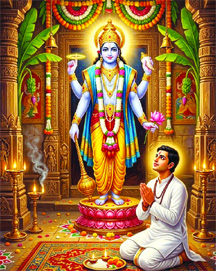

Among the many spiritually significant fasting days in the Hindu calendar, Papmochani Ekadashi is regarded as a powerful occasion for spiritual purification and redemption. Observed on the eleventh day (Ekadashi tithi) of the Krishna Paksha in the Hindu month of Chaitra, the day is dedicated to the worship of Vishnu. Devotees believe that sincere fasting and prayers on this day can free a person from accumulated sins and help them progress on the path of spiritual enlightenment.
The term “Papmochani” is derived from Sanskrit words-Paap meaning sin and Mochani meaning remover or liberator. Thus, Papmochani Ekadashi is revered as the sacred day that removes sins and purifies the soul.
Origin and Scriptural References
The significance and origin of Papmochani Ekadashi are described in the ancient Hindu scripture Bhavishya Purana, where the importance of the fast is explained through a dialogue between Krishna and Yudhishthira.
According to the narrative, King Yudhishthira asked Krishna to explain which Ekadashi had the power to remove sins and grant spiritual merit. In response, Krishna described Papmochani Ekadashi and narrated a powerful story illustrating its spiritual importance.
The Legend of Medhavi Rishi and Manjughosha
The most well-known legend associated with Papmochani Ekadashi revolves around the sage Medhavi Rishi.
Medhavi Rishi was a young ascetic known for his deep meditation and strict penance in a sacred forest. His spiritual practices were so intense that they began to worry the celestial beings. To disturb his meditation, the gods sent a heavenly dancer named Manjughosha.
Manjughosha used her beauty, charm, and melodious singing to attract the sage. Gradually, Medhavi Rishi lost his concentration and became deeply attached to her. What seemed like a short period of time turned out to be many years.
When the sage finally realized that he had abandoned his spiritual discipline, he became angry and cursed Manjughosha to become a ghostly spirit. However, she pleaded for mercy and asked for a way to be freed from the curse.
Later, Medhavi Rishi sought guidance from his father, the wise sage Chyavana Rishi. Chyavana advised him to observe the fast of Papmochani Ekadashi. By performing the sacred vrat with devotion, both the sage and Manjughosha were freed from the consequences of their actions.
This story highlights an important spiritual message-that sincere repentance and devotion can purify even serious mistakes.
Spiritual Significance of Papmochani Ekadashi
Papmochani Ekadashi carries deep philosophical meaning in Hindu spirituality.
First, it emphasizes the concept of karma and redemption. Human beings inevitably commit mistakes, but Hindu teachings stress that spiritual practices such as prayer, fasting, and repentance can purify the soul and reduce karmic burdens.
Second, the observance symbolizes control over desires and senses. The story of Medhavi Rishi illustrates how even great spiritual practitioners can be distracted by worldly temptations. Ekadashi fasting serves as a reminder to remain disciplined and focused on spiritual goals.
Third, the day is associated with spiritual cleansing and mental purification. Devotees believe that fasting and meditation remove negative energies and help cultivate peace, clarity, and devotion.
Papmochani Ekadashi is therefore not just about avoiding food but about transforming the mind and renewing spiritual commitment.
Rituals and Observances Preparations on Dashami
The observance usually begins on the tenth lunar day, known as Dashami. Devotees prepare for the fast by eating a simple, sattvic meal before sunset and avoiding foods such as grains, onions, and garlic.
They also focus on maintaining purity in thoughts and actions.
Ekadashi Fasting (Vrat)
On the day of Ekadashi, devotees wake up early before sunrise and take a ritual bath. Many people wear clean or traditional clothes and set up an altar for worship.
Fasting on Ekadashi is considered extremely important. There are different types of fasting observed:
– Nirjala fast – complete fast without food and water
– Phalahar fast – consuming fruits and milk
– Partial fast – eating special vrat foods such as buckwheat flour, water chestnut flour, and sabudana
The purpose of fasting is to discipline the body and mind while focusing on spiritual activities.
Worship of Lord Vishnu
Devotees perform elaborate worship of Vishnu or his incarnations. Idols or pictures of Vishnu are decorated with flowers, tulsi leaves, incense, and lamps.
Sacred mantras and hymns dedicated to Vishnu are recited, and devotees often read passages from scriptures such as the Bhagavata Purana.
Many temples conduct special prayers and religious gatherings on this day.
Night Vigil (Jagran)
Staying awake during the night of Ekadashi is considered highly auspicious. Devotees spend the night chanting devotional songs, meditating, and remembering the divine.
This practice is believed to enhance the spiritual merit of the observance.
Breaking the Fast (Parana)
The fast is traditionally broken on the following day, known as Dwadashi. Devotees perform morning prayers and then break the fast by eating a simple meal.
Before eating, many people offer food to Brahmins or donate to the poor, believing that charity multiplies the blessings of the vrat.
Papmochani Ekadashi in the
Annual Cycle of Ekadashis
Hindu scriptures mention 24 Ekadashis in a year, each with unique spiritual significance. Papmochani Ekadashi occurs toward the end of the Hindu lunar year, just before the beginning of the spring festival Chaitra Navratri.
This timing symbolically represents spiritual cleansing before the arrival of a new cycle of worship and renewal.
A Path Toward Spiritual Renewal
Papmochani Ekadashi reminds devotees that spiritual growth is a continuous journey. Through fasting, prayer, and self-reflection, individuals attempt to purify their minds and reconnect with divine consciousness.
The observance encourages humility, repentance, and compassion-qualities that strengthen both personal spirituality and moral character.
Ultimately, Papmochani Ekadashi stands as a powerful reminder that sincere devotion and righteous actions have the ability to cleanse the soul and guide human beings toward peace, liberation, and divine grace.


**prostafense**
ProstAfense is a premium, doctor-crafted supplement formulated to maintain optimal prostate function, enhance urinary performance, and support overall male wellness.