
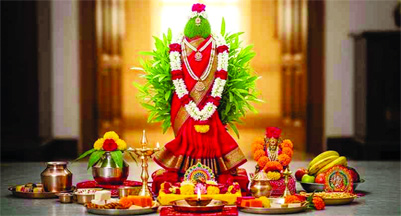

As the soft autumn breeze carries the scent of incense and the flicker of diyas illuminates courtyards, a divine celebration unfolds across India – Tulsi Vivah, the celestial wedding of Tulsi (Holy Basil) and Lord Vishnu in his Shaligram form. Revered as the festival that bridges heaven and earth, Tulsi Vivah is both a sacred ritual and a symbolic renewal of devotion, purity, and nature’s eternal rhythm.
The Legend: From Vrinda’s Devotion to Tulsi’s Divinity
The story of Tulsi Vivah has its roots in the Padma Purana, Skanda Purana, and other ancient scriptures. It tells of Vrinda, a virtuous and devoted wife of the asura king Jalandhar. Her chastity was so powerful that even the gods could not defeat her husband. To restore cosmic balance, Lord Vishnu disguised himself as Jalandhar and deceived Vrinda. When she realized the divine deception, she was heartbroken and cursed Vishnu to turn into a Shaligram stone and to be separated from his consort Lakshmi.
Overcome with remorse, Vishnu blessed Vrinda to be reborn as Tulsi, the most sacred plant on Earth. He promised that she would be worshipped eternally and that their divine union – Tulsi Vivah – would be celebrated by devotees every year on Earth.
Thus, the festival stands as an eternal reminder that divine love transcends illusion, suffering, and even time itself.
When and How Tulsi Vivah Is Celebrated
Tulsi Vivah is observed on the Ekadashi (11th) or Dwadashi (12th) day of the bright fortnight (Shukla Paksha) in the Hindu month of Kartik – generally falling between October and November. The day marks the end of Chaturmas, a four-month period when marriages and major religious ceremonies are avoided. From this day onward, the Hindu wedding season officially begins.
In homes and temples, the Tulsi plant is dressed as a bride – adorned with a sari, ornaments, vermilion, and bangles. Beside her, a Shaligram stone, Krishna idol, or Vishnu image is placed as the groom. A miniature marriage mandap (altar) is decorated with flowers, sugarcane, and marigold garlands.
Priests or elders recite the Tulsi Vivah Katha, chant Vishnu mantras, and perform kanyadaan – symbolically offering Tulsi in marriage to Vishnu. Devotees then distribute prasad, light lamps, and sing bhajans, turning the ceremony into a joyous, heartwarming celebration of divine love.
Spiritual Significance: The Soul’s Union with the Supreme
Beyond the symbolism of marriage, Tulsi Vivah represents the union of Bhakti (devotion) with Paramatma (the Supreme Soul). Tulsi, embodying devotion, purity, and surrender, unites with Lord Vishnu – the cosmic protector and preserver of life.
The ritual emphasizes the belief that true spiritual union lies in selfless love and service to the Divine. Just as Tulsi offers her fragrance and life-giving essence selflessly, devotees are reminded to live with purity, faith, and surrender.
In a deeper sense, Tulsi Vivah is also the celebration of feminine energy (Shakti) uniting with the masculine consciousness (Purusha) – the divine harmony that sustains the cosmos.
Regional Traditions Across India
Though the essence of Tulsi Vivah remains universal, its celebration varies beautifully across India’s diverse spiritual landscape.
Maharashtra:
The festival holds special prominence here. Families decorate courtyards with colorful rangolis, set up an ornate Tulsi Vrindavan (brick altar), and perform the ceremony with devotional songs, bhajans, and aarti. The Tulsi is dressed in a bright red or green sari, while the Shaligram or Krishna idol is adorned as a groom in a tiny turban.
North India (Uttar Pradesh, Bihar, Madhya Pradesh):
In many homes, especially among Vaishnava devotees, Tulsi Vivah is performed with full wedding rituals – mangalashtak, kanyadaan, pheras, and aarti. After the ceremony, sweets like laddoos, malpua, and panchamrit are offered.
South India:
In states like Tamil Nadu and Andhra Pradesh, the ceremony is called Tulasi Kalyanam, and it is observed with grandeur in Vishnu temples. Devotees perform elaborate rituals accompanied by traditional music, flower decorations, and offerings of pongal and payasam.
Gujarat and Rajasthan:
The festival is marked by decorative clay mandaps, garlands, and folk songs celebrating Tulsi’s purity and Lord Vishnu’s grace. Women observe fasts and seek blessings for family harmony and conjugal happiness.
Eco-Spiritual Essence: Honoring Nature as Divine
In today’s times, Tulsi Vivah carries profound ecological relevance. Tulsi is not merely a sacred plant; she is a natural purifier, known to release oxygen, repel insects, and heal ailments. By venerating her as divine, Hinduism expresses its deep ecological wisdom – seeing divinity in every element of nature.
In many eco-conscious households and temples, Tulsi Vivah has evolved into a celebration of environmental awareness, where devotees plant new Tulsi saplings and pledge to protect the earth. This blending of spirituality and sustainability reflects the timeless Hindu principle – Prakriti is sacred; the Earth is our mother.
The Living Goddess in Every Home
Every courtyard that houses a Tulsi plant is believed to be a miniature temple, a living link between the devotee and the Divine. Lighting a lamp before her each evening is said to bring harmony, health, and spiritual upliftment.
As the marriage rituals conclude and lamps glow beside the sacred plant, Tulsi Vivah reminds devotees that divine love resides not in the heavens alone, but in every breath of nature, every act of devotion, and every pure heart that surrenders in faith.
In Essence
Tulsi Vivah is more than a festival – it is a spiritual allegory of union, purity, and devotion.
It teaches that when the heart becomes as pure as Tulsi and devotion as steadfast as Vrinda’s, the Divine Himself manifests to accept that love.
“Where there is Tulsi, there is purity.
Where there is devotion, there resides the Divine.”



Be the first to comment