
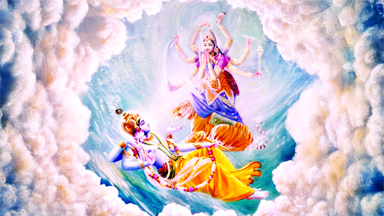

Among the 24 Ekadashis that grace the Hindu lunar calendar, Utpanna Ekadashi holds a particularly sacred place. Celebrated in the Krishna Paksha (waning phase) of the Margashirsha month (November-December), it is revered as the first Ekadashi, the day when the divine principle of Ekadashi itself was born.
It marks the origin of the Ekadashi fast, which is believed to grant liberation from sins, control over desires, and the ultimate gift of spiritual awakening – moksha.
The Sacred Birth of Ekadashi Devi
According to the Padma Purana and Bhavishya Purana, the story of Utpanna Ekadashi begins in the ancient cosmic age when evil forces troubled both mortals and gods. Among them was the formidable demon Mura, a powerful asura who wreaked havoc upon heaven and earth.
Unable to bear his tyranny, the Devas (celestial beings) sought refuge in Lord Vishnu, the protector of the universe. Vishnu waged a fierce battle against Mura for thousands of years, finally resting for a brief moment in a cave at Badarikashrama (Badrinath).
Seizing this opportunity, Mura tried to attack the resting Lord. Suddenly, from Vishnu’s body emerged a dazzling female energy – a radiant goddess armed with divine weapons. She fought the demon and destroyed him effortlessly.
When Vishnu awoke, He saw the demon slain and the beautiful goddess standing humbly before Him. Moved by her courage, Vishnu asked her to name her wish. She replied, “I wish to serve you forever and to deliver all beings from sin through devotion and fasting.”
Pleased, Vishnu declared,
“You shall be known as Ekadashi, born on the eleventh day of the lunar fortnight. Those who observe fasts and meditate on Me on this day shall be freed from all sin and attain my eternal abode.”
Thus, Utpanna Ekadashi marks the birth of Ekadashi Devi, the personification of purity, self-control, and divine grace.
Spiritual Significance of Utpanna Ekadashi
The word Ekadashi comes from Sanskrit – eka (one) and dashi (ten), meaning the eleventh day. Symbolically, it represents the union of body and soul, the moment when human consciousness transcends the ten senses (five of perception and five of action) to rest in divine awareness.
Utpanna Ekadashi thus signifies the awakening of spiritual consciousness – the moment when the seeker first turns inward toward the Divine. It is not merely a ritual fast but a discipline of mind, body, and spirit.
Fasting on this day symbolizes detachment from material indulgence and a redirection of energy toward devotion (bhakti), meditation (dhyana), and divine remembrance (smarana).
Rituals and Observances
The observance of Utpanna Ekadashi begins a day before, on Dashami Tithi, when devotees eat a simple satvik meal before sunset and mentally prepare for fasting.
On Ekadashi day, devotees perform the following:
– Morning Rituals – Wake up early, bathe before sunrise, and take a vow (sankalpa) to observe the fast with devotion to Lord Vishnu.
– Puja and Prayer – Offer flowers, incense, tulsi leaves, and naivedya to Vishnu’s idols or images, often in the form of Sri Hari, Vishnu-Narayan, or Krishna.
– Fasting – Most devotees observe a full fast (without grains or pulses), consuming only fruits, milk, and water. Some may take a partial fast with one meal (ekabhukti).
– Vigil and Meditation – The night is spent in prayer, bhajans, and reciting the Vishnu Sahasranama, Bhagavad Gita, or Ekadashi Mahatmya.
– Parana (Breaking the Fast) – The fast is broken the next morning, on Dwadashi Tithi, after offering prayers to Vishnu.
By controlling the senses, speech, and diet, devotees believe they purify both karma (action) and chitta (mind), allowing divine awareness to blossom.
Symbolism and Inner Meaning
The story of Utpanna Ekadashi is not just mythological – it is deeply symbolic.
– The demon Mura represents the ego, desires, and restless mind that attack the soul during spiritual rest.
– The sleeping Vishnu symbolizes the divine consciousness within, serene and ever-present.
– Ekadashi Devi, born from Vishnu, represents the awakened energy of self-control and devotion that slays ignorance and restores balance.
Thus, Utpanna Ekadashi is the day when the inner light of discipline (tapas) awakens to conquer the inner darkness of distraction and delusion.
The Path to Liberation (Moksha)
Scriptures declare that fasting on Utpanna Ekadashi with devotion to Lord Vishnu absolves one from the burden of sins and paves the way to Vaikuntha, the abode of the Lord. The Padma Purana states:
“He who observes this Ekadashi is freed from sins committed over a thousand births.”
Spiritually, it signifies the first step toward liberation – the birth of divine awareness in the seeker’s heart. When the senses are restrained, the mind becomes pure; when the mind is pure, knowledge awakens; and when knowledge dawns, the soul attains freedom.
Regional Observances
Across India, devotees mark this day with varied traditions:
– In North India, temples of Vishnu and Krishna hold bhajans and kirtans throughout the night.
– In South India, Vaishnava communities perform special Ekadashi Upavasas and recite the Vishnu Sahasranama.
– In Maharashtra and Gujarat, devotees often light lamps, chant Om Namo Bhagavate Vasudevaya, and donate food to the needy the next day.
– In all these customs, the essence remains the same – devotion, purity, and surrender.


Be the first to comment