Tag: Terror Attacks – Bomb Blasts – Terrorism

  • 2006 MUMBAI TRAIN BLASTS CASE: 12 CONVICTED, ONE ACQUITTED

    MUMBAI (TIP): Nine years after seven RDX bombs kept in Mumbai suburban trains exploded killing 188 people, a MCOCA court here today convicted 12 persons in the serial blasts case.

    Delivering the verdict, the Special Maharashtra Control of Organised Crime Act (MCOCA) Judge Yatin D Shinde pronounced 12 accused as guilty while acquitting one accused Abdul Wahid Shaikh (34) in the case.

    The 12 accused who were convicted today are: Kamal Ahamed Ansari (37), Tanvir Ahmed Ansari (37), Mohd Faisal Shaikh (36), Ehtesham Siddiqui (30), Mohammad Majid Shafi (32), Shaikh Alam Shaikh (41), Mohd Sajid Ansari (34), Muzzammil Shaikh (27), Soheil Mehmood Shaikh (43), Zamir Ahmad Shaikh (36), Naveed Hussain Khan (30) and Asif Khan (38).

    However, Azam Chima, along with 14 others, are still absconding in the case. Arguments for the quantum of sentence are likely to begin on Monday.

    In the trial that lasted for eight years, the prosecution examined 192 witnesses, including eight Indian Police Service (IPS) and five Indian Administrative Service (IAS) officers as well as 18 doctors. The defence lawyers examined 51 witnesses and one person was called as a court witness.

    The deposition made by witnesses runs into around 5,500 pages. Seven RDX bombs had exploded in the first class coaches of Mumbai’s suburban trains on July 11, 2006, killing 188 people and injuring 829.

    The blast occurred within a span of 10 minutes between Khar Road-Santacruz, Bandra-Khar Road, Jogeshwari-Mahim Junction, Mira Road- Bhayander, Matunga- Mahim Junction and Borivali.

    The MCOCA judge had concluded the trial on August 19 last year. The examination of witnesses resumed after two years since the Supreme Court had stayed the trial in 2008.

    Before the stay, the prosecution had already examined a police officer. The Supreme Court vacated the stay on April 23, 2010.

  • 2008 MALEGAON BLASTS CASE: SC SEEKS CENTRE, NIA REPLY ON PIL

    2008 MALEGAON BLASTS CASE: SC SEEKS CENTRE, NIA REPLY ON PIL

    NEW DELHI (TIP): The Supreme Court on Sept 11 sought response from Centre and National Investigating Agency (NIA) on a plea challenging removal of Special Public Prosecutor (SPP) in the 2008 Malegaon blasts case and alleging that Government was exerting pressure on her to “go soft” on the accused.

    A bench comprising Justices J Chelameswar and A M Sapre asked Centre and NIA to file their responses within one week.

    The bench, however, did not allow the submission of senior advocates Kapil Sibal and Indira Jaising that hearing on the bail applications of the accused persons be stayed for the time being.

    The bench has also issued notice to Maharashtra government in the case. Earlier, a Supreme Court Judge had recused from hearing the plea, saying that he had represented certain accused in the matter.

    The PIL, filed by social activist Harsh Mander, has accused NDA government of trying to interfere with the functioning of the prosecutor in the case by exerting “pressure” on her to “go soft” on the accused. It alleged that the executive was attempting to influence the judicial system.

    It has alleged that NIA officials had pressured erstwhile Special Public Prosecutor in case, Rohini Salian, “presumably” under instructions from their “political masters”.

    Salian, who was SPP in the case, had alleged that an NIA officer had told her to go soft on the accused. She also claimed the same officer had told her that she would be replaced. Salian is no longer on NIA’s panel of lawyers.

    The petition has sought the apex court’s intervention to ensure a fair trial as there were reasons to “credibly fear” that “executive is attempting to influence the judicial system to cave in to the pressure exerted by it in all matters, including affording protection to right-wing extremists who sympathize with its ideology”.

    The PIL also sought direction to the Centre to appoint an SPP to conduct “fair” trial and constitute a Special Investigating Team of CBI to probe alleged actions of NIA officials who allegedly pressured Salian.

    The high-profile accused in the case include Lt Col S P Purohit and Sadhvi Pragya Singh Thakur.

    The 4,000-page charge sheet had alleged that Malegaon was selected for the blasts because of its sizeable Muslim population. It named Pragya Singh Thakur, Purohit and another accused, Swami Dayanand Pandey, as the key conspirators.

  • Jihadists put squeeze on Syria’s Assad as Russia defends aid

    Jihadists put squeeze on Syria’s Assad as Russia defends aid

    BEIRUT (TIP): Jihadists advanced on a regime airbase in eastern Syria on Sept 10 after the fall of one in the north, as staunch ally Russia defended its military aid to embattled President Bashar al-Assad.

    Moscow dismissed criticism of its intervention by Western states, which are carrying out air strikes on jihadists in both Syria and neighbouring Iraq but also seek Assad’s ouster.

    “We helped, are continuing to help and will help the Syrian government when it comes to supplying the Syrian army with everything it needs,” said Russian Foreign Minister Sergei Lavrov.

    Islamic State group jihadists edged closer to a strategic airbase outside the eastern city of Deir Ezzor in heavy clashes that left 54 combatants dead, said the Syrian Observatory for Human Rights.

    The Sunni Muslim group, which has captured large chunks of Syria and Iraq, seized control of an army post near the base on Wednesday night.

    Jihadists put squeeze on Syria's Assad1Observatory director Rami Abdel Rahman said 36 IS fighters and 18 regime soldiers were killed.

    IS fought its way to barely one kilometre (less than a mile) from the airport with the seizure of the army post used by a rocket battalion.

    Two suicide bombers were used by the jihadists in the assault, one of them a child, driving cars laden with explosives, said Abdel Rahman.

    IS already controls most of oil-rich Deir Ezzor province, including about half of its capital, and has fought for more than a year to capture the airport and the rest of the city.

    The Deir Ezzor assault came as rival jihadists from Al-Qaeda’s Syrian affiliate and their allies on Wednesday seized the last regime-held military base in the northwestern province of Idlib.

    According to the Observatory, the regime is now left with just three airbases in the east and north — Deir Ezzor, and Neirab and Kweyris in Aleppo province.

    At least 56 soldiers were killed, some execution-style, as rebels captured Idlib’s Abu Duhur military airport under the cover of an intense sandstorm following a two-year battle, the Observatory said.

    Abdel Rahman, whose Britain-based group relies on a network of sources on the ground in Syria, said at least 40 soldiers were taken prisoner and dozens more were missing.

    Rebels tweeted images of helicopters and planes abandoned on the tarmac.

    Abdel Rahman said the entire province of Idlib was now under the control of Al-Nusra Front and other rebel groups.

    Assad’s regime appeared to admit the loss, with state television saying troops had left the base.

    It has been at war with different rebel groups since March 2011, in a conflict that has killed at least 240,000 people and forced millions to flee abroad.

    Russia denied it was ramping up its military presence in Syria, saying it was supplying its ally with humanitarian aid and military equipment under existing contracts.

    “Russian planes are sending to Syria both military equipment in accordance with current contracts and humanitarian aid,” Lavrov told reporters in Moscow.

    “We have never made our military presence (in Syria) a secret,” he said. “Russia is not taking any additional steps.”

  • California to organize parade to honour heroes who thwarted France train attack

    California to organize parade to honour heroes who thwarted France train attack

    SACRAMENTO, CALIFORNIA (TIP): Three young men who disarmed a gunman on a high-speed train bound for Paris will get a heroes’ welcome in their hometown in California, the mayor of Sacramento said on Monday.

    “Big news!” Sacramento Mayor Kevin Johnson tweeted. “We are throwing a parade for our 3 hometown heroes!” He used the hashtag “#SacramentoProud.”

    The state capital will strike up the bands for student Anthony Sadler, 22, Spencer Stone, a 23-year-old U.S. airman, and National Guardsman Alek Skarlatos, 22. The men grew up in the Sacramento area, attended middle and high school together and have remained friends.

    They were touring Europe, partly to celebrate Skarlatos’ return from a tour of duty in Afghanistan, when they saw the gunman, who was armed with a box cutter, a pistol and a Kalashnikov AK-47 assault rifle.

    When they saw him cocking the rifle, they said they had no choice but to react.

    Sacramento, parts of which are still suffering from the financial crisis, has been buzzing with pride for the Americans ever since.

    “I hope it’s a parade to end all parades, Mr. Mayor,” Bill Bird, a spokesman for the senate’s top Republican, Bob Huff, tweeted in response to Johnson, a Democrat.

    “Finally,” tweeted another conservative, who used the name LVN Nancy. “Something to be proud of in California.”

    Johnson’s chief of staff, Daniel Conway, said the parade was being organized and details would soon be announced.

    At Sacramento State University, where Sadler is a senior, president Robert S. Nelsen said he looked forward to thanking the kinesiology major in person when he returns to class. French President Francois Hollande bestowed France’s highest honor on Monday on the three Americans along with a Briton who helped disarm the suspected Islamist militant.Stone, whose thumb was almost severed by the attacker, has also been credited with saving the life of another passenger who had been shot and was bleeding profusely.

    Air Force Secretary Deborah James said Stone’s unit was nominating him for the Air Force’s highest medal for non-combat bravery.

    California Governor Jerry Brown tweeted on Saturday, “Proud of the brave Californians who helped prevent yesterday’s attack in France & saved countless lives.”

  • Blasts at Afghan gas storage facility kill 11, mostly children

    Blasts at Afghan gas storage facility kill 11, mostly children

    HERAT (TIP): At least 11 people, most of them children, were killed in a series of explosions at an Afghan gas storage facility, which triggered a massive inferno in a nearby settlement for displaced people, officials said today.

    It was not immediately clear whether the blasts late yesterday on the edge of the relatively peaceful western city of Herat were the result of an accident or caused by a militant attack.

    “Around midnight (Monday) a gas tanker exploded which triggered blasts in a gas storage plant, killing 11 people and injuring 10 others,” Herat police spokesman Abdul Rauf Ahmadi told AFP.

    The explosions triggered a plume of flames into the night sky, which rapidly spread to a nearby settlement of mud houses for internally displaced people where most of the deaths occurred.

    Ihasanullah Hayat, spokesman for the governor of Herat, confirmed the toll and said the majority of those killed were children.


  • Pakistan must take ‘forceful actions’ against LeT, US says

    Pakistan must take ‘forceful actions’ against LeT, US says

    WASHINGTON (TIP): Pakistan must take “forceful actions” against the dreaded Haqqani network and the Lashkar- e-Taiba in a manner similar to the way they campaigned against the Pakistani Taliban, a top Obama administration official has said.

    “Just as they have vigorously pursued the Pakistani Taliban, they must take equally forceful actions against groups like the Haqqani Network, which pose serious threats to American (and Afghan) lives and resources, and Lashkar-e- Taiba, which has the potential to destabilize the region,” Dan Feldman, special representative for Afghanistan and Pakistan, said.

    Having just returned from his final trip to the AfPak region, Feldman acknowledged that there has not been much change in Pakistan’s approach vis-a-vis the Haqqani Network and the LeT — the two terrorist organizations that pose a threat not only to the US but also India. Feldman was speaking at the US Institute of Peace (USIP) in Washington on Wednesday.

    Feldman, who has been Obama administration’s point man for Afghanistan and Pakistan for past one year, is now leaving the US government for the private sector.

  • How Gurdaspur terror attack is a wake up call

    How Gurdaspur terror attack is a wake up call

    Sand bags and fortifications have come up again outside the Dinanagar Police Station as an aftermath of the July 27 terrorist attack, which could have led to a bigger disaster if a bus driver and railway employees were not alert enough.

    The attack, the first such attack in nearly two decades in Punjab, is a wake up call for the security agencies in the state which had adopted a smug attitude after a peaceful span and had not expected such an attack as only Jammu and Kashmir had remained on the target of the terrorists from across the border over the years.

    Fortunately there is no indication of involvement of Sikh militants or supporters of Khalistan. There were initial reports quoting an eyewitness that there was a Sikh in the group. However, his claim was proved wrong and apparently in a state of panic he thought that one of the terrorist with long hair was a Sikh. Even a section of media initially speculated the hand of separatists based in Pakistan. Their speculation was solely based on assumption that such attacks from across the border were only aimed at Jammu and Kashmir and that there was no reason for them to have crossed into Punjab.

    However, they were proved wrong as the terrorists did not shout any slogan in favor of Khalistan nor did they leave behind any placard, banner or document to even remotely link the attack with the demand for Khalistan. The only reason, what the investigations have come to a conclusion, is that they found Punjab region an easy target in view of heavy security deployment in Jammu and Kashmir.

    Now it is not just the Dinanagar Police Station, which is located only about 15 kilometers from the international border, but several other police posts and stations close to the border have been ordered to set up security posts outside their complexes.

    The fortifications are a reminder for the old timers who were witness to macabre play of violence, torture, death and destruction during the decade and a half of bloodshed in the 80s and 90s in Punjab. Not just the fortifications outside the police stations, there were the ubiquitous nakas (check points) dreaded by all citizens. The highways and other roads were deserted before the sun set and there was a general atmosphere of fear. The attack has come as a rude reminder of the dark era which had brought the state on the brink of ruin and had left thousands killed and maimed.

    While the new generation, just stepping into youth, may be unaware of the situation during the dark period, those who had witnessed and particularly those who had suffered, now dread a repeat of such a situation. In fact there was hardly any family which was not affected directly or indirectly and many had to leave their homes and hearths for safety or a new life.

    Old timers recall how it was the rule of the security forces during the day time and that of the militants during the night hours, particularly in the rural areas. The common people were the worst targets from both the sides. Even if someone was remotely suspected to be protecting or supporting militants, the police would pick him up and there was little surety that he would ever return. Similarly if the militants suspected any one to be a police informer, he would face the wrath of the militants.

    There were tales of young men picked up by the security forces who were initially kept in torture cells and then there were reports that they had “attempted” to escape and were shot dead. Even till date there is no information about hundreds of young men of whom there is just no trace. Thus thousands of families were ruined and there is still no closure for them even though several policemen were still facing trial for alleged fake encounters. At couple of police offices, facing serious charges, have committed suicide.

    On the other hand it was the writ of the militants in the state, particularly in the rural areas, where they took shelter a night. There were several instances in which the militants killed innocents. There were also incidents when they ordered all non Sikhs to come out of public buses, lined them up and shot them dead. In one particular instance, they queued up engineering students from other states and shot them dead.

    On the other hand it was the writ of the militants in the state, particularly in the rural areas, where they took shelter a night. There were several instances in which the militants killed innocents. There were also incidents when they ordered all non Sikhs to come out of public buses, lined them up and shot them dead. In one particular instance, they queued up engineering students from other states and shot them dead.

    Even as violence dominated the state and the common people suffered, there was a sharp decline in its economy. While funds were diverted for security, and often misused or misappropriated, the businessmen began moving outside the state to safer pastures. Several of them, who were particularly targeted by militants as well as security personnel, wound up their establishments and shifted to other states. Even now, many of them have not returned.

    The Gurdaspur terror attack as brought back the specter of violence. The GPS coordinates have confirmed the target of the terrorists was Punjab and not Jammu and Kashmir this time. This could be partly due to their strategy to widen the arc of their target areas so as to further stretch the resources of security forces. Also, a mischievous attempt to vitiate the peaceful atmosphere of Punjab cannot be totally ruled out. The ultimate target of the terrorists to reach Gurdaspur is an indication that they were not aiming at fomenting trouble in Jammu and Kashmir.

    If the reports are true, this incident, seen in conjunction with the attempts to revive the demand for Khalistan, could point to a more sinister design behind the attack. Even as a section of NRIs are reportedly stepping up their effort to re-ignite the flames in India, their protégé 83-year Surat Singh Khalsa is currently on indefinite fast to demand release of Sikh prisoners who had completed their terms. This may not be possible because as per a Supreme Court ruling those prisoners who are convicted for terrorism and other heinous crimes cannot be given remission and have to serve the entire life in jail if they were handed over life term.

    Another indication of the militants and their supporters getting active is the demand to shift Sikh prisoners to Punjab. The state government has recently helped in getting two of these, including Devinder Singh Bhullar, to Punjab. Though a mental patient, Bhullar poses no threat to anyone but the reception they got from a section of supporters of Khalistan on their arrival in the state was an indication that the demand is still brewing and a little push may disturb the hard earned peace in Punjab. Also there are reports that a section of NRIs have started a campaign called Referendum 2020 to build public demand for a referendum in favor of a separate state. A resolution to this effect was recently passed in Toronto and there are apprehensions that the demand may be raised during Prime Minister Narendra Modi’s visit abroad next month. The union home ministry had also recently sent an advisory to the state government to step up alert and guard itself from attempts to revive militancy in the state.

  • One more terror attack

    One more terror attack

    What distinguishes Wednesday’s terror attack from the one in Gurdaspur is that this time some brave villagers, at a great risk to their lives, managed to overpower one of the terrorists. That is some achievement though India has lost two BSF men. There is uncertainty about the age of the captured terrorist. If he turns out to be a juvenile, the law could prove inadequate and he might escape jail and capital punishment. Just because he has confessed to being from Pakistan may not be enough to pin down the Pakistani establishment for the attack. Sections of the media are quick to point fingers towards the hostile neighbor, but the world at large looks for more credible evidence of the Pakistan government’s involvement. The latter may well dub him a “non-state actor” just as it did in the case of Ajmal Kasab.

    The Army played an important role in Wednesday’s anti-terror operation with the use of helicopters and para-commandos. In Gurdaspur the Punjab Police chose to go it alone and that took 12 hours to neutralize the terrorists. Punjab’s Deputy Chief Minister has promised to strengthen the police stations in the border areas. This is welcome as terrorists seem to have shifted their area of operation from Kashmir to the Jammu-Gurdaspur region. The Udhampur incident shows the advantage of having village defense committees. Civilian help is crucial in tackling terrorism.

    In his statement in the Rajya Sabha on Thursday Home Minister Rajnath Singh did not make the mistake of alluding to Pakistan’s role in the attack without first having proof in hand as he had done in the case of the Dinanagar incident. Another positive is the Modi government has resisted pressure from hawkish elements and stuck to the NSA-level talks, expected on August 23-24. The dialogue with Pakistan must continue as any contrary move would mean playing into the hands of those who use terror to abort peace efforts. The Congress has accused Modi of being soft on terror. Omar Abdullah too has played terror politics. This is not the right time for political one-upmanship and point-scoring.

  • US reiterates its support and commitment to pursue justice for 26/11 victims

    US reiterates its support and commitment to pursue justice for 26/11 victims

    The US is committed to pursuing justice on behalf of the victims of the 2008 Mumbai attack no matter how “arduous” the task is, said Assistant Secretary of State for South and Central Asian Affairs Nisha Desai Biswal.

    “We have certainly reiterated our support and our commitment to India’s efforts to seek justice on behalf of the victims” of the 26/11 attack, Biswal told PTI when asked about the delay in bringing to justice the perpetrators of the 2008 terror attacks.

    Assistant Secretary of State for South and Central Asian Affairs Nisha Desai Biswal.
    Assistant Secretary of State for South and Central Asian Affairs Nisha Desai Biswal.

    Given that nearly seven years have passed since the horrendous terror attacks that claimed over 160 lives and injured many others, Ms Biswal said “It is not an easy path and it never has been for these kinds of acts. The (path) of justice sometimes is very long and arduous but we are committed to pursuing that no matter how long the journey and how arduous the task”.

    Biswal, who had travelled to the city from Washington to speak at the Indian Consulate General’s Media-India Lecture Series on Tuesday, said not only were there a large number of Indian victims in the attack but there were Americans also who lost their lives.

    “We will continue to work very closely with the Indian government on those issues,” she said, adding that it is an ongoing process and the US is working with Indian authorities to address issues of concern emanating from the incident.

    On terror attack in Punjab’s Gurdaspur

    Referring to the terror attack in Punjab’s Gurdaspur district on July 27, Ms Biswal said the US has strongly condemned and expressed its concern over the attack.

    She said the US has expressed its cooperation with Indian authorities on any specific aspects of the incident.

    “But the broader issue is the increasing and deepening cooperation between our law enforcement agencies, intelligence agencies and between our governments at large to address the broader problems of terrorism and extremism and our partnerships across the region to try to address these issues,” she said.

    On media reports that the night vision device used by three terrorists in the Gurdaspur attack had US markings, Ms Biswal said the US is in conversation with Indian authorities to try to ascertain and trace the origins of the equipment found.

    “We will continue to work very closely with the Indian government on those issues,” she said, adding that it is an ongoing process and the US is working with Indian authorities to address issues of concern emanating from the incident.

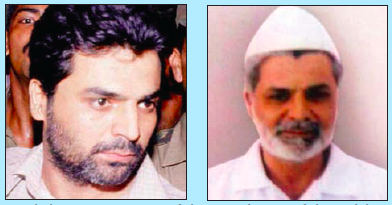
  • Mumbai serial blasts convict Yakub Memon hanged, buried

    Mumbai serial blasts convict Yakub Memon hanged, buried

    NEW DELHI (TIP): The two burials on Thursday July 30 represented the spectrum of what is the best and the worst of India. Millions mourned the death of one of the country’s favourite sons, former President APJ Abdul Kalam, as his body was laid to rest in his hometown Rameshwaram. On the other hand few shed any tear on the death of one of the conspirators of the Mumbai serial terror attacks of Mumbai Yakub Memon who was hanged early morning and his body interned in a graveyard in the City where a series of blasts ripped through Mumbai on March 12, 1993, killing 350 people and injuring 1200.

    With Yakub Memon’s execution in the early hours of Thursday morning at Nagpur jail, there may be some closure for the families of the victims but they would rather also see the same fate as Yakub for his brother Tiger Memon and the brain behind the conspiracy Dawood Ibrahim, both reportedly under protection in Pakistan.

    Yakub Memon was hanged in the Nagpur jail after a prolonged legal drama which lasted till early morning hours of his hanging. In fact in an unprecedented move, a bench of the Supreme Court was convened at 3 am following a plea to defer the hanging. The three member bench heard arguments that the President cannot reject a mercy petition at a short notice and also that Yakub had the right to file another mercy petition. However the arguments were contested by the government which said that the death row convict had exhausted all avenues of appeal. The court concurred with its arguments and said that a stay on the execution would be “travesty of justice”.

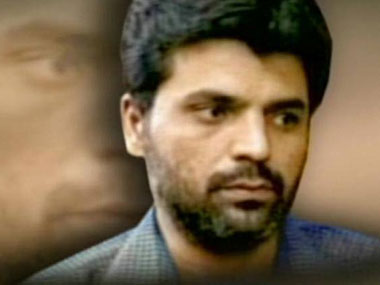
    Mumbai serial blasts convict Yakub Memon hanged imageWithin one and a half hour of the verdict Yakoob Memon was hanged in Nagpur and his body handed over to his family members. It was later flown to Mumbai and buried amidst tight security ironically what happened to be  his  53rd birthday.

    Yakub had allegedly handled Tiger’s funds and funded the training of 15 youths whom he sent to Pakistan to learn the art of handling arms and ammunition.

    While Yakub, along with other members of the Memon family had left the country just before and after the 1993 blasts, according to the Central Bureau of Investigation (CBI), Yakub later returned. The claims about the purpose of his return are contentious, but he was formally arrested on August 5, 1994, from New Delhi.

    Yakub was charged on July 27, 2007, under the Terrorist and Disruptive Activities Act (TADA) and Section 120-b of the IPC with criminal conspiracy, aiding and abetting and facilitating a terrorist act, arranging funds and vehicles, for planting bombs and possessing detonators and hand grenades that had been used in the 1993 serial blasts.

    Born on 30 July 1962 in Bombay, Yaqub was raised in Byculla. After completing his schooling from a prominent English medium school, Memon went on to complete his Commerce degree from the Burhani College of Commerce and Arts. In 1986, Memon enrolled into the Institute of Chartered Accountants of India, and four years later in 1990, he successfully graduated as a chartered accountant.

    Yakub Memon became the third terror convict to have been sent to the gallows in the last four years.

    Before Memon, Parliament attack convict Mohammed Afzal Guru was hanged on February 9, 2013. Afzal was convicted of conspiracy in the December 2001 attack on Parliament and was sentenced to death by the Supreme Court in 2004.

    Earlier, Ajmal Kasab, the sole Pakistani gunman involved in the 26/11 Mumbai terror attacks to have been captured alive, was hanged to death at the Yerwada central prison in Pune on November 21, 2012.

    He was among the 10 Pakistani Lashkar-e-Taiba terrorists who had descended on Mumbai on November 26, 2008 and had killed 166 people, including some foreigners. Nine of the perpetrators were killed during the 60-hour siege and Kasab was captured alive.

    The Timeline

    In what was an unprecedented turn of events, the Supreme Court of India opened the doors of Court Room Number 4 at 3 am on Thursday to hear a fresh mercy plea by a battery of lawyers representing a convicted terrorist in the 1993 Mumbai serial blast case, Yakub Abdul Razak Memon. Two hours later his fate was sealed.

    The story goes back to Tuesday. In the light of a disagreement between a two judge bench hearing the case to stay Yakub Memon’s execution on July 30, Supreme Court Chief Justice HL Dattu constituted a larger bench of Justice Dipak Misra, Prafulla C Pant and Amitava Roy to discuss Memon’s plea again.

    The next day, one day before his slated hanging of Yakub Memon filed a fresh mercy plea with the President of India at 11 am. The same day at 4.30 pm, a three member bench of the Supreme Court dismissed his petition and at 5.30 pm, the mercy petition filed with the President is sent to the Union Home Ministry as per the usual procedure. Yet another mercy petition filed by him before the Maharashtra Governor is also rejected.

    At 9 pm, union Home Minister Rajnath Singh personally takes the file and goes to meet President Pranab Mukherjee to discuss the mercy plea. This meeting is also attended by Home Secretary L C Goyal and Solicitor General Ranjit Kumar.

    At 11 pm, President Pranab Mukherjee rejects the mercy plea. This paved the way for Yakub Memon to hang at 7 am at the Nagpur Jail.

    The Midnight Drama

    The drama, however, didn’t end there. In a dramatic turn of events, Yakub Memon moves the Supreme Court again, his lawyers urging the President to not take a decision overnight.

    Several lawyers including Prashant Bhushan, Anand Grover, Vrinda Grover, Nitya Ramakrishnan and Yug Choudhary representing Yakub Memon reached the  residence of CJI Dattu seeking a stay on the execution. Citing a Supreme Court judgment in the Shatrughan Chouhan VS Union of India case, a fresh petition was filed with the CJI seeking at least a 14 day clear gap between the rejection of mercy petition of the convict and the hanging. The registrar of the Supreme Court also reached the CJI’s residence and in an unprecedented and remarkable move, the CJI agreed to hear the plea that very night.

    He constituted a three member bench which had earlier in the day rejected the plea. Perhaps for the first time ever a court room in the Supreme Court was opened at 3 am to hear the plea.

    At 3 am, Attorney General Mukul Rohatgi entered court room no.4 and the hearing began. Yakub Memon’s lawyers argued that the earlier mercy plea was filed by his brother, today’s plea was his own. Since the plea has been rejected today, the mandated 14 day period before the hanging must begin today. The Attorney General stressed that multiple mercy petitions were an abuse of the system.

    The bench finally dismissed the petition around 5 am and Yakub Menon was hanged les than an hour and a half later at Nagpur this closing a sad chapter in the history of the country.

  • 1993 Mumbai Serial Blasts Accused to Hang

    1993 Mumbai Serial Blasts Accused to Hang

    NEW DELHI (TIP): Twenty two years after 13 explosions rocked Mumbai leaving 257 dead and over 700 injured, one of the main accused Yakub Abdul Razak Memon is likely to be hanged at the month-end.

    Stage was set for the hanging of the serial bombings accused after the Supreme Court dismissed a curative petition. While the two key accused in the bombings, Dawood Ibrahim and Tiger Memon remain absconding, Yakub has been convicted for arranging and distributing money for the terrorist operation, facilitating air tickets for the other conspirators to undergo weapons training in Pakistan, possessing hand grenades and detonators supplied by his brother Tiger Memon and for purchasing vehicles in which the bombs were planted.

    Rejecting the curative mercy petition, a Supreme Court three judge bench led by Chief Justice H L Dattu rejected the convicts’s contention that he was a victim of bias and that principles of natural justice were ignored in his case.

    Yakub was awarded the death sentence by TADA court and an anti terror court had already issued warrant for his execution in the premises of the Nagpur jail. The Supreme Court had earlier dismissed his review petition while a mercy plea has also been rejected by the President.

    However, the mercy petition was filed by his brother Suleman and Yakub has now filed another mercy petition in his own name in a last ditch attempt to escape the gallows. This may buy him a little time (incidently his birthday is also on July 30) but there is little likelihood of his mercy petition being accepted by the President. Also as per an earlier Supreme Court guidelines, there should be a gap of at least 14 days between the rejection of a mercy petition and execution.

    Yakub, who is a trained chartered accountant, had said in his appeal that he was suffering from schizophrenia since 1996. He also took the plea that while he could be accused of being a conspirator, he was not involved in executing the blasts.

    There are a total number of 193 accused in the case out of which 35 are absconding. In all 11 accused died during the trail and two had turned approver. No less than 100 of the accused have been convicted and 48 of them were found guilty of conspiracy. Earlier 26 accused were discharged by a special TADA court and two others were subsequently discharged by the Supreme Court.

    A study conducted by the National Law University, Delhi and the Law Commission, has come out with some revealing figures although there has always been a lurking suspicion of the trend.

    The findings of the study, which were released in the wake of Supreme Court rejecting Yakub’s mercy petition, pointed out that more than 75 per cent of death row convicts in the country belonged to the Backward Classes and Minorities, 75 per cent were economically vulnerable and over 93 per cent of those sentenced for terror crimes were either Dalits or belonged to minority communities. The study indicated that in most cases they were unable to afford proper legal assistance.

    It also found that 23 per cent of such convicts had no schooling and most others were undergraduates, They were not allowed to attend court proceedings and had inadequate interaction with their lawyers.

    They were also lodged in separate barracks and generally remained in solitary confinement for long periods.

    The study, first of is kind in India, analyzed data relating to 373 death row convicts over a period of 15 years.

    Though the Supreme Court has laid down in 1980 that the death penalty can be given only in “rarest of rare” cases, the Indian courts have awarded death sentence to over 5000 convicts during the period from 2004 to 2013. Of these 1303 death sentences were confirmed by higher courts and the rest commuted to life sentences. Also during the period only three death row convicts were executed. There is also a debate raging over whether the death penalty should be completely scrapped because of its irreversible and retributive nature.


  • Louisiana movie theater shooting leaves several wounded, shooter dead

    Louisiana movie theater shooting leaves several wounded, shooter dead

    LAFAYETTE, LOUISIANA (TIP): A shooting at a Lafayette, Louisiana, movie theater left at least two people dead and nine others injured, health officials said.

    The shooting inside the Grand Theatre 16 involved “multiple victims,” the police department tweeted. Police said they received the call about 7:30 p.m. CT.

    The scene immediately after the shooting was chaotic.

    “A whole bunch of girls started screaming and we heard that someone was shot,” Roxy Martinez told CNN affiliate KATC. “There were a lot of people running.”

    Clay Henry with Acadian Ambulance said the wounded were taken to three area hospitals. He described the injuries as “wide and varied.”

    The shooter died of a self-inflicted gunshot wound, Sgt. James Anderson of the Louisiana State Police said. It wasn’t clear if the shooter was included among the dead list

    Louisiana Gov. Bobby Jindal tweeted, “I’m on my way to Lafayette right now. Please say a prayer for the victims at Grand Theatre and their families.” — Gov. Bobby Jindal (@BobbyJindal) July 24, 2015

    Lafayette is a city of about 120,000 people 60 miles west of Baton Rouge.

    The shooting happened days after the conviction of James Holmes in the July 19, 2012, Aurora, Colorado, theater shooting that left 12 people dead and 70 people wounded.

    #Louisianamovieshootingattack

  • One beheaded in attack in France; Hollande says terror act

    One beheaded in attack in France; Hollande says terror act

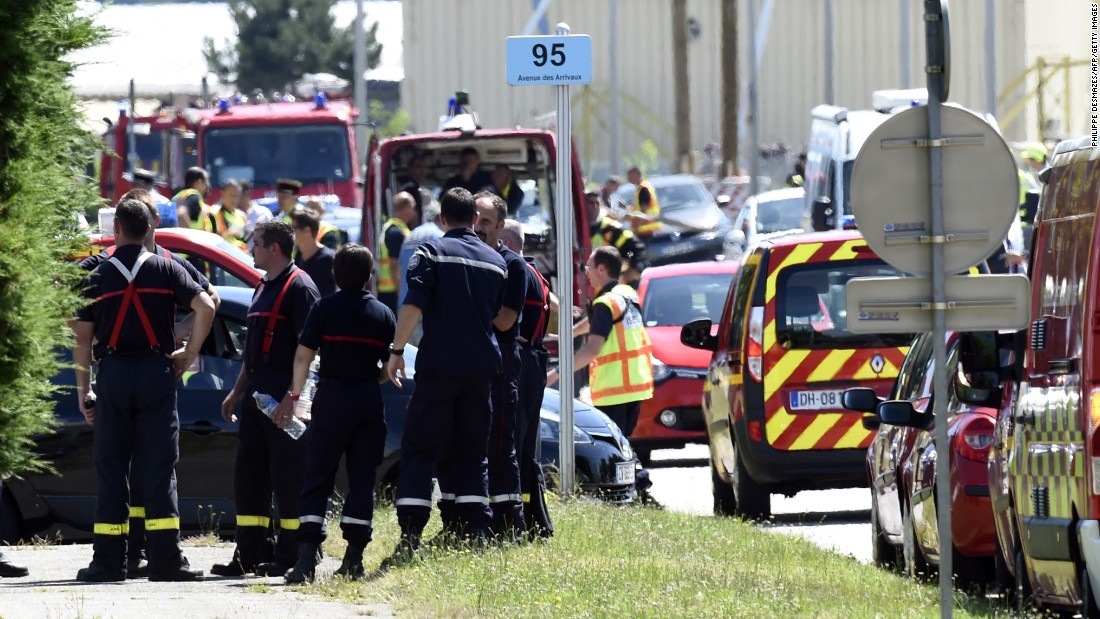
    A man was beheaded and several others injured on Friday in a suspected Islamist attack on a gas factory in Isere, in the Rhone-Alps region of France, which was declared a “terrorist” act by President Francois Hollande, media reports said.

    Several small explosive devices were also set off at the Air Products factory in Saint-Quentin-Fallavier, near the French city of Lyon, and the alleged attacker was said to have been carrying an Islamist flag, which was found nearby, Xinhua reported citing sources.

    One person who had no ID papers and has refused to speak to anti-terrorism police was arrested, officials said.

    Hollande, who was in Brussels for a European Council meeting, declared it a “terrorist” attack and was returning to Paris to head an emergency meeting of the security committee following the deadly attack.

    French Defence Minister Jean-Yves Le Drian confirmed that Hollande would meet the concerned ministers and top military and security chiefs at 3 p.m.

    “Unfortunately, a new terrorist attack occurred,” Le Drian was quoted as saying by local media.

    According to French newspaper Le Dauphine Libere, a man was seen driving back and forth in front of the target building earlier in the day.

    Prime Minister Manuel Valls has ordered tight security nationwide.

    According to earlier reports by The Local news portal, apart from the decapitated man, several others were also injured in the attack.

    In a statement, Paris Prosecutor Francois Molins, said a probe was ordered for murder and attempted murder in an organised group in relation to terrorism, and added that anti-terrorism police was investigating the attack.

    Alain Juppe, the mayor of Bordeaux, condemned the attack in a tweet.

    “The terrorist threat is at a maximum,” he said, adding that France “must make every effort to protect its citizens”.

  • David Headley writes his memoir in prison on 26/11 Mumbai attacks

    David Headley writes his memoir in prison on 26/11 Mumbai attacks

    WASHINGTON: Pakistani-American LeT terrorist David Headley, serving 35 years for his role in the 26/11 Mumbai attacks, has written a memoir in prison detailing how Lashkar’s “dedication” to the cause of the “liberation of Kashmir” inspired him to join the terror group.
     
    American public affairs TV programme Frontline was given access to a draft of the memoir Headley, 54, wrote in jail.
     
    Excerpts from the draft offer a “unique window” into Headley’s turn toward extremism, his training with Lashkar-e- Taiba and his preparations for the Denmark attack against the Jyllands-Posten newspaper.
     
    In one of the passages in the memoir, Headley writes about his first encounter with LeT militants in October 2000.
     
    “On one of my trips, October 2000, I made my first contact with Lashkar-e-Taiba (LeT), quite by accident. I attended their annual convection in November. I was very impressed with their dedication to the cause of the liberation of Kashmir from Indian occupation,” Headley writes.
     
    He writes that for the terror attack on Mumbai, the plan was to capture an Indian fishing vessel that would not raise alarm with the Indian Coast Guard as it transported the LeT terrorists to Mumbai’s shores.
     
    “The plan was to capture an Indian fishing vessel, which constantly strayed into Pakistani waters, and commandeer it all the way to Mumbai. The hope was that the Indian Coast Guard would not notice an Indian vessel. The boys would carry a GPS device which would guide them directly to the landing site, I had selected earlier,” he writes.
     
    Headley also writes in detail about his decision to join Lashkar “full time” following the 9/11 attacks, and says that by 2002 the group asked him to take “the Daura Aamma, the basic military training course offered by LeT.”
     
    In 2005, Lashkar asked him to change his name from Dawood Gilani to a “Christiansounding name” so that he could travel easily between the US, India and Pakistan and make it difficult for intelligence agencies to track his activities.
     
    “Finally, in June, my immediate superior, Sajid Mir, instructed me to return to the US, change my Muslim name to a Christian sounding name and get a new US passport under that name. He now informed me I would be going to India, since I looked nothing like a Pakistani in appearance and spoke fluent Hindi and Urdu it would give me a distinct advantage in India,” he said.
     
    Describing the training he got at Lashkar camps, Headley writes “we hid most of the day in caves and under trees, while we were given instructions on various lessons.”
     
    He says most of the “practical aspects” of the lessons were carried out at night and during the course, he was trained in “infiltration, survival, camouflage, raid/ambush tactics, hide out, hiding and retrieving weapons caches, more than a dozen night marches, target practice with AK-47 and 9 mm pistol, RPG, grenades, among other training.
  • Lahore hit by another blasts – 2 churches hit

    Lahore hit by another blasts – 2 churches hit

    TIP Bureau report: Pakistan Taliban’s Outfit called Jamatul Ahrar carried out two bomb blasts targeting two local churches in Lahore which have killed at least 10 people, local officials say. According to local media the death toll has already crossed 14.

    At least 50 people were reportedly hurt in the explosions at the Catholic church and Christ Church in the city’s Youhanabad area which is a Christian neighbourhood in the Pakistani city of Lahore.

    Violent protests erupted after the blasts, with large crowds already in the area to attend Sunday mass.

    Many experts suggest this is a new direction taken by the Pakistani Taliban to target other religions now in the country.

    Pakistan’s Christian community has often been targeted by militants.

    Witnesses say suicide bombers were responsible for the explosions but police have not confirmed this.

    The bombers are said to have detonated their explosives at the gates of the churches. 

  • Another BLASTS KILL 6 POLICEMEN IN PAKISTAN

    PESHAWAR (TIP): At least six soldiers were killed on February 10 in two separate roadside bomb blasts in Pakistan’s restive northwestern tribal region.

    Pakistan Taliban claimed responsibility for the attacks. The first remote-controlled improvised explosive device blast occurred in Mansehra district, killing two policemen this morning.

    A few hours later, second blast hit a police vehicle and claimed the lives of four cops in Urmagai area of central Kurram Agency bordering Afghanistan, officials said, adding that security forces cordoned off the area and launched a search operation.

    Tehreek-i-Taliban Pakistan, meanwhile in a statement, said that it has carried out both the attacks.

    Kurram is one of the most sensitive tribal areas as it borders three Afghan provinces. It is adjacent to North Waziristan region where security forces have launched an offensive againsgt the Taliban.

  • BLASTS KILL 6 POLICEMEN IN PAKISTAN

    BLASTS KILL 6 POLICEMEN IN PAKISTAN

    PESHAWAR (TIP): At least six soldiers were killed on February 3 in two separate roadside bomb blasts in Pakistan’s restive northwestern tribal region.


    Pakistan Taliban claimed responsibility for the attacks. The first remote-controlled improvised explosive device blast occurred in Mansehra district, killing two policemen this morning.


    A few hours later, second blast hit a police vehicle and claimed the lives of four cops in Urmagai area of central Kurram Agency bordering Afghanistan, officials said, adding that security forces cordoned off the area and launched a search operation.


    Tehreek-i-Taliban Pakistan, meanwhile in a statement, said that it has carried out both the attacks.


    Kurram is one of the most sensitive tribal areas as it borders three Afghan provinces. It is adjacent to North Waziristan region where security forces have launched an offensive againsgt the Taliban.

  • Moscow blasts US spy arrest as part of  ‘anti-Russian campaign’

    Moscow blasts US spy arrest as part of ‘anti-Russian campaign’

    MOSCOW (TIP): Moscow on Jnauary 28 blasted the United States over the arrest of an alleged Russian spy, condemning the move as a “provocation” that would further damage already tattered ties.


    “The US has decided to launch the latest stage of its anti-Russian campaign,” the foreign ministry said in a statement, accusing Washington of “stoking spy mania”.


    “We demand an end to this series of provocations by the US security services against representatives of Russia,” said the statement from ministry spokesman Alexander Lukashevich.


    Lukashevich lashed out at US authorities for providing “no evidence” to back up their claims that the arrested man, banker Evgeny Buryakov, 39, is a spy and demanded his immediate release.


    The top human rights official at the foreign ministry, Konstantin Dolgov, said that Russian consular representatives were trying to get access to the detainee and would “defend all his rights.” 


    “The hunt for Russian citizens by the American authorities is continuing,” Dolgov told TV channel Rossiya 24.


    “We are going to demand at a high level that the Americans halt actions that breach the rights of our citizens,” Dolgov said.


    Russia’s deputy foreign minister Sergei Ryabkov on Tuesday held a meeting with US ambassador to Moscow John Tefft to discuss “bilateral” issues, the ministry said.


    Buryakov — an employee at a Manhattan branch of a Russian state-run bank — was arrested by federal agents in New York on Monday and appeared in court over allegations he was trying to recruit sources and collect economic intelligence.


    US prosecutors said he was assisted in espionage by Russian spies Igor Sporyshev, 40, and Victor Podobnyy, 27, who had been attached to the Russian trade and UN missions in New York.


    Sporyshev and Podobnyy were protected by diplomatic immunity and have since left the United States, so have not been arrested. They are charged in absentia, officials said.


    Buryakov’s detention has rocked already deeply strained relations between Moscow and Washington, which are at their lowest ebb in years over the crisis in Ukraine and war in Syria. US Attorney General Eric Holder said America was committed “to combating attempts by covert agents to illegally gather intelligence and recruit spies within the United States.” 


    Manhattan federal prosecutor Preet Bharara said it showed that “more than two decades” after the Cold War, “Russian spies continue to seek to operate in our midst under cover of secrecy.”


    It is the first such case since 10 deep-cover agents including flame-haired Anna Chapman, were arrested in the New York area in 2010. They pleaded guilty and were part of a prisoner swap with Moscow.

  • Eight dead, more than 70 wounded in Nairobi blasts

    Eight dead, more than 70 wounded in Nairobi blasts

    NAIROBI (TIP): Eight people have been killed and over 70 wounded in two explosions in a busy market area in the Kenyan capital Nairobi, officials said on May 16.The National Disaster Operation Centre said the first blast occurred on a 14-seater matatu, or public minibus, and the second was inside Gikomba Market, situated to the east of Nairobi’s central business district.

    A spokesman at the Kenyatta National Hospital, Nairobi main hospital, said eight bodies had brought in and “more than 70” people admitted for treatment, many of them in a serious condition. “Many of the injured are bleeding profusely. We need a lot of blood,” the spokesman, Simon Ithae, told AFP. Kenyan media reports said bombs were thrown at the minibus and into a shop in the market. Images showed a red minibus with its windows blown out and the surrounding area strewn with debris.

    The attacks come amid a wave of bombings and attempted bombings in both Nairobi and the port city of Mombasa, and come days after several countries issued new warnings against travelling in Kenya. Yesterday and today, hundreds of British tourists were being evacuated from beach resorts near Mombasa because of the travel warnings.

    Earlier this month three people were killed and 86 wounded in twin bus blasts in Nairobi that were blamed on Islamic militant cells linked to Somalia’s al-Qaida-linked Shebab rebels. The previous day twin attacks left four dead in Mombasa. Kenya has been targeted by the Shebab since sending troops to war-torn Somalia in 2011. Kenyan soldiers are still posted in southern Somalia as part of an African Union force supporting the country’s fragile internationallybacked government.

    There was no immediate claim of responsibility for the latest attacks — although Kenyan authorities have been engaged in a major security crackdown on suspected Shebab supporters in Nairobi.The operation has focused on Nairobi’s main Somali district Eastleigh, and residents have accused police of indiscriminately arresting people of Somali origin. Gikomba Market is situated adjacent to Eastleigh.

  • TWIN BLASTS AT CHENNAI STATION; 1 DEAD

    TWIN BLASTS AT CHENNAI STATION; 1 DEAD

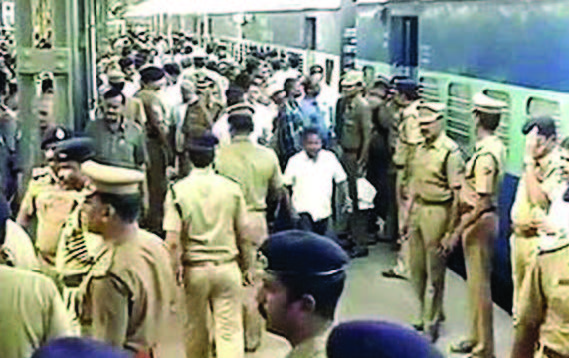
    CHENNAI (TIP): Two blasts in quick succession in a passenger train on May 1 killed a 24-year old woman techie and injured 14 others at the busy Chennai Central Station in a suspected terror attack. The two low-intensity bombs went off in S4 and S5 sleeper coaches of the Bangalore-Guwahati Superfast Express about 10 minutes after the train pulled into Platform No. 9 around 7.05 am, triggering chaotic scenes with panic strickenpassengers scurrying for safety.

    The woman killed in the mishap has been identified as Swathi, an employee with Tata Consultancy Services (TCS) at Bangalore. She was travelling to her home town Guntur in Andhra Pradesh along with a friend, the police said. Speaking to reporters at their residence in Guntur, Swathi’s parents were inconsolable and said their daughter was to get married in a couple of months.

    They later arrived here to collect Swathi’s body. Fourteen injured persons, including two critically wounded, were undergoing treatment at the state-run Rajiv Gandhi General Hospital where doctors described their condition as “out of danger”. The incident is among the rare terror attacks on trains in Tamil Nadu. Explosions had occurred in three trains in 1993 to mark Babri Masjid demolition day and in the RSS office here a few years later.

    However, major terror attacks in Tamil Nadu include a blast at Chennai airport in 1984 killing 33 persons and the 1998 Coimbatore blast that killed 60. The Tamil Nadu government is not treating today’s explosions as a terror attack as of now, according to sources in the Union Home Ministry.

    The police cordoned off the platform where the explosion occurred, rushed forensic experts, bomb disposal squads and sniffer dogs to look for clues and the Tamil Nadu Government transferred the investigation to its specialised wing CB-CID. The train was scheduled to reach Chennai at 5.40 am, but was running late. The ill-fated train continued its onward journey after railway authorities replaced the three damaged coaches, while other trains operated as scheduled after a brief disruption, railway officials said.

    The Chennai Central station handles some 200 trains and thousands of passengers every day. The police are probing all angles, including whether the bomb was planted after the train entered the city railway station or elsewhere, a police official refusing to be identified said. A man at the station said: “The blast was not very loud. It was only after we saw people running away from the train that we realised something is wrong.”

    He said rail coaches were not badly damaged, but the berth where the dead woman was seated bore the brunt of the explosion. Sheetal Pradhan, a passenger in one of the two coaches, told reporters that the first blast was like a Diwali bomb and was immediately followed by the second. She and her friend immediately came out on to the platform where the scene was chaotic.

    The Tamil Nadu Police have alerted railway authorities at various stations between Bangalore and Chennai to look for CCTV footages for suspects and also the point at which the explosive material was placed on the train, sources said. State DGP K Ramanujam, after visiting the mishap site, said, “It is a minor blast. We suspect Chennai could not have been target because the train was running late.

    Some other location could have been the target. It is premature to say what kind of device was used in the blast. The damage to the train is not heavy.” Railway Minister M Mallikarjun Kharge declared Rs 1 lakh ex-gratia to the woman’s family and Rs 25,000 to the seriously injured.

  • Bodh Gaya Blasts: Nia Zeroes In On Cylinder Factories

    Bodh Gaya Blasts: Nia Zeroes In On Cylinder Factories

    NEW DELHI (TIP): Investigators may be close to finding the source of the cylinders used in the Bodh Gaya blasts. National Investigation Agency (NIA) has come across certain factories in Bihar that manufacture such small cylinders that were used to make the 13 bombs planted in and around the Mahabodhi temple complex. The agency is now trying to trace from which factory the cylinders may have originated and which dealer may have sold it to the terrorists.

    Empty LPG cylinders of 2kg capacity were filled with a cocktail of ammonium nitrate, sulphur, potassium and shrapnel and then connected with a detonator, battery and Lotus brand clocks to make bombs that were used in the Bodh Gaya blasts. “There are some factories we have come across that make such cylinders. But further investigation is needed to reach the actual source,” said an NIA officer adding that a similar search for the clocks used in the blast was also on.

    Sources also insisted that the agency has got something significant out of the CCTV footages and forensic science help is being taken to sharpen them. “The footages are very bad but some suspicious activity before the blasts around the blast sites is visible,” another officer added. Interestingly, NIA investigators have learnt that Maoists have used cylinder bombs identical to those used in Bodh Gaya blasts in parts of Jharkhand. “Maoists often use such bombs, state police has told us.

    However, this does not mean that it’s a Naxal job. Anyone can copy anyone’s bomb. Just as Bodh Gaya bombs having similarity of circuit with 2008 Ahmedabad blasts does not mean that Indian Mujahideen executed the attack,” a senior NIA officer said. Sources said circumstances also pointed out that it was either not an IM operation or did not involve its Indian operations chief Ahmed Zarar Siddibappa alias Yasin Bhatkal — a highly-motivated jihadi and an expert bomb maker.

    “Had he been involved he would have gone for mass casualty and not bothered about just harming structures. He would have placed bombs more judiciously and timed them well. However, it is too early to rule anything out in this case,” the officer said. The NIA on July 10 released Vinod Mistri, whose voter ID card was found near the blast site, and Dashrath Yadav as nothing incriminating was found on the duo.

  • New Terror Module Behind Blasts

    New Terror Module Behind Blasts

    NEW DELHI (TIP): The terror module involved in the Bodh Gaya temple blasts in Bihar could be a new one as the unexploded IEDs do not have not signatures of bombs that were used in previous terror strikes across the country, sources in the National Investigation Agency said. The sources said a preliminary analysis of three unexploded IEDs recovered from the Mahabodhi temple do not match with the IEDs that have been so far used for terror strikes in the country.

    The NIA, which registered a case in connection the blasts, announced a reward of Rs 10 lakh for anybody providing information regarding the bombing suspects. Meanwhile, the state police said that four persons, including a woman, who were detained for questioning in connection with the blasts, were released as no evidence was found against them. “The four have been released after no evidence of their connection with the explosions was found during their questioning,” senior superintendent of police Manu Maharaj said told a news agency.

    In New Delhi, Union home minister Sushilkumar Shinde, who earlier visited the blast sites along with Congress president Sonia Gandhi, said initial investigation showed the bombs were placed during night and three or four people could be involved. “We are conducting complete investigations. Three-four people may be involved…with a car,” he said.

    Shinde said it seems small gas cylinders weighing two to three kg were used, and they contained nails and ball bearings. Asked about any involvement of Maoists, he said, “There are so many complex problems. Infiltration from other countries is there, Naxalites are there, local communal disturbances are there. We have to see all angles.” He also claimed that the Bihar government and police had been alerted about the possibility of a terror attack on the temple.

    “On July 3, Bihar Police DIG (deputy inspector general of police) had taken a security review on July 3 and spoken to the local security forces,” Shinde added. When asked about the banned terror outfit Indian Mujahidden’s tweet claiming responsibility for the bombings, Shinde refused to comment and said the NIA would look into it.

    Munde slams PM’s statement
    MUMBAI (TIP): Criticising Prime Minister Manmohan Singh over his statement about the Bodh Gaya serial blasts, senior BJP leader Gopinath Munde said India should have “zero tolerance” towards terrorism. “After every blast, PM Manmohan Singh says that the government will take strict action against terrorists, but he has completed nine years as PM and no such action has been seen from him,” Munde said here, while paying homage to victims of the July 11, 2006 Mumbai train blasts.

    Praising Gujarat Chief Minister Narendra Modi for good governance, he said, “During the past 12 years, Gujarat has not witnessed even a single terrorist incident of riot. Modi has taken appropriate decisions, which the Central government should also follow.”

  • Indian-Americans, Muslims condemn Boston blasts

    Indian-Americans, Muslims condemn Boston blasts

    WASHINGTON (TIP): Indian- Americans and the Muslim community in the US joined their shocked countrymen in condemning the Boston bomb blasts that killed three persons and injured about 140. “We hope that the perpetrators will be caught promptly, unlike after the Atlanta Olympics bombing, and punished to the fullest extent of the law,” said Indian American Dr Shaik Ubaid, who is co-chair of the New York chapter of the Muslim Peace Coalition. “Indian-American community strongly condemned the bomb blast in Boston today.

    Terrorism has no religion, race, or nationality. Standing against terror should unite us all. Whoever the culprit, no religion justifies this act of violence. We must remain united against extremism” the North American Punjabi Association (NAPA) said in a statement.

    The Muslim Public Affairs Council also issued a statement condemning the blast. “This is a horrible crime, and we call on all of us as Americans to work together to bring those responsible to justice,” it said. To attack people on what is supposed to be a day of jubilation is criminal and inexcusable, the council said. “This is a time for us to show resilience and calmness, as we come together to help the American public recover from this heinous act,” said Salam Al-Marayati, MPAC president.

    The Council on American-Islamic Relations (CAIR), the largest Muslim civil rights and advocacy organisation, also condemned the bomb attacks. “American Muslims, like Americans of all backgrounds, condemn in the strongest possible terms today’s cowardly bomb attack on participants and spectators of the Boston Marathon,” said its national executive director Nihad Awad. “We urge people of all faiths to pray for the victims and their loved ones and for the speedy recovery of those injured.

  • Sanjay Dutt gets 5 years  in jail in 1993 Mumbai  blasts case

    Sanjay Dutt gets 5 years in jail in 1993 Mumbai blasts case

    NEW DELHI (TIP): Bollywood actor Sanjay Dutt will have to undergo a jail term of more than three years after the Supreme Court on March 21 upheld his conviction in the 1993 Mumbai serial blasts case which it said was organised by underworld don Dawood Ibrahim and others with the involvement of Pakistan’s ISI. However, the apex court reduced to five years the six year jail term awarded to him by a designated TADA court in 2006, ruling out his release on probation because the “nature” of his offence was “serious”. 53-year-old Dutt, son of famous bollywood couple late Sunil Dutt and Nargis, has already spent one and half years in jail and was out on bail. Sunil Dutt was a long standing Congressman and was a union minister.

    Dutt was convicted by the TADA court for illegal possession a 9 mm Pistol and a AK-56 rifle which was part of the consignment of weapons and explosives brought to India for the coordinated serial blasts that killed 257 people and injured over 700. Bringing to a closure the appeals by the convicts and the state in the case, a bench of justices P Sathasivam and B S Chauhan upheld the death sentence of Yakub Abdul Razak Memon, brother of one of the absconding main conspirators Tiger Memon and life sentences of 16 of the 18 convicts.

    The death sentence of 10 others was commuted to life sentence by the court which directed that they will remain in prison till death. The life sentence of one Ashrafur Rehman Azimulla was reduced to 10 years while Imtiyaz Yunusmiya Ghavte was set free by reducing the sentence to jail term already undergone. “The circumstances and the nature of the offence is so serious that we are of the view that he (Sanjay Dutt) cannot take the benefit of provisions of the Probation of Offenders Act to release him on probation,” the bench said. “We reduce the punishment of six years to minimum of five years under the Arms Act,” the bench said and directed him to surrender within four weeks. The apex court concurred with the conclusion arrived at by the designated TADA court saying that it had adopted the “correct procedure” while awarding the sentence to Dutt. “We are in agreement with conclusion arrived at by the designated TADA court that had rejected the arguments of the appellant Sanjay Dutt,” the bench said. “We are of the view that the trial court adopted the correct procedure and the decision arrived at by it was correct,” it said and directed Dutt to surrender within four weeks from March 21.

    According to the CBI, RDX had come from Pakistan in boats and had landed in Dighy and Shekhadi coasts in Raigad district in January and February 1993. Besides, weapons had also landed and were collected by Tiger’s men. One of the weapons was given to actor Sanjay Dutt by bollywood film makers Samir Hingora and Hanif Kadawala. The apex court modified the nine year jail term awarded by TADA court to Hingora to the jail term already undergone. Hingora had supplied AK-56 rifles, magazines, cartridges and hand grenades, which were part of the illegal consignment to be used in the blasts, at Dutt’s Pali Hill residence and has spent six and half years in jail.

    Highlights of the SC decision
    YAKUB MEMON
    SC upholds death sentence of Yakub Abdul Razak Memon in the case
    ACTOR SANJAY DUTT
    SC upholds conviction of Sanjay Dutt under Arms Act in 1993 blasts case SC, however reduces Dutt’s six year jail term given by TADA court to five years
    OTHER CONVICTS
    SC commutes death sentence of 10 other convicts to life imprisonment SC commutes death sentence on the ground that the convicts were behind bars for 20 years and their economic condition was weak
    SC OBSERVATION
    Yakub Memon and all absconding accused (Dawood Ibrahim and others) were “archers” and rest of the accused were “arrows” in their hands: SC Training of convicts in Pakistan materialised in 1993 blasts, says SC

    The accused were trained in bomb making and to handle sophisticated weapons in Pakistan: SC

    SC says that Pakistan’s intelligence agency ISI was also involved in the 1993 blasts

    Police, customs and coastal guards are also to be blamed for 1993 blasts: SC

  • Hyderabad Twin Blasts: Cries And Chaos Rent The Air At Hospitals

    Hyderabad Twin Blasts: Cries And Chaos Rent The Air At Hospitals

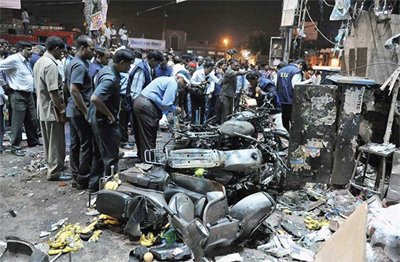
    HYDERABAD (TIP): A dazed childwith blood pouring down her foreheadand a 60-year-old man shrieking withpain summed up the scene in the cityhospitals as hundred of injured peoplepoured in with torn limbs, shrapnelwounds and blood-spattered bodiessoon after the twin blasts inDilsukhnagar on February 21 evening.In all, at least 70 people were rushedto various hospitals in the city afterthe blasts. With patients pouring intothe Emergencies all evening andworried relatives and friends movingfrom place to place in search of theirdear ones, the hospitals were a sceneof chaos.

    Eyewitnesses said that criesfor help echoed in the air and doctorsand nurses were constantly occupied.Most of the injured were taken toOsmania General Hospital wherearound 31 people are being treated forvarious burn injuries and multiplefractures. Around 10 bodies werereportedly brought to the mortuaryafter they were declared dead at OGHby 9.30pm.Among the patients at Osmania was37-year-old P Yadayya, resident ofSantosh Nagar and a real estate agentwho was returning home on Thursdayevening after collecting rent from histenants. He was in front of Venkatdritheatre in Dilsukhnagar when theexplosion occurred and left him withserious multiple fractures in both hislegs.His cousin, P Karunakar, a softwareengineer said it was very difficult tofind him in the hospital with all theconfusion.

    “I got a call from himasking me to come to Osmania but Icould not get into the building for agood 20 minutes. Moreover, he wasmoved around a lot from casualty, toemergency and then to another room,”he said.The confusion at Osmania led toaround eight cases being shifted toother private hospitals in the vicinity.Doctors at the hospital wereoverwhelmed with the sudden influxof patients and many injured peoplecomplained that they had to wait for along time to be attended. At YashodaHospital in Malakpet and very close tothe scene of the blasts the first batchof seven injured people were broughtin at 7.20pm. By 9pm, there were atotal of 16 patients of which 15 werecritical and four very critical withsevere burns and other shrapnelinjuries.

    The critical patients wereadmitted into the Acute Medical Careward.At least two patients were alreadyundergoing surgeries for abdominaland head injuries by 9.30pm. “Most ofthe patients have lost a lot of bloodand at least one patient is likely torequire amputation due to severedamage to a limb. Most patients willrequire surgery,” said a senior doctorat Yashoda.The burns ward of the hospital wasespecially chaotic with doctors andnurses running helter-skelter to tendto the ailing patients.One of the blast survivors at thehospital, 57 year-old L Vishwanathwho owns a mobile shop atDilsukhnagar said his shop wascompletely obliterated by theexplosion. “I only remember hearing ahuge sound and then everything wentblank. The entire shop caved in andwhen I came to my senses, I saw thatmy right leg was severely damaged,”he said.GHMC Commissioner KrishnaBabu, mayor Majid Hussain andcommissioner of police AnuragSharma visited the hospital andassured relatives of the injured peoplethat support will be provided.

    Two youths, Rajasekhar and Vijay, who areundergoing sub-inspector training, died on thespot. They were having snacks at the tiffin centre.This is the third time terrorists have madeDilsukhnagar their target. First, they planted ascooter bomb outside a famous Sai Baba Mandir, alittle away from Dilsukhnagar bus stop. Threeunexploded bombs were recovered in May 2008,during the serial blasts at Lumbini Park and GokulChat, killing 42.Though no outfit had claimed responsibility tillthe time of going to print, the police suspect thatthe blasts are the retaliation to the executions of2008 Mumbai attacks convict Qasab and the keyperson in the attack on Indian Parliament, AfzalGuru.Speaking to Mirror, a senior police official saidthey suspected the blasts to be the handiwork ofPakistan-based terror outfit Lashker-e-Toiba.