
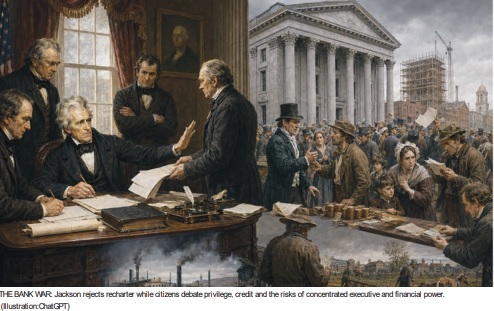

J ackson regarded the Second Bank of the United States as a dangerous concentration of financial privilege. The Bank was privately owned but federally chartered, held government deposits and helped regulate credit and currency. Its president, Nicholas Biddle, exercised substantial influence. Critics believed the institution favored wealthy eastern interests and foreign investors. In 1832, Henry Clay and Biddle sought early recharter, expecting Jackson’s veto to damage him politically. Jackson vetoed the bill and framed the issue as a contest between privileged monopoly and the people. Voters reelected him decisively. He then removed federal deposits and placed them in selected state banks, prompting charges that he had exceeded executive authority. Rapid credit expansion, land speculation, unstable banking, international conditions and Jackson’s Specie Circular-which required gold or silver for many federal land purchasescontributed to financial fragility. The Panic of 1837 erupted shortly after Van Buren took office, producing bank failures, unemployment and depression. The causes were multiple, but the Bank War shaped the unstable environment.
Jackson struck at concentrated financial power-and left the nation with weaker restraints upon speculative credit.



Be the first to comment