

VICTORY, TERRITORY AND A DEEPENING DIVIDE
“The United States won a continent-sized victory-and inherited a question that would help tear the Union apart.
A BORDER IN DISPUTE
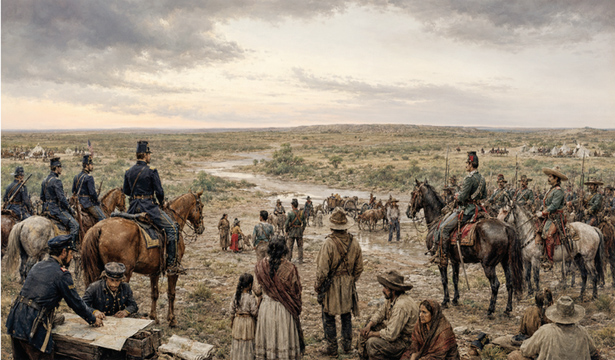
Texas entered the Union in December 1845 carrying an unresolved boundary claim. The Republic of Texas had asserted that its southern and western border followed the Rio Grande. Mexico maintained that Texas-whose independence it had never formally recognized-ended at the Nueces River. Between those rivers lay a broad, inhabited borderland whose sovereignty was contested rather than settled. President James K. Polk sought California and New Mexico as well as recognition of the Rio Grande boundary. His administration sent diplomat John Slidell to Mexico with authority to negotiate, but a government facing domestic upheaval refused to receive him. Polk then ordered General Zachary Taylor’s troops from Corpus Christi toward the Rio Grande. By March 1846, they had established a position opposite Matamoros, within the disputed zone.
THE THORNTON AFFAIR
On April 25, Mexican cavalry attacked a U.S. patrol commanded by Captain Seth Thornton. Sixteen Americans were killed, wounded or reported missing, and the remainder were captured. Polk told Congress that Mexico had “shed American blood upon the American soil.” Congress declared war on May 13. Yet whether the clash had occurred on American soil was precisely the unresolved question. “The first battle did not settle the border dispute. It became the argument used to settle it by war.”
POLK’S WAR AND THE ARGUMENT OVER POWER
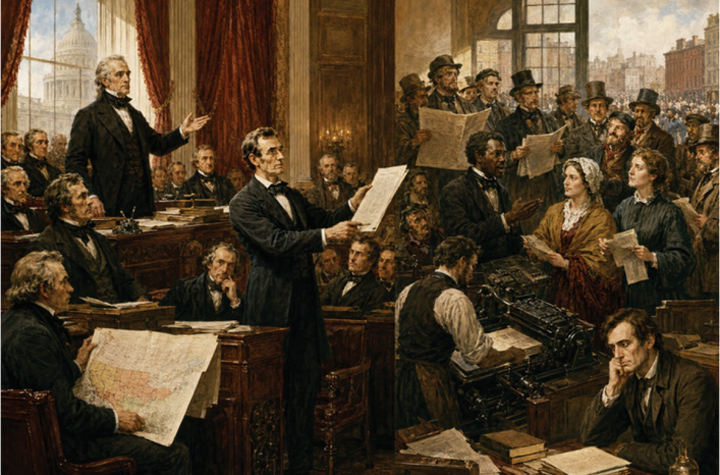
Polk presented the war as defensive: Mexico, he said, had crossed the boundary, rejected diplomacy and attacked American soldiers. Expansionists saw an opportunity to secure Texas, reach the Pacific and fulfill the nation’s continental ambition. Congress approved the war overwhelmingly, and thousands volunteered. Dissent nevertheless emerged immediately. Whigs questioned whether Polk had deliberately placed troops where conflict was likely. In 1847, freshman Congressman Abraham Lincoln introduced resolutions demanding the exact “spot” on which blood had been shed.
Henry David Thoreau’s refusal to pay a poll tax became associated with opposition to slavery and the war; his later essay on civil disobedience argued that conscience could require resistance to an unjust government. Abolitionists feared that conquest would become a program for expanding slave power. Frederick Douglass denounced the war’s aggression. Former president John Quincy Adams warned that territorial acquisition would intensify sectional crisis. Some soldiers and citizens opposed the conflict; others criticized it while still supporting troops in the field. Democratic government did not produce agreement-but it preserved a public record of moral resistance.
A WAR ON MANY FRONTS
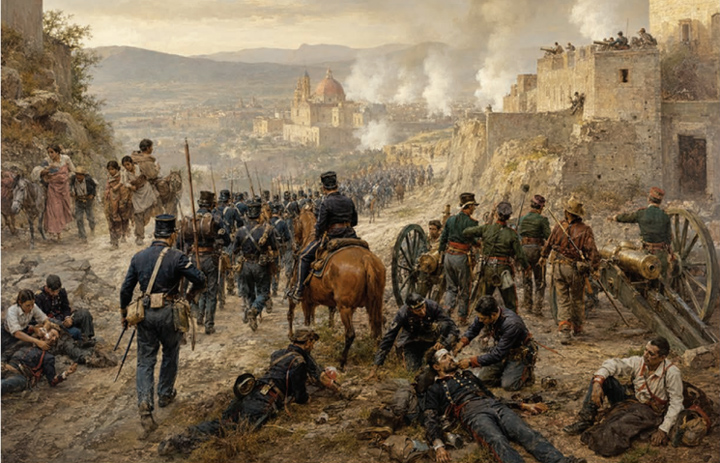
The conflict unfolded across an immense geography. Taylor won battles at Palo Alto and Resaca de la Palma, crossed the Rio Grande and took Monterrey. In February 1847, his outnumbered army defeated Santa Anna at Buena Vista. Colonel Stephen W. Kearny marched into New Mexico, where American occupation met both accommodation and resistance. In California, American settlers, naval forces and John C. Frémont’s expedition helped seize control amid the Bear Flag Revolt. The decisive campaign belonged to General Winfield Scott. His army carried out an amphibious landing near Veracruz, bombarded and captured the port, and marched inland along a route long associated with conquest. It won at Cerro Gordo, fought through the Valley of Mexico and entered Mexico City in September 1847. American forces benefited from stronger artillery, naval reach, logistics and a relatively stable government. Mexico fought while suffering political turnover, fiscal weakness, regional division and the legacy of earlier conflict. Those disadvantages did not erase resistance. Soldiers, civilians and local communities defended their country, while guerrilla warfare continued after conventional defeats.
SOLDIERS, CIVILIANS AND THE HUMAN COST
The war is often narrated through generals and captured capitals, but disease was its most efficient killer. Roughly 13,000 U.S. service members died; only a minority were killed in battle. Dysentery, yellow fever, measles and other illnesses swept crowded camps. Thousands more returned wounded or chronically ill. Mexican military and civilian losses are harder to calculate, but were severe.
THE SAN PATRICIO BATTALION
Hundreds of immigrant soldiers-many Irish Catholics-deserted the U.S. Army and fought for Mexico in the Batallón de San Patricio. Motives varied: religious sympathy, mistreatment, promised land or pay, and rejection of the invasion. Captured San Patricios were harshly punished; dozens were hanged. In Mexico they became symbols of solidarity, while their story complicates any simple account of national loyalty.
OCCUPATION
American armies requisitioned food, animals and shelter. Discipline sometimes restrained abuse, but looting, assault, retaliation and violence against civilians occurred. Mexican guerrilla attacks provoked reprisals. Veracruz endured bombardment; communities along marching routes bore hunger, destruction and fear. Mexican civilians were not scenery behind a military story-they were among its principal sufferers. The U.S. Army included recent immigrants, volunteers seeking adventure or advancement, enslavers, antislavery men and future political leaders. Junior officers such as Ulysses S. Grant and Robert E. Lee gained experience they would later use against one another in the Civil War. Grant eventually described the conflict as unjust, even while acknowledging that he
“War trains soldiers in command. It also trains nations in the consequences of power.”?
THE TREATY THAT REDREW A CONTINENT
With Mexico City occupied, peace commissioner Nicholas Trist negotiated despite instructions recalling him. The Treaty of Guadalupe Hidalgo was signed on February 2, 1848. Mexico recognized the Rio Grande as the Texas boundary and ceded Alta California and New Mexico-an enormous region that included all or part of the future states of California, Nevada, Utah, Arizona, New Mexico, Colorado and Wyoming.
The United States paid Mexico $15 million and assumed certain claims by American citizens. The treaty offered U.S. citizenship to many Mexican residents and promised respect for property. Yet the U.S. Senate removed an article guaranteeing recognition of Mexican and Spanish land grants and weakened another provision. Over time, expensive litigation, unfamiliar legal procedures, taxation, fraud and violence stripped many families of land even when formal promises appeared protective.
Indigenous nations were not parties to the treaty, although much of the transferred territory consisted of their homelands. A transaction between two states did not extinguish Native sovereignty or consent. American expansion would bring new forts, settlers, wars and coercive treaties into those lands.
“The boundary changed in ink. For millions of lives, the meaning of home changed with it.”
THE TERRITORY AND THE SLAVERY CRISIS
The acquisition was vast: the United States gained more than half a million square miles and secured continental reach to the Pacific. Yet victory immediately revived the question that expansion could not escape: would slavery enter the new territories?
THE WILMOT PROVISO
In August 1846, Pennsylvania Democrat David Wilmot proposed that slavery be prohibited in any territory acquired from Mexico. The proviso repeatedly passed the House but failed in the Senate. It never became law, but it rearranged political loyalties. Many northerners who were not abolitionists opposed the extension of slavery because they feared competition with enslaved labor or the political power of slaveholders. Southerners insisted that equal access to federal territories included the right to bring enslaved property.
COMPETING FORMULAS
Congress debated prohibition, extension of the Missouri Compromise line and “popular sovereignty,” under which territorial settlers would decide. California’s rapid population growth after the discovery of gold and its application as a free state sharpened the crisis. The Compromise of 1850 admitted California free, organized Utah and New Mexico without an immediate federal ban on slavery, settled Texas’s boundary and enacted a more coercive Fugitive Slave Act.
The compromise postponed disunion; it did not resolve the moral or constitutional conflict. Every proposed state, territorial government and federal law now raised the same question: was slavery a local institution to be contained, a national property right to be protected, or a violation of the nation’s professed ideals to be abolished?
“The war ended at the negotiating table. Its most dangerous argument entered Congress.”
VICTORY’S UNSETTLED MEANING
The Mexican-American War made the United States a Pacific and continental power. It opened ports, resources and migration routes that would reshape the economy. It elevated generals into national political figures: Zachary Taylor won the presidency in 1848, and Franklin Pierce would follow in 1852. It also intensified a confidence that national growth and military power were mutually reinforcing. For Mexico, defeat meant occupation, political trauma and the loss of roughly half the territory it had claimed. For Mexican residents north of the new border, citizenship arrived with insecurity.
For Indigenous nations, one expanding republic replaced another distant claimant and soon imposed greater pressure upon land and sovereignty. For Americans of conscience, the war became evidence that democratic institutions could serve conquest unless citizens challenged power. No single judgment can erase the courage of individual soldiers or the aspirations of settlers. But courage does not by itself establish justice, and victory does not retrospectively settle legitimacy. The durable question is how a republic uses superior power-and whether it remembers the people whose rights do not appear in the victor’s account.
“America’s territory grew dramatically. So did the distance between its sections-and between its power and its promise.”
Be the first to comment