
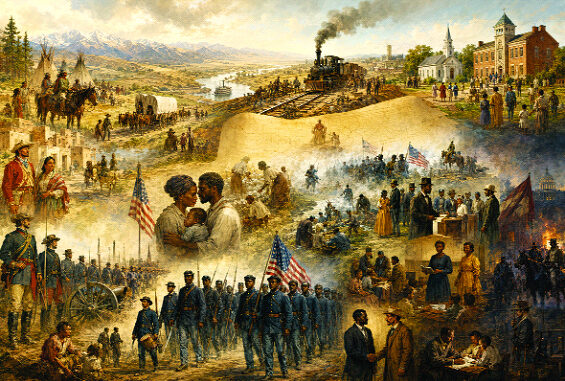

“Expansion made America larger. Division tested whether it could remain one nation. Reunion asked whether unity could be rebuilt upon freedom.”
America’s continental expansion opened land, markets and possibility while carrying conquest, Indigenous dispossession, Mexican displacement and slavery into new territories. Each acquisition enlarged the nation-and intensified the question it had postponed since its founding: could a republic proclaim liberty while holding human beings as property?
The Civil War became the new nation’s supreme test. The Union survived; slavery was destroyed; Black Americans claimed freedom and defended the Republic in uniform. Reconstruction then attempted something audacious: an interracial democracy grounded in birthright citizenship, equal protection, education and political participation.
That experiment was met by violence, judicial retreat and declining national will. Yet its constitutional achievements endured. This section is therefore a history of ambition and suffering, fracture and courage-a nation made larger by expansion, remade by war, and challenged to build reunion upon human dignity.
MANIFEST DESTINY
Continental Ambition and Its Human Cost
“Expansion promised land, opportunity and national greatness. It also carried conquest, dispossession and slavery westward.”
AN IDEA CALLED MANIFEST DESTINY
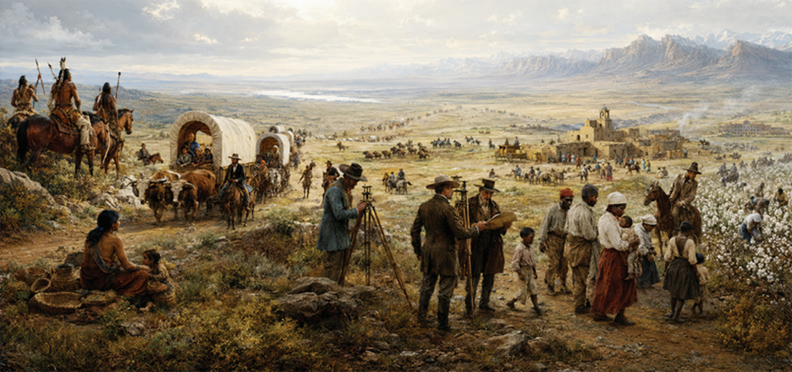
Americans had long imagined continental expansion, but in 1845 editor John L. O’Sullivan gave the ambition a memorable name: “manifest destiny.” He argued that the United States possessed a providential mission to spread across the continent. The phrase joined older beliefs in republican expansion, Protestant mission, economic development and racial hierarchy.
Supporters saw abundant land, Pacific trade, family farms and national greatness. Expansion offered genuine hope to migrants facing limited opportunity in the East or upheaval abroad. Roads, steamboats, newspapers and faster communication made distant territory seem reachable. Yet the ideology converted desire into destiny. It suggested that expansion was natural, divinely sanctioned and historically inevitable-thereby obscuring the choices, violence and existing rights involved.
Critics warned that expansion resembled empire and would spread slavery. Whigs such as Abraham Lincoln later challenged the justification for war with Mexico. Abolitionists condemned the political power of slaveholders. Indigenous and Mexican communities rejected the assumption that American settlement carried a superior right to their lands.
“Calling expansion destiny made political ambition sound like the judgment of history.”
TEXAS: SETTLEMENT, REVOLUTION AND ANNEXATION
After Mexico won independence from Spain, it encouraged immigration into sparsely populated Texas under conditions that included loyalty to Mexico and restrictions upon slavery. Thousands of migrants from the United States arrived, many bringing enslaved people. Conflict grew over immigration controls, slavery, federalism and the increasingly centralized government of Antonio López de Santa Anna.
Texas rebels declared independence in 1836. Mexican forces defeated defenders at the Alamo and executed prisoners after Goliad; Sam Houston’s army defeated Santa Anna at San Jacinto. The new Republic of Texas claimed a boundary at the Rio Grande that Mexico did not accept. Its government legalized and protected slavery.
WHY ANNEXATION WAITED
Many Americans supported Texas, but immediate annexation risked war with Mexico and intensified sectional conflict because Texas could enter as a large slaveholding state. President Andrew Jackson recognized the republic but stopped short of annexation. President John Tyler revived the effort, and James K. Polk won the 1844 election on an expansionist platform. Congress approved annexation by joint resolution, and Texas entered the Union in 1845.
Mexico regarded annexation as hostile, while the disputed boundary sharpened the path toward war. Annexation demonstrated how territorial growth, electoral politics and slavery had become inseparable.
“Texas enlarged the Union and brought the Union closer to war.”
OREGON: FAMILIES ON THE OVERLAND TRAILS
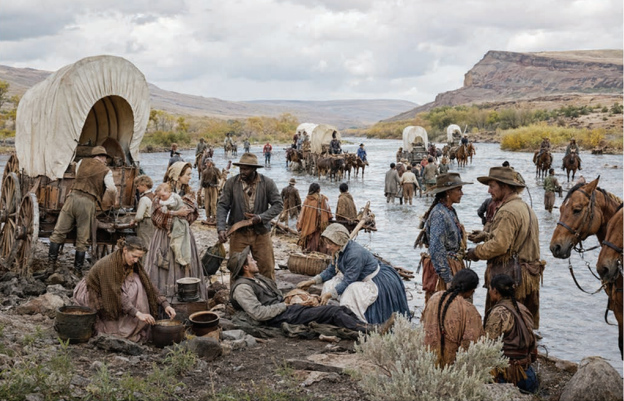
The Oregon Country was jointly occupied by Britain and the United States under an 1818 agreement, while Indigenous nations held and used the region. Missionaries, fur traders and settlers strengthened American claims. During the 1840s, wagon migration increased along routes later grouped under names such as the Oregon and California Trails.
The journey usually began along the Missouri frontier and followed river valleys, mountain passes and established Indigenous routes. Women’s labor was essential: cooking, washing, nursing, driving animals, maintaining family life and often completing the journey after death or illness removed male relatives. Disease-especially cholera-killed more emigrants than conflict with Native peoples. Accidents, river crossings, weather and exhaustion added danger.
Migrants depended upon Native knowledge and trade, but increasing traffic damaged grazing lands, depleted resources and spread disease. Settlements later imposed dispossession and racial exclusion. Oregon’s provisional and territorial laws sought to exclude Black residents, revealing that “free soil” could mean land without slavery while still denying Black equality.
“FIFTY-FOUR FORTY OR FIGHT”
Expansionists demanded all territory up to latitude 54°40?, but the United States and Britain compromised in 1846 at the forty-ninth parallel. The peaceful settlement contrasted with war in the Southwest and showed that Manifest Destiny could yield to diplomacy when the opposing power was Britain.
“The trail carried families toward new beginnings-and carried American sovereignty into other peoples’ homelands.”
LAND, LAW AND THE PEOPLE ALREADY THERE
Federal land policy surveyed territories into parcels and transferred them through sales, grants and later homestead legislation. The grid made land legible to government, investors and settlers. It did not make land empty. Indigenous nations possessed their own systems of territory, use, kinship and sovereignty that did not conform to American survey lines.
Treaties often followed military pressure, unequal bargaining or fraud. Removal policy had pushed eastern Native nations west of the Mississippi, only for later settlers to demand those lands as well. Forts, roads, mines and farms fragmented hunting grounds and sacred places. Epidemics and ecological change magnified disruption.
MEXICAN COMMUNITIES IN AN EXPANDING UNITED STATES
In Texas, New Mexico and California, Mexican and Indigenous communities possessed towns, ranches, irrigation systems, religious institutions and land grants long before American conquest. Expansion did not merely move a boundary over empty space; it placed established populations under a new government, language and legal order. Property rights promised on paper were often weakened by expensive litigation, taxes, fraud and violence.
ENVIRONMENTAL TRANSFORMATION
Expansion altered rivers, forests, grasslands and animal populations. Wagon traffic and livestock damaged trail corridors; mining polluted waterways; commercial hunting reduced wildlife; agriculture transformed ecosystems. The continent appeared vast, but its resources were never limitless.
“Survey lines could divide territory. They could not erase memory, sovereignty or human belonging.”
CALIFORNIA GOLD
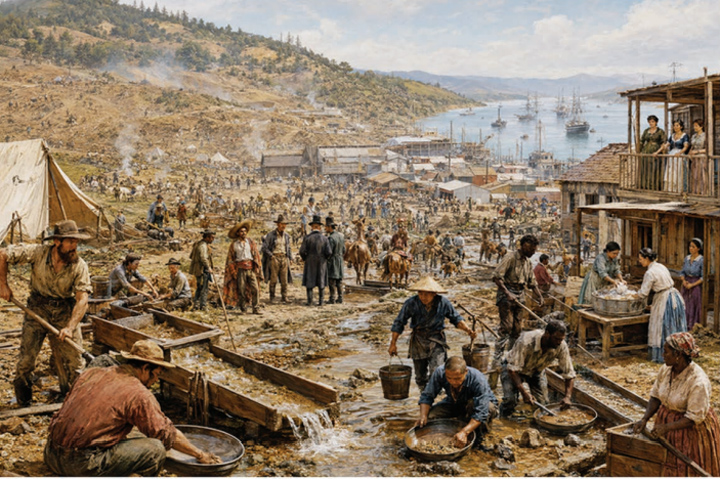
Gold discovered at Sutter’s Mill in January 1848 triggered one of history’s great migrations. News drew hundreds of thousands from the United States, Latin America, Europe, China, Australia and elsewhere. San Francisco expanded with astonishing speed. Merchants, transporters, boardinghouse operators, laundresses and suppliers often found more reliable profit than miners.
California became an international society. Mexican and Chilean miners brought expertise; Chinese migrants became an important presence; free Black entrepreneurs and miners pursued opportunity while confronting discrimination. Women were fewer in number but built businesses, managed households and supplied essential labor.
Opportunity existed beside violence. Foreign miners faced special taxes and expulsion. Chinese migrants encountered organized discrimination. Law was inconsistent and vigilante justice common. Indigenous Californians suffered catastrophic population decline through disease, displacement, starvation, state-supported violence, forced labor and kidnapping. Mining contaminated rivers and destroyed food systems.
“Gold created fortunes, cities and dreams. It also extracted wealth from land and people at a devastating price.”
THE SLAVERY QUESTION MOVES WEST
Every territorial acquisition reopened the question that compromise had postponed: would slavery expand? Slaveholders argued that they had a constitutional right to carry enslaved property into common territories. Many northern white opponents resisted expansion of slavery without supporting racial equality. Abolitionists insisted that bondage itself was morally intolerable.
FREE SOIL
The Free Soil movement opposed the extension of slavery into western territories, promoting “free soil, free speech, free labor, and free men.” Its coalition included antislavery Democrats, Conscience Whigs and former Liberty Party members. Some opposed slavery because it degraded labor and concentrated land; others held racist views and wanted western lands reserved for white settlers. Opposition to slavery’s expansion therefore did not automatically mean commitment to Black citizenship.
CALIFORNIA’S APPLICATION
Rapid growth led California to seek admission as a free state in 1849, upsetting the balance between free and slave states. Its application helped produce the Compromise of 1850, which temporarily resolved territorial questions while imposing a harsher Fugitive Slave Act. The West was no escape from sectional conflict; it became the arena in which conflict intensified.
“America moved west faster than it could resolve what freedom meant.”
THE PROMISE AND THE PRICE
Manifest Destiny helped build a continental nation. It encouraged migration, commerce, settlement and political confidence. It linked the Atlantic and Pacific and drew people from around the world into the American story. For many families, the West genuinely represented land, work and reinvention.
But opportunity was distributed through power. Indigenous nations paid through land loss, warfare and cultural disruption. Mexican communities confronted conquest and weakened property rights. Enslaved families were forced into new cotton territories. Free Black residents faced exclusion. Asian and Latin American migrants encountered discriminatory taxes and violence. The environment absorbed the costs of mining, transport and settlement.
“Expansion made the United States larger. The way it expanded determined what kind of nation it was becoming.”
The moral question is not whether Americans possessed ambition; nations and people always do. It is whether ambition recognized the humanity, sovereignty and rights of those standing in its path. Too often, destiny became the language through which power excused itself.



Be the first to comment