

In 1751, Captain Henry Ellis of an English slave-trading ship lowered a bucket with a built-in thermometer while sailing 25°N in the north Atlantic Ocean. In those times, water temperatures at different sites and depths were captured by seafarers sailing across the globe. The captain was startled by the findings. The deep water in the ocean was icy cold. “The cold increased regularly, in proportion to the depths, till it descended to 3,900 feet: from whence the mercury in the thermometer came up at 53 degrees (Fahrenheit); and tho’ I afterwards sunk it to the depth of 5,346 feet, that is a mile and 66 feet, it came up no lower,” he wrote in a letter.
This account, according to Stefan Rahmstorf of the Potsdam Institute for Climate Impact Research, was the first recorded temperature measurement of the deep ocean. The captain’s finding went on to become the basis on which scientists now understand workings of waters on Earth – deep waters are cold, and warmer waters are closer to the surface.
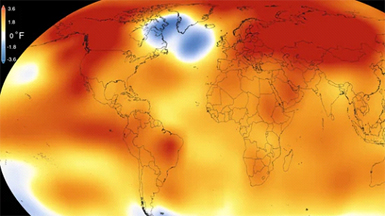
But just south of Greenland, in the northern Atlantic Ocean, is a large patch of water that has been cooling even as the rest of the ocean warms. On modern temperature maps, it shows up as a blue spot in brushes of red and orange that cover most of the world.
Known as the ‘cold blob’ or the ‘North Atlantic warming hole’, the patch that belies the global warming trend is located roughly 25°W–45°W, 50°N–60°N in the subpolar North Atlantic and has been cooling at a rate of 0.15 degrees Celsius per century from 1900 to 2014.
Nasa’s GISTEMP data confirms a long-term cooling trend from 1880 to 2025 in this region – and the reasons for it, research published last month, indicates it has much to do with an Atlantic Ocean current.
The cold blob was not discovered so much as gradually recognised.
The variance was present in temperature records captured by seafarers and datasets going back to the 19th century — visible, in retrospect, in the same Nasa GISTEMP data now used to map it. But, for decades, it was believed to be an anomaly, perhaps just ‘noise’ in the data. While the world saw temperatures increase by an average of 1°C over the past century, the patch had quietly cooled about 0.9°C.
The first modern study that took a systematic, long-period view was by Mihai Dima and Gerrit Lohmann in 2010. It analysed patterns of sea surface temperatures since 1870 and found that the blob may be linked to the Atlantic Meridional Overturning Circulation, or AMOC.
AMOC, a belt of water that influences weather across continents, had been weakening since the 1930s, the researchers flagged.



Be the first to comment