
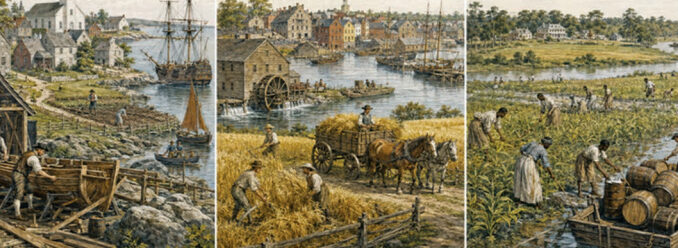

NEW ENGLAND
Rocky soil and a short growing season encouraged small farms, fishing, shipbuilding, lumbering and maritime trade. Compact towns gathered around meetinghouses. Congregational traditions shaped Massachusetts and Connecticut, though Rhode Island became an important refuge for religious dissent. Education and literacy received unusual emphasis because Protestants valued the ability to read Scripture.
THE MIDDLE COLONIES
Fertile lands made the region a major producer of wheat and other grains. New York and Philadelphia became important ports. Dutch, English, German, Swedish, Scots-Irish, Jewish, Quaker and other communities made the region notably diverse. Pennsylvania, founded by William Penn, promised representative government and a broad measure of religious toleration, though settlement still displaced Indigenous peoples.
THE SOUTHERN COLONIES
Tobacco dominated Virginia and Maryland; rice and indigo enriched South Carolina and parts of Georgia. Export agriculture generated fortunes and connected the region to Atlantic markets. It also drove territorial expansion and the growth of racial slavery. Enslaved Africans brought agricultural expertise-especially knowledge crucial to rice cultivation-and built communities, families, faiths and traditions under brutal constraint.



Be the first to comment