
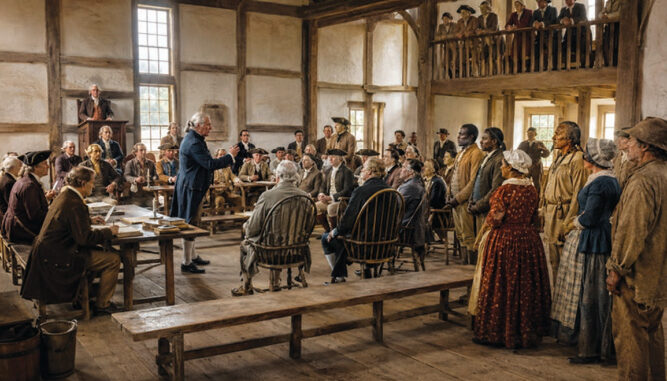

Distance from Britain required colonists to manage much of their daily public life. Royal governors represented imperial authority, but elected assemblies controlled local taxation and spending in many colonies. County courts, town meetings, juries and church bodies trained generations in argument, negotiation and administration. These practices nurtured an expectation that government should consult the governed. Colonial self-government was real but limited. Voting commonly depended upon property, religion, race, sex and local law. Women contributed decisively to farms, shops, households and communities but held no formal political equality. Enslaved people possessed no recognized political rights. Indigenous nations were treated as diplomatic powers when useful and obstacles when land was desired.
SLAVERY BECOMES A SYSTEM
During the seventeenth century, colonial laws increasingly transformed human bondage into hereditary racial slavery. By the eighteenth century slavery existed in every colony, although it was most extensive in the plantation South. Enslaved Africans and African Americans resisted through escape, revolt, negotiation, preservation of family and culture, and countless daily acts of endurance. The contradiction was already profound: colonists defended English liberties while denying liberty to others.
PRINT, EDUCATION AND A PUBLIC SPHERE
Newspapers, pamphlets, sermons, almanacs, taverns and coffeehouses carried news and argument. Colleges trained ministers and civic leaders. The 1735 acquittal of printer John Peter Zenger, charged with seditious libel in New York, became an influential symbol of resistance to official censorship, even though modern press freedom remained far away.
“The colonies learned to speak of rights before they learned to extend rights equally.”



Be the first to comment