

Madhya Pradesh occupies a unique place on India’s map and in its cultural imagination. Located at the geographical centre of the country, the state derives its name from its position, yet its true identity is far more layered. Popularly known as “The Heart of Incredible India,” Madhya Pradesh is a microcosm of the nation itself-where ancient history, sacred traditions, artistic brilliance, wildlife, cuisine, and modern life converge within a single landscape.
Surrounded by other Indian states on all sides, Madhya Pradesh lies largely across fertile plains and forested plateaus that form part of one of the oldest inhabited regions of the subcontinent. Much of this land was once known as Gondwana, the ancestral homeland of the Gond tribes, whose cultural legacy continues to shape the state’s rural and forest communities. Spiritually significant and historically rich, Madhya Pradesh is also one of the four sites of the Kumbh Mela, held every twelve years in the holy city of Ujjain.
The state’s vast cultural canvas includes everything from medieval temples and Buddhist monuments to royal palaces and colonial-era structures. Indore’s rare glass temple, Ujjain’s revered Mahakaleshwar Jyotirlinga, the sculpted marvels of Khajuraho, and the serene Sanchi Stupa near Bhopal collectively narrate India’s spiritual and architectural journey across centuries. Complementing this heritage is the state’s extraordinary natural wealth, with dense forests and wildlife reserves that rank among the finest in Asia.
Khajuraho: Stone Poetry of a Bygone Era
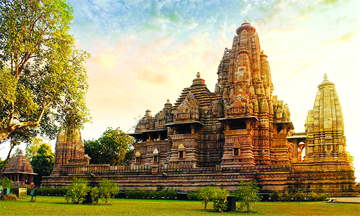
The temple town of Khajuraho, a UNESCO World Heritage Site, stands as one of India’s most extraordinary artistic achievements. Located in the Bundelkhand region, Khajuraho is renowned for its intricately carved Hindu and Jain temples built between 950 and 1050 AD under the Chandela dynasty. These temples depict not only religious devotion but also everyday life, music, dance, and human intimacy.
The famed erotic sculptures-often misunderstood-are deeply symbolic, reflecting ancient Indian philosophies that viewed desire as an integral part of existence and spiritual evolution. Once home to nearly 85 temples, the complex today preserves around 25, having survived centuries of invasions and natural decay. Yet what remains continues to astonish visitors with its boldness, symmetry, and artistic finesse.
Pachmarhi: The Quiet Charm of Satpuras
Tucked away in the Satpura range, Pachmarhi is the only hill station in Madhya Pradesh and its highest point. Known affectionately as “Satpura ki Rani,” the town sits at an altitude of about 1,067 metres and forms part of a UNESCO-recognised Biosphere Reserve. Dense forests, waterfalls, and ravines create a tranquil environment that contrasts sharply with the plains below.
According to legend, the Pandavas spent part of their exile here, leaving behind five sandstone caves that continue to attract pilgrims. Discovered in the 19th century by British officer Captain James Forsyth, Pachmarhi also retains colonial-era churches and bungalows, blending myth, nature, and history into a peaceful retreat.
Gwalior: Echoes of Royalty and Ragas
The city of Gwalior rises dramatically around its magnificent hilltop fort, one of the most formidable and visually striking forts in India. Founded by King Surajesan, Gwalior has long been associated with power, culture, and royal patronage. Its palaces and temples reflect centuries of architectural grandeur and strategic importance.
The opulent Jai Vilas Palace is among its most remarkable landmarks, famed for housing the world’s largest carpet and two massive chandeliers weighing nearly 3.5 tonnes each. Gwalior also holds a special place in India’s musical heritage as the birthplace of Tansen, one of the greatest exponents of Hindustani classical music. The annual Tansen Music Festival, held near his tomb, draws musicians and connoisseurs from across the country.
Bandhavgarh National Park: Realm of the Royal Tiger
Once the private hunting grounds of the Maharajas of Rewa, Bandhavgarh National Park is today one of India’s most celebrated tiger reserves. Known for having one of the highest densities of Bengal tigers, the park offers exceptional opportunities for wildlife sightings. In addition to tigers, it shelters over 22 species of mammals and nearly 250 species of birds.
The park derives its name from the ancient Bandhavgarh Fort, perched atop towering cliffs. Though now in ruins, the fort provides sweeping views of the surrounding forests. Jeep safaris remain the primary way to explore this rich and dynamic ecosystem.
Kanha National Park: Into
the Wild Heart of Central India
Sprawling across nearly 940 square kilometres, Kanha National Park is the largest national park in central India and ranks among the finest wildlife reserves in Asia. Established in 1955 and designated a Project Tiger Reserve in 1974, Kanha has been instrumental in wildlife conservation efforts, particularly in saving the rare Barasingha from extinction.
The park’s diverse landscapes-lush meadows, sal forests, and water bodies-are home to tigers, leopards, wild dogs, sloth bears, jackals, hyenas, deer, and a variety of reptiles. Immortalised through Rudyard Kipling’s The Jungle Book, Kanha continues to attract nature lovers, photographers, and wildlife enthusiasts from across the globe.


I’ll immediately grab your rss feed as I can not to find your email subscription hyperlink or newsletter service. Do you’ve any? Kindly permit me recognise in order that I could subscribe. Thanks.
Woh I enjoy your articles, saved to bookmarks! .
Thank you for some other informative web site. Where else could I am getting that kind of info written in such a perfect manner? I have a mission that I’m just now running on, and I have been at the look out for such info.
Some really nice and utilitarian info on this site, likewise I conceive the style and design has superb features.
I am curious to find out what blog platform you’re utilizing? I’m experiencing some small security issues with my latest website and I would like to find something more secure. Do you have any recommendations?
Olxtoto adalah agen terpercaya untuk situs toto dan bandar togel yang melayani pemain di Indonesia dengan komitmen tinggi terhadap kepuasan pelanggan.
Hi, I think your site might be having browser compatibility issues. When I look at your website in Safari, it looks fine but when opening in Internet Explorer, it has some overlapping. I just wanted to give you a quick heads up! Other then that, fantastic blog!
Having read this I thought it was very informative. I appreciate you taking the time and effort to put this article together. I once again find myself spending way to much time both reading and commenting. But so what, it was still worth it!
wonderful issues altogether, you simply received a emblem new reader. What may you suggest in regards to your submit that you simply made some days ago? Any positive?
I know this if off topic but I’m looking into starting my own blog and was wondering what all is required to get setup? I’m assuming having a blog like yours would cost a pretty penny? I’m not very internet smart so I’m not 100 positive. Any tips or advice would be greatly appreciated. Cheers
This design is spectacular! You obviously know how to keep a reader amused. Between your wit and your videos, I was almost moved to start my own blog (well, almost…HaHa!) Fantastic job. I really enjoyed what you had to say, and more than that, how you presented it. Too cool!
Only wanna comment on few general things, The website style is perfect, the articles is rattling good. “The way you treat yourself sets the standard for others.” by Sonya Friedman.
Wonderful work! This is the type of information that should be shared around the internet. Shame on Google for not positioning this post higher! Come on over and visit my website . Thanks =)
Hello there, I found your site via Google while searching for a related topic, your web site came up, it looks great. I’ve bookmarked it in my google bookmarks.
An interesting discussion is value comment. I believe that it is best to write more on this subject, it may not be a taboo subject however typically people are not sufficient to speak on such topics. To the next. Cheers
I conceive other website proprietors should take this web site as an model, very clean and excellent user genial layout.
Your house is valueble for me. Thanks!…
I keep listening to the news broadcast talk about getting free online grant applications so I have been looking around for the best site to get one. Could you advise me please, where could i find some?
Very good website you have here but I was curious if you knew of any community forums that cover the same topics talked about in this article? I’d really like to be a part of group where I can get feedback from other knowledgeable individuals that share the same interest. If you have any recommendations, please let me know. Kudos!
Great amazing issues here. I am very happy to peer your article. Thank you so much and i’m taking a look ahead to contact you. Will you kindly drop me a e-mail?
Real informative and fantastic anatomical structure of subject matter, now that’s user genial (:.
I like what you guys are up also. Such smart work and reporting! Keep up the excellent works guys I’ve incorporated you guys to my blogroll. I think it will improve the value of my website :)
Hello, Neat post. There’s a problem together with your site in internet explorer, would check thisK IE nonetheless is the marketplace leader and a big part of folks will pass over your magnificent writing because of this problem.
I was examining some of your articles on this site and I believe this site is very instructive! Keep on putting up.
I am always invstigating online for posts that can help me. Thanks!
My partner and I stumbled over here different website and thought I may as well check things out. I like what I see so now i’m following you. Look forward to exploring your web page repeatedly.
This blog is definitely rather handy since I’m at the moment creating an internet floral website – although I am only starting out therefore it’s really fairly small, nothing like this site. Can link to a few of the posts here as they are quite. Thanks much. Zoey Olsen
I know this if off topic but I’m looking into starting my own weblog and was curious what all is needed to get set up? I’m assuming having a blog like yours would cost a pretty penny? I’m not very web savvy so I’m not 100 sure. Any recommendations or advice would be greatly appreciated. Kudos
Would you be taken with exchanging links?
Great tremendous things here. I’m very happy to look your post. Thanks so much and i am taking a look ahead to touch you. Will you kindly drop me a e-mail?
There is apparently a bundle to identify about this. I think you made various nice points in features also.
I truly appreciate this post. I’ve been looking all over for this! Thank goodness I found it on Bing. You’ve made my day! Thx again
Awsome blog! I am loving it!! Will be back later to read some more. I am taking your feeds also.
I am impressed with this internet site, real I am a fan.
I am not very great with English but I line up this real easy to read .
Only wanna tell that this is invaluable, Thanks for taking your time to write this.
I truly enjoy reading through on this internet site, it has got excellent articles. “One should die proudly when it is no longer possible to live proudly.” by Friedrich Wilhelm Nietzsche.
You are my intake, I own few web logs and sometimes run out from to post : (.
Terrific work! This is the type of information that should be shared around the internet. Shame on the search engines for not positioning this post higher! Come on over and visit my website . Thanks =)
Excellent web site. Lots of useful info here. I’m sending it to a few friends ans also sharing in delicious. And of course, thank you to your effort!
Thank you for every other excellent post. The place else may just anybody get that type of information in such an ideal manner of writing? I’ve a presentation next week, and I’m on the search for such info.
I think other web-site proprietors should take this site as an model, very clean and wonderful user genial style and design, let alone the content. You’re an expert in this topic!
I like this post, enjoyed this one appreciate it for putting up. “When you make a world tolerable for yourself, you make a world tolerable for others.” by Anais Nin.
I’ve been surfing online greater than 3 hours today, but I never found any attention-grabbing article like yours. It is lovely worth enough for me. In my view, if all web owners and bloggers made excellent content as you probably did, the internet shall be a lot more helpful than ever before.
Hello there! Do you know if they make any plugins to assist with SEO? I’m trying to get my blog to rank for some targeted keywords but I’m not seeing very good gains. If you know of any please share. Thank you!