Tag: UN Ambassador Syed Akbaruddin

  • Permanent UNSC membership for India — mirage or achievable?

    Permanent UNSC membership for India — mirage or achievable?

    By Prabhu Dayal
    • PM Narendra Modi advocated India’s inclusion among the permanent members of the UNSC during the 75th session of the UN General Assembly
    • The only increase in the membership of the Security Council came in 1965, when the number of non-permanent members was increased from six to 10
    • Any reform to the Security Council would require an amendment to the UN Charter

    There have been expressions of support for India’s candidature from four out of the five permanent members–USA, UK, Russia and France. But what about China? Given the nature of Sino-Indian relations, it is not surprising that Beijing does not support India’s case. China’s close friendship with Pakistan is a compounding factor in this regard.

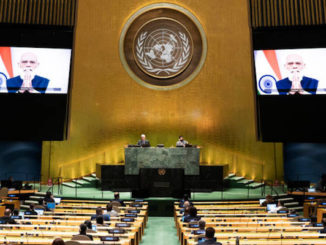
    On September 26, Prime Minister Narendra Modi delivered a virtual address during the General Debate of the 75th session of the UN General Assembly in which he made an impassioned and forceful plea for India’s candidature for permanent membership of the UN Security Council. His speech was brilliant, but when he had finished I was still asking myself this question: Is India’s quest heading anywhere, or is it just a pipe dream?

    The composition of the Security Council was established in 1945. The victors of the Second World War shaped the UN Charter in their national interests, giving to themselves the veto power in the Security Council. Since then the geopolitical realities have changed drastically, but the Council has changed very little. The Prime Minister did well to stress this when he said that the world of 1945 was significantly different from today’s world; the global situation, sources-resources, problems-solutions; all were quite different. Keeping this in mind, he urged that “Reform in the responses, in the processes, and in the very character of the UN is the need of the hour”.

    This was not the first time in recent months that PM Modi had urged the need for UN reforms. It would be recalled that while speaking at the high-level dialogue of the U.N.’s Economic and Social Council (ECOSOC) on July 17 this year, he had said that “Only reformed multilateralism with a reformed United Nations at its center can meet the aspirations of humanity.”

    PM Modi put forward several arguments that make India’s case for permanent membership appear quite strong. Highlighting India’s achievements and role in 75 years of the United Nations, he called for reforms with “changing times” and India’s inclusion in the decision-making process within the global body. He mentioned that India is the largest democracy of the world, with more than 18% of the world population; it had sent its soldiers for about 50 peacekeeping missions; it is also the country that has lost the maximum number of soldiers in the course of establishing peace; even during these very difficult times of the Covid 19 pandemic, the pharma industry of India has sent essential medicines to more than 150 countries. In this context, PM Modi assured that India’s vaccine production and delivery capacity will help all humanity in fighting the COVID-19 crisis.

    Thus, articulating the role being played by India for lending a helping hand to other nations, and putting forward cogent arguments for India to be given a permanent membership of the UN, he asked the General Assembly a very pointed question: “For how long will India be kept out of the decision-making structures of the United Nations?”

    It may be recalled that the only increase in the membership of the Security Council occurred in 1965 when the non-permanent membership was increased from six to 10 members, thus increasing the total strength from 11 to 15 members; fifty-five years have elapsed since then. Thus, PM Modi was right on target when he pointed out that the United Nations in its present form is out of date: “The international community today is faced with a very important question: Whether the character of the institution, constituted in the prevailing circumstances of 1945, is relevant even today”?

    However, the challenges which lie in India’s path should not be underestimated. Any reform of the Security Council would require an amendment to the UN Charter. In this regard, it is useful to remember that Article 108 of the UN Charter states:

    ‘Amendments to the present Charter shall come into force for all Members of the United Nations when they have been adopted by a vote of two thirds of the members of the General Assembly and ratified in accordance with their respective constitutional processes by two thirds of the Members of the United Nations, including all the permanent members of the Security Council’.

    Thus, any reform of the Security Council not only requires the support of at least two-thirds of UN member states, but also all the permanent members of the UN Security Council must also agree to this as they have veto powers. Assuming that India can get the support of two-thirds of the members of the General Assembly, the question which arises is simply this: Will all the Security Council’s permanent members give their nod for adding India as a permanent member?

    India’s quest has to be viewed in a broader perspective. The need for Security Council reform has been actively discussed among the UN member states for quite some time. By 1992, Japan and Germany had become the second and third-largest financial contributors to the United Nations , and they started to demand a permanent seat; so too did Brazil (the world’s fifth largest country in terms of territory) and India (the largest democracy and the second largest country in terms of population) which had emerged not only as the most important countries within their regional groups but also key players in the emerging global scenario. These four countries formed an interest group which came to be known as the G-4.

    On the other hand, their regional rivals opposed the idea of G4 countries becoming permanent members. Italy, Pakistan, Argentina and South Korea formed an interest group, known as the ‘Uniting for Consensus’ (also nicknamed the ‘Coffee Club’) which later grew to around 40 members. The Coffee Club members are opposed to increasing the number of the Security Council’s permanent members while wanting an increase in the non-permanent members category.

    Simultaneously, the African countries also started to demand two permanent seats for themselves, arguing that historical injustices had been done to them, and also that much of the Council’s agenda related to their continent. All these developments have further complicated the situation.

    On their part, the G-4 countries have shown flexibility on the veto issue in their bid to get the United Nations reform process moving. In a joint statement on their behalf delivered by India’s Permanent Representative to the UN Ambassador Syed Akbaruddin at an inter-governmental negotiations meeting in March 2017, the G4 nations– India, Brazil, Germany and Japan–stated that while the new permanent members would in principle have the same responsibilities and obligations as the current permanent members, they shall not exercise the veto until a decision on the matter has been taken during a review. Despite this flexibility, there has not been any progress in regard to the G4 demands.

    There have been expressions of support for India’s candidature from four out of the five permanent members–USA, UK, Russia and France. But what about China? Given the nature of Sino-Indian relations, it is not surprising that Beijing does not support India’s case. China’s close friendship with Pakistan is a compounding factor in this regard.

    There are many who believe that in actual fact, all the P-5 countries have reservations about adding any other country including India to their privileged group. The support extended to India by the US, UK, Russia and France has to be viewed against the background of their being fully aware that in any case, the process of Security Council reform is making no headway whatsoever. Many analysts think that they only render lip service by way of support to India in order to derive political mileage as they are fully aware of the Chinese position. In other words, whether their support is genuine is a matter of debate, for it is extended whilst knowing full well that the Chinese will oppose India anyway.

    Meanwhile, China, the world’s biggest dictatorship sits on the high table as a permanent member of the UN Security Council while India, the world’s largest democracy has to be content with getting a seat on that table from time to time as a non-permanent member. We can raise our voice against this injustice, as Prime Minister Modi has done. However, one cannot say when the winds of change will actually reach the UN Security Council, for diplomacy, like politics is only the art of the possible.

    Prime Minister Modi said in his address: “Today, people of India are concerned whether this reform-process will ever reach its logical conclusion”. He asked:” How long would a country have to wait particularly when the transformational changes happening in that country affect a large part of the world?” His words had a ring of anguish as well as disappointment.

    As I reflect on Prime Minister Modi’s address at the UN, I cannot help reminding myself of a verse from the Rubaiyat of Omar Khayyam:

    “Could thou and I with fate conspire,

    To grasp this sorry scheme of things entire,

    Would we not shatter it to bits–and then

    Remold it nearer to the heart’s desire.”

    (The author is a career diplomat. He can be reached at prabhu_dayal70@hotmail.com)

    (Courtesy OPOYI)


  • India Secures UNSC Non-Permanent Membership with Unanimous Support of Asia-Pacific Group

    India Secures UNSC Non-Permanent Membership with Unanimous Support of Asia-Pacific Group

    UNITED NATIONS (TIP): In an extremely significant diplomatic victory for India, the Asia-Pacific group of the world body, including Pakistan and China, unanimously endorsed India’s candidature for a non-permanent seat at the United Nations Security Council for a two-year term.

    “A unanimous step. Asia-Pacific Group UN unanimously endorses India’s candidature for a non-permanent seat of the security council for two-year term in 2021-22. Thanks to all 55 members for their support,” India’s Permanent Representative to the UN Ambassador Syed Akbaruddin tweeted on June 25.

    The Council is composed of 15 Members: Five permanent members: China, France, Russian Federation, the United Kingdom, and the United States, and ten non-permanent members elected for two-year terms by the General Assembly. Each year the 193-member UN General Assembly (UNGA) elects five non-permanent members for a two-year term.

    Previously, India has been elected as a non-permanent member of the Council for the years 1950–1951, 1967–1968, 1972–1973, 1977–1978, 1984–1985, 1991–1992 and most recently in 2011–2012.

  • Interview : 4th International Day of Yoga

    Interview : 4th International Day of Yoga

    The Fourth International Day of Yoga is just a few days away. Since June 21, 2015, when International Day of Yoga was first celebrated, IDY celebrations have multiplied, spreading over a couple of days. This year, with quite a few celebrations already scheduled, we will be seeing the celebrations starting as early as June 15 and going up to the end of the month. However, among all other celebrations, there are two which are official and more noteworthy. The one is organized by Permanent Mission of India at the United Nations, and, the other, by the Indian Consulate.

    The Indian Panorama Chief Editor Prof. Indrajit S Saluja spoke with Consul General of India in New York, Ambassador Sandeep Chakraborty, and Ambassador Syed Akbaruddin, Permanent representative of India to the United Nations to know from them how the historic event was planned this year.

    Here are excerpts from the interview with Ambassador Syed Akbaruddin.

     Prof: As I had requested, we want you to focus on the great event that is coming up. Congratulations to you, in the last 3 years it has become such a popular event having the whole world celebrate it at the UN. It does bring credit to you as India’s representative here and it does bring a lot of honor and respect for the country. This is the 4thone and every year the bar has been rising. So, this year the expectations are also very high. My readers would like to know what are the preparations for the event from 19 to 21stJune with regard to celebration of International Day of Yoga?

    Amb:Well the international day of Yoga as you know is perhaps the most significant effort that India has launched globally in promoting through soft power its culture and heritage. It’s an approach that started at the UN because we felt that the UN is the right platform to go global rather than do it in individual countries. We use the global platform to go global. As you said, every year the effort is to try and improve it and consolidate what we have done before. As in previous years we will have 2 events, one is the event of Yoga demonstration and another will be a conversation with the people who have benefitted from Yoga. So, there will be event on the 20thwhich will focus largely on the outside aspect of the UN where we expect more than a 1000 people to join us. They will be diplomats as well as some non- diplomats and we are working with various UN clubs as well as other organizations to get Yoga enthusiasts. And there are several Yoga masters who will also be participating in that with their supporters and those who are interested in joining in. In addition, the focus will be what we call Yoga for peace. Given today’s world where there is a lot of turbulence & violence in various parts of the world, the effort is that can Yoga contribute through its multifaceted approaches to a more peaceful world.  So, the outside event will be followed by an inside event on the 21stwhere we will have people who have benefitted from Yoga in various aspects for example, war veterans, disabled who have benefitted. Also, those who have served prison terms and how yoga has helped them reintegrate with world. So, we are trying to bring in different perspectives of people who have benefitted from yoga and how they have reintegrated with the society using Yoga as a pole along which they have constructed their lives.

    Prof: Well, very well said. But why are we so particular about spreading the message of Yoga?

    Amb: Well, Yoga is an ancient Indian heritage which has gone global because of its appeal in helping us tackle some of the most difficult issues that we have confronted. Because Yoga is not only an exercise; it is an approach to living in harmony with Nature. So, in today’s world where we have used and abused Nature in so many ways, living in harmony with Nature provides us a strong underpinning to reorient our lives. Look at the fear that we have in terms of a damage to the environment. Yoga is a philosophy of life which helps us in ensuring that man and environment are not in antagonism with each other. So, there are multifaceted benefits in terms of philosophical approach, in terms of controlling our emotions, in terms of living in harmony with Nature that Yoga helps us achieve and therefore the emphasis on promoting Yoga as a lifestyle approach in turbulent times.

    Prof: You mean that Yoga restores a balance in the health – Mental, Physical & Societal Health?

    Amb: It is one of the tools.

    Prof: And you want the world to know about this lifestyle?

    Amb:  It is a tool that helps human beings to confront the multifaceted issues that they face. .Like  various other tools are available. Meditation is a form; Anger management is one. So, there are multifaceted tools, and all must be used. In today’s world, every tool is useful in fostering harmony, fostering nonviolence, fostering peace, because we are in very turbulent times. We look around the world and we see around us a dissonance which many of us have not seen in our lifetimes. Change of such unprecedented nature is impacting on us and we need a pole that could help us stabilize in such turbulence.

    Prof:  Which means Yoga can be a very powerful business proposition also?

    Amb: Obviously, in today’s world anything to succeed, if it cannot manifest itself as a business proposition, it cannot succeed.

    Prof: Coming back to celebration of main event, is all set?

    Amb: Yes.

    Prof: Who all are coming this year?

    Amb: Dr. Nagendra from Bengaluru is coming. There will be an exhibition organized by Sehaj Yoga.

    Prof: What is your message to the readers of The Indian panorama?

    Amb: I want to invite readers of The Indian Panorama to come in large numbers to celebrate the historic day. I hope the message of Yoga is reflected from the global platform.

    Prof. How do participants get entry to the venue?

    Amb: They need to go to our website www.pminewyork.organd register.


  • UN To Create Counter-Terrorism Office; India’s Syed Akbaruddin Welcomes move

    UN To Create Counter-Terrorism Office; India’s Syed Akbaruddin Welcomes move

    India has welcomed an initiative by UN Secretary General Antonio Guterres to create a new office for counter-terrorism and stressed the nations should not allow “turf battles” to “hobble” the proposal.

    “Every day our collective conscience is being ravaged by terrorists in some part of the world or other. It is in this background of growing concerns, that we greatly appreciate the Secretary General’s initiative to promptly address the need to enhance coordination of the UN’s Counter-Terrorism efforts,”

    India’s Permanent Representative to the UN Ambassador Syed Akbaruddin said and appreciated SG’s initiative to promptly address the need to enhance coordination of the UN’s CT efforts.

    Akbaruddin quoted Bill Gates’s speech at the Munich Security Conference where the latter drew attention to how unprepared we were to a new kind of terrorism – bio-terrorism. According to Gates, epidemiologists say that a fast moving air borne pathogens could kill more that 30 million people in less than a year.

    Guterres mooted the proposal to move the Counter-Terrorism Implementation Task Force (CTITF) Office and the UN Counter-Terrorism Centre out of the Department of Political Affairs and create a new office for counter-terrorism.

    This office would be headed by a new Under-Secretary-General. The UN Chief said the only objective of the new body is to improve efficiency in combating terrorism and not to change the different mandates in the field of counter-terrorism.

    Akbaruddin said India welcomes the initiative and fully supports the proposal for creation of the Office of Counter-Terrorism, assuring all possible support in taking the proposal to its fruition. He however said that nations should not let differences impact the initiative and dent its credibility.

    “So, let us not allow turf battles to hobble this initiative, if we have to maintain its credibility,” he said during an informal meeting on strengthening of the capability of the UN system in implementing Global Counter-Terrorism Strategy here yesterday.

    “As terrorism thrives on and is sustained by its trans-boundary networks for ideology, recruitment, propaganda, funding, arms, training and sanctuary, no single nation alone can tackle this menace decisively. There is no stronger case for more multilateral action, more coordination and more cooperation on any matter amongst all stakeholders than on terrorism,” he said.

    Akbaruddin said India envisages the Under-Secretary General for Counter-Terrorism to be able to take positions and speak on behalf of “all of UN” and develop a comprehensive narrative on terrorism including on all issues relating to counter-terrorism. He added that there are differing mandates of various UN bodies and if the counter-terrorism coordinator is to have credibility, the individual needs to be seen as the UN’s voice on counter-terrorism issues.

    “Such differentiation of mandates is only known to those in this room or those who use this building as work space. It will never be comprehensible to the ordinary people at large,” the Indian envoy said.

  • The Diwali Stamp is a “shining tribute to the celebration of multi-culturalism”: Syed Akbaruddin

    The Diwali Stamp is a “shining tribute to the celebration of multi-culturalism”: Syed Akbaruddin

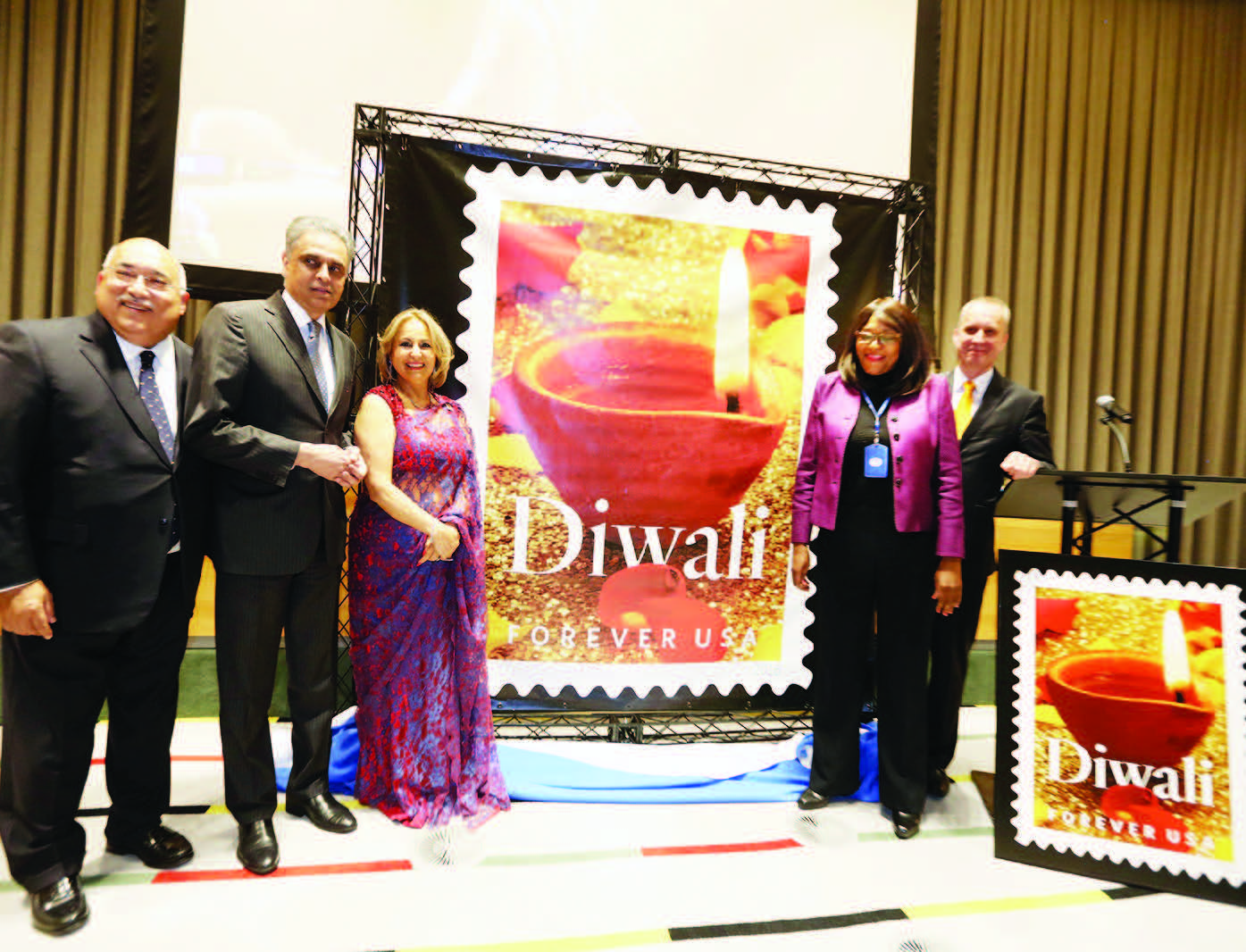
    UNITED NATIONS (TIP): Over 20 countries, including two UN Security Council permanent members- France and the UK– have supported a dedication ceremony hosted by India to commemorate the release of a Diwali postage stamp by the US.

    India’s Permanent Representative to the UN Syed Akbaruddin said at the event, December 5, that the Diwali Forever Stamp is a “shining tribute to the celebration of multi-culturalism”. Noting that Diwali was commemorated for the first time this year at the United Nations, Mr Akbaruddin said the celebration of Diwali at the world body is a reaffirmation of the foundational objectives of the UN Charter and its purposes and principles, which stand as a force for universal good.

    “Though celebrated by different communities for different reasons, the essence of the (Diwali) celebration is the triumph of good over evil, light over darkness. Philosophically, the fight is not only external but also within oneself,” he said.

    India's Permanent Representative to the United Nations, Ambassador Syed Akbaruddin said the celebration of Diwali at the world body is a reaffirmation of the foundational objectives of the UN Charter and its purposes and principles, which stand as a force for universal good.
    India’s Permanent Representative to the United Nations, Ambassador Syed Akbaruddin said the celebration of Diwali at the world body is a reaffirmation of the foundational objectives of the UN Charter and its purposes and principles, which stand as a force for universal good.

    The event lauded the efforts of Ranju Batra, Chair of the Diwali stamp project who spearheaded efforts for years to get the commemorative stamp issued, reaching out to the Indian-American community members and influential lawmakers, garnering support for the stamp.

    Ranju Batra, Chair of the Diwali stamp project who spearheaded efforts for 7 years to get the commemorative stamp issued said: "Today's celebration is not of a religion or of a nation but it is of the spirit of harmonious inclusiveness and cultural understanding that all religions deserve."
    Ranju Batra, Chair of the Diwali stamp project who spearheaded efforts for 7 years to get the commemorative stamp issued said: “Today’s celebration is not of a religion or of a nation but it is of the spirit of harmonious inclusiveness and cultural understanding that all religions deserve.”

    “The tens of thousands of paper petitions (for the Diwali stamp) were signed not only by Hindus, Sikhs, Jains and Buddhists but also by Christians, Jews, Muslims and every other faith and culture,” Ms Batra said, expressing gratitude for the support she got in her journey to get the stamp issued.

    Capping seven-year long efforts by the Indian-American community and influential US lawmakers, the US Postal Service (USPS) had issued the commemorative Diwali stamp to mark the festival of lights.

    Over 170,000 Diwali stamps have been sold, making history by becoming the number one best-selling stamp in USPS history.

    “Today’s celebration is not of a religion or of a nation but it is of the spirit of harmonious inclusiveness and cultural understanding that all religions deserve,” she said.

    Air India team led by its Regional Manager Vandana Sharma (4th from the right) with Diwali Stamp and Batras. Also seen are Regional Finance Manager Sangeeta Singh (5th from right), and District Manager Mohan Kothekar(extreme right). In a rare gesture of good will for the Diwali project, Air India promoted the sale of Stamp in a big way by gifting 10 return tickets to India for the raffle.
    Air India team led by its Regional Manager Vandana Sharma (4th from the right) with Diwali Stamp and Batras. Also seen are Regional Finance Manager Sangeeta Singh (5th from right), and District Manager Mohan Kothekar(extreme right). In a rare gesture of good will for the Diwali project, Air India promoted the sale of Stamp in a big way by gifting 10 return tickets to India for the raffle.

    Earlier, 20 nations had come together to support a special stamp dedication ceremony co-hosted by the Permanent Missions of India and Belarus.

    Eminent Indian-American attorney Ravi Batra said the event has being supported and celebrated by 23 nations, of which “12 are Christian, one Jewish, six Muslim… 23 nations spread across the world are celebrating not only the Diwali stamp but celebrating hope itself”.

    The 23 nations that supported the event include Armenia, Austria, Cyprus, France, Georgia, Honduras, Kuwait, Nepal, Sri Lanka, Tunisia, Ukraine, the UK and Vietnam.

    The Diwali Forever Stamp was formally launched by the USPS on October 5 at the Indian Consulate, New York in the presence of a large number of Indian Americans, some, like Shiv Dass from New York and Sante Chary from Dallas, TX who had initiated efforts long ago to have the Diwali stamp issued. Another person who made an effort at getting the Diwali stamp issued but failed for lack of political support for the project, the Indiaspora founder MR Rangaswami flew in from California to see his one time dream being realized, albeit by someone else.

    Congresswoman Carolyn Maloney who played a pivotal role in having the stamp issued, as also Congresswoman Grace Meng who had co-sponsored the House Resolution with Carolyn Maloney were present. Ravi and Ranju Batra praised Congresswoman profusely for her support. It was said again and again that Diwali stamp could not have been issued without the strong political support provided by lawmakers, led by Carolyn Maloney.

    Congresswoman Carolyn Maloney’s absence from the UN event was rather intriguing. More intriguing was absence of any reference to her contribution in getting the Diwali Stamp issued. Reminds me of Shakespeare.

    “But ’tis a common proof

    That lowliness is young ambition’s ladder,

    Whereto the climber upward turns his face.

    But when he once attains the upmost round,

     He then unto the ladder turns his back,

    Looks in the clouds, scorning the base degrees

    By which he did ascend.”

    (Julius Caesar Act 2, Scene 1)

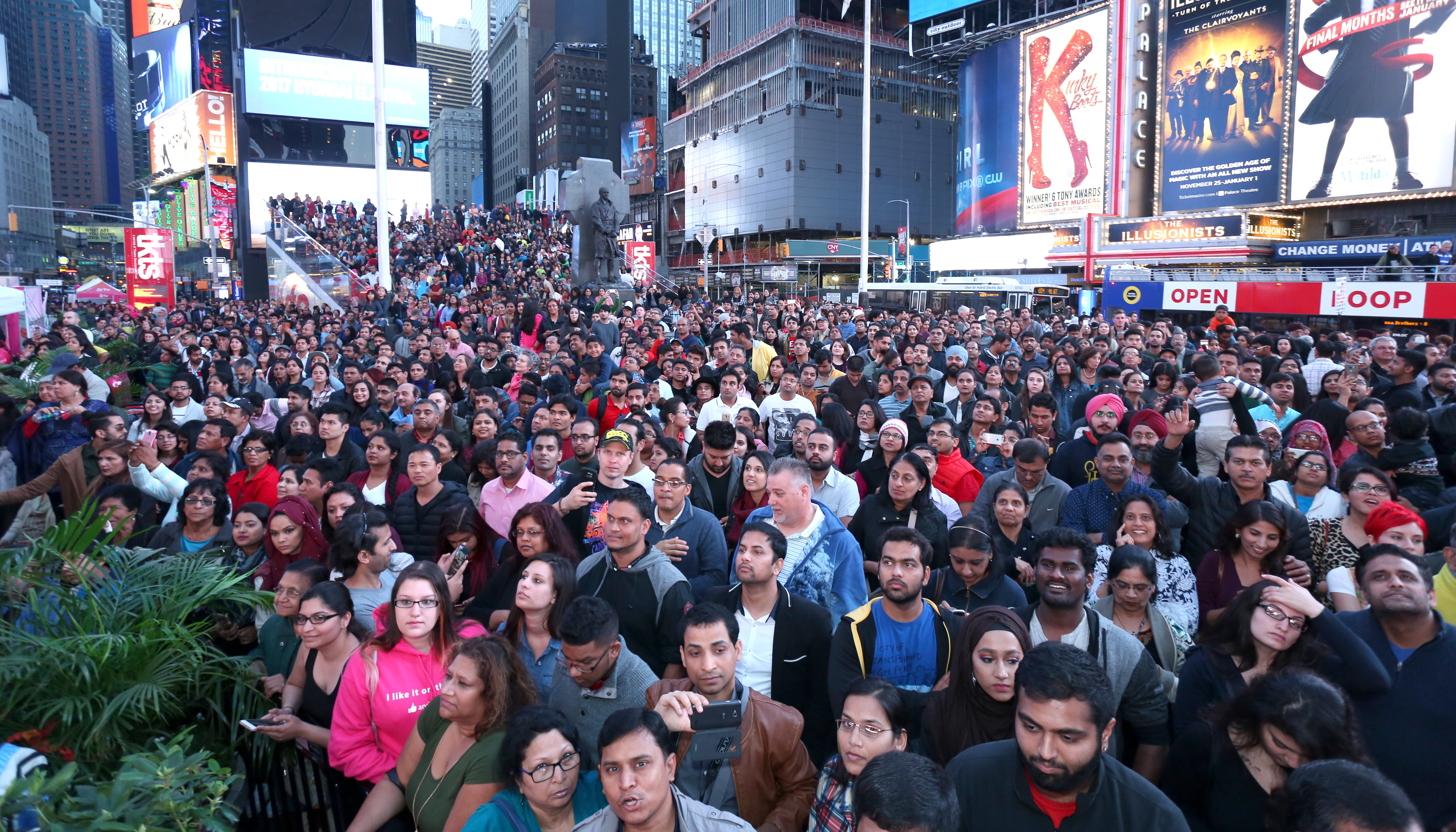
    A view of the gathering of the world at the UN
    A view of the gathering of the world at the UN
  • For the first time, 71 year old United Nations celebrates Diwali

    For the first time, 71 year old United Nations celebrates Diwali

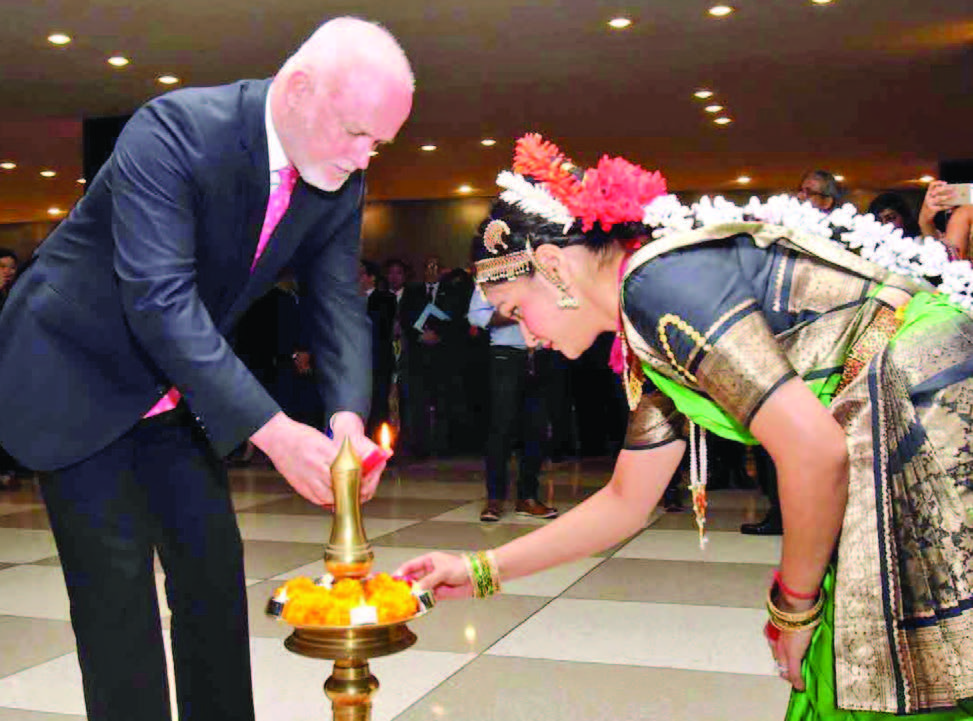
    UNITED NATIONS (TIP): Diwali was commemorated for the first time at the United Nations from October 29-31. The UN Secretariat building was lit up especially on the Indian festival of lights. UN General Assembly President Peter Thomson lit the traditional lamp at a ceremony on Oct 31 to celebrate Diwali at the UN Secretariat. The Diwali celebrations included Indian dance and music performances.

    The facade of the UN headquarters was lit in bright hues and the words ‘Happy Diwali’, along with the image of a traditional ‘diya’, projected onto the building. It was for the first time that the Indian festival of lights is celebrated at the world body after the UN General Assembly adopted a resolution in December 2014 that acknowledged the “significance of Diwali”.

    “Lighting up. @UN lights up for #Diwali for 1st time,” India’s Ambassador to the UN Syed Akbaruddin tweeted. “Happy Diwali! @UN celebrates Diwali for 1st time. Thank you @UN_PGA for this initiative,” Akbaruddin said in another tweet, thanking General Assembly President Peter Thomson for the initiative.

  • THOUSANDS JUBILATE AT DIWALI AT TIMES SQUARE

    THOUSANDS JUBILATE AT DIWALI AT TIMES SQUARE

    NEW YORK CITY (TIP): Diwali at Times Square 2016 is over but the memory of it will last a lifetime for many. Creating history third time in a row, it was a celebration unlike any other. It showcased the rich and diverse elegance of the Indian culture with credibility, creativity and celebrity. It honored the tradition of this happy holiday, which symbolizes the victory of light over darkness, knowledge over ignorance, good over evil, and hope over despair.

    Diya Lighting Ceremony. (Left to Right): Mr. Chuck Schumer, Mr. Ravi Batra, Mrs. Neeta Bhasin, Ms. Carolyn B. Maloney, Mrs. Brijbala Suri, Mrs. Ranju Batra, Mr. Syed Akbaruddin, Mrs. Reva Ganguly Das, Mr. Hardeep Singh Puri, Mr. Sudeep Parikh and Mr. Harish Bhasin
    Diya Lighting Ceremony. (Left to Right): Mr. Chuck Schumer, Mr. Ravi Batra, Mrs. Neeta Bhasin, Ms. Carolyn B. Maloney, Mrs. Brijbala Suri, Mrs. Ranju Batra, Mr. Syed Akbaruddin, Mrs. Reva Ganguly Das, Mr. Hardeep Singh Puri, Mr. Sudeep Parikh and Mr. Harish Bhasin

    The event had performances by young artists, differently abled kids, well-known celebrities, regional cultural dance performances from various states of India, a spectacular digital Diya lighting on one of the biggest Times Square screens followed by a special message from the Indian prime minister Mr. Narendra Modi and the launch of the U. S. Postal Service commemorative Diwali Stamp.

    Dignitaries from India and US, Senator Chuck Schumer, US Congresswoman Carolyn B. Maloney, Indian Ambassador to the UN Syed Akbaruddin, Consul General Ambassador Riva Ganguly Das and former Indian representative to the UN, Hardeep Singh Puri, graced the event with their presence and conveyed their Diwali greetings.

    International voice sensation Arjun rocked the stage. Television celebrities Kumkum Bhagya fame Shabir who plays Abhi and Sriti who plays Pragya greeted fans. Saregamapa 2016 winner Kushal Paul and soulful singer Jyotica Tangri mesmerized the gathering with their music, So You Think You Can Dance fame Kanchi Shah and Dance India Dance fame Siddhesh Pai gave all their energy to the stage, and heartthrob Karan Tacker stole the affections of many.

    Morning Diya Lighting Ceremony. (Left to Right): Veda Murthy Sarvothaman, Stephanie Judal from WU, Michele Rinn from Prudential, Sharmila Fowler from McDonalds, Elizabeth Riemersma, Dimple Malhotra from Sling Int, Neeta Bhasin, CEO Event Guru, Mrs. Brijbala Suri, Gajendra Suri, Esha Raja, Akhilesh from &TV, Vandana Sharma, Maharaja, John Massey from AirIndia.
    Morning Diya Lighting Ceremony. (Left to Right): Veda Murthy Sarvothaman, Stephanie Judal from WU, Michele Rinn from Prudential, Sharmila Fowler from McDonalds, Elizabeth Riemersma, Dimple Malhotra from Sling Int, Neeta Bhasin, CEO Event Guru, Mrs. Brijbala Suri, Gajendra Suri, Esha Raja, Akhilesh from &TV, Vandana Sharma, Maharaja, John Massey from AirIndia.

    People from many ethnicities were seen shaking their legs to Indian Bhangra tunes. Selected audience members even enjoyed the opportunity to dance on stage with their favorite celebrities, but the stand out act came from Sparsh Shah, a young singing sensation who performed “Jai Ho” to everyone’s delight. The event, hosted by the handsome Karan Tacker and local host Monty, showcased the rich traditions of the Indian culture. It was showered with love and blessings from across the world.

    The Indian Prime Minister Mr. Narendra Modi's message for Diwali at Times Square Oct 16, 2016.
    The Indian Prime Minister Mr. Narendra Modi’s message for Diwali at Times Square Oct 16, 2016.

    Event Guru’s CEO, Mrs. Neeta Bhasin, said, “Diwali at Times Square is not just a grand celebration of the festival of lights but also a beautiful display of our community and its roots. Our main focus this year was to give a platform to young Indian talent, both from India and US, as they represent our future and will carry forward our culture for years to come.”

    New York’s largest South Asian ethnic event, Diwali at Times Square 2016, was presented by &TV and was powered by Air India and Sling International.

    For more info, log on to www.diwalitimessquare.com  www.facebook.com/DiwaliTimesSquare or call 212-216-9305

  • International Day of Non-Violence celebrated at the UN

    International Day of Non-Violence celebrated at the UN

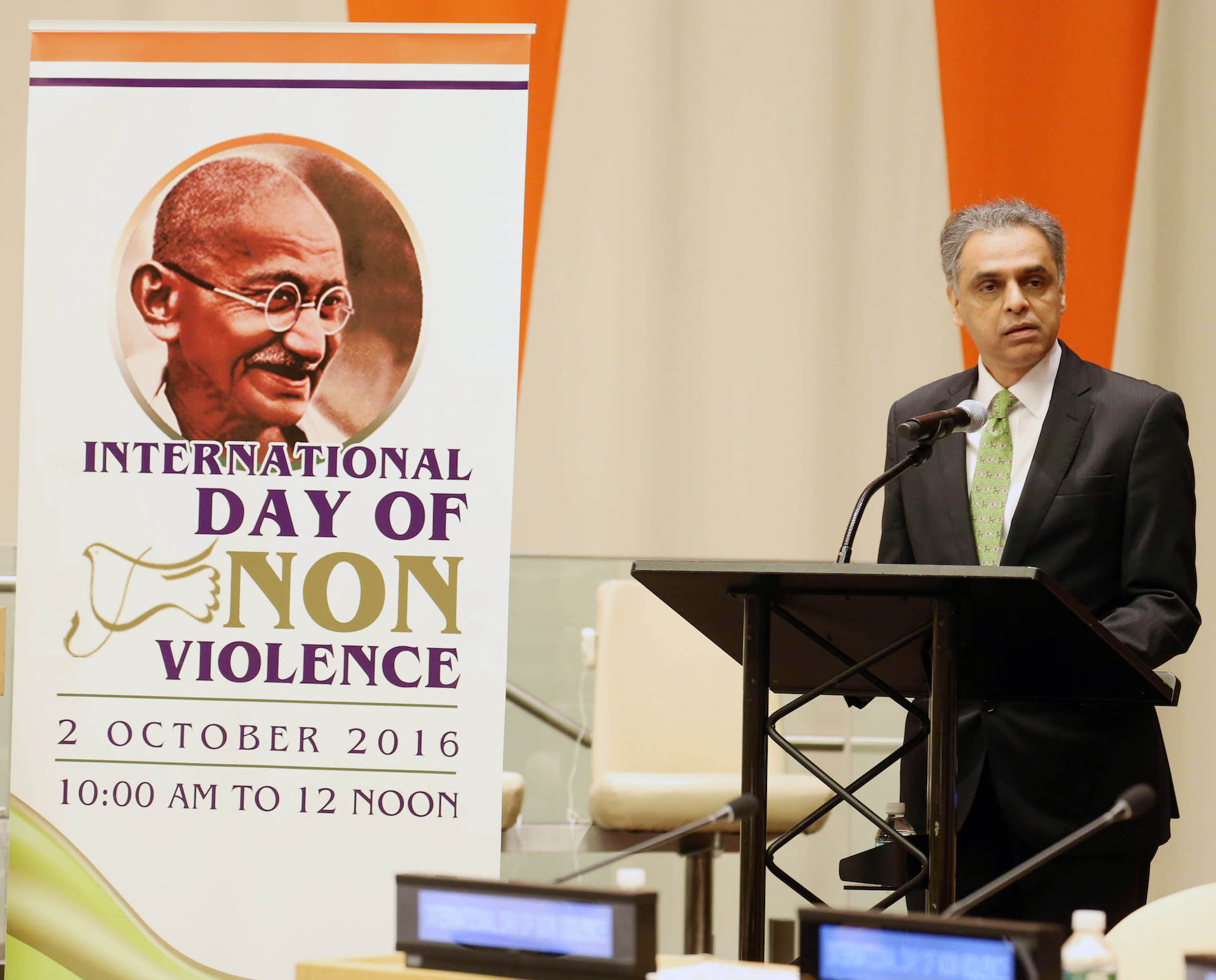
    UNITED NATIONS (TIP): The birth anniversary of Mahatma Gandhi and Non-Violence Day was observed, October 2, with a program that included, besides India’s ratification of the Paris Agreement, performance by renowned classical music singer Sudha Raghunathan as well as the unveiling of a commemorative UN postage stamp of Indian music legend M.S. Subbulakshmi.

    Sudha Raghunathan, India’s leading Carnatic Music singer performing on the occasion Photo / Mohammed Jaffer-Snapsindia
    Sudha Raghunathan, India’s leading Carnatic Music singer performing on the occasion

    Photo / Mohammed Jaffer-Snapsindia

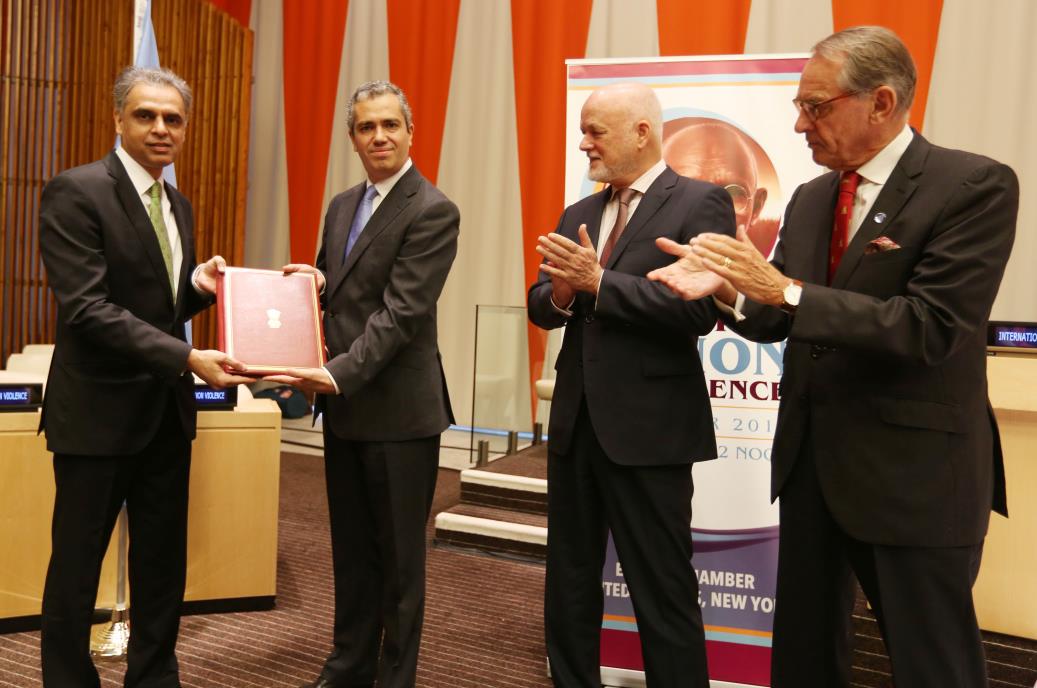
    India deposited its Instrument of Ratification to the Paris Agreement under the convention on Climate Change today, coinciding with the International Day of Non Violence. The day also commemorates the Birth Anniversary of Mahatma Gandhi who epitomized a lifestyle with the smallest carbon footprint. With this India became the 62nd country to ratify the Agreement taking the cumulative emission of the countries that have ratified the Agreement so far to 51.89 percent.

    This significant contribution towards the early entry into force of the Paris Agreement underlines Prime Minister Narendra Modi’s commitment to global cause of environmental protection and climate justice and reaffirms India’s responsive leadership in addressing the impact of climate change.

    The speakers included UN Deputy Secretary-General Jan Eliasson, General Assembly President Peter Thomson, and Professor Barry L. Gan, India’s Ambassador to the UN Syed Akbraruddin, Director of Center of Non-Violence, St. Bonaventure University, New York.

    The event was followed by a Carnatic Music concert by Sudha Raghunathan. The MC of the event was Manjunath Chennerrappa Head of Chancery of the Permanent Mission of India to the UN.

    UN Secretary General Ban Ki-moon stressed the link between non-violence, peace and nature as he observed the International Day of Non Violence. “Every year on the International Day of Non-Violence, we re-commit ourselves to the cause of peace, as exemplified by the life of Mahatma Gandhi who was born on this day 147 years ago,” Ban said. The UN General Assembly, through a resolution in 2007, designated 2 October as the International Day of Non-Violence to coincide with the birthday of Gandhi, who led the country’s independence movement and pioneered the philosophy and strategy of non-violence.

    UN Postal Administration unveiled the commemorative stamp of M.S. Subbulakshmi, Indian music legend on the 50th anniversary of her performance at the UN in 1966, during an event on the International Day of Non-Violence at the UN Headquarters on 2nd October 2016. The first copy is presented to musician Sudha Raghunathan (extreme left). Ambassador Akbaruddin is seen extreme right.                                                                                                       UN Photo/Evan Schneider
    UN Postal Administration unveiled the commemorative stamp of M.S. Subbulakshmi, Indian music legend on the 50th anniversary of her performance at the UN in 1966, during an event on the International Day of Non-Violence at the UN Headquarters on 2nd October 2016. The first copy is presented to musician Sudha Raghunathan (extreme left). Ambassador Akbaruddin is seen extreme right.

    UN Photo/Evan Schneider

    “We know that a culture of non-violence begins with respect for others, but it does not end there. To nurture peace, we must respect nature. I am pleased this year’s International Day of Non-Violence puts the focus on sustainability and the environment,” Mr. Ban said.

    “In all he did, Gandhi honored our obligation to all living things. He reminded us that ‘Earth provides enough to satisfy everyone’s needs, but not everyone’s greed.’ Gandhi also challenged us to ‘be the change we wish to see in the world,’” the Secretary-General noted. India’s commitment is reflected in a momentous way, the UN chief said, as its government is depositing its instrument of ratification for the Paris Agreement on climate change.

    There is no better way to commemorate Gandhi and his legacy for people and planet, he said, urging all countries to complete their domestic processes for ratification and also strive in all activities to achieve progress through non-violence. The Day is annually observed worldwide with commemorative events.

  • India ratifies historic Paris climate deal at #UN

    India ratifies historic Paris climate deal at #UN

    United Nations, Oct 2 (PTI) India today ratified the landmark Paris climate deal, giving a significant push for the deal to enter into force by the end of this year.

    Permanent Representative to the UN Ambassador Syed Akbaruddin (@AkbaruddinIndia – Twitter) handed over India’s Instrument of Ratification to the Paris Agreement under the convention on Climate Change today, coinciding with the International Day of Non Violence.

    The day also commemorates the Birth Anniversary of Mahatma Gandhi who epitomized a lifestyle with the smallest carbon footprint.

    With this India, the worlds third largest emitter of greenhouse gases, became the 62nd country to ratify the Agreement taking the cumulative emission of the countries that have ratified the Agreement so far to 51.89%.

    This significant contribution towards the early entry into force of the Paris Agreement underlines Prime Minister Shri Narendra Modi’s commitment to global cause of environmental protection and climate justice and reaffirms India’s responsive leadership in addressing the impact of climate change.

    UN Secretary-General Ban Ki-moon lauded India’s “climate leadership”, saying India’s ratification of the Paris Climate Change agreement moves the world an “important step closer” toward achieving the goal of entering the landmark deal into force this year.

    In his message for the International Day of Non-violence, marked every year on Gandhis birth anniversary, Ban said there is no better way to commemorate Gandhi and his legacy for people and the planet than with India submitting its instrument of ratification to the Paris Agreement on Climate Change.

    “I warmly congratulate India for its climate leadership, and for building on the strong momentum we see from all corners of the globe for the agreement to enter into force as quickly as possible this year. Indias ratification of the agreement moves the world an important step closer toward achieving that goal,” Ban said in the message.

    He called on all countries to complete their domestic processes for ratification and also strive in all activities to achieve progress through non-violence.

    The UN chief said the commitment to sustainable living that Gandhi emphasised on is reflected in a “momentous way” as India is depositing its instrument of ratification to the Paris Agreement on Climate Change.

    “India keeps its promise. On Gandhijis birth anniversary, we deposit the instrument of ratification of Paris Agreement on climate change,” External Affairs Ministry spokesperson Vikas Swarup tweeted.

    Syed Akbaruddin had on Friday said that India had played a “key role” in the negotiations and finalisation of the Paris agreement as Prime Minister Narendra Modi has a “personal commitment” to the climate deal.

  • Violin maestro and Padma Bhushan awardee Dr L Subramaniam calls on Ambassador Syed Akbaruddin

    Violin maestro and Padma Bhushan awardee Dr L Subramaniam calls on Ambassador Syed Akbaruddin

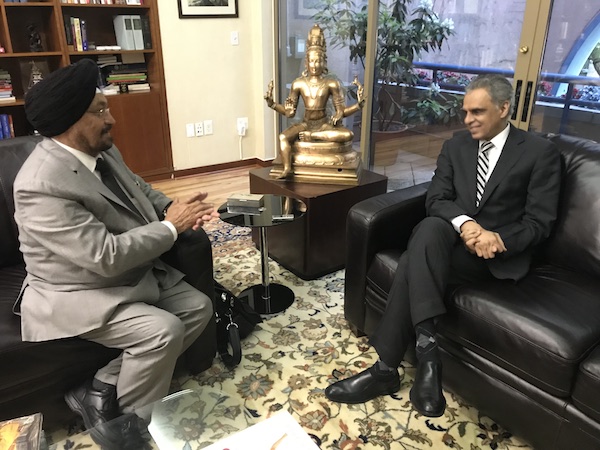
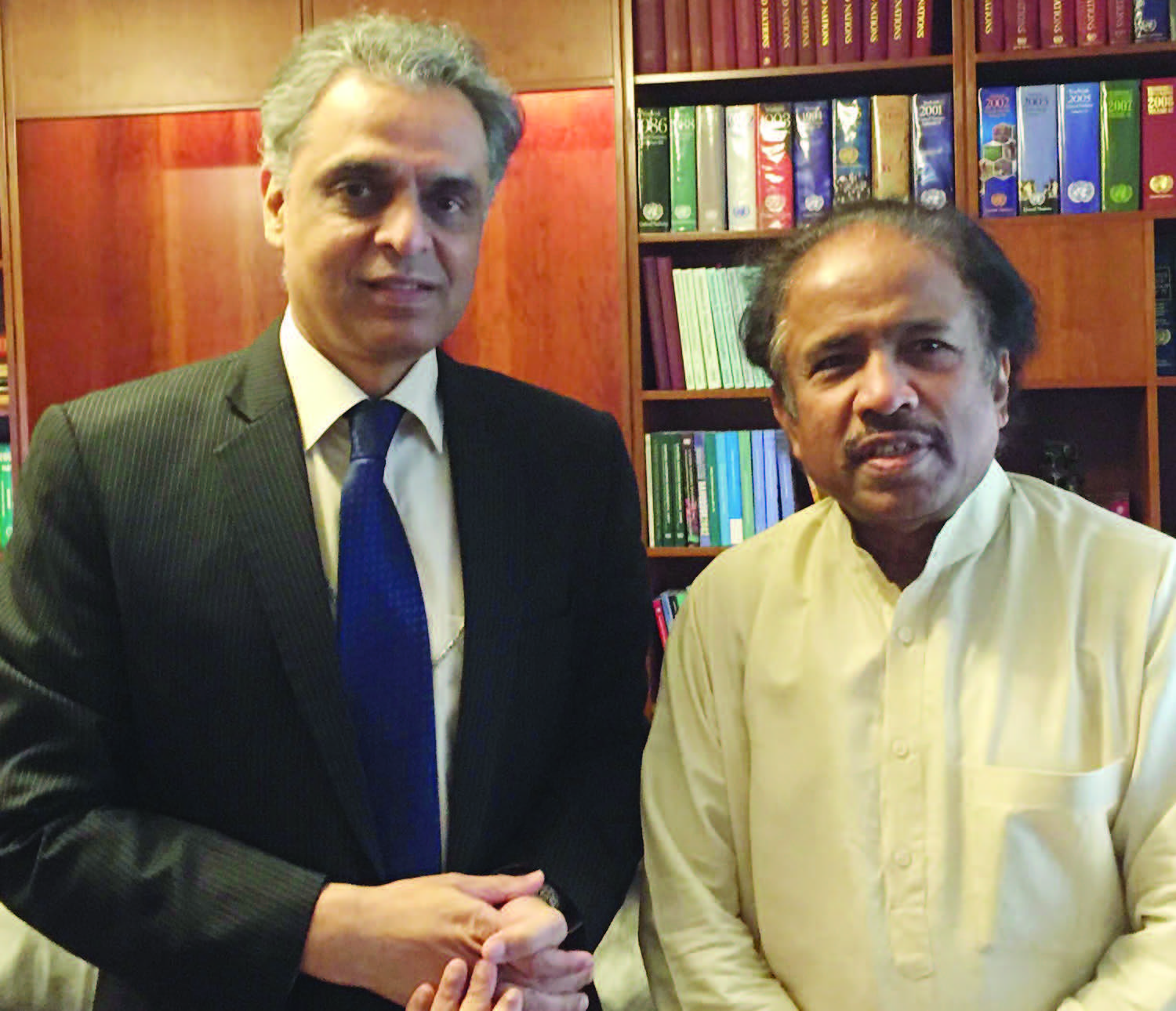
    Violin maestro and Padma Bhushan awardee Dr L Subramaniam called on India’s Permanent Representative to the United Nations Ambassador Syed Akbaruddin at the Indian Mission in Manhattan New York on Tuesday, July 12 and discussed matters of common interest.

  • 67th Republic Day of India | Greetings from Syed Akbaruddin

    67th Republic Day of India | Greetings from Syed Akbaruddin

    The Permanent Mission of India to the United Nations congratulates the team of Indian Panorama for publishing this special issue on the occasion of the 67th Republic Day of India. On the occasion of the 67th celebration of Republic Day, I extend my warmest greetings to all Indian origin community in America.

    66 years ago, the people of India adopted our Constitution with a dream of building a nation on the fundamental principles of equality, justice, liberty and fraternity. In this short span of time, India has established itself as a rising global power, deriving strength from its over one billion people, ancient wisdom, values, traditions, scientific outlook, robust economic growth and rich natural resources. We are also proud that India is counted among the few nations that have robust space and nuclear programmes.

    As one of the founding members, India has enriched United Nations and the goals of UN Charter with its political and civilizational ethos. We have selflessly shared with the world our vision of vasudeve kutmbhkam and Om Sarve Bhavantu Sukhinah, bringing valuable contributions to the three pillars of the United Nations’ work: international peace and security, development and human rights. The proclamation of June 21 as the International Day of Yoga last year is the most recent example of India’s quest for healthy living.

    We have also played a key role in the evolution of the UN’s specialized programmes and agencies, and UN global initiatives including peacekeeping, global disarmament, fight against apartheid and decolonization. India respects foremost the sovereignty of nations, rule of law, pluralism, peaceful coexistence and non-interference.

    As a responsible nuclear power, India desires a peaceful, secure and stable environment for development. We are an important partner in UN Peacekeeping operations, and have contributed nearly 180,000 troops, the largest number from any country, participating in more than 44 UN-Peacekeeping Missions.

    India is the founding member of NAM and G77 and has acquired the leading role of pursuing the aspirations of developing countries and the creation of a more equitable international economic and political order. Similarly, as a long standing member of the Human Rights Council, India is committed to work tirelessly for the promotion and protection of human rights.

    Despite all progress, the 21st century remains fraught with existing and newly emerging challenges including terrorism, violent extremism, armed conflict, epidemics, natural disasters, poverty eradication, climate change and inequality. India is a strong advocate of the policy of “zero tolerance” on terrorism. India is a committed partner in the spirit of multilateralism to achieve comprehensive and equitable solutions to these challenges.

    The year 2015 was a historic milestone in the history of multilateral cooperation culminating in the adoption of the “transformative” Agenda 2030 for Sustainable Development, Addis Ababa Action Agenda on Financing for Development and the UNFCCC Paris Agreement on Climate change. There is no doubt that the ‘transformation’ desired to be achieved by 2030 can become a reality only if we uphold the inalienable right of every person to development and create an equitable and just international order for its full realization.

    It is our strong belief that the way forward is to address the much needed UN reforms, including the expansion of the Security Council in both permanent and non-permanent categories. This is an imperative for the collective efforts of the international community to realise the objectives of internationally agreed goals.

    Our Government is committed to transform India as a global power. Though the journey is long and arduous, our resolve is stronger.

    I wish the team of Indian Panorama and the Indian origin community a very happy new year and congratulate them for making India proud of their valuable contributions to society.

    Syed Akbaruddin

  • Syed Akbaruddin assumes charge as India’s Permanent Representative to the UN

    Syed Akbaruddin assumes charge as India’s Permanent Representative to the UN

    NEW YORK (TIP) Syed Akbaruddin, a 1985 batch Indian Foreign Service (IFS) officer, has assumed charge as Permanent Representative to the United Nations. He succeeds Asoke K Mukerji who has retired. This is  his first-ever ambassadorial appointment.

    Currently an Additional Secretary in MEA, Akbaruddin was given charge of Indo-Africa Summit that was held in October. Akbaruddin  is credited with bringing a whiff of fresh air into the Ministry’s External Publicity division during his three-and-half year tenure as the spokesperson. He had also brought an effective mix of social and digital media into the External Publicity division.

  • Syed Akbaruddin to succeed Asoke K Mukherjee as India’s Permanent Representative to the United Nations

    Syed Akbaruddin to succeed Asoke K Mukherjee as India’s Permanent Representative to the United Nations

    NEWYORK (TIP): Syed Akbaruddin has been named  as the new permanent representative of India to the United Nations in New York. He succeeds Asoke Kumar Mukherjee who will be retiring at the end of December, 2015

    Syed Akbaruddin (left) willl succeed Ambassador Asoke K Mukerji as India's Permanent Representative to the United Nations. Ambassador Mukerji is retiring on 31st December
    Syed Akbaruddin (left) willl succeed Ambassador Asoke K Mukerji as India’s Permanent Representative to the United Nations. Ambassador Mukerji is retiring on 31st December

    The current reshuffle in the Ministry of External Affairs has facilitated the biggest career jump for Syed Akbaruddin, who stands promoted from the rank of Additional Secretary to a Secretary-level post.

    Asoke K Mukerji
    Asoke K Mukerji

    Mr. Akbaruddin, former MEA spokesperson, was the chief coordinator of the India-Africa Forum Summit (IAFS) held in New Delhi in October 2015. Prime Minister Narendra Modi had handpicked Mr. Akbaruddin to be the chief coordinator of the IAFS, a mega event that was attended by all the 54 countries of Africa.

    Mr. Syed Akbaruddin is the son of late Prof. S Bashiruddin, former Head of the Dept of Journalism and Communication, OsmaniaUniversity, Hyderabad. Bashiruddin also served as India’s Ambassador to Qatar.

    An alumnus of HyderabadPublic School, Akbaruddin is a 1985 batch civil servant and considered an “expert” on the West Asia issues.