

- I.S. Saluja
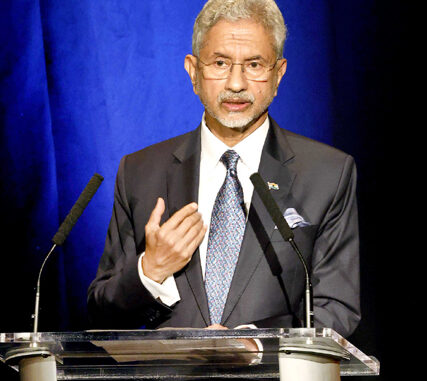
NEW YORK (TIP): India’s External Affairs Minister Dr. S. Jaishankar has raised a fundamental question about the ability of the United Nations to adjust to a dramatically transformed international order, saying an institution created eight decades ago for 51 member states must respond to the realities of a world undergoing a major redistribution of economic and political power.
Speaking at the Asia Society in New York on September 28, Jaishankar said the international system was experiencing an “enormous churn” as some countries increased their economic and political weight while others saw their relative influence decline.
“The UN has entered its ninth decade,” he said, asking whether an organization “invented with 51 members in a very different balance” could remain unchanged or would adjust to contemporary realities.
Jaishankar was in New York for the annual high-level meetings of the United Nations General Assembly. He said he had met close to 85 counterparts during an exceptionally busy period of diplomacy, and that those conversations had given him a sobering view of the international situation.
“The state of the world looks pretty grim,” he said.
He pointed to two major ongoing conflicts with worldwide repercussions, continuing instability in West Asia, conflicts in Africa, particularly Sudan, and growing economic pressures upon developing countries.
A large part of the world, he said, was confronting what he described in his UN General Assembly address as the “4F crisis” — food, fuel, fertilizers and finance.
Supply-chain vulnerabilities were also increasing, progress toward the Sustainable Development Goals was falling behind, and technological change was generating new anxieties.
“It’s a tough world, getting tougher by the day,” Jaishankar said, adding that the major powers were increasingly setting the tone.
Competition and interdependence
The External Affairs Minister described what he called one of the central paradoxes of the present international system: intense competition among countries exists alongside ever-deepening economic and strategic interdependence.
“Interdependence is the reality. Competition is the sentiment,” he said.
Countries, he argued, increasingly find themselves caught between their desire to compete and the constraints imposed by their dependence upon one another.
That contradiction has produced another troubling development — the increasing “weaponization” of interdependence.
Where one country possesses leverage over another through finance, trade, technology, energy, market access or geography, he said, there is a growing temptation to use that leverage strategically.
Jaishankar pointed to the emergence of what he called “choke points” — geographical, financial and economic pressure points that countries with influence can use against competitors or adversaries.
These could include geographical choke points such as the Strait of Hormuz, financial restrictions through sanctions, as well as constraints involving travel and market access.
The growing use of such instruments, he said, had made diplomacy considerably more difficult.
Diplomats today require two seemingly contradictory qualities: the patience and fortitude to endure long periods of turbulence, and the ability to remain nimble and responsive when circumstances change rapidly.
World cannot be divided into neat compartments
Jaishankar also cautioned against viewing regions and international problems in isolation.
In an increasingly interconnected world, he said, developments in one region quickly influence another. Traditional habits of dividing the world into countries, regions and continents and then attempting to find solutions within those compartments were becoming less effective.
The international landscape, he suggested, was becoming increasingly indivisible.
At the heart of the present turbulence, Jaishankar argued, is a rebalancing of power among nations.
Some economies are expanding in absolute or relative terms while others are declining relatively, changing perceptions of national influence and generating political anxieties.
Rising powers increasingly expect international institutions to recognize their growing weight, while countries accustomed to greater influence must adjust to changing circumstances.
That process, Jaishankar suggested, inevitably raises questions about institutions created for a very different distribution of global power — including the United Nations.
Rules and assumptions under strain
The External Affairs Minister said the difficulties facing the international system went beyond shifting national power.
Some of the basic assumptions upon which the postwar economic order was constructed were also being challenged.
Much of that system, he noted, had been built upon market assumptions. But when those assumptions were “gamed” and economic distortions became deeply embedded in the global economy, new stresses followed.
At the same time, countries possessing economic, technological or military advantages were becoming increasingly willing to exercise them.
The result, he suggested, was a departure from an earlier international environment in which deterrence and caution were often the preferred approach.
The world had become more impatient, and possessing capabilities increasingly created a temptation to use them.
From bipolarity to multipolarity
Looking at the evolution of the international order since the creation of the United Nations, Jaishankar recalled that the world had passed through distinct phases.
There had first been a bipolar world dominated by the United States and Soviet Union, followed by a unipolar period after the Cold War.
The international system, he argued, was now moving “quite visibly” toward greater multipolarity.
Countries around the world were consequently reassessing their relationships, diversifying partnerships and seeking ways to reduce excessive dependence upon any single power or economic source.
Governments were asking themselves how they could “de-risk,” where they could find new partners, and how they could obtain greater value from existing partnerships.
Despite his somber assessment of present conditions, Jaishankar did not suggest that the international system was incapable of adapting.
Countries, he said, respond to changing circumstances by calculating their interests, adjusting policies, finding new accommodations and developing new solutions.
That process of adjustment, he said, is how international orders evolve.
The United Nations today is both a witness to that transformation and an institution confronted by it.
The question posed by Jaishankar’s remarks was therefore larger than whether the UN continues to have relevance. It was whether an institution conceived for the balance of power of 1945 can adjust sufficiently to reflect the balance of power of the 21st century.


Be the first to comment