Tag: United Nations

  • The Dragon Covets the Arctic

    The Dragon Covets the Arctic

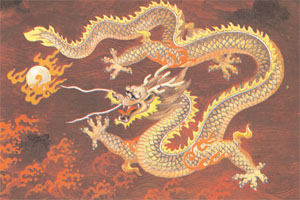
    China’s lust for oil, minerals, rare earths, fish and desire for an alternative northern sea route boils the Arctic Geopolitics!
    Iceland is a small, sparsely populated island nation with a population of only 320,000 and area of 40,000 square miles. It is the only member of the NATO that does not have an army of its own. Icelandic banks were part of the 2008 global financial crisis and meltdown when they exposed the Icelandic government of huge financial risks by indulging in risky loans and speculative foreign currency transactions without having enough liquidity and capital reserves. The fiscal crisis led to a former Icelandic prime minister losing his job and being hauled to court of law for not supervising the banks enough. In an international capitalistic, mercantile system, if Iceland were a company, it was “sitting duck” for outright purchase and acquisition. Fortunately, foreigners are not allowed to buy any property or real estate in Iceland and need a special permit. And here comes the Peoples’ Republic of China, rich with $ 3.4 trillion in foreign exchange reserves in its kitty.

    It has built a palatial embassy in Reykjavik, Iceland worth $250 million with only 7 accredited diplomats. China is negotiating a free trade area with Iceland, the first with any European nation. Former Chinese Prime Minister Wen Jiabao even paid a state visit to Iceland for two full days in 2012. Other Chinese ministers and officials have also been very active in Iceland with bilateral visits and cultural events. In 2010, Huang Nubo, a “poetry loving” Chinese billionaire and former communist party official visited Iceland to meet his former classmate Hjorleifur Sveinbjornsson, a Chinese translator with whom he had shared a room in 1970s in the Peking University. He expressed his intense love for poetry and put up $ one million to finance Iceland-China Cultural Fund and organized two poetry summits, the first one in Reykjavik in 2010 and the second one in Beijing in 2011.

    Last year (2012), Huang Nubo and his Beijing based company, the Zhongkun group offered to buy 300 sq km of Icelandic land ostensibly to develop a holiday resort with a golf course. This Chinese billionaire wanted to pay $7million to an Icelandic sheep farmer to take over the land and build a $100 million 100-room five star resort hotel, luxury villas, an eco-golf course and an airstrip with 10 aircrafts.

    A state owned Chinese bank reportedly offered the Zhongkun group a soft loan of $ 800 million for this project. The deal was blocked by the Icelandic Interior Minister who asked many pertinent questions but reportedly got no answers. Huang would not take no for an answer and has submitted a revised bid for leasing the land for $ one million instead of outright purchase. He makes an unbelievable assertion that there is a market demand for peace and solitude: “Rich Chinese people are so fed up of pollution that they would like to enjoy the fresh air and solitude of the snowy Iceland”. The current Icelandic government, a leftof- center coalition has given this proposal a cold shoulder.

    But, with elections due in April 2013 in Iceland, China is hoping for a more sympathetic government to approve the project. Iceland looks like an easy bird of prey for the wily red Dragon with insatiable appetite. China is showing generosity to another poor and sparsely populated, self-governing island of Greenland by offering investments in mining industry with proposal to import Chinese crews for construction and mining operations. Greenland is rich in mineral deposits and rare earth metals. China wants Greenland to provide exclusive rights to its rare earth metals in lieu of the fiscal investments. Under one such proposal, China would invest $2.5 billion in an iron mine and would bring 5000 Chinese construction and mining workers whereas the population of the capital of Greenland, Nuuk is only 15000.

    Arctic Council Membership:
    There are eight members of the Arctic Council that includes Canada, Denmark (including Greenland), Finland, Iceland, Norway, Russia, Sweden and the USA. All these eight countries have geographic territories within the Arctic Circle. It was constituted in 1996 as an intergovernmental body but has evolved gradually from a dialogue forum to a geo-political club and a decision making body. There are continuing territorial disputes in Arctic Circle. Ownership of the Arctic is governed by the United Nations Convention of the Law of the Sea, which gives the Arctic nations an exclusive economic zone that extends 200 nautical miles from the land. Member countries signed their first treaty on joint search and rescue missions in 2011. A second treaty on cleaning up oil spills is being negotiated. The group established its permanent secretariat at Tromso, Norway in January 2013.

    Arctic Melting and Opening of Newer Sea Lanes:
    With global warming becoming a reality, the Arctic ice has started to melt rapidly opening the northern sea-lanes that were frozen earlier. In summer of 2012, 46 ships sailed through the Arctic Waters carrying 1.2 million tonnes of cargo. There are legal questions about the international status of the northern sea lanes.

    China’s Lust for Arctic Resources:
    The Arctic has 13% of the world’s undiscovered oil and 30% of gas according to the US Geological Survey. Greenland alone contains approximately one tenth of the world’s deposits of rare earth minerals. China which already has a monopoly on world’s rare earth metal trade wants to continue controlling this global trade. China piously claims that the Arctic resources are the heritage of the entire mankind while insisting that the South China sea is its exclusive sovereign territory. In 2004, China set up its first and the only Arctic scientific research station, curiously named “Yellow River Station” on the Svalbard Island of Norway.

    China, so far, has sent 6 arctic expeditions. China plans to build more research bases. In 2012, the 170- meters long ice-breaker “Snow Dragon” (MV Xue Long) became the first Chinese Arctic expedition to sail along the Northern Sea Route into the Barente Sea. Incidentally, as early as 1999, this 21000 metric ton research ice-breaker Xue Long had docked in the Canadian North-Western territory unexpectedly. China is building another 120-meter long ice-breaker with the help of Finland while the Polar Research institute in Shanghai trains scientists and other personnel for Arctic expeditions.

    China’s Previous Use of Deception:
    There is no mandarin character for word transparency. China has been known to use duplicity and deception since the Art of War was written by Sun Tzu. China’s rhetoric of “peaceful and harmonious rise” and hegemonic behavior are predictably diametrically opposite to each other. China’s use of deception to camouflage its intentions in geopolitical matters is not surprising. While China joined the NPT in 1991, it provided 50 kg of highly enriched uranium to Pakistan, provided that country with a nuclear weapon design and supervised Pakistan’s first nuclear test at the Chinese nuclear testing site of Lop Nur.

    China purchased in 1998 an unfinished aircraft carrier from Ukraine after the break-up of Soviet Union ostensibly for developing a floating casino. The same “floating casino” is now China’s first aircraft carrier projecting Chinese naval and maritime power in the South China Sea. China’s Application in Arctic Council Membership: China currently has an ad hoc observer status with Arctic Council. China’s application for permanent observer-ship was denied by Norway in 2012 owing to bilateral dispute over awarding of Nobel peace prize to China’s Liu Xiabo in 2010. China still has a pending application to be decided in May 2013 Arctic Council summit in Sweden when Canada takes over the chair for the next two years. With a permanent observer status, China would get full access to all Arctic Council meetings. Permanent observers do not have voting rights in the council but can participate in deliberations.

    China is trying to distinguish itself from the rest of the applicants as a “Near Arctic State” on the perniciously clever but fallacious grounds that the northernmost part of China in the province of Manchuria (the Amur river) is only one thousand miles south to the Arctic circle. The fallacy is that Manchuria was a separate, independent country that was annexed by China after the Communist take-over. Manchus had ruled over China for centuries during the reign of Manchu dynasty and last Chinese Emperor Pu Yi was actually the last Manchu emperor. Chinese ownership and annexation of Manchuria (Manchu-Kuo) is still not settled. A disputed territory cannot be used by China to make a geo-political claim for being a “Near Arctic State”.

    Other Pending Applications:
    Other countries or non-state actors with pending applications for permanent observer-ship status include Japan, South Korea, India, Singapore, European Union, and non-state actors like Greenpeace and the International Association of Oil and Gas Producers. All these applications will be decided one way or the other in May 2013. The vote has to be unanimous for acceptance and how the US and Russia will vote is the crucial issue. In the past, Norway had vetoed China’s membership application. Some of the Arctic Council members may not approve European Union’s application because of EU’s penchant for restrictive and narrow rulings. Whereas Sweden, Canada, Iceland and Denmark may support China’s application, there are doubts about Norway, Russia and the US. Russia is currently the most vociferous member of Arctic Council that has serious reservations in expanding the Arctic club.

    Strategic Issues:
    China has voracious appetite for new territories and has been seeking new frontiers for the last three hundred years with Inner Mongolia, Manchuria, Xinjiang and Tibet. China’s list of “core issues” is ever-expanding, starting with Taiwan and Tibet. China has included the whole the South China Sea and its islands as a core issue. China is aggressively claiming sovereignty on these islands based on historical maps and manufactured mythological evidence. China has now a license from the UN for deep sea bed mining for minerals in the Indian Ocean and has developed naval bases in Indian Ocean and Arabian Sea ports. If China manages to get a toehold in Arctic Circle, its behavior will become as belligerent in Arctic as it is in the South China Sea. It might claim sovereignty over the whole of the Northern route sea lanes based on “historical evidence”. If in 22nd century, China decides that the Arctic Circle is its core national issue, one would be seeing Chinese aircraft carriers in the Arctic Sea and Chinese nuclear powered submarines in the Barente Sea along with military bases with “Chinese characteristics” in the Iceland and Greenland.

  • Diplomats celebrate the festival of Spring, Holi

    Diplomats celebrate the festival of Spring, Holi

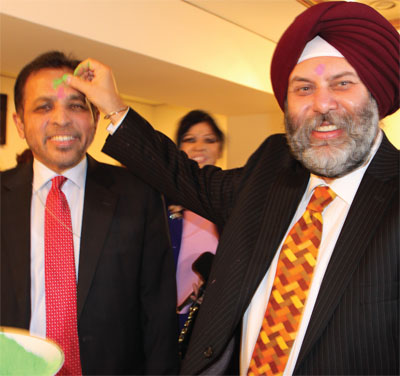
    NEW YORK (TIP): The Permanent Mission of India to the United Nations celebrated Holi at the permanent mission here on Wednesday, March 27, in style and with great enthusiasm. Colors and flower petals expressed the feeling of joy and delight that pervaded the atmosphere.

    Holi is one of the most popular festive occasions in India. The holiday celebrated mainly by the Hindus in India and Nepal marks the beginning of spring and the triumph of good over evil. Bonfires are set on the eve of Holi, and the next day the Hindus throw colored dry powder and water in celebration. It is also observed by the minority Hindus in Bangladesh and Pakistan as well in countries with large Indian Diaspora populations following Hinduism, such as Suriname, Malaysia, Guyana, South Africa, Trinidad and Tobago, the United Kingdom, the United States, Mauritius, and Fiji. Holi is of particular significance in the Braj region of North India, which includes locations traditionally connected to the Lord Krishna: Mathura, Vrindavan, Nandagaon, and Barsana, which become tourist destinations during the season of Holi. There is a legend associated with celebration of Holi. The word Holi originated from “Holika”, sister of Hiranyakashipu.

    The festival of Holi is celebrated because of a story in the old Hindu religion. In Vaishnavism, Hiranyakashipu is the great king of demons, and he had been granted a boon by Brahma, which made it almost impossible for him to be killed. The boon was due to his long penance, after which he had demanded that he not be killed “during day or night; inside the home or outside, not on earth or in the sky; neither by a man nor an animal; neither by astra nor by shastra”. Consequently, he grew arrogant and attacked the Heavens and the Earth. He demanded that people stop worshipping gods and start praising respectfully to him.

    According to this belief, Hiranyakashipu’s own son, Prahlada, was a devotee of Vishnu. In spite of several threats from Hiranyakashipu, Prahlada continued offering prayers to Vishnu. He was poisoned by Hiranyakashipu, but the poison turned to nectar in his mouth. He was ordered to be trampled by elephants yet remained unharmed. He was put in a room with hungry, poisonous snakes and survived. All of Hiranyakashipu’s attempts to kill his son failed. Finally, he ordered young Prahlada to sit on a pyre in the lap of Holika, Hiranyakashipu’s demoness sister, who also could not die because she had a boon preventing her from being burned by fire. Prahlada readily accepted his father’s orders, and prayed to Lord Vishnu to keep him safe. When the fire started, everyone watched in amazement as Holika burnt to death, while Prahlada survived unharmed.

    The salvation of Prahlada and burning of Holika is celebrated as Holi. In Mathura, where Krishna grew up, the festival is celebrated for 16 days (until Rangpanchmi) in commemoration of the divine love of Radha for Krishna. The festivities officially usher in spring, the celebrated season of love. The party at the Permanent Mission of India was hosted by Acting Permanent Representative Ambassador Manjeev S. Puri and his staff, who were in the best of spirits of Holi throughout the evening. Mrs. Puri who was dressed in a beautiful multicolored Saree for the multicolored occasion was enthusiastically going round, supervising arrangements and taking care of guests.

    The event was attended by Permanent Representative of Sri Lanka, Ambassador Palitha Kohona, and Permanent Representative of Republic of Singapore, Ambassador Albert Chua besides diplomats from many countries, and officials at the UN. Ambassador Puri was seen applying colors on his guests and welcoming them to the heavily attended celebratory party. He joyously threw flower petals and colors at the guests, as is the custom during Holi. The authentic Indian menu included Thandai, a special drink made during Holi and much other Holi specialty food that included chats and sweets, among many other delicacies.

  • My Goal On This Trip Is To Listen: Obama On His Forthcoming Visit To Israel And Palestinian Territories

    My Goal On This Trip Is To Listen: Obama On His Forthcoming Visit To Israel And Palestinian Territories

    JERUSALEM (TIP): US President Barack Obama said on Thursday his forthcoming trip to Israel and the Palestinian territories was to “listen” to both sides and hear their views on how to move forward after over two years without peace talks. His remarks came in an exclusive interview with Israel’s Channel 2 television broadcast a week before the US leader starts his first visit to Jerusalem and the West Bank town of Ramallah since being elected president in 2008. During the visit, starting March 20, Obama will meet with Israeli Prime Minister Benjamin Netanyahu in Jerusalem and Palestinian president Mahmud Abbas and his premier Salam Fayyad in Ramallah to hear their perspective on how to resolve the decadeslong conflict. “My goal on this trip is to listen.

    I intend to meet with Bibi (Netanyahu) … I intend to meet with Fayyad and Abu Mazen (Abbas) and to hear from them what is their strategy, what is their vision, where do they think this should go?” With Israel in the throes of establishing a new coalition government, which is due to be sworn in just days before he flies in, it was “unlikely” there would be any breakthrough, Obama acknowledged. But he would press both sides “to recognise the legitimate interests” of the other. “To Abu Mazen, I will say that trying to unilaterally go to, for example, the United Nations, and do an end run around Israel, is not going to be successful,” he said, referring to Palestinian attempts to secure UN recognition as a state that have angered Israel. “To Bibi (Netanyahu) I would suggest to him that he should have an interest in strengthening the moderate leadership inside the Palestinian Authority…” “For example, making sure that issues like settlements are viewed through the lens of: Is this making it harder or easier for Palestinian moderates to sit down at the table,” he said. The Palestinians have said they will only return to peace talks if Israel halts its settlement activity and recognizes 1967 lines as the basis for negotiations. But Israel is insisting it will only return to the negotiations if there are no preconditions. “I think we’re past the point where we should be even talking about pre-conditions and steps and sequences.

    Everybody knows what’s going to be involved here in setting up two states, side by side, living in peace and security,” he said. “How we get into those conversations, whether they can happen soon or whether there needs to be some further work done on the ground, that’s part of what I’ll explore when I’ll get there,” he said.

    In Washington, senior Obama aides said that the president wanted to speak directly to young Israelis, so had chosen to deliver a speech at a Jerusalem conference center and not to the Israeli legislature, the Knesset. They billed the speech as a complement to an address he delivered to the Muslim world in Cairo in 2009. “We thought it was very important for him to speak directly to Israelis,” said Ben Rhodes, a deputy national security advisor. While it may lack diplomatic ‘deliverables,’ Obama’s visit will not be short in symbolism.

    As soon as he arrives at Tel Aviv airport on Wednesday, Obama will inspect a battery in the Iron Dome air defense system that was largely funded by the United States and credited with saving lives in Israel’s showdown with Hamas last year. On Thursday, he will inspect the Dead Sea Scrolls, biblical texts seen as a testament to an ancient Jewish connection to Israel.

    Before he leaves Israel on Friday, Obama will travel to Mount Herzl, where he will lay wreaths at the graves of assassinated Israeli prime minister Yitzhak Rabin and Theodor Herzl, the founder of modern Zionism. Also on the trip, Obama will be feted at a state dinner by Israeli President Shimon Peres, visit the Yad Vashem Holocaust memorial and tour the Church of the Nativity in Bethlehem. In Jordan on Friday, Obama will meet King Abdullah II and hold a press conference before visiting the ancient ruins of Petra a day later.

  • Commonwealth Day Celebrated

    Commonwealth Day Celebrated

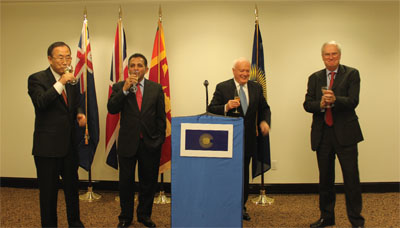
    NEW YORK (TIP): A reception to celebrate the Commonwealth Day was organized at Sri Lanka mission here on 11th March. Sri Lanka, UK and Australia cohosted the event. United Nations Secretary-General Ban Ki-Moon was among those present that included the Permanent Representative of UK Sir Mark Lyall Grant, Permanent Representative of Australia Gary Quinlan, Sri Lanka Permanent Representative Palitha Kohona, and Heads of Missions, senior UN officials and diplomats from various countries.


    img4

    The Permanent Representative of Sri Lanka, Palitha T.B. Kohona welcomed the guests in a speech and insisted on more unity among the Commonwealth Nations, “In the long run, it is tangible benefits that will keep us together. Although ideas and values are important, tangible benefits will be the glue that will bind us together as a family”. He also highlighted the challenges of “youth empowerment, women’s issues and trade and labor liberalization”.

    The Permanent Representative of Australia, Gary Quinlan, in his address spoke of the distinctive differences among the Commonwealth countries. “The Commonwealth comprises of 54 member states, of which, only 4 are developed countries. The rest are still developing”, he added. Permanent Representative of UK Sir Mark Lyall Grant read out a message from Queen Elizabeth. In her message the Queen said, “The heart of the Commonwealth lies in the striving of individuals and communities to achieve great goals”.

  • NACSAA’s ‘Thomas Jefferson’s Eternal Vigilance’ Awards Presented

    NACSAA’s ‘Thomas Jefferson’s Eternal Vigilance’ Awards Presented

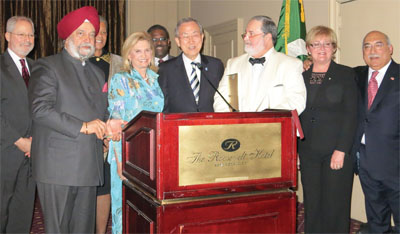
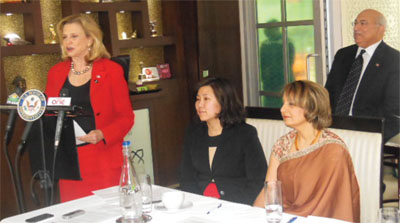
    NEW YORK (TIP): National Advisory Council on South Asian Affairs’ (NACSAA’s) “Thomas Jefferson’s Eternal Vigilance” Awards were presented to Ambassador Abdullah Hussain Haroon and Ambassador Hardeep Singh Puri on March 8, 2013, at the Roosevelt Hotel here.

    While Congresswoman Caroline Maloney presented the award to Ambassador Abdullah Hussain Haroon , Secretary General Ban Ki Moon presented the award to Ambassador Hardeep Singh Puri. Each was recognized for “for his exemplary service to humanity, unflinching dedication to freedom, the rule of law and helping ‘…form a more perfect world.’” In addition, Cong. Maloney presented Ambassador Haroon with a Congressional Record issued in his honor.

    At the event held in honor of UN Secretary General Ban Ki Moon, Ambassador Haroon spoke of the need for nations to keep talking in earnest, for as long as they are talking war is avoided. SG Ban spoke of the need to find a unified vision, with respect and friendship amongst nations, so humanity may better enjoy peace and prosperity.

    img2

    The select audience of over 130 guests was made up of members of the United Nations Security Council, Permanent Representatives, national, state and local elected officials, and dignitaries, including Congressman Gary L. Ackerman, Chef de Cabinet Susana Malcorra and Mrs. Ban. Congressman Meeks was unable to attend the event, as he was part of the official United States delegation to attend the funeral of President Hugo Chavez in Venezuela. Prior Thomas Jefferson Eternal Vigilance Award recipients include United States Assistant Secretary of State Richard Boucher, and Congressmen Gary L. Ackerman, Eliot L. Engel and inter alia, Gregory W. Meeks. NACSAA is made up of Americans with ancestry from, inter alia, Afghanistan, Pakistan, India, Sri Lanka, Nepal and/or Bangladesh.

  • PEACE STATUE OF SRI CHINMOY dedicated at Timor-Leste Parliament

    PEACE STATUE OF SRI CHINMOY dedicated at Timor-Leste Parliament

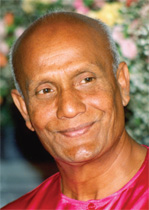
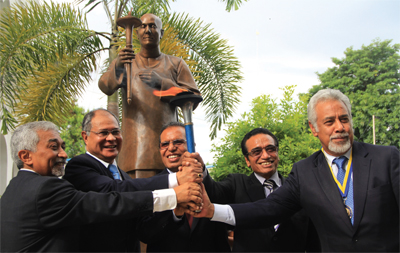
    NEW YORK (TIP): A beautiful bronze statue of Dreamer of World-Peace Sri Chinmoy was dedicated inside the grounds of the Parliament of Timor-Leste (East Timor) by President Taur Matan Ruak, Prime Minister Xanana Gusmão and first Prime Minister Dr. Mari Alkatiri, February 3, a late report says. Sri Chinmoy was an enormously creative peace leader who offered peace meditations at the United Nations headquarters in New York for leaders of all nationalities, delegates and staff members twice-weekly for 37 years at the invitation of Secretary- General U Thant. He created a wide range of cultural and athletic programs involving millions of peace-lovers throughout the globe.

    During the ceremony, Timor-Leste President Ruak stated, “Sri Chinmoy dedicated his life to seeking Harmony and Unity…and visited our country in 2004 to encourage our people’s effort to try to build Harmony after so many years of war and suffering…It is a great honor for the people of Timor-Leste to be awarded this Peace Statue which recognizes the Timorese people as peoples of Peace, and Timor-Leste as a World Peace symbol…”

    Prime Minister Xanana Gusmão and the nation’s first Prime Minister Dr. Mari Alkatiri were each presented with the Torch-Bearer Award by Mr. Salil Wilson, Executive Director of the Sri Chinmoy Oneness-Home Peace Run. Mr. Wilson hailed the supreme sacrifices and everlasting contributions by both leaders before presenting their medallions.

    After both leaders offered their gracious comments, they embraced warmly and then Prime Minister Gusmão ran with the Peace Torch from the entrance of the Parliament to Dr. Alkatiri-who then carried the torch to President Taur Matan Ruak. The top national leaders proceeded to the statue of Sri Chinmoy, which the President officially inaugurated by cutting the ribbon. The national luminaries-also including President of the Parliament Mr. Vicente Guterres and Deputy Prime Minister Fernando de Araújo-held the Peace Torch together in front of the statue in which Sri Chinmoy is offering the Peace Torch to the people of Timor Leste. The national leaders were each presented a large painting created by Sri Chinmoy and offered on behalf of Ranjana Ghose, Curator of the Jharna-Kala (Fountain-Art) Foundation, by Mr. Gangane Stefánsson, Head of UNICEF Iceland. Singers from an international choir performed a song written by Sri Chinmoy on Timor-Leste just prior to his visit in 2004. As a special treat, local Timorese children performed beautiful songs of peace in their native language of Tetung. The stirring ceremony was an official supplementary session of the Timor-Leste Parliament and attended as well by cabinet ministers, interfaith leaders and other luminaries of the nation. This statue created by British sculptor Kaivalya Torpy is the second of its kind-the first being inaugurated at a festive ceremony with Olympians and peace leaders in London as part of the Summer Olympics.

  • Engage’ US on rights issue in UN: India To Lanka

    Engage’ US on rights issue in UN: India To Lanka

    NEW DELHI (TIP): Against the backdrop of demands by Tamil parties that India should vote against Sri Lanka at the UN on human rights, government on Wednesday, March 6 remained evasive on the stand it will take even as it asked Sri Lanka to treat it as a humanitarian issue rather than “a matter of ego”.

    With a US-sponsored resolution set to be moved on Lankan Tamils at the United Nations Human Rights Council, external affairs minister Salman Khurshid said he has asked his Lankan counterpart GL Peiris to work with the United States and report progress if any made on the issue to arrive at a draft which is “acceptable to everybody”. “Government will take a stand. As of now I have told my colleague foreign minister of Sri Lanka to engage the US. If you have moved forward (on human rights issue), you should bring that to the knowledge of the US to arrive at a consensual draft which is acceptable to everybody,” Khurshid told reporters outside Parliament. “It is a humanitarian issue.

    It is not an issue on which anybody should stand on ceremony or ego. If it is possible, speak to them directly and find a suitable and acceptable draft,” he said. His comments came against the backdrop of mounting demands by Tamil parties that India should take a tough stand against Sri Lanka and vote in favor of resolution to be moved against it. The US is set to move the new resolution against Sri Lanka at the current session of the UN Human Rights Council for its alleged war crimes, asking the country to promote reconciliation and accountability.

    The resolution will ask the government of Sri Lanka to follow through on its own commitments to its people, including implementing the constructive recommendations from the report by Sri Lanka’s Lessons Learnt and Reconciliation Commission.

  • One Woman: A song for UN Womento launch on International Women’s Day

    One Woman: A song for UN Womento launch on International Women’s Day

    A musical celebration of women worldwide / Artists from 20 countries participate

    UNITED NATIONS (TIP): “One Woman: A song for UN Women” will launch on International Women’s Day. The track will be globally available for download as of 8 March (EST 7 March, 12 noon) on http://song.unwomen.org, together with the full song video and behindthe- scenes videos chronicling the song’s year-long production. “One Woman” is a musical celebration of women worldwide, featuring 25 artists from 20 countries across the globe. The song calls for change and celebrates acts of courage and determination by ordinary women who daily make extraordinary contributions to their countries and communities. The lyrics are inspired by stories of women whom UN Women has supported. UN Women is the UN organization charged with advancing women’s empowerment and gender equality worldwide. It began its work in 2011, the first new UN organization in decades. “One Woman” is the first theme song for a UN organization.

    “One Woman gives us a message of hope and inspiration”, says UN Women Executive Director Michelle Bachelet. “This song carries a message of unity and solidarity with women worldwide and reminds us that equality, human rights and human dignity are the birthright of all of us, every human being. I thank everyone who made this song possible. Singers and performers from all regions, women and men, donated their time and contributed their talent. They include: Ana Bacalhau (Portugal); Angelique Kidjo (Benin); Anoushka Shankar (India); Bassekou Kouyate (Mali); Bebel Gilberto (Brazil); Beth Blatt (US); Brian Finnegan (Ireland); Buika (Spain); Charice (Philippines); Cherine Amr (Egypt); Debi Nova (Costa Rica); Emeline Michel (Haiti); Fahan Hassan (UK); Idan Raichel (Israel); Jane Zhang (China); Jim Diamond (UK); Keith Murrell (UK); Lance Ellington (UK); Marta Gomez (Colombia); Maria Friedman (UK); Meklit Hadero (Ethiopia); Rokia Traoré (Mali); Vanessa Quai (Vanuatu); Ximena Sariñana (Mexico); Yuna (Malaysia).

    Initially performed during the launch event for UN Women in the UN General Assembly Hall in 2011, “One Woman” aims to become a rallying cry that inspires listeners about the mission of UN Women and engages them to join in the drive for women’s empowerment and gender equality. The music of the song is by Graham Lyle (Tina Turner’s “What’s Love Got To Do With It” and many other hits) and British/Somali singer-songwriter Fahan Hassan; the lyrics are by Beth Blatt.

    Jerry Boys – who has worked with a wide range of artists including REM, Everything But The Girl and was one of the people behind the Buena Vista Social Club recording – produced the song, together with executive producer Beth Blatt and her organization Hope Sings. Microsoft, as UN Women’s corporate partner for “One Woman” has sponsored the song and music video production. The song will be available for purchase on the song website and all common channels like iTunes and Amazon for $0.99. All proceeds go directly to UN Women in support of its programmes to empower women on the ground

  • International Media Lauds Ambassador Puri

    International Media Lauds Ambassador Puri

    NEW YORK (TIP): After a distinguished diplomatic career spanning 39 years, Ambassador Hardeep Singh Puri, India’s Permanent Representative to the United Nations, hung up his gloves on February 28.

    Three days before demitting office, Ambassador Puri who always had cordial relations with the international media, invited them over for an evening of good byes.

    In his brief address, Ambassador Puri spoke of his happy experience with “media friends” and thanked them for their affection for him. A couple of media persons also spoke.

    The common refrain was that Ambassador Puri was a lovable person working with whom has always been a pleasure. He was lauded for his gentle ways and warmth of friendship for journalists.

    He was wished well and a toast was raised to his health and happiness.

  • Ambassador Hardeep S. Puri And Consul General Prabhu Dayal Retire

    Ambassador Hardeep S. Puri And Consul General Prabhu Dayal Retire

    NEW YORK (TIP): Two senior Indian diplomats posted in New York retired on February 28. Ambassador Hardeep S. Puri, India’s Permanent Representative to the United Nations retired after a brilliant diplomatic career spanning 39 years. Mr. Puri had joined the Indian Foreign Service at the age of 22. Mr. Puri had joined as PR in March, 2009 and had superannuated in 2012. But he was given an extension for one year. During his tenure, India presided twice over the Security Council.

    Known as an exceptionally dynamic diplomat, Mr. Puri can solely be attributed for the many successes India has found itself being lauded with at the United Nations. His vision and efforts have helped India play a pivotal role at the United Nations. It would take volumes to do justice to the man who contributed so much not only for India but for the world at large, during his four year tenure as India’s Permanent Representative to the United Nations. One of the most loved and admired diplomats, he won many friends for India and minimized opposition to India which all contributed to India’s strength at the world body.

    Ambassador Puri’s relentless working was much in evidence when The Indian Panorama team of Prof. Indrajit S. Saluja and Pooja Premchandran walked in to his office February 25. Ambassador Puri was working feverishly on a file, to meet a deadline. He was to give an interview to another news agency and then follow it up with a reception he had hosted for the media. And, as we learnt later, he was to proceed to Washington immediately after the reception which all meant he would hit the bed in early hours of February 26 and follow up with meetings in the morning. In an exclusive interview with The Indian Panorama, Ambassador Puri relived his diplomatic pilgrimage, speaking from the heart, of his experiences and moments of joy as well as despair. We found him reminiscing, with eyes closed for a jiffy, and then picking up the thread of conversation. Obviously, he was getting nostalgic. Here are the excerpts.

    Q. How do you feel when you are ready to demit your office after having a distinguished career as a diplomat, and more particularly, as one of the best known Permanent Representatives of India to the United Nations?
    This is not just handing over the PR of New York. This is the end to a 39-year old service to the ministry and the government. I have a deep sense of satisfaction, a sense of fulfillment that I have been able to devote the bulk of my life to the nation. I joined the Foreign Service at the age of 22. I am 61 now. So I have a deep sense of satisfaction.

    Q. Was serving in the Foreign Service always your ambition?
    Unlike most of my other colleagues I was born into the Foreign services. My father Bhagat Singh Puri was a part of the ministry for foreign affairs. I undertook my first journey accompanying him to Bonn when I was four years old. For me the ministry and the Foreign Service have been the only life I know. The kind of experience Foreign Service provides and the kind of opportunities that come your way lead to self-growth; it leads to widening one’s horizon. I have seen the country evolve. Slowly, but surely.

    Q. Surely you have one too many wonderful experiences to share with our readers?
    I have a very funny story to tell. When I was accompanying my father on an international posting, we underwent an internal form of McCarthyism. They suspected a Communist under every bed. My father was posted in Belgrade, former Yugoslavia. Those were the days when there was no air travel. We took ship to reach our destination. When we reached Geneva, there was a telegram waiting for my father diverting him to Bonn. The reason was that my grandfather was an educationist. He was a principle at a Khalsa school in Delhi. He had apparently reprimanded a teacher. To get even with my grandfather he decided to write an anonymous letter to the intelligence bureau stating that Sardar Kartar Singh Puri (my grandfather) subscribed to a paper titled Preet Larhi, which was a left of center newspaper. This lead to my father getting posted in Bonn instead of Belgrade. But Bonn was a wonderful experience. I studied in a Catholic school. My younger brother studied in a Protestant school. So everyone wondered, what kind of people are they? They wear a turban on their heads and have their children sent to different kinds of school. We had to explain to them that we were Sikhs. There were not too many Sikhs there back then. In all, Bonn was a terrific experience.

    Q. Can you recall your journey in foreign services?
    I married into the foreign services. We had postings together in Tokyo, Delhi, Geneva and in Colombo. Then we came back to Geneva where I joined the United Nations and she joined a mission. Even after that I traveled to many different places.

    Q. You seem to have trained your staff well. But do you think, without you at the helm they will be able to deliver?
    My staff was born well trained. Let me make that clear. I was very lucky to get one of the best teams there is. And even after I joined I had the opportunity to select a few exceptionally skilled staff members. At present, I am also in the process of completing a book about my selected speeches in the United Nations and many exclusive photographs. Therefore, I have decided to dedicate this book to my staff. They are the ones who write these wonderfully woven speeches and I thought it best to acknowledge them.

    Q. Of all the issues that you faced, which one was the most significant to you?
    I joined the Permanent Mission at the UN in March 2009. When I came here, clearly the highest priority was to get a seat in the Security Council. In 2006, it was an act of courage by my predecessor and his team to recommend contesting election for a seat on the Security Council. On the previous occasion in 1996, we contested an election against Japan and we were traumatized. We received only about 40 or 45 votes whereas Japan got about 140. It was a complete misjudgment. And in the last election we received 187 out of 190 votes in total. But our critics questioned our performance and undermined it saying that we did not have any opponent. To that I would like to reply that Kazakhstan contested the elections twelve years before I joined. So it was an act of courage by my predecessor to recommend participating in elections in 2007. When I arrived we had about 37 reciprocal votes. We needed 120 to win. At this point I felt awkward to meet and talk about the elections with my Kazakhstan counterpart. I always found myself wondering what I would tell her with just about 37 votes in my kitty. I was always nice to her but we never discussed the election issues. Eventually we received half of the total number of votes. So we crossed the fifty percent mark. At this point I knew that Kazakhstan did not have enough votes as us to win. I was now more confident about India winning the elections. Subsequently, we contested and received 187 out of a total of 190 votes, a miss of just three votes. It was a record of sorts. It will surely stand in the books. We worked extremely hard. We fought many elections. The election at ACABQ (Advisory Committee on Administrative Budgetary Questions) was one of the toughest elections. It was a straight fight between India and China to join the inspection unit. Our contestant was UN Ambassador to Geneva, Mr. Gopinathan. For three seats we had 5 candidates. In an electoral college of 192, India received 165 votes, Japan got about 140 and China got 137. Saudi Arabia withdrew its participation and Pakistan lost. It is indicative of India’s popularity and strength. We have won every election we contested. This also proved that India is a constructive part of the UN. We played an important role in establishing (albeit behind the screens) UN Women. We have helped in bridging gaps between the West and many other democracies. On the Security Council we couldn’t have done more. We had two Presidencies of the Council, in August 2011 and again in November 2012. We took up key issues such as peacekeeping, terrorism, women, peace, piracy and development, etc. We received excellent reviews. We left the Council extremely gratified. We acquitted ourselves with dignity. After 19 years we have a more enduring presence in the Security Council. My advice would be that we must continually contest for reelection or we must continually fight for Security Council reforms.

    Q. What is India’s position on Syrian crisis?
    On Syria, to date the only common position remains the Presidential stand that we received in August 2011. The operative part is that both sides need to walk away from violence. We also need to note that our stand during the Libyan crisis makes sense with the passage of time. During the peak of this crisis, the perception was that Gaddafi was a tyrant tormenting peaceful protestors. But now we know that the protestors weren’t that peaceful. There were scores of jihadists involved in the fight. Libya was the second largest contributor to Al Qaeda. The grievance against Gaddafi was strong and he did not receive any support from the Security Council either. After all, he was the leader who walked into the Security Council and tore up the UN Charter before the representatives of UN. So our question is that if there is a crisis should the immediate response be an attack from the international community? Or should we not try and solve the problem? In Libya, we had none of the defined war crimes. And now similarly in Syria, we have about 20000 tons of arms coming from the gulf. These are used to destabilize Syria, Algeria and Mali. At the end of the day, when the history is written we will notice that India has always been a voice of moderation. Many countries acted under media pressure and opted for more violent response. Yet when the death toll keeps mounting, can we expect the two parties to resolve the conflict? Especially when this was a part of the Six-point plan formulated by Kofi Annan? In any negotiation its take two to tango. If we tell Assad to have a discussion he will probably do that too. And someone needs to do that with the armed opposition as well. Opposition is not a group who are peaceful and innocent. These are armed jihadists.

    Q. We had Lakhdar Brahimi approaching the opposition as soon as he took office. Nothing sufficed out of that either?
    I was hopeful that maybe he could have done something but unfortunately he couldn’t. Currently, the situation in Syria looks bleak. The consequences are going to be disastrous. There will be sectarian violence and it will spiral down further. Kofi Annan said brilliantly that when Libya exploded it will destabilize the country, but when Syria explodes it will destabilize the whole Middle Eastern region. Syria constitutes a different kind of demographics and so do many other countries in the region. We can only hope that better sense prevails soon and there is an end to the meaningless violence.

    Q. What are your plans for the future?
    I am not leaving New York; just the office. I am extremely excited. I now plan to reinvent myself. In my whole career, I never took a proper leave. I will also write exclusively for The Indian Panorama. So I look forward to this now. The

    Indian Panorama wishes Ambassador Hardeep Singh Puri all happiness and fulfillment in his new avatar as a retired career diplomat.

  • Ban Ki-Moon Condemns Hyderabad Attack

    Ban Ki-Moon Condemns Hyderabad Attack

    WASHINGTON (TIP): U.N. Secretary General Ban Kimoonhas joined the international community in condemningthe terrorist attack in Hyderabad that killed 18people and injuring scores of others.”The Secretary-General strongly condemns the indiscriminateattacks against civilians which occurred inthe Indian city of Hyderabad,” said a statement issued bythe office of the U.N. Secretary General on February 21.”He extends his heartfelt condolences to the families ofthe victims and to the Government and people of India,”the statement said.

  • Mukerji To Succeed Puri As India’s Ambassador To UN

    Mukerji To Succeed Puri As India’s Ambassador To UN

    NEW DELHI / NEWYORK (TIP): Asoke KumarMukerji has been appointedas the next PermanentRepresentative of India tothe United Nations at NewYork. The announcementwas made in New DelhiFebruary 13.

    Mukerji replacesHardeep Singh Puri, whoretires this month after atwo-year stint during whichIndia also held a nonpermanentseat at theSecurity Council. Puri’stenure has probably beenthe most action packed andhistoric for any PR inrecent years. After theIndia-US Civil Nuclear deal,the most important issuehas been India’s push for a permanent seat on the SecurityCouncil It was during Puri’s tenurethat the issue got the maximumattention and support and, again, it wasduring Puri’s tenure that India waselected as a non permanent member ofthe Security Council at which Indiaalso presided.

    Handpicked by External AffairsMinister Salman Khurshid for one ofthe most important diplomaticassignments, Mukerji is presently aSpecial Secretary in the ExternalAffairs Ministry. He has served asConsul General in Dubai and as DeputyHigh Commissioner in London. He wasalso private secretary to ExternalAffairs Minister Salman Khurshidduring his previous stint as a Ministerof State.

  • An Indian American’s Plea For Economic Partnership Between India And US

    An Indian American’s Plea For Economic Partnership Between India And US

    An Overview of the Economy in India
    I. Overview

    India is Asia’s third largest economy in nominal GDP. It hasa GDP of over $1.6 trillion, growing even during this globalrecession at approximately 6% per annum.

    II. India Economic Reforms
    How did India reach this point?In 1991, faced with a balance of payment crisis, India beganthe process of liberalizing its economy. While India has hadmany successive governments since 1991, with different rulingparties, the overall direction of liberalization has remainedthe same. Some may call it slow, plodding, reform, whichstudiously ignores contentious issues such as labor lawreforms. However, the fact is that India is today transformedfrom a socialist economy, with growth rates of 3 to 3.5%, to amarket economy, with an average growth rate of over 6%.

    Let’s put this into perspective:

  • Since 1991, India’s GDP has more than quadrupled;
  • Today, India is the third largest economy in the world inpurchasing power parity and tenth largest in nominal GDP;
  • Its foreign exchange reserves have grown from anegligible level to about $300 billion;
  • It has great strengths ininformation technology, auto components,telecommunications, chemicals, apparels andpharmaceuticals;
  • India has become one of the consumption and growthengines of the world;· IMF forecasts that India is expected to continue its growthmomentum for the next 20 years becoming five times itspresent size.
  • Poverty Reduction
    The best testimony to India’s economic reforms is the factthat, depending on how you define poverty, they helped 100 to300 million people to escape poverty. The history of economicreforms in India has proved that there is a direct correlationbetween the progress of economic reforms and elimination ofpoverty… more economic reforms in India have alwaystranslated into less poverty.

    III. What are the Key Drives of India’s Economy
    There are four key drivers of India’s economy:
    (i) Savings Rate

  • The first key driver is India’s high savings rate;
  • India has a savings rate of approximately 30%;
  • Which mean approximately $0.5 trillion dollars isavailable each year from domestic savings as investiblecapital;
  • India’s savings rate went up from 20% in 1991 to 30%today;
  • So as India’s GDP grows, India’s savings grow, both inactual numbers and percentage terms, and provide the criticalcapital require to finance its further growth;
  • At the same time, unlike China, India’s savings rate is notso high as to choke-off domestic demand.
  • (ii) Service Sector
    The second driver of India’s growth is its service sector which has:

  • Increased its share of the GDP from 41% in 1991 to over57%;
  • Creating an additional wealth of over $6.5 trillion;
  • This sector has grown at a rate of approximately 10%annually in the last decade;
  • It provides employment to 23% of the work force and isgrowing quickly; and
  • Accounts for approximately 33% of India’s total exports.
  • The biggest growth engines of this sector continue to be:

  • information technology and information technologyenabled services;
  • which have grown at a compound annual growth rate ofapproximately 20% over the last few years; and
  • generate a cumulative annual revenue of about $75 billion.
  • Cheap labor, low rents, tax incentives made India a hub for ITservices and outsourcing.While some of these advantages arebeing eroded, India’s service sector, nevertheless, continues togrow, with a low-end services moving to cheaper destinationslike Malaysia, Bangladesh, and Philippines and high-end valueadded services moving to India.

    (iii) Demographic Dividend
    The third key driver of the India’s economy is itsdemographic dividend.

  • India is an old country getting younger every day;
  • Half of India’s population is under 30 years old;
  • This will lead to an addition of 120 million people to theworking population in the next decade;
  • which already constitutes over 60% of the presentpopulation;
  • According to PricewaterhouseCoopers’ forecast, theworking age population growth rate in India will be thehighest among major economies in the world;
  • According to the United Nations, the median age of Indianpopulation is the lowest among the major economies and willcontinue to remain the lowest until 2020;
  • For instance, according to the United Nations, the medianage of population in India in 2020 will be 27.5 years, which willcompare very favorably to 37.5 years in China and the U.S., 42.5years in Europe and 47.5 years in Japan;
  • This will provide India with a requisite workforce, whichwhen properly educated and trained, would be a key driver forthis growth; and
  • It would also lead to a huge increase in the demand forgoods and services typically associated with the youngpopulation because a young wage earner starting life needseverything a house (and everything that goes withit), car, entertainment etc. and in his/her optimism isgenerally a liberal spender.
  • (iv) Urbanization
    The fourth key driver of India’s economy is increasingurbanization.

  • McKinzie forecasts that by 2030 the urbanized populationof India would increase by 70% to 590 million people;
  • The increasing urbanization is projected to requireinvestments in housing, education, healthcare, urbantransportation, telecommunications and sports facilities;
  • For example, increasing urbanization would require Indiato add 700 to 800 million square feet of residential andcommercial space every year. That is like building a brandnew Chicago every year.
  • IV. What are the Key Challenges to India’s Growth
    There are four key challenges to India’s growth:
    (i) Infrastructure

    One of the biggest challenges that India faces is the lack ofinfrastructure. Almost every statistic on India’s infrastructurespeaks of its inadequacy.The Indian government plans to counter the problem withan investment of $1 trillion during 2012-2017, half of whichwill be in the private sector, with significant public/privatepartnerships. A significant portion of this investment isplanned to be made in the construction of a high-speed roadnetwork, dedicated rail-freight corridor, intra-city connectivitythrough metros, power projects and telecommunicationnetworks. The road and metro rail capacities in India areexpected to increase by 20 times during the next two decades.All major airports are being modernized to internationalstandards. Therefore, once India gets its act together oninfrastructure, India’s infrastructure sector, with its massivecapital outlays and multiplier effect on growth, could be thebiggest driver of India’s growth and the biggest opportunityfor foreign investors.

    (ii) Massive Inefficient Public Sector
    The second key challenge for India is the massive inefficientpublic sector, a vestige of its socialist past. The Indiangovernment has made some progress towards privatization ofthe public sector. Generally, it has preferred to dribble downequity in the public sector companies, rather than sellstrategic stakes in government companies. However, the paceof privatization in India continues to be disappointing.

    (iii) Agriculture
    The third key challenge for India is its agricultural sector.Agriculture which supports over 50% of India’s populationsaw a decline from 32% of the GDP to approximately 16% ofthe GDP during the last two decades, which has resulted inincreasing disparity between the rural population and theurban population. This is a challenge that the Indiangovernment needs to tackle head on with a quantum leap insupply chain management and agricultural technology. TheIndian government has increased its budgetary support foragriculture from $800 million in 2001 to $2.7 billion in 2011.For all its shortcomings, agriculture sector is India’s mostpromising sector. Today, 40% of the total agricultural producein India which leaves the farm gates does not reach theconsumers because of lack of roads, refrigeration facilities,storage facilities, cold storage facilities and other supply chainissues. Therefore, as India builds its infrastructure andstrengthens its supply chain, the agricultural sector wouldreceive a boost and could become a key driver of the Indianeconomy.(iv) Manufacturing Sector The fourth key challenge ofIndia’s economy is its manufacturing sector. India’smanufacturing sector also has not done as well as its servicesector and India’s share in the world manufacturing is stillrelatively modest. However, rising middle class and consumerdemand is boosting India’s manufacturing sector. The grosscapital formation in industry has grown at a compoundannual growth rate of 11.76% between 2005 and 2010.

    However, India’s manufacturing sector also has greatpromise:

  • First, the development of the Delhi-Mumbai IndustrialCorridor will give a great boost to India’s manufacturingsector.
  • Second, the key challenge to India’s manufacturing sectoris that more than half of manufacturing is done in theinefficient, public sector. Therefore, as India privatizes itspublic sector, it would add efficiency to the manufacturingsector which could give the manufacturing sector a quantumleap.
  • Third, Indian manufacturing sector has struggled againstan artificially low RNB. As China, under the U.S. pressure,allows RNB to appreciate, India’s manufacturing sector willbecome more competitive.
  • V. How can the U.S. and India Help Each Other?
    U.S. is a rich developed economy that needs stable newmarkets to fuel its growth. India is an emerging economy thatneeds large capital investments, know-how in critical areassuch as supply chain management and a market for its servicesector.

    VI. Conclusion
    The idea of the world’s two largest democracies, U.S. andIndia, working together in an economic partnership, so thateach becomes the growth engine of the other is “an idea whosetime has come” and as Victor Hugo said, “an invasion ofarmies can be resisted, but not an idea whose time has come.”

  • U.S. Reps. Maloney And Meng, Leaders Of South Asian Communities Rally Support

    U.S. Reps. Maloney And Meng, Leaders Of South Asian Communities Rally Support

    NEW YORK, NY (TIP): CongresswomanCarolyn Maloney (D-Manhattan andQueens) joined Congresswoman GraceMeng (D-Queens) and South Asiancommunity leaders led by Ranju Batra,President of the Association of Indians in America-NY to rally grass-roots supportto press the Citizens Stamp AdvisoryCommission of the U.S. Postal Service toissue a postage stamp to honor Diwali, the”festival of lights” observed by Hindus,Sikhs, Christians, Jains, and Buddhists inIndia, the United States, and around theworld.

    “Diwali is an important spiritual andcultural festival along with other majorreligious holidays for which stamps areissued, such as Christmas, Kwanzaa,Hanukkah, and Eid, and it merits similarrecognition,” said CongresswomanMaloney.”Diwali – which literally translatedmeans ‘row of lights’ – is a festive andimportant Indian holiday that also signalsthe start of the Hindu New Year. As one ofthe world’s oldest religious holidays, itserves not only as a time for celebration,but also as an occasion for communitiesand families to convene in spiritual enlightenment.

    The practice of Diwali hassurvived political, economic and socialchanges throughout history, while alwayscarrying the universal symbolism of thevictory of light, goodness, knowledge andtruth.” Congresswoman Maloney said.Ranju Batra said “When I took over aspresident of AIA-NY, I set two goals: Tomake the 25th Silver Diwali celebrationshistory-making, and they were, and tolaser-focus on getting the Diwali Stampissued. I asked my dear friend Rep. CarolynMaloney to take the lead in Congress. I amso delighted to see Congresswoman GraceMeng here in person, and to have thesupport of Steve Israel, Ami Bera and Tulsi Gabbard.

    We need everyone who supportsreligious freedom and mutual respectamongst neighbors to sign on. We nowfinally have a strong core group to make ithappen.”Ravi Batra, attorney and chair ofNational Advisory Council on South AsianAffairs who emceed the meeting, added,”The target audience of the Diwali stampisn’t just 3 million Indian-Americans butover 1 billion in India alone. The sale of aDiwali Stamp would be a much-neededsource of revenue for the US Postal Servicein tough economic times. It may reduceUSPS’ need to raise first class rates for all.”

    “The Postal Service has issued stamps forseveral major religious holidays and nowit’s time for them to do the same forDiwali,” said U.S. Rep. Grace Meng. “Creating a Diwali stamp would be anoutstanding way to recognize and celebratethe vibrancy of the Hindu American andIndian American communities, and salutethe traditions and tremendouscontributions that they’ve made to ournation. Diwali deserves its own stamp, andI’m pleased to join my Congressionalcolleagues in urging the Postal Service tocreate one.”Congressman Steve Israel echoed thesentiments of his fellow New Yorkers,saying “I am proud to cosponsor thisresolution urging the Postal Service toissue a stamp that would recognize thefestival of Diwali, commonly known as the’festival of lights.’

    The holiday embodies theessential lessons of good triumphing overevil and embracing one’s inner light. Today,I join my colleagues to call on the Citizens’Stamp Advisory Committee to give Diwalithe recognition it deserves and issue acommemorative stamp.”India’s Permanent Representative to theUnited Nations, Ambassador HardeepSingh Puri and Ambassador LakshamiPuri, Deputy Secretary General, Women atthe United Nations also spoke.Others who addressed the gatheringincluded Mayor Ernie Davis, KamleshArya, a former President of AIA, NY andNew York City Council Member LetitiaJames.

    Indian-American Congressman AmiBera, in his statement, said “Diwali is oneof the world’s oldest religious holidays. Itcelebrates goodness and truth and isobserved by people from differentbackgrounds all across the United Statesand around the world. We should honor itsplace in our country’s tradition of religiousdiversity with a postage stamp, as we havedone for many other religious holidays. “Co-host of the lunch meeting SudhirVaishnav, President and CE of GlobosatEntertainment proposed a vote of thanks.

    Background:Diwali traditionally marks the lastharvest of the year before winter and overtime has come to also mark the first day of the new financial year in India. This”festival of lights” marks the triumph ofgood over evil, light above darkness, andinsight and knowledge over ignorance anddisregard. Diwali is celebrated byadherents of many faiths across the world.Congresswoman Carolyn Maloneyintroduced House Resolution 47 on January25th of this year to urge the Citizens’ StampAdvisory Committee, an entity of theUnited States Postal Service, to issue acommemorative stamp in honor of thefestival of Diwali.

    The bi-partisan and bicoastalresolution is co-sponsored byIndian-American Congressman Ami Bera(CA-07), Hindu-American Tulsi Gabbard,(HI-02), and by several members of the NewYork Congressional Delegation includingRep. Grace Meng (NY-06), Rep. Joe Crowley(NY-14), Rep. Steve Israel (NY-03) and Rep.Peter King (NY-02).Founded in 1967, the Association ofIndians in America is the oldestorganization of Indians in the country. TheNew York chapter is a microcosm of theextraordinary diversity of the Indiancommunity in the New York area, withmembers of all regions and religions ofIndia represented across the tri-stateregion.

    AIA prides itself on its tradition ofopenness and respect for persons of allreligious faiths, with members, as well as awide range of professions, backgroundsand occupations. AIA’s New York chapterperforms countless acts of public serviceand philanthropy, reflecting its motto,”Indian Heritage and Americancommitment.” Indeed, AIA-NY celebratedits history-making 25th Silver Diwali with adinner at the Pierre and the festival at theSouth Street Seaport, the largest suchcelebration in North America.

  • In Mutual Interest: India And Iran

    In Mutual Interest: India And Iran

    Inits first major diplomatic engagement of the New Year, India hosted Iran’s supreme national Security Council secretary and chief nuclear negotiator, Saeed Jalili, last week. Jalili was in Delhi at the invitation of the national security advisor, Shiv Shankar Menon, and met not only Menon but also the finance minister, P. Chidambaram, and the foreign minister, Salman Khurshid. In spite of bilateral ties between Delhi and Teheran losing their past sheen, Jalili underscored that “there are very good relations between the two countries” and that the two nations remain “friends”.

    The visit was also significant because Jalili is considered as a potential successor to the present Iranian president, Mahmoud Ahmadinejad, who completes his two terms in office this year. The economic situation in Iran has deteriorated rapidly over the last few months.

    Because the Central Bank of Iran has been having trouble maintaining its currency peg of 12,260 rials to the dollar, more and more Iranians are trying to trade their rials for foreign currency. This has led to a free fall in the value of the rial.

    The Western sanctions have blocked Iran international bank networks, making it difficult for Iranian businesses to borrow money at a time when the CBI is having difficulty meeting demands for dollars. As a consequence, Iran is facing its worst financial crisis since the Iran-Iraq war of the 1980s. It has therefore become urgent for Iran to reach out to non-Western nations to seek help. Russia, China and India are natural players in this context and so Jalili’s high-profile visit to Delhi is important. Jalili tried to project Iran as a destination where countries like India can fill the vacuum by suggesting that international economic sanctions on Iran were not a “threat”, but an “opportunity”. Even the Iranian healthcare system is close to collapse under the weight of sanctions and Teheran has reached out to India for help with life-saving drugs. India is now exporting one of its largest consignments of medicines ever to Iran.

    Iran is also trying to make a case to Delhi that it could be a reliable provider of energy security to India even though the past experience of India has been rather problematic. But Jalili argued that “Iran’s capability is not just supplying oil and gas. Providing security of energy is one of the principles of Iran’s policy in this respect. We have the best capability [among all neighboring countries] in providing energy security for the region”. Jalili made a case for the extension of the gas pipeline with Pakistan to India underlining that Iran “has the capacity to provide security”.

    But India has been trying to reduce its dependence on Iranian oil for some time now and it is not entirely clear if there will be a change of heart in New Delhi because of Jalili’s visit, although India recognizes the benefits of using Iranian territory as a transit route into Afghanistan and Central Asia. In terms of energy security, actions by the United States of America and the European Union considerably impede India’s pursuit of resources in Iran, where India is the third-largest recipient of exported oil. This is well-illustrated by recent EU sanctions banning European companies from insuring tankers that carry Iranian energy resources anywhere in the world. With nearly all tanker insurance based in Western nations, Indian shipping companies are reportedly forced to rely on state insurance, which only covers tankers for $50 million as opposed to the estimated $1 billion in coverage typically offered by European agencies. Shippers therefore face great risk in transportation. Western efforts to undermine financial institutions in Iran have also complicated payments for Iranian oil exports. An executive order issued by the White House in November 2011 authorizes the US secretary of state to impose financial sanctions on any entity failing to satisfactorily curb support of the Iranian market according to US terms, thus pressuring countries such as India to reduce imports supporting the Iranian economy.

    China, like India, has a massive demand for energy security. China is present in nearly every geographic area of importance to India’s energy security and Chinese State-owned companies have proved more willing and able to secure deals at any cost than Indian companies. This intricate challenge of remaining competitive with China and close to the US is manifest in Iran. While New Delhi faces pressure from the West to curb its ties with Iran, Beijing continues to pursue close bilateral relations with Teheran under a firm policy of non-interference to ensure the security of its energy and strategic interests. Beijing was a highly significant factor in Iran’s acquisition of capabilities throughout the 1980s and early 1990s that helped initiate its nuclear program. Although China curbed official support of Iran’s nuclear program in 1997 under heavy US pressure, American officials suspect the continuation of informal support under the auspices of non-governmental entities. China continues to supply arms to Iran as well, and although the value of these transfers declined in the first decade of the 2000s, Chinese arms are still presumed to be supporting proxy militant groups in the Middle East via Iran, much to the dismay of Washington. China also functions as a diplomatic ally that can offer leverage to Iran within the International Atomic Energy Agency and United Nations Security Council.

    Beijing is vocal in its support for diplomacy rather than force in dealing with Teheran and is adamant in denouncing unilateral or bilateral sanctions that prohibit economic interactions to isolate Iran. China thus retains significant value for Iran in a manner that would be difficult for India to emulate, particularly given its greater dependency on good relations with the US and basic objections to Iran’s nuclear program. Teheran and the P-5+1 (the five permanent UN security council members plus Germany) are set to resume talks later this month, although the place and date for the negotiations have not been finalized. The talks would be the first highlevel negotiations over Iran’s nuclear program since the negotiations in Moscow in June, offering at least the prospect of a thaw in a standoff that has grown increasingly tense in recent months. A Washington-Teheran rapprochement will allow India greater strategic space to pursue its diplomatic interests and, as the situation in Afghanistan continues to unravel, this will be useful in shaping the regional environment to India’s advantage.

  • Indian economy to grow 6.1% this year: UN

    Indian economy to grow 6.1% this year: UN

    NEW DELHI (TIP): Indian economy is projected to grow at a slower pace of 6.1% this year even as exports and capital investments are likely to be much better than in 2012, according to the United Nations. The UN has trimmed its growth forecast from 7.2% estimated in June 2012.

    However, the forecast of 6.1% growth for this year is much better than 5.5% expansion seen in 2012, as per the UN ‘World Economic Situation and Prospects 2013’ report. “GDP growth in India will accelerate to 6.1% in 2013 and 6.5% in 2014 as a result of stronger growth of exports and capital investment… Investment demand is expected to respond to a more accommodative monetary policy stance and slightly improved business confidence,” it said. UN ESCAP’s (Economic and Social Commission for Asia and the Pacific) Chief Economist Nagesh Kumar

  • Rajapaksa Names His Man As Sri Lanka’s New Chief Justice

    Rajapaksa Names His Man As Sri Lanka’s New Chief Justice

    COLOMBO (TIP): Sri Lankan President Mahinda Rajapaksa on Jan 15 appointed his cabinet’s legal adviser as the country’s new chief justice to succeed Shirani Bandaranayake, whose impeachment created much furore both inside and outside the nation. Rajapaksa sworn in new Chief Justice Mohan Peiris to replace Sri Lanka’s first woman chief justice who was impeached by the parliament in a controversial move. Peiris, a British qualified solicitor who retired in 2011 as the Attorney General was serving as the legal advisor to the Cabinet.

    He is being seen as a favourite of the government. Peiris has lobbied for Sri Lanka during the sessions of the United Nations Human Rights Council in recent years. He is also supervising the implementations of recommendations by Sri Lanka’s post war reconciliation commission (LLRC). Presidential officials said Peiris took over as the new chief justice today after the sacking of Bandaranayake following a parliamentary ratification last week of the impeachment against her. Bandaranayake’s impeachment came despite the Supreme Court’s ruling of the process against her illegal.

    She had walked out of the parliamentary investigation citing bias. National and international rights groups have severely criticised the government of Sri Lanka over the issue. Rights groups have questioned the legality of the impeachment that has pitted the judiciary against the government. In keeping with the opposition, Civil society think tank, the Centre for Policy Alternatives filed a fundamental rights petition in the Supreme Court seeking an order restraining Peiris from taking office. The legal fraternity was up in arms against the impeachment and had vowed not to cooperate with her successor.

  • India Rejects Pakistan demand for UN probe

    India Rejects Pakistan demand for UN probe

    NEW DELHI (TIP): India has rejected Pakistan’s demand that the UN be asked to probe allegations that Pakistani troops killed and beheaded two Indian soldiers in Jammu and Kashmir as Indian political parties called for “tough” action against Pakistan. “That (Pakistan’s) demand is rejected out of hand. We will not internationalize the issue nor go to the United Nations,” Finance Minister P. Chidambaram told reporters after a cabinet meeting.

    He said the cabinet committee on security was briefed about the January 8 killings near the Line of Control (LoC). “Our report is that the Indian forces did not violate the ceasefire (in place in LoC since 203),” he said. In Islamabad, Pakistan Foreign Minister Hina Rabbani Khar reiterated the demand for a third party enquiry into ceasefire violations on the LoC. Khar, addressing a news conference, said Islamabad abides by the 2003 ceasefire. She added that Pakistan has also contacted UN Military Observer Group for India and Pakistan (UNMOGIP) to probe the killing of one of its soldiers Jan 6 in alleged firing by Indian troops. She had a day ago denied the killing of Indian soldiers was a “tit-for-tat” reaction.

    According to Radio Pakistan, a Pakistani soldier was killed when “Indian troops resorted to unprovoked firing at Tatta Pani Sector in Kotli on January 10”. Hamid Mir of Geo TV said in a tweet: ‘Tatta Pani sector of Kashmir became another battlefield, one Pakistani soldier Havaldar Mohyudin martyred by Indian shelling.’ Home Minister Sushilkumar Shinde said the heightened border tensions will not to come in the way of a liberalized visa agreement between India and Pakistan. ‘The visa agreement (inked last year) will be carried out as scheduled, there is no rethink on it,’ Shinde told reporters. National Security Advisor Shivshankar Menon noted that ceasefire violations by Pakistan on the LoC had increased last year. ‘There has been an increase in ceasefire violations by Pakistan and in infiltration attempts in 2012 over 2011.’ The opposition Bharatiya Janata Party said it would organize nation-wide protests Friday over the killings of the two soldiers. ‘People are very angry over this matter,’ BJP spokesperson Nirmala Sitaraman said, adding: ‘We hold the Pakistan government and army accountable for breaking the ceasefire.’ ‘We should give proof, name and shame Pakistan for having done this… we can’t afford to have our goodwill misused,’ she added.

    BJP leader Sushma Swaraj said the party would support the UPA government if it takes ‘tough’ decisions against Pakistan for the killings. Shiv Sena executive president Uddhav Thackeray demanded that India should ‘take revenge’ against Pakistan for the brutal killing of the two soldiers.

    Bahujan Samaj Party (BSP) chief Mayawati asked the government to take ‘strong action’ to ensure that such brutalities are not repeated and that India-Pakistan relations did not suffer. The US has asked India and Pakistan to talk to each other to improve relations. ‘We’re urging both sides to take steps to end the violence.

    We continue to strongly support any efforts to improve relations between the two countries,’ State Department spokesperson Victoria Nuland told reporters in Washington. The UNMOGIP has asked India and Pakistan to respect the ceasefire and de-escalate tensions. The UNMOGIP said it has received an official complaint from the Pakistan Army to probe the Jan 6 killing of a Pakistani soldier. But Martin Nesirky, spokesman for Secretary-General Ban Ki-moon, said no official complaint had been from India or Pakistan on the second ‘alleged incident’ of Jan 8 for a probe.

    Indian Army sources have denied a media report linking the current border skirmishes to an elderly Kashmiri woman crossing into Pakistani Kashmir to be with her children. The sources also denied the Indian Army had transgressed the LoC on Jan 6, and said soldiers had only carried out ‘controlled retaliation’ in response to a ceasefire violation by Pakistan.

  • A Barbaric Act

    A Barbaric Act

    The world community needs to get together to condemn the barbaric brutality of Pakistani soldiers in mutilating the bodies of Indian soldiers. It is rather surprising that Pakistan continues to be in the denial mode perpetually for all that emanates from its heartland. . Pakistan Foreign Minister Hina Rabbani Khar has come out with an illogical explanation on expected lines: “No Pakistani troops were involved in any incident on the night that the alleged incident took place.” Suggesting an enquiry by the United Nations Military Observer Group for India and Pakistan (UNMOGIP) to find out the truth behind the highly deplorable incident, Ms Khar stated that “Pakistan remains committed to the ceasefire agreement” that was reached back in 2003. Whatever Pakistan may say, the brutal treatment meted out to the killed Indian soldiers, with the decapitation of one of them, after what happened at the Line of Control (LoC) on January 8 indicates a clear design behind the gruesome incident.

    Linking it with a minor happening at the LoC on January 6 or the crossing of the border by an old woman from India to live with her sons and grandchildren settled in Pakistan-occupied Kashmir is not fair. That no one in Pakistan has shown the guts to express disapproval of the brutal treatment of the bodies of the killed Indian soldiers cannot be without reason. Of course, nobody would expect Pakistan to admit the perfidy of its troops, but it could have come out with a statement to save the situation from taking a turn that may threaten the peace dialogue between the two countries.

    The brutality perpetrated by Pakistani soldiers seems to have the imprint of seniors in the Pakistan Army. Perhaps, General Headquarters in Rawalpindi believes that India and Pakistan are slowly but surely moving towards a situation when they may use their geographical location to have greater stake in economic growth. This may pose a threat to the dominance of the Pakistan Army in the scheme of things in that country. The Pakistan Army’s position has already been affected adversely by its unsuccessful Waziristan drive against the Taliban. The emergence of the India factor in a big way in Pakistan’s politics may also go in favor of the party or the leader having the blessings of the army in the coming elections there. But playing politics by coming to this deplorable level will ultimately harm Pakistan considerably.

  • Prime Minister Inaugurates 11th Pravasi Bharatiya Divas At Kochi

    Prime Minister Inaugurates 11th Pravasi Bharatiya Divas At Kochi

    KOCHI (TIP): Prime Minister, Dr. Mamohan Singh declared his government’s unequivocal commitment to deepen the connection of expatriate Indians with their country of origin and advance their interests. “While honoring their achievements, we will also seek to facilitate their travel, business and education and make it easier for them to be a part of life of India, enjoy due rights and participate in India’s economic development,” he said while inaugurating the 11th Pravasi Bharatiya Divas here on Tuesday, January 8.

    The Prime Minister said that the challenges to achieve an annual growth rate of 8% as set out in the 12th Plan were enormous, adding that “We will require enormous resources, reforms in policies and institutions, new models of public private partnership and community participation and innovation-driven science and technology.” Apart from the focus on rural areas, there is an urgent need to pay greater attention to our expanding cities and towns, the Prime Minister said, for which, new approaches would be needed to address challenges in areas like infrastructure, education, energy, water and agriculture.

    The Prime Minister observed that across India, there are also countless inspirational stories of innovation, enterprise and leadership by citizens and communities that are transforming lives and generating hope for millions of our citizens. “There is now a surge of expectation from an increasingly empowered and articulate public, for more responsive, transparent, participative, clean and efficient governance. The Government is determined to turn any setback into an opportunity to improve legal and regulatory frameworks. I have no doubt that the energy and the passions of our citizens, particularly our youth, will be a force of positive change in our country,” he declared.

    He invited the overseas Indian community to be a strong and vital partner and participant in India’s social and economic development. “Whether you wish to invest or share your knowledge, technology and skills, whether your enterprise takes you to the cities or your compassion brings you to a remote village, I assure you of our continuing effort to support your endeavors,” Dr. Singh said. The Prime Minister assured the Indian expatriate community that their safety and security was uppermost in the government’s mind. “We derive comfort from the assurances that we have received from governments in the countries of your residence that they will do everything for your safety and security.

    We recognize that the primary responsibility rests with the host countries, but when needed, as was the case last year in Libya, our government will provide prompt and necessary assistance.” “Apart from physical safety, we are also concerned with the social and emotional well-being of our overseas brethren. We have therefore launched an insurance scheme for workers, established welfare funds in our embassies for distressed Indians, and created mechanisms to help vulnerable women abroad,” he pointed out. He said that the protection and promotion of the rights and interests of Indian businesses, professionals and workers abroad is also a key task for our Missions in various countries.

    India’s Comprehensive Economic Partnership Agreements and Social Security Agreements with a number of countries play an important role in this regard. On the occasion, the Prime Minister released a stamp on ‘Gadar Movement’ and two publications, namely, ‘India Supports’ and ‘Handbook for Emigrants’. Mr. Rajkeswur Purryag, President of Mauritius, the Chief Guest at this year’s Pravasi Bharatiya Divas, declared, amid huge applause, that “We take pride in the rise of India… we share common values, a common heritage and we are grateful to India for its selfless support to Mauritius in its social and economic development process.”

    The Indian Diaspora, he said, needed to capitalize on India’s growth story and seek active partnerships with Indian companies is areas such as science & technology, education and other hard and soft infrastructure sectors. Mauritius, he said, offered a great opportunity for Indian companies to reach out to the entire African market, now dubbed as the continent of the century. The President of Mauritius also pledged his country’s support for India’s permanent membership of the United Nations Security Council Mr. Vayalar Ravi, Union Minister for Overseas Indian Affairs, announced that the emigration system was being amended to keep in step with the needs all concerned with the process of emigration.

    “We have worked on a law in this regard and we hope to finalize it soon,” he said. Mr. Ravi announced that the merger of the OCI and PIO cards would soon be done to create a single OCI card. He said that his Ministry had widened the scope of the Indian Community Welfare Fund to include payment of penalties to release Indian nationals who are in prisons for no fault of their; support to local overseas Indian associations to establish Overseas Indian Community Centers and support to start and run overseas Indian community-based student welfare centers.

    Mr. Oommen Chandy, Chief Minister of Kerala, in his address, pointed out that he expected the Planning Commission, Government of India, to respond positively to his suggestion to formulate a Centrally-sponsored scheme to supplement the efforts of the State Government in the rehabilitation of returning migrants. Some of the major concerns still being faced by Indian expatriates in their host countries, especially in the Gulf, related to issues of job security, reasonable living conditions and legal protection for the unskilled and semi-skilled workers. These, Mr. Chandy said, needed to be addressed by the Union Government.

  • Obama Criticized For White Male Cabinet

    Obama Criticized For White Male Cabinet

    WASHINGTON (TIP): The first black US president is coming under fire from some of his own Democratic Party for naming a stream of white men to key cabinet and leadership posts in his second administration. President Barack Obama on Thursday named Jack Lew as his Treasury secretary, the fourth white male he has named to the most prized cabinet posts in recent weeks. Lew’s nomination follows Obama’s pick of Senator John Kerry to replace Hillary Clinton as secretary of state. He has also named former Senator Chuck Hagel to be defense Secretary and John Brennan to head the Central Intelligence Agency. Against this, he lost the first Hispanic woman in the cabinet when Labor Secretary Hilda Solis announced her resignation on Wednesday.

    And last month Lisa Jackson, who is black, announced she was stepping down as head of the Environmental Protection Agency. “It’s embarrassing as hell,” New York Democrat Charles Rangel, one of the most senior black members of Congress, said of the Obama appointments. New Hampshire Democratic Senator Jeanne Shaheen, whose state has the only all-female delegation in Congress, described the appointments as “disappointing.” “We need a government that looks like America so we can address the concerns that we hear from across the spectrum,” she said. Republicans joined in the criticism with former presidential candidate Mike Huckabee accusing Obama of waging a “war on women,” using the same words Democrats coined to criticize Republican presidential candidate Mitt Romney during the election campaign last year. “Now a lot of those females who supported Barack Obama are scratching their heads, and they’re saying, ‘Whoa! How come there is so much testosterone in the Obama Cabinet and so little estrogen?’” the former Arkansas governor said on his radio show. Obama beat Romney 55 percent to 43 percent among women, according to Reuters/Ipsos exit polling on Election Day. He also won large majorities of the African-American and Hispanic vote.

    DIVERSITY AND DEMOGRAPHICS
    Diversity in the United States is usually defined as including women and racial minorities, especially Hispanics and African-Americans. U.S. political pundits parse polling data of women, Hispanics, African Americans and other groups for signs of voting patterns. They track the “gender gap,” which is the percentage difference between Democratic and Republican support among women. Since Obama’s reelection in November, many analysts have noted the rising percentage of U.S. ethnic minorities and described his victory as a reflection of changing demography. The criticism of Obama is surprising because Republicans usually are the party accused of insensitivity to diversity. Former President George W. Bush deflected this by pointing to the two secretaries of state during his eight years in office — African-Americans Colin Powell and Condoleezza Rice.

    They were followed by Hillary Clinton. If confirmed by the Senate, Kerry will be the first white male to hold the top US diplomatic post in more than a decade. Almost overlooked in the criticism is that the White House announced this week that Attorney General Eric Holder, who is black, will stay on as the nation’s senior legal officer. Obama also was widely reported to be considering an African-American woman, United Nations Ambassador Susan Rice as Secretary of State. She pulled her name from consideration because of Republican objections to her statements about the attack on the US consulate in Benghazi, Libya. White House spokesman Jay Carney urged critics on Wednesday to make their judgments only after Obama had completed his team.

    “Women are well represented in the president’s senior staff,” he told reporters, noting that his team included Homeland Security Secretary Janet Napolitano and Health and Human Services Secretary Kathleen Sebelius. Debbie Walsh, director of Rutgers University’s Center for American Women in Politics, which tracks women in elective office, said Obama’s choices were a missed opportunity to put women into powerful jobs such as heading the Pentagon. “A case could be made that Barack Obama won on the strength of the support that he had with women, given the gender gap,” she told Reuters. With women filling 36 percent of Cabinet posts in his first term, Obama had the highest percentage of women in top jobs of any president other than fellow Democrat Bill Clinton, she said.a

  • Rare Snowstorm Paralyses Jerusalem Area, North Israel

    Rare Snowstorm Paralyses Jerusalem Area, North Israel

    JERUSALEM (TIP): The worst snowstorm in 20 years shut government offices, public transport and schools in Jerusalem and along the northern Israeli region bordering on Lebanon on January 10. Many Palestinians in the hilly occupied West Bank were also snowed in and dozens were forced to flee flooded homes. Elisha Peleg, an official in charge of emergencies with Israel’s municipality for Jerusalem, urged residents to remain at home and stay off the streets, telling Israel Army Radio the area had overnight seen its greatest snowfall since 1992. He said 10 to 15 centimetres (4 to 6 inches) of snow had piled up in the city centre and more than that in outlying areas. “The downtown area is bathed in white,” Peleg said.

    “The elders of Jerusalem don’t remember such a snowstorm in years,” Peleg also said. Public transport ground to a halt for several hours. Many vehicles that ventured onto roads were stuck and citizens were urged to remain at home. Government offices also remained closed for the day. “Make it a family day. In the afternoon, the temperatures are supposed to rise and you will be able to head out for some shopping,” Peleg said. Israel Radio said a highway linking Jerusalem to Tel Aviv was blocked, and much of the northern Galilee region was paralysed by heavy snowfalls. Some traffic arteries opened later in the afternoon as temperatures rose and some snow melted. Public bus services partially resumed and were free of charge in Jerusalem, as an incentive to keep private vehicles off the slushy roads.

    In the occupied West Bank, city streets were largely abandoned, with few residents chancing the hilly and widely rutted roads and schools kept shut because of the weather. A general strike by government employees also kept Palestinians in their homes, as the Palestinian Authority has been unable to fully pay salaries following Israeli economic sanctions announced last month in anger at a campaign that won de facto United Nations recognition of Palestinian statehood. The Palestinian meteorological institute said that snow levels in the Ramallah, East Jerusalem and Bethlehem areas had reached 10-20cm and as much as 30cm in Hebron. Flooding was reported in the northern West Bank, where water “inundated dozens of houses and widely damaged agricultural areas local farmers depend on for their livelihoods,” Jenin governor Talal Dweikat told Palestinian Radio. “Dozens of families have been forced to flee their homes, but thank God there have been no deaths, and the Authority is dealing with the problem aggressively despite its financial problems,” Dweikat said.

  • Obama Cabinet Shuffle Takes Shape Amid Concerns About Diversity In Obama’s Inner Circle

    Obama Cabinet Shuffle Takes Shape Amid Concerns About Diversity In Obama’s Inner Circle

    WASHINGTON (TIP): The composition of President Barack Obama’s second term Cabinet became clearer on January 9, with Labor Secretary Hilda Solis resigning and three other members of the president’s team deciding to stay on amid concerns about diversity in Obama’s inner circle. Solis, a former California congresswoman and one of the highestranking Hispanics in the Cabinet, said she was departing after leading the department during the economic storms of the first term. She was the nation’s first Hispanic labor secretary. A White House official said three Cabinet members: Attorney General Eric Holder, Health and Human Services Secretary Kathleen Sebelius and Veterans Affairs Secretary Eric Shinseki: would stay on as the second term begins.

    It would ensure diversity among the president’s leadership team: Holder is black, Sebelius is a woman and Shinseki is of Japanese-American descent. The official, who spoke on condition of anonymity to discuss personnel changes, said the three remaining officials were not an exhaustive list of which Cabinet members intended to stay. Some Democratic women have raised concerns that the “big three” jobs in the Cabinet State, Defense and Treasury will be taken by white men. Democratic Sen. John Kerry of Massachusetts has been tapped as the next secretary of state; former Nebraska Sen. Chuck Hagel, a Republican, was picked to run the Pentagon and White House chief of staff Jack Lew is expected to be named treasury secretary later this week.

    The White House is expected to announce more members of Obama’s Cabinet in the coming weeks, giving the president a chance to present a team that reflects the diverse coalition of women, Hispanics and minorities that helped give him a second term. Susan Rice, the U.S. ambassador to the United Nations and a close friend of the president, removed her name from consideration for the State Department last month following criticism from Republicans over her initial comments about the attacks on Americans in Libya. Several female House Democrats said the criticism of Rice, who is black, was indicative of sexism and racism.

    EPA Administrator Lisa Jackson said last month she is stepping down after nearly four years as the administration’s chief environmental watchdog. No replacement has been named, although several names are reportedly under consideration, including Washington Gov. Chris Gregoire and Jackson’s deputy, Bob Perciasepe. Gregoire is a longtime Obama ally who is leaving office next week after two terms, while Perciasepe is slated to take over as acting EPA administrator after Jackson leaves, expected in the next few weeks. Energy Secretary Steven Chu, meanwhile, is expected to leave sometime after the inauguration, while Interior Secretary Ken Salazar’s plans are unknown. Contenders to replace Chu include former North Dakota Sen. Byron Dorgan, former Michigan Gov. Jennifer Granholm and Gregoire.

  • UN Urges India, Pak To De-Escalate Tensions Through Dialogue

    UN Urges India, Pak To De-Escalate Tensions Through Dialogue

    UNITED NATIONS (TIP): The UN has urged India and Pakistan to respect the ceasefire and “de-escalate” tensions over the recent cross-border firings through dialogue. The United Nations Military Observer Group in India and Pakistan (UNMOGIP) made the plea even as it received a complaint from Pakistan which claimed that Indian troops had allegedly crossed the Line of Control (LoC) and “raided” a border post on January 6. India has denied it has crossed the LoC. “UNMOGIP is aware that the Pakistan Army and Indian Army are in contact via the Hotline and urges both sides to respect the ceasefire and de-escalate tensions through dialogue,” the UN observer force said in an emailed statement to . The ceasefire has been in place along the LoC since 2003.

    However, “no official complaint has been received either from the Pakistan Army or Indian Army” regarding the January 8 clash in which two Indian soldiers were killed, it said. UN Secretary General Ban Ki-moon’s spokesperson Martin Nesirky said at the daily briefing yesterday that the UN observer mission had not received any complaint from either side over the January 8 clashes. “Regarding the 6 January alleged incident, the United Nations Military Observer Group in India and Pakistan, or UNMOGIP, has received an official complaint from the Pakistan Army and will conduct an investigation as soon as possible in accordance with its mandate,” the observer group added. An UNMOGIP official did not provide further details of the complaint, saying that the mission “is not in position to distribute communications between member states and the UN.”

    The Pakistani mission to the UN did not respond to queries from seeking comment on the complaint to UNMOGIP. Tensions between India and Pakistan escalated after two Indian soldiers Lance Naik Sudhakar Singh and Lance Naik Hemraj were brutally killed by Pakistani troops on January 8, which India has described as “highly provocative.” The attack took place along the LoC in Poonch district when the Pakistani troops entered into Indian territory and assaulted a patrol party. The bodies of the two Indian soldiers were mutilated by Pakistani troops. UNMOGIP observers have been located at the ceasefire line between India and Pakistan in Jammu and Kashmir since 1949 and supervise the ceasefire between the two countries. Currently there are 39 military observers in Kashmir, 25 international civilian personnel and 48 local civilian staff.

    Outraged over the attack, India summoned the Pakistan High Commissioner in New Delhi Salman Bashir yesterday and lodged a strong protest against the “highly provocative” attack in its territory and described as “extremely distressing” and “inhuman” the mutilation of bodies of the two soldiers. India has denied crossing the LoC on January 6 and said the Pakistan army started firing mortar shells towards its posts with some of the shells landing close to civilian habitation. It has said that Pakistani troops commenced “unprovoked firing on Indian troops” in the early hours of January 6. A civilian house was damaged in the firing and Indian troops then undertook “controlled retaliation” in response. Pakistan is currently holding the rotating Presidency of the UN Security Council. It will complete its two-year term at the 15-nation body this year end. India’s two years at the Council as a non-permanent member ended in December.

  • Ambassador Prabhu Dayal A Job Well Accomplished

    Ambassador Prabhu Dayal A Job Well Accomplished

    It is not easy to describe a man who has so many attributes of near perfection. A brilliant student, an accomplished sportsman, a forceful debater, a successful career diplomat, a loving husband, a doting father and a friend of friends. That, to some extent, describes Mr. Prabhu Dayal. Ambassador Prabhu Dayal has been heading the Indian Consulate in New York since September 2008. The New York Consulate is one of the most important and prestigious Diplomatic Missions of the Government of India and its jurisdiction covers Connecticut, Maine,

    Vermont, Massachusetts, New Hampshire, New Jersey, New York, Ohio, Pennsylvania, ,Puerto Rico, ,Rhode Island and Virgin Islands. Says Ambassador Dayal about his posting in New York, ‘This assignment gives me the opportunity to interact with the creme de la creme of New York — including people from the world of business, finance, media, culture, politics etc. Iam delighted that so many Americans of Indian origin have done so well in the United States and made their countrymen back home proud of their achievements:’ India has always chosen a senior and experienced diplomat to head the New York Consulate. Prabhu Dayal joined the Indian Foreign Service in 1976 and has served in a number of high-ranking positions including as Ambassador to Morocco (2004- 2008),Ambassador to Kuwait (1998- 2001) and Consul General in Dubai (1994-1998). His other postings have been to Egypt, Pakistan,, India’s Permanent Mission in Geneva and Iran. He is of the rank of Secretary to the Government of India ,and is one of the senior-most Foreign Service officers of India.

    During his tenure in New York, ,he has tactfully handled some of the ticklish issues that arose concerning NRIs (Non-Resident Indians) and PIOs (People of Indian Origin) such as the requirement of cancellation of Indian passport requirement for OCI/PIO cards and hike of surrender fee and its revocation. He oversaw the outsourcing of some of the consular functions to improve efficiency and convenience of people seeking consular services. And, of course, he is the gracious host to frequent visits of Indian ministers and dignitaries, particularly in September/ October when the United Nations General Assembly is in session. Dayal has a refreshing style of functioning and reaching out to the community. He is accessible and obliges as and when possible when invited to grace community events as a guest or honor or to address conferences and conventions. But what Indians in Tri-State area are grateful to Ambassador Dayal for is introducing a number of cultural events and holding of Indian festivals besides the mandatory celebration of Republic Day and Independence Day.

    In his own words, “,India has a rich culture, and not only Indian Americans but other friends of India here like to avail of opportunities to attend cultural events”. “We have been inviting a number of prominent artistes to perform at the Consulate from time to time under the “Jewels of India” series. Prominent artistes who have performed under the series include Ustad Amjad Ali Khan, Anup Jalota, Sivamani and Sujata Mahapatra. We also celebrate various Indian festivals such as Diwali, Dussehra, Eid, Baisakhi, Hanukkah and Christmas. These events reflect the cultural diversity of India and provide members of Indian community and friends of India, regardless of religion, an opportunity to take part in them. The idea is to promote unity in diversity”, says Dayal Ambassador Dayal is all praise for the Indian American community. Indian Americans have served as a bridge of friendship between India and the US. .They have become patriotic Americans while remaining proud Indians at the same time. They have left Indian shores but have retained their Indianness. It has been correctly said that ‘you can take an Indian out of India, but you cannot take India out of an Indian’. “My message to the community is that they should continue to do the wonderful work which they have been doing to bring India and America closer.” Born in 1953, Dayal holds a Masters Degree in Political Science from Allahabad University where he was amongst the toppers. He taught for a while before joining t the Indian Foreign Servicein1976. He is married to Mrs. Chandini Dayal and the two have a son, Akshay Dayal and a daughter, Akansha Dayal. Post superannuation, Dayal plans to play golf and bridge, relax and write a book detailing his experiences as a diplomat.