
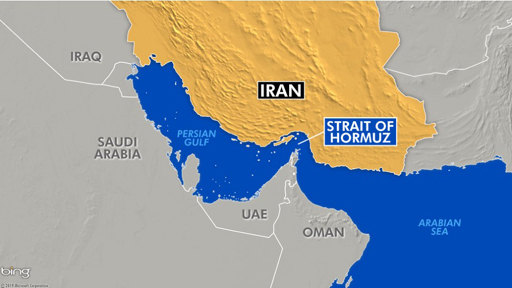

WASHINGTON, D.C. (TIP): The U.S. and its allies have intensified the battle to reopen the Strait of Hormuz, sending low-flying attack jets over the sea lanes to blast Iranian naval vessels and Apache helicopters to shoot down Iran’s deadly drones, The Wall Street Journal reports, quoting American military officials.
The stepped-up operation is part of a multistage Pentagon plan to reduce the danger from Iranian armed boats, mines and cruise missiles, which have halted ship traffic through the waterway since early March. If the danger can be reduced, the U.S. could send U.S. warships through the strait and eventually escort vessels in and out of the Persian Gulf.
But it will still likely take weeks for the U.S. to clear out Iran’s web of assets that have harassed traffic through a chokepoint for 20% of the world’s oil exports and a large amount of commercial shipping traffic. The strait’s effective closure has sent Brent oil prices soaring above $100 a barrel—briefly touching $119 before closing at $108.65, up 1.2%, on Thursday—and forced the Trump administration to grapple with the economic implications of the war it launched alongside Israel on Feb. 28.
Air Force Gen. Dan Caine, chairman of the Joint Chiefs of Staff, revealed the operation in a Pentagon news conference Thursday, saying heavily armed A-10 warplanes, known as the Warthog, along with Apache attack helicopters, were flying missions over the strait or off the southern coast of Iran. “The A-10 Warthog is now engaged across the southern flank, targeting fast-attack watercraft in the Strait of Hormuz,” he told reporters at the Pentagon. He added that the Apaches “have joined the fight on the southern flank.” He said some allies, without naming them, were using Apaches to “handle one-way attack drones,” one of the most effective weapons Iran has used to hit neighboring Arab states and their energy infrastructure across the Persian Gulf. Both the A-10s and the Apaches have for several days been blowing up Iranian fast-attack boats that have been harassing commercial shipping in the strait, a U.S. official said. Jet fighters already in the region can also help take out Iran’s small fast-attack boats and missile threats, but the additional aircraft intensify the campaign, the official said.
The U.S. has been bombing bases and heavily fortified cruise missile batteries manned by the Islamic Revolutionary Guard Corps, the paramilitary organization that oversees defense of the strait along with the Iranian navy, which has its own fleet of attack boats. The strikes have damaged or destroyed more than 120 Iranian naval vessels, Defense Secretary Pete Hegseth said Thursday.
Despite the strikes, Iran is still believed to have a vast stockpile of mines, cruise missiles on trucks and hundreds of undamaged boats in hidden facilities with deeply dug tunnels along the coast and on islands, said Farzin Nadimi, an expert on Iranian defenses at the Washington Institute for Near East Policy.
“I think it will take weeks to reach a point where there can be safe operations in the strait,” he said. “Even then, a lot of the Iranian assets will survive.”
Iran has attacked dozens of vessels in the strait, often with small, unmanned boats carrying explosive charges or airborne drones. Other ships have been hit by projectiles, in the strait and in the Gulf of Oman and the Persian Gulf.
Taking back control of the strait assumed new urgency Thursday as Iran began laying plans to allow select ships through, with Tehran’s Parliament considering a law to charge tolls. It raised the prospect that Iran could leverage its position and make deals with nations that need oil, gas and other commodities produced in the Persian Gulf region.
“In practice, this creates a form of coerced interdependence: states that seek access to gulf energy may find themselves needing to accommodate Iran, whether directly or indirectly,” said Danny Citrinowicz, a national-security fellow at the Atlantic Council, a Washington think tank. Even when the fighting ends, he said in a post on X, “There is real doubt that this dynamic will fundamentally change.”
The extent to which Iran has seeded naval mines in the strait couldn’t be determined. It has a large array of different mines, including versions that can be anchored to the sea floor and detonated by remote control when a ship passes. The U.S. recently moved littoral combat ships, which it uses to clear mines, out of the region.
Only 24 miles wide at its narrowest point, the Strait of Hormuz is such a confined space that cruise missiles can be fired from hundreds of miles away and still hit ships moving through it, said Michael Connell, an Iran analyst at the Center for Naval Analyses, a Washington think tank.
Lowering the threat to the point where ships can resume transiting the strait is “doable but it takes time and you are probably never going to get to 100%,” Connell said. “We could reach a stage where we’re getting ships through and they could still get a lucky shot,” he added. Houthi militants in Yemen, who are aligned with Iran, waged a two-month campaign last year with missiles, drones and unmanned boats against international shipping that parallels Iran’s closure of the strait. The U.S. struck more than 1,000 targets in Yemen, but never succeeded in halting Houthi attacks fully until the two sides declared a truce in May.
U.S. Army Apache attack helicopters, which are equipped with Hellfire missiles, have long had the mission of striking Iranian mine-laying boats from gulf states in the region.
The A-10 was developed to provide close air support for U.S. ground troops but has now been repurposed to strike ships at sea, Caine said.
The Air Force has long sought to retire the A-10s to save funds to develop more technologically advanced weapons that would be more useful in a conflict with China.
But the A-10, with its nose-mounted 30mm gun and wing-mounted bombs, has proven to be useful in past air campaigns against insurgents and now against Iranian targets at sea. In recent months, A-10s have been based in Jordan, from which they have been used to strike Islamic State militants.
The A-10, which has a titanium-lined cockpit to protect the pilot, has primarily seen combat in Iraq and Afghanistan. But it has also been used in a maritime role. In the spring of 2023, the Pentagon deployed the A-10 to help patrol the Strait of Hormuz in response to Iran’s attacks on commercial shipping. In February, A-10s exercised with a littoral combat ship in the region.
A rapid-response unit of roughly 2,200 Marines is on its way to the Middle East, where they could play a role in reopening the strait by seizing the islands off Iran’s southern coast.
(Source: The Wall Street Journal)



3 Trackbacks / Pingbacks