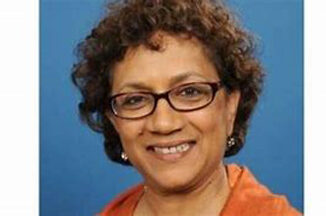
WASHINGTON, D.C. (TIP): Indian American Geeta Rao Gupta has been confirmed by the US Senate as the Ambassador at Large for Global Women’s Issues in the State Department. The department in a tweet on Friday, May 12 said it is looking forward to her efforts to promote women and girls’ rights through US foreign policy. Gupta was confirmed by the US Senate by 51 to 47 votes early this week.
According to Gupta, there are many inequities and indignities that women suffer around the world, which hold them back from participating fully in the economy. “They are subject to threats to their safety and have a fear of violence even on a daily basis, and that determines their mobility. “In situations of conflict and emergencies and humanitarian crises they are particularly vulnerable, both in terms of their safety but also in terms of their being able to look after their families and feed their families,” she said during her confirmation hearing last year.
Tag: Washington
-

Indian American Geeta Rao Gupta to be Ambassador at Large for Global Women’s Issues
-

President Biden to host PM Modi for Official State Visit to US on June 22: White House
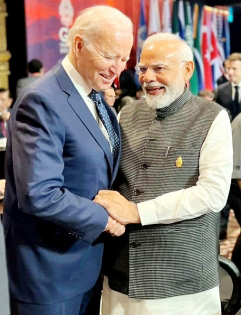
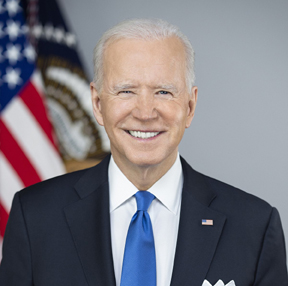
WASHINGTON, D.C. (TIP): President Joe Biden will host Prime Minister Narendra Modi for an Official State Visit to the United States, which will include a state dinner on June 22, the White House announced on Wednesday, May 10. This would be the first State Visit of an Indian leader after then President Barack Obama invited then prime minister Manmohan Singh for a State Visit in November 2009.
President Biden and the First Lady Dr Jill Biden will host Prime Minister Modi for an Official State Visit to the United States June 22, White House Press Secretary Karine Jean-Pierre said in a statement while announcing the visit.
“The upcoming visit will affirm the deep and close partnership between the US and India and the warm bonds of family and friendship that link Americans and Indians together,” she said.
Prime Minister Modi’s visit will strengthen two countries’ shared commitment to a free, open, prosperous, and secure Indo-Pacific, she said, amid China’s aggressive behavior in the strategic region.
The visit will also elevate the bilateral strategic technology partnership, including in defense, clean energy, and space, she said.
“The leaders will discuss ways to further expand our educational exchanges and people-to-people ties, as well as our work together to confront common challenges from climate change to workforce development and health security,” she added.
Prime Minister Modi’s visit to the US comes ahead of the G20 summit being hosted by India in September.
After becoming the Prime Minister in 2014, Modi has made more than half a dozen trips to the United States for bilateral and multilateral meetings with all the three American presidents, Obama, Donald Trump and now Biden, but this is for the first time he has been invited for an official State Visit, a privilege accorded to America’s close friends and allies.
He last visited Washington in September 2021 at the invitation of President Biden for a bilateral meeting and also attended the first in-person Quad Leaders Summit.
Modi will join Biden and his counterparts from Australia and Japan at a summit of the Quad leaders in Sydney on May 24 that is expected to focus on implications of the Ukraine conflict and the overall situation in the Indo-Pacific.
Before travelling to Australia, Modi is likely to visit the Japanese city of Hiroshima to attend the annual summit of the Group of Seven (G7) advanced economies which is scheduled to take place from May 19 to 21.
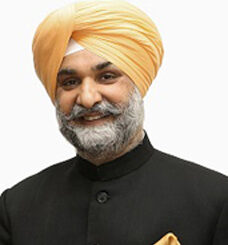
President Biden will attend the G7 leaders’ summit in Hiroshima as well as the Quad summit in Sydney. Modi’s State Visit is reflective of the importance that the President Biden attaches to his personal relationship with him and the India-US ties. “It is entirely good and proper that the world’s two greatest democracies further cement their strategic, economic, and technology convergence in these turbulent geostrategic times. The State Visit will remind the world that India and America still have so much more potential to capture in our bilateral relations, reflecting the energy and talent of our demographics and our systems, which serve to empower our free peoples,” US-India Business Council president Atul Keshap said. Earlier, Prime Minister Modi met President Biden on the sidelines of the G20 Summit in Bali, Indonesia in November last year. The two leaders also met on the sidelines of the G7 Summit in Germany in June 2022 and before that in May on the sidelines of the Quad Leaders Summit in Tokyo. Meanwhile, India’s ambassador the US Taranjit Singh Sandhu, on May 10 said: “Prime Minister Narendra Modi’s visit to the US will show that the partnership between the two nations is people-centric, people-driven, and is good for the world at large”, even as he called the visit “historic.”
“The PM’s forthcoming official state visit to the US, at the invitation of President Biden, is historic. Prime Minister and President Biden have together imparted significantly new vigor and momentum to our bilateral ties,” India’s Ambassador to the US, Taranjit Singh Sandhu told PTI. “The visit will be an opportunity for the two leaders to spend time together, take stock of the progress achieved and provide guidance on the future limitless possibilities. The visit will also underscore that India-US partnership is people-centric and people-driven, and that it is not just for the two countries, but for the world at large,” Sandhu said.
(Source: PTI) -

Diversity is America’s strength: President Biden
WASHINGTON, D.C. (TIP): America’s strength is its diversity, President Joe Biden has said, as he hosted one of the largest gatherings of Asian Americans at the White House attended by several prominent Indian-Americans.
The gathering on Monday, May 8, was organized for the screening of the “American Born Chinese” movie as part of a celebration of Asian American, Native Hawaiian, and Pacific Islander (AANHPI) Heritage Month.
“You embody the truth that our diversity is our strength as a nation. That’s not hyperbole. That’s a fact. That’s why we rebuild our economy, invest in America,” Biden told a packed gathering of the AANHPI community from various parts of the country including several Indian-Americans in the East Room of the White House.
Biden said the AANHPI represents diverse community culture that is reflected in every part of American life, including in the government. “I’m determined to remind everyone and we’re doing it again tonight that our strength lies in our diversity,” he said. Biden has appointed a record number of more than 150 Indian-Americans in his administration. This is for the first time in America’s history that a US administration is as diverse as this led by Vice President Kamala Harris, who is of Indian and African heritage.
“We see the community in all of you here tonight, leaders of business technology, philanthropy, media and so much more. And most of all, we see the possibilities of the community and all the young people here, all of you, what an attractive group of kids you represent. The most gifted and tolerant generation in American history,” he said before the special screening of the movie. “Just remember when one of you becomes President of the United States and your staff tells you Joe Biden’s out in the waiting room to see you promise me, you will not say Joe who. All right, You promised me to remember,” he said amidst laughter in the room.
Along with Harris, Second Gentleman Douglas Emhoff, Acting Labor Secretary Julie Su; Katherine Tai, United States Trade Representative, lawmakers Al Green and Judy Chu, the event was attended by the cast, producers, and partners of “American Born Chinese.” Community leaders and builders, elected officials, and activists who are working to combat hate-fueled violence. Biden was introduced on the occasion by Vietnamese American actor Ke Huy Quan, also known as Jonathan Ke Quan. Quan is one of two actors of Asian descent to win the Academy Award for Best Supporting Actor, and the first Vietnam-born actor to win an Academy Award. Time magazine named him one of the 100 most influential people in the world in 2023.
(Source: PTI) -

India keen to strengthen ‘people-to-people linkages weaved through common thread of Buddhism’: Ambassador Sandhu
WASHINGTON, D.C.(TIP): Describing Buddhism as amongst India’s greatest gifts to the world, Indian ambassador to the US Taranjit Singh Sandhu on Friday, May 5 said New Delhi is keen to strengthen the bond people share through this religion. He was speaking at an event on the occasion of Buddha Purnima.
“Buddhism is amongst the greatest gifts, from India to the world with more than 2,500 years of history. Today it is practiced in more than 100 countries. It is a strong unifying factor. I have, in my previous assignments in Sri Lanka, witnessed how strong our shared Buddhist heritage is,” Sandhu said.
“Under the leadership of Prime Minister Modi, Government of India, is keen to strengthen the people-to-people linkages, weaved through the common thread of Buddhism,” he said.
The event was attended by eminent Buddhist monks from the Greater Washington DC area.
Referring to Modi’s 2017 visit to Sri Lanka on International Vesak Day, he said several initiatives, like the development of the Buddha Circuit in India and Nepal, the rejuvenation of pilgrimage centers, like Sarnath and Kushinagar, the inauguration of the Kushinagar International Airport, the India International Centre for Buddhist Culture and Heritage in Lumbini and International Buddhist Confederation are a few examples of India’s efforts.
Sandhu also mentioned India’s assistance to its neighboring countries and Southeast Asia for the construction and renovation of Buddhist monasteries and joint projects to set up international centers and museums for Buddhist culture and heritage as some other examples. The first Global Buddhist Summit was organized by India last month, where scholars from across the world participated, he added.
“Today, the world is facing multiple challenges in the form of pandemics, terrorism, and environmental degradation. And yet, there is no problem for which solutions could not be found in the teachings of the Buddha, who said, ‘be your own light’ and showed us the path which he himself lived,” he said.
Sandhu said India has been deeply influenced by Buddhist philosophy and working with like-minded partners, including the United States, in addressing the diverse headwinds that we face.
“This is manifested in many ways – as one of the first responders, during disasters, or as an exporter of vaccines, to more than 100 countries, to fight Covid-19 pandemic, or by driving sustainability through Mission LiFE, promotion of Millets and Yoga, or the unifying spirit, in the theme of India’s G20 Presidency, Vasu-dhaiva-kutum-bakam – One Earth, One Family, One Future!” Sandhu said.(Source: PTI)
-

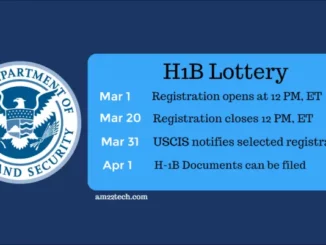
H1B lottery system has resulted in abuse, fraud: US immigration services
USCIS says it is in the process of initiating law enforcement referrals for criminal prosecution
WASHINGTON, D.C. (TIP): The computerized drawing of lots devised to select successful H-1B applicants every year has resulted in abuse of the system and a sharp increase in fraudulent efforts, a federal agency said on Friday, April 28. In an unusual statement, US Citizenship and Immigration Services (USCIS) on Friday, April 28, said that based on evidence from the Financial Year 2023 and Financial Year 2024 H-1B cap seasons, it has already undertaken extensive fraud investigations, denied and revoked petitions.
USCIS said it is in the process of initiating law enforcement referrals for criminal prosecution.
“The H-1B program is an essential part of our nation’s immigration system and our economy, and the USCIS is committed to implementing the law and helping meet the ever-changing needs of the US labor market,” it said.
“We are working on an upcoming H-1B modernization rule that will propose, among other improvements, bolstering the H-1B registration process to reduce the possibility of misuse and fraud in the H-1B registration system,” it added. USCIS said during the registration period for the FY 2024 H-1B cap, it saw a significant increase in the number of registrations submitted compared to prior years.
It said there were 780,884 applications for H-1B visas in this year’s computer-generated lottery, against 4,83,927 in 2023 and 3,01,447 in 2022 and 2,74,237 in 2021.
(Source: PTI) -

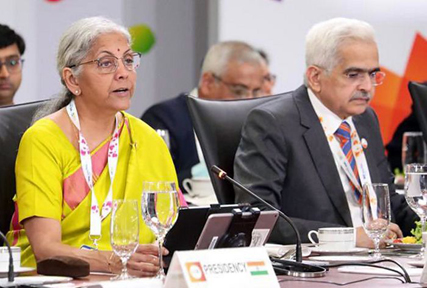
At G20 meet, FM stresses timely debt restructuring to address global crisis
Key challenges to world economic outlook discussed
WASHINGTON, D.C. (TIP): Union Finance Minister Nirmala Sitharaman on Thursday, April 13, called for timely debt restructuring as a solution to the global debt crisis, stressing it was closely intertwined with addressing the global poverty challenge. Addressing the second G20 meeting of Finance Ministers and Central Bank Governors on the first day, Sitharaman noted that the crisis adversely affected countries most in debt as these also housed the poorest people, according to tweets posted by the Ministry of Finance.
Sitharaman is co-chairing the two-day meeting with Reserve Bank of India Governor Shaktikanta Das in Washington. The meeting also discussed key challenges to the global economic outlook and explored possible areas of policy coordination on pressing global issues, besides exchanging views on accelerating progress on deliverables envisioned during the G20 India presidency.
As a priority for India’s G20 Presidency, she said there is a need to augment present global efforts, including those of the G20, to address growing debt distress across the globe.
Sitharaman stressed on debt transparency and information-sharing as well as clarity on the comparability of treatment, predictability and timeliness of the debt restructuring process, including those for steps involved in the process and ways to assess and enforce. Discussions focused on the actions that can be taken now to accelerate debt restructuring processes and make them more efficient, including under the G20 Common Framework, according to a statement issued by the roundtable, .
“We agreed on the importance to urgently improve information sharing including on macroeconomic projections and debt sustainability assessments at an early stage of the process. The IMF and World Bank will rapidly issue staff guidance on information sharing at each stage of the restructuring process,” it said.
“The meeting discussed the role of Multilateral Development Banks (MDBs) in these processes through the provision of net positive flows of concessional finance. The International Development Association’s (IDA) provision of positive net flows and the ex-ante implicit debt relief through increased concessionality and grants to countries facing higher risks of debt distress was welcomed,” the statement said.
To clarify key concepts to support predictability and fairness of debt restructuring processes, a workshop will be organized in the coming weeks on how to assess and enforce comparability of treatment, it said.
“Moreover, further work will be undertaken on principles regarding cut-off dates, formal debt service suspension at the beginning of the process, treatment of arrears, and perimeter of debt to be restructured, including with regard to domestic debt,” the statement said.
This work will also help in clarifying potential timetables to accelerate debt restructurings, it said.
(With inputs from ANI, PTI ) -

Indiaspora to organize its third annual Climate Summit virtually
SAN FRANCISCO CA/WASHINGTON, DC (TIP): Indiaspora, a nonprofit member organization of global Indian diaspora leaders, announced on March 23 that registration is now open for its third annual Climate Summit. This virtual event will take place on Wednesday April 5th at 9:00 am PST |12:00 pm EST | 9:30 pm IST, with a second session on April 5th at 10:00 pm PST | April 6th 10:30 am IST.
Indiaspora’s Climate Summit will bring together a variety of experts in policy, advocacy, academia and more to share their perspectives regarding how we can collectively combat the climate crisis. The event will include panel discussions, fireside chats, and other discussions with opportunities for audience questions and participation.
Presenters:
Mark Tercek Former CEO Nature Conservancy
Suriya Evans-Pritchard Jayanti Senior Fellow- Atlantic Council, Eurasia Center
Varun Sivaram SVP for Strategy & Innovation, Orsted
Shruti M Deorah Senior Energy Policy Specialist, UC Berkeley
Kiran Bhatraju CEO, Arcadia
Rudra Dalmia Co Managing Partner, Green Frontier Capital
Sushant Palakurthi Rao Managing Director for Global Relations, Agility
Amol Phadke Moderator Senior Scientist, UC Berkeley
Jane Burston Executive Director, Clean Air Fund
Dr. Arunabha Ghosh Founder and CEO of Council on Energy, Environment and Water (CEEW)
Anita Arjundas Executive Director, ATREE
Sameer Shishodia CEO, Rainmatter Foundation
Shloka Nath Acting CEO, India Climate Collaborative
Gaurav Gupta (Moderator) Global Managing Partner, Dalberg Advisors
Arun Sharma Head of Sustainability & Climate Change, Adani Group
Veena Sahajwalla Director of the Centre for Sustainable Materials Research & Technology at UNSW
Prachi Shevgaonkar Founder, Cool The Globe
REGISTRATION:
Session I: https://us02web.zoom.us/meeting/register/tZAkf-mrrTkuHNY8g3KTUkS_eDk0zsm-hnWh
Session II: https://us02web.zoom.us/meeting/register/tZYtd-2hpz4uGNMkEmgtRvK5aAWWeSUPsWm1
There is no cost to attend. Open to the public.
About Indiaspora:
Indiaspora (www.indiaspora.org) is a nonprofit community of powerful global Indian leaders from diverse backgrounds and professions who are committed to inspiring the diaspora to be a force for positive impact by providing a platform to collaborate, engage, and catalyze social change. -

New IRS features allow taxpayers electronically filing amended returns to choose direct deposit to speed refunds
WASHINGTON, D.C. (TIP): In the latest improvement for taxpayers, the Internal Revenue Service announced today, February 9, that people electronically filing their Form 1040-X, Amended U.S Individual Income Tax Return, will for the first time be able to select direct deposit for any resulting refund.
Previously, taxpayers who filed Form 1040-X with the IRS had to wait for a paper check for any refund, a step that added time onto the amended return process. Now, anyone who electronically files the Form 1040-X can select direct deposit and enter their banking or financial institution information for quicker delivery of refunds. Taxpayers file a total of approximately 3 million amended returns each year.
“This is a big win for taxpayers and another achievement as we transform the IRS to improve taxpayer experiences,” said IRS Acting Commissioner Doug O’Donnell. “This important update will cut refund time and reduce inconvenience for people who file amended returns. We always encourage direct deposit whenever possible. Getting tax refunds into taxpayers’ hands quickly without worry of a lost or stolen paper check just makes sense.”
The IRS began accepting the Form 1040-X electronically in 2020 but until now did not offer direct deposit as an option for a refund. Following IRS system updates, those filing amended returns can now enjoy the same speed and security of direct deposit as those filing an original Form 1040 tax return. Taxpayers filing an original tax return using tax preparation software can file an electronic Form 1040-X if the software manufacturer offers that service. This is the latest step the IRS is taking to improve service this tax filing season. As part of funding for the Inflation Reduction Act, the IRS has hired more than 5,000 new telephone assistors and is adding staff to IRS Taxpayer Assistance Centers (TACs). The IRS also plans special service hours at dozens of TACS across the country on four Saturdays between February and May.
No matter how a taxpayer files the amended return, they can still use the “Where’s My Amended Return?” online tool to check the status.
Taxpayers still have the option to submit a paper version of the Form 1040-X and receive a paper check. They should follow the instructions for preparing and submitting the paper form. Direct deposit is not available on amended returns submitted on paper.
Current processing time is more than 20 weeks for both paper and electronically filed amended returns, as processing an amended return remains a manual process even if it’s filed electronically. However, filing electronically cuts out the mail time, and including direct deposit information on an electronically submitted form provides a convenient and secure way to receive refunds faster. -

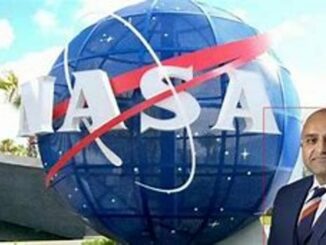
Indian American space expert AC Charania named NASA’s new chief technologist
WASHINGTON, D.C. (TIP): An Indian American aerospace industry expert has been appointed as NASA’s new chief technologist to serve as principal advisor to Administrator Bill Nelson on technology policy and programs at the space agency’s headquarters here.
In his position, AC Charania will align NASA’s agencywide technology investments with mission needs across six mission directorates and oversee technology collaboration with other federal agencies, the private sector, and external stakeholders, NASA said in a statement on Monday.
The position works within NASA’s Office for Technology, Policy, and Strategy.
“Technology plays a vital role in every NASA mission. Making sure that we’re pursuing the best policy objectives allows this agency to continue to serve as a global leader in innovation,” Bhavya Lal, NASA associate administrator for technology, policy, and strategy, was quoted as saying in the statement.
“Charania is an experienced leader in managing large, rapidly shifting technology portfolios. I am eager for him to apply his knowledge and enthusiasm at NASA,” Lal said. Lal served as acting chief technologist prior to the appointment of Charania, whose first day working at NASA Headquarters was January 3.
“The rate of advancement we seek in the 21st century is dependent upon selecting and maturing a portfolio of technologies into systems to execute our missions,” Charania said in the statement.
“With this in mind, there are incredible opportunities in partnerships within and outside of NASA. I now look forward to the opportunity to work with the entire community to increase the rate of space and aviation progress,” he added. Prior to joining NASA, he served as vice president of product strategy at Reliable Robotics, a firm that works to bring certified autonomous vehicles to commercial aviation.
His previous experience also includes working at Blue Origin to mature its lunar permanence strategy, Blue Moon lunar lander program, and multiple technology initiatives with NASA.
Charania has also worked in strategy and business development for the Virgin Galactic (now Virgin Orbit) LauncherOne small satellite launch vehicle program. Charania led the formation of the Fast Forward industry group focused on high-speed point-to-point transportation, was a NASA Innovative Advanced Concepts fellow, and served on the Lunar Exploration Analysis Group Commercial Advisory Board, according to the release. He received a bachelor’s and a master’s degree in aerospace engineering from the Georgia Institute of Technology, and a bachelor’s in economics from Emory University.
-

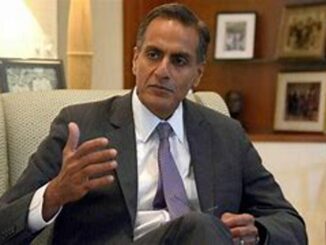
Indian American IMPACT Fund celebrates Biden’s nomination of Richard Verma for Deputy Secretary of State
WASHINGTON, D.C. (TIP): An Indian American body has welcomed the nomination of lawyer diplomat Richard Verma for Deputy Secretary of State, a top diplomatic position in the State Department.
In December, the White House in a statement said that Joe Biden announced his intent to nominate 54-year-old Verma to be Deputy Secretary of State for Management and Resources. If confirmed by the US Senate, Verma, also a former US ambassador to India, would be the highest-ranking Indian American in the State Department.
“This nomination is yet another historic addition by President Biden in his campaign pledge to diversify the current administration,” Indian American Impact Fund said in a statement. Verma’s historic opportunity to join the State Department is the culmination of his long and illustrious career in public service.
“We at Indian American Impact are thrilled to witness and potentially welcome the historic confirmation of yet another visionary South Asian leader,” said Neil Makhija, executive director of Indian American Impact Fund.
-

NASA nails trickiest job on newly launched James Webb Space Telescope
NASA aced the most complicated, critical job on its newly launched space telescope Tuesday: unrolling and stretching a sunshade the size of a tennis court. Ground controllers cheered and bumped fists once the fifth and final layer of the sunshield was tightly secured. It took just 1 1/2 days to tighten the ultra-thin layers using motor-driven cables, half the expected time.
The 7-ton James Webb Space Telescope is so big that the sunshield and the primary gold-plated mirror had to be folded for launch. The sunshield is especially unwieldly — it spans 70 feet by 46 feet (21 metres by 14 metres) to keep all the infrared, heat-sensing science instruments in constant subzero shadow.
The $10 billion telescope is more than halfway toward its destination 1 million miles (1.6 million kilometers) away, following its Christmas Day send-off. It is the biggest and most powerful observatory ever launched — 100 times more powerful than the Hubble Space Telescope — enabling it to peer back to almost the beginning of time.
Considered Hubble’s successor, Webb will attempt to hunt down light from the universe’s first stars and galaxies, created 3.7 billion years ago. “This is a really big moment,” project manager Bill Ochs told the control team in Baltimore. “We’ve still got a lot of work to do, but getting the sunshield out and deployed is really, really big.”
Engineers spent years redoing and tweaking the shade. At one point, dozens of fasteners fell off during a vibration test. That made Tuesday’s success all the sweeter, since nothing like this had ever been attempted before in space.
-

Modi arrives in Washington, DC to a warm welcome by the Indian American community
Sept 23 engagements include meeting with US Vice President Kamala Harris and bilateral with Japanese and Australian PMs
TIP Special Correspondent
WASHINGTON, DC (TIP): Prime Minister Narendra Modi on Thursday, September 23, a day after his arrival here, is scheduled to have as many as eight meetings, including one with Vice President Kamala Harris, on the first working day of his current US trip. Apart from meeting Harris at the White House, the Prime minister will have two bilateral meetings with his Australian and Japanese counterparts — Scott Morrison and Yoshihide Suga.
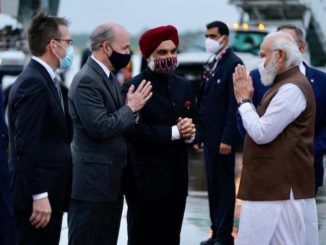
Prime Minister Modi was received on arrival at the Andrews airbase by Mr. T. H. Brian McKeon, Deputy Secretary of State for Management and Resources on behalf of the government of the USA and India’s Ambassador to the US Taranjit Singh Sandhu. A large number of Indian Americans had gathered at the airport, despite rain, to welcome Mr. Modi. Touched by the love and warmth of the Indian American community, Modi later tweeted:
Narendra Modi
@narendramodi
Grateful to the Indian community in Washington DC for the warm welcome. Our diaspora is our strength. It is commendable how the Indian diaspora has distinguished itself across the world.
7:58 PM · Sep 22, 2021·Twitter for iPhone
Modi would kick off his day’s engagements with a series of one-on-one meetings with five top American CEOs representing diverse areas from technology, the IT sector to finance, defense and renewable energy.
These CEO’s include Shantanu Narayen from Adobe and Vivek Lall from General Atomics, Cristiano E Amon from Qualcomm, Mark Widmar from First Solar and Stephen A Schwarzman from Blackstone.
According to sources, these CEOs represent fairly large corporate interests, companies that have particular expertise, have invested in India and have the potential to invest significantly there.
In the afternoon, Modi is scheduled to have a bilateral with Prime Minister Morrison of Australia. The two leaders have met in the past on a number of occasions on the sidelines of various international conferences.
Morrison had recently called Modi to brief him about planning to go ahead with the AUKUS alliance.

Modi meeting the enthusiastic Indian Americans who had gathered at the airport and on way to hotel, despite rain, to welcome him Photo/Twitter The US, Britain and Australia last week announced the AUKUS alliance for the Indo-Pacific to take on the threats of the 21st century and allow for greater sharing of defense capabilities, including help Australia acquire nuclear-powered submarines, in a bid to counter China’s growing power in the strategically vital region. Morrison was to visit India in January last year which he had to postpone because of a massive fire in Australia. Another trip to India in May had to be postponed due to the COVID-19 situation. After meeting with Morrison, Modi would drive down to the White House for a meeting with Indian-origin US Vice President Kamala Harris at her ceremonial office. The maiden meeting between the two leaders has been scheduled for an hour. The two leaders are likely to talk to the press. According to sources, they are expected to talk on a range of issues that interest both sides — from the management of COVID-19 to issues like cooperation in the high tech and space sectors. Prime Minister Modi is looking forward to his first meeting with Vice President Harris, sources said. The two leaders have earlier spoken to each other over the phone during the COVID-19 crisis in June. Later in the day, the prime minister is scheduled to meet prime minister Suga of Japan. The two leaders have been speaking to each other quite frequently. On Friday, the Prime Minister would spend most of his time at the White House, first a bilateral meeting in the Oval Office with President Biden. This would be followed by the first-ever in-person Quad summit.
In November 2017, India, Japan, the US and Australia gave shape to the long-pending proposal of setting up the Quad to develop a new strategy to keep the critical sea routes in the Indo-Pacific free of any influence.
The prime minister will then leave for New York. He is the first speaker scheduled to address the UN General Assembly on September 25.
-

Indian American Congressmen’s Efforts Lead Lawmakers to Condemn China’s Curbs on Hong Kong
WASHINGTON (TIP): Led by Indian American Congressman Ami Bera, a bipartisan group of influential lawmakers on Monday, March 8, expressed concern over changes sought to be imposed by Beijing on Hong Kong’s electoral system. “We are deeply concerned about the changes Beijing announced in Hong Kong’s electoral system. These revisions will only continue to advance Beijing’s ever-tightening grip on Hong Kongers’ autonomy, basic freedoms and fundamental human rights,” said a group of lawmakers from both the House of Representatives and the Senate.
Indian American Congressman Ami Bera who is the chairman of the Asia Sub-Committee of Foreign Affairs Committee of the House led the effort.
He was joined by Ed Markey, the chairman of the East Asia Sub-Committee of the Senate’s Foreign Relations Committee, Senator Mitt Romney, Ranking Member of the East Asia Sub-Committee of the Senate’s Foreign Relations Committee and Congressman Steve Chabot, Ranking Member of the Asia Sub-Committee on the House Foreign Affairs Committee.
Other lawmakers who joined Bera are Senator Jeff Merkley and Congressman James McGovern, co-chairs of the Congressional-Executive Commission on China, and Senator Marco Rubio and Congressman Chris Smith, co-Ranking Members of the Congressional-Executive Commission on China.
The joint statement was issued in response to the Chinese government’s decision to schedule a March 11 vote in the National People’s Congress that would impose new restrictions on Hong Kong’s electoral system.
“With these planned actions, the Chinese Communist Party is doubling its attempts to impose an authoritarian system on Hong Kong,” the statement said.
“Beijing is once again violating its binding international commitments under the 1984 Sino-British Joint Declaration and its obligations under Hong Kong’s Basic Law,” it added.
“Contrary to recent Chinese government statements, true patriots are not ‘yes-men and -women’,” the statement said, adding “Beijing’s efforts to stamp out democratic opposition in Hong Kong only underscores its own insecurities”.
“Congress will continue to speak with one voice in support of freedom, democracy and justice for the people of Hong Kong. In the past two years, we passed legislation giving the executive branch significant new tools to support the people of Hong Kong as they defend their autonomy and basic freedoms,” the statement said.
“We urge the Biden Administration to use those tools, and to work with allies and partners to develop other mechanisms to support the people of Hong Kong,” the lawmakers said.
-

U.S. House passes two Democratic-backed gun control bills
WASHINGTON (TIP): The U.S. House of Representatives on Thursday, March 11, approved a pair of gun control bills as Democrats seized upon a shifting political landscape that they said improved chances for enacting new laws after years of failed attempts, says a Reuters report.
The first measure, which passed the Democratic-led House 227-203, would close a long-standing loophole in gun laws by expanding background checks to those purchasing weapons over the internet, at gun shows and through certain private transactions. Only eight Republicans joined the Democrats in backing the bill.
The second bill, passed 219-210 with only two Republicans supporting it, would give authorities 10 business days for federal background checks to be completed before a gun sale can be licensed. Currently, such sales can proceed if the government cannot complete complicated background checks of prospective buyers within three days. President Joe Biden is a supporter of expanded gun control measures. The legislation may face a tougher battle in the U.S. Senate, where Biden’s fellow Democrats hold an even slimmer majority than in the House.
The bills follow a series of deadly U.S. mass shootings over the past decade. Gun control is a divisive issue in the United States, which enshrines gun rights in its Constitution. Most Republicans strongly oppose gun restrictions, while most Democrats argue that new laws are needed to curb gun violence.
The House Judiciary Committee’s senior Republican, Jim Jordan, wrote on Twitter that House Democrats were “making it harder for law-abiding citizens to buy a gun.”
Many Democrats want to go further by banning sales of some high-capacity, military-style rifles that can fire ammunition rapidly.
Democratic Representative Mike Thompson, who has spearheaded a drive for expanded gun control for years, said 30 people are killed by gun violence daily in the United States, with that number growing to 100 if suicides and accidental deaths involving firearms are counted. At the same time, Thompson said, 170 felons and 50 domestic abusers are stopped from buying a gun every day.
“It only makes sense that if you expand it, you’ll stop even more felons, more domestic abusers,” Thompson said.
Republicans opposing the bills argued that the legislation would not make American streets safer and would infringe upon the right to bear arms guaranteed under the U.S. Constitution’s Second Amendment.
With Democrats now controlling the White House along with both chambers of Congress, they are seeking to pursue liberal goals thwarted when Republicans led either the House or Senate. Democrats have said their position has been further strengthened by turmoil within the National Rifle Association, the influential gun lobby closely aligned with Republicans.
The Senate’s longstanding filibuster rule makes it so most legislation requires 60 votes to proceed in the 100-seat chamber rather than a simple majority, and Republicans could use the maneuver to try to block gun control measures. Senate Majority Leader Chuck Schumer said if that happens, Democrats would “come together as a caucus and we’ll see how we’re going to get this done,” possibly hinting at ending or altering the filibuster rule.
A bipartisan gun control bill in 2013 – proposed after a mass shooting at a Connecticut elementary school – failed on a vote of 54-46 in the Senate, short of the needed 60 votes.
During a news conference before the gun control votes, a tearful Representative Lucy McBath, who lost her son to gun violence, said: “No one deserves the kind of pain and anguish that people are suffering.”
(Source: Reuters)
-

Biden gives a message of hope on the first anniversary of COVID-19 Pandemic
“We are bound together by the hope, by the possibilities”
I.S. Saluja
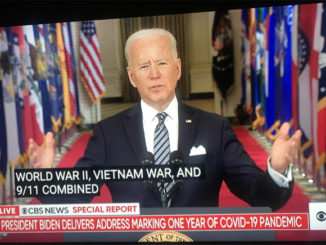
WASHINGTON (TIP): President Joe Biden marked a year since the beginning of the coronavirus “shutdown” with a prime-time speech Thursday, March 11 night where he announced he would direct states to make all adult Americans eligible to get vaccinated by May 1. He also predicted a possible return to some semblance of normalcy by the Fourth of July and detailed several more measures aimed at speeding up vaccinations across the country.
It was the first prime-time address of his presidency, delivered from the White House’s East Room. It came the same day he signed a $1.9 trillion COVID-19 relief package into law, a major legislative victory, and several days before he planned to hit the road to pitch the law to Americans. In his remarks, Biden said he was “announcing that I will direct all states, tribes and territories to make all adults, people 18 and over, eligible to be vaccinated no later than May 1.” But Biden warned that this would not mean all Americans would have their shot on that day. “It means you’ll be able to get in line beginning May 1,” he said. While the federal government procures and distributes vaccine doses, states and other non-federal jurisdictions control eligibility for that supply. While many have largely followed federal guidance for the order in which to vaccinate different groups, there is still a patchwork of different eligibility guidelines that restrict who can receive it. The president also set the Fourth of July as a new marker for the United States on the path to normalcy, saying that if people follow guidelines from the Centers for Disease Control and Prevention — by wearing masks, socially distancing and getting vaccinated when possible. “By July the 4th, there’s a good chance you, your families and friends, will be able to get together in your backyard or in your neighborhood and have a cookout or a barbecue and celebrate Independence Day,” he said.
But, he added, “large events with lots of people together” should still not take place. “After this long hard year, that will make this Independence Day something truly special where we not only mark our independence as a nation but begin to mark our independence from this virus,” Biden said. Earlier in the evening, the White House said the military will deploy 4,000 more active-duty service members “to support vaccination efforts,” with 6,000 total troops backing vaccination programs. It also said the number of community health centers and pharmacies administering COVID-19 vaccines would dramatically expand.
On Friday, the White House said, the administration would allow many more professionals to give shots: dentists, paramedics, veterinarians and even medical and nursing students, among the additional groups.
“We’re mobilizing thousands of vaccinators to put the vaccine in one’s arm,” Biden said in his remarks.
The administration also plans to centralize information on a federally supported website to show vaccination locations — with a call center, too — as well as provide technological support to states that allow people to make vaccination appointments on their own sites, an official said.
Biden’s remarks mixed compassion for the lives lost with hope about the path forward.
“History, I believe, will record, we faced and overcame one of the toughest and darkest periods in this nation’s history,” he said. “The darkest we’ve ever known. I promise you, we’ll come out stronger with a renewed faith in ourselves, a renewed commitment to one another, to our communities and to our country.”
Even so, he said the “truth” was that the country was not out of the pandemic yet — and that Americans must follow scientific guidance to emerge on its other side.
“A lot can happen,” he said. “Conditions can change. The scientists have made clear that things may get worse again. As new variants of the virus spread, we’ve got work to do to ensure that everyone has confidence in the safety and effectiveness of all three vaccines.”
Biden said it was up to Americans to ensure the country made it to the other side of the pandemic.
“Listen to Dr. Fauci,” he said, referencing the government’s top infectious disease expert, Anthony Fauci.
Biden directly condemned recent attacks on Asian Americans, describing them as “vicious hate crimes against Asian Americans who have been attacked, harassed, blamed and scapegoated.”
“At this very moment, so many of them, our fellow Americans, they’re on the front lines of this pandemic trying to save lives, and still — still — they are forced to live in fear for their lives, just walking down streets in America,” he said. “It’s wrong, it’s un-American and it must stop.”
Biden also implicitly criticized his predecessor, President Donald Trump, for intentionally downplaying the virus.
“A year ago, we were hit with a virus that was met with silence and spread unchecked — denials for days, weeks, then months,” he said.
Biden added that “too often, we’ve turned against one another” — with the issue of mask-wearing dividing Americans and states pitted against one another.
Biden briefly mentioned the American Rescue Plan which he signed earlier in the day. He said the plan was meant to provide immediate relief to American people. A family of four will have $5600 to take care of their needs.
The plan, he said, provided forrestoration of health of small businesses which had suffered a lot during the pandemic.
Funds have also been provided in the plan to accelerate vaccination and contain spread of the pandemic.
“Our economy will be back on rails”, he said.
Lauding Americans and America, Biden said, “This country can do anything, hard things, big things”. He hastened to add that anything could be achieved if all come together as “one people, one America”.
“We will come out stronger, with renewed faith in ourselves and America”, he said.
Concluding his address, he offered solace to families which lost their loved ones in the pandemic.
(Agencies)
-

Texas family detention centers expected to transform into rapid-processing hubs

By Nick Miroff WASHINGTON (TIP): A report by Nick Miroff of The Washington Post says that the Biden administration is preparing to convert its immigrant family detention centers in South Texas into Ellis-Island-style rapid-processing hubs that will screen migrant parents and children with a goal of releasing them into the United States within 72 hours, according to Department of Homeland Security draft plans. The plans show the Biden administration is racing to absorb a growing number of migrants crossing the U.S.-Mexico border amid shortages of bed space and personnel. Republicans and some Democrats fear that relaxing detention policies will exacerbate a surge that is already straining the Biden administration. Transforming family detention amounts to a wholesale repudiation not only of the Trump administration’s policies but also those of former president Obama and presents a dramatically new vision of how to handle the fast-changing character of mass migration at the southern border.
For decades, single adults — particularly men — dominated the flows northward into the United States but families and minors traveling without their parents have risen substantially in recent years. Before the pandemic struck, migrant families and unaccompanied minors were a majority of those taken into custody at the southwest border, a trend that more closely resembles refugee streams worldwide.
During the Obama and Trump administrations, most families were quickly released or deported. But some were held in dormitory-style facilities for weeks or months, sometimes longer, for immigration proceedings. Advocates for these families have long said they shouldn’t be detained at all — a sentiment that Biden echoed on the campaign trail last year.
Biden administration facing a border ‘challenge,’ not crisis, DHS chief says
Children should be released from ICE detention with their parents immediately,” Biden wrote on Twitter in June. “This is pretty simple, and I can’t believe I have to say it: Families belong together.”
Six weeks into Biden’s presidency, advocates are frustrated that his administration has continued to detain families and expel them from the border under a public-health order. The number of detained family members more than doubled from 228 adults and children before Biden took office to 476 last week, federal records show.
While the tally is a fraction of the combined capacity of 3,300 people at three family residential centers, the uptick baffled child-welfare advocates who hoped that the detention centers would finally close. They note that Biden and DHS Secretary Alejandro Mayorkas helped to expand use of these detention centers during the Obama administration. “There needs to be open expression of what they’re going to do with these facilities,” said Bridget Cambria, a lawyer representing migrant families in Pennsylvania. “They shouldn’t detain families or children even for one second.” The Biden administration has said it is reviewing the way it uses family detention facilities but told a federal judge last week in a lawsuit over the detentions that their policies had not changed.
But DHS officials, speaking on condition of anonymity to describe the unpublicized plans, said the transition to rapid-release centers is already underway.
ICE emptied out the Berks Family Residential Center in Leesport, Pa, on Friday, releasing all 21 people there. ICE confirmed that the center is empty but would not say why.
Officials are considering turning Berks into a women-only facility for migrants, a DHS official said, while Karnes and Dilley would serve as quick-release intake centers that would screen migrant families, check their backgrounds and release them pending an immigration court hearing. Some would enroll in “alternatives to detention,” such as ankle monitoring programs. Families would undergo coronavirus testing and nonprofits would then help them secure airplane or bus tickets to their final destinations in the United States, typically staying with friends or family.
The goal is to process and release 100 families per day, the plans show. Migrants who test positive for COVID will be quarantined for 10 days.
ICE would not confirm the plans Wednesday and said the detention centers are under review but remain “fully operational.” A spokeswoman said that most attempted border crossers are still being expelled at the southern border.Advocates for immigrants have cheered the preliminary plans in recent days — albeit cautiously, because DHS has not made a formal announcement.
In Texas, advocates said the region’s top immigration officials called them for an emergency conference call on Feb. 20 to discuss plans to transform the centers into shorter-term facilities. Officials told them to prepare for more migrants to be released from Dilley and Karnes.
“It’s incredibly encouraging to hear a completely different philosophy and attitude for people coming into this country,” said Daniel Klein, board chair for the Interfaith Welcome Coalition, and who was on the call, which was first reported by the San Antonio Express-News.
Klein said the nonprofit has added more volunteers at the bus station in downtown San Antonio to help migrants find shelter or make travel plans sometimes spending $1,000 a night on food, water and bus tickets.
“We welcome the change because the detention of families — we never thought that was a good system or a good policy at all for individuals who are coming to the U.S.,” said Edna Yang, co-executive director of American Gateways, an immigration legal aid organization in Texas, who was on the ICE conference call last month. “They shouldn’t be detained, and they should be given the opportunity to go before the immigration judge and be released in the community and not held like prisoners.”
These plans are part of a series of changes Biden has made to the immigration system since taking office. But as he tries to rebuild the system and make it more humane, Biden is also eager to skirt a border crisis that could imperil his legislative agenda, including an effort to legalize 11 million longtime undocumented immigrants.
Many Republican lawmakers and some Democrats from southern border communities expressed concern that hastening the release of migrant families would encourage an even larger surge on the border at a time when they are reeling from the coronavirus and a deadly winter storm that cut power to millions and killed more than 30 in Texas. Rep. Henry Cuellar (D-Texas) said he urged the Biden administration to slow all of their immigration plans in an appearance on Fox News Wednesday, citing statistics showing border apprehensions are on track to reach the historic levels of families and unaccompanied minors crossing in 2019.
“Let’s be cautious,” Cuellar said he told the White House. “They cannot only listen to the immigration activists. They also need to listen to the communities on the border that I represent, the mayors, the judges, the NGOs down there. And with that, you can come up with a balanced approach.
The Biden administration has not yet detailed how exactly it will cope with another influx.
In 2014 — when Biden was vice president and Mayorkas was deputy DHS secretary — the United States experienced an influx of 68,000 families, up from 14,800 the year before. At the time, Biden said this was a “crisis” that was “untenable and unsustainable,” and he and Mayorkas worked to stem flows from Central America and expanded family detention by opening the facilities in Dilley and Karnes. Mayorkas said then that he would ensure that “the detention of adults with children is done as humanely as possible.”
After the centers expanded migrant families apprehended at the border dropped below 40,000, but detention did not stop the flows and after a judge ruled that officials could not detain children longer than 20 days in unlicensed facilities the numbers began to rise again. Advocates for immigrants say detention had little impact because of the severe conditions in Central America and the Caribbean that are driving migrants north, such as violence, climate change, poverty and government corruption.
The numbers have only continued to grow.
More than 470,000 migrant families and 76,000 unaccompanied minors arrived in fiscal year 2019, a record on both counts, and most were released into the country pending a court hearing.
Dora Schriro, who led ICE’s office of detention policy and planning, said ICE’s experience with family detention shows that it is harmful to both children and their parents by placing them in conditions where they are afraid. She said she found the conditions in family detention “dehumanizing” and removed all families from a Texas facility and reduced capacity to 84 beds at the facility in Pennsylvania, a former nursing home that opened under the George W. Bush administration. She left ICE in 2009 to run New York City’s Department of Correction.
After the Obama administration dramatically expanded the detention centers to more than 3,300 beds, she said DHS asked her and others to issue recommendations in a report published in late 2016, just before Trump took office. Their first recommendation: DHS should operate under the “presumption that detention is generally neither appropriate nor necessary for families” and “detention is never in the best interest of children.”
“DHS should discontinue the general use of family detention, reserving it for rare cases when necessary,” because someone is a flight risk or a danger to the community, the report said.
Soon after, Trump took office and sought to detain families and even separated parents from their children in a failed attempt to stem the rising flows of migrants.
Schriro said the Biden administration faces dual challenges at the border — keeping its international obligations to offer safe refuge to people feeling harm, and making sure Americans are safe from people who would pose a danger crossing into the United States.
“You’ve got two really critical commitments and this administration is finding a path to honor both of those obligations,” she said. “The trick is not sacrificing one for the other.”
(Nick Miroff covers immigration enforcement and the Department of Homeland Security for The Washington Post. He was a Post foreign correspondent in Latin America from 2010 to 2017 and has been a staff writer since 2006.)
(Source; The Washington Post)
-

Out competing China will be key to national security in decades ahead: Biden’s CIA nominee
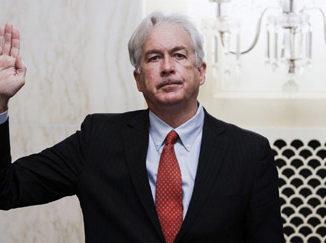
WASHINGTON (TIP): Out competing China will be key to America’s national security in the decades ahead, President Joe Biden’s pick to lead the CIA has told lawmakers, stressing that Beijing is the “biggest geopolitical test” that the US will face. Willian Burns, 64, a former diplomat who served in Russia and the Middle East, shared the assessment with members of the Senate Select Committee on Intelligence during his confirmation hearing on Wednesday, Feb 23, for the post of Central Intelligence Agency (CIA) Director.
“Out competing China will be key to our national security in the decades ahead. That will require a long-term clear eyed bipartisan strategy underpinned by domestic renewal and solid intelligence,” Burns said.
“There will be areas in which it will be in our mutual self-interest to work with China from climate change to nonproliferation. And I am very mindful that (President) Xi Jinping’s China is not without problems and frailties of its own,” he said. “The challenge posed by Xi Jinping’s China, by an adversarial China, it is hard for me to see a more significant threat or challenge for the United States as far out as I can see into the 21st century than that one. It is the biggest geopolitical test that we face,” Burns said.
The relations between the US and China are at an all-time low. The two countries are currently engaged in a bitter confrontation over various issues, including trade, the origins of the novel coronavirus pandemic, the communist giant’s aggressive military moves in the disputed South China Sea and human rights.
“There are, however, a growing number of areas in which Xi’s China is a formidable authoritarian adversary, methodically strengthening its capabilities to steal intellectual property, repress its own people, bully its neighbors, expand its global reach, and build influence in American society,” Burns said.
For the CIA, that will mean intensified focus and urgency, continually strengthening its already impressive cadre of China specialists, expanding its language skills, aligning personnel and resource allocation for the long haul, and employing a whole of agency approach to the operational and analytical challenges of this crucial threat, he told the lawmakers.
“Another priority intimately connected to competition with China is technology,” he said.
Responding to a question, Burns said that the evolution of China under Xi’s rule over the last six or seven years has been a very sharp wake-up call in a lot of ways, the kind of aggressive, undisguised ambition and assertiveness has made very clear the nature of the adversary and rival that America faces today.
“The challenge is how do you build a long-term… We have to buckle up for the long haul, I think, in competition with China. This is not like the competition with the Soviet Union and the Cold War, which was primarily in security and ideological terms,” he said.
“This is an adversary that is extraordinarily ambitious in technology and capable in economic terms as well. So, it is buckling up for the long term and developing a very clear-eyed bipartisan strategy, which I think is entirely possible right now,” Burns said.
Burns told lawmakers that it’s important for the United States to view cooperation with China on climate issues is not a favor to the United States. It’s in the self-interest of China to do that.
“So, in other words, it’s not something to be traded. It’s in the self-interest of China as well to work on these issues. And it’s important for us to be clear eyed about that, as I’m sure the president and Secretary (John) Kerry will be,” he said. The Chinese military has been flexing its muscles in the strategically vital Indo-Pacific region and is also engaged in hotly contested territorial disputes in both the South China Sea and the East China Sea.
Also, at the hearing, Burns stressed the importance of “firmness and consistency” in responding to Russia, CNN reported. Burns said he learned through his foreign policy work “in dealing with those threats, responding to them and deterring them, firmness and consistency is hugely important, and it’s also very important to work to the maximum extent possible with allies and partners.” “We have more effects sometimes on Putin’s calculus, when he sees responses coming, firm responses coming not just from the United States, but from our European allies and others as well. So, it pays off to work hard at widening that circle of countries who are going to push back,” he was quoted as saying by the report.
Burns also said that “it’s always a mistake to underestimate Putin’s Russia,” noting that under Vladimir Putin’s leadership it can be at least as disruptive as a rising power like China.
“So, we have to be quite cold-eyed in our view of how those threats can emerge,” he said.
If confirmed, Burns won’t be a member of Biden’s Cabinet, which represents a change from the Trump administration, but a return to the status the job had in the Obama administration, the report added.
CIA deputy director David Cohen has served in the role of acting director as Burns awaits confirmation. (Source: PTI)
-

US report on Khashoggi death expected to single out Saudi crown prince
Riyadh admitted that Khashoggi was killed in a “rogue” extradition operation gone wrong
WASHINGTON (TIP): A declassified version of a U.S. intelligence report expected to be released on Thursday, February 25, finds that Saudi Crown Prince Mohammed bin Salman approved the 2018 killing of journalist Jamal Khashoggi, four U.S. officials familiar with the matter said, according to a Reuters report. The officials said the report, for which the CIA was the main contributor, assessed that the crown prince approved and likely ordered the murder of Khashoggi, whose Washington Post column had criticized the crown prince’s policies.
President Joe Biden, a Democrat who succeeded the Republican Donald Trump five weeks ago, told reporters on Wednesday he had read the report and expected to speak soon by phone with Saudi Arabian King Salman, 85, father of the crown prince, the country’s 35-year-old de facto ruler.
The report’s release is part of Biden’s policy to realign ties with Riyadh after years of giving the Arab ally and major oil producer a pass on its human rights record and its intervention in Yemen’s civil war.
Biden is working to restore the relationship with Riyadh to traditional lines after four years of cozier ties under Trump. White House spokeswoman Jen Psaki told reporters on Wednesday Biden would only communicate with the Saudi king and said the declassified Khashoggi report was being readied for release soon.
While Biden restricts his contacts to the king, others in the Biden administration are talking to Saudi officials at various levels. “We have been in touch with Saudi officials at numerous levels in the early weeks of this administration,” said State Department spokesman Ned Price.
The 59-year-old Khashoggi, a Saudi journalist and Washington Post columnist, was lured to the Saudi consulate in Istanbul on Oct. 2, 2018 and killed by a team of operatives linked to the crown prince. They then dismembered his body. His remains have never been found.
Riyadh eventually admitted that Khashoggi was killed in a “rogue” extradition operation gone wrong, but it denied any involvement by the crown prince. Five men given the death penalty for the murder had their sentences commuted to 20 years in jail after being forgiven by Khashoggi’s family.
In 2019, a U.N. human rights investigator, Agnes Callamard, accused Saudi Arabia of a “deliberate, premeditated execution” of Khashoggi and called for further investigation.
“There is sufficient credible evidence regarding the responsibility of the crown prince demanding further investigation,” Callamard said after the six-month probe.
A classified version of the report was shared with members of Congress in late 2018.
But the Trump administration rejected demands by lawmakers and human rights groups to release a declassified version, seeking to preserve cooperation amid rising tensions with Riyadh’s regional rival, Iran, and promote U.S. arms sales to the kingdom.
Biden’s new director of national intelligence, Avril Haines, committed at her confirmation hearing to complying with a provision in a 2019 defense bill that required the Office of the Director of National Intelligence to release within 30 days a declassified report on Khashoggi’s murder.
Biden pledged during the 2020 presidential campaign to reassess U.S.-Saudi ties in part over Khashoggi’s murder. Since taking office, he has ended sales of offensive arms that Riyadh could use in Yemen and appointed a special envoy to boost diplomatic efforts to end that country’s grueling civil war.
(Source: Reuters)
-

Indian American Climate Expert Bidisha Bhattacharyya Appointed to Key Post in US Agriculture Department
WASHINGTON (TIP): The Biden administration has appointed an Indian American climate and energy expert, who spent three years deploying solar energy solutions in rural India, to a key position in the agriculture department. Bidisha Bhattacharyya on Monday, Feb 22, was appointed as Senior Policy Advisor in the Farm Service Agency (FSA). She was earlier posted as Director of Climate and Energy Policy at the Centre for American Progress. Prior to joining American Progress, Ms Bhattacharyya was vice president of Emerging Markets at the impact-investment firm Village Capital, where she led a global team across India, Mexico, and East Africa to invest in high-impact startups innovating to solve problems across clean energy deployment and financial inclusion. She previously spent three years deploying solar energy solutions in rural India with the technology startup Simpa Networks, where she led the end-to-end rollout of a new off-grid solar product line. Ms Bhattacharyya spent four years on Capitol Hill as Senior Energy and Agriculture Policy Adviser to Senator Al Franken of Minnesota and as Energy and Agriculture Legislative Assistant for Congressman Betty McCollum of Minnesota. She holds a master’s degree in public policy from Harvard University. She holds a bachelor’s degree in economics from St Olaf College.
-

NASA’s Moment of Joy: Perseverance Rover Lands on Mars
The Rover is only the fifth ever to set its wheels down on Mars.
WASHINGTON (TIP): “Touchdown confirmed,” said operations lead Swati Mohanat around 3:55 pm Eastern Time (2055 GMT),and mission control at NASA’s Jet Propulsion Laboratory headquarters erupted in cheers. It was NASA’s moment of joy and pride. After seven months in space, NASA’s Perseverance rover survived a nail-biting landing phase to touch down gently on the surface of Mars on Thursday, ready to embark on its mission to search for the signs of ancient microbial life. The autonomously guided procedure was completed more than 11 minutes earlier, which is how long it takes for radio signals to return to Earth.
“WOW!!” tweeted NASA Associate Administrator Thomas Zurbuchen as he posted Perseverance’s first black and white image from the Jezero Crater in Mars’ northern hemisphere.
US President Joe Biden hailed Perseverance’s “historic” landing.
“Today proved once again that with the power of science and American ingenuity, nothing is beyond the realm of possibility,” he tweeted.
Congratulations to NASA and everyone whose hard work made Perseverance’s historic landing possible. Today proved once again that with the power of science and American ingenuity, nothing is beyond the realm of possibility. pic.twitter.com/NzSxW6nw4k
— President Biden (@POTUS) February 18, 2021
Over the course of several years, Perseverance will attempt to collect 30 rock and soil samples in sealed tubes, to be eventually sent back to Earth sometime in the 2030s for lab analysis.
About the size of an SUV, it weighs a ton, is equipped with a seven foot (two meter) long robotic arm, has 19 cameras, two microphones, and a suite of cutting-edge instruments to assist in its scientific goals.
Before it could embark on its lofty quest, it first had to overcome the dreaded “seven minutes of terror” — the risky landing procedure that has scuppered nearly 50 percent of all missions to the planet.
Shortly after 3:30 pm Eastern Time (2030 GMT), the Mars 2020 spacecraft careened into the Martian atmosphere at 12,500 miles (20,000 kilometers) per hour, protected by its heat shield.
It then deployed a supersonic parachute the size of a Little League field, before firing up an eight-engined jetpack to slow its descent even further, and then eventually lower the rover carefully to the ground on a set of cables.
Its target site was “absolutely treacherous for landing,” Allen Chen, lead engineer for the landing stage said Thursday. But the vessel had new landing technologies up its sleeve to help it navigate during descent, including the “Terrain Relative Navigation” that uses a special camera to identify surface features and compare them to an onboard map.
Scientists believe that around 3.5 billion years ago the crater was home to a river that flowed into a lake, depositing sediment in a fan-shaped delta.
“The question of whether there’s life beyond Earth is one of the most fundamental and essential questions we can ask,” said NASA geologist Katie Stack Morgan.
“Our ability to ask this question and develop the scientific investigations and technology to answer it is one of the things that make us as a species so unique.”
It will begin drilling its first samples in summer, and its engineers have planned for it to traverse first the delta, then the ancient lake shore, and finally the edges of the crater.
Perseverance’s top speed of 0.1 miles per hour is sluggish by Earth standards but faster than any of its predecessors, and along the way it will deploy new instruments to scan for organic matter, map chemical composition, and zap rocks with a laser to study the vapor.
“We astrobiologists have been dreaming about this mission for decades,” said Mary Voytek, head of NASA’s astrobiology program.
Despite the rover’s state-of-the-art technology, bringing samples back to Earth remains crucial because of anticipated ambiguities in the specimens it documents.
For example, fossils that arose from ancient microbes may look suspiciously similar to patterns caused by precipitation.
Before getting to the main mission, NASA wants to run several eye-catching experiments.
Tucked under Perseverance’s belly is a small helicopter drone that will attempt the first powered flight on another planet.The helicopter, dubbed Ingenuity, will have to achieve lift in an atmosphere that’s one percent the density of Earth’s, in a demonstration of concept that could revolutionize the way we explore other planets.
Another experiment involves an instrument that can convert oxygen from Mars’ primarily carbon dioxide atmosphere, much like a plant, using the process of electrolysis to produce 10 grams of oxygen an hour.
The idea is that humans eventually won’t need to carry their own oxygen, which is crucial for rocket fuel as well as for breathing.
Perseverance’s two microphones will meanwhile attempt to record the Martian soundscape for the very first time, after past efforts failed.
The rover is only the fifth ever to set its wheels down on Mars. The feat was first accomplished in 1997 and all of them have been American.
That will probably soon change: China’s Tianwen-1 spacecraft entered Martian orbit last week and is expected to touch down with a stationary lander and a rover in May.
(Agencies)
-

US reaches H-1B visa cap for 2021
Successful candidates for the most sought-after work visa among foreign professionals, including Indians, will be decided by a computerized draw of lots
WASHINGTON (TIP): The US has received enough petitions needed to reach the congressionally mandated 65,000 H-1B visa cap for the fiscal year 2021 and successful candidates for the most sought-after work visa among foreign professionals, including Indians, would be decided by a computerized draw of lots.
The H-1B visa is a non-immigrant visa that allows the US companies to employ foreign workers in specialty occupations that require theoretical or technical expertise. The technology companies depend on it to hire tens of thousands of employees each year from countries like India and China.
US Citizenship and Immigration Services (USCIS) has said it has received a sufficient number of petitions needed to reach the congressionally mandated 65,000 H-1B visa regular cap and the 20,000 H-1B visa US advanced degree exemption, known as the master’s cap, for fiscal year (FY) 2021.
Successful applicants would be decided by a computerized draw of lots.
“We have completed sending non-selection notifications to registrants’ online accounts,” a media release said.
“We will continue to accept and process petitions that are otherwise exempt from the cap,” it said.
Petitions filed for current H-1B workers who have been counted previously against the cap, and who still retain their cap number, are exempt from the FY 2021 H-1B cap.
The USCIS will continue to accept and process petitions filed to extend the amount of time a current H-1B worker may remain in the US and change the terms of employment for current H-1B workers.
The Biden administration this month announced that it was delaying the H-1B policy of the previous Trump administration on the allocation of the popular foreign work visas by continuing with the lottery system until December 31, 2021, to give the immigration agency more time to develop, test and implement the modifications to the registration system.
On January 7, the US Citizenship and Immigration Services (USCIS) announced to do away with the traditional lottery system in deciding the successful applicants for the H-1B visas.
The Trump-era rule was scheduled to go into effect on March 9.
(Source: PTI)
-

India- Born Muslim chaplain graduates from Chaplin College to take her duty as a spiritual mentor
WASHINGTON (TIP): Saleha Jabeen, US military’s first India-born female Muslim chaplain, has graduated from Air Force Basic Chaplain Course, vowing to take her duty as a spiritual mentor very seriously.
The historic graduation ceremony was held on February 5, an official statement said on Wednesday.
Jabeen said she was grateful for the opportunity and aware of the responsibility that she has to set an example and show that there is a place in the military for anyone who wants to serve.
“I did not have to compromise on any of my religious beliefs or convictions. I am surrounded with people who respect me and are willing to receive what I bring to the table as a woman, a faith leader, and an immigrant,” she said. “I am provided with numerous opportunities to learn and develop skills that best equip me to be a successful officer and a chaplain in a pluralistic environment,” Jabeen said.
Jabeen was commissioned in December as a Second Lieutenant at the Catholic Theological Union in Chicago, becoming the first female Muslim chaplain in the Department of the Defense. She came to the United States 14 years ago as an international student.
“I get to provide spiritual care to all service members, guardians and families and advise the commanders on religious and moral matters regardless of my faith, ethnicity or gender. Like our boss says, it has never been a better time to serve as a chaplain in the US Air Force Chaplain Corps,” she said.
Capt. John Richardson, Air Force Chaplain Corps College staff chaplain, said that his goal is to create chaplains who are ready to provide front-line ministry upon graduation.
“They are trained to lead the units they serve spiritually. The bottom line is to care for Airmen – every single Airman. When they care for Airmen in a professional way, every other aspect of our calling falls into place: advising leaders and providing for the religious needs of our force,” Richardson said.
Capt. Mara Title, Air Force Chaplain Corps College staff chaplain, said Jabeen’s addition to the chaplain corps will be of great benefit to everyone.
“The Air Force Chaplain Corps endeavors to promote diversity in all respects,” Title said.
“Chaplain Saleha Jabeen’s presence enables an even broader scope of spiritual care for our Airmen, and for this we are very grateful. She is as determined to take on the role of chaplain as she is kind, caring and compassionate. We are thrilled to have had the opportunity for her to graduate with the class of BCC 21A,” she said.
Jabeen said she was passionate about her role as a chaplain and takes her duty as a spiritual mentor very seriously.
“We all have a purpose that is specifically meant for us to fulfill,” she said.
“We must listen to our heart and follow our conviction. It is important to have people in our lives who model that for us. Choose that kind of mentorship and choose good companionship. I just want people to remember that God, or higher power or the values that people uphold, remind us that we all are created with a plan: to become the best versions of ourselves,” she said.
-

Economic Impact Payments issued; eligible people can claim Recovery Rebate Credit
WASHINGTON (TIP): The IRS announced, Feb 18, that, as required by law, all legally permitted first and second round of Economic Impact Payments have been issued and the IRS now turns its full attention to the 2021 filing season. Beginning in April 2020, the IRS and Treasury Department began delivering the first round of Economic Impact Payments within two weeks of the legislation. The IRS issued more than 160 million EIPs to taxpayers across the country totaling over $270 billion, while simultaneously managing an extended filing season. In addition, since Congress enacted the COVID-related Tax Relief Act of 2020, the IRS has delivered more than 147 million EIPs in the second-round totaling over $142 billion. The legislation required that the second round of payments be issued by Jan. 15, 2021. While some second round Economic Impact Payments may still be in the mail, the IRS has issued all first and second Economic Impact Payments it is legally permitted to issue, based on information on file for eligible people. Get My Payment was last updated on Jan. 29, 2021, to reflect the final payments and will not update again for first or second Economic Impact Payments. Most people who are eligible for the Recovery Rebate Credit have already received it, in advance, in these two rounds of Economic Impact Payments. If individuals didn’t receive a payment – or if they didn’t receive the full amounts – they may be eligible to claim the Recovery Rebate Credit and must file a 2020 tax return. Eligibility for and the amount of the Recovery Rebate Credit are based on 2020 tax year information while the Economic Impact Payments were based on 2019 tax year information. For the first Economic Impact Payment, a 2018 return may have been used if the 2019 was not filed or processed.
Individuals will need to know the amounts of any Economic Impact Payments they received to claim the Recovery Rebate Credit. Those who don’t have their Economic Impact Payment notices can view the amounts of their first and second Economic Impact Payments through their individual online account. For married filing joint individuals, each spouse will need to log into their own account.
To avoid refund delays, the IRS urges people to file a complete and accurate tax return. Filing electronically allows tax software to figure credits and deductions, including the Recovery Rebate Credit. The Recovery Rebate Credit Worksheet on Form 1040 and Form 1040-SR instructions can also help.
Anyone with income of $72,000 or less, including those who don’t have a tax return filing requirement, can file their federal tax return electronically for free through the IRS Free File Program. The fastest way to get a tax refund is to file electronically and have it direct deposited – contactless and free – into the individual’s financial account. Bank accounts, many prepaid debit cards and several mobile apps can be used for direct deposit when you provide a routing and account number. IRS.gov/filing has details about IRS Free File, Free File Fillable Forms, free VITA or TCE tax preparation sites in your community or finding a trusted tax professional.
More information
Recovery Rebate Credit Video
Publication 5486, Claiming the Recovery Rebate Credit on a 2020 Tax Return
Recovery Rebate Credit Frequently Asked Questions
IRS.gov/freefile
(IRS press release)
-

Republic Day celebrated at Indian Embassy in Washington

Ambassador Taranjit Singh Sandhu reads out the president’s Address to the Nation 
Virtual participation in Republic Day celebration. WASHINGTON (TIP): The 72nd Republic Day of India was celebrated in Washington D.C. with a flag-hoisting ceremony on 26th January 2021 at the India House. Members of the Indian community joined the celebrations in large numbers virtually, in view of the local public health guidelines due to COVID 19.
Ambassador of India, H.E. Taranjit Singh Sandhu, unfurled the tricolor, which was followed by singing of the National Anthem. In his remarks to the community, Ambassador complimented them for their work during the pandemic and their role in bringing India and the US closer. He said that the Indian Government “looks forward to working with the new Administration, led by President Joseph Biden and Vice President Kamala Harris. From outer space to nanotechnology, from the Indo-Pacific to climate change, from healthcare to education & IT, there is a recognition, that our partnership can benefit, not just our two nations, but the entire world.” The Address by the Hon’ble President of India on the eve of Republic Day was played. This was followed by a short cultural program involving local artist and rendition of patriotic songs by students of Gandharva School of Music, Richmond, and a violin recital by Mr. KamalakiranVinjamuru.