
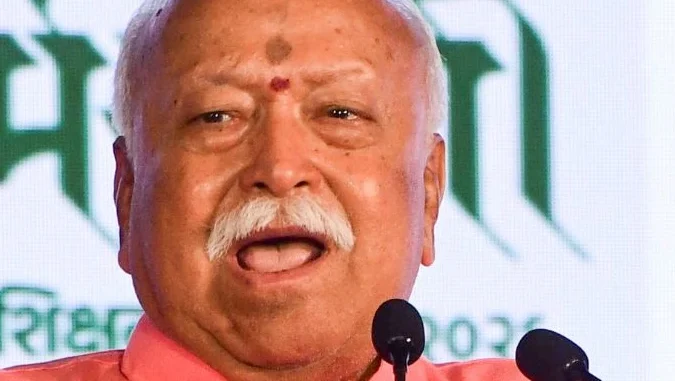

Celebrate him or protest him—that is the freedom America guarantees. But Indian Americans must not allow rhetoric here to deepen communal divisions in India.
Mohan Bhagwat, Sarsanghchalak of the Rashtriya Swayamsevak Sangh, comes to New York carrying not merely the leadership of a century-old organization, but a century of controversy over what India is—and what India should become.
His scheduled appearance in New York on August 29 has generated enthusiasm among supporters of the RSS and opposition from minority, interfaith and human-rights groups. Supporters regard the RSS as a patriotic cultural organization devoted to Hindu society and India’s civilizational regeneration. Critics see it as the ideological fountainhead of a Hindu majoritarian project that could threaten India’s plural character.
Both sides feel strongly.
Our appeal is simple: Exercise your freedom. But lower the temperature.
Those who admire Bhagwat should welcome him, attend his meeting and celebrate his visit. Those who oppose the RSS should protest peacefully, question its philosophy and present their alternative vision of India.
America protects both.
A CENTURY OF ARGUMENT
Founded by Keshav Baliram Hedgewar in Nagpur in 1925, the RSS has become one of modern India’s most consequential organizations.
Its history deserves greater care than either admirers or detractors sometimes give it. Hedgewar participated in anti-British activity, and the RSS maintains that individual swayamsevaks participated in independence movements. But the organization did not occupy the institutional place in Gandhi’s mass freedom struggle that the Indian National Congress did; its principal project became the organization of Hindu society.
The shadow of Mahatma Gandhi’s assassination also remains part of the historical argument. Nathuram Godse had an association with the RSS, although his precise status at the time of the assassination remains disputed. It would be wrong to turn that association into an unsupported allegation of organizational responsibility for Gandhi’s murder.
History should neither be sanitized nor weaponized. Facts without fear. Fairness without favor.
WHAT KIND OF INDIA?
The more important argument today concerns the meaning of Hindu Rashtra. The RSS places Hindu civilization at the center of its conception of Indian nationhood. Bhagwat has described Bharat as a Hindu Rashtra while arguing that the concept does not exclude Muslims or Christians. Critics remain unconvinced.
Their concern produces a legitimate question: Why should an Indian Muslim, Christian, Sikh, Buddhist, Jain—or an Indian of no faith—have to understand citizenship through terminology identified principally with another religious-cultural tradition?
Why cannot each simply be an Indian, equal in citizenship, dignity and ownership of the Republic? That question deserves an answer, not an insult.
INDIA IS LARGER THAN ANY ORGANIZATION
The RSS is a century old. Indian civilization is millennia old. Across centuries, India encountered peoples, languages, philosophies and faiths and displayed an extraordinary capacity to absorb and accommodate. This is not to romanticize history. India has known conquest, caste oppression, religious persecution, Partition and horrific communal violence. Yet India endured—not because everyone became alike, but because it continued making room for difference.
Hinduism itself contains remarkable philosophical diversity. India became home to Buddhists, Jains, Sikhs, Muslims, Christians, Jews and Zoroastrians. That inheritance belongs to no single organization, party or community. India belongs to Indians. All of them.
A WORD TO THE CELEBRANTS
To Hindu Americans enthusiastic about Bhagwat’s visit: welcome him. You have every right to honor a leader you admire and celebrate a heritage you cherish. But pride in Hindu civilization need not become contempt for another faith. Do not allow enthusiasm to become rhetoric challenging Muslims, Christians, Sikhs or other minorities. And do not import India’s communal antagonisms into American streets.
Diaspora communities carry a particular responsibility. A provocative statement made comfortably in New York can reach an Indian neighborhood within seconds and have consequences far from those who uttered it.
Words have passports now. Those who speak here should remember those who must live together there.
A WORD TO THE PROTESTERS
To those who distrust the RSS: protest peacefully if your conscience requires it. Question Bhagwat. Challenge Hindutva. Dispute historical claims and oppose policies you consider discriminatory. But do not answer perceived intolerance with intolerance. Nor should every Hindu who admires the RSS be presumed hostile to minorities. Pride in Hindu civilization does not automatically imply hatred of another faith. Challenge the ideology without condemning the community. India has already paid too terrible a price when political disagreement becomes communal antagonism.
LET AMERICA PROVIDE THE LESSON
There is an instructive irony in this controversy. Bhagwat’s admirers can gather because America protects their freedom of expression. His opponents can demonstrate because America protects theirs. One may defend Hindutva. Another may condemn it. And when the argument ends, each remains entitled to equal protection of law.
That is not weakness. That is democratic confidence.
India’s Constitution contains its own magnificent expression of that principle.
It does not begin: We, the Hindus.
Or: We, the Muslims.
Or: We, the majority.
It begins: WE, THE PEOPLE OF INDIA.
Those words embrace Hindu and Muslim, Sikh and Christian, believer and non-believer, majority and minority. Everyone is an heir to India. Everyone is an owner of the Republic.
LET INDIA REMAIN INDIA
The RSS is entitled to advocate its conception of India’s future. Its opponents are entitled to reject it. Political parties may seek mandates for their ideas. The people decide. But political strength should never persuade any party or organization that it owns India.
India’s greatness has never depended upon everybody praying alike, speaking alike or thinking alike. Its extraordinary achievement has been remaining India despite its astonishing diversity.
So welcome Mohan Bhagwat. Or protest Mohan Bhagwat. But let neither celebration nor protest become an occasion for Indians to push one another farther apart. A confident majority need not fear a minority. A secure faith does not require another faith to become insecure. And an ancient civilization does not become stronger by narrowing the definition of who belongs to it.
Perhaps the most useful message Indian Americans can send home this weekend is therefore the simplest: Do not make India smaller in the name of making it stronger.
Let Bhagwat speak. Let his critics speak. And let the people judge.
Facts without fear. Fairness without favor. Questions without prejudice. Judgment left to the people.
May wisdom prevail over provocation, accommodation over exclusion, and fellowship over fear.
Let us wish India well!

Be the first to comment