

The real measure of India’s freedom is not how loudly we celebrate Independence Day but whether every Indian, regardless of faith, caste, language, ethnicity, or political belief, can live with dignity, speak without fear, worship according to conscience, and dream without intimidation.
As Indians across the world celebrate another Independence Day, an uncomfortable but unavoidable question keeps resonating in the minds of millions both at home and across the Diaspora: whose freedom are we actually celebrating?
Seventy-nine years after India won political independence, the debate is no longer about freedom from colonial rule. It is about whether every Indian today enjoys the constitutional freedoms envisioned by Mahatma Gandhi, Jawaharlal Nehru, Dr. B.R. Ambedkar, Maulana Azad, Sardar Patel and countless others who sacrificed for a democratic, pluralistic republic.
For many citizens, Independence Day is still a celebration of India’s remarkable achievements as the world’s largest democracy and one of its fastest-growing economies. Yet for many others, including students marching peacefully in the streets, journalists questioning authority, religious minorities living under fear, and communities displaced by violence, the occasion has become one for self-examination rather than celebration.
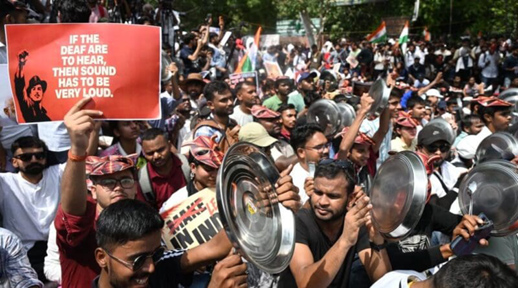
The nationwide student uprising witnessed in recent months has become one of the defining moments in contemporary India. What began as protests over educational policies and alleged irregularities evolved into something much larger, a movement insisting on accountability, honesty and respect for democratic rights. Images of students confronting police barricades, allegations of excessive force by law enforcement, and the detention of student leaders have renewed an old debate about the shrinking space for peaceful dissent in the world’s largest democracy.
Universities have historically been the conscience of every democracy. Institutions like Jawaharlal Nehru University were once famous for encouraging debate, intellectual diversity and critical thinking. Today, many students and faculty members argue that campuses have increasingly become arenas of surveillance, intimidation and prolonged disciplinary or legal proceedings. Whether one agrees with their politics or not, a democracy must protect the right of its young people to question authority without fear of being branded enemies of the nation.
The Student Awakening: The students in New Delhi were protesting for one simple reason: justice. They were not seeking privilege, power, or political advantage. They were asking only for fairness, the assurance that years of sacrifice, discipline, and relentless hard work would not be rendered meaningless by a system that failed them.
Instead of listening to the students’ grievances and engaging in productive dialogue, the Modi government sought to suppress the protests through force. Security personnel reportedly used pellet guns, lathi-charged peaceful demonstrators including female students and, according to reports, even fired an AK-47 rifle during the unrest. Scores of protesters were allegedly manhandled and injured, while many faced FIRs, detention, and other legal actions for participating in the demonstrations.
Manipur: The violence in Manipur represents one of the gravest human rights and religious freedom crises in contemporary India. Since the conflict began in May 2023, hundreds have been killed, thousands injured, and tens of thousands displaced from their homes. Numerous churches and other places of worship were destroyed or damaged, while entire communities were uprooted along ethnic and religious lines. Reports through human rights organizations, civil society groups, and the media have documented allegations of killings, sexual violence, arson, forced displacement, and prolonged failures to defend vulnerable populations. The extended instability, coupled with concerns over delayed justice and accountability, has raised serious questions about the protection of fundamental rights guaranteed under India’s Constitution, including the rights to life, equality, religious freedom, and equal protection under the law. The Manipur tragedy functions as a clear reminder that safeguarding human dignity, guaranteeing justice for victims, and protecting religious minorities are necessary to protecting India’s democratic tenets and constitutional devotion to pluralism.
Religious Freedom Under Strain: The findings of the U.S. Commission on International Religious Freedom (USCIRF) paint a deeply troubling picture of the state regarding religious freedom in India. In successive annual reports, USCIRF has expressed concern over what it describes as a continuing deterioration in the treatment of religious minorities, including Christians, Muslims, Sikhs, and other vulnerable communities. The Commission has documented reports of churches being demolished or sealed, prayer meetings disrupted by mobs, pastors and clergy arrested under anti-conversion laws, and increasing incidents of intimidation, violence, and harassment against Christians. In several instances, victims of religiously motivated attacks have themselves faced criminal charges, while perpetrators have often escaped accountability. These developments, coupled with the misuse of restrictive legislation and the failure to adequately protect minority communities, have contributed to an atmosphere of fear and insecurity. USCIRF has concluded that these patterns reflect a serious decline in religious freedom and has repeatedly urged the Government of India to protect its constitutional guarantees of freedom of religion, ensure equal protection under the law, and hold liable those responsible for acts of religiously motivated violence and discrimination.
Institutions Under Pressure: India’s democratic institutions have come under increasing strain, eliciting concern both within the country and internationally about the health of its constitutional democracy. Parliament has frequently witnessed diminished debate on major legislation and the reduced functioning of parliamentary committees, restricting opportunities for examination and consensus-building. Investigative agencies such as the Enforcement Directorate (ED), Central Bureau of Investigation (CBI), and Income Tax Department have encountered criticism from opposition parties and civil society over allegations of selective enforcement and politically motivated investigations, although the government rejects these claims and maintains that these agencies operate independently. Sections of the media have been accused of self-censorship and declining editorial independence, while journalists reporting on sensitive issues have encountered legal action, intimidation, or prosecution. Universities, once regarded as energetic centers of intellectual inquiry and dissent, have seen increased tensions over academic freedom, student activism, and administrative intervention. Civil society organizations and human rights groups have also encountered heightened regulatory scrutiny, restrictions on foreign funding, and judicial challenges that critics maintain have constrained their capacity to operate freely. Collectively, these developments have driven a wider debate about the strength of India’s democratic institutions, the protection of civil liberties, and the need to preserve the constitutional principles of accountability, pluralism, and the rule of law. Parliament, investigative agencies, media, universities, and civil society.
The Diaspora’s Moral Responsibility: At this decisive moment in India’s democratic journey, the Indian diaspora cannot afford to remain silent. As beneficiaries of the freedoms, constitutional protections, and democratic traditions that characterize both the United States and India, we have a moral responsibility to speak out whenever the tenets of justice, equality, religious liberty, and the rule of law are threatened. Genuine patriotism is not determined by unquestioning loyalty to any government but by a firm dedication to the abiding ideals enshrined in the Constitution. Our voices should be raised not in anger or partisanship, but in defense of democratic institutions, human dignity, and the rights of every citizen, regardless of religion, caste, ethnicity, or political belief. By defending these shared values, the Indian diaspora can act as a bridge between the world’s two largest democracies, encouraging both countries to uphold the freedoms that have inspired generations and fortified the bonds between them. Silence in the face of injustice risks normalizing it; principled engagement, by contrast, affirms our common commitment to democracy, pluralism, and the universal rights that each nation aspires to protect.
A New Generation Has Arrived: In the midst of these challenges, there is a powerful reason for hope: a new generation of Indians is finding its voice. Across the country, young people are demonstrating an increasing willingness to stand up for their constitutional rights, insist on accountability, and take part actively in molding the future of their nation. They are driven not by blind allegiance to political parties or ideologies, but by a desire to preserve the democratic tenets of justice, liberty, equality, and fraternity that form the foundation of the Indian Constitution. Their courage in speaking out, organizing peacefully, and insisting that those in authority remain accountable reflects the strength of India’s democratic spirit. Every generation is tested by history, and this generation has shown that it is prepared to defend the values it has inherited. Their awakening offers a sign of hope that India can become stronger, more embracing, and more faithful to its constitutional promise, proving once again that the nation’s greatest strength does not lie in those who wield power, but in citizens who are willing to protect freedom with conviction and courage.
Independence is not simply the memory of August 15, 1947: It is a daily devotion to liberty, equality, justice and fraternity. The real measure of India’s freedom is not how loudly we celebrate Independence Day but whether every Indian, regardless of faith, caste, language, ethnicity, or political belief, can live with dignity, speak without fear, worship according to conscience, and dream without intimidation.
That remains the unfinished work of the Republic.
(George Abraham is a former Chief Technology Officer with the United Nations, and Vice-Chairman, IOC USA. He is a regular contributor to The Indian Panorama. He can be reached at gta777@gmail.com)


Be the first to comment