

NAIROBI (TIP): Centennial celebrations are rare and unique as they come after witnessing many ups and downs, quick to forget or golden moments but not without leaving a trail of sweet memoirs.
Those who are lucky get a chance to cherish those memoirs, both as participants and witness to history. And at times, some of the stars of such celebrations also become part of history or legends that future generations hold in high esteem while acknowledging their rarest of rare accomplishments.
Early this month, when the premises of Sikh Union Club, the oldest Club of Sikhs outside India, reverberated with high quality competitions in hockey, cricket, badminton, golf, darts and treasure hunt besides a series of reunions of old, present and future stars of the Sikh community of Africa, many pages from historic annals were read repeatedly to remind the great exploits of the community on playfields worldwide.
From individual to family brilliance, the history of Sikh Union Club is dotted with stories that at times look unbelievable.
There is a story of Marwa brothers. Four of them were players at the international level. Three of them made the Kenyan Olympic Hockey team and two of them represented the country of their domicile in the World Cup.
They arrived on the scene in the late 60s when two of them – Amarjit Singh Marwa and Harvinder Singh Marwa also known as Gora – were chosen to represent Kenya in the 1968 Mexico Olympics. That edition of the summer Olympic Games had an unusual distinction where the number of Sikh players representing Kenya was more than those representing India.
Avtar Singh Sohal “Tari”, Surjeet Singh Panesar “Junior”, Kirpal Singh Bhardwaj, Davinder Singh Deegan, Amarjeet Singh Marwa, Harvinder Singh Marwa “Gora” and Jagjit Singh Kular not only represented Kenya but also supported white turbans tied in a unique “African” style during the ceremonies.
That was perhaps the first time that turban sporting Sikhs from countries other than India were recognized as real brand ambassadors of hockey, a journey that they continued till 1988 when Inderjit Matharu “Koolie” became the last turbaned Sikh to represent Kenya.
While Amarjit Marwa and Harvinder Marwa went on to represent Kenya in the 1972 Munich Olympic Games, their third brother, Satpal Singh Marwa, was chosen to play in the 1976 Montreal Olympic Games. However, a controversy over New Zealand Rugby team’s tour of South Africa, made African nations pull out of the Montreal Olympic Games. This Satpal Marwa, like rest of the members of the Kenyan contingent, had to come out of the Olympic village and lost a chance of playing in the Olympic Games.
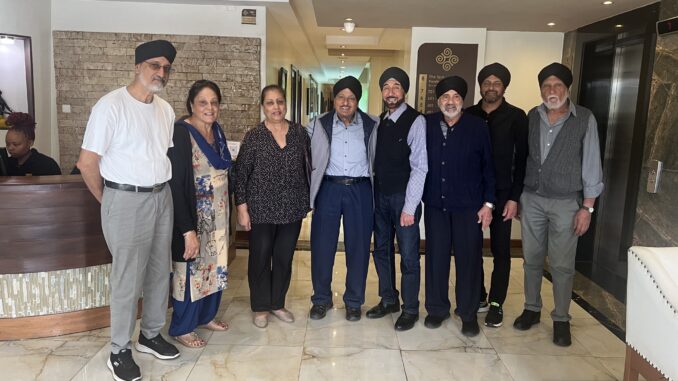
I had a chance to meet the Marwa brothers in Nairobi during the centenary celebrations of Sikh Union Club.
“Though we have a home far away from Nairobi, we made it a point that we all four brothers came here to join the celebrations,” remarked Amarjit Marwa.
Like the rest of Olympians and World Cuppers who one time represented Sikh Union Club, they were felicitated at the gala banquet organized to mark the conclusion of the celebrations.

Be the first to comment