

Expansion, Exploration and the Price of Growth
“The republic grew across a continent already inhabited-and every mile of
growth enlarged both its promise and its contradictions.”
THE LOUISIANA PURCHASE
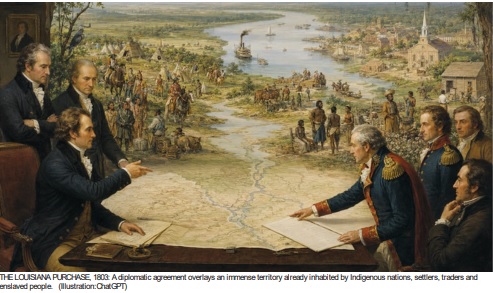
New Orleans and the Mississippi River were vital to western farmers who needed access to world markets. When Spain transferred Louisiana back to France, Americans feared that Napoleon might close their commercial lifeline. President Thomas Jefferson sent envoys to negotiate for New Orleans. Instead, France offered the entire Louisiana territory, burdened by war in Europe and the collapse of its ambitions in Saint-Domingue following the Haitian Revolution. In 1803, the United States purchased France’s claim for approximately $15 million, doubling the nation’s claimed territory. The agreement was a diplomatic triumph, but France sold sovereignty it did not fully possess. Numerous Indigenous nations governed, used and defended the lands. Spanish, French, African, mixed-race and other communities already lived along the Mississippi and Gulf regions.
JEFFERSON’S CONSTITUTIONAL DILEMMA
Jefferson had long favored a limited reading of federal power, yet the Constitution did not expressly authorize territorial acquisition. He considered an amendment but feared delay might lose the opportunity. He accepted broader treaty-making authority and submitted the purchase to the Senate. Practical national ambition overcame strict constitutional theory. The Purchase opened enormous possibilities for settlement, agriculture and commerce. It also ensured future contests over Native sovereignty and whether slavery would expand into new territories.
The Purchase doubled the republic’s domain-and multiplied the questions the republic had not answered.



Be the first to comment