
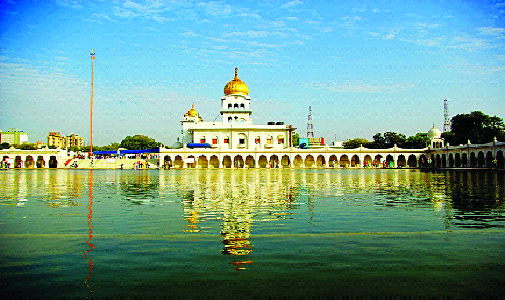

Gurdwaras — literally meaning “the doorway to the Guru” — are far more than places of worship in Sikhism. They are living embodiments of spiritual philosophy, social equality, and divine presence. Rooted in the teachings of Guru Nanak Dev Ji and shaped by successive Gurus, the gurdwara represents an open, inclusive, and sacred space where the Divine is experienced through prayer, service, and community.
Every architectural feature, spatial arrangement, and ritual practice within a gurdwara carries deep symbolic meaning. Together, they express the core Sikh principles of equality, humility, devotion, and unity.
The Concept of the Gurdwara: A Doorway to Divine Wisdom
The term “Gurdwara” combines Guru (spiritual teacher) and Dwara (door or gateway), signifying a place where one can connect with the wisdom of the Guru. In Sikhism, the eternal Guru is the Guru Granth Sahib, and thus the gurdwara is centered not around idols or images, but around the living Word (Shabad).
This emphasis on scripture over iconography distinguishes Sikh sacred spaces from many other religious traditions. The focus remains on listening, understanding, and internalizing divine teachings rather than visual representation.
Architectural Layout: Simplicity and Accessibility
Unlike grand temples designed to inspire awe through exclusivity, gurdwaras are intentionally built to be accessible and welcoming. While architectural styles may vary across regions-from the marble domes of Harmandir Sahib to smaller village gurdwaras-the fundamental layout follows a consistent spiritual logic.
A typical gurdwara includes:
– Darbar Sahib (Prayer Hall): The central hall where the Guru Granth Sahib is placed on a raised platform (Takht) under a canopy. Devotees gather here for prayer and kirtan.
– Langar Hall: A community kitchen and dining space where free meals are served to all visitors, regardless of background.
– Sarovar (Sacred Pool): Found in major gurdwaras like Harmandir Sahib, symbolizing spiritual purification and reflection.
– Nishan Sahib: A tall saffron flag that marks the presence of a gurdwara and serves as a beacon of hope and refuge.
The absence of barriers-both physical and symbolic-reflects the Sikh rejection of hierarchy and discrimination.
The Four Entrances: A Symbol of Universal Equality
One of the most profound architectural features of many historic gurdwaras, especially Harmandir Sahib, is the presence of four entrances, one on each side. These doors symbolize openness to all people, regardless of caste, creed, gender, or social status.
This design reflects the teachings of Guru Amar Das, who strongly advocated for equality and inclusivity. The four doors serve as a powerful reminder that the path to the Divine is open to everyone.
The Centrality of the Guru Granth Sahib
At the heart of every gurdwara lies the Guru Granth Sahib, treated with the utmost reverence as the eternal Guru. It is placed on a raised platform, often beneath a beautifully adorned canopy, signifying respect and devotion.
Devotees enter the gurdwara with covered heads and bare feet, bowing before the Guru Granth Sahib as a gesture of humility and surrender. The practice emphasizes that spiritual authority lies not in human intermediaries but in divine wisdom.
The continuous recitation and singing of Gurbani (kirtan) create a sacred atmosphere, transforming the space into a living center of spiritual energy and reflection.
Langar: Architecture of Equality in Action
The langar hall is one of the most distinctive and revolutionary aspects of gurdwara architecture. Instituted by Guru Nanak Dev Ji and formalized by Guru Amar Das, the langar embodies the principle of equality through shared meals.
In the langar, all individuals sit together on the floor in rows (pangat), regardless of social or economic status. This spatial arrangement eliminates hierarchy and reinforces the idea that all are equal before the Divine.
The kitchen itself is a place of seva (selfless service), where volunteers prepare and serve food with humility and devotion. The architecture of the langar thus becomes a living expression of Sikh ethics.
The Nishan Sahib: A Beacon of Faith
The Nishan Sahib, the tall saffron flag bearing the Khanda symbol, stands prominently outside every gurdwara. It serves both a practical and symbolic purpose-guiding travelers to a place of refuge and representing the presence of Sikh values.
Its height and visibility signify that the gurdwara is open to all, offering shelter, food, and spiritual solace. It is a declaration of the Sikh commitment to service, justice, and community.
The Sarovar: Reflection and Inner Cleansing
In major gurdwaras like Harmandir Sahib, the presence of a sarovar (sacred pool) adds another layer of symbolism. While not all gurdwaras have one, the sarovar represents purity, introspection, and the cleansing of the mind.
Bathing in the sarovar is seen not merely as a physical act but as a spiritual experience-an opportunity to reflect, meditate, and renew one’s connection with the Divine.
Sound and Space: The Role of Kirtan
The architecture of a gurdwara is designed to enhance the auditory experience of Gurbani. The central hall often features acoustics that amplify the sound of kirtan, allowing the sacred hymns to resonate throughout the space.
This emphasis on sound reflects the Sikh belief in the power of the Shabad (Divine Word). The vibrations of kirtan create an atmosphere of peace and devotion, drawing the mind inward and fostering spiritual awareness.
Global Expressions: Gurdwaras Around the World
As Sikh communities have spread across the globe, gurdwaras have been established in diverse cultural contexts-from London to Vancouver and beyond. While architectural styles may adapt to local environments, the core principles remain unchanged.
Whether a modest structure or a grand complex, every gurdwara upholds the same values of equality, service, and devotion, serving as a spiritual and cultural anchor for Sikh communities worldwide.
Symbolism of Humility and Service
A defining characteristic of gurdwara architecture is its emphasis on humility. Unlike towering monuments designed to assert dominance, gurdwaras invite participation and service. The act of cleaning floors, washing dishes, or serving food becomes a form of worship.
This integration of physical space and spiritual practice reinforces the Sikh ideal that true devotion lies in selfless service and ethical living.
Living Symbols of Sikh Philosophy
Gurdwaras are not static structures; they are dynamic, living spaces that embody the essence of Sikh philosophy. Every element-from the open doors and shared meals to the central placement of the Guru Granth Sahib-communicates a powerful message of unity, equality, and devotion.
Inspired by the teachings of Guru Nanak Dev Ji and shaped by the vision of the Sikh Gurus, gurdwaras continue to serve as sanctuaries of peace, learning, and service.
In a fragmented world, they stand as enduring symbols of inclusivity and spiritual harmony-true gateways to the Divine.


Be the first to comment