
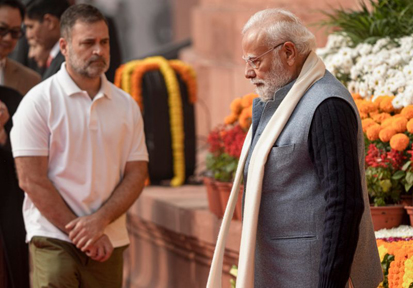

Regularly touring the country, meeting people at the grassroots, sharing meals with them, Rahul seems to be slowly developing the image of a popular leader
“The BJP’s celebration of PM Modi surpassing Nehru, despite his victory in election after election, is far-fetched. We cannot forget that Nehru inherited a divided country, a ruptured social fabric and an empty treasury. He and his team, of which Sardar Vallabhbhai Patel was an integral part, proceeded to build a violence-torn nation brick by brick. They bound the dissimilar regions and communities of the country by the thread of a nationhood that barely existed. Factories, educational institutions, dams, institutions of governance and his insistence that India would be a full-fledged democracy was unprecedented — notice, that hardly any other nation that shed the colonial yoke followed India’s example. He built a foreign policy, the touchstone of which was the Non-Aligned Movement.”
Even as author and analyst Ramachandra Guha stirred a hornet’s nest by demolishing Rahul Gandhi, a fourth generation scion of the Nehru-Gandhi family, as incapable of challenging Prime Minister Narendra Modi in a recent article and TV show, the day has arrived when the PM — whose party has often used the comparison with Jawaharlal Nehru as a yardstick — surpassed Nehru as the longest serving prime minister of India.
Nehru, who ruled democratically from 1952-1964, was in power for 4398 days. On June 10, Modi completed 4399 days of his premiership. But there was no word from the BJP about counting the days since August 1947, when India became independent, to 1952, when the results of the first election came out in which the Congress, and Nehru himself, had won a huge victory.
Nehru and his great grandson can be compared with each other in two very different ways. Nehru was PM for almost 17 years; Rahul was an MP for 20 years, when in 2024 he became the Leader of Opposition (LoP) in the Lok Sabha.
In Guha’s assessment, Rahul Gandhi ‘lacks gravitas’ (endorsing the Pappu and Rahul Baba taxonomy); ‘lacks a CV for a claim to India’s premiership’; ‘his only claim to fame is his Nehru-Gandhi lineage’; ‘lacks Modi’s charisma (and) instead of stating his constructive agenda, makes personal attacks on Modi’; under his leadership the Congress has been losing elections since 2014, and has shrunk both in legislative bodies both at the national and state levels as well as on the ground. The party, Guha adds, has become a ‘family firm’ and is completely out of breath to reach the goalpost. All these characteristics, he says, only display Rahul’s political incompetence with no capacity for hard work.
I believe that Guha’s objectivity is seriously in question. An analysis of political developments in the country since 2009 is completely missing. Can he say, with authority, that PM Modi possesses all the qualities he has declared Rahul Gandhi lacks?
Rahul won the 2004 Lok Sabha elections from Amethi by 300,000 votes — a seat he retained in 2009 — and declined PM Manmohan Singh’s invitation to join his Cabinet. He remained a reticent backbencher in Lok Sabha for nearly a decade and was only noticed for his controversial public trashing of his own government’s ordinance to protect convicted lawmakers from immediate disqualification on September 27, 2013, at the Press Club of India. In 2019 when the Congress lost for the second time, party president Mallikarjun Kharge resigned as party president and took the blame, although it was widely known that Rahul had called the shots.
The most damaging to Rahul’s image since 2014 was the hostile ‘Pappu’ campaign launched against him by the BJP. However, after taking over as LoP following the 2024 election, when the party won 99 Lok Sabha seats, his image began changing. The Bharat Jodo Yatra in 2022-23 and the Bharat Jodo Nyay Yatra in 2024 helped mitigate the impact of the ‘Pappu’ campaign, on which Rahul alleged the BJP spent Rs 2 crore. But the BJP’s derision, right from the top leadership, continued.
As Rahul began raising issues by assertively leading discussions in the Lok Sabha, he was disqualified from his membership of the House in March 2023. The Supreme Court reinstated him in August. This incident of his expulsion also reflects the partisanship of the presiding officers of Parliament.
Regularly touring the country, meeting people at the grassroots, sharing meals with them, Rahul seems to be slowly developing the image of a popular leader. With his white T-shirt and jeans, he has adopted simple middle class attire. As LoP he participates in policy debates in Lok Sabha — the PM mostly attends when he has to speak himself. However, given the weaknesses of the Congress at the organizational, multi-level leadership pool, Rahul needs to build the party organization, leadership, cadre and bases in states.
As Modi overtakes Nehru on the longest-serving PM parameter and consolidates his party’s hold on India’s politics, Rahul Gandhi , two years ago, managed to dent the PM and BJP’s invincible image by leading the Congress in the 2024 election limiting the NDA from reaching an absolute majority in the Lok Sabha.
The BJP’s victory in several states — Haryana, Maharashtra, Delhi, Bihar and West Bengal — has called Rahul’s leadership into question. Party insiders point to several faulty decisions. They believe he must be open to suggestions of grassroots leaders in framing party strategies. The recent decision of the party to end the long-time association with the DMK in Tamil Nadu shows that he does not value old alliances.
Back in 2001, RSS swayamsevak Narendra Modi was rewarded by then Deputy Prime Minister Lal Krishna Advani with the chief ministerial chair in Gujarat for facilitating his rath yatra. However, within his first four months in office, Modi had to face his first major test as a leader when brutal riots broke out in the aftermath of the burning of the Sabarmati Express. About a thousand people were killed in the violence that followed, in the wake of which then PM Atal Bihari Vajpayee’s advice to Modi to follow ‘rajdharma’ will go down in history.
I will argue that the BJP’s celebration of PM Modi surpassing Nehru, despite his victory in election after election, is far-fetched. We cannot forget that Nehru inherited a divided country, a ruptured social fabric and an empty treasury. He and his team, of which Sardar Vallabhbhai Patel was an integral part, proceeded to build a violence-torn nation brick by brick. They bound the dissimilar regions and communities of the country by the thread of a nationhood that barely existed. Factories, educational institutions, dams, institutions of governance and his insistence that India would be a full-fledged democracy was unprecedented — notice, that hardly any other nation that shed the colonial yoke followed India’s example. He built a foreign policy, the touchstone of which was the Non-Aligned Movement. He turned down luxury — in 1958, at the age of 69, his 10-day journey to Bhutan by vehicle, trekking and on mules is an example never followed.
The great grandfather stood tall despite challenges all around; his great grandson is still taking baby steps under adversity of a different kind. But Guha’s analysis shows that India is being failed by its intelligentsia too. Rahul Gandhi’s efforts may not be perfect, but they are sincere.
(Ajay K Mehra is a political scientist and Visiting Senior Fellow, Centre for Multilevel Federalism. His X handle is @AjaykmehraK)


Be the first to comment