
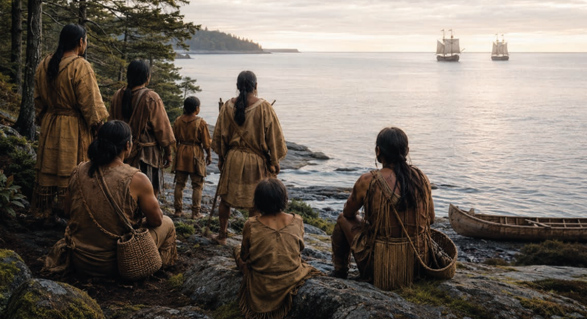

Europeans Arrive, New Worlds Collide
“What one people called discovery, another experienced as arrival-and soon as upheaval.”
AN OCEAN BECOMES A ROAD
For thousands of years, the Atlantic Ocean separated societies that knew nothing of one another. By the late fifteenth century, however, European monarchies, merchants and navigators were searching for routes to Asian markets, sources of wealth and opportunities to expand Christian and imperial power. Improvements in ships, navigation and mapmaking made longer voyages possible, while rivalry among kingdoms made them urgent. Christopher Columbus’s 1492 voyage under the Spanish Crown did not reveal an empty world. It initiated sustained contact between Europe and the Americas, joining continents whose peoples had developed independently for millennia.
Norse voyagers had reached Newfoundland centuries earlier, but their settlement did not produce the enduring transatlantic system that followed 1492. Spain built the first vast European empire in the Americas. Portugal established its position in Brazil and across the Atlantic. France entered through fishing, exploration and the fur trade; the Dutch pursued commerce; England moved more slowly but eventually planted colonies along the Atlantic coast. Each power brought different institutions, ambitions and alliances, yet all sought land, labor, trade and advantage.
A NEW ATLANTIC WORLD
Europeans were never the only actors. Indigenous nations assessed the newcomers, traded with them, used them in regional diplomacy, resisted them and sometimes formed alliances against established rivals. Africans-first carried through expanding systems of coerced labor and slavery-would become indispensable makers of the emerging societies, economies and cultures of the Americas.
“The Atlantic ceased to be a barrier. It became a highway of migration, commerce, conquest and captivity.”



Be the first to comment