
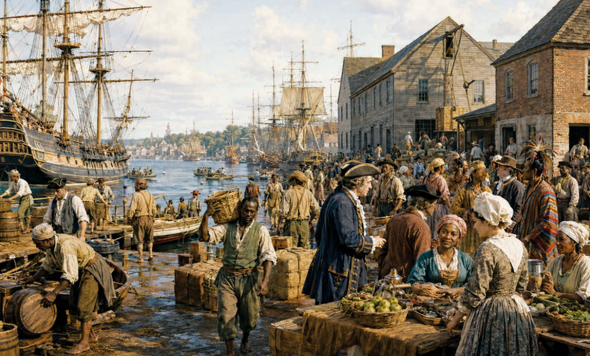

From Settlements to a New Society, 1620-1763
“Separate colonies became neighboring societiesand slowly discovered what they shared.”
THIRTEEN COLONIES, MANY BEGINNINGS
The thirteen colonies did not begin as a single national project. They were established at different times for different purposes-commerce, religious community, strategic advantage, land speculation and imperial expansion. Each possessed its own charter, government, economy and relationship with Indigenous neighbors. Yet by the middle of the eighteenth century, roads, rivers, coastal shipping, newspapers, war and migration were drawing them into a connected society.
The English colonies stretched from New Hampshire to Georgia. Their population expanded through high birth rates and successive migrations from England, Scotland, Ireland, German-speaking lands, the Netherlands, France and elsewhere. Africans arrived overwhelmingly through force, and their labor, knowledge and culture became foundational. Indigenous nations remained powerful actors beyond and within colonial borders, conducting diplomacy, trade and war while resisting the relentless pressure upon their homelands. THE COLONIES IN 1763 New England: New Hampshire, Massachusetts, Rhode Island, Connecticut. Middle Colonies: New York, New Jersey, Pennsylvania, Delaware. Southern Colonies: Maryland, Virginia, North Carolina, South Carolina, Georgia.
“The colonies were British in allegiance, regional in character, Atlantic in commerce-and increasingly American in experience.”


Be the first to comment