
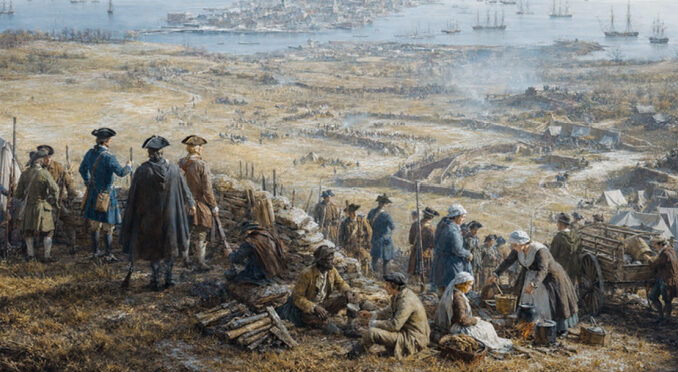

“Independence was declared in words. It had to be sustained by sacrifice, endurance, alliance and war.”
AN ARMY BEFORE A NATION
After Lexington and Concord, thousands of New England militia surrounded British forces in Boston. The Second Continental Congress, meeting in Philadelphia, assumed responsibility for the resistance and created the Continental Army in June 1775. It selected George Washington of Virginia as commander, partly because his military experience and southern identity could give the struggle continental reach. Washington inherited courage but not yet an army. Units answered to different colonies; enlistments were short; weapons, uniforms, gunpowder, food and pay were unreliable. Discipline varied. The central military task was therefore also political: to persuade men from separate colonies to serve a common cause under common authority.
BUNKER HILL
On June 17, 1775, British troops assaulted colonial positions on Breed’s Hill overlooking Boston. The British captured the ground, but at staggering cost. The battle demonstrated that colonial forces could withstand professional troops, while also revealing the limits imposed by ammunition shortages and weak coordination. Congress still pursued reconciliation through the Olive Branch Petition. King George III rejected it and declared the colonies in rebellion. Meanwhile, Henry Knox transported artillery captured at Fort Ticonderoga across winter roads to Boston. Washington placed the guns on Dorchester Heights in March 1776, forcing the British evacuation of the city.
“The first American victory was not a single charge; it was the creation of an army capable of remaining in the field.”



Be the first to comment