
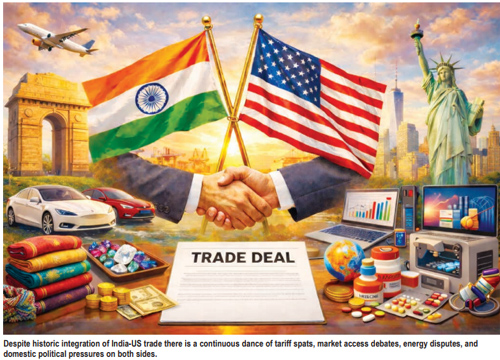

- BY TIP TEAM
As two of the world’s largest democracies navigate an increasingly fragmented global order, few bilateral partnerships carry as much economic potential—or as much strategic friction—as that between the United States and India. For the five-million-strong Indian American community, this economic nexus is not merely a headline in financial daily papers. It represents the bedrock of professional mobility, cross-border venture capital, corporate supply chain realignments, and the cultural-economic corridor that connects Silicon Valley, Wall Street, and Capitol Hill with Bengaluru, Mumbai, and New Delhi.
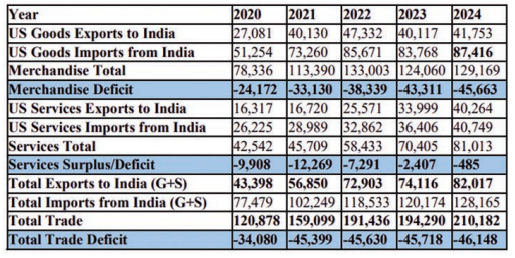
Today, the numbers reflect a staggering transformation. From barely $7.3 billion in total bilateral trade during the early 1990s, U.S.–India trade in goods and services surged to $210.1 billion in calendar year 2024, solidifying the United States as India’s single largest trading partner. American Foreign Direct Investment (FDI) into India reached $6.6 billion in the first half of FY 2025–26 alone (accounting for 19% of India’s total equity inflows), while over 163 Indian companies have invested upwards of $40 billion in the U.S., creating more than 425,000 direct American jobs. Yet, alongside this historic integration sits a continuous dance of tariff spats, market access debates, energy disputes, and domestic political pressures. Examining where this relationship came from, where it stands today, and what lies ahead reveals how economic ties between Washington and New Delhi evolved into a vital pillar of 21st-century global commerce.
1. Historical Evolution: Building the Bilateral Bedrock (1993–2024)
To understand today’s complex trade landscape, one must look at how the economic relationship untangled itself from decades of Cold War-era non-alignment and entrenched Indian protectionism.
The Clinton Years (1993–2001):
 Re-engaging After Decades of Distance When President Bill Clinton took office in 1993, India had just launched its landmark 1991 economic liberalization reforms under Prime Minister P. V. Narasimha Rao and Finance Minister Manmohan Singh. The Clinton administration recognized an opportunity to pivot from geopolitical coldness toward commercial engagement. The creation of the U.S.–India Commercial Dialogue marked the first attempt to bring regulators and executives together. Though American economic sanctions imposed after India’s 1998 Pokhran-II nuclear tests created a temporary setback, President Clinton’s historic March 2000 visit to India signaled a permanent shift. By the end of his term, two-way trade had nearly doubled from $7.3 billion in 1993 to $13.4 billion in 2001
The Bush Years (2001–2008):
StrategicConvergence and High-Tech Trade
The George W. Bush administration elevated India from a promising market to a prime strategic partner in Asia. The breakthrough Next Steps in Strategic Partnership (NSSP) in 2004 eased export controls on dual-use high technologies, civilian spaceflight, and advanced industrial equipment.
Institutional mechanisms quickly followed:
U.S.–India CEO Forum (2005): Directly involved private-sector leaders in policy advice. 123 Civil Nuclear Agreement (2005–2008): Ending decades of nuclear isolation and opening doors for U.S. technology in nuclear energy. By 2008, annual trade growth approached 20%, driven by American exports of machinery, chemicals, and energy products, alongside Indian exports of textiles, gems, and burgeoning IT services.
The Obama Era (2009–2016):
Institutionalizing Sectoral Dialogues
Under President Barack Obama, the economic architecture expanded significantly with the launch of the U.S.–India Economic and Financial Partnership (2010) and the Strategic and Commercial Dialogue (2015). These channels unlocked gains in renewable energy, infrastructure financing, and defense manufacturing offsets. However, structural limits persisted. American exporters frequently pointed to high Indian tariff walls, complex agricultural import restrictions, and weak enforcement of Intellectual Property Rights (IPR). Between 2009 and 2015, two-way trade expanded by nearly 90%, yet India still accounted for a small percentage of overall U.S. exports.
The First Trump Term (2017–2020):
“America First” and Market Access Battles
The first Trump administration brought long-standing trade grievances to the foreground. Tariff disputes escalated when Washington imposed Section 232 tariffs on steel and aluminum, leading to retaliatory tariffs from New Delhi on U.S. almonds, apples, and industrial products. The major friction point arrived in 2019 when the U.S. revoked India’s preferential trade status under the Generalized System of Preferences (GSP), affecting over $6 billion in Indian exports. Despite the rhetoric, structural interdependence sustained bilateral trade, supported by U.S. demand for Indian generic pharmaceuticals and IT services, and India’s reliance on U.S. capital goods and aircraft.
The Biden Years (2021–2024):
Tech Alignment and Supply Chain Resilience
President Joe Biden shifted the narrative toward critical technology alignment while leaving key tariff structures in place. Re-establishing the Trade Policy Forum (TPF) in 2021 reopened institutional channels to manage trade disputes. The signature achievement of this period was the U.S.–India Initiative on Critical and Emerging Technologies (iCET), launched in 2023. iCET tightly bound commercial trade policy to strategic technology collaboration— spanning semiconductor manufacturing, artificial intelligence, defense co-production, and commercial space exploration. India also joined three of the four pillars of the IndoPacific Economic Framework (IPEF), prioritizing supply chain resilience, clean energy, and fair economy standards.
2. Foreign Direct Investment: A Two-Way Street
FDI flows demonstrate that the U.S.–India commercial relationship has transcended simple buyer-seller dynamics into deep capital integration. Cumulative U.S. FDI in India (2000–2025): $77.27 Billion (10% of total FDI to India) Recent Inflow Acceleration: $5.45 Billion (FY 2024–25) to $6.60 Billion (H1 FY 2025–26)


Be the first to comment