

THE WEALTH OF A NATION AND THE PRICE PAID IN HUMAN LIVES
“Enslaved people were not outside America’s economic rise. Their stolen labor stood near its center.”
KING COTTON
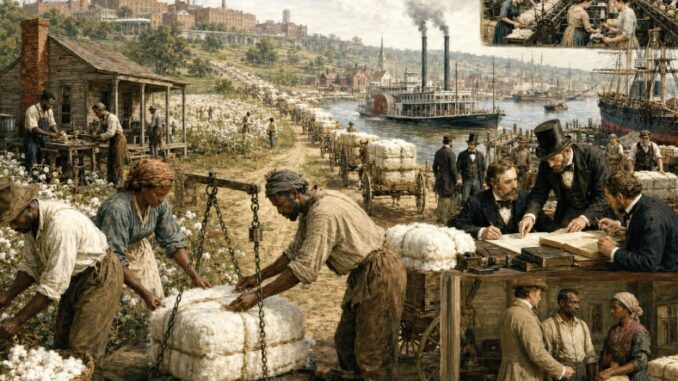
During the first half of the nineteenth century, cotton became the leading American export and a foundation of the Atlantic economy. The invention and spread of the cotton gin made shortstaple cotton easier to process, while Indigenous dispossession and U.S. expansion opened millions of acres across the Deep South. Demand from British and northern mills seemed limitless. Behind that expansion stood coerced labor. Enslaved workers cleared forests, drained swamps, planted, hoed and harvested under surveillance and punishment. Picking quotas converted every hand movement into measurable profit. Knowledge of soil, weather, tools, animals and processing made enslaved people highly skilled producers, though law denied them wages, mobility and control over the wealth they created.
A COMMODITY OF GLOBAL POWER
By 1860 the South produced most of the world’s commercially traded cotton, and cotton represented well over half the value of U.S. exports. New Orleans became a great commercial port. Mississippi River steamboats carried bales to factors and warehouses; ships carried them to Liverpool, New York and beyond. Cotton linked remote fields to industrial cities and imperial markets.
“Cotton was called king. Its throne rested upon labor that could not say no.”
PEOPLE ENTERED IN THE LEDGER
Slavery was both a labor system and a property regime. Enslaved people could be mortgaged, inherited, leased, insured, seized for debt and sold. Their appraised value supported credit used to purchase land, equipment and more enslaved workers. Banks and investors-southern, northern and transatlantic-helped finance the expansion of plantations and trade. The total market value assigned to enslaved people by 1860 ran into billions of contemporary dollars. Such figures reveal the system’s economic scale, but they repeat its own distortion if left unexplained: price was not human worth. A ledger recorded an asset where a person lived-with memory, kinship, talent, fear and hope.
PROFIT AND RISK
Merchants advanced funds against future crops. Insurers protected ships, warehouses and sometimes enslaved lives as property. Lawyers enforced contracts; newspapers carried sale notices; railroads and steamboats moved cotton and people. Local stores extended credit, while federal and state power protected ownership. No single institution created slavery, but many institutions made it profitable, transferable and durable.
“The ledger could calculate a price. It could not comprehend a person.”
THE SECOND MIDDLE PASSAGE
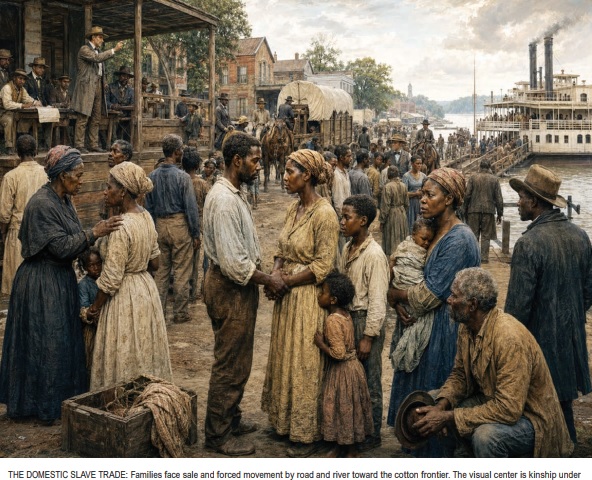 After the United States ended legal participation in the transatlantic slave trade in 1808, slavery expanded through birth, interstate sale and forced migration. As tobacco regions diversified and cotton lands opened farther south and west, traders moved roughly one million enslaved people from the Upper South toward the Deep South between 1790 and the Civil War. People were marched in coffles or transported by ship and steamboat. Richmond, Alexandria, Washington, Charleston, Natchez and New Orleans became important nodes in a domestic market. Traders advertised health, age and skill. Buyers inspected bodies. Parents, children and spouses could be separated permanently because their relationships possessed little protection in law. Enslaved families nevertheless struggled to remain connected. They negotiated with enslavers, carried news through networks, adopted separated children, maintained naming traditions and searched for relatives long after emancipation. The sale of a person was an economic transaction to the marketand a human catastrophe to a family.
“Expansion moved cotton westward. It drove families southward against their will.”
A NATIONAL, NOT MERELY SOUTHERN, ECONOMY
Plantation slavery was concentrated in the South, but its products and profits traveled nationally. Northern mills converted slave-grown cotton into cloth. New York merchants arranged shipping and credit. Shipbuilders, dockworkers, insurers, wholesalers and exporters earned income from cotton commerce. Western farmers sold food to southern markets; consumers wore textiles whose origins were easy to ignore. This does not mean that every northern worker or business profited equally, or that northern society uniformly supported slavery. Free Black communities, abolitionists, religious reformers and many labor activists challenged the institution. Some manufacturers sought alternative sources. Yet geographic distance did not produce economic innocence.
BRITAIN AND THE ATLANTIC WORLD
British industrialization depended heavily upon imported cotton, much of it grown by enslaved labor in the American South. European finance and shipping helped sustain the trade even after Britain abolished slavery in most of its empire. American cotton also competed with production in India, Egypt and Brazil. Slavery in the United States belonged to a global story of industrial demand, empire, land and labor.
FREE LABOR AND UNFREE FOUNDATIONS
Northern economic growth also drew upon free wage labor, immigration, technological innovation and expanding domestic markets. The nation contained distinct labor systems, but they were commercially intertwined. The central contradiction was not that all American wealth came from slavery; it was that a republic celebrating free labor permitted unfree labor to occupy a commanding place in national development.
“The Mason-Dixon line divided law. Cotton crossed it every day.”
LIFE BEYOND THE LEDGER
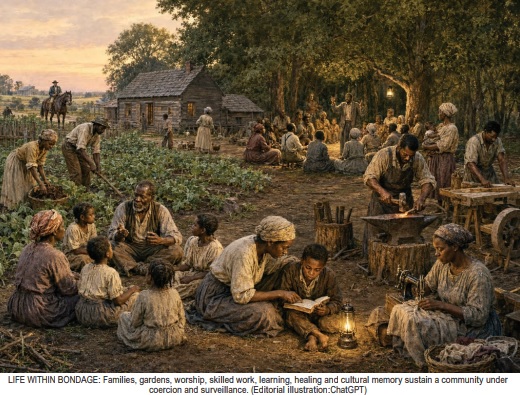 Enslavement attempted to control time, movement, marriage, parenthood, learning and worship. Yet enslaved people built lives that the law could neither fully authorize nor extinguish. Families formed the primary source of affection, identity and survival, even though sale continually threatened them. People cultivated gardens, hunted, cooked, cared for children and elders, made clothing and exchanged goods. Skilled workers served as blacksmiths, carpenters, coopers, boatmen, seamstresses, midwives and mechanics. Some hired out their labor and negotiated limited autonomy, although earnings and movement remained vulnerable to an enslaver’s claim. Christian faith could be used by enslavers to preach obedience, but enslaved worship transformed biblical stories of Exodus and deliverance into languages of hope. African memories, music, storytelling and burial practices survived in changing forms. Literacy, often prohibited, was pursued secretly. These acts were not ornaments around an economic history; they reveal the human beings whom economic records tried to reduce to capital.
“Bondage governed circumstances. It never achieved ownership of the human soul.”
WOMEN, CHILDREN AND THE REPRODUCTION OF SLAVERY
Enslaved women worked in fields, houses, workshops and markets while bearing disproportionate responsibility for family care. They faced sexual violence and the legal rule that a child’s status followed the mother. Enslavers therefore treated childbirth as both family life and expansion of property-a brutal collision of intimacy and commerce. Women resisted by protecting children, preserving kinship, negotiating work, practicing healing, transmitting knowledge and sometimes fleeing. Their labor was productive and reproductive, physical and emotional. The famous image of plantation work must therefore widen: women’s coerced labor helped sustain both crops and the generations upon which the institution depended.
CHILDHOOD UNDER BONDAGE
Children learned early that family authority existed beneath an enslaver’s power. They performed errands and gradually entered heavier labor. Education was restricted, play was constrained and sale remained a threat. Yet parents and communities taught survival, faith, skill, memory and self-respect. Childhood endured, though slavery repeatedly violated its security.
FREE BLACK AMERICANS
Nearly half a million free Black people lived in the United States by 1860, in both North and South. They formed churches, schools, businesses, mutual-aid societies and abolitionist networks while confronting exclusion, kidnapping and discriminatory law. Their achievements refuted the racial ideology used to defend bondage and provided essential institutions for the struggle against it.
Slavery claimed generations. Families answered by carrying humanity from one generation to the next.”
WEALTH, POWER AND THE APPROACHING CRISIS
By 1860 nearly four million people were enslaved in the United States. Their labor helped make the South wealthy, strengthened national trade and supplied the raw material of industrial growth. But wealth was concentrated. Large enslavers exercised influence beyond their numbers, while many nonslaveholding white southerners remained committed to racial hierarchy, hoped to acquire slaves or feared a society built upon Black freedom. Defenders of slavery increasingly described it not as a regrettable inheritance but as a “positive good.” They demanded federal protection for slave property, recovery of fugitives and access to western territories. Opponents ranged from abolitionists demanding immediate emancipation to Free Soilers chiefly resisting slavery’s expansion. The argument fused morality, race, labor, constitutional power and sectional interest. The Mexican Cession had provided the arena. The economic power of slavery raised the stakes. Compromises could distribute offices and territories, but they could not reconcile property claims in human beings with the promise of liberty.
“Slavery was not a backward remnant awaiting progress. It was a modern engine of wealth-and a moral crisis progress alone could not cure.
RESISTANCE: FROM THE EVERYDAY TO REVOLT
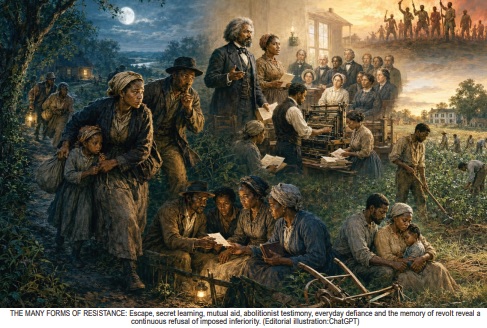 Enslaved people resisted because they had never consented to enslavement. Resistance ranged from preserving family and culture to slowing work, breaking tools, bargaining, learning, stealing back time, escaping and, more rarely, organized violence. Each choice carried risks shaped by age, family responsibility, geography and opportunity. Thousands fled temporarily or permanently. The Underground Railroad was not a single route but a changing network of Black initiative, free Black communities, mariners, religious allies and antislavery activists. Harriet Tubman repeatedly returned south to guide others. Frederick Douglass transformed personal testimony into political argument. Black women, including Sojourner Truth, Maria Stewart and the Forten and Purvis networks, made abolition a movement of speech, print, organizing and mutual aid. Revolts such as those associated with Gabriel, Denmark Vesey and Nat Turner terrified slaveholding society and produced harsher controls. Most enslaved people could not safely attempt armed rebellion or permanent escape. Survival itself could contain resistance: sustaining a child, worshipping beyond surveillance, remembering a stolen name, or refusing inward submission.
“Resistance was not one heroic act. It was the daily refusal to become what slavery declared a person to be.



Be the first to comment