

A Civilization, a Subcontinent, a Nation in the Making
India marks its 80th Independence Day celebration on August 15, 2026. This event completes 79 years of freedom since 1947 and enters the country into its 80th year of independence. Eighty years is a short chapter in the life of an ancient civilisation, but for modern India it has been a period of extraordinary transformation. Since Independence in 1947, the country has travelled from the uncertainties of Partition, poverty and limited infrastructure to become one of the world’s largest economies, a vibrant democracy, a major technological power and an increasingly influential voice in global affairs.Yet the India of today cannot be understood without looking beyond 1947. Its foundations lie in a civilisation shaped over millennia by diverse cultures, languages, religions, kingdoms, knowledge traditions and trading networks. The freedom struggle added another defining chapter, uniting millions in the quest for self-rule and giving birth to a democratic republic committed to liberty, equality and justice.The eight decades since Independence have brought triumphs and trials: nation-building, wars, economic reforms, the Green Revolution, scientific and technological advances, social transformation and the digital revolution. They have also exposed enduring challenges of inequality, employment, education, health and social cohesion.India @ 80 looks at this remarkable journey—from civilisation to colony, from freedom to republic, and from nation-building to global ambition—while asking the most important question of all: What lies ahead for India?
-
INDIA BEFORE THE RAJ
The Civilization That Endured
Long before the map of India acquired its modern political shape, the subcontinent was already home to one of the world’s great civilization experiments. Cities rose along rivers, merchants crossed seas, philosophers debated the nature of existence, physicians recorded diseases and treatments, mathematicians developed sophisticated numerical ideas, poets composed epics, artisans produced textiles and metalwork, and rulers built states that stretched across vast territories.
There was never one uninterrupted Indian empire. There was no single political authority that ruled the entire subcontinent for most of its history. Yet political fragmentation did not mean civilisational isolation. Ideas travelled across kingdoms. Pilgrims followed religious routes. Merchants crossed mountains and seas. Languages borrowed from one another. Religious traditions debated, absorbed and transformed each other.
That distinction is essential to understanding India’s history before independence. India was not historically one political state; it was a remarkably interconnected civilizational space.
The cities of the first urban civilization
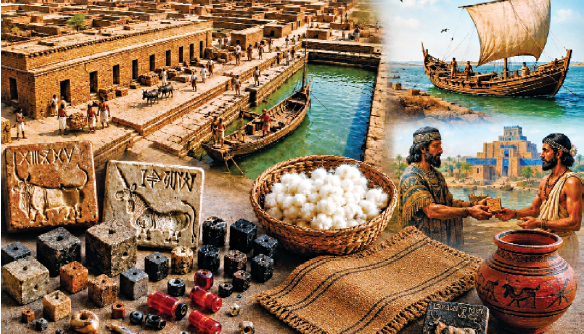
Some of the earliest evidence of complex urban life comes from the Indus or Harappan civilisation, which flourished broadly across parts of present-day Pakistan and northwestern India from roughly the third millennium BCE.
Harappa, Mohenjo-daro, Dholavira, Rakhigarhi and other sites reveal an urban society of extraordinary organisation. Streets were laid out systematically. Houses were built with standardised bricks. Drainage systems demonstrated sophisticated civic planning. Craft production, long-distance trade and standardised weights point to a society connected by economic and administrative practices.
The Harappans traded with regions far beyond the subcontinent, including Mesopotamia. Their world was not isolated; it was part of a wider Bronze Age network.
Yet the civilisation remains partly mysterious. Its script has not been conclusively deciphered, and historians continue to debate its political organization, social structure and the reasons for its transformation after the second millennium BCE.
What is beyond doubt is that urban civilization in the subcontinent has extremely deep roots.
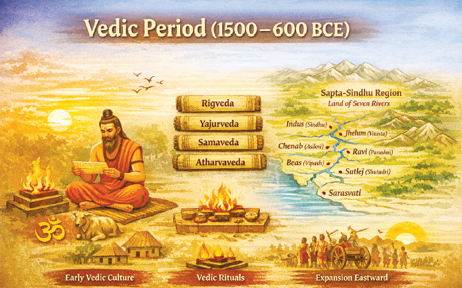
The Vedic world and the changing social landscape
After the decline of the urban Harappan phase, different forms of settlement and social organization developed across northern India. Vedic traditions became important in the cultural and intellectual history of the region.
The Vedas, composed and transmitted orally over generations, became foundational texts within the Brahmanical tradition. The later Vedic period witnessed significant changes in agriculture, settlement, political organisation and social institutions.
The early political landscape was dominated by clans and tribal polities, but gradually larger territorial states emerged. Agriculture expanded and iron technology became increasingly important in parts of northern India.
By the middle of the first millennium BCE, the subcontinent was entering another period of profound change.
The age of the Mahajanapadas
The sixth century BCE was an age of political experimentation and intellectual ferment.
The old tribal structures increasingly gave way to territorial states. Buddhist and Jain texts refer to a number of major political entities known as the Mahajanapadas.
Among them were Magadha, Kosala, Vatsa and Avanti.
Magadha eventually became particularly powerful. Its fertile territory, access to iron resources, strategic location and strong rulers helped it dominate much of northern India.
But political consolidation was only one part of the story.
This was also the age of Gautama Buddha and Mahavira.
Buddhism and Jainism emerged in a society questioning established assumptions about ritual, social order, renunciation and the nature of liberation. Both traditions placed ethical conduct, discipline and the individual’s spiritual journey at the centre of their teachings.
Buddhism would eventually travel far beyond India—to Sri Lanka, Central Asia, Southeast Asia, China, Korea and Japan—becoming one of the world’s major religions.
Jainism remained more geographically concentrated but became a lasting and influential Indian religious tradition, particularly in western and southern India.
The Mauryan moment
The rise of the Mauryan Empire in the fourth century BCE represented one of the earliest large-scale political unifications of much of the subcontinent.
Chandragupta Maurya established the empire around the end of the fourth century BCE. His successors expanded its reach, and under Ashoka, the empire reached one of its greatest extents.
Ashoka’s reign became particularly significant after the devastating Kalinga War.
His inscriptions, carved on rocks and pillars across his empire, provide some of the earliest extensive written evidence of an Indian ruler addressing his subjects across a large territory.
Ashoka promoted dhamma, emphasising ethical conduct, tolerance, compassion and respect among different religious communities.
His patronage helped Buddhism expand, although his empire did not simply become a Buddhist theocracy. The inscriptions reveal an attempt to articulate an ethical political order across a diverse population.
The Mauryan state also demonstrates something that would recur throughout Indian history: political unity could emerge without erasing cultural diversity.
After the Mauryas: Many centres, many traditions
The Mauryan Empire eventually declined, but political and cultural life did not collapse with it.
A succession of regional powers emerged. Indo-Greek, Shaka, Kushan and Satavahana rulers played important roles in different parts of the subcontinent.
The Kushans, particularly under Kanishka, helped connect northern India with Central Asia and the wider Buddhist world. Trade routes linked India with Central Asia, the Mediterranean and China.
Meanwhile, southern India developed powerful political and commercial centres of its own.
The Gupta age and the flowering of classical culture
The Gupta period, particularly between the fourth and sixth centuries CE, is often remembered as a high point in classical Indian culture.
The political authority of the Guptas did not cover the whole subcontinent, and historians today are careful about describing the period simply as an all-India “golden age.” Nevertheless, it witnessed important developments in literature, mathematics, astronomy, art, religion and political culture.
Kalidasa became one of the great names of Sanskrit literature.
Astronomers and mathematicians developed sophisticated methods for understanding numbers, planetary movements and mathematical operations.
The visual arts flourished. Sculpture, temple architecture and painting reached notable levels of refinement.
At the same time, Buddhism and Jainism continued alongside expanding Brahmanical traditions.
The famous Chinese traveller Faxian, who visited India during this period, left observations about society and Buddhist institutions.
The South writes its own history
The story of pre-modern India cannot be reduced to the history of northern empires.
Across the peninsula, powerful kingdoms developed their own political, cultural and maritime traditions.
The Pallavas contributed to the development of temple architecture and helped shape the cultural landscape of southern India. The Chalukyas and Rashtrakutas built powerful states in the Deccan.
The Cholas later created one of the most formidable maritime powers in Indian history.
Under rulers such as Rajaraja Chola I and Rajendra Chola I, the Chola state developed extensive connections across the Bay of Bengal. Their influence reached parts of Southeast Asia, while Tamil merchants participated in long-distance commerce.
The monumental Brihadisvara Temple at Thanjavur stands as one of the great achievements of medieval Indian architecture.
India’s history was therefore not merely a story of armies moving across land. The sea was equally important.
Delhi and the Sultanate
The establishment of the Delhi Sultanate at the beginning of the 13th century introduced another major political phase.
The Sultanate was ruled by successive dynasties, including the Mamluks, Khaljis, Tughlaqs, Sayyids and Lodis.
Its authority varied considerably over time and geography. At different moments, rulers in Delhi exercised control over large parts of northern and central India, while powerful regional states continued to exist elsewhere.
The Sultanate brought new political institutions, military techniques, architectural forms and cultural influences.
Persian became an important language of administration and high culture. Indian traditions interacted with those brought by Central Asian and Persianate elites.
The result was neither simple replacement nor complete continuity. It was interaction, conflict, adaptation and synthesis.
The emergence of Indo-Islamic architecture, the growth of new literary traditions and the development of vernacular languages were among the long-term consequences of this interaction.
The Mughal century and beyond
In 1526, Babur defeated Ibrahim Lodi at the First Battle of Panipat and established the Mughal dynasty.
The empire expanded substantially under Akbar, Jahangir, Shah Jahan and Aurangzeb, although its territorial reach and administrative control changed over time.
Akbar’s reign was particularly important for the consolidation of a large, diverse empire. His administrative system, including the mansabdari and revenue arrangements, helped create a sophisticated imperial structure.
Mughal culture produced extraordinary achievements in painting, architecture, gardens, literature and court culture.
The Taj Mahal, built under Shah Jahan, became one of the most recognisable monuments in the world.
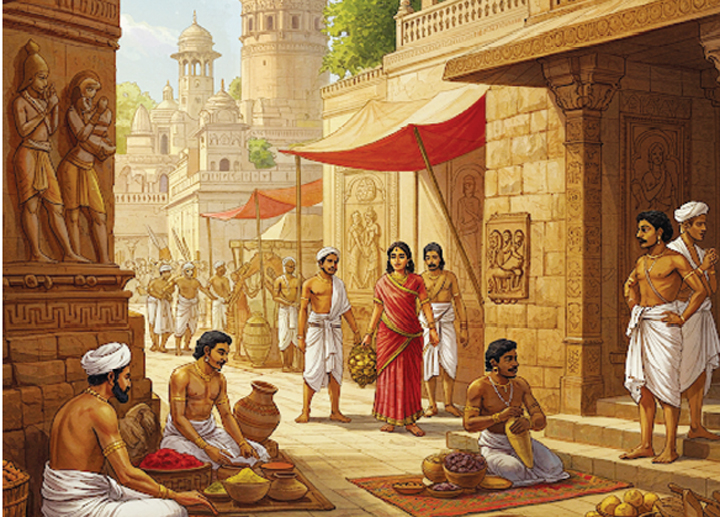
But Mughal India was not simply an imperial court. It was also a vast economic world of farmers, artisans, merchants, bankers, soldiers and regional elites.
Indian textiles—especially cottons and silks—were sought after in international markets. Ports on both the western and eastern coasts connected the subcontinent with the Indian Ocean economy.
The age of regional powers
The decline of Mughal political authority in the 18th century did not mean the collapse of India.
Instead, power became increasingly distributed among regional states.
The Marathas emerged as a major political and military force.
The Sikhs gradually developed from a religious community into a significant political and military power, culminating in the Sikh Empire under Maharaja Ranjit Singh in the early 19th century.
The kingdoms of Mysore under Haider Ali and Tipu Sultan, the Nizam’s Hyderabad, Awadh, Bengal and numerous Rajput states also played important roles.
The political landscape was fragmented, but it was dynamic.
And into this world came another force: European commercial powers.
India before colonial rule was not a static civilization
It is tempting to look backwards and imagine pre-colonial India as a fixed civilization waiting for modernity to arrive from Europe.
History tells a different story.
India was constantly changing.
Religions evolved. Languages developed. New kingdoms appeared. Trade routes shifted. Agricultural frontiers expanded. Technologies changed. Communities migrated. New artistic styles emerged.
Indian society was marked by enormous inequalities of caste, class, gender and status, and political violence was hardly unknown. But alongside these realities existed powerful traditions of intellectual debate, religious pluralism, commerce, craftsmanship and cultural exchange.
The India encountered by European merchants was therefore not a passive land awaiting discovery.
It was a major civilisation already deeply connected to the world.
And that is the India that Europe entered.
-
THE MAKING OF A SUBCONTINENT
How Geography, Languages, Faiths and Trade Created India’s Extraordinary Diversity
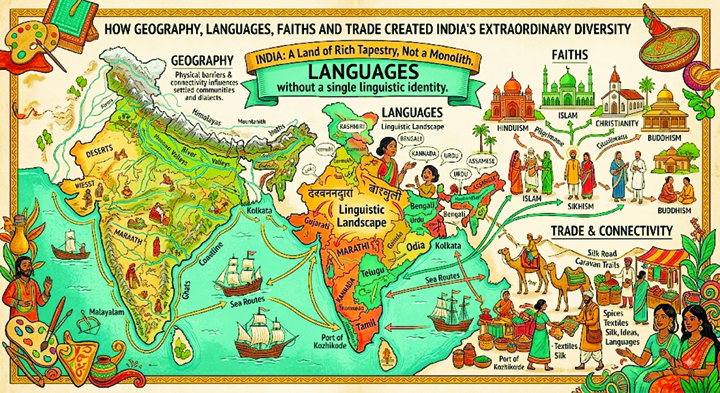
India’s diversity is often described through a familiar list—languages, religions, cuisines, festivals, clothing and customs. But diversity in the subcontinent is deeper than cultural variety. It is rooted in geography, migration, agriculture, trade and centuries of political interaction.
The Himalayas, the great river plains, the deserts of the west, the Deccan Plateau and the long coastline created different ecological worlds. Communities adapted to these environments, developing distinct economies and cultures.
Yet these worlds were never completely separate.
A geography of enormous contrasts
The Himalayas formed a dramatic northern boundary, but they were never an absolute barrier. Mountain passes connected the subcontinent to Central Asia and Tibet.
The Indus and Ganga river systems supported enormous agricultural zones.
The Deccan Plateau created another vast ecological and political region.
The Western Ghats and Eastern Ghats shaped the peninsula’s rainfall and agriculture.
And beyond them lay the Indian Ocean.
The sea was not the edge of India. It was one of its great highways.
Rivers and civilization
The great rivers were central to settlement and agriculture.
The Indus basin supported one of the world’s earliest urban civilisations. Later, the Ganga basin became a major centre of agriculture, cities and states.
River systems supported not only food production but also political power. Surplus agriculture enabled rulers to maintain armies, administrators and monumental construction.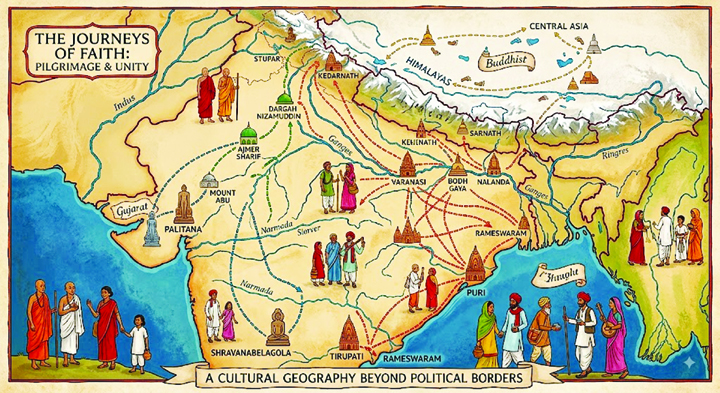
Languages without a single linguistic identity
India developed several major language families.
Indo-Aryan languages became dominant across much of northern, western and eastern India, while Dravidian languages—including Tamil, Telugu, Kannada and Malayalam—flourished primarily in the south.
Tibeto-Burman and other language groups added further diversity.
Sanskrit became an influential language of scholarship and religious literature. Prakrits and later regional languages carried traditions into wider society.
Persian became important under several medieval regimes. Arabic entered Indian intellectual and commercial life through Islamic networks.
Eventually, languages such as Hindi, Bengali, Marathi, Punjabi, Gujarati, Urdu, Assamese and others developed powerful literary identities.
The result was not a single linguistic culture but a civilisation communicating across languages.
Religions that travelled—and transformed
Hindu traditions evolved over centuries rather than emerging as a single, centrally organised religion.
Buddhism and Jainism originated in India and became major intellectual and religious forces.
Islam arrived through multiple channels—Arab merchants on the western coast, Central Asian migrations, political conquest and Sufi networks.
Christian traditions have also had a long history in India, while Zoroastrian Parsis found a home on the western coast after migrating from Persia.
Sikhism emerged in Punjab in the late 15th century and developed into a distinctive religious tradition.
India therefore became a meeting ground of religious traditions rather than the exclusive homeland of one.
The pilgrimage routes
Pilgrimage created another form of unity.
Buddhist sites connected different regions.
Hindu pilgrimage networks linked sacred places from the Himalayas to the southern peninsula.
Sufi shrines attracted people across religious and social boundaries.
Jain pilgrimage routes connected communities across western, central and southern India.
These journeys helped create a cultural geography that often extended beyond political borders.
Markets connected what armies could not
Merchants were among the great unifiers of the subcontinent.
Textiles, spices, precious stones, metal goods, salt, horses and agricultural commodities moved across regional boundaries.
Merchant communities developed networks extending from inland markets to coastal ports.
India’s western coast connected it to Arabia and East Africa. The eastern coast connected it to Southeast Asia.
Ports such as Bharuch, Cambay, Calicut, Surat, Masulipatnam and others became important nodes in different periods.
A civilization of regional identities
India’s unity therefore did not emerge from uniformity.
A Tamil merchant could participate in an Indian Ocean trading world while belonging to a highly distinctive linguistic and cultural environment.
A Punjabi Sikh, a Bengali Vaishnava, a Kashmiri scholar, a Gujarati Jain merchant or a Kerala Muslim merchant inhabited very different social worlds.
Yet they could all participate in networks that crossed political and cultural boundaries.
That is perhaps the most important feature of India’s pre-modern history:
Its unity was layered.
People belonged simultaneously to a village, caste or community, linguistic region, religious tradition, kingdom and wider civilizational world.
-
INDIA’S GOLDEN THREADS
The Knowledge Traditions That Shaped a Civilization
India’s contribution to knowledge cannot be reduced to a handful of famous discoveries. Its intellectual history developed through mathematics, astronomy, medicine, philosophy, linguistics, architecture, metallurgy, literature and systems of education.
Some claims about ancient Indian science have been exaggerated in popular accounts, but the genuine achievements are impressive enough without embellishment.
The mathematics of numbers
One of India’s most consequential intellectual contributions was the development of the decimal place-value system and the mathematical use of zero.
Indian mathematicians built on earlier numerical traditions and developed increasingly sophisticated methods of calculation.
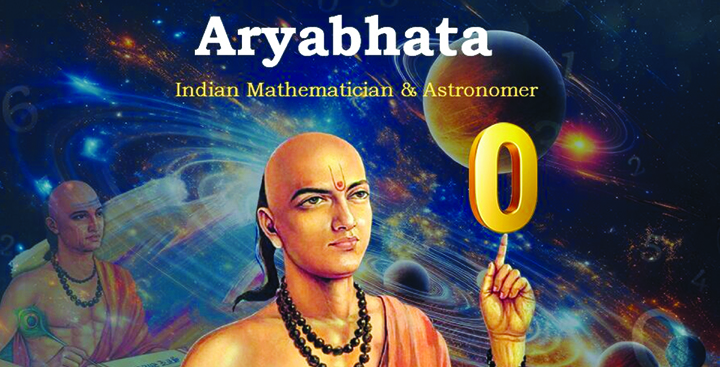
Aryabhata, writing in the fifth century CE, made important contributions to mathematics and astronomy.
Brahmagupta, in the seventh century, provided systematic rules involving zero and negative numbers.
Over time, Indian mathematical ideas travelled westward through scholarly exchanges and the Islamic world and eventually became part of the global mathematical tradition.
The numerals we commonly call “Arabic numerals” have a more complicated history: their roots lie in Indian mathematical traditions, with transmission and further development through the medieval Islamic world.
Looking at the heavens
Astronomy was closely connected with calendars, ritual and mathematics.
Aryabhata proposed sophisticated explanations of celestial phenomena and calculated astronomical constants with notable precision for his time.
Indian astronomical traditions developed methods for calculating planetary positions, eclipses and calendars.
Astronomy was not simply abstract speculation. It served practical purposes: agriculture, ritual, navigation and the organisation of time.
Ayurveda and medical knowledge
Indian medical traditions developed through texts and schools of thought collectively associated with Ayurveda.
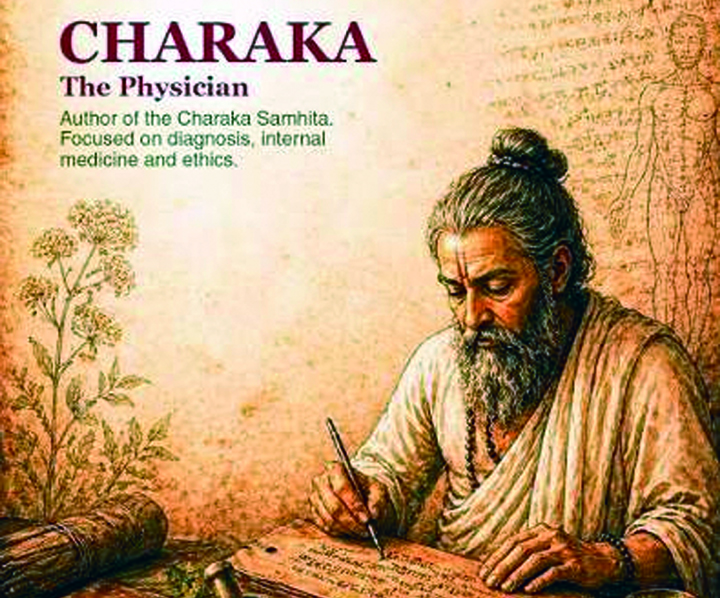
The Charaka Samhita emphasised medicine, diagnosis and treatment, while the Sushruta Samhita is particularly associated with surgery.
The historical development of these texts is complex and spans centuries, but they demonstrate a sustained Indian effort to systematise knowledge of the body, disease and treatment.
The Sushruta tradition is especially notable for its detailed discussions of surgical procedures and instruments.
Ancient medicine, however, should not be judged as if it possessed modern biomedical knowledge. Its concepts were rooted in the intellectual frameworks of its time.
Its importance lies in the development of systematic medical traditions and observation-based practices.
The science of metal
Indian metallurgical traditions produced remarkable achievements.
The Iron Pillar of Delhi, generally dated to the Gupta period, has long attracted attention because of its unusual resistance to corrosion.
Indian iron and steel production also became internationally significant.
Wootz steel, produced in parts of southern India, became famous for its quality and played a role in the development of the steel associated with Damascus blades.
The story of metallurgy reveals an India in which craft knowledge was not merely manual skill. It involved generations of accumulated experimentation.
Architecture as engineering
From the urban planning of Harappan cities to the monumental temples of southern India, architecture reveals another strand of Indian technical knowledge.
Stupas, rock-cut caves, temples, forts, stepwells and palaces required knowledge of materials, geometry, water management and construction.
The great temple complexes of the Cholas demonstrate sophisticated planning and engineering.
Stepwells in western India combined water management with architectural design.
Fortifications across the subcontinent show the adaptation of military architecture to terrain.
Universities and centers of learning
Ancient and early medieval India developed major centers of scholarship.
Nalanda became one of the best-known centers of Buddhist learning, attracting students and scholars from different parts of Asia.
Taxila, although belonging to a much earlier and different historical context, was another major centre of learning and intellectual exchange, though it is anachronistic to imagine it as a modern university.
Other monastic institutions and scholarly centres existed across the subcontinent.
Education was also transmitted through temples, monasteries, gurukuls, courts, scholarly households and specialised professional communities.
Literature and philosophy
India’s intellectual tradition was never limited to science.
The Vedas, Upanishads, epics, Buddhist texts, Jain literature, Sanskrit poetry, Tamil Sangam literature and countless regional traditions created an enormous literary inheritance.
The Mahabharata and Ramayana became cultural frameworks whose stories were repeatedly retold and reinterpreted across languages and regions.
Indian philosophical schools debated questions concerning knowledge, consciousness, reality, ethics and liberation.
The Buddhist philosophical tradition developed sophisticated analyses of mind, perception and causation.
Jain philosophers developed ideas about multiple perspectives on reality.
The intellectual history of India was therefore fundamentally plural.
The knowledge of the sea
Indian civilization was also maritime.
Sailors and merchants travelled across the Arabian Sea and Bay of Bengal.
Indian ports connected the subcontinent to East Africa, Arabia, Persia and Southeast Asia.
The monsoon winds made predictable seasonal travel possible, creating a maritime rhythm that linked distant societies.
South Indian kingdoms and merchant guilds played important roles in Indian Ocean commerce.
This maritime history is crucial because it challenges the idea that pre-modern India was primarily inward-looking.
India was both continental and oceanic.
-
WHEN EUROPE CAME TO INDIA
The Merchants Who Arrived by Sea
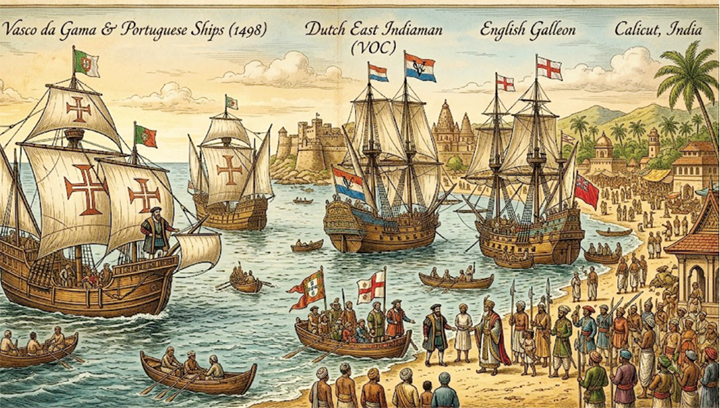
When Vasco da Gama reached the Malabar coast in 1498, he did not discover an unknown India.
He entered an old and sophisticated commercial world.
Calicut was already a major port. Arab merchants had traded along India’s western coast for centuries. Chinese vessels had crossed the Indian Ocean. Indian merchants operated extensive networks.
What changed after the arrival of the Portuguese was the entry of European powers determined to reshape the existing commercial system.
Portugal arrives
The Portuguese were the first Europeans to establish a major maritime presence in the Indian Ocean after the beginning of the European maritime expansion.
Vasco da Gama’s arrival at Calicut opened a new phase.
The Portuguese did not merely want to trade. They sought to control key maritime routes and impose a system of naval dominance.
They established bases and fortified settlements, most famously at Goa, which became the centre of Portuguese power in Asia.
Their arrival brought violence as well as commerce. Naval warfare, attacks on shipping and attempts to control the spice trade became part of the Portuguese strategy.
The Dutch challenge
The Dutch East India Company entered the Indian Ocean at the beginning of the 17th century.
Dutch commercial interests were particularly strong in the spice trade and Southeast Asia, but Dutch merchants also established trading settlements in India.
They competed with the Portuguese and later with the English.
Yet none of these European companies initially possessed the power to conquer the entire subcontinent.
They depended on Indian rulers, merchants, bankers, suppliers and local political conditions.
The English arrive
The English East India Company received its royal charter in 1600.
Its original purpose was commercial.
It established trading centres at places such as Surat, Madras, Bombay and Calcutta over the course of the 17th and 18th centuries.
The Company initially sought privileges from Indian rulers rather than territorial sovereignty.
It bought Indian textiles, spices, saltpetre and other commodities and exported them to international markets.
But commerce brought political influence.
And political influence eventually brought armies.
The French enter the contest
France also established trading interests in India.
Pondicherry became the centre of French influence.
The Anglo-French rivalry reached a critical stage during the Carnatic Wars in the 18th century.
The conflict demonstrated that European companies could use Indian political rivalries to expand their own influence.
The British ultimately emerged as the stronger European power.
Why did commerce become conquest?
This question lies at the heart of modern Indian history.
European companies entered a subcontinent that was politically fragmented but economically wealthy.
They found powerful Indian states, established merchant communities and sophisticated commercial networks.
The transformation occurred because European companies increasingly combined commercial capital with military power and political intervention.
The English East India Company became particularly adept at exploiting rivalries between Indian states while building its own military and financial resources.
The decisive shift came in Bengal.
-
THE EAST INDIA COMPANY
From Merchants to Masters
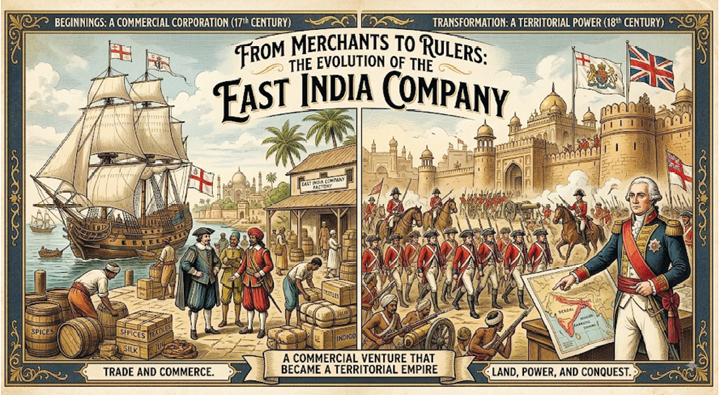
The East India Company began as a commercial corporation.
By the 18th century, it had become something far more consequential: a territorial power.
The transformation did not happen overnight. It emerged from a combination of military victories, political alliances, financial arrangements, administrative innovation and the weakening of major regional powers.
Plassey: the turning point
The Battle of Plassey in 1757 is often treated as the moment when British power began in India.
The reality is more complicated, but the battle was unquestionably decisive.
The Company’s forces under Robert Clive defeated the Nawab of Bengal, Siraj-ud-daulah.
The victory was aided by defections and political conspiracies within the Nawab’s camp.
Plassey gave the Company enormous influence over Bengal.
More importantly, it demonstrated that a trading company could intervene directly in Indian politics and emerge as the decisive power.
Buxar completes the transformation
Seven years later came another crucial battle.
At Buxar in 1764, the Company defeated the combined forces of the Mughal emperor Shah Alam II, the Nawab of Awadh Shuja-ud-daulah and the Nawab of Bengal Mir Qasim.
Buxar strengthened the Company’s military position in northern India.
In 1765, the Mughal emperor granted the Company the Diwani—the right to collect revenue in Bengal, Bihar and Orissa.
This was revolutionary.
A company established to make profits from trade was now collecting taxes from millions of people.
Revenue becomes the foundation of empire
The Diwani transformed the Company’s financial position.
Indian revenues could now help finance the Company’s army and further territorial expansion.
This created a powerful cycle:
territorial conquest → revenue collection → larger military resources → further conquest.
The Company was no longer merely importing Indian goods.
It was increasingly governing Indian territory.
Building the Company state
The Company developed administrative structures to govern its expanding territories.
The Regulating Act of 1773 and Pitt’s India Act of 1784 increased parliamentary oversight over Company affairs.
The British state was increasingly involved in Indian governance even though the Company continued to exercise substantial authority.
The Company also built one of the largest military establishments in the subcontinent.
Indian soldiers—sepoys—formed the overwhelming majority of Company forces.
Subsidiary alliances
Under Governor-General Lord Wellesley, the Company developed the system of Subsidiary Alliances.
Indian rulers who entered such arrangements accepted the presence of British troops and agreed to pay for their maintenance.
They often surrendered significant control over foreign affairs.
The system allowed the Company to expand its influence without direct annexation in every case.
The defeat of rivals
The Company fought numerous wars against Indian states.
The Mysore Wars brought the Company into conflict with Haider Ali and Tipu Sultan.
The Marathas were defeated in a series of Anglo-Maratha wars.
Punjab became a major theatre of conflict, culminating in the annexation of the Sikh kingdom after the Anglo-Sikh wars.
Each victory expanded the Company’s territorial and political authority.
The Doctrine of Lapse
Under Governor-General Lord Dalhousie, the Company pursued an aggressive policy of annexation.
The Doctrine of Lapse allowed the British to annex certain princely states where a ruler died without a recognised natural heir, rejecting adopted heirs in specified circumstances.
States including Satara, Jhansi and Nagpur were annexed under policies associated with Dalhousie.
These measures generated deep resentment among sections of Indian political society.
The transformation of power
By the middle of the 19th century, the East India Company had become ruler of vast territories.
Its original commercial identity had not disappeared. Profit remained important.
But the Company now operated as a state: collecting revenue, maintaining armies, administering justice and shaping economic policy.
The irony was striking.
A corporation had acquired the machinery of sovereignty.
That experiment would end dramatically with the uprising of 1857.
-
THE PRICE OF EMPIRE
How Colonial Rule Reshaped India’s Economy
The British built railways. They established telegraph lines. They expanded ports. They created modern bureaucratic institutions. They introduced new legal and educational systems.
But infrastructure cannot be examined separately from the purpose for which it was built.
The central economic question of colonial India was not simply whether development occurred.
It was whose interests that development primarily served.
The colonial economy
Before British political dominance, India had a large manufacturing and commercial sector, particularly in textiles.
Indian cotton textiles were exported to markets across Asia, Africa and Europe.
Bengal’s muslin became famous. Indian calicoes and chintzes influenced European fashion.
British industrialisation changed this relationship dramatically.
Mechanised textile production in Britain created enormous quantities of cheap cloth.
At the same time, Indian producers faced changing trade conditions and colonial policies.
Indian textile manufacturing suffered severe disruption during the 19th century.
This process is often described as deindustrialization.
The term needs nuance: India did not become completely deindustrialised, and some modern industries later emerged. But traditional handicraft sectors, especially handloom and textile production, faced intense competitive and structural pressures.
The drain of wealth
One of the most influential nationalist economic arguments was the Drain Theory, associated particularly with Dadabhai Naoroji.
Naoroji argued that substantial resources generated in India were transferred to Britain without an equivalent return.
The argument focused on several channels, including salaries and pensions of British officials, military expenditure, profits, interest payments and other transfers.
Later nationalist economists expanded the critique.
The “drain” became more than an economic theory. It became a powerful political argument against colonial rule.
It helped Indian nationalists explain why a country producing enormous quantities of goods and revenue could nevertheless experience widespread poverty.
Land and revenue
Colonial rule transformed relationships between land, cultivators and the state.
The Permanent Settlement in Bengal created a system in which zamindars were recognised as revenue-collecting intermediaries under fixed arrangements with the state.
Elsewhere, systems such as the Ryotwari settlement placed greater emphasis on direct revenue relations between the state and cultivators.
The Mahalwari system operated in parts of northern and central India.
These systems differed, but all made land revenue a central feature of colonial administration.
High or inflexible revenue demands could leave cultivators vulnerable when harvests failed or prices collapsed.
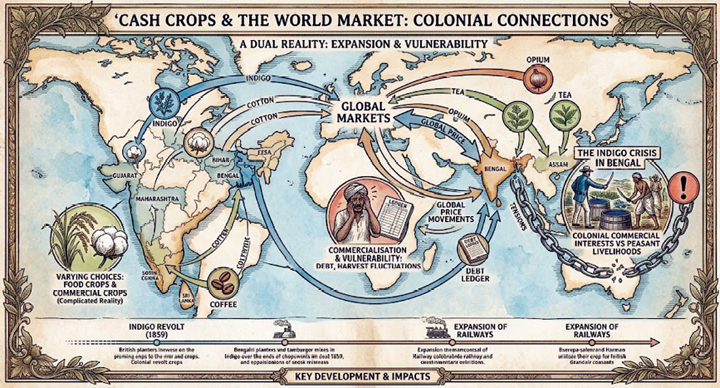
Cash crops and the world market
Colonial agriculture became increasingly connected to global markets.
Indigo, cotton, opium, tea, coffee and other commercial crops expanded in different regions.
This did not mean Indian farmers everywhere simply abandoned food crops. The reality was more complicated and varied by region.
But commercialisation exposed cultivators to global price movements while leaving many vulnerable to debt and fluctuations in harvests.
The indigo crisis in Bengal, for example, demonstrated the tensions that could emerge when colonial commercial interests collided with peasant livelihoods.
Famines and vulnerability
Famines were not new to India.
The subcontinent had experienced severe food crises long before British rule.
But the scale and frequency of major famines during the colonial era became a defining feature of 19th-century India.
The Bengal famine of 1770 occurred during the early period of Company rule and caused catastrophic mortality.
Later famines struck large parts of India in the 19th century.
Historians continue to debate the precise interaction of rainfall, harvest failure, markets, prices, government policy, relief systems and exports in particular famines.
What is clear is that colonial institutions often struggled to protect vulnerable populations from extreme food insecurity, and policy choices could worsen the consequences of scarcity.
The railway paradox
The railway became one of the most visible symbols of British India.
The first passenger railway ran between Bombay and Thane in 1853.
Railways transformed travel and trade. They connected inland production centres to ports and linked previously distant regions.
They also enabled faster movement of troops and officials.
For the colonial state, railways had obvious strategic and commercial value.
For Indians, they eventually became something more than imperial infrastructure. They helped create new markets, facilitated migration and communication and unintentionally contributed to the emergence of a more interconnected political public.
The railway therefore embodied the contradictions of colonial modernity:
It was simultaneously an instrument of empire and an infrastructure later used to challenge empire.
Ports, telegraphs and modern infrastructure
British India developed major port cities such as Bombay, Calcutta and Madras.
Telegraph networks reduced communication times dramatically.
Roads and canals expanded in different regions.
But investment was uneven, and infrastructure frequently reflected imperial priorities—moving raw materials to ports, connecting military centres and facilitating trade within the colonial economy.
The emergence of Indian industry
Colonial India was not economically frozen.
Indian entrepreneurs responded to new opportunities.
The development of modern cotton mills in Bombay and Ahmedabad created an emerging industrial sector.
The Tata group became one of the most important Indian industrial enterprises, eventually expanding into steel, power and other sectors.
Jute manufacturing expanded in Bengal, although much of the industry was controlled by British capital.
Coal mining grew.
Railways themselves generated demand for Indian production.
Thus, late colonial India witnessed the beginnings of modern industrial capitalism alongside widespread poverty and economic inequality.
The rise of the Indian economic critique
By the late 19th and early 20th centuries, educated Indians increasingly analysed colonialism in economic terms.
Dadabhai Naoroji, R.C. Dutt and others argued that India’s poverty was connected to the structure of colonial rule.
Economic nationalism became a central component of the freedom movement.
The call for Swadeshi was not merely a political slogan. It was an economic strategy: buy Indian goods, build Indian industry and reduce dependence on foreign manufactures.
The freedom struggle therefore became increasingly linked to questions of economic sovereignty.
The complicated legacy of colonial infrastructure
A mature historical assessment must resist two simplistic positions.
The first is that British rule produced no modern infrastructure or institutional change.
That is demonstrably false.
The second is that the existence of railways, universities, ports and modern administration somehow makes colonial rule fundamentally developmental.
That is equally misleading.
Infrastructure was built within an imperial system whose central political purpose was control and whose economic structures largely served imperial interests.
The important historical question is therefore not simply:
“Did the British build railways?”
It is:
“Why were they built, who financed them, who benefited from them, and how did Indians eventually repurpose them?”
That distinction helps explain the paradox of colonial India.
The same railway that carried cotton to a port could later carry a nationalist worker to a political meeting.
The same printing technologies used by colonial institutions helped create a nationalist press.
The same English education intended partly to produce colonial intermediaries created generations of Indians capable of challenging imperial rule.
Colonialism changed India profoundly—but Indians also appropriated, resisted and transformed many of the institutions colonial rule created.
And by the beginning of the 20th century, an increasingly organised national movement was asking the question that would ultimately reshape the subcontinent:
If India could produce wealth, knowledge and institutions for an empire, why should it not govern itself?



Be the first to comment