

1857–1947: The Long Road to Independence
India’s independence was not the achievement of a single movement, a single leader or a single generation. It was the culmination of a long, complex and often painful historical process in which political resistance, social reform, economic criticism, revolutionary nationalism, mass mobilization and constitutional negotiation gradually converged. When the Indian tricolour rose over a free nation on 15 August 1947, it represented decades of struggle—and the sacrifices of countless people whose names would never enter the history books.
The story of India’s freedom struggle is often told through its most recognizable figures: Mahatma Gandhi, Jawaharlal Nehru, Subhas Chandra Bose, Bhagat Singh, Bal Gangadhar Tilak, Lala Lajpat Rai and many others. But beneath these towering personalities lay a much larger story involving peasants, workers, students, women, tribal communities, soldiers, journalists, reformers and ordinary citizens. Their participation gradually transformed resistance to colonial rule from scattered opposition into a powerful national movement.
The road from 1857 to 1947 was neither straight nor peaceful. It contained moments of extraordinary unity as well as deep divisions, constitutional negotiations as well as revolutionary violence, non-violent resistance as well as armed rebellion. It witnessed the birth of Indian nationalism, the growth of democratic ideas, the rise of mass politics and, ultimately, the tragedy of Partition.
1857: The First Great Revolt
The first great rupture in the history of British rule came in 1857. By then, the East India Company had expanded its political authority over large parts of India. Its policies had displaced rulers, altered traditional power structures and imposed new systems of revenue collection and administration. Among soldiers of the Company’s army, resentment had also been building over pay, service conditions, promotion and perceived threats to religious practices.
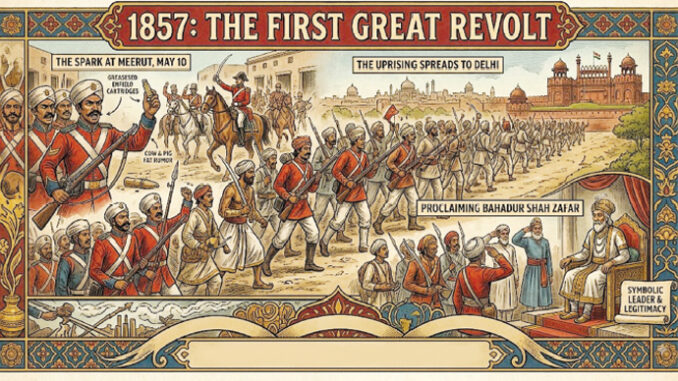
The immediate spark came from the controversy over the new Enfield rifle cartridges, which Indian soldiers were required to bite open. Rumors spread that the cartridges were greased with cow and pig fat, offending the religious beliefs of both Hindu and Muslim soldiers. The controversy became the trigger for a much deeper accumulation of anger.
The revolt began at Meerut on 10 May 1857 and quickly spread to Delhi. The rebels entered the Mughal capital and proclaimed the ageing emperor Bahadur Shah Zafar as their symbolic leader. Although the Mughal emperor possessed little real political power, his presence gave the uprising a powerful historical legitimacy.
From Delhi, the revolt spread across large parts of northern and central India. At Kanpur, Nana Sahib emerged as a major rebel leader. In Jhansi, Rani Lakshmibai became one of the most enduring symbols of resistance. Tantia Tope continued the struggle through a mobile guerrilla campaign. In Bihar, the elderly Kunwar Singh joined the rebellion, while Begum Hazrat Mahal became a prominent leader of resistance in Awadh.
The uprising was far more than a military mutiny in several regions. Peasants, landlords, dispossessed rulers and sections of the urban population joined the rebellion. Yet it was not a uniformly national uprising. Large parts of India remained outside it, and many Indian rulers and soldiers supported the British.
The British eventually reconquered the rebel territories with overwhelming military force. Delhi fell. Jhansi fell. Lucknow was recaptured. The suppression was accompanied by severe reprisals.
Yet the revolt had fundamentally altered the political landscape.
In 1858, the British Crown took direct control of India, ending the rule of the East India Company. The failed revolt had therefore produced a historic consequence: the Company Raj gave way to the British Raj.
After 1857: The Empire Reorganizes
The British government understood that India could not be ruled in exactly the same manner after 1857. Queen Victoria’s proclamation of 1858 promised respect for Indian religions and customs and assured princely rulers that their territories would not be annexed simply through the earlier policies of expansion.
The British also reorganized the army. The proportion of European troops was increased, while recruitment patterns were altered to prevent the emergence of another large-scale military rebellion. Indian soldiers were increasingly recruited from communities that colonial officials classified as “martial races”, a policy that itself reflected the racial assumptions of the Raj.
The relationship with princely states also changed. Rather than seeking to annex every state, the British increasingly relied on princes as allies within the imperial structure. India thus developed a complicated political arrangement: directly ruled British provinces existed alongside hundreds of princely states.
At the same time, the colonial state became more powerful. Railways, telegraph lines, courts, police networks and administrative institutions expanded. The British built these systems primarily to serve the needs of empire, but they produced an unintended consequence. They connected India more closely than ever before.
People, newspapers, ideas and political movements could travel faster.
The infrastructure of empire gradually became one of the networks through which opposition to empire could spread.
The Intellectual Awakening
The emergence of Indian nationalism cannot be understood without looking at the social and intellectual transformations of the 19th century.
Reformers such as Raja Ram Mohan Roy challenged social practices and advocated modern education. Ishwar Chandra Vidyasagar campaigned for widow remarriage and women’s education. Jyotirao Phule attacked caste inequality and worked to expand education among oppressed communities. Swami Dayanand Saraswati called for social reform and educational revival. Swami Vivekananda sought to restore confidence in India’s intellectual and spiritual traditions while engaging with the modern world. Sir Syed Ahmad Khan promoted modern education among Muslims and encouraged intellectual engagement with contemporary knowledge.
Their objectives were different, and they did not constitute a single political movement. But together, the reform movements helped create a new public sphere.
Education produced a growing class of lawyers, teachers, journalists and professionals. Newspapers became increasingly influential. Public meetings and debating societies emerged. Indians began discussing representation, rights, economic exploitation and political freedom.
The question was no longer simply whether British rule was efficient.
It was whether a foreign power had the moral and political right to govern India.
1885: The Birth of the Congress
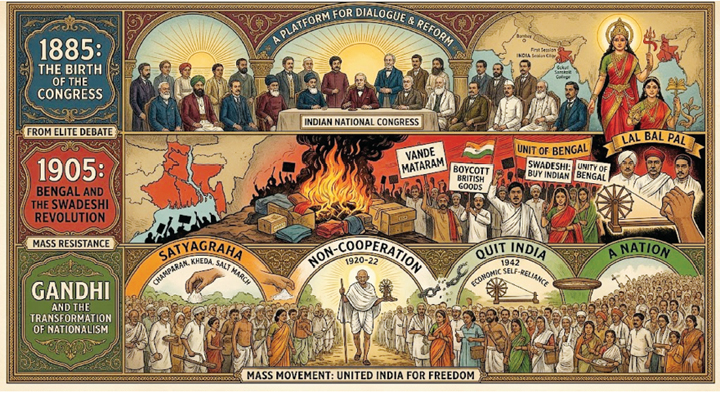 The creation of the Indian National Congress in 1885 marked another decisive stage. Its first session was held in Bombay under the presidency of W.C. Bonnerjee, with the retired British civil servant A.O. Hume playing an important role in its formation.
The early Congress was cautious. Its leaders did not initially demand complete independence. They sought greater Indian participation in government, expansion of legislative councils, reform of the civil services and changes in economic policy.
Yet their constitutional approach laid the foundation for organised Indian nationalism.
Dadabhai Naoroji gave the movement an important economic dimension through his analysis of the “drain” of Indian wealth to Britain. He argued that India’s poverty was not simply the result of internal weaknesses but was linked to the structure of colonial rule.
Surendranath Banerjee became an influential voice for political rights, while Gopal Krishna Gokhale represented a belief in gradual constitutional reform.
The early Congress was often criticized for being dominated by an educated elite.
That criticism was not entirely without basis.
But its historical significance lay in creating an all-India political platform where Indians from different regions could begin discussing common political interests.
The Rise of a More Assertive Nationalism
By the beginning of the 20th century, patience with gradual reform was wearing thin.
Bal Gangadhar Tilak emerged as one of the most powerful advocates of assertive nationalism. Through newspapers, public festivals and political mobilization, he sought to take nationalism beyond elite political circles.
In Bengal, Bipin Chandra Pal became a major advocate of Swadeshi, while Punjab produced the powerful nationalist voice of Lala Lajpat Rai. Together, Tilak, Lajpat Rai and Pal became known as the Lal-Bal-Pal triumvirate.
Their approach was more confrontational than that of the early Congress leadership.
They advocated boycott, Swadeshi and mass political mobilization.
The disagreement between the two tendencies eventually contributed to the Congress split at Surat in 1907.
But the nationalist movement had already entered a new era.
1905: Bengal and the Swadeshi Revolution
The partition of Bengal in 1905 by Lord Curzon became one of the great turning points in India’s freedom struggle.
The British government defended the decision as an administrative measure. Indian nationalists saw it as an attempt to weaken political opposition by dividing a large and politically active province.
The response was immediate and intense.
The Swadeshi movement encouraged Indians to boycott foreign goods and promote Indian products. Students participated in demonstrations. Women joined picketing campaigns. National schools and educational institutions were established.
Swadeshi became more than an economic program.
It became a political philosophy.
Buying Indian goods became an expression of patriotism. Rejecting British goods became an act of resistance.
The movement also strengthened revolutionary nationalism, particularly in Bengal. Secret societies began organizing young men who believed that armed struggle was necessary to overthrow colonial rule.
The British eventually annulled the partition in 1911, but the political impact could not be reversed. Nationalism had moved beyond petitions and public meetings and entered everyday life.
The Revolutionaries
The revolutionary stream of the freedom movement developed alongside constitutional and mass politics.
Organizations such as Anushilan Samiti and Jugantar emerged in Bengal. Revolutionary groups also appeared in other parts of India and among Indians living abroad.
Young men such as Khudiram Bose became symbols of revolutionary sacrifice. Madan Lal Dhingra carried the struggle overseas, assassinating Curzon Wyllie’s in London in 1909 and later facing execution.
The revolutionary tradition reached a new stage in the 1920s. The Hindustan Republican Association brought together figures such as Ram Prasad Bismil, Ashfaqulla Khan and Chandrashekhar Azad.
The Kakori train action of 1925 became one of the most famous episodes in revolutionary history.
Then came Bhagat Singh.
Unlike some earlier revolutionaries, Bhagat Singh increasingly saw the struggle through the lens of socialism, anti-imperialism and political transformation. His actions in the Central Legislative Assembly, his hunger strike and his courtroom statements turned him into a figure whose influence extended far beyond revolutionary circles.
His execution in 1931, alongside Rajguru and Sukhdev, transformed him into one of the most enduring symbols of India’s freedom struggle.
The revolutionaries did not defeat the British militarily.
Their significance lay elsewhere.
They demonstrated the depth of political anger among India’s youth and created a culture of sacrifice that deeply influenced nationalist consciousness.
Gandhi and the Transformation of Nationalism
When Mohandas Karamchand Gandhi returned to India in 1915, Indian nationalism was already developing rapidly. Yet Gandhi transformed its scale and character.
He introduced satyagraha as a method of political resistance based on truth, non-violence and civil disobedience.
His early campaigns in India were rooted in local grievances. In Champaran, he supported indigo cultivators facing exploitative arrangements. In Kheda, he backed peasants demanding relief from land revenue after crop failure. In Ahmedabad, he became involved in a dispute between textile workers and mill owners.
These campaigns established Gandhi’s distinctive political method.
He could connect local suffering with a larger national struggle.
A farmer could see the connection between his land and colonial policy.
A worker could understand his labor dispute as part of a broader struggle for justice.
Nationalism was no longer confined to political associations and urban elites.
It was becoming a movement of ordinary people.
Jallianwala Bagh: A Turning Point
 The events of 1919 accelerated this transformation.
The Rowlatt Act gave the colonial government extraordinary powers to deal with political dissent. Protests spread across India.
In Amritsar, tensions reached a devastating climax.
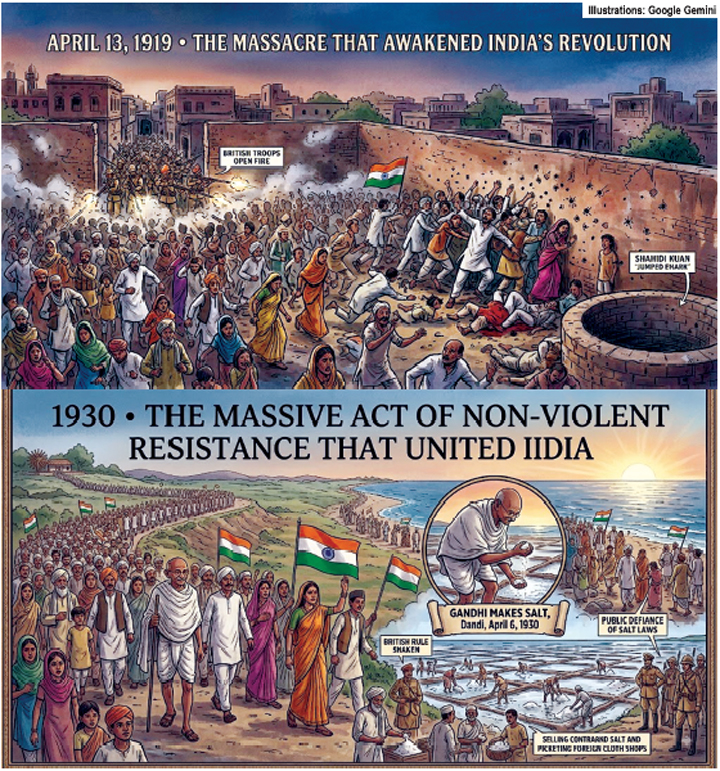
On 13 April 1919, thousands gathered at Jallianwala Bagh. Brigadier-General Reginald Dyer ordered troops to fire on the crowd.
The massacre shocked India.
It also damaged the moral legitimacy of British rule in the eyes of many Indians who had previously believed that reform within the empire might be possible.
Rabindranath Tagore renounced his knighthood. Gandhi moved towards a much more confrontational political strategy.
Jallianwala Bagh became a permanent wound in the memory of the freedom struggle.
Non-Cooperation and the Rise of Mass Politics
In 1920, Gandhi launched the Non-Cooperation Movement.
Indians were encouraged to withdraw from British institutions, boycott foreign goods and participate in peaceful political resistance.
The movement coincided with the Khilafat movement and created a significant period of Hindu-Muslim political cooperation.
Across the country, students left government institutions, lawyers abandoned legal practice and people participated in boycotts.
The movement revealed the extraordinary potential of mass mobilisation.
But it also exposed its dangers.
In February 1922, violence at Chauri Chaura resulted in the deaths of policemen. Gandhi, unwilling to continue a movement that had turned violent, suspended the campaign.
Many nationalists disagreed with the decision.
Yet the significance of Non-Cooperation remained immense. The Congress had been transformed into a mass political organisation.
Purna Swaraj and the Demand for Complete Independence
By the end of the 1920s, the political vocabulary of the freedom movement had changed again.
The demand for greater self-government was increasingly replaced by the demand for complete independence.
At the Lahore session of the Congress in December 1929, under Jawaharlal Nehru’s presidency, the Congress adopted the goal of Purna Swaraj.
26 January 1930 was observed as Independence Day.
It was a declaration of political intent.
The idea of an independent India was no longer a distant aspiration.
It had become the central objective of the national movement.
Salt: The Weapon of Civil Disobedience
Gandhi’s next great campaign demonstrated his extraordinary understanding of political symbolism.
He chose salt.
It was an everyday necessity, consumed by rich and poor alike, and the colonial government imposed a tax and restrictions on its production.
In March 1930, Gandhi began his famous march from Sabarmati Ashram to Dandi.
When he reached the coast and broke the salt law, the act itself was simple.
Its political meaning was enormous.
Across India, people began making or selling salt in defiance of colonial regulations. Foreign cloth was boycotted. Women entered the movement in large numbers. Thousands were arrested.
The Salt Satyagraha demonstrated how civil disobedience could turn an apparently minor issue into a nationwide challenge to state authority.
The British could imprison leaders.
They could not easily imprison an entire population.
Women and the Freedom Struggle
The national movement also changed the public role of Indian women.
Sarojini Naidu became one of its most prominent leaders. Annie Besant had already played an important role in the Home Rule movement. Kasturba Gandhi participated in campaigns alongside her husband. Kamaladevi Chattopadhyay promoted both political activism and social reconstruction.
During the 1940s, Aruna Asaf Ali became a powerful symbol of resistance during the Quit India Movement. Usha Mehta helped run the underground Congress Radio. Matangini Hazra became a martyr of the Quit India struggle.
In the northeast, Rani Gaidinliu resisted British authority.
During the Second World War, Captain Lakshmi Sahgal became the commander of the Rani of Jhansi Regiment of the Indian National Army.
Yet the history of women in the freedom struggle extends far beyond famous names. Thousands of women acted as messengers, organisers, fundraisers, protestors and underground workers.
Their participation changed the social meaning of nationalism.
The Forgotten Millions
The freedom struggle was not fought only in Congress sessions or major cities.
Across rural India, peasants challenged revenue demands and oppressive landlords. Tribal communities resisted colonial restrictions on forests, land and traditional livelihoods. Workers organised strikes and protested exploitative working conditions. Plantation labourers and industrial workers became increasingly involved in political movements.
These struggles did not always fit neatly into the national narrative.
A peasant might join a movement because of land revenue rather than constitutional reform.
A tribal community might resist forest laws because its livelihood depended on traditional access to forests.
A worker might strike over wages and working conditions.
Yet these local struggles gradually became part of a larger challenge to colonial authority.
India’s freedom movement was therefore both national and local.
Its strength came from the ability of the idea of freedom to acquire different meanings in different parts of the country.
The Constitutional Battle
 Alongside mass movements, Indian leaders continued to engage with constitutional reforms.
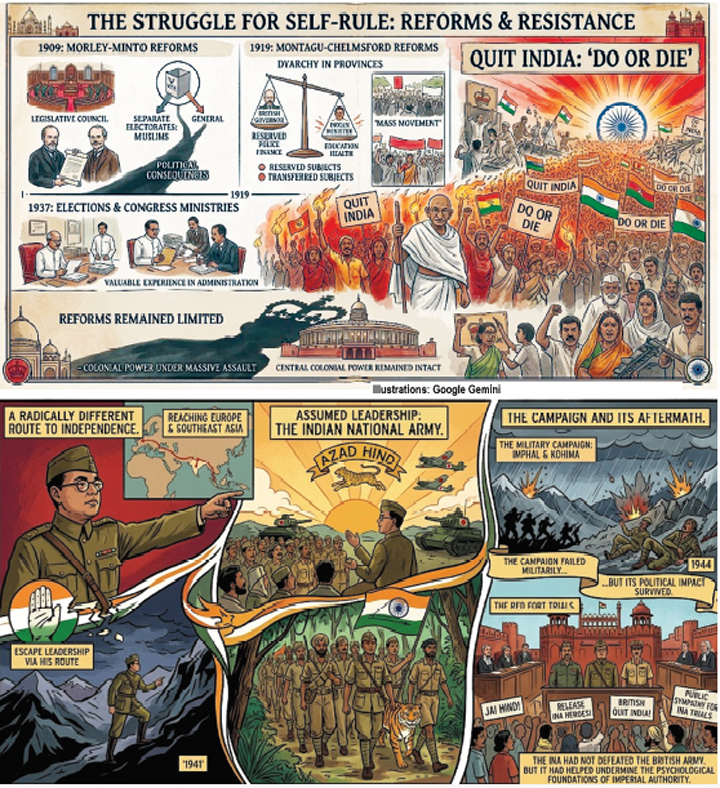
The Morley-Minto reforms of 1909 expanded legislative councils but also introduced separate electorates for Muslims, a development that would have lasting political consequences.
The Montagu-Chelmsford reforms of 1919 introduced dyarchy in the provinces.
The Government of India Act of 1935 went further, providing provincial autonomy and expanding the electorate.
The elections of 1937 brought Congress ministries to power in several provinces.
These governments gave Indian politicians valuable experience in administration.
But the reforms remained limited.
The central structure of colonial power remained intact.
The political question was increasingly unavoidable: could India be governed indefinitely without Indian sovereignty?
The Second World War
The outbreak of the Second World War in 1939 created a new crisis.
Britain declared India to be at war without consulting Indian political leaders. Congress objected, and its provincial ministries resigned.
The war nevertheless transformed India’s strategic importance.
Indian soldiers fought across multiple theatres. Indian industries expanded to support the war effort. The colonial government demanded resources from a population already facing economic hardship.
For Indian nationalists, the contradiction became stark.
Britain claimed to be fighting for freedom and democracy while continuing to deny India independence.
The failure of the Cripps Mission in 1942 convinced many Congress leaders that further negotiations without mass pressure would not produce freedom.
Quit India: “Do or Die”
In August 1942, the Congress launched the Quit India Movement.
Gandhi’s message was uncompromising: “Do or Die.”
The British responded immediately.
Gandhi, Nehru and other major leaders were arrested.
But the movement continued.
Students, workers and ordinary citizens organised protests. Underground networks emerged. Secret communication systems were established. Aruna Asaf Ali became one of its most visible figures, while Usha Mehta’s underground radio helped spread nationalist messages.
In some regions, parallel governments emerged briefly.
The British eventually suppressed the movement, but the political damage to colonial authority was considerable.
The message was clear: Britain could suppress resistance, but it could not indefinitely secure Indian consent.
Subhas Chandra Bose and the INA
At the same time, Subhas Chandra Bose was pursuing a radically different route to independence.
Bose had broken with the Congress leadership over strategy and eventually escaped India in 1941. After reaching Europe and later Southeast Asia, he assumed leadership of the Indian National Army and the Azad Hind movement.
The INA sought to enter India with Japanese military support and challenge British rule through armed struggle.
The campaign failed militarily at Imphal and Kohima.
But its political impact survived the battlefield.
When INA officers were put on trial at the Red Fort after the war, public sympathy for them was widespread.
The trials generated protests and united many Indians across political divisions.
The INA had not defeated the British Army.
But it had helped undermine the psychological foundations of imperial authority.
1946: The Empire Begins to Lose Its Grip
By 1945, Britain itself was exhausted by war.
The economic cost of maintaining the empire had increased enormously.
In India, nationalist sentiment was stronger than ever.
The INA trials were followed by another dramatic development: the Royal Indian Navy revolt of 1946.
Indian naval ratings protested against poor conditions and racial discrimination. The unrest spread from Bombay to other centres, and sections of the civilian population expressed support.
The revolt was eventually brought under control.
But its significance was profound.
The British could no longer take the unquestioning loyalty of Indian servicemen for granted.
The foundations of colonial rule were weakening.
The Road to Partition
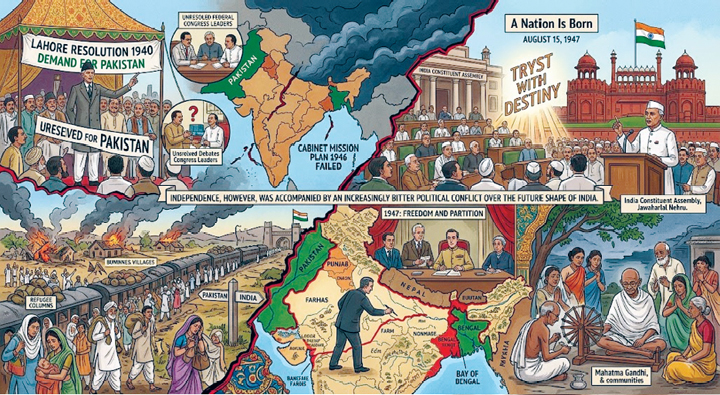
Independence, however, was accompanied by an increasingly bitter political conflict over the future shape of India.
The Muslim League, under Muhammad Ali Jinnah, increasingly demanded a separate homeland for Muslims.
The Lahore Resolution of 1940 became central to the League’s political programme.
Congress leaders continued to argue for a united India, though disagreements over federal arrangements and political representation remained unresolved.
The Cabinet Mission of 1946 attempted to find a compromise that could preserve Indian unity through a complex federal structure.
The plan ultimately failed.
Communal tensions escalated.
The Direct Action call by the Muslim League in August 1946 was followed by devastating communal violence, beginning with the Great Calcutta Killings and spreading elsewhere.
By 1947, the political question of independence had become inseparable from the question of Partition.
1947: Freedom and Partition
Lord Louis Mountbatten arrived in India as the last Viceroy with instructions to transfer power.
The timetable was accelerated.
The Mountbatten Plan accepted the division of British India.
The Indian Independence Act was passed by the British Parliament.
A new boundary had to be drawn.
The task fell to Sir Cyril Radcliffe, who had never previously visited India.
The Radcliffe Line divided Punjab and Bengal.
It separated villages, farms, railway lines and families.
Independence came with an extraordinary human cost.
Millions crossed the new borders.
Hindus and Sikhs moved towards India, while Muslims moved towards Pakistan.
Communal violence killed vast numbers of people.
Homes were abandoned.
Families disappeared.
Refugee columns stretched across the Punjab countryside.
Trains became symbols of both migration and horror.
The new India inherited not only freedom but also the enormous responsibility of rebuilding the lives of those displaced by Partition.
15 August 1947: A Nation Is Born
At midnight between 14 and 15 August, Jawaharlal Nehru addressed the Constituent Assembly.
India had finally achieved freedom.
His famous “Tryst with Destiny” speech captured the mixture of triumph and responsibility that defined the moment.
But Mahatma Gandhi was not in Delhi celebrating.
He was in Bengal, working among communities torn apart by communal violence.
His presence there was a reminder that political independence was only one part of freedom.
The deeper challenge was to build a country in which different communities could live together with dignity and security.
On the morning of 15 August, the Indian flag was raised over a free nation.
The British Raj had ended.
But India’s work had only begun.



Be the first to comment