

1947–2026: Democracy, Development and Transformation
On 15 August 1947, India inherited freedom. On 26 January 1950, it gave that freedom a constitutional shape. Between those two dates lay one of the most demanding transitions in modern history: the transformation of a newly independent, deeply divided and economically fragile country into a sovereign democratic republic.
Independence had ended British rule, but it had not ended the problems created by centuries of political fragmentation and colonial economic structures. The new India faced the enormous task of integrating hundreds of princely states, rehabilitating millions displaced by Partition, establishing democratic institutions, protecting its borders, reviving an impoverished economy and creating a political system capable of accommodating extraordinary diversity.
There was little room for complacency. The country was poor, overwhelmingly rural and burdened by low literacy, inadequate healthcare and limited industrial capacity. Partition had left deep scars. Communal tensions remained raw, refugees needed homes and livelihoods, and questions surrounding Kashmir and the integration of princely states demanded immediate attention.
Yet the founders of the republic chose an ambitious path. They did not postpone democracy until India became prosperous. They did not restrict political participation to the educated or wealthy. They built a constitutional democracy based on universal adult franchise, fundamental rights, federalism, parliamentary government and an independent judiciary.
The making of modern India therefore began not with a single event but with a series of foundational decisions.
The first was to hold the country together.
The second was to give it a Constitution.
The third was to transform independence into republican citizenship.
- 1947: A NATION IS BORN, BUT THE WORK HAS JUST BEGUN
The celebrations of August 1947 unfolded against a landscape of extraordinary suffering.
India had become independent, but Partition had displaced millions. Refugees crossed the new borders on foot, by train and in convoys, leaving behind homes, farms, businesses and ancestral lands. Cities such as Delhi had to absorb enormous numbers of displaced people. Punjab and Bengal were particularly devastated by communal violence.
The new government faced the immediate task of restoring order and rebuilding lives.
Jawaharlal Nehru became independent India’s first prime minister. His government inherited a state apparatus designed by the colonial regime but now had to transform it into an instrument of democratic governance.
The priorities were enormous: food security, refugee rehabilitation, economic reconstruction, education, public health, infrastructure and national defence.
The country also faced the question of political geography.
British India had consisted of directly ruled provinces, but alongside them existed hundreds of princely states. Their rulers had enjoyed varying degrees of autonomy under British paramountcy. With British rule ending, paramountcy itself disappeared.
The question was simple but potentially explosive:
Would these states join India, join Pakistan or attempt to remain independent?
The answer would determine whether the new country emerged as a united political entity or as a fragmented collection of territories.
- THE INTEGRATION OF INDIA
The Map Had to Be Rebuilt
Few tasks in the early years of independence were more consequential than the integration of the princely states.
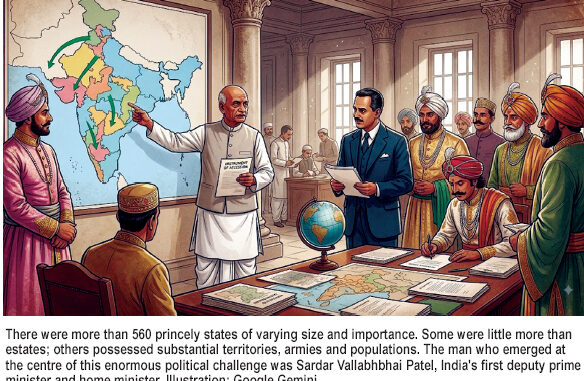
There were more than 560 princely states of varying size and importance. Some were little more than estates; others possessed substantial territories, armies and populations.
The man who emerged at the centre of this enormous political challenge was Sardar Vallabhbhai Patel, India’s first deputy prime minister and home minister.
Working closely with V.P. Menon, the senior civil servant who played a crucial role in negotiations and administrative planning, Patel sought to persuade the rulers to accede to India.
The Instrument of Accession provided the initial constitutional mechanism. By signing it, princely rulers transferred authority over specified subjects, principally defence, external affairs and communications, to the new Union.
For most states, accession occurred through negotiation.
But several cases were considerably more complicated.
Travancore and the Question of Independence
Travancore, a prosperous princely state in southern India, initially considered remaining independent.
Its location, resources and political importance made the issue significant.
Negotiations eventually led to accession to India.
Travancore’s eventual integration illustrated an important characteristic of the process: not every challenge required military action. Political negotiation, persuasion and changing circumstances brought many rulers into the Union.
Junagadh: A Complicated Accession
Junagadh presented a different problem.
The princely state had a predominantly Hindu population but was ruled by a Muslim nawab who announced accession to Pakistan.
India objected, arguing that geography and the wishes of the population made the decision untenable.
Political turmoil followed, and India eventually assumed control.
A plebiscite subsequently recorded overwhelming support for joining India.
Junagadh demonstrated the complexity of the principle of accession in a subcontinent where rulers and populations did not always share the same religious identity.
Hyderabad: The Largest Challenge
Hyderabad was perhaps the most formidable integration challenge.
The princely state was geographically surrounded by Indian territory and was ruled by the Nizam, who initially sought to maintain independence.
Negotiations continued for months.
The situation deteriorated amid political tensions and violence involving the Razakars, a paramilitary organisation associated with the Nizam’s government.
In September 1948, India launched what it called “Operation Polo”. The Hyderabad state forces surrendered within days.
Hyderabad was integrated into India.
The episode remains historically significant not only because of its political outcome but also because of the violence surrounding the process and the subsequent debates over the conduct of the operation.
Kashmir: The Unfinished Question
Kashmir presented an entirely different challenge.
Maharaja Hari Singh initially sought to remain independent.
In October 1947, tribal forces supported from Pakistan entered Kashmir. Faced with the invasion, the Maharaja sought military assistance from India and signed the Instrument of Accession.
Indian troops were subsequently deployed.
The First India-Pakistan War followed.
A ceasefire eventually came into effect, but the conflict left Kashmir divided and created one of the most enduring disputes in South Asian history.
Unlike most princely states, Kashmir’s accession became entangled with war, international diplomacy and competing political claims.
It would remain a central issue in India-Pakistan relations for decades.
The Political Achievement of Integration
By the early 1950s, the map of India had been fundamentally transformed.
Former princely territories were incorporated into the Union. Many were merged into larger administrative units. The process eventually culminated in the States Reorganisation Act of 1956, which reorganised much of the country largely along linguistic lines.
The integration of India was therefore not simply the work of signing accession documents.
It was the beginning of a much longer project: turning a politically fragmented subcontinent into a functioning federal republic.
Patel and Menon’s achievement lay in ensuring that the political map inherited at independence did not become the permanent map of India.
THE CONSTITUTION: INDIA’S FOUNDING DOCUMENT
 From Freedom to Constitutional Government
The Constitution was the bridge between the struggle for independence and the functioning of the republic.
The Constituent Assembly began its work in December 1946, before independence. After Partition, its composition changed, but the Assembly continued the task of designing the constitutional framework of the new nation.
The debates were extensive.
India’s founders had to answer fundamental questions.
What should citizenship mean?
How should power be divided between the Union and the states?
What rights should individuals possess?
How should minorities be protected?
What should be the relationship between the legislature, executive and judiciary?
How could democracy function in a country marked by enormous social inequality?
And perhaps the most ambitious question of all:
Could universal democracy work in a country where most people were poor and many were not yet literate?
The framers answered with a resounding yes.
Ambedkar and the Constitutional Vision
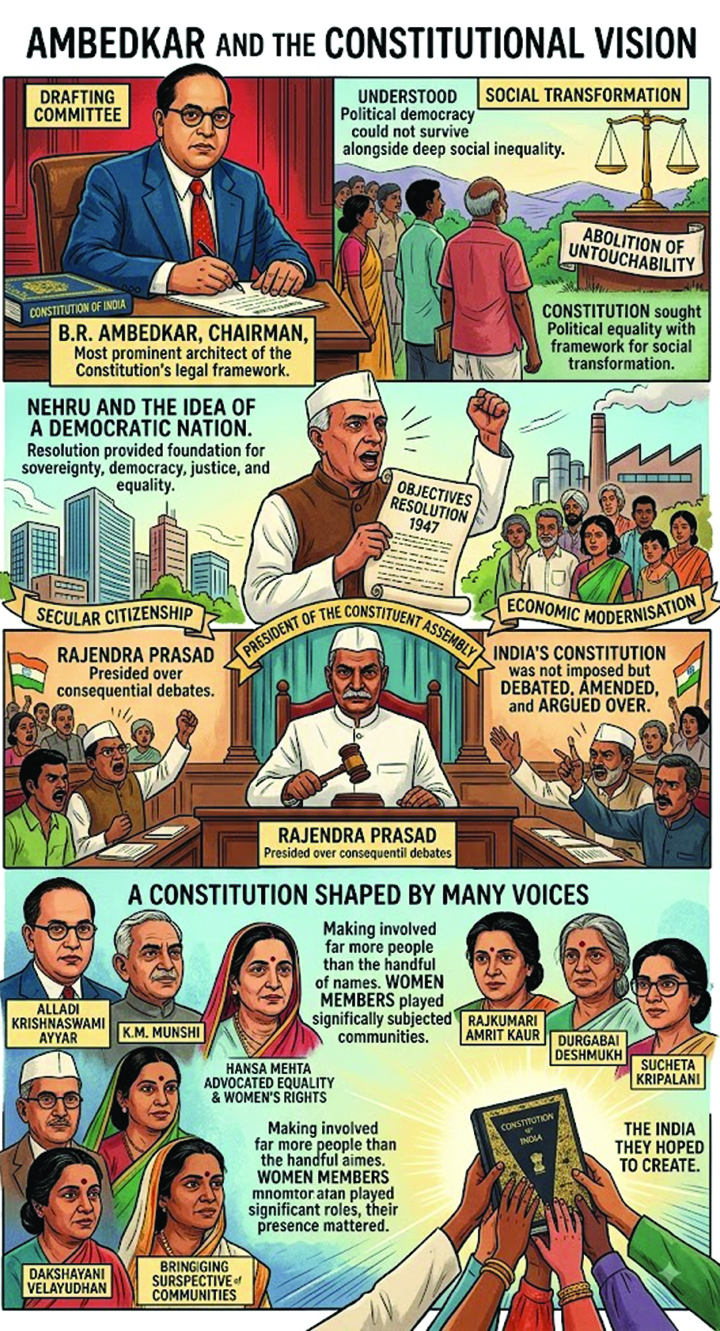
B.R. Ambedkar, chairman of the Drafting Committee, became the most prominent architect of the Constitution’s legal framework.
His contribution went beyond drafting legal provisions.
Ambedkar understood that political democracy could not survive indefinitely alongside deep social inequality. The Constitution therefore sought to establish political equality while providing a framework for social transformation.
The abolition of untouchability, equality before law, fundamental rights and safeguards for historically disadvantaged communities reflected this broader vision.
Ambedkar repeatedly warned that constitutional democracy required more than institutions.
It required constitutional morality.
Nehru and the Idea of a Democratic Nation
Jawaharlal Nehru played a major role in shaping the political philosophy of the new republic.
His Objectives Resolution, adopted by the Constituent Assembly in 1947, provided an important foundation for the Constitution’s vision of sovereignty, democracy, justice and equality.
Nehru’s conception of India emphasised parliamentary democracy, scientific temper, secular citizenship and economic modernisation.
He believed political freedom had to be followed by social and economic transformation.
Rajendra Prasad and the Assembly
As president of the Constituent Assembly, Rajendra Prasad presided over some of the most consequential debates in India’s history.
The Assembly brought together lawyers, politicians, administrators, social reformers and representatives from different parts of the country.
Their political disagreements were often intense.
But the debates demonstrated an important characteristic of the founding moment: India’s Constitution was not imposed by a victorious leader.
It was debated, amended and argued over.
A Constitution Shaped by Many Voices
The making of the Constitution involved far more people than the handful of names most commonly remembered.
Alladi Krishnaswami Ayyar, K.M. Munshi and numerous other members made important contributions to the constitutional debates.
Women members of the Assembly also played significant roles.
Hansa Mehta advocated equality and women’s rights and contributed to debates on fundamental rights.
Dakshayani Velayudhan, one of the first Dalit women to become a member of the Constituent Assembly, brought the perspective of communities historically subjected to social discrimination.
Other women members, including Rajkumari Amrit Kaur, Durgabai Deshmukh and Sucheta Kripalani, contributed to discussions on rights, social reform and governance.
Their presence mattered.
The Constitution was being written not merely for the India that existed in 1947 but for the India that its framers hoped to create.
A DOCUMENT OF RIGHTS AND RESPONSIBILITIES
The Constitution established a parliamentary system of government and a federal structure with a strong Union.
It guaranteed Fundamental Rights.
It established an independent judiciary.
It created institutions designed to prevent the concentration of political power.
The Directive Principles of State Policy articulated social and economic goals for the state.
The Constitution also adopted universal adult franchise.
This was revolutionary.
India did not gradually expand voting rights over generations.
It began its democratic life by giving adult citizens the right to vote.
The decision reflected confidence in ordinary Indians.
A landless labourer and a wealthy industrialist were equal in the voting booth.
A village woman and a university professor possessed the same vote.
The republic would ultimately be judged by whether it could convert this political equality into broader social and economic opportunity.
THE CONSTITUTION IS ADOPTED
The Constituent Assembly adopted the Constitution on 26 November 1949.
That date is now observed as Constitution Day.
The Constitution came into force on 26 January 1950.
The choice of 26 January was deeply symbolic.
Two decades earlier, the national movement had observed 26 January 1930 as the day of Purna Swaraj, or complete independence.
Thus, the Republic deliberately connected the constitutional present with the nationalist aspirations of the freedom struggle.
The journey from colonial subject to constitutional citizen had reached its formal conclusion.
But another journey was beginning.
REPUBLIC DAY: INDIA BECOMES A REPUBLIC
26 January 1950
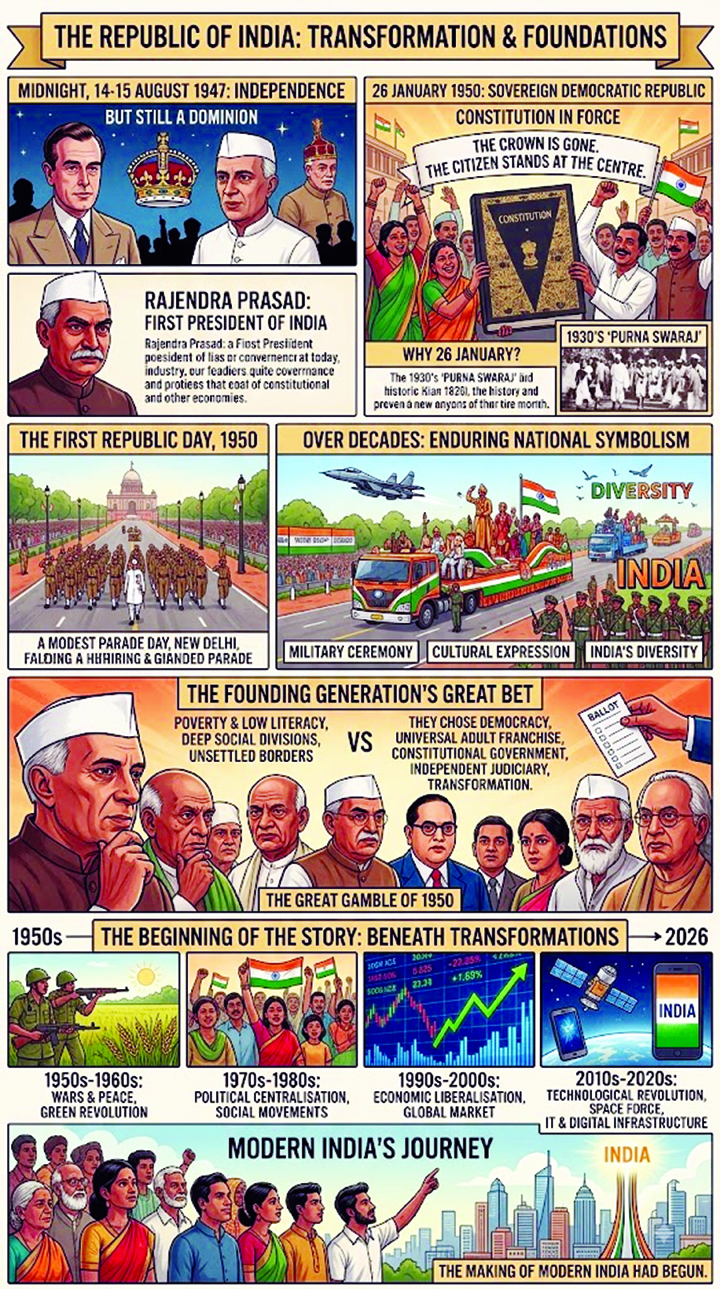
At midnight on 14–15 August 1947, India had become independent.
But it remained a Dominion within the Commonwealth, with the British monarch as its formal head of state and the Governor-General representing the Crown.
On 26 January 1950, that transitional arrangement ended.
The Constitution came into force.
India became a sovereign democratic republic.
Rajendra Prasad became the first President of India.
The transformation was profound.
India was no longer governed under an imperial constitutional framework.
Its supreme legal authority now came from a Constitution created by representatives of the Indian people.
The Republic therefore represented something larger than a change in ceremony.
It marked a change in the source of political legitimacy.
The Crown was gone.
The citizen stood at the centre of the new political order.
Why 26 January?
The date was deliberately chosen to honour the earlier declaration of Purna Swaraj.
On 26 January 1930, Indians had pledged themselves to complete independence.
Twenty years later, the Constitution transformed that aspiration into a functioning republic.
The symbolism was unmistakable.
The freedom struggle had demanded sovereignty.
The Constitution gave sovereignty institutional form.
The First Republic Day
The first Republic Day celebrations were held in New Delhi on 26 January 1950.
The ceremony was modest compared with the grand spectacle that Republic Day would eventually become.
Over the decades, the day evolved into one of India’s most important national occasions, combining military ceremony, cultural expression, technological achievement and a display of India’s diversity.
The Republic Day parade became a visual representation of the country itself.
Its armed forces symbolised national security.
Its tableaux represented different states and cultural traditions.
Its schoolchildren and performers represented a new generation.
Its ceremonial traditions connected the modern republic with the historical memory of the freedom struggle.
THE FOUNDING GENERATION’S GREAT BET
The men and women who built the early republic faced a fundamental dilemma.
India was poor.
Its institutions were young.
Its population was vast.
Its social divisions were deep.
Its borders were unsettled.
Its literacy rate was low.
Yet its founders chose democracy.
They chose elections rather than authoritarian rule.
They chose universal adult franchise rather than restricted voting.
They chose constitutional government rather than rule by decree.
They chose federalism rather than excessive centralisation.
They chose an independent judiciary rather than unchecked executive power.
And they chose a Constitution that sought not merely to preserve the society they inherited but to transform it.
That was the great gamble of 1950.
The subsequent history of India—from elections and economic planning to wars, social movements, technological transformation, liberalisation and the expansion of the middle class—would repeatedly test that founding choice.
But the institutional framework survived.
THE BEGINNING OF THE INDIA @ 80 STORY
The India that emerged in 1950 was very different from the India of 2026.
The country would go through wars and peace, food shortages and the Green Revolution, state-led industrialisation and economic liberalisation, political centralisation and federal assertion, social movements and technological revolutions.
New states would be created.
New political parties would emerge.
The economy would change fundamentally.
Cities would expand.
India would move from dependence on imported food to becoming a major agricultural producer, from a largely agrarian economy to a diversified industrial and services economy, and from limited technological capacity to a major force in space, information technology, pharmaceuticals and digital infrastructure.
But beneath these transformations lies the same foundational framework created in the republic’s earliest years.
The integration of territory created the political India.
The Constitution created the institutional India.
Republic Day gave that constitutional order its enduring national symbolism.
The next chapters of the story would be about what Indians did with these foundations.
The making of modern India had begun.
Be the first to comment