
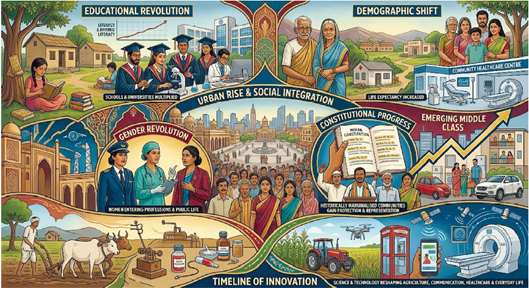

When India became independent in 1947, the challenge before the new republic was not only to build a political democracy or an economic system. It was also to transform the lives of its people. Poverty was widespread, literacy was low, healthcare facilities were inadequate and social inequality was deeply embedded in everyday life. Caste shaped opportunity and social relations, women faced severe restrictions, and millions of people lived in villages with limited access to schools, hospitals, roads and markets.
Over the next eight decades, India experienced one of the world’s most extensive social transformations. Schools and universities multiplied, literacy expanded, life expectancy increased, cities grew, women entered professions and public life, and historically marginalised communities gained greater constitutional protection and political representation. A large middle class emerged, while science and technology reshaped agriculture, communication, healthcare and everyday life.
Yet modernisation has not erased India’s old inequalities. Caste continues to influence social and political life, gender disparities persist, tribal communities continue to negotiate development and identity, and access to quality education and healthcare remains uneven.
Social India is therefore neither a simple story of progress nor one of continuing deprivation. It is a story of change, contestation and aspiration—of a society constantly negotiating between its inherited structures and its modern ambitions.
- THE INDIA OF 1947: POVERTY, ILLITERACY AND INEQUALITY
A Republic Begins with a Social Challenge
India’s independence came after decades of colonial rule, but political freedom could not immediately change the social conditions of ordinary Indians.
The new republic inherited a society in which poverty was widespread and educational opportunities were severely limited. Most Indians lived in rural areas and depended directly or indirectly on agriculture. Villages often lacked proper roads, schools, healthcare facilities, sanitation and reliable access to markets.
Illiteracy was one of the most serious obstacles to social transformation. Education remained inaccessible to large sections of the population, particularly women and disadvantaged communities.
Healthcare presented an equally difficult challenge. Infectious diseases, malnutrition, poor sanitation and limited medical facilities contributed to high mortality.
Social inequality added another dimension.
Caste hierarchy had shaped Indian society for centuries, while untouchability and exclusion denied millions basic dignity and opportunity.
The Constitution attempted to establish a new social foundation.
Equality before the law became a constitutional principle. Untouchability was abolished. Universal adult franchise gave every adult citizen an equal vote.
This was revolutionary.
A person who had historically been denied social equality was now constitutionally recognised as an equal citizen.
The State as an Instrument of Social Change
The new government understood that constitutional promises would have little meaning without institutions and programs capable of improving people’s lives.
Schools were expanded.
Hospitals and primary-health centers were established.
Reservations were introduced for Scheduled Castes and Scheduled Tribes.
Community development programs sought to improve rural life.
Universities and technical institutions were established.
The welfare state became an important instrument of social transformation.
India’s challenge was therefore larger than economic development.
It was an attempt to change the conditions under which generations of Indians lived.
- EDUCATION: FROM A FEW INSTITUTIONS TO MASS EXPANSION
The Long Road from Literacy to Learning
At independence, education was available to only a relatively small section of society.
The republic began expanding the school system while simultaneously creating institutions capable of producing scientists, engineers, doctors, administrators and teachers.
This produced a distinctive two-track educational strategy.
India sought mass education for its population while also creating centres of excellence.
The Indian Institutes of Technology became symbols of technical education.
Universities expanded.
Medical colleges multiplied.
Research institutions were created.
Over time, primary and secondary schooling reached millions of children who would previously have had little opportunity to study.
The Girl Who Went to School
Perhaps the most important social transformation in education has been the expansion of girls’ education.
For generations, social expectations, poverty and early marriage limited educational opportunities for many girls.
The expansion of schools, scholarships, welfare programs and changing social attitudes gradually altered the situation.
Educated women entered professions, government service, science, medicine, journalism, business and politics.
Education became one of the most powerful mechanisms through which traditional social expectations began to change.
From Access to Quality
India’s educational challenge has evolved.
The central question is no longer simply how to bring children into classrooms.
It is whether they receive quality learning.
Teacher training, foundational literacy and numeracy, vocational skills, higher education, digital access and employability have become increasingly important.
India has built one of the world’s largest education systems.
The next challenge is to make that system capable of preparing citizens for an economy and society undergoing rapid technological change.
WOMEN AND THE MAKING OF MODERN INDIA
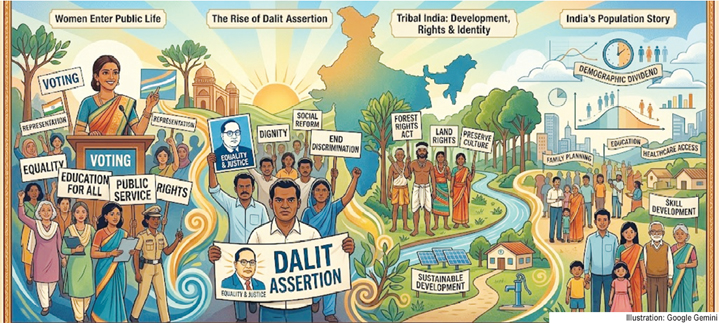
No account of modern India can be complete without examining the changing position of women.
At independence, women faced significant barriers in education, employment, property ownership and political participation.
The Constitution established equality, and subsequent legal and social reforms gradually widened women’s rights.
Women entered schools and universities in increasing numbers.
They became doctors, teachers, lawyers, engineers, scientists, civil servants, entrepreneurs, journalists, soldiers and political leaders.
The transformation was particularly visible in urban India, but changes also reached rural communities.
Women Enter Public Life
Indian women were voters from the beginning of the republic.
Universal adult franchise did not distinguish between male and female citizens.
Over time, women’s participation in politics expanded further through local-government institutions.
Reservations in panchayats and municipalities brought millions of women into grassroots governance.
For many, political office became a first experience of public leadership.
This process created a new generation of women leaders who participated in decisions concerning roads, water, education, sanitation and local development.
The Unfinished Gender Revolution
Despite enormous progress, equality remains incomplete.
Women continue to face violence, unequal domestic responsibilities, discrimination and barriers to economic participation.
The question is no longer whether women can enter India’s public and economic life.
They already have.
The question is whether social structures will allow them to participate on equal terms.
The future of India’s development is therefore inseparable from the future of its women.
- THE DALIT MOVEMENT AND THE QUEST FOR EQUALITY
From Social Exclusion to Constitutional Citizenship
The struggle against caste discrimination is one of the central stories of modern India.
Dr B.R. Ambedkar became the most influential constitutional and political voice of this struggle.
He argued that political democracy could not survive without social democracy.
The Constitution reflected this principle.
Untouchability was abolished.
Equality before the law was guaranteed.
Discrimination on specified grounds was prohibited.
Reservations were established to improve representation and opportunity for historically disadvantaged communities.
These measures marked a fundamental transformation in the relationship between the state and caste.
The Rise of Dalit Assertion
Constitutional safeguards were followed by a broader social and political awakening.
Dalit movements challenged discrimination through literature, journalism, political organizations and grassroots activism.
Political parties representing Dalit interests gained influence in several states.
Dalit literature became an important intellectual and cultural force, challenging traditional representations of caste and society.
The political system itself changed.
Groups historically excluded from power could now organise, vote, contest elections and demand representation.
Equality and Its Limits
Yet legal equality has not eliminated social discrimination.
Caste violence, exclusion and unequal access to resources remain realities in parts of India.
The struggle for equality therefore continues.
But the constitutional transformation remains historic.
A society once organized through inherited hierarchy was attempting to rebuild itself around the idea of equal citizenship.
- TRIBAL INDIA: DEVELOPMENT, RIGHTS AND IDENTITY
A Different Relationship with Land and Forest
India’s tribal communities represent extraordinary diversity in language, culture, geography and social organization.
Many communities traditionally maintained close relationships with forests and natural resources.
The post-independence development process brought roads, schools, hospitals, electricity and markets into many tribal regions.
But it also brought displacement.
Dams, mines, industries, infrastructure projects and conservation initiatives sometimes affected traditional livelihoods and access to land.
For tribal communities, therefore, development could have contradictory meanings.
It could bring education, healthcare and connectivity while simultaneously threatening traditional livelihoods and cultural identity.
The Struggle for Rights
Over time, tribal movements increasingly demanded recognition of land, forest and community rights.
Political representation and constitutional protections provided important institutional mechanisms.
The debate over tribal development remains one of India’s most difficult policy questions.
The issue is not simply whether roads should reach remote communities.
It is also who decides where those roads are built, who owns the land, who benefits from natural resources and how cultural identities are protected.
For tribal India, development must increasingly be understood as a partnership rather than simply an administrative project.
- INDIA’S POPULATION STORY
From Population Explosion to Demographic Transition
Population has been one of the defining forces of modern India.
At independence, India’s population was a little over 300 million.
It subsequently expanded rapidly, creating enormous demands for food, housing, employment, education and healthcare.
Population growth became a major concern of policymakers.
India was among the earliest countries to establish a national family-planning program.
Over time, fertility rates began falling, particularly as education, urbanization and incomes increased.
The demographic picture has therefore changed.
India now has a very large working-age population.
This creates the possibility of a demographic dividend.
But demographic advantage is not automatic.
Young people need education, skills, healthcare and productive employment.
If these opportunities are unavailable, a large young population can instead create economic and social pressures.
India’s population story has therefore entered a new phase.
The challenge is no longer simply controlling population growth.
It is converting demographic scale into human capital.
URBANISATION: FROM TOWNS TO MEGACITIES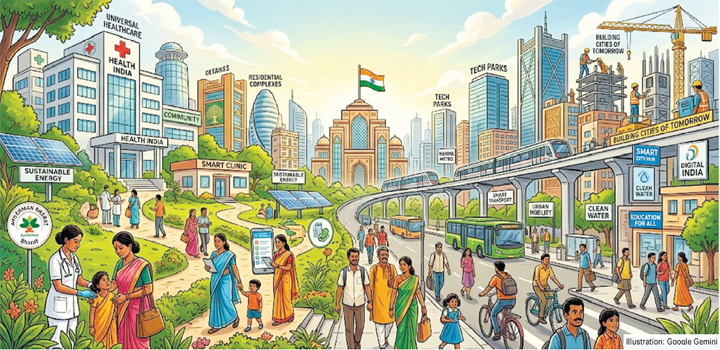
India Moves to the City
Independent India was overwhelmingly rural.
The India of the 21st century is increasingly urban.
Cities such as Delhi, Mumbai, Bengaluru, Chennai, Hyderabad, Kolkata, Pune and Ahmedabad have become centers of employment, education, technology, finance and culture.
Urbanization has created enormous opportunities.
A young person moving from a village to a city may gain access to universities, hospitals, technology and employment opportunities that were previously unavailable.
Cities have also become laboratories of social change.
People from different regions, languages and communities live and work together.
Traditional social boundaries can become less rigid.
But urbanisation has also produced major challenges.
Traffic congestion, pollution, water shortages, waste management and inadequate housing have become everyday problems.
Informal settlements exist alongside modern office districts and residential complexes.
Building the Cities of Tomorrow
India’s future will depend heavily on the quality of its cities.
Urban planning must provide affordable housing, efficient public transport, clean air, water, sanitation and reliable public services.
The goal cannot simply be to create larger cities.
It must be to create cities in which people can live with dignity.
- THE INDIAN MIDDLE CLASS: THE GREAT SOCIAL TRANSFORMATION
The Rise of Aspiration
The economic changes that accelerated after 1991 produced a major social transformation.
Millions of Indians experienced rising incomes and new forms of consumption.
Television, automobiles, private education, smartphones, air travel, shopping malls and online commerce gradually became part of a wider middle-class experience.
The transformation was psychological as much as material.
For earlier generations, economic security often meant a government job, modest housing and savings.
The new middle class increasingly sought professional careers, entrepreneurship, international opportunities and higher standards of living.
A New Political Expectation
Economic aspiration also changed the relationship between citizens and government.
People increasingly demanded better infrastructure, cleaner cities, reliable electricity, improved schools and more efficient public services.
The middle class became an important political constituency.
But the growth of the middle class did not eliminate poverty.
India continued to contain enormous differences in income, wealth and access to services.
The great social transformation therefore created a society of rising aspirations alongside persistent inequalities.
- CASTE, COMMUNITY AND THE CHANGING SOCIAL ORDER
Old Identities in a New Democracy
Modernization has not erased caste.
Instead, it has changed the way caste operates.
Urbanization and education have weakened some traditional structures.
Economic mobility has allowed individuals to move beyond occupations associated with inherited social status.
Inter-caste interaction has increased in workplaces and educational institutions.
Yet caste continues to influence marriage, political mobilization, social networks and access to opportunity.
Democracy has produced an interesting paradox.
The Constitution treats citizens as equals.
Elections, however, have encouraged communities to organize around identity in order to demand political representation and resources.
Caste has therefore become both a structure challenged by democracy and a political identity strengthened by democratic mobilization.
Community and Citizenship
Religion, language and regional identity similarly remain important.
India’s modern social order is not a simple replacement of tradition by modernity.
Instead, inherited identities interact with constitutional citizenship, market forces, education, urbanization and technology.
The result is a society that is constantly changing but rarely abandoning its past completely.
- HEALTH INDIA: FROM EPIDEMICS TO UNIVERSAL ASPIRATIONS
A Revolution in Life Expectancy
At independence, India faced a formidable public-health burden.
Infectious diseases were widespread.
Sanitation was poor.
Medical facilities were limited.
Maternal and infant mortality were high.
The expansion of vaccination, sanitation, public-health programs, hospitals and medical education gradually changed the situation.
Life expectancy increased substantially.
India also developed a major pharmaceutical industry.
Its ability to manufacture affordable generic medicines and vaccines eventually made it an important player in global healthcare.
A New Health Challenge
India’s health burden has now changed.
Infectious diseases remain important, but non-communicable diseases have become increasingly significant.
Diabetes, cardiovascular disease, cancer and other chronic conditions now affect millions.
At the same time, malnutrition and unequal healthcare access remain concerns.
The country therefore faces a double challenge: controlling traditional public-health problems while managing the diseases of a rapidly urbanizing and ageing society.
The aspiration has shifted from merely preventing premature death to providing affordable, high-quality healthcare throughout life.
The transformation of India has always been linked to its ability to use science and technology to solve national problems.
From agricultural research and heavy engineering to satellites, software and digital payments, technology has repeatedly expanded the possibilities available to Indian society.
The foundations were laid during the first decades of the republic.
NEHRU’S SCIENTIFIC TEMPER
Building the Institutions of Modern Science
Jawaharlal Nehru believed that science was central to India’s modernization.
The republic therefore invested in research laboratories, universities, technical institutes and scientific organizations.
The Indian Institutes of Technology became centers of advanced technical education.
The Council of Scientific and Industrial Research developed a network of laboratories.
Scientific research expanded into agriculture, medicine, engineering, atomic energy and other fields.
The objective was not simply to create technological products.
Nehru saw scientific thinking as a way of building a modern society based on reason, evidence and experimentation.
That institutional investment became one of the foundations for later achievements.
India’s atomic program, space program, agricultural research and technology industry all benefited from the scientific infrastructure created during these formative decades.
- THE ATOMIC INDIA STORY
Homi Bhabha and the Nuclear Vision
India’s nuclear program was closely associated with physicist Homi J. Bhabha.
The Atomic Energy Commission was established in 1948, reflecting the new republic’s determination to develop advanced scientific capabilities.
Nuclear technology was seen as important for energy, scientific research and strategic autonomy.
India built research reactors and developed expertise across the nuclear fuel cycle.
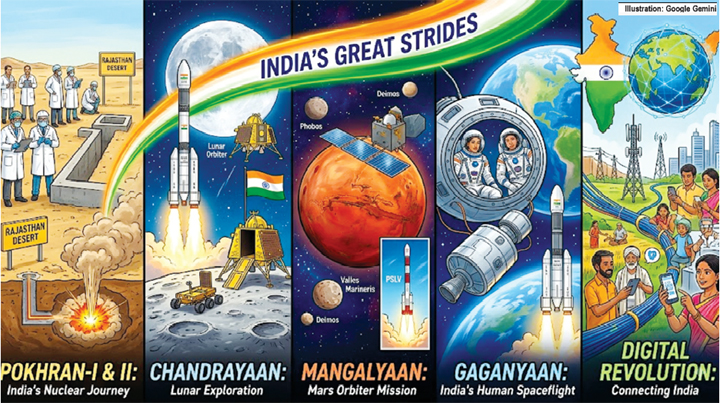
The country’s first nuclear test took place at Pokhran in 1974.
A second series of tests was conducted in 1998.
The nuclear program subsequently became an important component of India’s strategic posture.
At the same time, India continued developing civilian nuclear-energy capabilities.
The story reflects a broader feature of Indian scientific policy: the pursuit of strategic autonomy through domestic technological capability.
- INDIA REACHES FOR SPACE
From a Small Satellite to the Moon
India’s space program began with a development-oriented vision.
Vikram Sarabhai believed that space technology should address practical national needs.
Satellites could support communications, weather forecasting, education, agriculture and resource management.
The Indian Space Research Organization became the institutional centre of the program.
Aryabhata, India’s first satellite, was launched in 1975.
The country gradually developed its own launch vehicles.
The SLV program represented an important early step.
The PSLV later became one of India’s most successful launch vehicles and established the country’s reputation as a reliable space-launch provider.
Chandrayaan and Mangalyaan
India’s ambitions then expanded beyond practical satellite applications.
Chandrayaan-1, launched in 2008, became India’s first lunar mission and contributed important scientific evidence concerning water molecules on the Moon.
The Mars Orbiter Mission, popularly known as Mangalyaan, demonstrated India’s ability to reach Mars.
In 2023, Chandrayaan-3 achieved a historic soft landing in the Moon’s southern polar region.
The achievement represented decades of institutional investment in space science and engineering.
Gaganyaan and Beyond
India’s ambitions now extend to human spaceflight.
Gaganyaan seeks to demonstrate India’s capability to send Indian astronauts into space.
The space programme has thus travelled an extraordinary distance—from a development-oriented satellite programme to lunar exploration and human-spaceflight ambitions.
- FROM THE GREEN REVOLUTION TO THE DIGITAL REVOLUTION
Technology as a Development Tool
India’s technological transformation has occurred through several major waves.
The Green Revolution used agricultural science to increase food production.
The White Revolution transformed dairy production.
The space program expanded communication and remote-sensing capabilities.
The IT revolution created a globally competitive services industry.
The digital revolution connected citizens, businesses and government services.
Each technological transformation addressed a specific national challenge.
Food insecurity required agricultural science.
Geographical isolation required communications.
Economic opportunity required computing and telecommunications.
Financial exclusion created space for digital banking and payments.
Technology therefore became a tool of development rather than merely a symbol of modernity.
THE IT REVOLUTION AND INDIA’S SOFTWARE POWER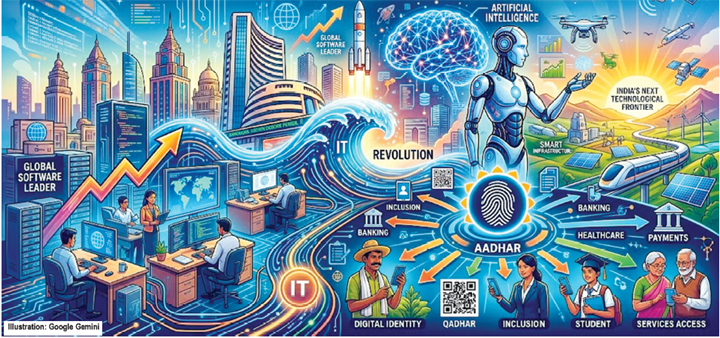
The Software Nation
India’s IT industry became one of the most successful examples of the country’s post-liberalization transformation.
Companies such as TCS, Infosys and Wipro helped establish India as a global centre for software services.
Bengaluru became internationally associated with India’s technology economy, while Hyderabad, Chennai, Pune, Mumbai and the National Capital Region also developed major technology clusters.
Indian professionals became part of global technology networks.
The industry created millions of direct and indirect employment opportunities and generated significant export earnings.
Beyond Outsourcing
The technology sector has evolved considerably.
India is now home to startups, fintech companies, software-product firms and deep-tech ventures.
Indian engineers and entrepreneurs increasingly build products for global markets.
Artificial intelligence, cloud computing, cybersecurity and digital platforms are creating new opportunities.
The IT revolution therefore did more than generate export revenues.
It helped create a new generation of Indians whose professional lives were connected directly to the global economy.
- DIGITAL INDIA
The Architecture of a Digital Society
India’s digital transformation has been built around several interconnected developments.
Aadhaar created a large-scale digital identity infrastructure.
The expansion of bank accounts increased financial inclusion.
Smartphones brought digital services into the hands of hundreds of millions of people.
UPI transformed payments.
Government services increasingly moved online.
Together, these developments created what has increasingly been described as India’s digital public infrastructure.
The significance lies in the scale and openness of the system.
Digital platforms can be used by banks, businesses, government agencies and startups.
A small merchant can accept digital payments.
A citizen can access government services online.
A consumer can transfer money instantly.
A business can build new services on top of digital infrastructure.
The Challenge of Inclusion
Digital transformation also creates risks.
Not everyone has equal access to devices or reliable connectivity.
Digital literacy remains uneven.
Cybersecurity and data protection are increasingly important.
The next stage of Digital India must therefore ensure that technology expands opportunity without creating new forms of exclusion.
- ARTIFICIAL INTELLIGENCE AND INDIA’S NEXT TECHNOLOGICAL FRONTIER
The Age of Intelligent Machines
Artificial intelligence is emerging as the next major technological transformation.
AI is already influencing software development, healthcare, finance, manufacturing, education, agriculture, media and government services.
India enters this era with important advantages.
It has a large technology workforce, strong engineering talent, a growing research ecosystem and one of the world’s largest digital populations.
AI could help farmers make better decisions, assist doctors in diagnosis, personalise education, improve logistics and increase industrial productivity.
It could also create entirely new businesses.
The Risks of the AI Revolution
The opportunities are accompanied by serious questions.
Automation could alter employment patterns.
AI systems can reproduce bias.
Synthetic media can accelerate misinformation.
Personal data can be misused.
The country will need appropriate rules for safety, privacy, accountability and responsible innovation.
From Consumer to Creator
The larger ambition is to ensure that India does not remain only a consumer of advanced technologies.
The country will need investment in computing infrastructure, semiconductor manufacturing, research laboratories, advanced education and scientific talent.
If the first decades of independent India were devoted to building scientific institutions, and the later decades to building digital capabilities, the coming era may be about creating frontier technologies.
EIGHT DECADES OF CHANGE
The India of 1947 and the India of 2026 are separated by an extraordinary social transformation.
A largely illiterate society built one of the world’s largest education systems.
A country with limited healthcare facilities developed a vast medical infrastructure and a globally significant pharmaceutical industry.
Women moved into universities, professions, public institutions and political life.
Dalit movements transformed the politics of equality and representation.
Tribal communities continued to assert their rights and identities amid rapid development.
Cities grew into economic and cultural centres.
A large middle class emerged.
Science and technology changed the way Indians farmed, travelled, communicated, worked and paid.
The country moved from radio to television, from landlines to smartphones, from cash to instant digital payments, and from limited access to information to an era in which billions of digital interactions take place every day.
Yet social transformation has never been uniform.
India continues to contain extraordinary differences between regions, communities, classes and generations.
The task ahead is therefore not simply to modernise further.
It is to make modernisation more inclusive.
The next India will need better schools, healthier citizens, more productive cities, greater opportunities for women, stronger social protection and deeper inclusion of historically disadvantaged communities.
Technology will be central, but technology alone cannot solve social problems.
The ultimate measure of progress will remain human.
The great social question for the next decades is whether India’s extraordinary economic and technological transformation can translate into greater equality of opportunity, dignity and quality of life for every citizen.
That is the unfinished story of Social India.


Be the first to comment