
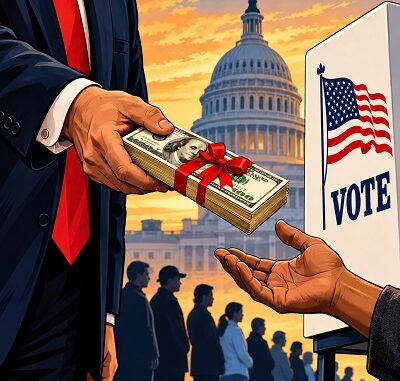


If public assistance is justified because citizens need it, why should its availability depend on which political party wins an election?
That question has acquired fresh relevance following President Donald Trump’s promise of a $5,000 payment to every adult American citizen if Republicans retain control of both chambers of Congress in the November 3 midterm elections.
Announced at the Republican convention in Dallas on September 9, the proposed “Trump dividend” has been repeated in subsequent campaign appearances. The President has suggested that tariff revenues could help finance the payments. Yet the proposal remains without congressional authorization, and independent estimates put its cost at approximately $1.2 trillion or more.
The controversy raises questions extending beyond the approaching election. What distinguishes a legitimate promise of public assistance from an electoral inducement? Who has the authority to commit public resources? And what obligations do political leaders owe citizens whose votes they may never receive?
These questions deserve consideration without presuming that every election promise is improper or that every proposed financial benefit is a disguised attempt to purchase political support.
The Purpose of Public Welfare
Governments routinely provide assistance to citizens. Social Security, Medicare, unemployment insurance, food assistance, tax credits, and emergency relief programs reflect different judgments about the responsibilities of the state.
Such programs can be debated on their merits. Some are universal; others are directed toward particular groups. Their effectiveness and affordability remain legitimate subjects of political disagreement.
Nor is it unusual for candidates to promise economic benefits. Elections allow citizens to choose between competing proposals for taxation, public expenditure, healthcare, education, and social protection.
A political party may reasonably explain that implementing its proposals requires legislative support. Voters, in turn, may reasonably consider the financial consequences of those proposals.
The more difficult question arises when a payment is expressly described as dependent upon the electoral victory of a particular party.
Supporters may regard such a statement as an ordinary explanation of how political power enables policy. Critics may regard it as an inappropriate connection between public financial assistance and partisan electoral success.
The distinction cannot be resolved merely by attaching a label to the promise.
Is It Bribery?
The word bribery carries serious legal implications. Federal law prohibits certain expenditures intended to influence voting, but applying those provisions to a broadly offered payment contingent on an election result presents disputed legal questions.
A universal payment promised to citizens regardless of their individual votes is materially different from money offered to a particular person in exchange for voting for a candidate. That distinction matters.
Nevertheless, legality is not the only standard by which public conduct is examined. A proposal may raise ethical or institutional concerns without constituting a proven criminal offense.
The appropriate questions include whether a financial commitment is presented as a public policy requiring lawful authorization, whether its electoral conditions are clearly explained, and whether its costs are disclosed.
The answers require evidence, not assumptions about political motives.
Public Money and Public Authority
Public funds are administered through institutions established by law. They are not the personal property of presidents, legislators, or political parties.
In the American constitutional system, Congress exercises the power of appropriation. A president may propose expenditures and advocate legislation, but a presidential announcement does not itself create an entitlement to receive money from the Treasury.
That constitutional distinction is especially relevant to a proposed payment of such magnitude.
The estimated cost of the $5,000 dividend raises substantial questions. Would it be financed through tariffs, borrowing, taxation, or reductions in other expenditures? What would be its effects on inflation, federal debt, and household finances? Would the payment be universal, and what conditions would govern eligibility?
The answers matter as much as the promised amount.
A benefit financed through public borrowing, for example, may provide immediate relief while imposing future obligations on taxpayers. Tariff revenue, meanwhile, is not an unlimited source of funds, and tariffs can also increase costs for American consumers and businesses.
A serious policy proposal should therefore be accompanied by a credible explanation of its financing and implementation.
A Broader Election-Time Debate
The current controversy is not confined to the proposed dividend.
In early October, the administration announced $90 payments to approximately 20.8 million Medicare Part B enrollees to offset part of their premiums. Separate $500 payments to certain healthcare.gov users were also reported.
The administration presents these measures as financial assistance, while critics question their timing and political presentation.
These programs are distinct from the proposed $5,000 dividend. Their legal authority, eligibility rules, financing, and implementation must be examined separately.
The distinction is important because the timing of public expenditure, by itself, does not establish wrongdoing. Governments continue to administer programs during election campaigns, and citizens do not lose their need for assistance simply because an election approaches.
At the same time, election proximity can make transparency especially important.
A Challenge Shared by Democracies
Similar debates arise in India, where political parties frequently promise free electricity, subsidized transportation, direct cash transfers, agricultural assistance, and other benefits.
Supporters describe many such measures as instruments of social justice and economic inclusion. Critics question whether some promises are financially sustainable or primarily designed to attract electoral support.
Neither description can fairly be applied to every program.
A carefully designed welfare measure may address genuine hardship. An expensive election promise may lack a credible financing plan. The distinction depends on evidence concerning need, eligibility, cost, implementation, and public benefit.
These standards should apply consistently across political parties and countries.
Democratic accountability requires more than asking who proposed a benefit. It requires asking what the benefit is intended to achieve and whether the government can responsibly deliver it.
The Independence of the Voter
The secret ballot protects the citizen’s freedom to choose without coercion or improper interference.
Citizens are entitled to evaluate governments according to their records. A voter may support an administration because its policies have improved employment, reduced costs, or provided effective assistance. That is an ordinary and legitimate expression of democratic accountability.
Yet a fundamental distinction remains between appreciating a government’s performance and feeling personally indebted to a political party for benefits financed by public resources.
Once a public benefit is lawfully established, eligible citizens ordinarily receive it according to the program’s rules, not according to their political preferences.
The citizen who votes against the government remains entitled to the protection of its laws and the services for which that citizen qualifies.
Government does not cease to serve those who disagree with it.
People Before Politics
Democracy gives political parties the opportunity to compete for power. It gives governments the responsibility to exercise that power within constitutional limits and for public purposes.
Financial promises made during election campaigns deserve neither automatic condemnation nor unquestioning acceptance.
They deserve scrutiny.
Are they lawful? Are they affordable? Are they designed to meet identifiable public needs? Are their eligibility conditions transparent? Can their financing withstand independent examination?
And perhaps most importantly, can the public purpose of the promised assistance be explained independently of the political advantage its announcement may produce?
The controversy over President Trump’s proposed dividend offers an opportunity to examine these questions with the seriousness they deserve.
The underlying principle is straightforward: the ballot determines who governs; it should not determine whose needs deserve recognition.
Political parties may disagree about the extent of government’s obligations. Citizens may disagree about the wisdom of particular expenditures. Such disagreements are natural in a democracy.
But whatever policies emerge from those disagreements must ultimately be administered under law, through accountable institutions, and with respect for the equal citizenship of those they serve.
People before politics is therefore not merely an appealing phrase. It is a standard by which public promises, public expenditure, and public accountability may be examined.
The dignity of the voter lies in the freedom to choose. The responsibility of government lies in serving citizens regardless of the choice they make.


Be the first to comment