
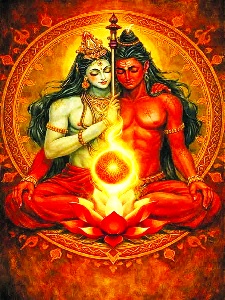

In the vast philosophical landscape of Hindu traditions, few ideas are as profound and evocative as the eternal union of Shiva and Shakti. They are often represented as a divine masculine and feminine couple, but their significance extends far beyond gender or mythology. In Tantric cosmology, Shiva and Shakti represent two inseparable dimensions of the One – consciousness and energy, stillness and movement, transcendence and manifestation. The universe, according to this vision, does not exist through one principle acting alone. It is created, sustained and ultimately withdrawn through the interaction of these two fundamental forces. Shiva represents the unchanging ground of existence, while Shakti is the dynamic power through which that existence becomes active and visible. This relationship gives rise to one of the most powerful philosophical ideas associated with Shaktism: there is no Shiva without Shakti, and no Shakti without Shiva.
Shiva: The principle of pure consciousness
In the metaphysical understanding of the Shiva-Shakti tradition, Shiva represents the abiding, transcendent aspect of the Divine. He is associated with pure consciousness – still, limitless and beyond the changing world of forms.
Shiva’s familiar image as the meditating ascetic captures this dimension beautifully. Seated in profound stillness, detached from worldly distractions, he represents consciousness untouched by the fluctuations of creation.
Yet stillness alone cannot produce manifestation. This is where Shakti enters the cosmic picture.
Shakti: Power that makes creation move
Shakti literally embodies divine power or energy. She is the dynamic potency through which the universe comes alive and through which the forces of creation operate. If Shiva represents the potential for existence, Shakti represents that potential in action.
She is therefore understood as the immanent aspect of the Divine – the force actively participating in creation and life. Nature, movement, transformation, fertility, creativity and the countless processes through which existence expresses itself are associated with her dynamic principle. This helps explain why the Goddess occupies such a central place in Shaktism.
The Divine Feminine is not simply regarded as a consort or companion of a male deity. Shakti is herself the cosmic force through which the Divine becomes active in the manifested universe.
Two aspects, one reality
The distinction between Shiva and Shakti should not be mistaken for a separation. Tantric philosophy presents them as complementary aspects of a single reality. Shiva without Shakti would remain pure, unmoving consciousness; Shakti without Shiva would lack the transcendent ground from which her energy arises.
Their relationship can therefore be understood through several complementary pairs:
-Shiva is consciousness; Shakti is energy.
-Shiva is stillness; Shakti is movement.
– Shiva is transcendence; Shakti is manifestation.
-Shiva is the eternal ground; Shakti is the power of creation.
– The two are ultimately one.
This philosophical unity is reflected in the iconic image of Ardhanarishvara, in which Shiva and Shakti are represented as two halves of a single divine form. The image expresses the idea that masculine and feminine principles are not opposing realities but inseparable dimensions of existence.
The Shakta vision
Shaktism places the Divine Feminine at the centre of spiritual understanding. This does not necessarily mean rejecting masculine or neuter conceptions of divinity. Rather, Shaktism emphasises that manifestation and activity are impossible without Shakti.
A celebrated line associated with Adi Shankara’s Saundaryalahari expresses the idea powerfully: “If Shiva is united with Shakti, he is able to create.”
The philosophical message is clear: consciousness may be fundamental, but it is Shakti that enables consciousness to express itself through creation.
The traditional image of Goddess Kali standing upon Shiva communicates this paradox in striking visual form. Shiva lies apparently still beneath her while Kali embodies overwhelming movement and power. The image is not simply one of dominance. It represents the relationship between the unchanging and the dynamic – the consciousness that provides the ground and the energy that acts upon it.
The three dimensions of Shakti
Within the philosophical traditions described in the source material, Shakti is distinguished into three broad aspects:
Para-Shakti – Transcendental Energy
Para-Shakti represents the supreme or transcendental dimension of divine energy. It points towards the reality beyond ordinary manifestation and the highest level of spiritual existence.
Apara-Shakti – Immanent Energy
Apara-Shakti represents the energy present within the manifested universe. It is the force experienced through life, nature, action and creation.
Para-Apara-Shakti – The
Intermediate Energy
Para-Apara-Shakti occupies an intermediate position between transcendence and manifestation, connecting the two dimensions.
Together, these aspects express the many ways in which the one divine power can be understood.
The five powers of Shakti
Shaiva traditions also describe five fundamental powers through which Shakti operates. These are often presented as dimensions of divine consciousness and activity:
– Chit-Shakti – The Power of Consciousness
– Chit-Shakti represents consciousness itself – the awareness underlying existence.
The story of Shiva and Sati
The philosophical relationship between Shiva and Shakti is also expressed through powerful mythology.
One of the best-known stories concerns Sati, the first wife of Shiva and an embodiment of Shakti.
According to the traditional narrative, Sati was the daughter of Daksha, who did not approve of her marriage to Shiva. When Daksha later organised a great yajna, Shiva and Sati were not invited.
Despite Shiva’s reluctance, Sati went to her father’s gathering. There, she was deeply distressed by Daksha’s disrespect towards Shiva. Unable to bear the humiliation, Sati immolated herself in the sacrificial fire.
When Shiva learned of Sati’s death, he was overcome with grief and fury. Carrying her body, he began the terrifying Rudra Tandava, the cosmic dance of destruction.
The universe itself appeared to be threatened by the intensity of his grief and anger.
According to the legend, Vishnu intervened and used his divine weapon to separate Sati’s body. The places where parts of her body are believed to have fallen became sacred Shakti Peethas, centres of worship of the Divine Feminine.
Among the important Shakti sites associated with this tradition are Kamakhya in Assam and Vindhyavasini in Uttar Pradesh.
The story transforms personal grief into a cosmic myth about separation, destruction and eventual renewal.
From Sati to Parvati
Following Sati’s death, Shiva withdrew into profound meditation in the Himalayas.
But Shakti was not absent from the world.
She was reborn as Parvati, daughter of the Himalayas. Determined to unite with Shiva once again, Parvati undertook intense austerities and devotion.
Her spiritual discipline eventually won Shiva’s attention. With the intervention and encouragement of sages and the divine forces, Shiva and Parvati were ultimately reunited in marriage.
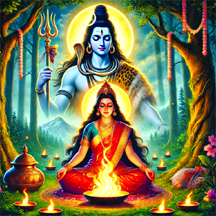
The union is one of the most enduring images in Hindu mythology: the ascetic Shiva and the devoted Parvati coming together as complementary forces.


Be the first to comment