Tag: Afghanistan

  • CPEC may ignite more India-Pakistan tensions: UN report

    CPEC may ignite more India-Pakistan tensions: UN report

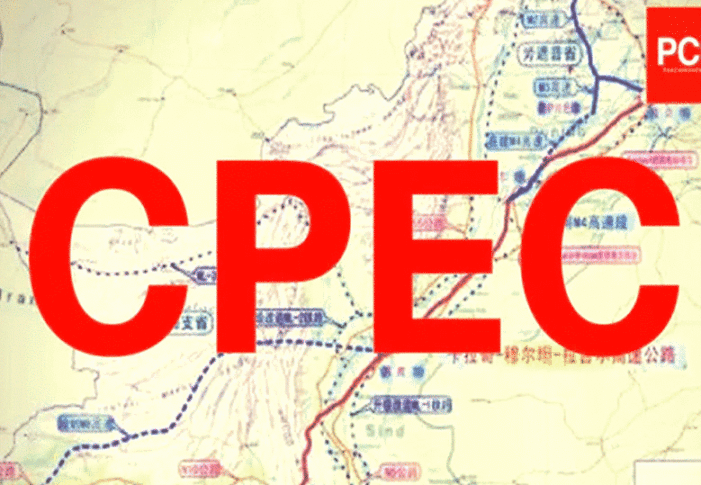
    ISLAMABAD (TIP): The $50 billion China-Pakistan Economic Corridor (CPEC) traversing through PoK might create “geo-political tension” in the region by igniting further tensions between India and Pakistan, a UN report has warned.

    The report released by the UN’s Economic and Social Commission for Asia and the Pacific (ESCAP) said that the project could also fuel separatist movement in Pakistan’s Balochistan province. “The dispute over Kashmir is also of concern, since the crossing of the CPEC in the region might create geo-political tension with India+ and ignite further political instability,” said the report on China’s ambitious Belt and Road Initiative (BRI).

    The report, prepared at the request of China, also cautioned that the instability in Afghanistan could cast a shadow over viability of the CPEC over which India has already raised protests with China and boycotted the last week’s BRI summit in Beijing. “Afghanistan’s political instability could also limit the potential benefits of transit corridors to population centres near Kabul or Kandahar, as those routes traverse southern and eastern Afghanistan where the Taliban are most active,” the report said.

    The report also covered other economic corridors of the BRI including the Bangladesh-China-India-Myanmar Economic Corridor (BCIM). According to the report, while the CPEC could serve as the “driver for trade and economic integration” between China, Pakistan, Iran, India, Afghanistan and the Central Asian states, it could also cause many problems within Pakistan and reignite separatist movement in the country due to opposition in Balochistan.

    “However, social and environmental safeguards are a concern. The CPEC could lead to widespread displacement of local communities+ . In Balochistan, there are concerns that migrants from other regions of Pakistan will render ethnic Baloch a minority in the province,” it said.

    Further, concerns exist that the CPEC will pass from the already narrow strip of cultivable land in the mountainous western Pakistan, destroying farmland and orchards. The resulting resettlements would reduce local population into an “economically subservient minority”, it said. “In addition, Hazaras are another minority of concern. If the benefits of the proposed CPEC are reaped by large conglomerates, linked to Chinese or purely Punjabi interests, the identity and culture of the local population could be further marginalised,” the report cautioned. “Marginalisation of local population groups could reignite separatist movements and toughen military response from the government,” it said.

    About the BRI, it said, the scale of the BRI both in terms of geographical coverage and its cross-sectorial policy influence will shape the future of global development and governance.

    “It brings wide-reaching implications for China, for the countries it links across the Asia-Pacific and for the global economy+ ,” it said. “In order for the full potential of the BRI to be realised there are several prerequisites. It should be founded on principles such as trust, confidence and sharing benefits among participating states.” It should play a positive role in the response to climate change over the coming decades, promoting low carbon development and climate resilient infrastructure, the report said.

    “Lastly, to be effective and deliver results in a timely fashion, it should go beyond bilateral project transactions to promote regional and multilateral policy frameworks,” it said. “The BRI will serve the interests of China and the countries along its corridors more effectively if it is shaped as a collective endeavour and is well integrated into existing regional cooperation initiatives,” it said.

    To this end, the BRI needs to co-opt and engage Asian sub regional platforms to ensure that it reinforces regional plans of connectivity and prioritises the missing transport links along corridors, particularly those in the China-Central-West Asia and the China-Indo-China-Peninsula corridors, it said.

    Shamshad Akhtar, former governor of State Bank of Pakistan, who heads the ESCAP wrote the foreword for the report. In her foreword Akhtar said, “our analysis confirms the benefits the BRI could bring are significant. The BRI could help raise economic output levels by an average of 6 per cent in participating countries. If these countries lowered border transaction costs and import tariffs, the difference the BRI could make would be greater still.” (PTI)

  • KARTHIK IN FOR INJURED PANDEY IN CT SQUAD

    KARTHIK IN FOR INJURED PANDEY IN CT SQUAD

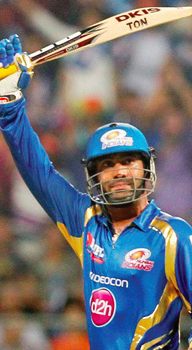
    NEW DELHI (TIP): Senior Tamil Nadu wicketkeeper-batsman Dinesh Karthik on May 18 earned a recall to the Indian team for the upcoming Champions Trophy after Manish Pandey was ruled out due to a side strain.

    Karthik was one of the five stand-byes for the Champions Trophy and has been rewarded for his stupendous form in domestic cricket last season.

    Karthik, who will soon be celebrating his 32nd birthday, scored 607 runs during Tamil Nadu’s victorious Vijay Hazare Trophy campaign, including a century in the final. His average was 86-plus and scored his runs at a strike rate of over 100.

    He also scored 704 runs in the Ranji Trophy and another 361 runs in IPL-10, capping off a consistent domestic season. He last played for India against Afghanistan in the 2014 Asia Cup in Bangladesh.

    Having played 23 Tests and 71 ODIs for India, Karthik pipped another glovesman, Rishabh Pant, who was also among the reserves.

    Incidentally, Karthik was a part of the Indian team which won the Champions Trophy in 2013. Pandey had suffered a side strain during one of Kolkata Knight Riders’ training sessions and was replaced by Ishank Jaggi for their Eliminator against Sunrisers Hyderabad on Wednesday.

    Source: PTI

  • Trump to ask Muslim leaders to ban raising of funds for extremists

    Trump to ask Muslim leaders to ban raising of funds for extremists

    WASHINGTON (TIP): When US President Donald Trump travels to Saudi Arabia to address the Muslim world this week, participating leaders would be asked to sign a pledge to make it “illegal” in their country to fund outfits that promote extremism and terrorism.

    Leaders of more than 50 mostly-Muslim countries, including Afghanistan and Pakistan from India’s neighbourhood, are scheduled to attend the meeting convened by Saudi Arabia.

    Trump would address the gathering on Sunday. Such a pledge would have a far-reaching implications on countries like Pakistan, where fundraising for terrorist organisations is common and at times supported by the ruling establishment.

    While the pledge would be legally non-binding, it would be used for making these countries accountable by the Trump administration, which has made the fight against terrorism a priority, a senior administration official said. (PTI)

  • Gunmen attack state TV station in Afghanistan, 2 civilians among 4 killed

    Gunmen attack state TV station in Afghanistan, 2 civilians among 4 killed

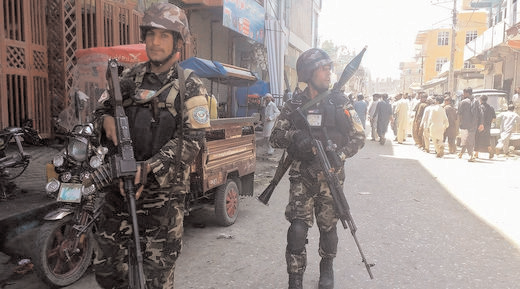
    JALALABAD (TIP): Suicide bombers stormed the national television station in the eastern Afghan city of Jalalabad today, triggering gunfights and explosions as journalists remained trapped inside the building, officials and eyewitnesses said.

    At least two people were killed and 14 others wounded in the ongoing assault, which underscores the growing dangers faced by media workers in Afghanistan.

    No insurgent group has so far claimed responsibility for the raid in Nangarhar province, a hotbed of Islamic State jihadists, where the US military dropped its largest non- nuclear bomb last month in an unprecedented attack.

    “Four attackers entered the RTA (Radio Television Afghanistan) building this morning. Two blew themselves up and two others are still resisting,” government spokesman Attaullah Khogyani told AFP. He had earlier said there were three attackers.

    “At least two civilians have been killed and 14 others wounded so far,” Kohgyani said, with a health worker telling AFP that many of those brought to hospital suffered gunshot wounds.

    An RTA photographer said he fled the building as soon as the gunfight erupted, but many of his colleagues were still stuck inside. Unconfirmed reports said that Islamic State militants have claimed responsibility for the attack.

    Islamic State insurgents are active in Nangarhar province, of which Jalalabad is the capital.

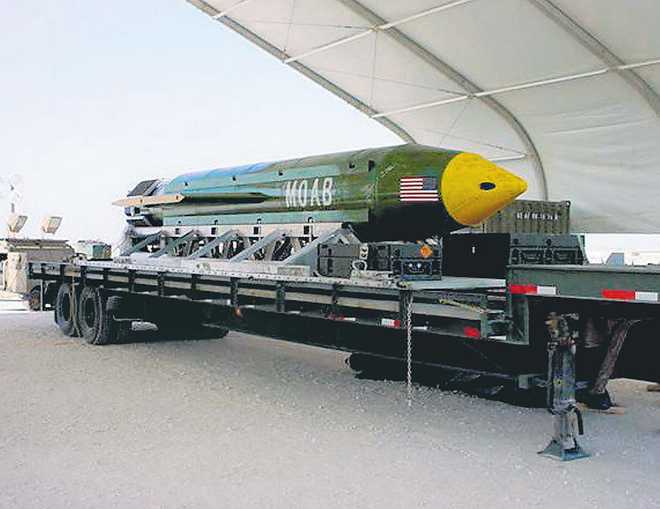
    The US military last month dropped the GBU-43/B Massive Ordnance Air Blast bomb- dubbed the “Mother Of All Bombs”- on IS positions in Nangarhar, killing dozens of jihadists.

    The bombing triggered global shock waves, with some condemning the use of Afghanistan as what they called a testing ground for the weapon, and against a militant group that is not considered as big a threat as the resurgent Taliban.

    According to the US Forces- Afghanistan, defections and recent battlefield losses have reduced the local IS presence from a peak of as many as 3,000 fighters to a maximum of 800.

    The Pentagon has reportedly asked the White House to send thousands more troops to Afghanistan to break the deadlocked fight against the Taliban.

    (AFP)

  • Taliban likely to gain ground in Afghanistan this year

    Taliban likely to gain ground in Afghanistan this year: US intelligence official

    WASHINGTON (TIP): The Taliban is likely to gain ground in Afghanistan this year and the security situation will deteriorate in the country in 2018, a top US intelligence official has told US lawmakers.

    The Afghan National Security Forces would need sustained international support to prevent it from collapse, director of National Intelligence Dave Coats told members of the Senate Select Committee on Intelligence ruing over Kabul’s political dysfunction and ineffectiveness.

    “Although the Taliban was unsuccessful in seizing a provincial capital in 2016, it effectively navigated its second leadership transition in two years following the death of its former chief, Mullah Mansoor, and is likely to make gains in 2017,” Coats said in his testimony on worldwide threats.

    “The overall situation in Afghanistan will very likely continue to deteriorate, even if international support is sustained,” he said.

    According to Coats, the intelligence community assesses that the political and security situation in Afghanistan will almost certainly deteriorate through 2018 even with a modest increase in military assistance by the US and its partners.

    “This deterioration is undermined by its dire economic situation. Afghanistan will struggle to curb its dependence on external support until it contains the insurgency or reaches a peace agreement with the Taliban,” Coats said.

    “Endemic state weaknesses, the government’s political fragility, deficiencies of the Afghan National Security Forces (ANSF), Taliban persistence, and regional interference will remain key impediments to improvement,” he said.

    “Kabul’s political dysfunction and ineffectiveness will almost certainly be the greatest vulnerability to stability in 2017,” Coats said.

    ANSF performance will probably worsen due to a combination of Taliban operations, ANSF combat casualties, desertions, poor logistics support, and weak leadership, he added.

    The ANSF will almost certainly remain heavily dependent on foreign military and financial support to sustain themselves and preclude their collapse, he said.

    Coats said the fighting will also continue to threaten US personnel, allies, and partners, particularly in Kabul and urban population centres.

    Islamic State militant group’s Khorasan branch (ISIS-K) which constitutes ISIS’s most significant presence in South Asia–will probably remain a low-level developing threat to Afghan stability as well as to US and western interests in the region in 2017, Coats said. (PTI)


  • INDIA

    US spymaster says Pak terror groups plan to attack India, Afghanistan

    NEW DELHI (TIP):Pakistan-based terrorist groups are planning to attack both India and Afghanistan, a top US spymaster has said. “Islamabad has failed to curb militants and terrorists in Pakistan,” Daniel Coats, director of National Intelligence told members of the Senate Select Committee on Intelligence during a Congressional hearing on Worldwide threats. “These groups will present a sustained threat to the United States’ interest in the region and continue to plan and conduct attacks in India and Afghanistan,” Coats said.

    He blamed Pakistan for deteriorating Indo-Pak relations and warned that the ties might worsen further if another “high- profile” terrorist attack emanates from across the border this year. Pakistan, he rued, is expanding its nuclear arsenal in pursuing tactical nuclear weapons, potentially lowering the threshold for their use.

    In South Asia, the intelligence community assesses that the political and security situation in Afghanistan will almost certainly deteriorate through 2018 even with a modest increase in military assistance by the United States and its partners, he told the lawmakers. “This deterioration is undermined by its dire economic situation. Afghanistan will struggle to curb its dependence on external support until it contains the insurgency or reaches a peace agreement with the Taliban,” he said. “Meanwhile, we assess that Taliban is likely to continue to make gains especially in rural areas. Afghan Security Forces performance will probably worsen due to a combination of Taliban operations, combat casualties, desertion, poor logistic support and weak leadership,” Coats said.

    “Pakistan is concerned about international isolation and sees its position of India’s rising international status including India’s expanded foreign outreach and deepening ties to the United States. Source: PTI

  • US army photographer captured fatal blast that took her life

    US army photographer captured fatal blast that took her life

    WASHINGTON (TIP): The US Army has released two photographs that show the moment an accidental mortar tube explosion killed five people in Afghanistan, including an American combat photographer who took one of the images just before her death.

    Army Specialist Hilda I. Clayton was photographing a live-fire training exercise on July 2, 2013, in Laghman Province, east of Kabul, when a mortar tube exploded, killing her and four Afghan army soldiers, according to the US army magazine Military Review.

    \One of the Afghan soldiers killed in the blast was a photojournalist who was training with Clayton, the magazine said in an article posted on its website.

    It said there has been discussion about the decision to publish the images taken by Clayton and her Afghan counterpart.

    “This edition of the Military Review is focused on promoting the concepts of gender equality and these photographs illustrate the dangers our military men and women face both in training and in combat,” the magazine said. (Reuters)

  • U.S. Drops ‘Mother of all Bombs’ on ISIS Target in Afghanistan

    U.S. Drops ‘Mother of all Bombs’ on ISIS Target in Afghanistan

    Militant caves in Afghanistan targeted

    GBU-43 bomb used for the first time in combat

    WASHINGTON (TIP): The United States dropped a massive GBU-43 bomb, the largest non-nuclear bomb it has ever used in combat, in eastern Afghanistan on Thursday, April 13, against a series of caves used by Islamic State militants, the military said.

    It was the first time the United States has used this size of bomb in a conflict. It was dropped from a MC-130 aircraft in the Achin district of Nangarhar province, close to the border with Pakistan, a Pentagon spokesman said.

    Also known as the “mother of all bombs,” the GBU-43 is a 21,600 pound (9,797 kg) GPS-guided munition and was first tested in March 2003, just days before the start of the Iraq war. The security situation in Afghanistan remains precarious, with a number of militant groups trying to claim territory more than 15 years after the US invasion which toppled the Taliban government.

    General John Nicholson, the head of US and international forces in Afghanistan, said the bomb was used against caves and bunkers housing fighters of the Islamic State in Afghanistan, also known as ISIS-K. It was not immediately clear how much damage the device did.

    White House spokesman Sean Spicer opened his daily news briefing speaking about the use of the bomb and said, “We targeted a system of tunnels and caves that IS fighters used to move around freely, making it easier for them to target US military advisers and Afghan forces in the area.”

    Last week, a US soldier was killed in the same district as the bomb was dropped while conducting operations against Islamic State. “The United States takes the fight against ISIS very seriously and in order to defeat the group, we must deny them operational space, which we did,” Spicer said.

    He said the bomb was used at around 7 p.m. local time and described the device as “a large, powerful and accurately delivered weapon.” The United States took “all precautions necessary to prevent civilian casualties and collateral damage,” he said.

    US officials say intelligence suggests Islamic State is based overwhelmingly in Nangarhar and neighboring Kunar province.

    Estimates of its strength in Afghanistan vary. US officials have said they believe the movement has only 700 fighters but Afghan officials estimate it has about 1,500.

    Islamic State’s offshoot in Afghanistan is suspected of carrying out several attacks on minority Shi’ite Muslim targets. The Afghan Taliban, which is trying to overthrow the U.S.-backed government in Kabul, are fiercely opposed to Islamic State and the two group have clashed as they seek to expand territory and influence.

    Efforts to dismantle ISIS strongholds have been concentrated in Iraq and Syria. But a small stronghold of fighters made up of former Taliban members has grown in eastern Afghanistan since 2014. The group is known as Islamic State Khorasan, according to a U.S. Institute for Peace report released in November.

    “IS-K receives funding from the Islamic State’s Central Command and is in contact with leadership in Iraq and Syria, but the setup and day-to-day operations of the Khorasan province have been less closely controlled than other Islamic State branches such as that in Libya,” the report notes.

    President Donald Trump lauded the strike on Thursday, calling it “another very, very successful mission.” Just last week, he also approved a strike on a Syrian air base in the aftermath of a chemical weapon attack on Syrian civilians that killed almost 100 people.
    Trump, while advocating for a lessened U.S. role in international conflicts, also claimed he would “bomb the shit” out of the Islamic State during his presidential campaign.

    There is an anxious concern on US plans about North Korea. In view of the bombings carried out in Syria and Afghanistan, there is concern that US may translate its warning given by Nikki Haley, its ambassador to the UN that if the World Body failed to act against North Korea, US will act against the “rogue regime” on its own. And, quite obviously, member nations are concerned about the consequences of a US strike against North Korea.

  • Afghanistan women swim against threats for Olympic dream

    Afghanistan women swim against threats for Olympic dream

    KABUL (TIP): There are 30 pools in Afghanistan, only one that welcomes girls — and it is facing militant threats for doing so. Nevertheless a handful are diving in, pioneers racing to achieve Olympic glory in Tokyo.

    The story of the 25-year-old coach and head of the Women’s Swimming Committee, Elena Saboori, epitomises the struggle to swim in a conservative, conflict-plagued country that largely opposes women taking part in sports. A woman friend first took her for swimming, but after that she taught herself by downloading videos and practicing in the pool in Kabul. “I was afraid of drowning, but that’s when I thought I’d become a coach, because girls do not know how to swim here,” said Saboori, an economics student. Saboori said that she had been advised to stay away from the pool after violent threats were made for allowing her team to train there.

    “I know that I have broken a taboo. I took a big risk by launching this team.” The risks include a burgeoning Taliban insurgency. But Afghanistan’s patriarchal, ultra-conservative society, where many believe women should be veiled and confined to the home, adds another layer of risk. Saboori and her team cannot swim with their backs, arms or thighs exposed. The team is in touch with a Brazilian firm to design swimwear. Until then, they wear tights and black lycra, long-sleeved tops under one-piece swimsuits, with a swimming cap covering their hair.

    “The main obstacle for our swimmers is safety, of course,” said the president of the Afghan Federation of Swimming, Sayed Ihsan Taheri. “We aim to be at the 2020 Olympic Games in Tokyo, with a team of at least two men and one woman.” That woman will be Afghanistan’s first ever female Olympic swimmer.

    Challenges of poor infrastructure and a patriarchal culture have been compounded by government’s lack of support. “All Muslim countries except Afghanistan have a women’s team, even the strictest,” said Taheri, citing Qatar, Iran and Saudi Arabia. The government has even blocked the allocation of 500 Afghanis (less than $8) paid monthly to members of national sports teams. He has launched a fundraiser to finance high-level athletes. “We have raised $900 so far.” (AFP)

  • Bacha bazi: Afghan practice of child sex slavery

    Bacha bazi: Afghan practice of child sex slavery

    Afghanistan is set to criminalise the practice of “bacha bazi”, sexual exploitation of boys, with a slew of stringent punishments laid out for the first time in a revised penal code.

    The move comes after an AFP report last year found the Taliban are exploiting the centuries-old practice, one of the most egregious violations of human rights in the country, to mount deadly insider attacks in the volatile south.

    Powerful warlords, commanders, politicians and other members of the elite often keep “bachas” as a symbol of authority and affluence. Bachas, sometimes dressed as women, are often sexually exploited. They can also be used as dancers at private parties.

    Bacha bazi is not widely seen as homosexual behaviour- popularly demonised as a deviant sexual act, prohibited in Islam- and is largely accepted as a cultural practice.

    “Women are for child-rearing, boys are for pleasure” is a common saying across many parts of Afghanistan.

    The ancient custom, banned under the Taliban’s 1996-2001 rule, has seen a resurgence in recent years. It is said to be widespread across southern and eastern Afghanistan’s rural Pashtun heartland, and with ethnic Tajiks across the northern countryside.

    Tight gender segregation in Afghan society and lack of contact with women have contributed to the spread of bacha bazi, rights groups say. Several other factors such as an absence of the rule of law, corruption, limited access to justice, illiteracy, poverty, insecurity, and the existence of armed groups have also helped the practice spread, the Afghanistan Independent Human Rights Commission (AIHRC) said in a report in 2014. AIHRC points out that Afghanistan’s criminal law prohibits rape and pederasty, but so far there are no clear provisions on bacha bazi. “There is a gap and ambiguity in the laws of Afghanistan regarding bacha bazi and the existing laws do not address the problem sufficiently,” the report said. (AFP)

  • At least five killed, 27 wounded in Afghan triple bombing

    At least five killed, 27 wounded in Afghan triple bombing

    JALALABAD, AFGHANISTAN (TIP): At least five people were killed and 27 others wounded in a triple bombing in eastern Afghanistan’s Nangarhar province Nov 26, provincial officials said.

    There was no claim of responsibility for the three bombings in Jalalabad, the capital of Nangarhar province, which is a hotbed of IS militancy.

    “Five people were martyred in three explosions in different parts of Jalalabad of Nangarhar province this morning,” provincial spokesperson Ataullah Khogyani told AFP.

    Khogyani said the first blast was a roadside bomb which detonated outside the house of a senior prison official, Abdul Hakim, killing him and a child and wounding six others.

    The second blast came outside the fire brigade office –from where the first rescuers are usually dispatched after an attack — killing three and wounding 21.

    Khogyani said the third blast came as people gathered at Hakim’s house after the first blast, but there were no casualties.

    Dr Najib Kamawal, director of the Nangarhar civil hospital confirmed the toll.

    The IS group appears to be intensifying attacks against the government and civilians as Afghan forces, backed by NATO air strikes, step up operations against them in Nangarhar.

    Last week IS claimed a massive suicide blast targeting Shiites in Kabul that killed at least 27 people.

    In late October, a suicide bomber killed at least six people at a gathering of tribal elders seeking aid for war-displaced families in Jalalabad.

    As well as the emerging threat from IS loyalists, who are making gradual inroads across Afghanistan, Taliban fighters are active in Nangarhar. (AFP)

  • 2 killed, 100 wounded in suicide attack on German consulate in northern Afghanistan

    2 killed, 100 wounded in suicide attack on German consulate in northern Afghanistan

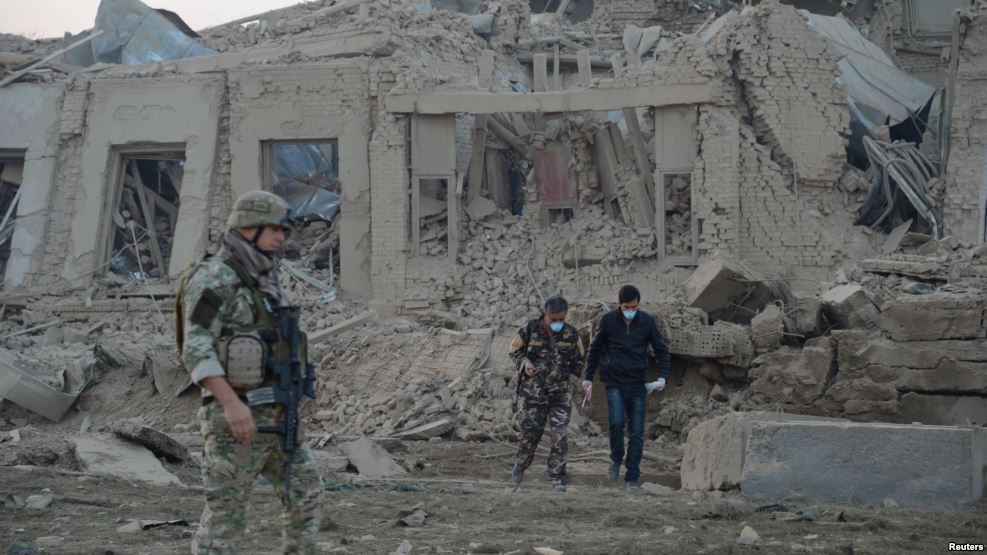
    MAZAR-I-SHARIF (TIP): A powerful Taliban truck bomb struck the German consulate in Afghanistan’s northern Mazar-i-Sharif city late on Nov 10, killing at least two people and wounding more than 100 in a major militant assault in the war-torn country.

    The Taliban called it a “revenge attack” for US air strikes in the volatile province of Kunduz earlier this month that left up to 32 civilians dead.

    The huge explosion, followed by sporadic gunfire, reverberated across the usually tranquil city, smashing windows of nearby shops and leaving terrified local residents fleeing for cover.

    “The suicide attacker rammed his explosives-laden car into the wall of the German consulate,” local police chief Sayed Kamal Sadat told AFP.

    The German foreign ministry said the attack had ended and that all German staff from the consulate were unharmed.

    “The consulate building has been heavily damaged. It is not yet clear how many Afghan civilians and security personnel died or were injured in the attack,” the ministry said in a statement.

    “Our sympathies go out to the Afghan injured and their families.”

    A diplomatic source in Berlin said Foreign Minister Frank-Walter Steinmeier had convened a crisis meeting.

    “There was fighting outside and on the grounds of the consulate,” a ministry spokesman said. “Afghan security forces and Resolute Support (NATO) forces from Camp Marmal (German base in Mazar-i-Sharif) are on the scene.”

    Afghan special forces cordoned off the consulate, previously well-known as Mazar Hotel. Helicopters were heard flying over the diplomatic mission early Friday as ambulances with wailing sirens rushed to the area, according to an AFP reporter near the scene.

    At least two dead bodies and more than 100 wounded people — including at least 10 children — had so far been brought to two city hospitals, said local doctor Noor Mohammad Fayez. Some of the wounded were in a critical condition, he added. The carnage underscores worsening insecurity in Afghanistan as Taliban insurgents ramp up nationwide attacks despite repeated government attempts to jump-start stalled peace negotiations. Taliban spokesman Zabihullah Mujahid said the “martyrdom attack” on the consulate had left “tens of invaders” dead. The insurgents routinely exaggerate battlefield claims. Posting a Google Earth image of the consulate on Twitter, Mujahid said the assault was in retaliation for American air strikes in Kunduz.

    US forces conceded last week that its air strikes “very likely” resulted in civilian casualties in Kunduz, pledging a full investigation into the incident.

    The strikes killed several children, after a Taliban assault left two American soldiers and three Afghan special forces soldiers dead near Kunduz city.

    The strikes triggered impassioned protests in Kunduz city, with the victims’ relatives parading mutilated bodies of dead children piled into open trucks through the streets. Civilian casualties caused by NATO forces have been one of the most contentious issues in the 15-year campaign against the insurgents, prompting strong public and government criticism.

    The country’s worsening conflict has prompted US forces to step up air strikes to support their struggling Afghan counterparts, fuelling the perception that they are increasingly being drawn back into the conflict. (AFP)

  • Suicide bomber kills 4 in Kabul: Officials

    Suicide bomber kills 4 in Kabul: Officials

    KABUL (TIP): Afghan security officials have confirmed that at least four security forces were killed when their vehicle was attacked by a suicide bomber in the capital Kabul.

    The security officials, who did not want to be named as the investigation into the attack is still underway, said Wednesday that 11 others were wounded in the attack which took place in Puli Mohmood Kahn area near the Afghan defense ministry compound.

    They said it is not clear if the bomber was on foot or on a motorbike when he attacked the forces.

    No any group has claimed responsibility for the attack, but Taliban insurgents have recently increased their attacks against Afghan security forces across the country.

  • Taliban insurgents abduct, kill 26 Afghan civillians

    Taliban insurgents abduct, kill 26 Afghan civillians

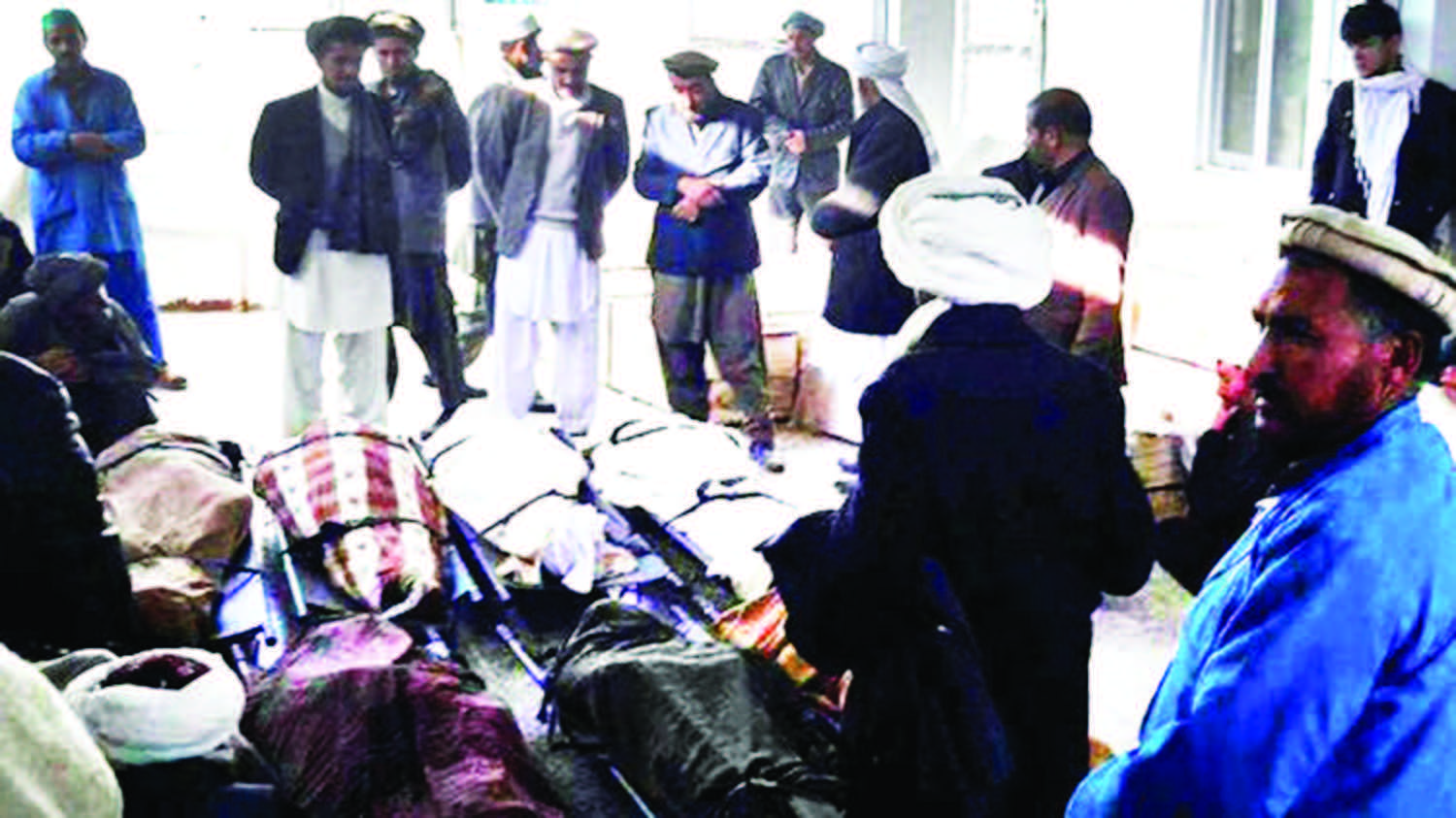
    KABUL (TIP): Taliban insurgents on Oct 26 killed 26 Afghan civilians after abducting them in the remote central province of Ghor the previous day, officials said, the latest brutal attack targeting the local population on one of the country’s most lawless areas.

    The slain civilians were from a group of 33 taken by the militants near the provincial capital of Ferozkoh, according to Ziauddin Saqib, the deputy provincial police chief. Earlier reports suggested 20 were killed but the death toll rose later in the day.

    The abductions took place while battles were underway between the Taliban and Afghan security forces on Tuesday that saw two militant commanders killed, Saqib added.

    Both commanders were infamous figures in Ghor and were involved in many anti-government activities, Saqib also said, adding that the “cowardly insurgents killed innocent civilians in revenge for their commanders killed by security forces.”

    There was no immediate statement from the Taliban on the incident in the largely lawless Ghor.

    However, Abdul Hai Khateby, the spokesman for the provincial governor, said he is convinced the militants behind the attacks and abductions were a renegade Taliban group that had sworn allegiance last year to Afghanistan’s Islamic State affiliate.

    “The group is former Taliban who just a year ago announced their support to their Islamic State group and changed their white flag to black,” Khateby told The Associated Press, speaking over the telephone from Ghor.

    The two different statements could not immediately be reconciled. Khateby also said he believed the abductions and killings were in revenge for the deaths of the two commanders.

    The civilians who were abducted are all poor people from the area, mainly villagers and shepherds, and there were even children among those taken, said Khateby.

    He said that the victims’ families and relatives, along with other residents ofGhor, held a protest rally near the governor’s office in Ferozkoh, the provincial capital, later on Wednesday.

    The demonstrators denounced the government, which they said cannot protect the local population.

    “The locals were so angry and they were throwing stones toward the governor’s building,” he said. No one was hurt in the protest, which later ended with the help of tribal leaders who mediated between the crowd and the authorities.

    Ghor is one of Afghanistan’s poorest and least developed provinces, with many areas outside Ferozkoh believed to be under Taliban control.

    In a report from eastern Paktika province, 17 people, including two children, were wounded when a bomb went off on Wednesday at a marketplace in the provincial capital of Sharan, according to local officials.

    Dr Wali Gul Kharoti, head of the public health department, said there were also two military personals among the wounded. He said all of the wounded were ins table condition.

    Abdul Raouf Massoud, deputy police chief in Paktika, said the explosive was “placed inside a shop at the city market” in an attack obviously meant to target civilians. No one immediately claimed responsibility for the attack.

    The Taliban have in recent months stepped up attacks across Afghanistan, taking advantage of the warm weather to wage war against the Kabul government. Many civilians have been caught in the cross-fire and also targeted by roadside bombs, which are among the insurgents’ weapons of choice.

    Recently, the Taliban have attacked Afghan security forces in northern Kunduz province, briefly taking control of a district headquarters. The militants have also overrun a district in northern Baghlan province and in eastern Paktia province.

    Meanwhile, in eastern Nangarhar province, Taliban militants have fought pitched battles with security forces. Afghanistan’s Ministry of Defense says its forces are waging operations in 15 provinces.

    In July, Kabul was shaken by a massive suicide bombing that struck a peaceful rally by Afghanistan’s minority ethnic Hazara community, killing more than 80 people and wounding hundreds. That attack was claimed by the Islamic State group, which emerged last year in Afghanistan as an affiliate of the militant group fighting in Iraq and Syria. Analysts believe the Islamic State affiliate in the country is mostly made up of disenfranchised Taliban fighters.

    The Hazara attack was the IS Afghan branch’s first assault in the country’s capital and the deadliest attack in Kabul since the US-led invasion to oust the Taliban regime in 2001. (PTI)

  • Nepal lifts ban on allowing migrant workers to Afghanistan

    Nepal lifts ban on allowing migrant workers to Afghanistan

    KATHMANDU (TIP): Nepal will allow its nationals to go to war-torn Afghanistan for work, a labour ministry official said on Oct 27, ending an almost four-month ban imposed after 13 Nepali security guards were killed by a Taliban suicide bomber in the Afghan capital.

    Labour Ministry spokesperson Govinda Mani Bhurtel said employers would have to make adequate security arrangements for their stay, travel and work before Nepali nationals were given a work permit by the government to leave Nepal.

    “We’ll allow our people to go to Afghanistan to work only with foreign missions and international companies located inside the Green Zone which is considered safe,” Bhurtel told the Thomson Reuters Foundation.

    “Their security and safety must be ensured by the employers,” he said, adding the organisations included UN agencies and embassies of the United States, Britain and Canada.

    Nepalis are still banned from working in other conflict hotspots such as Iraq, Libya and Syria, Bhurtel said.

    The impoverished Himalayan nation, which relies heavily on remittances from its migrant workers, imposed the ban after 13 Nepalis and two Indians who were security guards at the Canadian Embassy in Kabul were killed while on a bus on June 23.

    Nepal, one of the world’s 10 poorest countries, is still reeling from two devastating earthquakes in 2015 that killed nearly 9,000 people.

    Political instability since a decade-long civil conflict ended in 2006 has discouraged investment, stunted growth and curtailed job creation — forcing hundreds of thousands of Nepalis to migrate overseas in search of work.

  • Presidential debates: Hillary has an edge but irrationality rules

    Presidential debates: Hillary has an edge but irrationality rules

    The US democratic machinery entered the home stretch for the Presidential elections slated for November 8 with the two leading candidates ending the three-phase debate on Wednesday, October 19.

    The third debate was also replete with the by-now-familiar routine of name calling, innuendoes and interruptions. The experienced Hillary Clinton has emerged as more rationale and logical but in the universe of wisecracks and smart comebacks, Donald Trump kept his supporters interested in his prospects with a series of non-sequiturs laced with caustic personal comments. Opinion polls give Hillary a decisive lead but given his numerous comebacks despite being repeatedly cornered, Trump remains in the hunt.

    The three general Presidential debates have failed to throw up a winner. The saving grace of the third debate held in the fun city of Los Angeles was its intermittent focus on substantive policy issues. For once, both candidates engaged with each other on immigration, gun control, national debt and abortion. The unpredictable, spontaneous and boorish Trump along with the suave, rehearsed, hard-as-nails Hillary have ensured an audience comeback for the Presidential debates. In the earlier two debates, the audience was none the wiser about the candidates’ ability to govern. Los Angeles was no exception though the New York and Washington debates left an even more bitter after-taste.

    The third debate will be remembered for Trump’s “nasty woman” broadside against Hillary and his use of the term “bad Hombres”. This was a continuation of the previous two contests. All that remained in the end was bitter name calling. These have been poor advertisements for Brand US Democracy. Washington’s attempts to foist their version of democracy on Afghanistan, Iraq or Libya have spectacularly failed. The preponderance of personal showdowns in the debates suggests it is not much to talk about at home as well. The level is unlikely to get better as three weeks of take-no-prisoners style of campaigning lies ahead. More bitterness is in store as debates have exposed skeletons in the closet of both candidates. A cherished tradition since 1960, the debates have now become part of the US TV’s entertainment fixtures. It now needs a recast.

  • Nepal lifts ban on allowing migrant workers to Afghanistan

    Nepal lifts ban on allowing migrant workers to Afghanistan

    KATHMANDU (TIP): Nepal will allow its nationals to go to war-torn Afghanistan for work, a labour ministry official said on October 20, ending an almost four-month ban imposed after 13 Nepali security guards were killed by a Taliban suicide bomber in the Afghan capital.

    Labour Ministry spokesperson Govinda Mani Bhurtel said employers would have to make adequate security arrangements for their stay, travel and work before Nepali nationals were given a work permit by the government to leave Nepal.

    “We’ll allow our people to go to Afghanistan to work only with foreign missions and international companies located inside the Green Zone which is considered safe,” Bhurtel told the Thomson Reuters Foundation.

    “Their security and safety must be ensured by the employers,” he said, adding the organisations included UN agencies and embassies of the United States, Britain and Canada.

    Nepalis are still banned from working in other conflict hotspots such as Iraq, Libya and Syria, Bhurtel said.

    The impoverished Himalayan nation, which relies heavily on remittances from its migrant workers, imposed the ban after 13 Nepalis and two Indians who were security guards at the Canadian Embassy in Kabul were killed while on a bus on June 23.

    Nepal, one of the world’s 10 poorest countries, is still reeling from two devastating earthquakes in 2015 that killed nearly 9,000 people.

    Political instability since a decade-long civil conflict ended in 2006 has discouraged investment, stunted growth and curtailed job creation –forcing hundreds of thousands of Nepalis to migrate overseas in search of work.

    More than four million of the country’s 28 million population are working mainly in the Middle East, South Korea and Malaysia as guards, drivers, construction workers or domestic staff –sending home remittances which make up nearly 30 percent of the country’s annual gross domestic product.

    But many also face abuses such as a lack of freedom of movement, long working hours, unsafe working conditions and withholding of their salaries, activists say, adding that many are trafficked through India and then onward to these countries.

    Bhurtel said it was imperative that employers take full responsibility for their overseas workers and ensure all provisions are made to ensure their safety.

    “If there is an accident or attack on workers the employing company must pay compensation and make arrangements for their evacuation to Nepal during emergencies,” said Bhurtel.

    (Reuters)

  • Afghan army helicopter crashes in north Afghanistan; 8 dead

    Afghan army helicopter crashes in north Afghanistan; 8 dead

    KABUL, AFGHANISTAN (TIP): Eight Afghan soldiers were killed early Oct 10 morning when a military helicopter crashed in northern Baghlan province, officials said.

    Afghan Defense Ministry spokesman Dawlat Waziri said that five crew members and three army soldiers were killed in the crash. The crash took place in Dand Ghori district while the helicopter was supplying a military base, he said.

    Waziri blamed a technical problem with the aircraft and said he rejected any claims by insurgents to have downed the helicopter. One helicopter was on the ground while a second was patrolling in the air above, when suddenly a technical problem caused the helicopter to catch fire and hit the ground,” Waziri said.

    However, Taliban spokesman Zabihullah Mujahid issued a statement claiming responsibility for downing the helicopter, saying the aircraft was shot down by fighters. (AP)

  • Blast kills 14 Shiites in northern Afghanistan: Officials

    Blast kills 14 Shiites in northern Afghanistan: Officials

    MAZAR-I-SHARIF (TIP): At least 14 Shiites were killed on Oct 12 in a powerful blast at a mosque in northern Afghanistan, the second deadly attack on the minority in as many days during the major festival of Ashura.

    “The explosion happened at the gate of the Shiite mosque in the centre of Balkh district (in Balkh province),” said the provincial governor’s spokesman Munir Ahmad Farhad, adding that 14 people were killed and 28 injured.

    His account was confirmed by the provincial deputy police chief.

    The blast came as the Islamic State group claimed responsibility for twin attacks in Kabul on Tuesday that also targeted Shiites, killing up to 18 people and wounding dozens.

    Witnesses said gunmen entered the Karte Sakhi shrine near Kabul University late Tuesday, firing indiscriminately on men, women and children as they tried to flee. The interior ministry said one was wearing a suicide vest.

    At the same time, another attacker entered a nearby mosque and took an unspecified number of people hostage as they were commemorating Ashura, the ministry said.

    The UN called the attack an “atrocity” and put the toll at 18, though the interior ministry later said it was 16.

    The threat of attacks on Shiites was considered particularly serious during Ashura, and many foreign embassies in Kabul had restricted staff movements until the end of the week.

    Ashura, marked on Wednesday, commemorates the death of Imam Hussein, grandson of the Prophet Muhammad, who was assassinated in the year 680 and whose tragic end laid the foundation for the faith practised by the Shiite community.

    For Shiites around the world, Ashura is a symbol of the struggle against oppression.

    In 2011 about 80 people were killed and more than 100 wounded when a suicide bomber struck a gathering of Shiites during Ashura in the heart of Kabul.

    Grieving worshippers today described desperately trying to shelter their children against a hail of gunfire during the Kabul attacks.

    One mother who gave her name as Saleha told AFP of a gunman who was “killing everyone”. She was shot in the leg as she tried to protect her child.


  • Sikh man shot dead in Afghanistan

    Sikh man shot dead in Afghanistan

    PESHAWAR (TIP): A Sikh man was abducted from his home and gunned down by suspected militants in Afghanistan’s restive Nangarhar province bordering Pakistan, a media report said. Sardar Rawail Singh, who lived in Jalalabad, was abducted from his house by militants wearing military fatigues and killed in Khalis Famil area.

    The incident triggered a massive protest by the minority Sikh community who staged a demonstration by placing the body of Singh in front of the provincial governor’s house in Jalalabad and demanded the arrest of the killers.

    They accused security forces of negligence in arresting the killers and asked the government to bring to justice the killers as soon as possible.

    Later, deputy governor Mohammad Hanif Gardiwal met the protesting Sikhs and pacified them. He said a case has been filed and a manhunt launched to nab the culprits.

    The insurgents abducted Singh from his home at about 7:20 AM (local time) yesterday and gunned him down at Khalis Famil area, provincial governor’s spokesman Attaullah Khogyani was quoted as saying by Pajhwok Afghan News. Rawinder, one of the protesters, said Singh had a dispute with his neighbour on Friday Next morning, the neighbour came along with some gunmen and abducted Singh from his home before killing him, he said, adding that Singh had invited his friends for a party at his home when his neighbour objected. (TNN)

  • Hitting where it hurts: India must keep up the momentum

    Hitting where it hurts: India must keep up the momentum

    As I write these lines, Pakistan has strongly denied that the Indian army carried out surgical strikes across the LoC. It has claimed, indeed asserted, through the official army spokesman that the Indian action was confined to the traditional exchange of fire across the LoC which the two armies have undertaken many times in the past, including heavy fire last year. In doing so, as of now, Pakistan has obviously sought to ensure that it does not come under pressure from its domestic public opinion to adequately respond to uphold the country’s honor. For if it acknowledges that Indian soldiers crossed the LoC, even by a short distance of a couple of kilometers, the Pakistani people, more so, Pakistani soldiers and officers will demand of its generals, especially army chief General Raheel Sharif, that the Indian Army be soonest taught a lesson so it does not undertake such an action again. This refrain would be heard the loudest from the jehadi tanzeems.

    Raheel Sharif has an image to live up to – his elder brother and maternal uncle were decorated with the Naishan-e-Haider, Pakistan’s highest gallantry award, and the Sharif family is greatly respected in army circles and by the public at large. Raheel Sharif is also credited with successful action in North Waziristan to clear Tehrik-e-Taliban-e-Pakistan cadres under the Zarb-e-Arz operation. Thus more than Prime Minister Nawaz Sharif, it is the General who is under greater scrutiny. It is obvious that his initial reaction has been not to immediately get into a tit-for-tat situation and to move cautiously. That is not unnatural, for the Pakistan General staff would need to carefully weigh all options, especially as the international community knows that Pakistan has provoked India continuously over two decades with its pursuit of cross-border terrorism and that no army would take the Uri terrorist attack lying down.

    The major powers, especially the US, have advised Pakistan that it has to take action against all terrorist groups, not only those that have turned against the state. This counsel has fallen on deaf ears, for there is no evidence that Pakistan army is willing to take a re-look at its security doctrines. These prescribe the pursuit of low-intensity conflict to contain India by keeping it off-balance. The fact is that despite the Pathankot attack and India’s acceptance of a Pakistani joint investigation team, including an ISI representative, to visit the Pathankot air base, it continued to essentially remain in denial, which is a clear evidence of its unwillingness to modify its security approaches. As India has crossed a threshold, Pakistan’s security planners will be under international pressure to modify their policies on the use of terror, even as they will not easily give it up. Why?

    The major powers, including Pakistan’s all-weather friend, China, do not want a conflagration between two countries with nuclear weapons. As India has always acted “responsibly”, it has ironically been under greater pressure to avoid taking any step that would enhance the chance of escalation. This has been so after every significant terrorist provocation, including the Parliament attack and the Mumbai outrage. Each time, India absorbed terrorist action, despite the loss of life. Indeed, influential sections of the Indian political and security classes advanced the view that terrorism did pose a real security challenge to the country. Thus Pakistan-sponsored terrorism was cynically relegated to a matter of political management. If this was the view of those who governed the country, the international community naturally went along. The Pakistan Generals too felt secure that India’s political masters would not really react with force. They were initially concerned that Prime Minister Narendra Modi may be different and they tested him even prior to his taking oath when the Indian consulate-general in Herat was attacked. When Modi flip-flopped, laying down red lines only to dissolve them, they felt that he was no different from his predecessors. They will now have to reassess.

    The only time the global powers brought pressure to bear on Pakistan was during the Kargil encroachment. Then India acted with determination to throw out Pakistan forces that had occupied the Kargil heights. It is because India refused to accept Pakistani action and the Indian Army started meeting with success despite great odds that the US put pressure on Pakistan to abandon its unacceptable misadventure. The US pressure was a contributory factor to Pakistan’s decision to withdraw. The Kargil lesson was that if India showed resolve and acted then Pakistan was asked to act responsibly. The key factor in all such situations is calm and sober resolve and deliberate action. Now after the surgical strikes, which have been undertaken with precision, it would be Pakistan that would be under pressure not to notch up the situation. That would be the quiet message that the Chinese would also give, notwithstanding the public postures that they may take.

    Modi government has also done well not to have undertaken the surgical strikes in isolation, but as part of a package of measures to show that India is re-examining the premises of its Pakistan policy. No previous government has focused on the Indus Waters Treaty and Pakistan’s MFN status. Nor has any government raised Pakistan’s human rights record in Balochistan internationally, that too at the UN. Most importantly, the withdrawal from the SAARC Summit -and, it is obvious that Afghanistan, Bangladesh, Bhutan and India have consulted on this matter – would not have gone unnoticed in important capital cities. While there will be routine counsels of restraint, there is no doubt that there will be an understanding that India has suffered much and Modi expended much political capital and the present action – with no intention, at present, to undertake any other surgical strike – was neither adventurous nor unnatural.

    There is little doubt that Pakistan will loudly proclaim the dangers of Indian action leading to the danger of acquiring a nuclear dimension. This is hogwash and self-serving. Pakistan will also renew efforts to draw attention to the Kashmir situation, but global indifference to developments in the Valley will continue as no country wants to intervene in it.

    So, how will Pakistan respond? Indian security managers should redouble their vigilance against a major terrorist strike.

    (The author is a former Secretary, Ministry of External Affairs)

  • Suicide bomber kills 28 at mosque in northwest Pakistan

    Suicide bomber kills 28 at mosque in northwest Pakistan

    Peshawar, Sep 16 (PTI) At least 28 people, including five children, were killed and 30 others injured when a Taliban suicide bomber shouting Allahu Akbar blew himself up inside a mosque packed with worshippers for Friday prayers in Mohmand Agency in Pakistans restive northwest tribal region,

    The attacker blew himself when the prayers were in progress at the mosque in the Anbar tehsil of the agency bordering Afghanistan.

    “A suicide bomber was in the mosque. He shouted Allahu Akbar and blew himself up,” Assistant Political Agent Naveed Akbar told reporters.

    Jamat-ul-Ahrar, a splinter group of Tehrik-i-Taliban Pakistan, today claimed responsibility for the attack.

    He said that Friday prayers were being offered around 2 PM when the powerful blast took place.

    At least 28 people, including five children, were killed in the attack and 30 others injured, Pakistani media reported, citing officials.

    “Many people were gathered inside the mosque when a suicide bomber blew himself up,” an eyewitness said.

    Rescue teams and police rushed to the spot. The bodies and the injured are being shifted to local hospitals for medical treatment.

    Injured were also taken to hospitals in Bajaur Agency, Charsadda and Peshawar for treatment.

    There was no immediate claim of responsibility, but Pakistani Taliban routinely targets courts, schools and mosques.

    Prime Minister Nawaz Sharif has expressed his grief over the loss of lives in the blast.

    “The cowardly attacks by terrorists cannot shatter the governments resolve to eliminate terrorism from the country,” he said in a statement.

    The attack came on a day when Sharif vowed to continue the war against militancy and terrorism till elimination of the last terrorist.

    During a meeting with Army chief General Raheel Sharif today, the prime minister expressed the resolve to continue the war against terrorism and militancy.

    The army had launched operation Zarb-e-Azb in June 2014 to flush out militant bases in the northwestern tribal areas.


  • Heavy fighting as Taliban breach southern Afghan city

    Heavy fighting as Taliban breach southern Afghan city

    KANDAHAR (TIP): The Taliban stormed into Tarin Kot september 8, triggering heavy fighting around government buildings as panicked residents scrambled to flee the capital of southern Uruzgan province, the latest city to be targeted by insurgents.

    The pitched battles prompted urgent calls from officials for reinforcements and air support, after the militants toppled security posts on the outskirts to breach the city gates.

    “If reinforcements do not arrive the city will collapse into the hands of the Taliban,” Karim Khademzai, head of the provincial capital, told AFP.

    The fighting comes as the Taliban are threatening to capture Lashkar Gah in neighbouring Helmand province, and northern Kunduz, which the insurgents briefly seized last year in a stinging blow to Afghan forces.

    “The Taliban have entered the city and are fighting to take over police and NDS (intelligence agency) headquarters, and we fear they will storm the prison to free captured insurgents,” Haji Bari Daad, a tribal elder in Tarin Kot, told AFP.

    Sabir Menawal, a city resident, said Taliban fighters entered his house near the police headquarters and took up positions inside to fire at government buildings.

    “The Taliban instructed us to leave the area immediately,” Menawal told AFP. “I fled with my family to a safer area of Tarin Kot, but we fear fighting could spread to this area too.”

    Tarin Kot’s normally bustling streets were empty and shops closed as local residents sought to flee the city, which has practically been besieged by the Taliban for months.

    President Ashraf Ghani’s office, meanwhile, said the government will not allow “Uruzgan to become a sanctuary for terrorists”.

    “Reinforcements have reached the province, and the local police chief and provincial officials are on the frontline fighting the enemy,” presidential spokesman Shahhussain Murtazawi said on Facebook.

    Seen previously as a rural militant movement capable only of hit-and-run attacks on cities, the Taliban have demonstrated an alarming new push into urban centres in recent months.

    The deteriorating security highlights the struggle of Afghan forces, stretched on multiple fronts, to secure remote provinces such as Uruzgan, where Australian, Dutch and American troops fought for years.

    As the Taliban edged closer to Tarin Kot on Wednesday, they promised on social media to show leniency towards government forces who surrender unconditionally.

    Defence ministry spokesman Mohammad Radmanish however rejected what he called the Taliban’s “propaganda campaign”, saying Wednesday the Taliban would be flushed from the city’s outskirts. (AFP)

  • Secretary Kerry’s visit: India unfurls its big power vision

    Secretary Kerry’s visit: India unfurls its big power vision

    The military agreement signed with the US (LEMOA) has stolen all the thunder in two recent high-level interactions with the US. The spin seems to make the agreement the epitome of Indo-US ties because of its outsized political weight. The Americans had actually offered a palette of four military agreements. India had earlier signed the end-user verification agreement which is theoretically more intrusive. The real test of Indo-US strategic closeness will be the other two military agreements that have been opposed by the Indian military.

    But the LEMOA, despite its strategic ordinariness, has created a climate of freshness in Indo-US ties. Its timing should give India considerable political capital when a new US President takes office. In India, US Secretary of State John Kerry uttered platitudes on terrorism that India likes to hear but Sushma Swaraj also evoked a phrase that is music to American ears — India’s willingness to be a net provider of security to the region. In other words, it means the Indian military will rise to the occasion in case of any trouble in the region. In the diplomatic world of give and take, US President Barack Obama has already assured US backing to India’s renewed quest for Nuclear Suppliers’ Group membership.

    That is not all. Kerry’s surprise suggestion of an India-US-Afghanistan trilateral can bring New Delhi back into the Kabul game. It also suggests increasing American exasperation with Pakistan that has been reflected in the US holding back funds for F-16 fighter jets as well as $300 million in military aid. And in a reminder to the world that India should not be hyphenated with Pakistan, India stood up to its G-20 stature when Sushma Swaraj reminded the Americans about the pending transfer of $100 billion to developing countries to battle climate change. The agreement for joint Indo-US research in the Arctic may not turn many heads but this will be the arena for resource grab in the coming decades. Taken together — net provider of security, NSG, Afghanistan, climate change and the Arctic — signal India’s long-term vision on the world stage in the coming years.

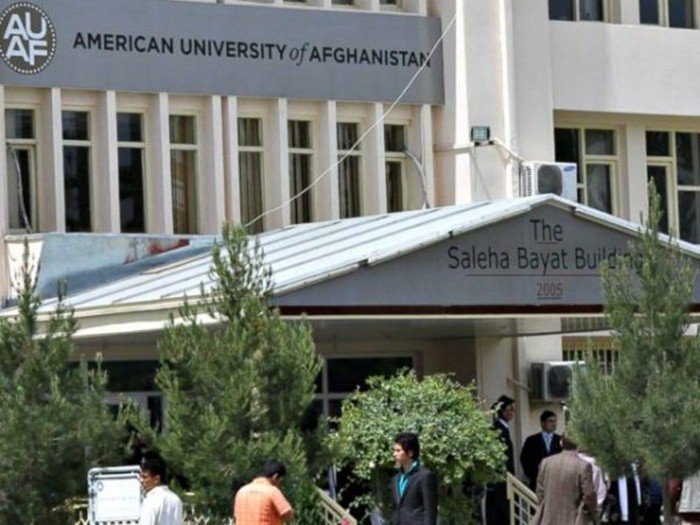
  • American University attacked In Kabul, Over 12 Dead, 21 Hurt

    American University attacked In Kabul, Over 12 Dead, 21 Hurt

    Twelve people were killed in an attack on the American University of Afghanistan in Kabul, a spokesman for the Chief of Kabul Police told CNN on Thursday, August 25.

    Seven students, three policemen and two security guards were killed in the attack and Thirty-five students and nine police were injured and about 750 students and staff were rescued, Kabul police chief Abdul Rahman Rahimi told the BBC.

    Police searched the American University of Afghanistan early Thursday about 10 hours after the assault began and killed two of the attackers who stormed the campus with guns and explosives.

    The gunmen detonated explosives and fired guns, witnesses said, causing some students and faculty to flee. Others hid inside buildings, a senior State Department official told CNN.

    Police described the attack, which began at about 7 p.m., as “complex”. Special forces were on the scene along with American military advisers, the BBC said.

    One of those trapped inside the university for several hours was Massoud Hossaini, a Pulitzer Prize-winning photojournalist, who tweeted his experience and pleaded for help.

    The attack comes two weeks after two university staff – one American, one Australian – were kidnapped by unknown gunmen. Their whereabouts still remain unknown.

    The school opened in 2006. It’s the only private, nonprofit coed university in the country and has about 1,700 full- and part-time students, CNN reported.

    Indian Prime Minister Narendra Modi on Thursday, August 25, condemned the bomb attack on the American University of Afghanistan in Kabul that left a security guard dead while injuring over 20 people.

    “We strongly condemn the attack on American University in Kabul,” the Prime Minister tweeted.

    “Condolences to the bereaved families and prayers with the injured.”