

Astronomers searching for extraterrestrial intelligence (SETI) may have already surveyed a much larger portion of the Milky Way than previously believed, according to new research. The findings suggest that while the search has yet to detect signs of alien civilisations, scientists have unknowingly observed millions more stars than earlier estimates indicated.
Louisa Mason, a PhD student at the University of Manchester, reanalysed observations made by the Green Bank and Parkes radio telescopes. Earlier calculations, based on existing star catalogues, suggested that 1,327 observations covered around 288,315 stars. However, Mason’s analysis found that the same observations likely included more than 6.1 million stars, many of which are too faint to appear in optical catalogues.
“One of the most exciting things about this work is realising that we’ve surveyed many more stars than initially thought,” Mason said in a statement. “Even a very small observation can contain a huge number and diversity of stars that we might never have intended to study.”
The discovery stems from the way radio telescopes operate. When aimed at a target star, they simultaneously receive signals from every star within their field of view. This makes them particularly useful for commensal SETI, where searches for alien signals are conducted alongside routine astronomical observations.
Traditional estimates rely on visible star catalogues, such as those produced by the European Space Agency’s Gaia mission. However, these catalogues exclude countless dim stars that remain invisible to optical telescopes but could still produce detectable radio signals.
Despite the larger search area, researchers caution that the hunt remains limited. Most stars have only been observed for brief periods, meaning any transmission outside those observation windows would have gone unnoticed. In addition, SETI searches have largely focused on a narrow section of the radio spectrum.
For decades, scientists have concentrated on the so-called water-hole frequencies between 1,420 MHz and 1,666 MHz, a region considered favourable because radio waves there travel efficiently through Earth’s atmosphere and carry symbolic significance related to water, a key ingredient for life.
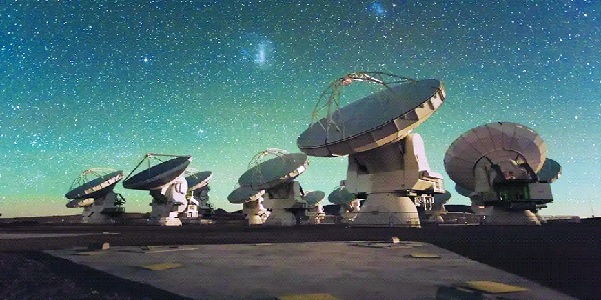
Mason is now exploring frequencies beyond that range. She recently carried out the first SETI search using archival data from the Atacama Large Millimeter/submillimeter Array (ALMA) in Chile, which operates at much higher radio frequencies than conventional SETI instruments.



Be the first to comment