

For decades, central India’s travel identity has been shaped by familiar names-Khajuraho, Gwalior, Sanchi, Ujjain, Kanha and Bandhavgarh. Yet beyond these celebrated destinations lies another world, one that is still waiting to be fully discovered. In the rugged ravines of the Chambal, along the quiet banks of ancient rivers, amid forgotten temples and imposing forts, Northern Madhya Pradesh reveals a landscape where wilderness, history and folklore meet.
This is a region that does not always announce itself with polished tourist boulevards or crowded sightseeing circuits. Its appeal lies elsewhere: in the silence of the river at dawn, in the deep gullies carved by centuries of erosion, in stories of rebels and dacoits, and in towns whose monuments carry memories of Rajput kingdoms, Mughal campaigns, Maratha ambitions and British rule.
For travelers looking beyond the conventional map of Madhya Pradesh, the Chambal and northern region offer an unusual journey into one of India’s most dramatic and culturally layered landscapes.
The Chambal: Beyond the Legends of Dacoits
For generations, the very mention of Chambal evoked images of ravines, guns, outlaws and police pursuits. Popular cinema and folklore transformed the region into a symbol of rebellion and lawlessness. The notorious beehads, or labyrinth-like ravines, became the setting for countless stories of dacoits who challenged authority and disappeared into the difficult terrain. But Chambal today tells a very different story.
The river, one of the cleanest major rivers in India, flows through a landscape that has gradually emerged as an important ecological destination. The rugged ravines remain, but they are now as much a part of the region’s natural beauty as its legendary past. The once-feared landscape has become a place where travelers can encounter rare wildlife, riverine ecosystems and a quieter side of central India.
A boat ride on the Chambal is perhaps the best introduction to the region. The journey unfolds slowly. Sandy banks stretch along the river, birds rise from the water and the silence is broken only by the sound of the boat or the calls of wildlife.
The National Chambal Sanctuary is known for protecting several endangered and threatened species, including the gharial, the Gangetic river dolphin and the Indian skimmer. Marsh crocodiles can also be spotted along the riverbanks, while the surrounding landscape attracts a remarkable variety of migratory and resident birds. Unlike the more familiar experience of a jeep safari in a tiger reserve, wildlife tourism here has a different rhythm. The Chambal is about watching rather than chasing. A traveller waits for movement along a sandbank, scans the river for the long snout of a gharial or watches flocks of birds glide across the water.
At sunrise and sunset, the landscape can feel almost untouched by modern life.
Morena: Where History Rises from the Ravines
Morena is often treated merely as a point on the way to other destinations, but the district has enough history and architecture to reward a longer stay.
One of its most remarkable treasures is the group of temples at Bateshwar. Spread across a wide area, the complex contains hundreds of small temples, creating an extraordinary archaeological landscape. The temples, many dedicated to Shiva and Vishnu, belong largely to the medieval period and reflect the architectural traditions that flourished in central India centuries ago. Walking through Bateshwar is like entering a stone city that has slowly re-emerged from the past. Temples of different sizes stand close together, their shikharas rising above the surrounding landscape. Some appear carefully restored, while others retain the weathered character of ruins.
The sheer scale of the complex makes it one of the most striking yet relatively underexplored heritage sites in the region. Morena also offers access to the ancient temple of Chausath Yogini at Mitawali, a circular shrine perched on a hill. The temple is associated with the Yogini tradition and is notable for its distinctive circular design. The structure, with a central courtyard surrounded by a ring of small shrines, creates a powerful architectural impression.
Standing there, it is easy to understand why the monument has attracted so much curiosity. The open circular form and elevated setting give the site a sense of both symmetry and mystery.
Nearby heritage sites, including Padavali and other temple complexes, make this part of northern Madhya Pradesh an ideal destination for travellers interested in archaeology and early Indian architecture.
Gwalior: The Familiar Gateway to an Unfamiliar Region
Gwalior may be better known than many other destinations in northern Madhya Pradesh, but it remains the perfect gateway to the wider region.
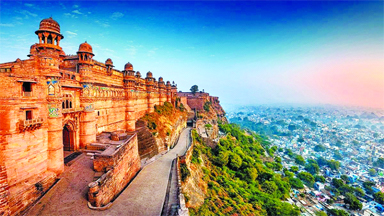
Dominated by its magnificent fort, Gwalior carries the grandeur of a city that has repeatedly occupied a central place in Indian history. The fort rises dramatically above the city, its walls and palaces representing centuries of political and cultural change.
The sandstone fort complex includes palaces, temples and other structures that reflect different periods of rule. The Man Singh Palace, with its striking decorative facade, remains one of the architectural highlights.
But Gwalior is more than its fort.The city has deep connections with Indian classical music and is associated with the Gwalior gharana, one of the most influential traditions of Hindustani classical music. It is also remembered as the birthplace of Tansen, the legendary musician who became one of the celebrated Navratnas in Emperor Akbar’s court. A journey through Gwalior can therefore move easily between military history, architecture and music. The city’s old neighbourhoods, palaces and monuments provide a dramatic introduction before travellers head towards the quieter landscapes of Morena, Shivpuri and the Chambal basin.
Shivpuri: A Royal Retreat in the Forest
Further south-east, Shivpuri offers a different face of northern Madhya Pradesh. Once associated with the Scindia rulers of Gwalior, the town served as a summer retreat because of its relatively pleasant climate and surrounding forests. The royal connection is visible in the elegant chhatris and other monuments that continue to define its heritage landscape.
The Shivpuri cenotaphs, built in honour of the Scindia rulers, are among the town’s architectural highlights. Set amid landscaped surroundings, the structures combine Rajput, Mughal and regional influences. But Shivpuri’s greater surprise may be its natural setting.
The surrounding forests, lakes and wildlife areas make the destination suitable for travellers who want to combine heritage with nature. The landscape provides a sharp contrast to the harsh ravines of Chambal. Here, the terrain is greener and more open, with forests offering refuge to wildlife.


Be the first to comment