Tag: COUNTER TERRORISM

  • Pak court jails spokesperson of Hafiz Saeed-led JuD for 32 years in terror financing cases

    Pak court jails spokesperson of Hafiz Saeed-led JuD for 32 years in terror financing cases

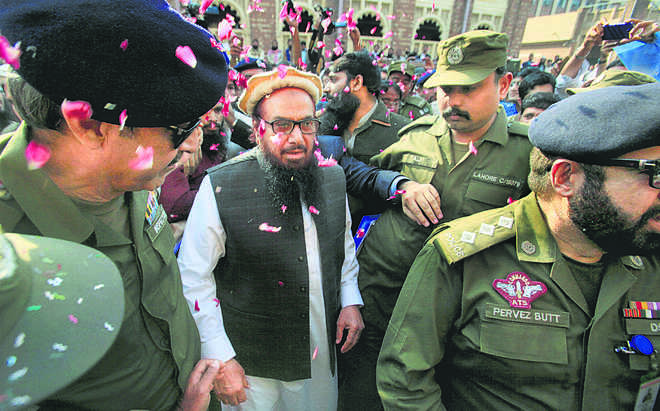
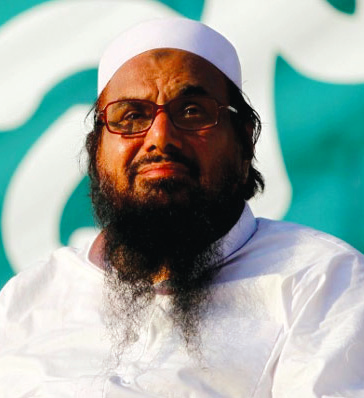
    Lahore (TIP): A Pakistani anti-terrorism court has handed down 32 years of imprisonment to Yahya Mujahid, spokesperson of Mumbai attack mastermind Hafiz Saeed’s Jammat-ud-Dawah (JuD) terror group, in two terror financing cases. The Anti-Terrorism Court (ATC) here on Wednesday also convicted two other JuD leaders, including the brother-in-law of Saeed, in terror financing cases.
    “ATC Judge Ijaz Ahmad Buttar handed down 32 years’ imprisonment to JuD spokesperson Yahya Mujahid in two FIRs. Prof Zafar Iqbal and Prof Hafiz Abdul Rehman Makki (brother-in-law of Saeed) were awarded 16-year and one-year jail terms in two cases,” a court official told PTI.
    He said that the two other JuD leaders – Abdul Salam bin Muhammad and Luqman Shah – were indicted in more terror financing cases. The court directed the prosecution to present its witnesses on November 16. The suspects were presented in the court in high security and media was not allowed to enter the court premises during the case proceedings. Last week, the ATC Lahore convicted JuD’s Hafiz Abdul Rehman Makki, Zafar Iqbal and Muhammad Ashraf in two more cases of terror financing registered by the Counter Terrorism Department (CTD) of Punjab police. Zafar Iqbal and Muhammad Ashraf have been given a collective imprisonment of 16 years each under different sections of the Anti-Terrorism Act. Makki has been sentenced to one-year imprisonment in a case with a fine of Rs 1,70,000. In September last year, the ATC Lahore handed down over 16 years’ imprisonment to Prof Zafar Iqbal and Hafiz Abdus Salam bin Muhammad and one-and-a-half-year sentence to Makki in a terror financing case.
    In February last year, Saeed had been sentenced to jail for 11 years on terror finance charges by an ATC in Lahore.
    The ATC sentenced Saeed and his close aide Zafar Iqbal to five-and-a-half years each in two cases. A total of 11 years’ sentence will run concurrently. Saeed is serving his term in Lahore’s Kot Lakhpat jail. He was arrested in July last year. The CTD of Punjab police had registered 23 FIRs against Saeed and his accomplices on charges of terror financing in different cities of the province.
    Saeed-led JuD is the front organisation for Lashkar-e-Taiba which is responsible for carrying out the 2008 Mumbai attack that killed 166 people, including six Americans.
    The US named Saeed as a Specially Designated Global Terrorist, and the US, since 2012, has offered a USD 10-million reward for information that brings Saeed to justice.
    He was listed as a terrorist under the UN Security Council Resolution 1267 in December 2008. PTI

  • Indian American Kash Patel named Chief of Staff to Acting US Defense Secretary 

    Indian American Kash Patel named Chief of Staff to Acting US Defense Secretary 

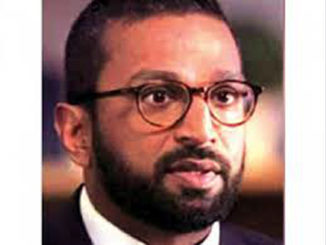
    WASHINGTON (TIP):  (TIP): Indian American Kash Patel has been named as the Chief of Staff to the Acting US Defense Secretary Chris Miller, the Pentagon has announced.

    The new appointment from the Pentagon comes a day after Donald Trump fired Defense Secretary Mark Esper and designated the National Counter Terrorism Center Director, Chris Miller, as the Acting Secretary of Defense. Chris Miller took over the functions and responsibilities of the new role on Monday, the Pentagon said on Tuesday.

    Kash Patel, currently on the National Security Council staff, has been named by Acting Secretary Chris Miller as his Chief of Staff, the Pentagon announced on Tuesday. He replaces Jen Stewart, who resigned earlier in the day. Acting Under Secretary of Defense for Policy Dr. James Anderson, Under Secretary of Defense for Intelligence and Security Joseph Kernan have submitted letters of resignation. Kashyap Pramod Patel, popularly known as Kash Patel, had previously served as senior counsel for counterterrorism at the House Permanent Select Committee.

    In June 2019, Patel, 39, was appointed as senior director of Counter-terrorism Directorate of the National Security Council (NSC) in the White House.

    New York-born Kash Patel has his roots in Gujarat. However, his parents are from East Africa mother from Tanzania and father from Uganda. They came to the US from Canada in 1970. The family moved to Queens in New York which is often called as Little India – in the late 70s.

    After his schooling in New York and college in Richmond, Virginia, and law school in New York, Kash Patel went to Florida where he was a state public defender for four years and then federal public defender for another four years.

    From Florida, he moved to Washington DC as a terrorism prosecutor at the Department of Justice. Here he was an international terrorism prosecutor for about three and a half years. During this period, he worked on cases all over the world, in America in East Africa as well as in Uganda and Kenya. While still employed by the Department of Justice, he went as a civilian to join Special Operations Command at the Department of Defense.

    At the Pentagon, he sat as the Department of Justice’s lawyer with Special Forces people and worked inter-agency collaborative targeting operations around the world.

    After a year in this sensitive position, Congressman Davin Nunes, Chairman of the House Permanent Select on Intelligence Committee, pulled him as senior counsel on counterterrorism.


  • India sought a solution while Pakistan was comfortable with continuing with cross-border terrorism: Dr. S Jaishankar

    India sought a solution while Pakistan was comfortable with continuing with cross-border terrorism: Dr. S Jaishankar

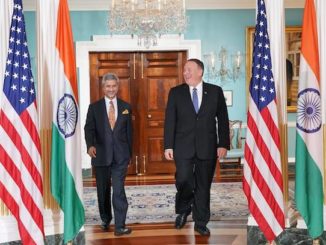
    WASHINGTON(TIP): External Affairs Minister (EAM), Dr. S Jaishankar concluded a comprehensive visit (28 September to 02 October 2019) to Washington DC, his first visit to Washington after his appointment as Minister for External Affairs of India.

    During the visit, EAM met his counterpart Secretary of State Mike Pompeo; Secretary of Defense Mark Esper; Acting Secretary for Homeland Security Kevin McAleenan; and newly appointed National Security Advisor Robert C O’Brien.

    EAM also addressedfive major think tanks (Carnegie Endowment for International Peace, The Atlantic Council, Center for Strategic and International Studies, The Heritage Foundation and the Brookings Institutions).

    Speaking on the on the topic ‘Preparing for a Different Era’ at Center for Strategic and International Studies, Dr. S Jaishankar cautioned that ‘a world of “all against all” is neither desirable nor indeed probable.’ “The weight of history and the compulsions of politics will make sure that convergences end up as some form of collectivism. Nor can beliefs and values be divorced from the behavior of states. Thus, even as we look at an era of more dispersed power and sharper competition, the way forward is more likely to be new forms of accommodation rather than pure transactions. While nations will naturally each strive to advance their particular interests, similarities and affinities will always remain a factor. So, while this is an exposition on changes in international affairs, I would emphasize that the direction is towards a new architecture rather than the absence of one”, he said.

    He also highlighted how for many years India sought a solution while Pakistan was comfortable with continuing with cross-border terrorism. “The choice as this Government came back to power was clear. Either we had more of past policies and the prospect of further radicalization. Or we had a decisive change in the landscape and a change of direction towards de-radicalization. The economic costs of the status quo were visible in the absence of entrepreneurship and shortage of job opportunities. The social costs were even starker: in discrimination against women, in lack of protection for juveniles, in the refusal to apply affirmative action and in denial of the right to information, education and work. All this added up to security costs as the resulting disaffection fed separatism and fueled a neighbor’s terrorism. At a broader level, these realities also contradicted our commitment that no region, no community and no faith would be left behind. The legislative changes made this summer put India and the entire region on the road to long-term peace. That is the reality today in the making. And this is the India that will navigate the world which I have described just now”, he said.

    Dr Jaishankar also emphasized that different era which we have entered also calls for both India and the United States to press the refresh button of their relationship.


  • “It is essential that the pressure is kept on to defeat the terror groups and support the host nations”:  General Petraeus

    “It is essential that the pressure is kept on to defeat the terror groups and support the host nations”: General Petraeus

    NEW YORK(TIP): A day after Pakistan Prime Minister Imran Khan claimed his country’s spy agency ISI provided information that helped the US track down and kill Osama bin Laden, former Director of the Central Intelligence Agency (CIA) General David Petraeus said he is “convinced” that the Pakistani intelligence did not know the Al-Qaeda chief was in Pakistan, even as he asserted that terror groups such as the Tehrik-e-Taliban Pakistan and other “internal extremists” are the real “existential threat” for Pakistan and are a “very diabolically difficult problem to deal with”.

    “The challenge for Pakistan, of course, is that the existential threat is not the country to its east, it is not India. It is the internal extremists. It is a very diabolically difficult problem to deal with,” Petraeus said Tuesday during an interactive session at the Indian Consulate, following his address on the topic of the Indo-Pacific.

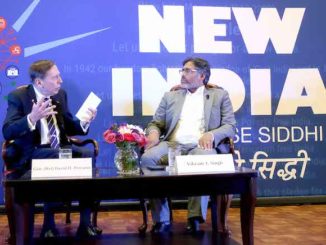
    Petraeus, a partner in the international investment firm KKR and Chairman of the KKR Global Institute, was the special guest for the ‘New India Lecture’ series organized by the Consulate General of India, New York in partnership with the US India Strategic Partnership Forum.

    General (Ret) David Howell Petraeus (Left), former Director of CIA and Ambassador Sandeep Chakravorty, India’s Consul General in New York at the Consulate General of India in New York
    Photo / Jay Mandal-On Assignment

    Responding to a question on US-Pakistan relationship, Petraeus said he has experienced the bilateral ties “on a very first hand basis” as the Commander of the US Central Command around the year 2009 and there have been some “positive” as well as “disappointing and frustrating periods” in ties between Washington and Islamabad. He added that the US has always provided “enormous” support to Pakistan, recalling that he and former special adviser on Pakistan and Afghanistan Richard Holbrooke went to the US Congress and got 7.5 billion dollars for economic assistance for Pakistan over a five year period, which was in addition to the two billion dollars already extended in various categories of defense assistance and counter-terrorism support. “At the end of the day, of course there was a degree of disappointment,” he said.

    On a question  from Prof. Indrajit S Saluja, editor of The Indian Panorama, about slain Al Qaeda leader Osama bin Laden living in Pakistan before he was killed, Petraeus asserted the US is convinced that the Pakistani intelligence was not aware that the terrorist leader was hiding in their country.

    “We are quite convinced that the ISI, Pakistani intelligence, no one else knew that he (bin Laden) was there (in Pakistan). They were not harboring him or hiding him or anything like that. We have very good insights on that. We probably differ with those who said that the Pakistanis were allowing him to live in that particular compound” in Abbottabad.

    Petraeus’s assertion runs counter to claims made by Pakistan’s Prime Minister Imran Khan that Pakistan’s powerful spy agency ISI provided information to the CIA which helped the US track down and kill the al-Qaeda chief. Khan’s comments are a significant revelation as Islamabad had so far denied having any knowledge of the terror chief until he was shot dead in 2011. Khan, who is visiting Washington on his maiden official trip, revealed this during an interview with Fox News when he was asked whether his country would release jailed Pakistani surgeon Shakeel Afridi who helped the CIA track down Osama. The Al Qaeda leader was killed in a covert raid by a US Navy SEAL team in Abbottabad, a garrison town north of Islamabad, on May 2, 2011.

    “It was ISI that gave the information which led to the location of Osama bin Laden. If you ask CIA it was ISI which gave the initial location through the phone connection,” Khan has said.

    A view of the audience
    Photo / Jay Mandal-On Assignment

    Petraeus said that during counter-insurgency campaigns, Pakistani authorities could never close in on North Waziristan where terror outfits such as the Haqqani network, Al Qaeda and others had their headquarters and some of their forces. He added that the US learnt later on that bin Laden was not in that area but near the Pakistan Military Academy in Abbottabad. “I figured out later that I had probably flown right over his compound in a helicopter as I went to address the cadets at the military academy one time,” he said referring to the Pakistan Military Academy.

    Petraeus said he hopes Khan will be able to deal with the challenges of his country, where the economy is “very distorted” and where the “realities of the situation are really quite difficult.”

    On Afghanistan, the veteran and decorated US military officer said while the Afghans are fighting and dying for their country, “sadly the momentum of recent years has been against Afghanistan rather than for it. It’s why I have some reservations about the prospects for a peace agreement that we would all support. What adds to my concern is the fact that the Taliban has not even been willing to allow the democratically elected government of Afghanistan to sit at the same negotiating table with them.”

    He however expressed hope that President Donald Trump’s special adviser to Afghanistan Zalmay Khalilzad “can produce magic here and can produce an agreement that would allow us to draw down further, still achieve our objectives and ensure that our Afghan partners are taken care of as well.

    “But yet I think it is a very challenging situation,” he said recalling that the US was not able to get a negotiated agreement at a time when he commanded 150,000 coalition forces and “when we had the momentum on the battlefield… so it is a little difficult to see why the Taliban would agree to much more than our departure.”

    Petraeus also highlighted that what is more challenging is that the Taliban is just one group of many insurgent and extremist elements operating on Afghan soil. “You also have the Haqqani group. I am not at all confident that they are reconcilable , if some of the elements of the Taliban are. By the way, not all of them would necessarily agree to a peace agreement.” He added that among the other groups operating in the region are the Islamic Movement of Uzbekistan, remnants of Al Qaeda, Islamic State. “And you even have the other Taliban – the Tehrik-e-Taliban Pakistan, the Pakistani Taliban which along with some other groups, I want to contend is the true existential threat to Pakistan, not Pakistan’s neighbor to the east,” again a reference to India.

    Further, the challenge has always been putting pressure on an enemy whose senior leaders are “beyond our reach in sanctuaries either in the Federally Administered Tribal Areas or in Balochistan.”

    Petraeus said that the biggest lesson that the US has taken from the fight against the Islamic extremists since 9/11 is that “this is a generational struggle. This is not the fight of a decade or a few years. You can defeat this enemy, but you have to keep your eye on it. If you take your eyes off, what happens is that Al Qaeda in Iraq rises back up into the Islamic State, goes into Syria and takes advantage of the Syrian civil war and roars back into Iraq with an army.”

    He added that just as the Taliban regrouped in Pakistan after it was destroyed in Afghanistan,it is essential that the pressure is kept on to defeat the terror groups and support the host nations,enabling them to do the frontline fighting, political reconciliation and reconstruction.

    “I always remind folks that we went to Afghanistan for a reason and we have stayed for a reason. We went there because the 9/11 attacks were planned in eastern Afghanistan when Al Qaeda had a sanctuary there. We went in to eliminate that sanctuary and we have stayed to ensure that it is not re-established,” he said adding that the challenge now is that it’s not just the Al Qaeda trying to reestablish, it is the Islamic State that also has a “fascination” with this area (eastern Afghanistan).

     He noted that the US has been helping the Afghan government and forces, who are fighting very hard and sustaining casualties. “India has helped Afghanistan considerably as well.”

    The US is successfully drawing down its forces in Afghanistan, he said adding that another core interest for the US in Afghanistan is that the nation provides a platform from where Washington conducts counter-terrorism campaign in the region. “It is well known that the launch of the operation that killed Osama bin Laden was from a base in eastern Afghanistan.”

    (With inputs from PTI)

  • Terrorist Attack in J& K kills more than 40 Security Personnel , Many injured;  worst terror strike since Uri

    Terrorist Attack in J& K kills more than 40 Security Personnel , Many injured; worst terror strike since Uri

    India withdraws Most Favored Nation status given to Pakistan

    United Nations and  US condemn the attack

    Police say the 21-year-old suicide bomber driving the explosive-laden vehicle was Adil Ahmad from Kakapora in Pulwama who joined the JeM in 2018

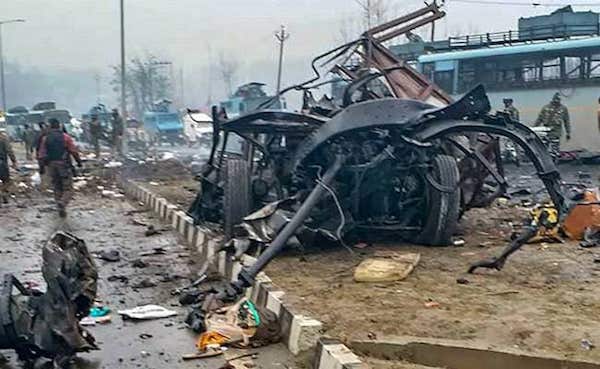
    SRINAGAR(TIP):  At least 40 CRPF personnel were killed in Jammu and Kashmir’s Pulwama district on February 14 (Thursday) when a Jaish-e-Mohammed terrorist rammed an explosives-laden vehicle into the bus they were travelling in, one of the worst terror strikes in the state in recent years, officials said.

    More than 2,500 Central Reserve Police Force personnel, many of them returning from leave to rejoin duty in the Valley, were travelling in the convoy of 78 vehicles when they were ambushed on the Srinagar-Jammu highway at Latoomode in Awantipora.

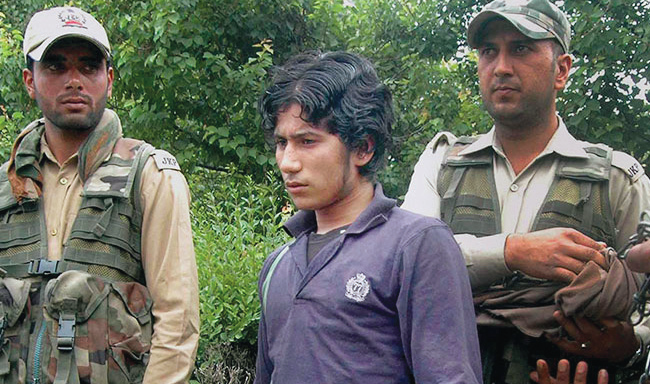
    Police said the terrorist driving the suicide vehicle was Adil Ahmad from Kakapora in Pulwama who joined the JeM in 2018.

    The terror group has claimed responsibility for the attack that took place about 30 km from Srinagar, they said.

    Over 20 people were injured in the terror attack, which reduced the bus to a mangled heap of iron. Body parts could be seen strewn around the area.

    “It was a large convoy and about 2,500 personnel were travelling in multiple vehicles. Some shots were also fired at the convoy,” CRPF DG R R Bhatnagar told PTI.

    National Security Advisor (NSA) Ajit Doval is monitoring the situation in Kashmir, said sources. Senior CRPF officials are also briefing him about the developments.

    The convoy started from Jammu around 3.30 am and was supposed to reach Srinagar before sunset, officials said.

    The number of personnel travelling back to the Valley was high as there was no movement on the highway for the last two to three days because of bad weather and other administrative reasons, they said.

    Usually, about 1,000 personnel are part of a convoy. A road opening party was deployed, and the convoy had armored counter-terror vehicles, officials said. Forensic and bomb analysis teams are on the spot.

    The bus that was the focus of the attack belongs to the 54th battalion of the force and had 44 personnel on board, officials said.

    CRPF Inspector General (Operations) in the Kashmir Valley Zulfiqar Hasan described it as a “vehicle-bound attack” and said Jammu and Kashmir Police has taken up the investigation.

    “Governor Satyapal Malik observed forces responsible for the insurgency in J&K are desperate & frustrated and just want to prove presence. Visibly it seems to be guided from across the border as Jaish-e-Mohammad  has claimed responsibility,” said J&K Raj Bhawan PRO on the terror attack.

    Rajnath, who will visit Srinagar on Friday, has also spoken to Satyapal Malik. Home Minister Rajnath Singh has already spoken to DG CRPF RR Bhatnagar over the terror attack.

    “Senior officers at the spot, the investigation is underway. Injured being taken care of. There were 2500 personnel in the convoy,” said Bhatnagar.

    Condemning the attack, Union Minister Arun Jaitley said, “attack on CRPF in Pulwama is cowardice & a condemnable act of terrorists. Nation salutes martyrs & we stand united with families of martyrs. We pray for the speedy recovery of the injured. Terrorists will be given an unforgettable lesson for their heinous act.”

    In the attack on the Uri military base in September 2016, JeM militants killed 18 Army jawans and injured dozens of others.

    Experts of the anti-terror commando force National Security Guard (NSG) and investigators of the National Investigation Agency (NIA) are being sent to Jammu and Kashmir to join the probe into the terror attack in Pulwama in which at least 39 CRPF personnel were killed, officials said Thursday, Feb 14.

    (Source: PTI)

  • Give us back friendliness of late 1970s

    Give us back friendliness of late 1970s

    By Shahzad Raza

    Both nuclear rivals have almost tried all options — wars, dialogues and trade — but to no avail. The two sensitive issues, Kashmir and terrorism, have been hampering progress in other areas for long……… In 2009, at Sharm-el-Sheikh, Pakistan’s former Prime Minister Yousaf Raza Gillani and his Indian counterpart Manmohan Singh agreed to cooperate on fighting terrorism together. That was the most remarkable development after the deadly Mumbai attacks.

    Pakistani schoolchildren of the 1980s had a great fascination with Indian classic Mahabharat, which was telecast on Doordarshan and used to reach TV sets across the border through analogue antennas. The character of Bheem was quite popular among viewers.

    That generation of the late 1970s or early 1980s, which had no remorse watching Indian entertainment shows, transferred the same fascination to their children who had Chotta Bheem to enjoy. Those who had access to PTV in India would still remember the character of Chaudhry Hashmat Ali of one of the greatest Pakistani drama, Waris.

    People were then beginning to forget the horrific memories of the Partition and two unfortunate wars. Pakistani agencies were not meddling in the Kashmir affairs and their Indian counterparts were not colluding with Afghans to fan separatism in Balochistan. Osama bin Laden and his jihadis were preparing to defeat the Red Army. Uncomprehending then was the frequent stalemates on multiple issues, including Kashmir, water, visas, trade, etc. India granted Pakistan MFN status, vying for access to Afghanistan and Central Asia. However, Pakistani policy makers did not respond.

    Things changed drastically after the collapse of the Soviet Union, leaving Pakistan to bear the burden of refugees and radical ideologies. The jihadis had no inclination to return to their barracks like a regular army. Many of them joined Kashmir separatist groups, sparking serious tension between the two neighbors.

    The complexities of proxy war were not suitable for both India and Pakistan, given their proximity, economies and cultural bonds. Yet, the two countries have been exhausting themselves since the end of the first Afghan war.

    Both nuclear rivals have almost tried all options — wars, dialogues and trade — but to no avail. The two sensitive issues, Kashmir and terrorism, have been hampering progress in other areas for long. During Gen Pervez Musharraf’s regime, a remarkable progress was made on the Kashmir issue. The last People’s Party government almost convinced the then Indian government to stop accusing Pakistan of sponsoring terrorism. In 2009, at Sharm-el-Sheikh, former Prime Minister Yousaf Raza Gillani and his Indian counterpart Manmohan Singh agreed to cooperate on fighting terrorism together. That was the most remarkable development after the deadly Mumbai attacks.

    The successive PML-Nawaz government took several bold initiatives but for one reason or other things went back to square one. For a long time, Indian policy makers kept on pressing Pakistan to leave the issue of Kashmir until there was a congenial atmosphere. Pakistani establishment was not listening. Now both civilian and military leaderships in Pakistan are talking about building the same atmosphere through economic and cultural ties. The Indians are not listening, perhaps because of the impending General Election.

    Musharraf and his PM Shaukat Aziz envisioned if the bilateral trade was increased it would diminish the state-level animosity. They often cited the example of Germany and France that how the World War-II rivals rebuilt their relations through trade. The incumbent government of PTI in Pakistan feels the same. Germany and France are a classic example for the neighboring countries to repair the fractured relations. The South Asian rivals have their own Alsace-Lorraine — Kashmir. The nature of conflict and emotional attachment with the beautiful territory cannot be underestimated.

    Both have their stakes in Afghanistan. What if the two sides, somehow, start considering that barren land their Alsace-Lorraine. What if Pakistan and India take over the process of rebuilding Afghanistan together? Dialogue with the Taliban seems to have entered the final stage. Pakistan can still use whatever leverage left over Taliban. And India can pull strings and make Afghani establishment toe the line. Together, the two countries could do wonders in Afghanistan. While shifting their joint interests into a third country, both neighbors must revive once strong cultural ties.

    Warmongers need to take a back seat. The next course should be determined by the likes of late Asma Jehangir and Arundhati Roy. Can’t Pakistan’s real estate tycoon Malik Riaz build urban metropolises in Afghanistan, with steel provided by Lakshmi Mittal? Otherwise, dare one can say that sudden death is much better than prolonged and painful illness through slow poisoning.

    (Source: Tribune India)

  • Pakistan’s Nuclear Arsenal more worrisome than North Korea’s

    Pakistan’s Nuclear Arsenal more worrisome than North Korea’s

    Pakistan is more dangerous than North Korea as it does not have a centralized control on its nuclear weapons, making them vulnerable to theft and sale.

    By Ven Parmeswaran

    9/11 happened because Pakistan supported the Taliban and the Al Qaeda.  We discovered that Pakistan was the epicenter of global terrorism.  Almost all terrorists emanated from Pakistan and committed terrorism in the U.S.A. and Europe.  President George W Bush sent his Secretary of State, Gen. Collin Powell to Pakistan, with whom the USA had a Mutual Security Pact from 1954.  Powell met Gen. Musharraf of Pakistan and made a deal. Pakistan agreed to cooperate fully with the USA and provide all help in finding Osama bin Laden and other leaders of Al Qaeda.    

    President Obama had intelligence that Pakistan was hiding and protecting Osama Bin Laden in one of military cantonments.  In 2011, that is 10 years after 9/11, the U.S. secretly got rid of Osama Bin Laden. The Pakistani doctor who confirmed the identity of Osama Bin Laden has been held in jail by Pakistan.  Thus, Pakistan betrayed its ally, the U.S.A.  For ten years, Pakistan was trying to use Osama bin Laden’s leadership to stage terrorism in India.  The mutual trust between the USA and Pakistan was broken.  However, President Obama chose not to punish Pakistan.

    WAKE UP CALL BY PRESIDENT TRUMP

    President Trump is the first U.S. President to challenge Pakistan.  He wrote in his tweet: “The U.S. has foolishly given Pakistan more than 33 billion dollars in aid over the last 15 years, and they have given us nothing but lies, deceit, thinking of our leaders as fools.”   President Trump withdrew military aid and gave an ultimatum to Pakistan to stop supporting the Taliban in Afghanistan and to dismantle all terror organizations and terrorist sanctuaries in Pakistan.

    PAKISTAN’S ECONOMY IN SHAMBLES WITH NO FOREIGN EXCHANGE

    Mr. Imran Khan, the new Prime Minister of Pakistan has been elected with the tacit support and help of Pakistan’s military.  For his survival his first loyalty is to the military.   Pakistan is negotiating with the I.M.F. for a $12 billion loan.  The U.S. has leverage in the IMF being the largest investor.  The IMF cannot approve the loan without consent from the USA.    Pakistan has been devoting its scarce resources to keep on producing nuclear bombs.

    PAKISTAN’S NUCLEAR WEAPONS ARE VULNERABLE TO THEFT AND SALE

    Pakistan is more dangerous than North Korea as it does not have a centralized control on its nuclear weapons, making them vulnerable to theft and sale, former Senator Larry Pressler warned, describing both the nations as rogue states.    He feared that Pakistan’s nuclear weapons might be used against the US, warning of the possibility of someone buying these nuclear weapons from generals.    “The weapons could be transported to the US fairly simply.  Just as 9/11 was a very simple operation run by 20 or 30 people,” he said.  “The Pakistani nuclear bombs are not controlled.  They are subject to sale or stealing and they could be easily gotten out of Pakistan to just about anywhere in the world,” he said speaking at an event sponsored by The Hudson Institute, a top American think-tank.    The former top American Senator, however, said he does not think that Pakistan’s nuclear weapons are going to be used against India. I do not agree.   The Senator said “I think what North Korea needs is just a lot of attention and hand-holding.  Pakistan Is a different thing because you don’t really have one person in-charge.  I think Pakistan is more dangerous to the US,” he reiterated in response to a question.

    “We should declare Pakistan a terrorist state.  We should put certain sanctions on Pakistan,” he said.

    PAKISTAN’S GROWING ARSENAL WITHOUT CENTRAL CIVILIAN CONTROL IS THREAT TO GLOBAL SECURITY

    Why does Pakistan need to keep on increasing the number of bombs?  There are thousands of nuclear weapons in the world today.  According to the latest count from the Federation of American Scientists, the 5 original nuclear powers have a combined 15,465 nuclear weapons between them, most of which are divided amongst the US and Russia. Yet, the fastest growing arsenal in the world is not included in this number.  While Pakistan has a range of 100-120 nuclear weapons in its possession—a figure that pales in comparison to the US or Russia—Islamabad has devoted a tremendous amount of its military budget to growing its arsenal and producing the associated delivery systems that are needed to launch them.

    More alarming than Pakistan’s current stockpile is the projected growth of its arsenal over the next decade.  In a wide ranging report for the Council on Foreign Relations, professor Gregory D Koblentz of George Mason University assessed that Pakistan had enough highly enriched uranium to increase its stockpile to 200 nuclear weapons by 2020 if fully utilized.  Percentage wise, this would mean that Pakistan could have as many nuclear weapons as the U.K. by 2020.  Moreover, Pakistan falls outside the purview of the Nuclear Nonproliferation Treaty.

    To guarantee the ability to rapidly expand their stockpile, the Pakistani military is investing in reprocessing plutonium in addition to enriching uranium.  In January 2015, the Institute for Science and International Security reported that the Pakistanis opened up their fourth plutonium facility at Khushab, which provides Islamabad with an additional channel to construct nuclear bomb material in a relatively short period of time.  “Its expansion appears to be part of an effort to increase the production of weapons-grade plutonium,” the ISIS report (Pakistan’s intelligence agency) reads:  “Allowing Pakistan to build a larger number of miniaturized plutonium-based nuclear weapons that can complement its existing highly enriched uranium nuclear weapons.”

    PAKISTANI NUKES A MAJOR U.S. INTELLIGENCE PRIORITY

    To say that the U.S. Intelligence community is closely monitoring the development of Pakistan’s nuclear weapons program would be an understatement.  The U.S. government is doing more than just monitoring:  they are actively preparing for a terrible catastrophe and engaging Pakistani officials in the hopes that they will stop pouring resources into the expansion of their program.  The last thing Washington wants or needs is a nuclear crisis flashpoint in a dangerous and unpredictable region filled with an alphabet soup of Islamist terrorist groups.  The US government under both George W Bush and Barack Obama has been trying to prevent such a crisis scenario from occurring.

    THE BOTTOM LINE

    Despite all the attempts from the nuclear nonproliferation community, Pakistan will continue to develop and strengthen its nuclear deterrent as long as the high brass in the Pakistani military continues to have an India-centric mindset in its defense policy. India and Pakistan have fought three wars since independence in 1947, and in each case, the Pakistanis were either the losers or forced into a stalemate before acceding to a ceasefire (1971 breakaway of East Pakistan was an especially embarrassing defeat for the Pakistanis).  Islamabad has not forgotten these cases ever since.  And for the Pakistanis, the lessons of these past conflicts are all the same: we cannot repeat history.

    PRESIDENT TRUMP’S NEW WORLD ORDER: INDIA AND THE USA HAVE SIGNED A DEAL THAT MAKES THEM CLOSEST ALLIES ON A PAR WITH THE NATO MEMBERS

    The US and the IMF have told Pakistan that it cannot use IMF loan to repay China or divert the resources to increasing its nuclear arsenal.  President Trump, unlike George W Bush or Obama, is challenging Pakistan to behave.  In effect, Trump is saying that he will not tolerate Pakistan to betray again.  Trump is also anxious to withdraw from Afghanistan and he knows Pakistan is the bottleneck.  Based on his tough negotiations and policies towards his close allies, be it Canada or Western Europe, Trump means business.  Therefore, it is to be hoped that the U.S. will not allow Pakistan to mess up with international security.   I think President Trump is giving clear messages to Pakistan’s new Prime Minister and its military/ISIS leaders.

    (Scarsdale, New York based Ven Parameswaran is Chairman, Asian American Republican Committee founded in 1988)

  • Leveraging China vis-a-vis Uncle Sam

    Leveraging China vis-a-vis Uncle Sam

    By G Parthasarathy

    It would be naive to infer any change in China’s efforts to undermine India’s influence across its Indian Ocean neighborhood or moderate its support for Pakistan and terrorist groups like the Jaish-e-Mohammed. But it does indicate that China would not like Doklam-like tensions again. Also, it gives India more space to deal with Trump’s US., says the author.

    While public attention was focused on the highly publicized 2+2 Dialogue between the Foreign and Defense Ministers of India and the US, two interesting developments took place in India’s relations with China. The first was a remarkably warm meeting that Prime Minister Modi had with the visiting Chinese Defense Minister, General Wei Fenghe, on August 21. The Prime Minister appreciated that differences between the two countries were being handled with “sensitivity and maturity”, which was evident from the prevailing peace along the China-India borders. He also welcomed the growing cooperation between the two countries, including in areas of defense and military exchanges.

    Unlike its earlier behavior, which resulted in three million people being stranded and 130 killed in floods in Assam last year, China provided India information on the rising levels of the Brahmaputra, this year well in advance. This enabled India to deal with the flood situation effectively. It would, however, be naïve to infer that these developments signal any change in China’s efforts to undermine India’s influence across its Indian Ocean neighborhood, or moderate its economic, diplomatic and military support for Pakistan and terrorist groups like the Jaish-e-Mohammed. But it does indicate that after the Modi-Xi Jinping summit in Wuhan last year, China would not like tensions like those witnessed in Doklam last year, to arise again, in the near future.

    These developments give India more diplomatic space to deal with Trump’s US, which has offended friends and foes alike. The Trump Administration has unilaterally renounced many past American bilateral, regional and global commitments, with its “America First” policies. It is an Administration that has offended and dealt arbitrarily, even with long-term allies like Canada, Germany and Japan. India needs to be totally realistic in dealing with the Trump Administration. Even before commencing discussions with New Delhi, the Trump Administration filed a complaint against India in the World Trade Organization challenging our export programs. Ironically, this move came at a time, when the US had levied heavy duties on India’s exports of steel and aluminum.

    The Americans are indicating a desire for an early, face-saving exit, from Afghanistan. The Afghan armed Forces will, hopefully, continue to be armed, equipped and financed to meet challenges posed by the Pakistan-backed Taliban. A far more active engagement by India, with parties that respect the Constitution in Afghanistan, is imperative, so that the Afghans can ensure that Pakistan does not lead the Americans up the garden path, with a promise of good behavior, by the Taliban. Russia and China, for different reasons, now have a cozy relationship with the Taliban. They evidently hope that the Taliban will join them in taking on the Islamic state. Neither the Russians nor the Chinese, however, have a past record of understanding Afghanistan and its people objectively. China will also inevitably face the consequences of brutal suppression of its Muslim population in Xinjiang, bordering Afghanistan.

    Military cooperation between India and the US received a boost during the Pompeo-Mattis visit, with the establishment of formal links between India’s Western Naval Command and the American Fifth Fleet, based in Bahrain. Maritime cooperation with this Fleet would be very helpful, in events affecting the safety and security of over six million Indians, living in the Gulf region. Moreover, the Communications and Security Agreement signed during the recent talks would give India access to valuable intelligence information that Americans could provide. The US and India have shared concerns about growing Chinese assertiveness across the Western Pacific and Indian Oceans. These include Beijing seeking the establishment of a “string of pearls” across sea-lanes, from Kyaukpyu in Myanmar, to Djibouti. India, the US and Japan have been carrying out tripartite naval exercises. These exercises should now be extended across India’s west coast.

    Recent US legislation, popularly alluded to as CAATSA, enables it to impose sanctions on countries, which have “significant transactions” with Russian arms industries. These would adversely affect all banks having dollar transactions, which virtually all major Indian banks have. After strong lobbying by India, the Trump Administration got the legislation amended to enable it to exempt countries like India, Indonesia and Vietnam from its provisions. India has also been affected by recent sanctions imposed by the Trump Administration on oil purchases from Iran, a major supplier, after the Obama Administration revoked UN sanctions. With the reintroduction of sanctions on Iran by the Trump Administration, New Delhi would have to get a sanctions waiver from President Trump, for oil imports from Iran, after November.

    China escapes the effect of these sanctions, because it has a largely balanced trade with Iran and Russia and no dollar transfers are required. India has trade deficits and cannot arrange payments through bilateral settlement mechanisms, with either Russia or Iran. These are the two most crucial issues, affecting India-US relations presently. But what is interesting is that not a word was uttered officially about these crucial issues, by either side, after the recent 2+2 Dialogue. The American move, imposing sanctions on purchase of Russian arms, are obviously as motivated by a desire to promote its own arms sales, as by geopolitical considerations, to pressurize Russia. India will lose face internationally if it backs off from getting crucial S400 air defense missiles from Russia, for which negotiations have been completed.

    India could consider devising measures to modify its arms relationship with Russia, to one linked to its “Make in India” program. Payments will, of course, be made easier, if the Russians import more from India, by resorting to rupee trade, like the Soviet Union did. While US sanctions are not likely to be applied for India’s Chabahar port project in Iran, New Delhi will inevitably have to progressively reduce oil imports from Iran, after persuading the US not to oppose dollar payments, for a specified time, beyond November.

    In a long-term perspective, international cooperation has to be sought, if the US is to be prevented from acting in an arbitrary manner. Even its allies like Germany, which could face US sanctions for gas imports from Russia, may not be averse to considering such actions, to end the dominance of the US dollar, in international transactions.

    (The author is a former Indian diplomat.)

  • Deep state, deeper problems: Pakistan

    Deep state, deeper problems: Pakistan

    Pakistan has been ill-served with the ‘corruption is the only problem’ oversimplification, as elections beckon

    By Husain Haqqani

    It is ironic that Mr. Sharif faces jail ahead of an election that opinion polls indicate his party would win, if voting was free and fair, even as a long list of internationally designated terrorists is free to seek votes. That contradiction is at the heart of why the outcome of the elections is unlikely to change any of the fundamentals of the Pakistan crisis. If the PML-N overcomes all odds and still manages to win, the corruption cases will continue to cast their shadow. If someone like Imran Khan wins with the help of invisible hands, he would start his term under a different cloud.”

    Whatever their outcome, Pakistan’s general election scheduled for July 25 is unlikely to change four fundamental realities. First, Pakistan’s military-led establishment will continue to wield effective power, drawing strength from allegations of incompetence and corruption against civilian politicians. Second, civilian politicians will continue to justify their incompetence and corruption by invoking the specter of military intervention in politics. Third, jihadis and other religious extremists will continue to benefit from the unwillingness of the military and the judiciary to target them as well as the temptation of politicians to benefit from their support. Fourth and finally, Pakistan’s international isolation and economic problems, stemming from its ideological direction and mainstreaming of extremism will not end.

    The conviction of former Prime Minister Nawaz Sharif by an accountability court last Friday has set the stage for him to portray himself as the latest martyr for democracy. He has argued, as others have done before him, that he is being punished not for corruption but for standing up to Pakistan’s invisible government — the military-intelligence combine that has dominated the country effectively since 1958.

    His supporters are willing to ignore the fact that Mr. Sharif’s own political career was launched by the Pakistan Army and the Inter-Services Intelligence (ISI), and the likelihood that allegations of unusual expansion of the Sharif fortune since the family’s advent in politics are true.

    Spotlight on the judiciary

    The conduct of Pakistan’s judiciary in the matter has been far from judicious. The Chief Justice of Pakistan, Saqib Nisar, views himself less as an adjudicator in accordance with the law and more as a super policy maker. He has expressed interest in everything — from water scarcity to running of mental hospitals and prisons. He has taken to touring various government facilities and has even created a fund for the construction of dams. The fund will receive public contributions because the Chief Justice knows the exchequer does not have enough money to build the dams he wants built.

    None of these actions is part of a Chief Justice’s job description, even after recognizing that some judges are more activist than others. Justice Nisar has made his political biases well known and the case against Mr. Sharif proceeded in reverse order. Instead of beginning in a trial court where evidence of his wrongdoing was established beyond reasonable doubt, he was first disqualified by the Supreme Court and then put on trial.

    But perceptions and common knowledge of political corruption cannot be a substitute for following legal principles. Elsewhere in the civilized world, the Pakistani practice of accusing someone of criminal conduct first in the highest court and then demanding that they prove their innocence would be deemed grossly unjust. The fact that this happens only in political cases further strengthens the view that politics, not corruption, is at the heart of such ‘prosecutions’.

    Moreover, the Supreme Court invited representatives of the Military Intelligence and the ISI to help investigate the money trail for Mr. Sharif’s alleged properties in London. This highly unusual procedure itself casts doubt on the real motives behind the former Prime Minister’s trial. The military-led prosecutions of politicians, even when their malfeasance is well known, helps the politicians in building their case that their political conduct is the source of their troubles.

    Pakistan is, therefore, unable to hold the politically powerful accountable through its politicized judiciary. The cynical view of Pakistani politics would be that three decades ago the deep state advanced Mr. Sharif’s political career while portraying Benazir Bhutto’s spouse, Asif Zardari, as corrupt; now Imran Khan is the ‘chosen one’ while Mr. Sharif’s alleged corruption is being targeted.

    Problem with this ‘narrative’

    The military, which now refers to itself as ‘the institution’, has helped build a simplified narrative to justify its constant intervention in political matters as well as to explain Pakistan’s myriad problems. According to this narrative, civilian politicians are incompetent and corrupt, which is the only reason the military needs to periodically intervene to set things right. There is no explanation for how politicians would ever learn the art of governance if they are to be constantly corrected by unelected generals and judges.

    Another part of ‘the narrative’ is the notion that Pakistan’s dysfunction and periodic economic crises are the result of the massive corruption by civilians. Imran Khan and his supporters have been advancing that simplified narrative. Their message finds resonance with those who want to believe that once kickbacks on large projects and their corrupt practices are eliminated, Pakistan would somehow become the land of milk and honey.

    There is, of course, no justification or excuse for corruption but Pakistan has been ill-served with the ‘corruption is the only problem’ over-simplification. Since at least 1990, it has become an excuse to gloss over more significant policy issues that hold Pakistan back. Corruption has been exposed in many countries, from Iceland to China but none of them is as dysfunctional as Pakistan.

    Limiting national discourse to a discussion of corruption makes it impossible for Pakistanis to discuss how jihadi ideology and religious extremism are leading to Pakistan’s isolation. Similarly, Pakistan’s slow growth in exports, for example, is hardly a function of corruption. It reflects low productivity and inadequate value addition which are consequences of poor human capital development and failure to attract investment, among other factors.

    Pakistan is the sixth largest country in the world in terms of population, has the sixth largest army in the world, and possesses one of the largest nuclear arsenals. Yet, it has the highest infant mortality rate; more than one-third of its children between the age of 5 and 15 are out of school. The country’s GDP on a nominal basis ranks 40 out of nearly 200 countries while its GDP per capita stands at 158 out of 216 countries and territories, according to World Bank data.

    None of these facts, however, has found any mention in the election campaign of any Pakistani political party. Although Mr. Sharif’s Pakistan Muslim League (PML-N) and Bilawal Bhutto Zardari’s Pakistan People’s Party (PPP) have at least cared to publish detailed manifestos, Imran Khan’s Pakistan Tehreek-e-Insaf (PTI) published its manifesto on Monday, July 9, less than 20 days before the election. The party feels it only needs Mr. Khan’s charisma and the outrage against corruption or enemies of Pakistan to claim voters’ loyalty.

    Economic woes

    The anti-corruption enthusiasm has sometimes added to Pakistan’s economic woes. Pakistan is currently burdened with compensation payments running into billions that must be made to foreign companies whose contracts were cancelled as part of investigations into corruption of officials involved in awarding those contracts. But fighting corruption is a useful slogan if the deep state wants to avoid fighting all jihadis and does not wish to acknowledge the flaws of its national narrative.

    It is ironic that Mr. Sharif faces jail ahead of an election that opinion polls indicate his party would win, if voting was free and fair, even as a long list of internationally designated terrorists is free to seek votes. That contradiction is at the heart of why the outcome of the elections is unlikely to change any of the fundamentals of the Pakistan crisis. If the PML-N overcomes all odds and still manages to win, the corruption cases will continue to cast their shadow. If someone like Imran Khan wins with the help of invisible hands, he would start his term under a different cloud.

    Pakistan will, unfortunately, not emerge stronger after an election whose winner lacks credibility and whose loser is likely to initiate confrontation with the winner right after polling day.

    (The author,  Director for South and Central Asia at the Hudson Institute, Washington DC, was Pakistan’s Ambassador to the U.S. from 2008-11. His latest book is ‘Reimagi

  • A difficult campaign: on the Pakistan elections

    A difficult campaign: on the Pakistan elections

    In the run-up to the election, Pakistan’s judiciary and military are showing their hand

    Democracy has always been fragile in Pakistan. It was only in 2013 that a transfer of power from one democratically elected government to another was realized for the first time. As the country heads for the second such transfer, with a general election scheduled for July 25, the celebration is muted, overshadowed by a series of dramatic developments. Last week, former Prime Minister and Pakistan Muslim League leader Nawaz Sharif was sentenced to 10 years in prison in a corruption case involving undeclared property in London. The case, first outed in the Panama Papers, has seen Mr. Sharif disqualified from office and then barred from holding a party position in the ruling PML(N) after being held guilty by the Supreme Court. The charges are serious, even for a country plagued by corruption in high places. But many Pakistanis, including Mr. Sharif’s critics, believe the anti-corruption court was overzealous, and even motivated by those in the deep state unhappy with his recent run as Prime Minister. In an unusual move, military and intelligence officers had been dispatched to cities around the world to gather as much evidence as possible against him. Mr. Sharif, who has been sentenced along with his daughter and son-in-law, accuses the Opposition parties led by Imran Khan’s Pakistan Tehreek-e-Insaf of having received support from the establishment to hold massive rallies calling for his ouster. This was a role Mr. Sharif himself played in the 1990s, when he was the politician favored by Pakistan’s all-powerful establishment.

    While the attempt to neutralize Mr. Sharif’s political role in Pakistan’s future is the biggest story in this campaign, it is by no means the only destabilizing trend. In the past few weeks, the media have battled harassment, with copies of the Dawn banned from cantonments. Journalists have faced death threats. This week, Awami National Party leader Haroon Bilour became the second member of his family to be assassinated, pointing to a systematic targeting of politicians who don’t adhere to an Islamist line or kowtow to the military. The atmosphere is by no means conducive to the conduct of a free and fair election and has been further vitiated by terrorist groups being ‘mainstreamed’ in the polity. The most notable such group is the Allah-o-Akbar Tehreek. Sectarian groups and radical Islamist ideology are being tolerated by the military, despite harsh strictures on terror funding from the Financial Action Task Force, and an international grey-listing that threatens to cripple the economy. The elections will serve as one marker for the democratic process; the larger struggle in Pakistan for the deepening of democracy will continue.

    (Tribune, India)

  • Demarche to UK over ‘anti-India’ meet

    Demarche to UK over ‘anti-India’ meet

    NEW DELHI(TIP): India has issued a demarche to the UK protesting a meeting convened on August 12 in London by separatist organization Sikhs For Justice (SFJ).

    The SFJ that claims to be an international advocacy group has offered to sponsor youth and political activists from Punjab to travel to London for the August meeting.

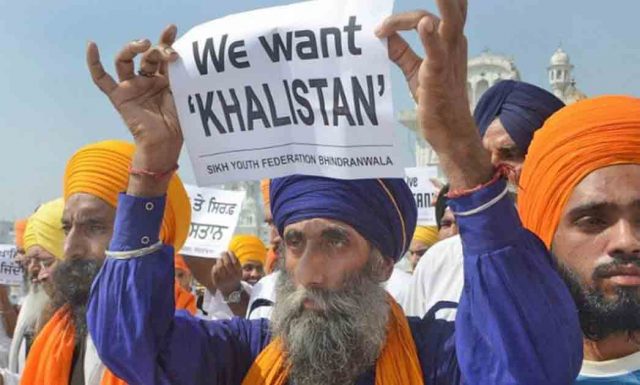
    The meeting at Trafalgar Square is aimed at shaping up the “London Declaration on Referendum 2020” campaign seeking a separate Khalistan.

    India has lodged its protest through diplomatic channels against the proposed “anti-India activity”. “We have taken it up with UK and have issued a demarche. We expect UK will not allow such anti-India activities to be carried out in UK,” said MEA spokesperson Raveesh Kumar.

    India’s official response comes a day after the British High Commission spokesperson in Delhi defended the right of people in the UK “to gather together and to demonstrate their views, provided that they do so within the law”.

    “However, will not tolerate any groups who spread hate or deliberately raise community fears and tensions by bringing disorder and violence to our towns and cities and the police have comprehensive powers to deal with such activities,” the British High Commission spokesperson told The Tribune in a cautious statement.

     Khalistan remains a sensitive issue in bilateral ties between the two countries. In April, India had lodged a protest with the UK after the Tricolour was burnt by Khalistani elements at Parliament Square, while PM Narendra Modi was addressing a diaspora event in Westminster.

    “Majority of the Sikh community have good relations with India and with the country where they stay. The rest are fringe elements,” underlined Raveesh Kumar on Thursday.

     According to its legal adviser based in New York, the SFJ plans to provide sponsorship letters to participants from Punjab and also arrange free stay for them from August 10 to 14. It plans to unveil a declaration advocating for “Sikhs’ right to self-determination for the independence of Punjab” at the Trafalgar meeting.

    Separatist group Sikhs For Justice plans to sponsor Punjab youth and political activists to travel to London for August 12 meet aimed at shaping up the “London Declaration on Referendum 2020” campaign seeking Khalistan

  • Crucial ‘2+2’ Dialogue Postponed: Strain in India-US Ties?

    Crucial ‘2+2’ Dialogue Postponed: Strain in India-US Ties?

    PM Narendra Modi knows why US deferred talks with India: Nikki Haley

    WASHINGTON(TIP): US abruptly postponed the crucial ‘2+2’ dialogue with India scheduled on July 6, for the second time in a row. US Ambassador to UN Nikki Haley, in Delhi, however said there’s a good reason to delay talks and PM Modi knows about it. But questions are being asked if India-US ties are facing a rough weather and are cracks emerging in India-US relationship?

    US Ambassador to United Nations, Nikki Haley, has said that Prime Minister Narendra Modi knows the reason for the Donald Trump administration cancelling 2+2 dialogue which was scheduled to be held in Washington on July 6 and 7.

    Speaking to NDTV, Haley said that the talks were cancelled for reasons that had nothing to do with India, adding that the world would soon be informed about the same. She added that Prime Minister Modi is aware of the “exact reason”, which is a “very good” one.

    Dismissing reports of differences between the two countries of rescheduling of the talks, Haley said that the relationship between India and US has “never been stronger”. Her remarks come a day after the US conveyed to India that it had postponed the 2+2 dialogue scheduled to be held in Washington next week, due to “unavoidable reasons”.

    Earlier, Haley had said that the US wants to take bilateral ties with India to the next level, adding that US President Donald Trump shares Prime Minister Narendra Modi’s vision of nations pursuing growth “free and fearless in their choices” in the Indo-Pacific region.

    Responding to a question, she also talked about the contentious issue of immigration amid an uproar over detention of scores of people in the US, including Indians, for illegally entering the country. America is a country of immigrants, but it cannot allow illegal immigration in the wake of the challenge of terrorism, Haley said.

    India and the US enjoy a natural friendship that is based on their shared values and interests, the 46-year-old Indian American said. “The Trump Administration seeks to take the US-India relationship to the next level; to build a strategic partnership rooted in our common values and directed toward our common interests,” she said.

    Haley said India was a state with advanced nuclear technologies widely accepted around the world because it is a democracy and continues to be a responsible leader. Noting that in the last couple of years, India has joined three major nonproliferation groupings, she said the US also fully supports India’s membership bid for the Nuclear Suppliers Group. “India continues to demonstrate it is a responsible steward of its nuclear technology,” she said.

    (With inputs from PTI)

  • North Texas student arrested for planning ‘ISIS-inspired’ mass shooting at mall

    North Texas student arrested for planning ‘ISIS-inspired’ mass shooting at mall

    FRISCO, TX(TIP): A North Texas student has been arrested for planning an “ISIS-inspired” mass shooting at a shopping mall, Collin County officials said in a news release.

    Plano resident Matin Azizi-Yarand, 17, was arrested for criminal solicitation of capital murder and making a terroristic threat when officials say he planned a mass shooting at Stonebriar Centre in Frisco and solicited others to assist him in the attack, which was planned for mid-May.

    Collin County officials said Azizi-Yarand was inspired by ISIS.

    In Dec. Azizi-Yarand began communicating online with an FBI Confidential Human Source about his desire to either “make hijah [travel]” or to conduct a terrorist attack within the United States, an arrest affidavit said.

    In January, he began communicating with an undercover FBI agent, to whom he joked about getting a knock on his door and getting big smiles from men in suits.

    When discussing potential places for the attack, he mentioned school as the “perfect place for an attack,” the affidavit said. Azizi-Yarand wrote a speech with his “message for America,” in which he described his plan to attack the shopping mall.

    Azizi-Yarand sent more than $1,400 to other individuals to buy weapons and tactical gear, the news release said.

    “We are fortunate that the brave men and women of local and federal law enforcement work around the clock to prevent acts of terrorism and mass shootings,” said Collin County District Attorney Greg Willis. “I’d like to thank the FBI’s North Texas Joint Terrorism Task Force and the Frisco and Plano Police Departments for their efforts in this case and their vigilance in protecting the citizens of Collin County.”

    This case will be prosecuted by the Collin County District Attorney’s Office. If convicted, the 17-year-old could face life in prison.

    Azizi-Yarand is in custody with bonds totaling at $3 million.

  • Indian Origin Engineer in US Pleads Guilty to Raising Money for top Al Qaida Leader

    Indian Origin Engineer in US Pleads Guilty to Raising Money for top Al Qaida Leader

    HOUSTON(TIP): A 38-year-old Indian engineer Ibrahim Zubair Mohammad, in the US state of Ohio, accused of funding a top al-Qaida leader, has pleaded guilty to concealment of financing of terrorism.

    The accused sent money to Anwar al-Awlaki in Yemen. Al-Awlaki was later designated a terrorist and killed by a US drone in 2011.

    Mohammad is to receive an agreed-upon prison sentence of 60 months, although he would receive credit for the 30 months he already has spent in the Lucas County jail awaiting trial.
    US District Judge Jeffrey Helmick told him that due to his plea and conviction, he would be deported to India.

    “You ultimately will be removed from this country and told you are not welcome to come back,” the judge said.

    Mohammad had studied at the University of Illinois and lived in Toledo since 2006.

    As part of a plea agreement, the four original charges brought by a federal grand jury in 2015 are to be dismissed at the time of sentencing, which was not scheduled, the report said.

    Two co-defendants, Sultane Roome Salim, 43, and his brother, Asif Ahmed Salim, 37, are scheduled for a change of plea hearing before Judge Helmick later on April 12.

    A fourth co-defendant, Mohammad’s brother, Yahya Farooq Mohammad, 39, pleaded guilty last year to conspiracy to provide and conceal material support or resources to terrorists.

    He had also pleaded guilty to solicitation to commit a crime of violence for a separate case in which he tried to hire a hitman to kill Judge Jack Zouhary. At the time, Judge Zouhary was presiding over the terrorism case.

    Yahya Farooq Mohammad was sentenced to a total of 27 years in prison and ordered deported to India once he completes his prison term.


  • Indian Origin Chief of Scotland Yard Launches New Anti-Terror Campaign

    Indian Origin Chief of Scotland Yard Launches New Anti-Terror Campaign

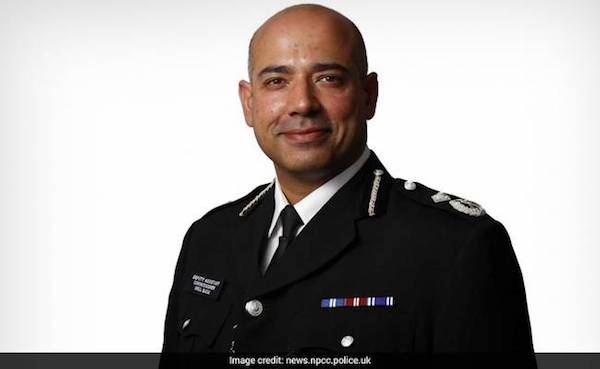
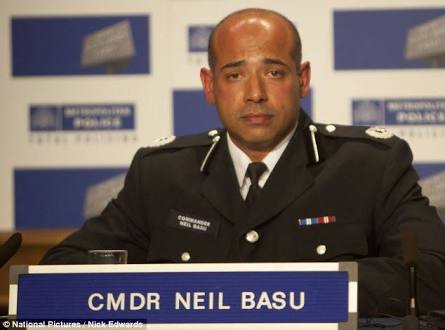
    LONDON (TIP):  Scotland Yard’s newly appointed Indian-origin counter-terrorism chief, Neil Basu, has launched a new campaign to urge the public to help in the fight against terrorism.

    The Metropolitan Police Assistant Commissioner of Specialist Operations revealed that last year more than a fifth of reports from the public produced intelligence which is helpful to police.

    “Since the beginning of 2017, we have foiled 10 Islamist and four right-wing terror plots, and there is no doubt in my mind that would have been impossible to do without relevant information from the public,” Basu said at the launch of Action Counters Terrorism (ACT) campaign in London, March 20.

    “We have been saying for some time now that communities defeat terrorism, and these figures demonstrate just how important members of the public are in the fight to keep our country safe,” he noted.

    According to the police data, of the nearly 31,000 public reports to the Met Police’s Counter Terrorism (CT) Policing unit during 2017, more than 6,600 (21.2 per cent) resulted in useful intelligence information which is used by UK officers to inform live investigations or help build an intelligence picture of an individual or group.

    Research carried out by CT Policing suggests that while more than 80 per cent of people are motivated to report suspicious activity or behavior, many are unclear exactly what they should be looking for.

    The ACT campaign, accompanied by a 60-second film based on real life foiled plots, aims to educate the public about terrorist attack planning and reinforce the message that any piece of information, no matter how small, could make the difference.

    “Like other criminals, terrorists need to plan and that creates opportunities for police and the security services to discover and stop these attacks before they happen. But we need your help to exploit these opportunities, so if you see or hear something unusual or suspicious trust your instincts and ACT by reporting it in confidence by phone or online,” Basu said.

    He detailed some forms of suspicious activity, which could involve someone buying or storing chemicals, fertilizers or gas cylinders for no obvious reasons, or receiving deliveries for unusual items, or someone embracing extremist ideology, or searching for such material online.

    UK Security Minister Ben Wallace added: “The police’s fantastic ACT campaign is rightly highlighting the vital part that communities are playing in defending this country against terrorism.

    “The public should remain alert, but not alarmed, and I urge anyone who is worried about suspicious behavior and activity to follow this advice and report their concerns to the police.”

  • Pak trips on free run: 37-nation Financial Action Task Force to probe terror funding

    Pak trips on free run: 37-nation Financial Action Task Force to probe terror funding

    By G Parthasarathy

    Pakistan will now have to provide a detailed action plan on actions it proposes to take on curbing funding for UN-designated terrorist groups. It would then be placed on the FATF grey list, where its financial flows would be subject to intense international scrutiny. Pakistan would, thereafter, be placed on the FATF “black list” if it fails to present a credible and comprehensive action plan to the FATF by June. This would virtually end any prospect of it receiving adequate financial flows.

    The Financial Action Task Force (FATF), set up in 1989 by the G7 countries, and with headquarters in Paris, acts as an “international watchdog” on issues of money laundering and financing of terrorism. It has 37 members, including all five permanent members of the Security Council, and countries with economic influence all across the world. Two regional organizations — the Gulf Cooperation and the European Commission — are members of the FATF. Saudi Arabia and Israel are observers. India became a full member of the FATF in June 2010. The FATF is empowered to ensure that financing of UN-designated terrorist organizations is blocked. It has the power to publicly name countries not abiding by its norms, making it difficult for them to source financial flows internationally.

    Pakistan is particularly vulnerable to pressures from this task force as the Afghan Taliban, Haqqani network, LeT and JeM — all internationally designated terrorist groups — operate from its soil. Pakistan has long claimed that it has done its best to prevent terrorism emanating from its soil. It has also averred that there is no firm evidence against the LeT and the JeM, even after these groups have publicly acknowledged that they were promoting terrorism in India. Pakistan has also rejected evidence like wireless transcripts of conversations of Jaish terrorists involved in the Pathankot airport and the vast evidence available internationally of the Lashkar role in the Mumbai 26/11 attack. The Americans and their allies have focused attention primarily on Pakistan support for the Haqqani network in Afghanistan.

    Pakistan has believed that sooner, rather than later, the Americans would cut their losses and withdraw from Afghanistan, leaving the country open for a Pakistan-backed Taliban takeover. President Donald Trump, however, made it clear that he was determined that the US would not “lose” in Afghanistan. He is augmenting the US troop presence and moving fast to strengthen the Afghan armed forces, including its air force. American economic assistance to Pakistan has been placed on hold. In addition, the US has mobilized its NATO allies to take a tougher line on Pakistan. The NATO allies are also expanding their deployments in Afghanistan. More recently, the US has initiated moves to get the task force to place Pakistan on its “grey list” at its next meeting in June.

    The American effort in the FATF on Pakistan funding of terrorist groups predictably ran into problems initially. Pakistan had mobilized support from China, the Gulf Cooperation Council led by Saudi Arabia, Turkey and quite evidently Russia to counter the American-led move. Islamabad banked on Russian support, given the bonhomie that Russian foreign minister Sergei Lavrov manifested when he invited his Pakistani counterpart Khawaja Asif to Moscow on the eve of the FATF meeting. Further, despite parliamentary opposition, Pakistan declared, just over a week before the FATF meeting, that it would be deploying additional troops in Saudi Arabia. It clearly expected Saudi support in the FATF after its decision was announced. The Lavrov bonhomie led the inexperienced Khawaja Asif to proclaim hastily and prematurely that Pakistan had succeeded in prevailing over moves to place it on the FATF “grey list” involving monitoring of its international financial flows.

    The Americans responded immediately to these developments. Saudi Arabia and the GCC fell in line with American demands for the FATF to act against Pakistan. European powers like the UK, Germany and France remained steadfast in their determination to corner Pakistan. Russia quietly receded to the background. Recognizing that its support for Pakistan would leave it isolated in the FATF, where it was aspiring to become its vice-chairman at the forthcoming FATF session in June, Pakistan’s “all-weather friend” China pulled back its support for Pakistan. The only country that steadfastly continued supporting Pakistan was Turkey, whose egotistic President Recep Erdogan would certainly not win an international popularity contest today!

    Pakistan will now have to provide a detailed action plan on actions it proposes to take on curbing funding for UN-designated terrorist groups. It would then be placed on the FATF grey list, where its financial flows would be subject to intense international scrutiny. Pakistan would, thereafter, be placed on the FATF “black list” if it fails to present a credible and comprehensive action plan to the FATF by June. This would virtually end any prospect of it receiving adequate financial flows. There has been disappointment, anger and frustration in Pakistan at the FATF decision. Hardly anyone in Pakistan is prepared to publicly advise that it is time for Pakistan’s rogue army to end support on its soil to armed terrorist groups, acting against India and Afghanistan. While Pakistan recently claimed it had closed Lashkar offices, it was soon found that only the gates of these offices were closed, while routine activities continued inside.

    In these circumstances, India should urge members of the European Union and Japan to join the US and end providing concessional credits to Pakistan. Given its precarious foreign exchange position, Pakistan will inevitably have to go to the IMF for a bailout in a few months. Institutions like the IMF, World Bank and Asian Development Bank need to be persuaded to withhold providing concessional credits to Pakistan, even if it takes some token measures to claim it has acted against UN-designated terrorist outfits. India should urge that no concessional credits should be provided to Pakistan till it dismantles the infrastructure of terrorism on its soil irrevocably. China will not follow suit; but its “aid” for the China-Pakistan Economic Corridor will only increase Pakistan’s already heavy debt burden.

    The withdrawal of Chinese support in the FATF has shaken the Pakistan establishment’s belief that Chinese support to “contain India” has no limitations. China recognizes that backing Pakistan unconditionally in the FATF would not only earn it the ire of the mercurial Donald Trump but would also sully its image internationally. At the same time, this does not mean that there will be any change in China’s policies on issues like declaring Jaish chief Masood Azhar an international terrorist. Moreover, we should also clearly recognize that President Trump’s actions are primarily in response to Pakistan’s support for the Haqqani network in Afghanistan. They are not highly or significantly focused on Pakistan-sponsored terrorism on Indian soil. That is a battle that will have to be fought primarily by us.

    (The author is an Indian career diplomat. He was High Commissioner of India to Pakistan in 1998-2000)


  • Pakistan says ready for mediation between Afghanistan govt and Taliban

    Pakistan says ready for mediation between Afghanistan govt and Taliban

    ISLAMABAD (TIP): Pakistan on March 1 said it was ready for mediation between the Afghan government and the Taliban as it extended support to Afghan President Ashraf Ghani’s political process in the war-torn country.

    Speaking at the second Kabul Process conference, Ghani yesterday said that his government was ready to recognise the Taliban as a political group and offered unconditional talks with the militant group to “save the country”.

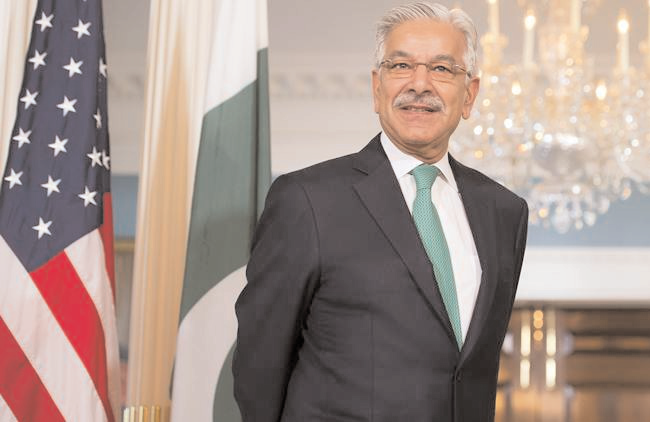
    The Afghan Taliban are a political entity and Pakistan supports the dialogue between the Afghan government and the Taliban, Foreign Minister Khawaja Asif told journalists here.

    “The talks between the Taliban and the Afghan government are actually discussions between two political forces, and Pakistan will support it…Pakistan is also ready for one-on-one mediation with the Afghan Taliban,” he said.

    He said Pakistan wants peace and stability in the neighbouring country, while stressing that there was no military solution to the Afghan conflict.

    The foreign minister also asked Washington to strike a balance in its policy towards South Asia if it was interested in having a dialogue between Pakistan and India.

    “The US can have an interest in Pak-India discussions, but before that it should create some balance in its South Asia policy,” he said.

    He also talked about the so-called “institutional interests” in Pakistan and said that practice of portraying interests of institutions as the greater national interest “will also be changed soon”.

    Asserting that Pakistan will frame its foreign policy keeping in view the national interests, Asif said, “We will not sacrifice our own interests for the protection of the interests of the United States.”

    “The effects of the 80s and the Musharraf era still exist, Pakistan will not make the same mistakes now to keep American interests above its own interests,” he said.

    He was referring to the military governments of General Zia-ul Haq and General Pervez Musharraf that allied with the US respectively in 1980s and after 9/11 to support it against erstwhile USSR and terrorism.

    (PTI)

  • Anti-terror fight is against a mindset, not any religion, says PM Modi

    Anti-terror fight is against a mindset, not any religion, says PM Modi

    NEW DELHI (TIP): Prime Minister Narendra Modi on Thursday said the fight against terrorism and radicalization was not against any religion, but against a mindset that misguides the youth.

    Speaking at a conference on “Islamic heritage: Promoting understanding and moderation”, Modi said India’s values of equality, diversity and harmony strengthened it in a world of uncertainty and these were important to defeat violence and extremism.

    “Indian democracy is a celebration of age-old pluralism,” Modi said in a speech to an audience that included King Abdullah II of Jordan and many Islamic clerics and scholars.

    Abdullah, a 41st generation direct descendant of Prophet Mohammed, is known for his global initiative to fight radicalization and terrorism. He is also the custodian of holy sites in Jerusalem, including the Al-Aqsa mosque, the third holiest site in Islam, located in the Old City of Jerusalem.

    India views Jordan as an “oasis of stability and harmony” in conflict ridden West Asia and New Delhi is looking to deepen bilateral ties with the country, according to senior government officials in New Delhi.

    India has been a victim of terrorism since the 1980s and, since the 1990s, witnessed an Islamist insurgency in Kashmir that has claimed many thousands of lives. India blames Pakistan for supporting anti-India terrorist groups inimical in Kashmir.

    In his speech, Modi said that “those who perpetrate acts of violence against humanity perhaps don’t realise that they harm the religion they claim to stand for.”

    “The fight against terrorism and extremism, against radicalization is not a fight against any religion. It is a fight against a mentality that misguides our youth to perpetrate acts of violence against innocents,” he said, urging the youth to associate themselves with the humanitarian aspects of Islam on the one hand and the use of modern technology on the other.

    In his speech, the Jordanian king said the current global war against terror should not be viewed as a fight between religions. “It is between moderates of all faiths and communities and against extremists who spread hatred and violence,” he said. He also emphasized the need to “recognize and reject the misinformation groups promote about Islam, or indeed any religion.”

    “We need to take back the airwaves and internet from the voices of hatred, those who have victimized our world not only with bombs and terror but with ignorance and lies,” the king said, adding that inclusion was the path to coexistence.

    “The fact that the king came to India and delivered this address is very significant given that he is the direct descendent of the Prophet (Mohammed). His words carry great weight,” said a person familiar with Abdullah’s visit.

    Later in the day, India and Jordan signed 12 agreements including a framework pact on defence cooperation that defines the “scope of such cooperation and making provisions for implementation of the cooperation in some of the recognized areas like training; defence industry; counterterrorism; military studies; cybersecurity; military medical services, peace-keeping, etc.,” a statement from the Indian foreign ministry said.

    Another pact aims to set up a Centre of Excellence in Jordan “for training of minimum 3,000 Jordanian IT professionals over a period of 5 years, and setting up of a resource centre in India for training of master trainers in IT field from Jordan,” the foreign ministry statement said.

    A third pact on setting up a fertilizer production facility in Jordan “with a long-term agreement for 100% off take to India” was also signed. It is aimed at ensuring long-term and sustained supply of rock phosphate to India, the statement said.

    Briefing reporters after official talks between Modi and Abdullah, S. Tirumurthy, secretary-economic relations in the Indian foreign ministry said, “There was a keenness on both sides to take this (the relationship) further.”

    Both sides are looking at closer security cooperation given that Jordan sits at the crossroads of a very volatile region neighbouring Israel, Palestine, Syria, Iraq and Saudi Arabia.

    Source: PTI

  • Indian Origin Woman And Her Partner Arrested In South Africa For British Couple’s Kidnapping

    Indian Origin Woman And Her Partner Arrested In South Africa For British Couple’s Kidnapping

    JOHANNESBURG (TIP):  South African special police unit Hawks have arrested an Indian origin woman and her partner on charges of abducting a British couple. They both are allegedly linked to ISIS.

    Fatima Patel and Safydeen Aslam Del Vecchio also face charges of robbery and theft after they went on a spending spree using the couples’ credit cards, building up a stash of jewellery, camping equipment and electronic devices which were found at a remote location where an ISIS flag was being flown.

    The Hawks declined to provide any further information due to the sensitive nature of the case as the search continues for the couple whose vehicle was found abandoned more than 300 km away from where they were last seen on February 9.

    Patel and Del Vecchio also stand accused of contravening the Protection of Constitutional Democracy Against Terrorism and Related Activities Act by hoisting an ISIS flag at a modest homestead in a rural area.

    Del Vecchio also faces another terrorism-related charge for allegedly participating in “extremist web forums that support ISIS and offering to supply phone numbers and sim cards that are not traceable.”

    Yousha Tayob, the lawyer representing Patel and Del Vecchio, confirmed that the pair had appeared in the court and were remanded in custody at Westville Prison in KwaZulu-Natal province.

    The incident had prompted the British government to issue a travel advisory about possible terrorist attacks on foreign nationals in South Africa, but local Muslim organizations have dismissed this as an “overreaction”.

    Ebrahim Deen of the Afro-Middle East Centre told the weekly that South African Muslims posed no threat to travelers and that the incident was more related to crime than an ISIS attack.

    “Muslims are largely integrated in (South African) society, are not disillusioned and they face little discrimination like in Europe and elsewhere,” he said.

    Martin Ewi of the Institute for Security Studies said South Africa was regarded as a “logistics base” for terror cells in transit, and is not traditionally a target for attacks, although the arrests of Patel and Del Vecchio confirmed the presence of an active terror cell in South Africa.

    “We in the counter terror fraternity suspected that they were working as members of an active cell, and the kidnapping will confirm the presence of an active ISIS cell,” Mr Ewi said.

  • Indian Origin Former Met Officer May Take Charge As Britain’s Anti-Terrorism Chief

    Indian Origin Former Met Officer May Take Charge As Britain’s Anti-Terrorism Chief

    LONDON (TIP):  A senior Indian origin metropolitan police officer is running for the charge of Britain’s anti-terrorism chief .The Scotland Yard’s National Lead for Counter Terrorism resigns next month.

    Neil Basu, currently Metropolitan police deputy assistant commissioner and Senior National Coordinator for UK Counter Terrorism Policing, is tipped to take over one of the British policing s toughest jobs from Mark Rowley, The Sunday Times reported.

    Mr Basu, whose father is of Indian origin, is a former Met Police commander overseeing organized crime and gangs. He has specialized in anti-terrorism policing for the past three years and is currently Rowley’s deputy.

    He has been vocal about cracking down on British nationals who joined the ISIS terrorist group in Syria and Iraq.

    In a recent interview with the Combating Terrorism Centre in New York, he said that exclusion powers would be applied to about 200 of the 300 fighters in the war zone as he revealed that about half of the 850 who travelled from Britain to join ISIS had already returned and more than 100 were dead. Of the remaining 300, two-thirds would be blocked from the UK.

    Like other countries, we operate on the principle that we don’t want you back, and therefore we will deprive you of your British passport for those among these who end up coming back, we are absolutely waiting for them. That’s the bottom line, he said.

    The big threat for us now is the ideology that’s been diffused onto the internet and the calls for attacks by its followers in the West by ISIS online. The caliphate may have been defeated militarily, but it has now become a virtual network, he warned.

    Other possible candidates for the post of Britain’s anti-terror chief include Helen Ball, a Met Police assistant commissioner, and Dave Thompson, the West Midlands chief constable, from whose area numerous terrorist plots have emerged in the UK.


  • 4 arrested for firing in Srinagar hospital, helping Pak terrorist escape

    4 arrested for firing in Srinagar hospital, helping Pak terrorist escape

    SRINAGAR (TIP): Four men have been arrested for yesterday’s firing in a Srinagar hospital that enabled Pakistani terrorist Naveed Jutt to escape from police custody. The police said they have tracked down on the motorcycle and the vehicle they had used for the getaway.

    The escape of 22-year-old Jutt when he was taken to the hospital for a routine check-up with five other prisoners, has been put down to a detailed conspiracy.

    The superintendent of Rainawari Central Jail has been suspended, Jammu and Kashmir home secretary said.

    Gunshots rang out in the Shri Maharaja Hari Singh Hospital yesterday, when the prisoners were brought into the Out Patients’ Department. Two policemen accompanying the prisoners collapsed. One died on the spot, the other in the hospital. In the confusion, Jutt managed to escape with the pheran-clad men, who had come on a motorbike.

    Naveed Jutt, 22, has been at the jail since 2016, since his arrest two years before. Senior police officers said he managed to get a court order to stay in a Srinagar jail even though all Pakistani terrorists are lodged outside Kashmir.

    His escape, said state police chief SP Vaid, had been carefully planned with active collaboration from inside the jail.

    The police had prior information about Lashkar activities inside the jail.

    Naveed Jutt was known to be close to Abu Qasim, who headed Lashkar-e-Taiba in Kashmir and was killed by security forces in 2015. He is also close to Zaki ur Rehman Lakhvi, one of the masterminds of 26/11 terror attack in Mumbai.

    The police said Naveed Jutt was involved in several terror attacks in Kashmir, including one in which a teacher on election duty was killed. He is also believed to be behind the killing of at least seven policemen. Source: NDTV

  • US State Department designates Hamas leader Ismail Haniyeh as terrorist

    US State Department designates Hamas leader Ismail Haniyeh as terrorist

    WASHINGTON (TIP): The US State Department said on Wednesday, January 31, it had designated Ismail Haniyeh, leader of the Islamist Palestinian group Hamas, as a terrorist.

    The State Department said in a statement that Haniyeh, along with two Islamist groups active in Egypt and one in the Palestinian territories, were listed as specially designated global terrorists.

    It quoted Secretary of State Rex Tillerson as saying the designations “target key terrorist groups and leaders – including two sponsored and directed by Iran – who are threatening the stability of the Middle East, undermining the peace process, and attacking our allies Egypt and Israel.”

    In Gaza, Hamas official Sami Abu Zuhri told media: “We reject and condemn the decision and we see it as a reflection of the domination by a gang of Zionists of the American decision.”The decision is worthless,” he added.

    Hamas, which dominates the Gaza Strip, advocates Israel`s destruction and is designated as a terrorist group by the United States and some other Western countries.

    In December, after US President Donald Trump recognized Jerusalem as the capital of Israel, Haniyeh told a rally in Gaza marking the 30th anniversary of Hamas`s founding: “We will knock down Trump`s decision. No superpower is capable of offering Jerusalem to Israel, there is no Israel that it should have a capital named Jerusalem.”

    The three groups designated by the State Department are:

    – Harakat al-Sabireen, which the statement said is backed by Iran, operates primarily in Gaza and the West Bank, and fired rockets into Israel;

    – Liwa al-Thawra, which it said has claimed responsibility for killing an Egyptian army general in Cairo in 2016 and a bombing in 2017;

    – Harakat Sawa’d Misr (HASM), which it said claimed responsibility for killing an Egyptian security officer and other attacks.

    The State Department designations deny Haniyeh and the three groups access to the U.S. financial system.


  • India Americans decry apparent image of a Sikh in a US News terrorism story

    India Americans decry apparent image of a Sikh in a US News terrorism story

    The group had recently launched an electronic guidebook to educate journalists who report on Sikhism.

    NEW YORK (TIP): The US News has removed an apparent image of a Sikh running with a rifle in a story on how terrorism is taught in classrooms around the world, after a Sikh civil rights group demanded its removal and sought an apology.

    The story, posted on January 23, explores “how 9/11 turned terrorism into a hot topic” and “what students learn about it in academia” in the post-9/11 world.

    The apparent photo of a Sikh was the featured post image—meaning it was the photo visible when the article is shared on twitter and Facebook by readers.

    The image drew condemnation from the Sikh Coalition, a New York-based organization.

    “Using the apparent image of a Sikh in this @USNews story examining post 9/11 terrorism is reckless and we will be seeking a correction and apology immediately,” the group tweeted on Friday night.

    The photo was also denounced by Nathan C. Walker, executive director of 1791 Delegates, a group of constitutional and human rights experts that provides advice on issues related to religion and public life.

    “Dangerous journalism, contributing to religious illiteracy, fueling stereotypes, and contributing to discrimination and violence against Sikhs,” Walker tweeted, adding that he has already written to the editors of US News and the author of the piece, Sintia Radu, “requesting that this inaccurate and consequential image be removed.”

    By Sunday morning, the image was gone. In was replaced by a 9/11 image of plumes of smoke billowing from the twin towers.

    Misconceptions about Sikhs and Sikhism are widely prevalent in the US media and the society in general. After 9/11, there has been a series of attacks against Sikhs.

    In fact, the Sikh Coalition, in collaboration with Religious News Foundation, on January 16, posted the first-ever electronic guidebook for journalists who report on Sikhism to avoid the kind of mistake the US News made.

    The hard copy of the comprehensive guidebook for journalists looking to report on Sikhism was released in September last year at the Religion News Association’s annual conference in Nashville, Tennessee. The electronic version of the same has been delivered to over 3,500 reporters, producers, and editors at over 500 U.S. news outlets.

    “This is a wonderful guide and resource for reporters covering Sikh issues,” said Orange County Register Religion Reporter, Deepa Bharath in a statement. “This guide provides depth and nuance and will be a go-to resource for me and my colleagues.”

    The comprehensive guide aims to raise awareness among media professionals on Sikhism. It covers almost all aspects of Sikhism from its history to beliefs, worships and important Sikh calendar dates.

    The illustrated guide has also a section to clear the common doubts about the Sikh faith.

    “We all know that the media has to do a better job of covering Sikhism and the Sikh community,” said Sikh Coalition Senior Religion Fellow and primary author, Simran Jeet Singh.

    “We hope that this will help them do so, both by improving the accuracy of coverage and by equipping reporters with a resource that helps them write more about Sikh issues,” he added.

    The Sikh Coalition worked for nearly two years to complete the book before the Religion News Foundation took the product to print.

    “Partnering with the Sikh Coalition to provide this expert reporter guide has been outstanding,” said Thomas Gallagher, CEO, Religion News Foundation. “The Sikh Coalition’s expertise and professionalism from start to finish ensure this product will be a valuable resource for reporting in America in the years to come.”

    (Source: Sikh Coalition)


  • Indian Origin ISIS Man, Dubbed “New Jihadi John”, Designated Global Terrorist By US

    Indian Origin ISIS Man, Dubbed “New Jihadi John”, Designated Global Terrorist By US

    WASHINGTON (TIP):  The US designated Indian-origin ISIS terrorist from Britain Siddhartha Dhar along with a Belgian-Moroccan citizen as global terrorists and imposed sanctions on them, the State Department said.

    Siddhartha Dhar, a British Hindu who converted to Islam and now goes by the name Abu Rumaysah, had skipped police bail in the UK to travel to Syria with his wife and young children in 2014.

    Siddhartha Dhar was dubbed as the “New Jihadi John” and became a senior commander of the dreaded outfit, the report had said.

    The State Department has designated two ISIS members, Siddhartha Dhar and Abdelatif Gaini, as Specially Designated Global Terrorists under Section 1(b) of Executive Order which also imposes sanctions on foreign persons determined to have committed, or pose a significant risk of committing, acts of terrorism that threaten the security of US nationals or the national security, foreign policy, or economy of the US, a state department spokesperson said in a statement.

    These designations seek to deny Siddhartha Dhar and Abdelatif Gaini the resources they need to plan and carry out further terrorist attacks, it said.

    Among other consequences, all of Siddhartha Dhar’s and Abdelatif Gaini’s property and interests in property subject to US jurisdiction are blocked, and US persons are generally prohibited from engaging in any transactions with them, it said. Siddhartha Dhar was a leading member of now-defunct terrorist organization Al-Muhajiroun. In late 2014, Siddhartha Dhar left the United Kingdom to travel to Syria to join ISIS, it said.

    He is considered to have replaced ISIS executioner Mohammad Emwazi, also known as “Jihadi John”, it said.

    Siddhartha Dhar is believed to be the masked leader who appeared in a January 2016 ISIS video of the execution of several prisoners ISIS accused of spying for the UK, the statement said.

    Abdelatif Gaini is a Belgian-Moroccan citizen believed to be fighting for ISIS in the Middle East. Abdelatif Gaini is connected to UK-based ISIS sympathizers Mohamad Ali Ahmed and Humza Ali, who were convicted in the UK in 2016 of terrorism offenses, it said.

    Today’s action notifies the US public and the international community that Siddhartha Dhar and Abdelatif Gaini have committed or pose a significant risk of committing acts of terrorism, it said.

    Terrorism designations expose and isolate organizations and individuals and deny them access to the US financial system. Moreover, designations can assist the law enforcement activities of US agencies and other governments, it said.


  • Hafiz Saeed should be prosecuted to fullest extent of law: US

    Hafiz Saeed should be prosecuted to fullest extent of law: US

    WASHINGTON (TIP): The United States has called for Hafiz Saeed’s prosecution “to the fullest extent of the law,” following Pakistan’s Prime Minister Shahid Khaqan Abbasi’s remark that no action could be taken against the United Nations-designated terrorist.

    Abbasi, during an interview to Geo TV on Tuesday, referred to Saeed as ‘sahib’ or ‘sir’ “There is no case against Hafiz Saeed sahib in Pakistan. Only when there is a case, can there be action,” he said when asked why there was no action against Saeed.

    US fumes at non-action Reacting strongly to the comments, State Department spokesperson Heather Nauert said the US believed that Saeed should be prosecuted and they have told Pakistan as much.

    “We believe that he should be prosecuted to the fullest extent of the law. He is listed by the UNSC 1267, the Al- Qaeda Sanctions Committee for targeted sanctions due to his affiliation with Lashkar-e-Taiba, which is a designated foreign terror organisation,”Ms. Nauert told reporters at her daily news conference on Thursday.

    “We have made our points and concerns to the Pakistani government very clear. We believe that this individual should be prosecuted,” she said.

    Responding to a question, Nauert said the US has “certainly seen” the reports about Abbasi’s comment on Saeed. “We regard him as a terrorist, a part of a foreign terrorist organisation. He was the mastermind, we believe, of the 2008 Mumbai attacks which killed many people, including Americans as well,” she said. Saeed, the chief of the Jamaatud- Dawah (JuD), was released from house arrest in Pakistan in November.

    The US has labelled JuD the “terrorist front” for the Lashkar-e-Taiba (LeT), a group Saeed founded in 1987. LeT was responsible for carrying the 2008 Mumbai attack that killed 166 people.

    Pak need to do more Acknowledging that the US has had some challenging times with the government of Pakistan recently, Ms. Nauert has said the Trump Administration expects Pakistan to do a lot more to address terrorism issues. “That’s something that we’ve been very clear about all along. You know the news that we had that came out a couple weeks ago about our decision to withhold some of the security funding for Pakistan,” she said.

    Nauert said the entire administration was on the same page on the issue of USPakistan relationship.

    Early this month, the US suspended about $2 billion worth of security assistance to Pakistan accusing it of not doing enough in the fight against terrorism.

    In retaliation, Pakistan suspended military and intelligence co-operation with the US.

    The State Department on Thursday said it has not received any formal information in this regard from Pakistan.

    Source: PTI