
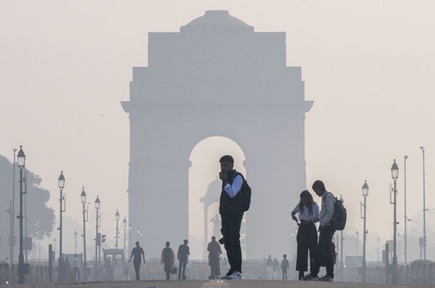

Crop-residue burning is a seasonal contributor in parts of Punjab and Haryana, but not the sole explanation for Delhi’s winter pollution
Delhi-NCR cannot clean its air by itself, but neither can it absolve itself of responsibility for its own emissions. Local and airshed-level actions must proceed in tandem. Unless governance reflects the environmental realities of interconnected airsheds, winter haze will continue to exact an enormous human and economic toll.
Every winter, a toxic haze blankets much of northern India. Delhi-NCR is its most visible casualty, but the problem extends well beyond the capital. Across Punjab, Haryana, Uttar Pradesh (UP), Bihar and West Bengal, cities and rural areas experience deteriorating air quality, though sources and severity vary. The Indo-Gangetic Plain, stretching from the Indus plains in the west to the Ganga-Brahmaputra plains in the east, comprises several distinct and interconnected airsheds. Since pollutants can travel hundreds of kilometers, crossing state and national boundaries, tackling this problem requires managing air pollution at the airshed level, not the municipal level.
Official responses have been fragmented and largely reactive. Traffic restrictions, construction bans, water sprinkling and temporary shutdowns become necessary when pollution reaches emergency levels, but cannot substitute for year-round emission reductions. Since sources differ across urban centers, industrial corridors and rural areas, a unified airshed strategy must address them where they originate, not merely where haze is most visible.
Winter inversions, with warmer air above cooler surface air, restrict vertical mixing and prevent pollutant dispersal. Shallow, stable boundary layers and low winds further trap pollutants near the ground. Fine particles absorb moisture and grow in size, while humid conditions accelerate chemical reactions that generate additional particulate matter. These conditions sustain the haze.
This is not solely an urban problem. Household fuels, brick-kilns, rural biomass and agricultural practices contribute alongside vehicles, power plants, industries, construction dust and waste burning. Ammonia released from fertilizers and livestock reacts with sulphuric and nitric acids formed from sulphur dioxide and nitrogen oxides emitted by combustion sources to form secondary particulate matter. The World Bank estimates that over half of India’s PM2.5 is formed through such secondary processes, with precursor gases travelling hundreds of kilometers across state boundaries. Controlling precursor gases is as important as reducing smoke and dust.
Crop-residue burning is a seasonal contributor in parts of Punjab and Haryana, but not the sole explanation for Delhi’s winter pollution. Its timing is linked to the narrow interval between paddy harvesting and wheat sowing. The policy intended to conserve groundwater by delaying paddy transplantation has also pushed harvesting and residue burning later, sometimes by one to four weeks. Economically viable alternatives should be made available through access to machinery, residue-collection networks, productive uses for straw and crop diversification incentives.
Climate change adds a layer of uncertainty. Western disturbances, which bring winter rain and pollutant-dispersing winds, are an important influence on northern India’s air quality. Their winter patterns have become less predictable, with activity shifting to the pre-monsoon months. Meanwhile, climate modelling projects an increase in winter atmospheric stagnation over the Indo-Gangetic Plain under high-warming scenarios. These shifts reinforce the need for year-round, multi-sectoral emission reductions.
The economic and human costs are enormous. Air pollution undermines public health, constrains productivity and weighs on economic growth. A FICCI-EY report estimates India’s pollution-related economic losses at 9-9.5 per cent of GDP, with business losses of $95 billion and 1.3 billion working days lost. Illness, premature death and lost productivity impose costs on businesses, public health systems and households.
The National Clean Air Programme (NCAP) is city-oriented. Its targets focus on PM10, giving insufficient attention to the regional nature of PM2.5 and its precursor gases. A 2026 assessment found that 28 of the 130 NCAP cities lacked continuous monitoring, while only 23 of 100 cities with adequate data met the 40 per cent PM10 reduction target. These gaps reflect disjointed jurisdiction, uneven implementation and inadequate accountability.
Northern India must move from a fragmented, city-centric response to airshed-based management, building on existing institutions. The Commission for Air Quality Management (CAQM) has statutory powers to coordinate action across Delhi-NCR and adjoining areas in Punjab, Haryana, Rajasthan and UP, but does not cover the wider Indo-Gangetic Plain.
An Indo-Gangetic Airshed Council, created by extending the CAQM’s statutory mandate, should coordinate action across the region’s distinct but interconnected airsheds. Chaired by the Union Environment Minister, it should bring together chief secretaries of the affected states, representatives of relevant Central ministries and the CAQM, with the Central Pollution Control Board (CPCB) providing technical coordination. It should prepare a five-year Indo-Gangetic Clean Air Framework, supported by separate airshed-level action plans, set measurable annual targets for each airshed, broken down by state and sector, and allocate responsibilities according to each state’s emission contribution. Targets must cover ambient PM2.5 concentrations and precursor emissions such as sulphur dioxide, nitrogen oxides and ammonia.
Each airshed action plan must translate targets into sector-specific responsibilities. State transport departments and urban local bodies should accelerate cleaner public transport and dust control. Pollution control boards must enforce industrial standards and modernize brick-kilns. Agriculture departments should make crop-residue management financially attractive through collection networks and productive uses for straw. The programme must cover cleaner household fuels, better waste management and fertilizer use. Success should be measured by sustained reductions in ambient PM2.5 concentrations and precursor emissions, not by restrictions imposed or pollution-control devices deployed.
Each state should translate the relevant airshed action plan into time-bound departmental and district action plans, with its chief secretary personally accountable for delivery. The CPCB and state pollution control boards should expand their monitoring networks, prepare periodic emission inventories and publish a common dashboard-tracking progress. Independent scientific institutions should validate data. Annual performance reviews should identify lagging states, with Central funding directly linked to independently verified progress.
Beijing offers a relevant precedent: during 2013-2017, coordinated action reduced PM2.5 by 35 per cent in the city and 25 per cent in surrounding regions. Its experience shows that sustained coordination and multi-sector action can deliver measurable results.
There are promising initiatives: UP has developed an airshed-based Clean Air Plan (2024) and the World Bank’s $600 million programs in UP and Haryana are among India’s first state-led, multi-sectoral initiatives of this kind. They address transport, agriculture and industry, including cleaner technologies for small enterprises and alternatives to crop-residue burning. They should be integrated into the airshed framework with compatible targets and shared data.
Air pollution ignores borders. The region’s interconnected airsheds extend into Pakistan, Nepal and Bangladesh. The South Asia Cooperative Environment Programme provides a regional framework for cooperation on transboundary air pollution and can facilitate the exchange of non-sensitive air-quality data, research and early warnings.
Delhi-NCR cannot clean its air by itself, but neither can it absolve itself of responsibility for its own emissions. Local and airshed-level actions must proceed in tandem. Unless governance reflects the environmental realities of interconnected airsheds, winter haze will continue to exact an enormous human and economic toll.
(Ajai Malhotra is Distinguished Fellow Emeritus, TERI and former Ambassador of India to Russia, Kuwait, UN/New York and Romania)

Be the first to comment